GALACTIC MICROLENSING
BINARY-LENS LIGHT CURVE MORPHOLOGIES AND
RESULTS FROM THE ROSETTA SPACECRAFT BULGE
SURVEY
Christine Elisabeth Liebig
A Thesis Submitted for the Degree of PhD at the
University of St Andrews
2014
Full metadata for this item is available in Research@StAndrews:FullText
at:
http://research-repository.st-andrews.ac.uk/
Please use this identifier to cite or link to this item:
http://hdl.handle.net/10023/4881
This item is protected by original copyright
Galactic Microlensing
Binary-lens light curve morphologies and
results from the Rosetta spacecraft bulge survey
Christine Elisabeth Liebig
Submitted for the degree of
Doctor of Philosophy in Astronomy
Declaration
I, Christine Liebig, hereby certify that this thesis, which is approximately 20.000 words in
length, has been written by me, that it is the record of work carried out by me and that it
has not been submitted in any previous application for a higher degree.
Date Signature of candidate
I was admitted as a research student in January 2010 and as a candidate for the degree of
PhD in January 2010; the higher study for which this is a record was carried out in the
University of St Andrews between 2010 and 2013.
Date Signature of candidate
I hereby certify that the candidate has fulfilled the conditions of the Resolution and
Reg-ulations appropriate for the degree of PhD in the University of St Andrews and that the
candidate is qualified to submit this thesis in application for that degree.
Date Signature of supervisor
Copyright Agreement
In submitting this thesis to the University of St Andrews we understand that we are
giv-ing permission for it to be made available for use in accordance with the regulations of
the University Library for the time being in force, subject to any copyright vested in the
work not being affected thereby. We also understand that the title and the abstract will be
published, and that a copy of the work may be made and supplied to any bona fide library
or research worker, that my thesis will be electronically accessible for personal or research
use unless exempt by award of an embargo as requested below, and that the library has
the right to migrate my thesis into new electronic forms as required to ensure continued
access to the thesis. We have obtained any third-party copyright permissions that may be
required in order to allow such access and migration, or have requested the appropriate
embargo below.
The following is an agreed request by candidate and supervisor regarding the electronic
publication of this thesis:
Access to Printed copy and electronic publication of thesis through the University of St
Andrews.
Date Signature of candidate
Date Signature of supervisor
Abstract
For 20 years now, gravitational microlensing observations towards the Galactic bulge have provided us with a wealth of information about the stellar and planetary content of our Galaxy, which is inaccessible via other current methods. This thesis summarises work on two research topics that arose in the context of exoplanetary microlensing, but we take a step back and consider ways of increasing our understanding of more fundamental phenomena: firstly, stellar microlenses in our Galaxy that were stereoscopically observed and, secondly, the morphological variety of binary-lens light curves.
In autumn 2008, the ESA Rosetta spacecraft surveyed the Galactic bulge for microlensing events. With a baseline of ∼1.6 AU between the spacecraft and ground observations, significant parallax effects can be expected. We develop a photometry pipeline to deal with a severely undersampled point spread function in the crowded fields of the Galactic bulge, making use of complementary ground observations. Comparison of Rosetta and OGLE light curves provides the microlens parallax πE, which constrains the mass and
distance of the observed lenses. The lens mass could be fully determined if future proper motion measurements were obtained, whereas the lens distance additionally requires the determination of the source distance.
In the second project, we present a detailed study of microlensing light curve morpholo-gies. We provide a complete morphological classification for the case of the equal-mass binary lens, which makes use of the realisation that any microlensing peak can be cat-egorised as one of only four types: cusp-grazing, cusp-crossing, crossing or fold-grazing. As a means for this classification, we develop a caustic feature notation, which can be universally applied to binary lens caustics. Ultimately, this study aims to refine light curve modelling approaches by providing an optimal choice of initial parameter sets, while ensuring complete coverage of the relevant parameter space.
Contents
Abstract 7
Table of Contents 10
I Galactic gravitational microlensing
11
1 Gravitational lensing 13
2 Microlensing fundamentals 17
2.1 Lens equation . . . 17
2.2 Einstein ring . . . 20
2.3 Lens magnification . . . 21
2.4 Paczyński curve . . . 22
2.5 Single lens events . . . 23
2.6 Multiple lenses . . . 24
2.7 Higher-order effects . . . 26
2.8 Modelling . . . 28
3 Exoplanetary microlensing 31
II Rosetta bulge microlensing campaign
35
4 Rosetta spacecraft and mission 39 5 Photometric analysis 41 5.1 Observations . . . 415.2 Analysis . . . 43
5.3 Limitations of the photometric analysis . . . 48
6 Microlens parallax 51
10 CONTENTS
7 Results 57
7.1 Rosetta microlensing events . . . 57
7.2 Paczyński fit . . . 57
7.3 Microlens parallax measurement . . . 60
7.4 Physical properties . . . 61
8 Conclusion and future prospects 63
III Morphology of binary-lens light curves
65
9 Microlensing of the equal-mass binary lens 71 10 Classification scheme 77 10.1 The four peak types in microlensing . . . 7710.2 Notation for binary-lens caustic features . . . 81
11 Methodology 87 11.1 Light curve simulation and processing . . . 87
11.2 Iso-maxima regions . . . 88
12 Results 93 12.1 Classes overview . . . 96
12.2 Further considerations . . . 102
13 Conclusion and future prospects 107 14 Appendix Morphology 109 14.1 s = 0.65 . . . 109
14.2 s = 0.7 . . . 112
14.3 s = 0.85 . . . 115
14.4 s = 1.0 . . . 118
14.5 s = 1.5 . . . 121
14.6 s = 2.05 . . . 124
14.7 s = 2.5 . . . 127
Part I
Introduction to gravitational
microlensing towards the Galactic bulge
1
|
Gravitational lensing
Gravitational lensing occurs when the light of a background source is deflected by an
in-tervening massive body. This phenomenon can be observed on all astronomical scales. At
the cosmological distance scale, quasars are gravitationally lensed by foreground
galax-ies, and early galaxies are lensed by galaxy clusters. In the Local Group, we can detect
star-on-star lensing. In the phenomenon named “strong lensing” single or multiple images
of the same source can be observed that will be more or less distorted from their
origi-nal shape. A single point-mass lens acting on a single background source will create an
Einstein ring (Figure 1.1), if source, lens and observer are perfectly aligned, but if that is
not the case it always produces two (distorted) images of the background source, one
out-side and another one, mirror-inverted and flipped, inout-side the imaginary Einstein ring. As
long as the angular distance between the source and the lens is substantially larger than
the Einstein ring radius, the inner image will be vanishingly small and the outer image
matches the unlensed source. But if the angular separation is of the order of the Einstein
radius or smaller, then the inner image will increase in size and the centroid of the outer
image is increasingly shifted away from the projected source position. In “microlensing”
the images cannot be resolved in normal observations, simply because the angular scale
is so much smaller in Galactic gravitational lensing with an Einstein ring size of the
or-der of milliarcseconds rather than arcseconds (Figure 1.2)1. Because of this, star-on-star
lensing is next to impossible to discover in static systems2. But transient events that
oc-cur whenever there is a relative transverse movement of source and lens can be detected
1Microlensingdoeshappen in the extragalactic setting as well, when the macro images of a quasar pass
through a dense stellar field of the lensing galaxy and individual stars act as (secondary) lenses.
2As Einstein (1936) put it: “no great chance of observing this phenomenon”.
14
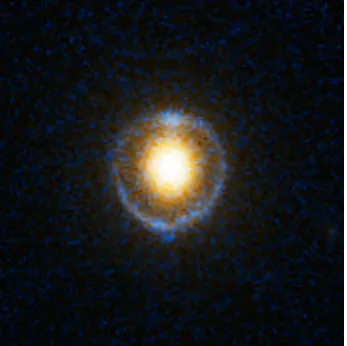
Figure 1.1: Hubble ACS B- and I-band image of gravitational lens SDSS J232120.93-093910.2. The light of a (blue) background galaxy is de-flected by the (yellow) foreground galaxy to form the Einstein ring. The image is 8 arcsec-onds wide.
Credit: NASA, ESA, A. Bolton
(Harvard-Smithsonian CfA) and the SLACS Team.
as a passing increase in brightness. A single point-mass lens is then detected through a
symmetric rise and fall in flux; the light curve can be expressed in a strictly analytic form.
The fundamental equations of gravitational lensing are discussed in Chapter 2. The lens
system can be more complex: exoplanetary research (Chapter 3) is interested in cases that
are composed of a host star with one or more planetary companions. Due to the unique
way that multiple lenses manifest themselves in extended “caustic” structures (imaginary
lines, where the background source star is formally infinitely magnified), the detection of
extrasolar planets via microlensing does not depend on the brightness of their host star
and is sensitive to planets in icy orbits (several AU) around distant (several kpc) host stars.
With extrasolar planets having been detected in their hundreds since the first exciting
dis-coveries in the 1990’s, exoplanetary microlensing might not be leading the numbers game,
but is the method uniquely suited to fill in the parameter space of distant, cool and even
solivagant planets (Gould et al., 2010; Gaudi, 2012; Cassan et al., 2012; Sumi et al., 2011).
Only by combining all available methods, we will be able to gain a full picture of the
planetary population of the Milky Way (Dominik et al., 2008).
While the principal mechanisms of microlensing are well understood, the method still
poses unsolved challenges. Even for the single lens, one cannot directly obtain a full
so-lution, as the physical parameters of the lensing system are all contained within a single
observable, the event duration. In Part II, we can measure a second independent
CHAPTER 1. GRAVITATIONAL LENSING 15
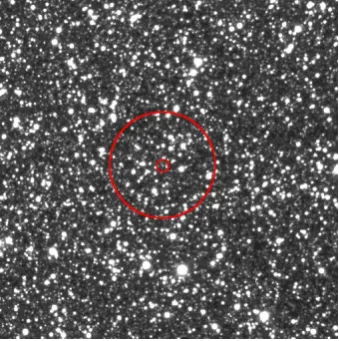
Figure 1.2: Microlensing target OGLE-2008-BLG-510, marked with two red concentric circles, in a typical bulge field. I-band image taken with the DFOSC instrument on the Danish 1.54m tele-scope at ESO La Silla, Chile. The image is 200 arcseconds wide.
Own observation for MiNDSTEp.
binary lens, the transient magnification cannot be expressed in a closed analytical form.
The model optimisation has to work on a highly non-linear parameter space, while each
individual model evaluation is time-costly because typically hundreds of data points from
different telescopes have to be fitted. Modelling the physical characteristics of an observed
lens system often runs into competing solutions; it is essential to increase our
under-standing of the parameter space and the topography of the optimisation surface, which is
2
|
Microlensing fundamentals
2.1 Lens equation
From Einstein’s general theory of relativity (Einstein, 1916) it follows that light is deflected
by massive bodies or, more precisely, that light always follows the null geodesics of
space-time, but spacetime is bent under the influence of gravitation. General relativity predicts
that a light ray which passes a point mass M at a minimum distance ξ will be deflected by
an angle
˜
α = 4GM
c2ξ , (2.1)
where G denotes the Gravitational constant, c the speed of light. The deflection angle was
first confirmed by Dyson, Eddington & Davidson (1920) during the solar eclipse in 1919,
when they observed the apparent astrometric shifts of the positions of the bright stars of
the Hyades cluster caused by the mass of the sun.
The point mass or point lens approximation is justified in a Galactic lensing situation,
where slowly rotating and nearly spherical stars align to form a gravitational lens system,
assuming that all light rays from the source star pass at a distance from the centre of the
lensing body which is larger than the radius of that body. We can also make the thin-lens
approximation: since the length of the optical system is much larger than the extent of the
lensing body along the line of sight, it is safe to approximate the action of deflection as
instantaneous and as taking place in an imaginary plane at the location of the lensing mass,
the so calledlens plane. The hyperbolic light paths can then be approximated as straight
18 2.1. LENS EQUATION
lines with a sharp bend at the lens plane. We apply these considerations in Figure 2.1.
The gravitational lensing of a single source by a point mass will generally result in
two images of the source. In Galactic stellar microlensing scenarios these arc-shaped
im-ages will be within a milliarcsecond or so of each other and generally photometrically
detected as an apparent amplification of the background source light. Astrometric stellar
microlensing, by means of measuring the light source centroid shift that is caused by the
asymmetric geometry of the two images, has also been proposed. Promising impending
events have been identified by Sahu et al. (2014)1and by Proft, Demleitner & Wambsganss
(2011)2, but the effect has not yet been observed in practice. In the Galactic context, we
most commonly observe bulge stars “lensed” by other bulge or disk stars, which sometimes
reveal themselves to be in binary systems and/or hosting planets. This kind of star-on-star
lensing is – with today’s methods – only detected in transient events, where source and
lens star have a non-zero relative proper motion µLS.
If one considers the geometry of Figure 2.1, one can directly infer the lens equation
βDS= θDS–αD˜ LS. (2.2)
The the small-angle approximation, tan x ≈ x, is applied here – justified by the fact that
˜
α, β, θ 1 in (almost) all astronomical settings, with the notable exception of black-hole lensing where the deflection angle can be large, see Bozza (2010a).
Using thescaled deflection angle(i.e. scaled to theobserver plane),
α =˜αDLS DS
, (2.3)
the lens equation can be written as
β = θ – α. (2.4)
1Two Proxima Centauri events, measurable later this year with HST’s single-observation∼0.2 mas
pre-cision.
CHAPTER 2. MICROLENSING FUNDAMENTALS 19
DLS
DS
DL
observer plane lens plane source plane
L ξ
˜
α
η S
β α
θ
I1
[image:20.595.140.483.186.550.2]O I2
Figure 2.1: Sketch of a gravitational lensing system. The light of a background source S at a distance DSis deflected by the angle ˜α as it follows the null geodesic in the spacetime, curved
by the lensing mass L at a distance DL, before it reaches the observer O. The light path is shown
in the thin-lens approximation, with a sharp bend at the lens plane, not in the true hyperbolic form. I1 and I2denote the apparent locations of the two images of the source. For the observer’s
20 2.2. EINSTEIN RING
It is a mapping R2 7→ R2, from the lens plane to the source plane. The apparent source
position (i.e. the image position) θ maps to the true source position β. Knowing the
image position θ, the lens equation can be solved for the source position β for any given
mass distribution in the lens plane. Problematic is the inversion of the lens equation.
Determining the image positions θi for a given source position β can, in general, not be
done analytically.
2.2 Einstein ring
If observer, lens and source are perfectly aligned, the two images merge into oneEinstein
ringas the angular source position becomes β = 0.
I2
L S
I1
Figure 2.2:View of the lens plane from the observing point O. The source S is not directly visible and is only depicted here to mark the true source position in rela-tion to the images Ii(see also Figure 2.1). The
(theoret-ical) Einstein ring is indicated by the dashed circle. If the angular separation between L and S is decreased, the two images will further elongate into arcs and fol-low the Einstein ring more closely. If the source is di-rectly behind the lens, the two images merge into one ring-shaped image. Figure reproduced from Paczyński (1996).
With the minimum distance ξ = θDL, we can rewrite the lens equation 2.4,
β = 0 = θ –4GM c2θ
DLS
DLDS
(2.5)
and solve for the angularEinstein radius,
θE =
r
4GM c2
DLS
DLDS
= s 4GM c2 1 DL – 1 DS , (2.6)
where in the non-cosmological distance scale of our galaxy DLS = DS– DL holds true.
More than being just a singularity, the Einstein radius θEdetermines the angular scale
CHAPTER 2. MICROLENSING FUNDAMENTALS 21
restricted to the point mass lens) in terms of the Einstein radius:
β = θ –θ
2 E
θ (2.7)
This equation has two solutions corresponding to the two images of the source (Figure
2.2),
θ1,2 =
1 2
β±pβ2+ 4θ2 E
. (2.8)
2.3 Lens magnification
The magnification A of an image is defined as the ratio between the solid angle of the
magnified image and the solid angle of the original source,
A = θ β
dθ
dβ, (2.9)
in other words, the ratio of the two-dimensional image and source areas as seen by an
observer.
Since the surface brightness is conserved in the gravitational lensing process (because
of Liouville’s theorem, cf. Misner, Thorne & Wheeler (1973), p. 586), the increased image
area equals an magnification in source brightness when integrating over the image. In
microlensing, where the images are not resolvable by definition, one can only detect the
total brightness magnification changing over time. Substituting β from Equation (2.7) and
employing the useful dimensionless quantity u, defined as the angular separation of the
source from the lens in units of the Einstein angle,
u = β θE
22 2.4. PACZYŃSKI CURVE
two solutions for the two images arise:
A1,2 =
1 –
θE
θ1,2
4–1
= 1 2 ±
u2+ 2
2u√u2+ 4. (2.11)
One image will always lie inside the Einstein ring. In Figure 2.1, this is I2, leading to a
negative impact parameter and formally negative magnification, θ2 < θE ⇒ u2 < 0 ⇒
A2 < 0. The image I2has negative parity with respect to the source, i.e. it appears mirrored
and flipped. While the formal sum of the two magnifications thus is unity, A1 + A2 = 1,
the total flux magnification of the source is obtained by summing over the two absolute
values,
A = |A1| + |A2| =
u2+ 2
u√u2+ 4. (2.12)
If the source is located at an angular separation from the lens of exactly one Einstein angle,
β = θE ⇔u = 1, the total magnification will become,
A(β = θE) =
3
√
5 ≈1.34. (2.13)
Translating this (dimensionless) magnification of the source flux into the apparent
bright-ening compared to the unlensed source in magnitudes viamag = –2.5 log10A, this
corre-sponds to an increase in brightness of ∆mag= –0.32.
2.4 Paczyński curve
If the relative projected positions of a point-mass lens and a point source star change over
time and under the assumption that they move uniformly and on rectilinear paths, the
angular lens-source separation can be parameterised as a function of time,
u(t) =
s
u2 0+
t – t0
tE
2
CHAPTER 2. MICROLENSING FUNDAMENTALS 23
where u0 is the impact parameter, i.e. the separation angle at the time t0 of closest
ap-proach. The Einstein time tE is the time it takes the source to cross the Einstein radius
(tE= θE/µLS), providing a characteristic time scale for an individual transient event.
Plug-ging u(t) into Equation (2.12) gives the time dependent magnification,
A(t) = u(t)
2+ 2
u(t)pu(t)2+ 4, (2.15)
corresponding to the magnitude variation (∝ log A(t)) in the plot on the right-hand side of Figure 2.3. This function is known as the point-source, point-lens (PSPL) light curve
or the Paczyńskicurve as it was first shown in Paczyński (1986). In Equation (2.15) the
magnitude variation is only dependent on the one parameter u, which itself is a function
of t, t0 and tE.
Brightness
Time
Figure 2.3:If a source star passes behind a lens star (centre) along the source trajectory depicted in the magnification map on the left, this gives rise to a point-source, point-lens light curve, also calledPaczyński curve, following the analytic form of Equation (2.15).
2.5 Single lens events
Light curves such as the one in Figure 2.3 can be observed in star-on-star lensing and
24 2.6. MULTIPLE LENSES
survey the Galactic bulge, such as OGLE3 and MOA4, although the probability for an
individual event is only “one in a million” (Paczyński, 1986; Griest, 1991).
The single-lens light curve is observed as the magnified source star flux FS, which can
be blended with unmagnified flux Fblend from unresolved neighbouring sources (or light
from the lens star itself),
F(t) = A(t)FS+ Fblend = (A(t) + g)FS, (2.16)
where we have A(t) from Equation (2.15) and we introduce the blend factor g = Fblend/FS.
The fluxes FS and Fblend are specific to the observing instrument, because the filter
bandpass and resolution obviously affect the collection of photons from the target and
nearby targets. When data points from different telescopes are combined for the model
search (as is common practice in Galactic microlensing), the number of free parameters is
therefore increased by a pair of [FiS, Fiblend] per instrument and filter.
2.6 Multiple lenses
Much attention in current Galactic microlensing is paid to multiple-lens systems, which
may or may not contain planetary lenses. For the projected positions, which are now
two- rather than one-dimensional, one can use complex coordinates. Let η be the source
position in the lens plane and ξ an image position. For N point-mass lenses the lens
equation then becomes (Witt, 1990; Gaudi, Naber & Sackett, 1998)
η = ξ +
N
X
i=1
qi ξi– ξ
, (2.17)
where qi is the mass ratio between lens i and the primary lens (qi = Mi
M0), which is
conve-niently placed at the origin (ξ0 = 0). The magnification is now obtained as the inverse of
CHAPTER 2. MICROLENSING FUNDAMENTALS 25
the determinant of the Jacobian of the mapping equation (2.17),
A = 1
det J(ξ) with det J(ξ) = 1 –
∂η
∂ξ
∂η
∂ξ. (2.18)
In the case J(ξ) = 0, a hypothetical point source would undergo infinite magnification
(whereas a real, extended source will be highly, but finitely magnified). The mapping
of all image positions satisfying J = 0 (called critical curves) to the source plane forms
caustics, lines of formally infinite magnification that arise when the lens system is not
circularly symmetric or when it is a continuous mass distribution5. Caustic lines offer a
visualisation of the “optics” of a gravitational lens system.
In Figure 2.4, we see a magnification map with caustic structures and an extracted light
curve, while Figure 2.5 shows the three topologies of binary lens caustics.
Brightness
Time
Figure 2.4:Caustics form when there an asymmetric lens mass distribution, for example, several point lenses. The magnification map, on the left, corresponds to a star-planet binary, with a mass ratio of 10–3. If the source trajectory crosses the caustic lines, this often gives rise to a characteristic deviation from the Paczyński curve, a binary signature.
The multiple lens case is much more complex than the single lens case that we looked
at before. The simple quadratic form of Equation (2.7) now gives way to a fifth-order
polynomial with 3 solutions, or 5 if the source is inside the caustic lines, in the case of a
binary lens (Schneider & Weiß, 1986), whereas for a triple lens the polynomial is already
5For a single point lens, the “caustic” is a single point at the position of the lens and the Einstein ring is
26 2.7. HIGHER-ORDER EFFECTS
of 10th order with 4 up to 10 solutions, where an extra pair is created or destroyed at
every caustic crossing (Rhie, 1997). The number of solutions corresponds to the number
of images of the source. While this is theoretically true it can conjure up a misleading
idea: when η → ∞, there are still three images for a binary lens system, one coinciding with the unmagnified source star and the other two at the two lens positions ξi, but with
zero magnification they cannot be seen as physical images. When the source moves closer
to the lens system, the latter two images move away from the lens positions and have a
non-zero photon flux.
2.7 Higher-order effects
2.7.1 Extended source effects
Generally speaking, an extended source will “blur” caustic lines and broaden and flatten
peaks of high magnification. The simple model of a point source can be sufficient for
single-lens cases as long as the minimum angular distance to the lens is at least of the
order of several angular source radii ρ, but it breaks down when an extended source gets
very close to the lens (Gould, 1994a; Witt & Mao, 1994). If the lens is a binary,
extended-source effects become significant whenever the extended-source is close to a caustic line, which is
observed in the majority of binary microlensing events (see, for example, Jaroszyński et al.
(2010)). Night, Di Stefano & Schwamb (2008) however argues that this might eventually
be traced back to a selection effect, as “smoothly-perturbed” binary light curves are much
easier to miss in the data noise.
Events that reach a very high magnification can display chromatic limb-darkening
effects (see, for example, Alcock et al., 1997; Zub et al., 2011).
2.7.2 Microlens parallax
Parallax effects can be detected, when event observations from more than one location
CHAPTER 2. MICROLENSING FUNDAMENTALS 27
and observer breaks down. An example of the latter is the Earth-orbital parallax: the
orbital movement of the Earth around the Solar system barycentre can cause a wave-like
perturbation in long-timescale events with a period of one year with the non-uniform
change in angular lens-source separation,u(t)˙ 6= 0. In medium time-scale events it can still be detected as a significant asymmetry, as in the first detected microlens parallax effect
(Alcock et al., 1995). The same effect on the light curve can be caused by a source star
that is orbiting a binary companion, although it can be assumed that the probability for
it to match the annual period and orientation is low. This latter effect is sometimes called
xallarap, to emphasise that it is a kind of “reverse parallax” effect (Poindexter et al., 2005).
The very steep gradient of caustic crossings sometimes allows to detectterrestrial
par-allaxeffects, when telescopes spread across the globe observe the exact peak of the caustic
crossing at slightly different times due to the (minute) differences in perspective, in effect
“time-shifting” the light curve. The first successful observations of this effect are described
in Gould et al. (2009).
Of course, the effect persists on a larger scale: Earth-spacecraft parallax is the term
commonly used, when two quasi-independent light curves of the same source-lens system
are observed by telescopes that are separated by a baseline of the order of AUs. In Part II
of this work, we discuss observations of this effect and treat the theory of the microlens
parallax in more detail (Chapter 6).
2.7.3 Orbital motion
In most Galactic binary microlensing events, with a typical timescale of tE ∼ 1 month,
orbital motion can be ignored in the modelling, but the longer the duration of the event,
the more likely are perturbations to the static model (Dominik, 1998). The orbital motion
rotates and changes the shape of the binary caustic. This kind of caustic change was
detected in the triple-lens, two-planet system OGLE-2006-BLG-109 and helped to constrain
28 2.8. MODELLING
2.7.4 Binary sources
Smoothly perturbed, i.e. non-caustic-crossing, binary lens light curves can be virtually
indistinguishable from a microlensedbinary source, where the Paczyński curve of the first
source star is followed and superposed by that of its binary companion to give the
im-pression of a smooth double-peaked cusp-grazing light curve as caused by a single source
(Griest & Hu, 1992). Jaroszyński et al. (2010), for example, show competing binary-source
and binary-lens models for many binary events from the 2006-2008 OGLE-III database. In
principle, these can be distinguished by colour effects, which was originally proposed by
Gaudi (1998) and first carried out by Hwang et al. (2013).
2.8 Modelling
Different approaches have been tried out to deal with the fact that the microlensing
mag-nification cannot be analytically calculated for multiple lens systems. One is the inverse
ray-shooting method, where light rays are traced back from the observer to the source
plane, summing up the deflection by individual masses in the lens plane. After deflection,
all light rays are collected in pixels of the source plane. Since this is equivalent to tracing
rays from the background source to the observer plane, the calculated magnification
pat-tern then shows the magnification a pixel-sized source would experience at the respective
pixel position in the source plane. A one-dimensional cut through a magnification map
that has been convolved with a source profile represents a light curve model. The source
model can have an arbitrary shape; here we use a flat-disc model, parametrised by a radius
ρ.
This method was first deployed for microlensing purposes by Schneider & Weiß (1986)
and Kayser, Refsdal & Stabell (1986), and later refined by Wambsganss (1990, 1999) to
accommodate for a large number of lenses. It was first applied to planetary microlensing in
Wambsganss (1997) and various implementations exist (Bennett & Rhie, 1996; Rattenbury
et al., 2002; Dong et al., 2006; Hundertmark, Hessman & Dreizler, 2008), the latest being a
CHAPTER 2. MICROLENSING FUNDAMENTALS 29
The other method is contouring along the source images (Schramm & Kayser, 1987),
in effect applying Green’s theorem to find the image magnification by integrating along
its contours. This method has also been further developed (Dominik, 1995; Gould &
Gaucherel, 1997; Dominik, 1998; Dong et al., 2006; Dominik, 2007; Bozza, 2010b). This
is a method with potentially very fast computing, although this can break down in
high-magnification events, when the image contour becomes comparable in size to the image
30 2.8. MODELLING
(a) Close binary case. Depicted here is an angular separation of d = 0.7θE.
(b) Intermediate binary case. d = 1.0θE.
(c) Wide binary case. d = 1.3θE.
3
|
Exoplanetary microlensing
After centuries of speculation about the existence of worlds apart from our own and many
failed attempts to secure evidence for them (Marcy & Butler, 2000), the recent decades
have finally brought robust detections of extrasolar planets of which hundreds and
thou-sands1 have been confirmed to date. There are many excellent introductions to the
fast-evolving field of exoplanetary research; Perryman (2011) covers the techniques as well as
the breakthrough discoveries, from the first planetary system discovered around a
pul-sar (Wolszczan & Frail, 1992), the first planet around a main-sequence star, detected via
radial-velocity measurements, (Mayor & Queloz, 1995) and the first transit detection of
an extrasolar planet (Henry et al., 2000; Charbonneau et al., 2000), up to a preview of the
state-of-the-art space programmes, the transit monitoring Kepler/NASA2which helped to
almost double the then-known number of exoplanets over its (original mission) lifetime
2009–2013 and Gaia/ESO3, launched December 2013, which is designed for astrometry,
but should have considerable impact on extrasolar planet research not only with its
astro-metric planet detections but also with time-series searches such as microlensing.
Exoplanetary microlensing was first put forth when Liebes (1964) mentioned that
ex-trasolar planets around lensing host stars would perturb the microlensing event light curve
of the stellar lens, but the idea could was not put into practice at the time.
Paczyński (1986) pointed out the possibility of gravitational lensing due to masses as
small as 10–11M
in the halo of the Milky Way with background source stars in the nearby
1exoplanet.eu
2nasa.gov/kepler
3sci.esa.int/gaia
32
galaxies4; this minimum mass estimate is limited by the requirement of having an angular
source size which is smaller than the Einstein ring to achieve a significant magnification
(assuming solar-size source stars in the paper). If found, those masses would provide an
explanation of the dark matter in the halo. The idea was eventually picked up and several
searches for microlensing events were called into life in the early 1990s. Alcock et al.
(1993) and Aubourg et al. (1993) reported discoveries towards the Large Magellanic Cloud.
Udalski et al. (1993) found events towards the Galactic bulge. As a general study of lensing
behaviour Schneider & Weiß (1986) had investigated the case of binary point mass lenses.
Paczyński (1991) provided details of lensing by Galactic bulge stars. On this foundation,
Mao & Paczyński (1991) proposed to look for lensing signatures of binary stars and also
extrasolar planets.
The search for massive compact halo object as potential dark matter, was not very
fruitful (see, e.g., Afonso et al., 2003). Microlensing experiments carried out towards the
Galactic bulge had originally been intended as test experiments for the halo surveys, but
Mao & Paczyński (1991) estimated that roughly 10% of the lensing events should show
the signature of a binary companion. It was realised, that through constantly
monitor-ing a very large number of stars one would surely detect binary systems and possibly
planets. Gould & Loeb (1992) qualitatively estimated the fraction of light curves that
would show signs of companions of Jupiter or Saturn mass. Bennett & Rhie (1996) found
that Earth-mass planets are in principle detectable. Wambsganss (1997) provided a
de-tailed study of possible planetary light curve perturbations with different mass-ratio and
angular-separation settings, concluding with the identification of the so-called “lensing
zone” between angular star-planet separations of 0.6 to 1.6 θEthat favours detections,
be-cause the planetary anomalies will settle on the slope of the Paczyński curve – on top of
the ongoing primary lens magnification.
Steady monitoring of the Galactic bulge was realised by different groups, since 1992. As
of 2009, OGLE (The Optical Gravitational Lens Experiment, see Udalski et al. (1992)) and
MOA (Microlensing Observations in Astronomy, see Muraki et al. (1999)) are active survey
CHAPTER 3. EXOPLANETARY MICROLENSING 33
collaborations that complement each other by operating wide-field telescopes in Chile and
New Zealand, respectively. Every season these groups detect microlensing events in their
hundreds. In 2004, they jointly discovered a planet of 1.5 Jupiter masses with an orbit of
∼3 AU, which made history as the first microlensing detected planet (Bond et al., 2004). Already in 1995, a cooperative follow-up strategy had been realised by the GMAN
(Pratt et al., 1995) and PLANET networks (Albrow et al., 1998; Dominik et al., 2002). The
idea behind it was, and still is, to find a compromise between the field-of-view, the
sam-pling rate, the limiting magnitude and the resolution of the targets. The survey groups
OGLE and MOA monitor and publish all (detected) microlensing events. To maximise
the gain, the follow-up community only reacts to events that promise to be interesting
– because it is evolving towards a very high magnification or because it already shows
deviations from the Paczyński curve. Several groups are active in the field of follow-up
observations,5although the distinction between survey and follow-up is less clear cut than
in the past, as the survey telescopes become increasingly fast and the follow-up networks
include more telescopes, freeing more resources for monitoring observations. The common
goal is to get dense time resolution on interesting light curve features to be able to
con-strain a planetary model (or a binary star model, or a source star atmosphere model etc.)
for that light curve. Crucial to the success of these operations is the continuous exchange
of live data during the observing season6 that enables fitting of preliminary models and
thereby tentative predictions about the development of the light curve, to decide about the
priority of observing the given event. This approach has led to further planet discoveries.
Dominik (2010, Table 1) lists 26 planets reported in the microlensing literature up until
31 December 2009, with stronger or weaker evidence for each individual case. Since then
further planet discoveries have been published (Miyake et al., 2011; Muraki et al., 2011;
Batista et al., 2011; Yee et al., 2012; Kains et al., 2013; Poleski et al., 2014), with some
detections probing the “brown dwarf desert” (Bozza et al., 2012; Street et al., 2013) – a
5Currently, these follow-up groups are PLANET (planet.iap.fr), MicroFUN
(www.astronomy.ohio-state.edu/~microfun), RoboNet-II/LCOGT (robonet.lcogt.net) and
MiNDSTEp (www.mindstep-science.org).
6The Galactic microlensing season lasts roughly from April to September, the time of year when the
34
term that Marcy & Butler (2000) coined to describe the paucity of binary companions with
masses in the brown-dwarf range (13–80 MJupiter). Even the detection of extrasolar moons
seems to be within reach (Bennett et al., 2014; Liebig & Wambsganss, 2010). Gaudi (2010)
Part II
Galactic bulge microlensing events as
observed from the Rosetta spacecraft
in 2008
37
For 20 years now, microlensing observations have provided us with a wealth of
infor-mation about the stellar and planetary content of our Galaxy, which is inaccessible via
other current methods. Ground-based observations have brought us far and the lensing
theory is ever-better understood, but it is the nature of the simplest conceivable
single-source, single-lens lensing event to still pose a challenge as the physical parameters of the
lens are heavily convolved in the common observables.
Dual-site microlensing observations with a significant baseline (comparable to the
pro-jected Einstein radius) provide one more independent observable beyond the common
ob-servables of a transient single-source, single-lens event: the microlens parallax πE.
Combining this with either a measurement of the Einstein radius θEor of the relative
lens-source proper motion µLS, it is possible to obtain a mass and a distance measurement
for an object at a distance of the order of kiloparsecs – without requiring prior assumptions
about the type of the lensing body. Measurements like these are necessary for unbiased
Galactic population estimates, which in turn are fundamental for planet abundance
statis-tics.
Before this background, an enterprising idea was realised in 2008: to “borrow” one of
the cameras of the Rosetta spacecraft (Chapter 4) to monitor the Galactic bulge in order to
collect stereoscopic data on Earth-observed microlensing events.
Sahu et al. (2001) were the first to observe a microlensing light curve from space as
part of an M22-monitoring HST campaign. Other space-based (follow-up) light curves
of individual microlensing targets have been published by Dong et al. (2007) and Muraki
et al. (2011), but our work represents the first (and, to our knowledge, only) space survey
of the Galactic bulge microlensing fields and the only one with a substantial baseline of
O(AU). Recently, Gould and Yee have explored the microlens-parallax measuring potential of space telescopes closer to Earth in a string of publications (Gould & Yee, 2012; Gould,
2013; Gould & Horne, 2013; Yee, 2013; Gould & Yee, 2014).
The photometric analysis (Chapter 5) proved challenging, as we are dealing with
crowded-field data taken with a close-imaging camera (rather than a space telescope).
38
the theoretical context of which is given in Chapter 6. The end result of the study,
pre-sented in Chapter 7, relies on ground light curves published by OGLE (Udalski, 2003) for
the detection of microlens parallax effects between ground and space observations.
Clarification The work in Part II will be published as Liebig et al. (2014b) (in prepara-tion). As is the nature of this kind of research, the work relies heavily on previous
collab-orative efforts. I joined the team in 2012 to analyse the Rosetta microlensing data, all prior
planning and all observational work were done without any input from me. Throughout
4
|
Rosetta spacecraft and mission
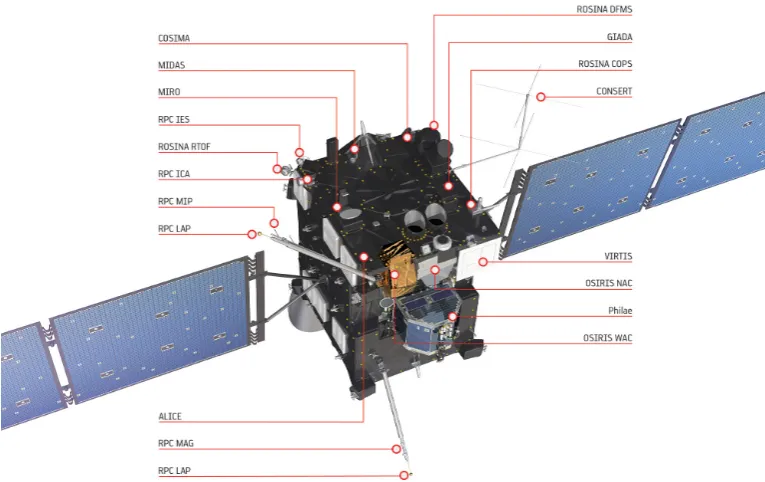
Figure 4.1: Rosetta and its instruments. This study works on data taken by the OSIRIS NAC, where OSIRIS stands for Optical, Spectroscopic, and Infrared Remote Imaging System Camera. OSIRIS is a dual camera imaging system consisting of a narrow-angle (NAC) and a wide-angle camera (WAC) and operating in the visible, near infrared and near ultraviolet wavelength range. Copyright: ESA/ATG medialab
“Rosetta” is one of the cornerstone missions of the European Space Agency. The
space-craft has been launched on 2 March 2004 on a mission to study the comet
67P/Churyumov-Gerasimenko. During its scheduled flight time of 10 years so far, it has completed four
fly-by manoeuvres around Earth and Mars and has had two close encounters with asteroids
2867 Šteins and 21 Lutetia.
Rosetta spent the last 3 years in deep-space hibernation and successfully woke itself
40
up on 20 January 2014 to begin the last leg of its journey. The spacecraft is now being
propelled towards 67P/CG, in May 2014 it will begin a braking manoeuvre to rendezvous
with the comet at a relative speed of 2 m/s in August 2014 and, from then on, it will
continuously monitor the comet on its voyage around the Sun. Rosetta has 11 on-board
instruments, see Figure 4.1, among them OSIRIS (Optical, Spectroscopic, and Infrared
Re-mote Imaging System) dual camera imaging system consisting of a narrow-angle (NAC,
(2◦)2) and a wide-angle camera (WAC, (12◦)2) and operating in the visible, near infrared
and near ultraviolet wavelength range.
Rosetta also carries the “Philae” lander unit with another 14 instruments, which will
be deployed in November 2014 to land on the comet’s surface and examine the chemical
and physical composition of the comet.
The Rosetta microlensing campaign was realised just after the 2867 Šteins flyby in
September 2008 and made use of the OSIRIS Narrow-Angle Camera, originally designed
[image:41.595.74.332.419.674.2]to image asteroids from close range, as shown in Figure 4.2.
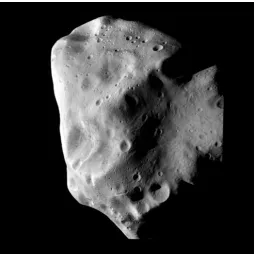
Figure 4.2: 21 Lutetia. The asteroid measures about 100 km across and orbits the sun with a semi-major axis of∼
2.4 AU. The image was taken with the OSIRIS Narrow-Angle Camera at closest approach (∼ 3200 km). The surface resolution in this image is approximately 60 meters per pixel.
Copyright: ESA 2010 MPS
for OSIRIS Team
5
|
Photometric analysis of the Rosetta
microlensing data
5.1 Observations
The OSIRIS Narrow-Angle Camera (OSINAC from hereon) observed the Galactic bulge, in
the region [–5◦ < b < –3◦, –5◦ < l < 11◦] in Galactic coordinates, on seven epochs between
7 September and 4 October 2008. On each occasion, eight frames of (2◦)2 were taken. The
OSINAC was designed to image a comet from close range and is not a space telescope.
The pixel scale is 3.9 arcseconds. The diameter of the camera entrance pupil is 89.4 mm.
The “orange” filter was used, as this is the broadband filter with the greatest sensitivity
on-board. For the central wavelength (649.4 nm) of the orange filter, the (purely theoretical)
diffraction limit is 1.82 arcseconds. The uniform exposure time used was 300 seconds. For
all technical specifications of the camera, see Keller et al. (2007a). The data were reduced
using the OSIRIS standard pipeline, the procedure is detailed in e.g. Keller et al. (2007b).
After observations had been concluded, 20 events of interest were identified among the
total of 655 candidate microlensing events announced by the OGLE Early-Warning
Sys-tem1 (Udalski et al., 1994) in the 2008 microlensing season. The criteria applied were that
the candidate event must lie within the OSINAC-covered field, must not last significantly
longer than our observation span (tE < 60 days) and should have peaked reasonably close
to the observing window (7 Sep – tE< t0 < (5 Oct + tE).
For 12 events out of these 20, the team obtained complementary ground observations in
1ogle.astrouw.edu.pl/ogle3/ews/2008/ews.html
42 5.1. OBSERVATIONS
June 2009 using the Wide Field Imager (WFI) instrument mounted on the MPG/ESO
2.2m-telescope, La Silla, Chile (Baade et al., 1999). The filters Rc/162-844 and MB-646/27-8562
were chosen to match the OSINAC orange filter as closely as possible, the passbands are
compared in Figure 5.1. Exposure times were 30 to 45 seconds. The WFI data were reduced
0 0.1 0.2 0.3 0.4 0.5 0.6 0.7 0.8 0.9 1
550 600 650 700 750 800
T ra n sm it ta n ce Wavelength [nm] OSINAC orange WFI MB 867 WFI R 844
Figure 5.1:Passbands of the OSINAC orange filter and the two WFI fil-ters used for follow-up observations. Only observations with the WFI R 844 filter were used in the analysis.
using a version of the Cambridge Astronomical Survey (CASU) pipeline (Irwin & Lewis,
2001) that has been adapted to work with the MPG/ESO WFI instrument. The following
analysis is based on the Rc filter images as they were of an overall cleaner quality, while the
MB data have only been used for sanity checks. Four of these 12 events had to be excluded
from the final analysis, because, back at baseline, they were too faint to be identified on
the WFI frames.
In the end, we have analysed the OSINAC data of eight event candidates, which are
listed in Table 5.1.
CHAPTER 5. PHOTOMETRIC ANALYSIS 43
Event name RA(J2000.0) Dec(J2000.0)
OGLE-2008-BLG-092 17:47:29.42 -34:43:35.6 OGLE-2008-BLG-374 17:54:56.33 -32:50:32.4 OGLE-2008-BLG-517 18:04:16.53 -28:50:22.2 OGLE-2008-BLG-571 18:01:18.75 -30:17:03.2 OGLE-2008-BLG-574 17:56:04.00 -32:05:01.0 OGLE-2008-BLG-582 18:10:24.03 -26:09:05.0 OGLE-2008-BLG-601 18:07:46.78 -26:20:15.0 OGLE-2008-BLG-605 18:07:41.50 -27:25:17.9
Table 5.1: Candidate events for the analysis.
5.2 Analysis
The OSINAC frame resolution is not sufficient for a direct identification of the
microlens-ing targets. This problem is aggravated by the high source density of the observed fields,
Figure 5.2 illustrates this problem.
OSIRIS NAC WFI
Figure 5.2: Juxtaposition of two observed frames, showing the same (97.5 arcsec)2 field centred on the target OB08601, which is marked with the green circle. On the left, a OSIRIS Narrow-Angle Camera sub-frame as observed from the Rosetta spacecraft on 7 September 2008; on the right, a Wide-Field-Imager sub-frame, observed with the 2.2m telescope at ESO La Silla, Chile, on 18 June 2009.
44 5.2. ANALYSIS
analysis for the photometric reduction (Alcock et al., 1999), which is well suited for the
detection of difference flux in crowded fields. Originally, we expected to achieve good
results with a direct image subtraction, because space-based observations are free from
atmospheric perturbations. Unfortunately, image subtraction is not a viable option here,
because the point-spread functions not only change considerably between epochs due to
the spacecraft drift, but are severely undersampled at the same time. Additionally, there
are simply not enough un-crowded stars on the OSINAC frames to calculate the
convolu-tion kernels.
The first challenge was calibrating the astrometry. The OSINAC FITS frames were
fit-ted with initial World Coordinate System (WCS) information using theastrometry.net
code (Lang et al., 2010) and index files based on the USNO-B1.0 catalogue (Monet et al.,
2003), but, due to the aberrations of the optical system, deviations from the true positions
of the order of 10 arcseconds occur on the wide-field frames. We cut down the original
images to 0.125 degree fields, centred on the OGLE candidate events, and repeated the
astrometric calibration. The post-calibration astrometric accuracy of the OSINAC
sub-frames is comparable to the pixel size, i.e. 3.9 arcseconds.
Facing the adverse combination of a low resolution detector and a high stellar density,
as well as a significant pollution with cosmic ray hits, we chose a compromise aperture
size of (3 px)2, where the aperture is placed so that the OGLE target coordinates for the
microlensing event are contained in the central pixel.
The background will generally dominate over the source flux. To separate out the
microlensed flux F from the total aperture flux Faper, we have to subtract the blend flux
Fblend. Since we observed from space, far beyond Earth’s atmosphere, the sky background
is negligible. By visual inspection, we identify and sort out data corrupted by cosmic
ray hits. Afterwards, we consider all non-microlensed flux collected by the aperture as
coming directly from the background stars near the target. These we hoped to identify
from existing ground-based catalogues, but this idea proved to be unfeasible: While the
OGLE photometric catalogue in V and I (Szymański et al., 2011) is cut off too early at
CHAPTER 5. PHOTOMETRIC ANALYSIS 45
for the OSINAC orange filter, the APASS3 catalogue is not deep enough for our purposes
(complete for roughly 10 mag to 17 mag in several filters, of which Sloan r’ is the best
match) and is even more shallow in crowded fields.
Therefore, it was decided to make use of higher-resolution ground observations of the
microlensing events at baseline. In June 2009, when all chosen events of interest were
safely back to baseline, the complementary observations of 12 events were obtained using
WFI.
Using SExtractor (Bertin & Arnouts, 1996), we retrieve a catalogue of WFI sources for
the field of interest around each target, i.e. a data set of sky position and (un-calibrated)
flux {RA, Dec, FWFI}star for each source on the frame. The equatorial coordinates RA and
Dec are converted into the coordinate system of the OSINAC pixels, {X, Y, FWFI}star, to
facilitate the creation of a synthetic OSINAC (baseline) frame. For creating the synthetic
OSINAC frame, we need to photometrically and astrometrically match the WFI catalogue
to the original OSINAC frame, which includes convolving the catalogue stars with the
correct point spread function (PSF). The OSINAC PSF is best described by a Moffat (1969)
function,
PSF(x, y; α, β) = β – 1 πα2
1 +
x2+ y2 α2
–β
. (5.1)
The PSF is severely undersampled in the OSINAC frames with a FWHM of the order of 1
pixel. The flux density for a given source is described by
fWFI(x, y) = FWFI×PSF(x, y; α, β). (5.2)
So we have five parameters to fit: linear shifts δx and δy, the Moffat PSF parameters
α and β and, lastly, a WFI-to-OSINAC flux conversion factor k = F/FWFI. The first four
parameters must be adjusted for each frame, because the stellar PSFs change position and
shape between epochs. The latter parameter, k, on the other hand, should be constant for
a given filter choice (we checked that there was no sensitivity change in the OSINAC CCD
46 5.2. ANALYSIS
over the course of observations). While fitting it, we risk overcompensating for the target
flux variabilities that we want to detect. The fit is also influenced by cosmic ray hits on the
subframe, which are obvious in some cases, but can be imperceptible in others. For these
reasons, we ran the optimisation below on a number of frames withfivefree parameters
until we reached a good match for each frame and then fixed the flux conversion factor at
the mean value, k = 0.1875, leaving onlyfourfree parameters for regular pipeline runs.
We then limit ourselves to a 25×25 pixel OSINAC sub-frame, where the PSF can be assumed stable and the optical aberrations are negligible, and use the SciPy (Jones et al.,
2001–)optimize.fminimplementation of a downhill simplex algorithm to minimise
X
all pixels
FSYNpixel– Fpixel
p
Fpixel
!2
(5.3)
with the synthetic, WFI-based pixel flux
FSYNpixel= X
all stars
Z
OSINAC pixel area
fWFIstar ×k, (5.4)
where the stellar flux density is translated by δx, δy and the PSF shape modified by α and
β:
fWFIstar(x – Xstar+ δx, y – Ystar+ δy; α, β). (5.5)
Parameters δx, δy, α, β, are optimised globally over the sub-frame, i.e. a sky area of (97.5
arcsec)2, via Equation (5.3), where typically 0 < |δx| ∼|δy| < 0.5 and α∼1.0, β∼1.5. We can now work on the synthetic frame FSYNpixel(Figure 5.3, centre) and we are interested in the
synthetic baseline flux.
CHAPTER 5. PHOTOMETRIC ANALYSIS 47
100 1000 10000
100 1000 10000
-800 -400 0 400 800
Figure 5.3: Comparison of the OSINAC frame (left) from Figure 5.2 with its synthetic reproduc-tion from the WFI frame (centre). On the right is the difference image. A cosmic ray from the original image stands out in the top-right quarter and the brighter targets on the lower left of the frame can be traced by their stronger residuals.
in the aperture,
FSYNaper = X
pixel in aperture
FSYNpixel(α, β, δx, δy). (5.6)
Thetargetsynthetic aperture flux, i.e. the synthetic baseline flux, is derived analogously to
Equation (5.4) by identifying the target star in the WFI catalogue through astrometry
(clos-est star to OGLE event coordinates) and visual inspection of the finding chart in doubtful
cases:
FSYNtarget=
Z
aperture
fWFItarget(α, β, δx, δy)×k. (5.7)
Now, we infer the OSINAC blend flux from the WFI frame by modelling the aperture
blend flux as
FSYNblend = FSYNaper– FSYNtarget. (5.8)
The OSINAC data points, F, are then determined, after running the above analysisfor
each frame individually, as
48 5.3. LIMITATIONS OF THE PHOTOMETRIC ANALYSIS
where Faperis the raw OSINAC flux and FSYNblendthe synthetically constructed blend flux. F is
the net target flux with any remaining time variability expected to be microlensing (but cf.
limitations in Section 5.3). The reported uncertainties are the propagated Poisson errors of
the raw OSINAC flux and the synthetic blend flux. The Rosetta microlensing light curves
are discussed in Section 7.
For testing the reliability of the method, we have extracted light curves for a selection
of comparison stars around target OB08601, Figure 5.4 shows the results.
5.3 Limitations of the photometric analysis
There might still be additional blending due to either the limited resolution of the WFI
frames or the limited deblending abilities of SExtractor. Typically, a bright lens star could
be the source of such unresolved blend flux. We address this while fitting the Paczyński
curve, see Section 7.2, by making use of the blend parameter as determined by the OGLE
fit solution to the ground-observed microlensing light curve.
Our tool of choice, SExtractor, was not primarily designed for use on crowded stellar
fields, but for the automatic classification of galaxies. We adapted the input parameters
(circular apertures, low deblending threshold), optimising the stellar identification to a
certain extent, but bear in mind that we use and value this tool for its ready usability
and high throughput rather than expecting completely flawless star catalogue results. We
have carefully checked the correct SExtractor identification of the target stars themselves
and argue that for the blend flux determination it is fairly irrelevant whether two close
neighbours are identified as one or two stars given the difference of scale for the WFI and
OSINAC point spread functions.
Of course, ground observations are affected by changing seeing conditions and a high
sky background, therefore the source identification can hardly be perfect and we miss out
on stars fainter than the WFI magnitude limit4. Given the respective areas of the OSINAC
and WFI detectors, 0.092/2.202 = 0.0017, the flux of stars too faint to be identified on the
4About 21 R-mag (S/N≥20) in good conditions, for t
exp= 60 seconds, based on the ESO exposure time
CHAPTER 5. PHOTOMETRIC ANALYSIS 49
(a) Selected comparison stars around target OB08601, picked to match the baseline brightness of the target. FL05 is probably two unresolved sources.
-0.6
-0.4
-0.2
0
0.2
0.4
0.6
4720 4730 4740
M
ag
n
it
u
d
e
d
iff
er
en
ce
JD - 2450000 FL01
FL02 FL03
FL04 FL05 FL06
OB08601
(b) Corresponding light curves, displayed relative to their respective average magnitude. The data points are connected by lines to guide the eye. The uncer-tainties are modelled as Poisson noise. The variation in the target clearly stands out. FL02 had three obvious cosmic ray hits, those epochs have been eliminated from the light curve.
50 5.3. LIMITATIONS OF THE PHOTOMETRIC ANALYSIS
6
|
Microlens parallax
We recall from Section 2.5, Equation (2.16), that a microlensing light curve is observed as
F(t) = A(t)FS+ Fblend = (A(t) + g)FS,
where A(t) is the single-lens microlensing magnification, Equation (2.15).
The light curve F(t) yields only one fit parameter, tE, which contains all available
in-formation on the “optics” of the lensing set up, i.e. the mass M, the distance DL, the source
distance DSand the relative proper motion µLS(Dominik, 2006):
tE=
1 µLS
s
4G c2 M
1 DL
– 1 DS
. (6.1)
The Rosetta microlensing campaign enabled us to add one more independent observable
to determine the physical properties of the lens system, the microlens parallax πE.
Refsdal (1966) was the first to point out the potential of observing Galactic
gravita-tional microlensing events from Earth and a distant spacecraft at (roughly) the same time.
Due to parallactic viewing, the same background source star and foreground lens will,
in general, result in two light curves with different impact parameters and different peak
times for the two observatories (see Figure 6.1). If there is a relative motion between Earth
and the spacecraft, this can additionally lead to a difference in tE. These differences
pro-vide constraints on both the mass and the distance of the microlensing body, which can
otherwise only be assessed through stellar models and statistical arguments.
The term “microlens parallax” only came into use some time later (see, for example,
52
Gould (2000) where it is defined it as πE := AU e
rE , one Astronomical Unit over the physical
lens-plane Einstein ring radius projected back from the source onto the observer plane).
The quantity is intuitively understood as the relative parallax of lens and source star,
πLS = AUDL –AUDS, normalised to the Einstein angle θE:
πE=
πLS
θE
. (6.2)
(6.3)
As we will see, πEcan be expressed in terms of the observables ∆t0 and ∆u0. This
deriva-tion is partly following Gould (1994b), with modernised notaderiva-tion.
We pick a coordinate system in the lens plane with right-handed basis vectors (ek,
e⊥) in units of (dimensionless) Einstein angles. The former, ek, is parallel to the
source-lens relative proper motion, µLS = µL –µS. The latter, e⊥, is parallel to the impact axis,
e⊥ k u0, which in the case of uniform rectilinear relative motion is always orthogonal
to the relative proper motion. We place the origin of the coordinate system at the lens
position. We use this definition of the coordinate system independently of the observer
position; see Figure 6.1 for an overview.
Now, we consider that the transient microlensing magnification in a given
point-source, point-lens scenario depends only on the angular separation of source and lens
|u(t)|. With the chosen coordinate system,u(t) is identical to the source position as well as
the angular lens-source separation in units of Einstein radii. At a time t, for an Earth-based
observer, the source appears to be at position
u⊕
(t) = t – t
⊕
0
tE
×ek+ u⊕0 ×e⊥, (6.4)
while at the same time, an observer based on the Rosetta spacecraft would see
uR(t) = t – t R 0
tE
CHAPTER 6. MICROLENS PARALLAX 53
This means we have an apparent source displacement of
∆u(t) =u⊕(t) –uR(t) (6.6)
= –∆t0 tE
×ek+ ∆u0×e⊥, (6.7)
where the last line is no longer time-dependent, but assumes uniform rectilinear relative
motion throughout; Equation 6.7 is also illustrated in Figure 6.1.
On the other hand, we can derive the source displacement from the known spacecraft
position. We project the vector pointing from Earth to the spacecraft onto the observer
plane asρand assume it to be static throughout the observations. When we scale it to the
lens plane and normalise it to Einstein angles, we again have the difference in apparent
source positions:
∆u= DS– DL DS
ρ 1
DLθE
(6.8)
= πLS AU θE
ρ (6.9)
= πE
AUρ. (6.10)
Thus we can rewrite the angular lens-source separation on the plane of sky as observed
from Rosetta by adjusting Equation (6.4) to reflect the difference in perspective,
uR(t) =u⊕
(t) + ∆u (6.11)
= t – t
⊕
0
tE
×ek+ u⊕0 ×e⊥+
πE
1AUρ. (6.12)
By equating the magnitudes of Equations (6.7) and (6.10), we can solve for πE,
πE=
AU |ρ|
s
∆t0
tE
2
+ ∆u2
0. (6.13)
The Einstein time tEdepends on the (comparatively) static quantities: lens mass, lens
54
change of the relative positions of Earth and spacecraft during the course of observations,
we can assume that t⊕E ∼tR
Eis equal for both ground and space observations.
The peak time difference ∆t0 = |t⊕0 – tR0| would only be zero, if the projected source
trajectory would coincidentally be orthogonal to the Earth-spacecraft axis. Similarly,
∆u0 = u⊕0 – uR0 will generally be unequal to zero, although by how much depends on
the geometry of the gravitational lensing system. ∆u0 is degenerate in two ways:
• One degeneracy can be gleaned from Figure 6.1: |∆u0| = |u⊕0| ∓|uR0| depends on
whether the source trajectories are observed on the same side (cis→–) or opposite sides (trans→+) of the lens.
• Secondly, the sign of ∆u0: we use a right-handed coordinate system (ek, e⊥), as
indicated in Figure 6.1, which means that an impact parameter is positive, when the
source passes the lens in a clockwise sense.
This fourfold degeneracy carries over to the angle between the orientation of the source
trajectory and the apparent source displacement tan φ = ∆u0/∆t0. As Refsdal (1966) noted,
it could be resolved with additional remote observers.
Having determined πE, we directly have˜rE = AU/πE, the radius of the projected
Ein-stein radius in the observer plane, which in turn yields the relative lens-source transverse
velocity˜v =˜rE/tE, see Boutreux & Gould (1996) for typical˜v.
For the complete determination of the actual physical parameters of the lensing body,
at least one more observable is needed. Either θE or µLS can fulfil this need. While θE
is routinely measured for planetary or binary events, when the source passes over or
near a caustic (as in the first successful mass measurement in microlensing (An et al.,
2002)), it is close to impossible to determine in single-lens events – with the notable
ex-ception of high-magnification events that can display chromatic extended-source effects
(cf. Section 2.7). There is however potential here for measuring the relative proper
mo-tion of source and lens µLS. High-resolution, multi-band follow-up observations could –
in some cases – reveal the lens and distinguish it from the source star. As a rough guide,
CHAPTER 6. MICROLENS PARALLAX 55
00000000000 11111111111
–u0R
u0⊕ ⊕
u0
–t0R t0⊕
R
u0
⇒∆u0
∆mag ∆t0
Magnitude
Time
e⊥
ek
t0
t0
⊕
R –∆t0
∆u0 ∆u
∆u φ Lens
Figure 6.1: Sketch of the microlens parallax effect. Top: Two light curves of the same source, observed from two observatories, one on Earth, one on the Rosetta spacecraft. Assuming for illustrative purposes and without loss of generality that the two observations start and end si-multaneously, with the source observed on the respective trajectories, the peak times t0 will
generally be unequal as will be the impact parameters u0.
Bottom left: Relative to a lens and its (theoretical) Einstein ring on the plane of sky, the sketch illustrates the source trajectory as observed from Earth ( ) and as observed from Rosetta ( ).e⊥andekindicate our choice of coordinate system; the origin is always at the lens po-sition. The source displacement vector ∆upoints from the spacecraft-observed source position to the Earth-observed source position at any given time. Its orientation is the orientation of the Earth-spacecraft separation projected onto the observer plane.