Geology
doi: 10.1130/G35402.1
published online 10 April 2014;
Geology
Peter A. Cawood and Chris J. Hawkesworth
Earth's middle age
Email alerting services
articles cite this article
to receive free e-mail alerts when new
www.gsapubs.org/cgi/alerts
click
Subscribe click www.gsapubs.org/subscriptions/ to subscribe to Geology
Permission request click http://www.geosociety.org/pubs/copyrt.htm#gsa to contact GSA
official positions of the Society.
citizenship, gender, religion, or political viewpoint. Opinions presented in this publication do not reflect
presentation of diverse opinions and positions by scientists worldwide, regardless of their race,
includes a reference to the article's full citation. GSA provides this and other forums for the
the abstracts only of their articles on their own or their organization's Web site providing the posting
to further education and science. This file may not be posted to any Web site, but authors may post
works and to make unlimited copies of items in GSA's journals for noncommercial use in classrooms
requests to GSA, to use a single figure, a single table, and/or a brief paragraph of text in subsequent
their employment. Individual scientists are hereby granted permission, without fees or further
Copyright not claimed on content prepared wholly by U.S. government employees within scope of
Notes
articles must include the digital object identifier (DOIs) and date of initial publication.
priority; they are indexed by GeoRef from initial publication. Citations to Advance online
prior to final publication). Advance online articles are citable and establish publication
yet appeared in the paper journal (edited, typeset versions may be posted when available
Advance online articles have been peer reviewed and accepted for publication but have not
ABSTRACT
Earth’s middle age, extending from 1.7 to 0.75 Ga, was char-acterized by environmental, evolutionary, and lithospheric stability that contrasts with the dramatic changes in preceding and succeeding eras. The period is marked by a paucity of preserved passive margins, an absence of a signifi cant Sr anomaly in the paleoseawater record and in the εHf(t) in detrital zircon, a lack of orogenic gold and volcanic-hosted massive sulfi de deposits, and an absence of glacial deposits and iron formations. In contrast, anorthosites and kindred bodies are well developed and major pulses of Mo and Cu mineralization, including the world’s largest examples of these deposits, are features of this period. These trends are attributed to a relatively stable continental assemblage that was initiated during assembly of the Nuna supercon-tinent by ca. 1.7 Ga and continued until breakup of its closely related successor, Rodinia, ca. 0.75 Ga. The overall low abundance of passive margins is consistent with a stable continental confi guration, which also provided a framework for environmental and evolutionary sta-bility. A series of convergent margin accretionary orogens developed along the edge of the supercontinent. Abundant anorthosites and related rocks developed inboard of the plate margin. Their temporal distribution appears to link with the secular cooling of the mantle, at which time the overlying continental lithosphere was strong enough to be thickened and to support the emplacement of large plutons into the crust, yet the underlying mantle was still warm enough to result in widespread melting of the lower thickened crust.
INTRODUCTION
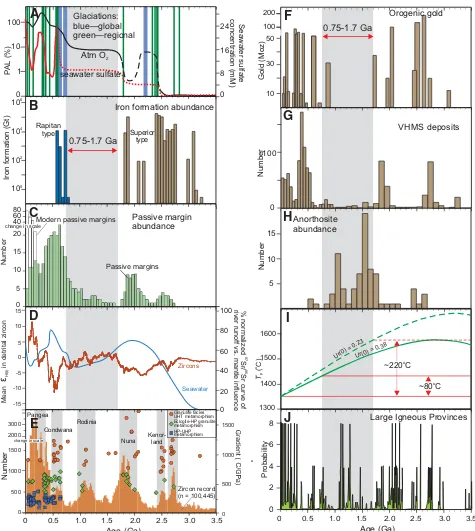
Earth’s rock record is incomplete, with a heterogeneous distribution of rock units and events that correspond to periods of supercontinent as-sembly (Cawood et al., 2013). For example, U-Pb zircon crystallization ages (Voice et al., 2011), whether determined from igneous rocks or de-trital sediments, and the age distribution of metamorphic rocks (Brown, 2007) show peaks in the frequency of occurrence at the time of super-continent assembly (Bradley, 2011). The period 1.7–0.75 Ga, however, is anomalous (Fig. 1) in that it is characterized by the following.
1. A paucity of passive margins (Bradley, 2008), and notably no pas-sive margin age peak corresponding with the phase of assembly of the Rodinia supercontinent as there is for the preceding Nuna and succeeding Gondwana cycles.
2. An absence of glacial deposits (Bradley, 2011) and iron formations (Bekker et al., 2010).
3. No signifi cant Sr anomaly in the paleoseawater record (Shields,
2007) or in the εHf(t) record in detrital zircon (Belousova et al., 2010).
4. A lack of phosphate deposits, even though they were well estab-lished ca. 2.2–1.8 Ga and after 0.75 Ga (Papineau, 2010), periods that also correspond with maxima in the geological record in black shale abundance and in the chemical index of alteration (Condie et al., 2001). Such patterns suggest major global changes in ocean and atmospheric chemistry in the Paleoproterozoic and Neoproterozoic, and perhaps more stable conditions in the intervening interval (cf. Brasier and Lindsay, 1998).
5. Relatively high ocean salinity before a signifi cant decrease after 800 Ma in association with the development of major evaporate basins, possibly linked to increased sulfate delivery and development of S-rich porphyry deposits in the Phanerozoic (Richards and Mumin, 2013).
6. Massif-type anorthosites and kindred bodies, also variously termed A-type granite, anorogenic granite, anorthosite-mangerite-charnockite-granite suite, ferroan feldspathic granitoids, ilmenite-anorthosite-mangerite-charnockite-granite, or Rapakivi granites, are characteristic features of the Proterozoic, largely in the period 1.8–1.0 Ga (Ashwal, 2010).
7. Limited orogenic gold deposits between 1.7 and 0.9 Ga, account-ing for signifi cantly less than 1% of known production, yet correspondaccount-ing to the generation of almost 20% of the preserved crustal record (Goldfarb et al., 2001). Volcanic-hosted massive sulfi de (VHMS) deposits show a similar distribution (Huston et al., 2010). Sedimentary rock-hosted man-ganese deposits are also conspicuous by their absence between 1.8 and 0.8 Ga; Maynard (2010) suggested that this corresponds to the low fre-quency of black shale deposition and may relate to a monotonous low-oxygen ocean, with nonsulfi dic deep water. Sedimentary rock–hosted stratiform copper deposits are largely absent from the rock record be-tween 1.8 and 0.8 Ga (Hitzman et al., 2010).
PALEOGEOGRAPHIC CONFIGURATIONS
The pattern of rock units and the events outlined in Figure 1 indi-cate that the period from ca. 1.7 Ga to 0.75 Ga, herein termed Earth’s middle age, was unique with respect to preceding and succeeding eras of Earth history (cf. Holland, 2006). This period encompasses the proposed Rodinian supercontinent cycle (ca. 1.3–0.75 Ga) and part of the Nuna cycle (ca. 2.1–1.3 Ga). There is increasing evidence that the change from Nuna to Rodinia was one of transition in which Siberia, Laurentia, and Baltica formed a stable core that assembled during construction of Nuna by 1.8–1.7 Ga and continued, with little change in confi guration, until Rodinia breakup at 0.75 Ga (e.g., Evans, 2013). This contrasts with the signifi cant changes in continental confi gurations that occurred in the ini-tial assembly of Nuna or in the transition from Rodinia breakup to Pangea assembly. Extension-related magmatism at ca. 1.4–1.25 Ga is widespread around parts of Laurentia, Baltica, and Siberia and is ascribed to Nuna breakup (Evans, 2013). However, the general paucity of passive margins through the Mesoproterozoic (Fig. 1) and the absence of any evidence for 1.1–1.0 Ga orogenesis in blocks such as Siberia (Gladkochub et al., 2010) argue for no signifi cant breakup and reassembly of these continental frag-ments in the transition from Nuna to Rodinia (cf. Bradley, 2008).
The overall stability in the confi guration of the core components of Nuna and Rodinia is mimicked in the presence of a long-lived accretionary orogen that developed along the margins of Laurentia, Baltica, Australia, and Amazonia from ca. 1.8 Ga to 1.25 Ga (e.g., Whitmeyer and Karlstrom, 2007). Accretionary activity terminated with the 1.25–0.95 Ga Grenville orogeny and equivalent tectonothermal events leading to fi nal assembly of Rodinia, which involved collision assembly of Amazonia, India, and related fragments onto the stable Nuna core. These events resulted in the 1.1–1.0 Ga peak in granulite and eclogite facies metamorphism (Fig. 1; Brown, 2007).
IMPLICATIONS
Rock units and events depicted in Figure 1 span surfi cial (atmo-sphere, oceans, biosphere) and deep Earth (lithospheric) proxies, and their temporal equivalence suggests that they are linked and therefore controlled through common processes. Drivers that tie across different as-pects of the Earth system and exert long-term control on the rock record include (1) tectonic processes associated with the structure, interactions, and confi gurations of the lithosphere, and (2) the secular evolution of *E-mail: [email protected].
Earth’s middle age
Peter A. Cawood
1,2* and Chris J. Hawkesworth
11Department of Earth Sciences, University of St Andrews, Irvine Building, North Street, St Andrews, Fife KY16 9AL, UK
2 www.gsapubs.org
|
June 2014|
GEOLOGY 010
Iron formation (Gt)
2
10
4
10
Iron formation abundance
Superior type Rapitan type Glaciations: blue—global green—regional Passive margins 0 5 10 15 20 40 60 80 Number
Modern passive margins Passive margin
abundance 0.75-1.7 Ga
change in scale
Anorthosite abundance Number 5 10 15 200 100 50 30 10 Gold (Moz) Orogenic gold VHMS deposits Number 100 0 0.75-1.7 Ga
0.5 1.0 1.5 2.0 2.5 3.0 3.5
0 Age (Ga) 8 6 4 2 0 Probability
Large Igneous Provinces
Atm O2
6 10 1 10 100 0 P A L (%) o T (C ) p 1600 1500 1400 1300
0.5 1.0 1.5 2.0 2.5 3.0 3.5
0 Age (Ga) 1500 1000 500 0 0 1000 2000 3000 Zircon record (n = 100,445)
500 1500 Granulite facies UHT metamorphism Eclogite-HP granulite metamorphism HP-UHP metamorphism Number Pangea Gondwana Rodinia
Nuna Kenor-land
0 20 40 60 80 100 87 86 % normalized Sr/
Sr curve of
river runof
f vs. mantle influence
Ur(0) = 0.23 o ~220 C o ~80 C -15 -10 -5 0 5 10 15 Mean
ε
Hf(t)in detrital zircon
Seawater
Zircons
0 8 16 24 Seawater sulfate
concentration (mM)
seawater sulfate
Ur(0) = 0.38
[image:3.594.60.535.60.591.2]change in scale
A
B
C
D
E
G
F
H
I
J
Figure 1. A: Temporal distribution of glaciations (Bradley, 2011), atmospheric (Atm) oxygen relative to present atmospheric level (PAL) (Berner et al., 2003; Canfi eld, 2005), and seawater sulfate (adapted from Farquhar et al., 2010; Pope and Grotzinger, 2003). B: Iron formation abundance (Bekker et al., 2010). C: Ages of ancient and modern passive margins (Bradley, 2008). D: Normalized seawater 87Sr/86Sr curve (Shields, 2007) and running mean of initial ε
Hf in ~7000 detrital zircons from recent
Earth’s internal heat production. The absence of any change in the inferred frequency of large igneous provinces across the 1.7–0.75 Ga time period (Fig. 1), relative to preceding and succeeding intervals, suggests that pro-cesses within the deep mantle were not a signifi cant factor.
Unusually, the confi guration of core elements of the Nuna supercon-tinent over the period ca. 2.1–1.7 Ga continued until ca. 0.8 Ga, when the inferred succeeding supercontinent of Rodinia started to break up (Evans, 2013). Paleogeographic reconstructions suggest that the supercontinent assemblage straddled equatorial and temporal climatic zones throughout the intervening time frame; there is little or no evidence for continental fragments in polar latitudes (Evans, 2013, and references therein). A con-sequence of a limited breakup history is a paucity of passive margins in the range 1.8–0.8 Ga (Fig. 1; Bradley, 2008). This stable confi guration in both space and time provides the primary constraint on the environ-mental stasis that characterizes the oceans, atmosphere, and biosphere (Brasier and Lindsay, 1998). In detail, the ocean was relatively warm and sulfi dic euxinic (Farquhar et al., 2010), as evidenced by the absence of glacial deposits and iron formations. The subdued seawater Sr and zircon Hf isotopic signatures from 1.7 to 0.75 Ga likely refl ect the long accre-tionary history and juvenile magmatism, combined with inferred ocean closure through dual subduction zones beneath the opposing Laurentian and Amazonian margins (Cawood et al., 2013; Spencer et al., 2013). The general trend of seawater Sr values is in part mimicked by seawater sul-fate (Fig. 1). Pope and Grotzinger (2003) linked the ca. 1.7 Ga change from halite to gypsum as the main evaporite phase to increasing seawa-ter sulfate values along with decreasing oversaturation in seawaseawa-ter of calcium carbonate. Increasing input to seawater of sulfate around that time corresponds with Nuna assembly, suggesting that the source of the sulfate runoff was from chemical weathering of the continental crust in response to collisional orogenesis and growth of major mountain chains. The change in seawater proxies in the late Neoproterozoic corresponds with the introduction of high-pressure metamorphic assemblages into the rock record and a pulse of crustal reworking associated with Gondwana
assembly, as evidenced by εHf(t) values in detrital zircons. These features
may refl ect an increasing scale of collision-generated mountain ranges, which in turn links to increases in weathering, erosion, and runoff, as refl ected in seawater composition.
The anorthosites and related igneous activity during Earth’s middle age are spatially and temporally linked to convergent plate margins and occur in either synsubduction or postcollisional settings (McLelland et al., 2010; Whitmeyer and Karlstrom, 2007). Phase equilibria and geochemis-try for these plutons suggest that the enhanced upper mantle thermal con-ditions resulted in extensive melting of a thickened arc root with variable input of a mantle component at 10–13 kbar (40–50 km) at ~950–1000 °C (Bédard, 2009). The spatial constraint of a convergent plate margin set-ting does not, however, account for the temporal preponderance of these pluton types to the period 1.8–1.0 Ga (Fig. 1). Rather, it is linked to secular cooling of the mantle to a temperature at which the overlying continental lithosphere was strong enough to be both thickened and to support the em-placement of large plutons into the crust, yet still warm enough to result in widespread melting of the lower thickened crust.
Since 3 Ga the upper mantle has progressively cooled, and it may have been at temperatures 220 °C and 80 °C hotter than today at 1.7 Ga and 0.75 Ga, respectively (Herzberg et al., 2010). Geodynamic modeling studies indicate that mantle temperature is a prime control on lithosphere behavior, infl uencing the processes by which the plates interact. Sizova et
al. (2010) highlighted that at mantle temperatures above ΔT = 250 °C
(rel-ative to present-day values), there is no subduction, the lithosphere is weak and deforms internally, and continental plates are fragmented by
spread-ing centers. Between ΔT = 250 and 160 °C, plates are still weak and
de-form internally due to melt percolation, but oceanic plates can underthrust continental plates along shallow subduction zones. Plate interaction of the
type observed on Earth today requires mantle temperatures below ΔT =
160 °C. In collision zones, mantle temperatures hotter than ΔT = 80 °C
appear to preclude deep subduction of the continental crust due to shallow depth of breakoff of the attached subducting oceanic lithosphere, resulting in an absence of ultrahigh-pressure metamorphism (Sizova et al., 2014). The restriction of ultrahigh-pressure metamorphic assemblages (Fig. 1), together with the general distribution of ophiolites and the subduction- and collision-related gemstones of jadeite and ruby to the Neoproterozoic or younger, has led to the suggestion that modern plate tectonics began in the Neoproterozoic (Stern et al., 2013, and references therein).
The paucity of orogenic gold and VHMS deposits is diffi cult to ex-plain based on models involving uniformitarian accretionary orogen set-tings (Goldfarb et al., 2001). The well-developed convergent plate bound-ary along the margin of Laurentia and Baltica constitutes an ideal fertile upper mantle source region for these deposit types (Hronsky et al., 2012). Secular changes in the distribution of these deposit types may refl ect the changing processes of lithospheric interaction associated with decreas-ing mantle temperatures. Neoproterozoic and younger deposits are con-trolled by modern-style orogenic processes. Pre–1.7 Ga deposits refl ect shallow subduction with the weak lithosphere disrupted by shear zones that acted as conduits for gold-bearing fl uids. Although orogenic gold deposits were poorly developed in Earth’s middle age, signifi cant gold accumulations are present in the form of iron oxide copper-gold (IOCG) deposits (Richards and Mumin, 2013). IOCG and molybdenite mineral-ization, including the largest examples of these deposits (Parnell et al., 2012), are temporally linked to anorthosites and kindred intrusions and form in extensional environments in suprasubduction and postcollision settings. Richards and Mumin (2013) suggested that IOCG deposits are the Precambrian equivalent of Phanerozoic porphyry-type deposits, with the change in mineralization type related to increasing seawater sulfate in subducted oceanic lithosphere in the mid-Neoproterozoic, as well as to decreasing lithospheric geothermal gradients, resulting in a change from S-poor to S-rich arc magmas.
The termination of Earth’s middle age corresponds with Rodinia breakup at 0.75 Ga. Falling mantle temperatures enabled deeper levels of slab breakoff in collision zones, and the resultant greater depths to which continental crust was subducted prior to exhumation allowed the develop-ment of high-pressure metamorphic assemblages. Eledevelop-ments of the rock record that showed little change during Earth’s middle age show a strong-ly episodic distribution linked to the supercontinent cycles of Gondwana and Pangea (Fig. 1). The oxygen levels in both the atmosphere and deep oceans increased, and phosphate and evaporate deposits became wide-spread and provided a major spurt for metazoans evolution. The impact of changing lithospheric behavior on surfi cial processes is likely an ongoing event in Earth history.
ACKNOWLEDGMENTS
We thank the Natural Environment Research Council (grant NE/J021822/1) and the University of St Andrews for funding. Comments from Brendan Murphy, Sergei Pisarevsky, Tony Prave, Aubrey Zerkle and journal reviewers Dwight Brad-ley, Mike Brown, and Steve Whitmeyer helped clarify our ideas.
REFERENCES CITED
Ashwal, L.D., 2010, The temporality of anorthosites: Canadian Mineralogist, v. 48, p. 711–728, doi:10.3749/canmin.48.4.711.
Bédard, J. H., 2009, Parental magmas of Grenville Province massif-type anor-thosites, and conjectures about why massif anorthosites are restricted to the Proterozoic, in Clemens, J.D., ed., Sixth Hutton Symposium on The Origin of Granites and Related Rocks: Royal Society of Edinburgh Transactions, Earth and Environmental Science, v. 100, parts 1 and 2, p. 77–103, doi.org /10.1017/S1755691009016016.
Bekker, A., Slack, J.F., Planavsky, N., Krapež, B., Hofmann, A., Konhauser, K.O., and Rouxel, O.J., 2010, Iron formation: The sedimentary product of a complex interplay among mantle, tectonic, oceanic, and biospheric process: Economic Geology and the Bulletin of the Society of Economic Geologists, v. 105, p. 467–508, doi:10.2113/gsecongeo.105.3.467.
4 www.gsapubs.org
|
June 2014|
GEOLOGYfrom zircon Hf-isotope data: Lithos, v. 119, p. 457–466, doi:10.1016/j .lithos.2010.07.024.
Berner, R.A., Beerling, D.J., Dudley, R., Robinson, J.M., and Wildman, R.A., 2003, Phanerozoic atmosphere oxygen: Annual Review of Earth and Planetary Sciences, v. 31, p. 105–134, doi:10.1146/annurev.earth.31.100901.141329. Bradley, D.C., 2008, Passive margins through Earth history: Earth-Science
Re-views, v. 91, p. 1–26, doi:10.1016/j.earscirev.2008.08.001.
Bradley, D.C., 2011, Secular trends in the geologic record and the superconti-nent cycle: Earth-Science Reviews, v. 108, p. 16–33, doi:10.1016/j.earscirev .2011.05.003.
Brasier, M.D., and Lindsay, J.F., 1998, A billion years of environmental stability and the emergence of eukaryotes: New data from northern Australia: Geol-ogy, v. 26, p. 555–558, doi:10.1130/0091-7613(1998)026<0555:ABYOES >2.3.CO;2.
Brown, M., 2007, Metamorphic conditions in orogenic belts: A record of secular change: International Geology Review, v. 49, p. 193–234, doi:10.2747/0020 -6814.49.3.193.
Canfi eld, D.E., 2005, The early history of atmospheric oxygen: Homage to Robert M. Garrels: Annual Review of Earth and Planetary Sciences, v. 33, p. 1–36, doi:10.1146/annurev.earth.33.092203.122711.
Cawood, P.A., Hawkesworth, C.J., and Dhuime, B., 2013, The continental record and the generation of continental crust: Geological Society of America Bul-letin, v. 125, no. 1–2, p. 14–32, doi:10.1130/B30722.1.
Condie, K.C., Des Marais, D.J., and Abbott, D., 2001, Precambrian superplumes and supercontinents: A record in black shales, carbon isotopes, and paleo-climates?: Precambrian Research, v. 106, p. 239–260, doi:10.1016/S0301 -9268(00)00097-8.
Evans, D.A.D., 2013, Reconstructing pre-Pangean supercontinents: Geological Society of America Bulletin, v. 125, p. 1735–1751, doi:10.1130/B30950.1. Farquhar, J., Wu, N., Canfi eld, D.E., and Oduro, H., 2010, Connections between
sulfur cycle evolution, sulfur isotopes, sediments, and base metal sulfi de deposits: Economic Geology and the Bulletin of the Society of Economic Geologists, v. 105, p. 509–533, doi:10.2113/gsecongeo.105.3.509. Frost, C.D., and Frost, B.R., 2013, Proterozoic ferroan feldspathic magmatism:
Pre-cambrian Research, v. 228, p. 151–163, doi:10.1016/j.precamres.2013.01.016. Gladkochub, D.P., Donskaya, T.V., Wingate, M.T.D., Mazukabzov, A.M.,
Pisarevsky, S.A., Sklyarov, E.V., and Stanevich, A.M., 2010, A one-billion-year gap in the Precambrian history of the southern Siberian Craton and the problem of the Transproterozoic supercontinent: American Journal of Science, v. 310, p. 812–825, doi:10.2475/09.2010.03.
Goldfarb, R.J., Groves, D.I., and Gardoll, S., 2001, Orogenic gold and geologic time: A global synthesis: Ore Geology Reviews, v. 18, p. 1–75, doi:10.1016 /S0169-1368(01)00016-6.
Herzberg, C., Condie, K., and Korenaga, J., 2010, Thermal history of the Earth and its petrological expression: Earth and Planetary Science Letters, v. 292, p. 79–88, doi:10.1016/j.epsl.2010.01.022.
Hitzman, M.W., Selley, D., and Bull, S., 2010, Formation of sedimentary rock-hosted stratiform copper deposits through Earth history: Economic Geology and the Bulletin of the Society of Economic Geologists, v. 105, p. 627–639, doi:10.2113/gsecongeo.105.3.627.
Holland, H.D., 2006, The oxygenation of the atmosphere and oceans: Royal Soci-ety of London Philosophical Transactions, ser. B, v. 361, no. 1470, p. 903– 915, doi:10.1098/rstb.2006.1838.
Hronsky, J.M.A., Groves, D.I., Loucks, R.R., and Begg, G.C., 2012, A unifi ed model for gold mineralisation in accretionary orogens and implications for regional-scale exploration targeting methods: Mineralium Deposita, v. 47, p. 339–358, doi:10.1007/s00126-012-0402-y.
Huston, D.L., Pehrsson, S., Eglington, B.M., and Zaw, K., 2010, The geology and metallogeny of volcanic-hosted massive sulfi de deposits: Variations through geologic time and with tectonic setting: Economic Geology and the Bulletin of the Society of Economic Geologists, v. 105, p. 571–591, doi:10.2113/gsecongeo.105.3.571.
Maynard, J.B., 2010, The chemistry of manganese ores through time: A signal of increasing diversity of Earth-surface environments: Economic Geology and the Bulletin of the Society of Economic Geologists, v. 105, p. 535–552, doi:10.2113/gsecongeo.105.3.535.
McLelland, J.M., Selleck, B.W., Hamilton, M.A., and Bickford, M.E., 2010, Late- to post-tectonic setting of some major Proterozoic anorthosite-man-gerite-charnockite-granite (AMCG) suites: Canadian Mineralogist, v. 48, p. 729–750, doi:10.3749/canmin.48.4.729.
Mosier, D.L., Berger, V.I., and Singer, D.A., 2009, Volcanogenic massive sulfi de deposits of the world—Database and grade and tonnage models: U.S. Geo-logical Survey Open-File Report 2009–1034, 46 p.
Papineau, D., 2010, Global biogeochemical changes at both ends of the Protero-zoic: Insights from phosphorites: Astrobiology, v. 10, p. 165–181, doi:10.1089 /ast.2009.0360.
Parnell, J., Hole, M., Boyce, A.J., Spinks, S., and Bowden, S., 2012, Heavy metal, sex and granites: Crustal differentiation and bioavailability in the mid-Proterozoic: Geology, v. 40, p. 751–754, doi:10.1130/G33116.1.
Pope, M.C., and Grotzinger, J.P., 2003, Paleoproterozoic Stark Formation, Athapus-cow Basin, northwest Canada: Record of cratonic-scale salinity crisis: Journal of Sedimentary Research, v. 73, p. 280–295, doi:10.1306/091302730280. Prokoph, A., Ernst, R.E., and Buchan, K.L., 2004, Time-series analysis of large
igneous provinces: 3500 Ma to present: Journal of Geology, v. 112, p. 1–22, doi:10.1086/379689.
Richards, J.P., and Mumin, A.H., 2013, Magmatic-hydrothermal processes within an evolving Earth: Iron oxide–copper–gold and porphyry Cu ± Mo ± Au deposits: Geology, v. 41, p. 767–770, doi:10.1130/G34275.1.
Shields, G.A., 2007, A normalised seawater strontium isotope curve: Possible implications for Neoproterozoic–Cambrian weathering rates and the further oxygenation of the Earth: eEarth, v. 2, p. 35–42, doi:10.5194/ee-2-35-2007. Sizova, E., Gerya, T., Brown, M., and Perchuk, L.L., 2010, Subduction styles
in the Precambrian: Insight from numerical experiments: Lithos, v. 116, p. 209–229, doi:10.1016/j.lithos.2009.05.028.
Sizova, E., Gerya, T., and Brown, M., 2014, Contrasting styles of Phanerozoic and Precambrian continental collision: Gondwana Research, v. 25, p. 522– 545, doi:10.1016/j.gr.2012.12.011.
Spencer, C.J., Hawkesworth, C., Cawood, P.A., and Dhuime, B., 2013, Not all supercontinents are created equal: Gondwana-Rodinia case study: Geology, v. 41, p. 795–798, doi:10.1130/G34520.1.
Stern, R.J., Tsujimori, T., Harlow, G., and Groat, L.A., 2013, Plate tectonic gem-stones: Geology, v. 41, p. 723–726, doi:10.1130/G34204.1.
Voice, P.J., Kowalewski, M., and Eriksson, K.A., 2011, Quantifying the timing and rate of crustal evolution: Global compilation of radiometrically dated detrital zircon grains: Journal of Geology, v. 119, p. 109–126, doi:10.1086/658295. Whitmeyer, S.J., and Karlstrom, K.E., 2007, Tectonic model for the
Protero-zoic growth of North America: Geosphere, v. 3, p. 220–259, doi:10.1130/ GES00055.1.
Manuscript received 19 December 2013 Revised manuscript received 5 March 2014 Manuscript accepted 6 March 2014