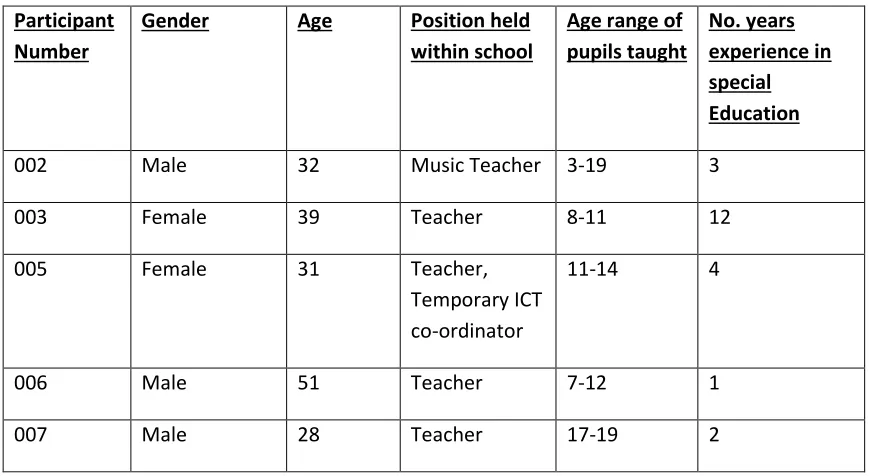
Table 1 – Characteristics of teachers
Participant Number
Gender Age Position held
within school
Age range of pupils taught
No. years experience in special Education
002 Male 32 Music Teacher 3-19 3
003 Female 39 Teacher 8-11 12
005 Female 31 Teacher,
Temporary ICT co-ordinator
11-14 4
006 Male 51 Teacher 7-12 1
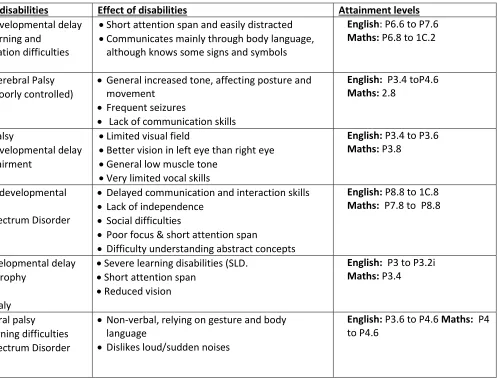
Table 2 Characteristics of pupils
Pupil Gender Age Summary of disabilities Effect of disabilities Attainment levels
KW Male 12 General developmental delay Severe learning and
communication difficulties
Short attention span and easily distracted Communicates mainly through body language,
although knows some signs and symbols
English: P6.6 to P7.6 Maths: P6.8 to 1C.2
SH Male 10 Dystonic Cerebral Palsy Epilepsy (poorly controlled)
General increased tone, affecting posture and movement
Frequent seizures
Lack of communication skills
English: P3.4 toP4.6 Maths: 2.8
ST Female 11 Cerebral palsy
General developmental delay Visual impairment
Limited visual field
Better vision in left eye than right eye General low muscle tone
Very limited vocal skills
English: P3.4 to P3.6 Maths: P3.8
TH Male 17 Significant developmental delay
Autistic Spectrum Disorder Epilepsy
Delayed communication and interaction skills Lack of independence
Social difficulties
Poor focus & short attention span
Difficulty understanding abstract concepts
English: P8.8 to 1C.8 Maths: P7.8 to P8.8
TN Male 9 Global developmental delay Cerebral atrophy
Epilepsy Microcephaly
Severe learning disabilities (SLD. Short attention span
Reduced vision
English: P3 to P3.2i Maths: P3.4
PF Female 13 Mild cerebral palsy Severe learning difficulties Autistic Spectrum Disorder
(ASD)
Non-verbal, relying on gesture and body language
Dislikes loud/sudden noises
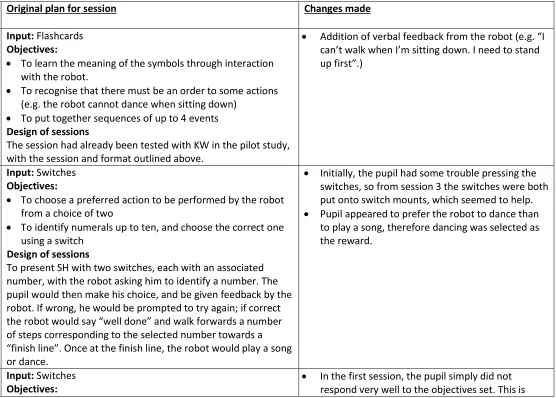
Table 3 – The plans for the case study sessions with each pupil, and the modifications made to each session.
Pupil Learning Objective
Original plan for session Changes made
KW To use symbols to build sequences of up to 4 events, and recognise they have an order.
Input: Flashcards Objectives:
To learn the meaning of the symbols through interaction with the robot.
To recognise that there must be an order to some actions (e.g. the robot cannot dance when sitting down)
To put together sequences of up to 4 events Design of sessions
The session had already been tested with KW in the pilot study, with the session and format outlined above.
Addition of verbal feedback from the robot (e.g. “I can’t walk when I’m sitting down. I need to stand up first”.)
SH To learn to recognise numbers up to ten and
encourage choice making.
Input: Switches Objectives:
To choose a preferred action to be performed by the robot from a choice of two
To identify numerals up to ten, and choose the correct one using a switch
Design of sessions
To present SH with two switches, each with an associated number, with the robot asking him to identify a number. The pupil would then make his choice, and be given feedback by the robot. If wrong, he would be prompted to try again; if correct the robot would say “well done” and walk forwards a number of steps corresponding to the selected number towards a “finish line”. Once at the finish line, the robot would play a song or dance.
Initially, the pupil had some trouble pressing the switches, so from session 3 the switches were both put onto switch mounts, which seemed to help. Pupil appeared to prefer the robot to dance than
to play a song, therefore dancing was selected as the reward.
ST To gain an appreciation of
Input: Switches Objectives:
cause and effect To trigger a preferred stimulus from a choice of switches Design of sessions
To present the pupil with a choice of 2 switches, with each triggering a different stimulus. By pressing the switch, it was hoped that the pupil would learn that one switch (with a particular symbol or colour) would trigger a stimulus she preferred to the other. The pupil would then, hopefully, be able to consistently choose the switch triggering the stimulus she preferred, even when the switches were moved around, for example. This would help the pupil understand the principle of cause and effect.
possibly due her impaired vision, which made it difficult to see the robot and the switch. After a rethink with the teacher, a more
appropriate learning objective of “to encourage vocalisation by repeating what the robot says” was set.
The pupil’s vocabulary was limited, so only words and utterances from the pupil’s vocabulary were used
Audio recordings of the pupil saying the words were used, as the robot has the function to play mp3 and wav sound files. A “game” of repeating to one another could then be played.
TH To improve the pupils sense of direction by learning the concepts of “forwards”, “backwards”, “left” and “right”
Input: Smartphone (Samsung Galaxy Note II) Objectives:
To correctly steer the robot from a start point to an end point using the Smartphone’s accelerometer as a steering wheel (using an app for the phone, and a server for the computer, available from (Robot App Store, 2012)
To correctly answer questions about the direction travelled Design of sessions
The robot was placed on a blue cross, and the pupil was asked to make the robot move to a red cross. He was then questioned whether the robot was moving forwards, backwards, left or right. It was hoped that by having the robot demonstrate these abstract concepts, it would help him learn.
The pupil found the staff member to be more distracting than helpful, therefore after the first session the pupil and researcher worked together without additional staff members
The pupil struggled to hold and use the phone in the first session. As a result, the phone was attached to a plastic steering wheel to make it simpler for the pupil.
The pupil struggled to grasp the concepts of direction, so the starting cross had “forwards”, “backwards”, “left” and “right” written on, and the robot had post-it notes with “left” and “right” stuck to each shoulder to help give the pupil a reference for his directions. It was hoped these could be removed as his skills progressed;
although this was not the case by the fifth session, he did seem to be showing improvement.
TN To understand that his actions can have an
Input: Sound recognition Objectives:
To deliberately trigger the robot to perform a desired
effect from a distance
behaviour
To refrain from attempting to re-trigger the robot until it has finished the behaviour.
Design of sessions
The sound recognition on the robot was used to recognise when the pupil made a noise (e.g. clapped, stamped feet). When a noise was recognised, the robot would perform an action, such as dancing, or waving and saying “hello”.
to trigger the robot.
In the first session, the pupil was shown a number of actions. It seemed that his favourite was a short dance to the song “Gangnam Style” (produced by (Arcambal, 2012) and freely available for
[image:5.842.71.506.230.442.2]download), therefore this was chosen as the action as it appeared to be most motivational.
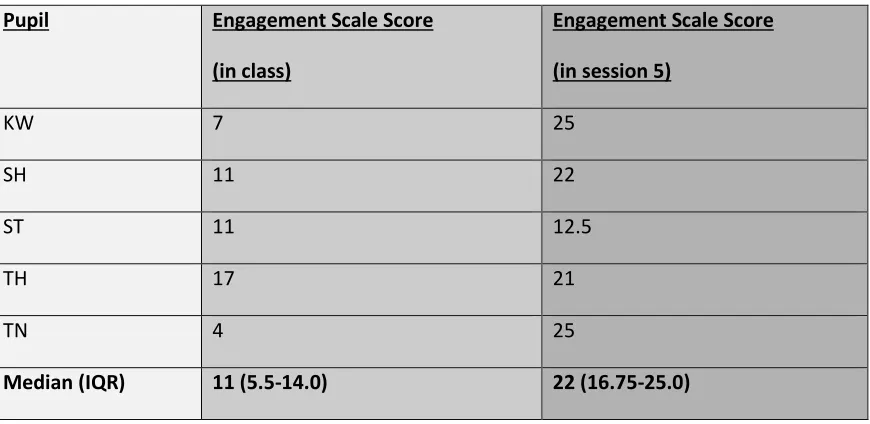
Table 4 Engagement scale scores for all pupils
Pupil Engagement Scale Score
(in class)
Engagement Scale Score (in session 5)
KW 7 25
SH 11 22
ST 11 12.5
TH 17 21
TN 4 25