Supporting Group Interaction in Museum Visiting
Peter Tolmie, Steve Benford, Chris Greenhalgh, Tom Rodden and Stuart Reeves
Mixed Reality Lab, School of Computer Science, University of Nottingham
Nottingham, United Kingdom
[email protected]
ABSTRACT
Ethnographic study in two contrasting museums highlights a widespread but rarely documented challenge for CSCW design. Visitors’ engagement with exhibits often ends prematurely due to the need to keep up with or attend to fellow group members. We unpack the mechanics of these kinds of phenomena revealing how the behaviours of summoning, pressurizing, herding, sidelining, and rounding up, lead to the responses of following, skimming and digging in. We show how the problem is especially challenging where young children are involved. As an initial prompt we explore two ways in which CSCW could help address this challenge: enabling a more fluid association between information and exhibits; and helping reconfigure the social nature of visiting.
Author Keywords
Museums; collaboration; visiting practices; ethnography.
ACM Classification Keywords
H5.m. Information interfaces and presentation (e.g., HCI)
INTRODUCTION
The appropriate provision of information to support people in activities such as visiting is a significant topic in the design of CSCW systems. It touches numerous fields of work and expertise. It might therefore seem that most of the core requirements associated with group visiting would have been uncovered by now. However, in this paper we want to introduce a feature of information support that has, to date, been left largely undiscussed in the literature, despite its pervasive character.
The issue we want to look at was first uncovered during intensive ethnographic studies at two major museums. At the heart of the problem is the work groups of people, or even couples engage in, in order to preserve the coherence
of the group. It reveals some potential issues with existing approaches to physical displays of information that might be open to technological intervention and design.
Discussion in this paper is going to revolve around the ways people manage their engagement with exhibits and with one another in order to keep together as they go around museums. In particular we note that, to accomplish this, members of groups regularly interrupt themselves and one another in their engagements with information regarding the exhibits. As a result members of groups often have to abandon interactions with specific exhibits before those interactions are properly concluded. The fact that they have not yet finished their interactions is made manifest through the way they sometimes try to resist these interruptions or to hasten their mode of consumption. This means that aspects they would have liked to have read about and seen are recurrently being lost to them over the course of a visit.
At heart there is a tension that has to be managed when visiting museums as part of a group. This tension resides between wanting, as an individual, to attend to exhibits and associated information (such as labels, noticeboards and guides), whilst also wanting to preserve the coherence of the group. The tension is exacerbated by the ways in which exhibits and their associated information are routinely physically co-located. This means that leaving the exhibit also requires breaking off from any consumption of that information. In order to delineate the nature of the issue here and the challenge it presents to design we look at certain aspects of how people work to maintain group coherence in museum environments. We also look at some of the ways in which people resist simply complying with that work. We then conclude with some reflections upon different kinds of strategies that might serve to improve the character of support. First of all we consider the implications of this for existing ideas regarding enabling a more fluid association between exhibits and information. Then we move on to exploring ways in which the social nature of visiting might be reconfigured so as to offset some of the tension we have identified.
PREVIOUS WORK
The nature of people’s with exhibits and with one another in museums and galleries has been an abiding interest in both CSCW and in the broader HCI community. This interest has spread across a variety of technological
Permission to make digital or hard copies of all or part of this work for personal or classroom use is granted without fee provided that copies are not made or distributed for profit or commercial advantage and that copies bear this notice and the full citation on the first page. Copyrights for components of this work owned by others than acm must be honored. Abstracting with credit is permitted. To copy otherwise, or republish, to post on servers or to redistribute to lists, requires prior specific permission and/or a fee. Request permissions from [email protected].
agendas. One body of work, for instance, looks at the use of mobile technologies in museums [e.g. 5 &17]. Others focus more broadly upon the support of collaboration [e.g. 14], with some extending this to the ways in which exhibits can be assembled to encourage different kinds of interactions [e.g. 21]. Others again consider the use of different kinds of media to accomplish different ends [e.g. 25], with one especially notable concern being the use of technology to support learning [e.g. 35]. Inevitably the focus of actual studies of such environments has therefore been somewhat varied, according to the interests of the parties involved. Sometimes that interest is centred upon how people move around museums [e.g. 32 & 38]. Sometimes the discussion is more concerned with how people engage with exhibits [1]. Sometimes there is an effort to do both [7]. Yet few studies explicitly attend to how people go around museums together and interact with one another as groups. This is the case even though the cooperative work involved in actually managing to keep together as a group is often quite significant. The nature of that work is one of the principal topics of this paper. In cases where group interactions are
discussed a strong emphasis is put upon the collaborative character of people’s engagement with exhibits [e.g. 8]. Some previous (and rather old) studies have documented certain ways in which children can impact on how families progress through museums [e.g. 20 & 36]. However, only one study seems to concretely allude to the kinds of issues we will be focusing on in this paper:
“younger children pull the adults away from one exhibit toward any other exhibit before they have had a chance to digest the science behind the first exhibit” [24].
Related to all of this a wide variety of different works focus upon the actual provision of technology to support users visiting museums in various ways. This includes: ways of personalizing visits [e.g. 2 & 17]; mechanisms for accessing information [e.g. 4, 9 & 23]; the provision of guidance [e.g. 12 & 39]; and new ways of encouraging interaction [e.g. 18, 27 & 33]. More foundational literature can be seen to examine the constitution of various kinds of information
ecologies and the situated support of information
consumption and use [e.g. 28]. However, the need to support simultaneously the management of group interaction, physical movement through space, and engagement with exhibits, largely stands beyond this literature to date. Brown et al [6] and Szymanski et al [35] are amongst the few who have even begun to move in this direction, though without specific explication of the mechanics of managing group coherence. We therefore wish to highlight here what might be seen to constitute an important new challenge for design.
RESOURCES
The materials we shall be drawing upon here relate to a series of studies conducted at two very different but popular and well-known European museums. One of these was the Acropolis Museum in Athens. This is a new, purpose-built museum that presents a significant and valuable collection
of artefacts gathered from various chronological periods on the Acropolis. It also includes the much discussed marble friezes from the Parthenon. The museum is a major tourist destination and is visited by people from all over the world as well as various local parties of school children and university students. The other site studied was the Cite de l’Espace in Toulouse. This museum hosts a wide range of exhibits concerned with space exploration. It includes full-scale replicas of rockets and space-stations, together with a large number of highly interactive exhibits designed to enhance visitors’ understanding of mankind’s relationship with space. The whole complex includes a park, an IMAX cinema and a planetarium and is a popular destination for days out with families, as well as educational visits from all over France. In the year prior to our study a total of 274,680 visitors went to the Cite de l’Espace and over 1.3 million to the Acropolis Museum. Whilst the two sites are, in a variety of ways, very different from one another, it is important to note that at both sites the vast majority of visitors come in groups. For instance, a tiny 3.4% of visitors to the Cite de l’Espace came to the site on their own in 2010. Equivalent figures for the Acropolis Museum are not available but a third of its visitors are made up of organized groups such as tours and school visits. This preponderance of group visits to cultural sites and the importance of its impact upon visiting behaviours has been previously documented by a number of researchers [11, 22, 29].
such this work can be seen as part of a growing trajectory of ethnomethodological studies of cultural sites [6, 19].
PRESERVING GROUP COHERENCE – EXAMPLES
In this part of the paper we will first of all present a range of examples illustrative of the kinds of phenomena we are discussing. After that we will explore aspects of these phenomena in greater depth to tease out their workings and the orientations in human interaction they exhibit.
The basic character of the interactions we are looking at here is as follows: A group of people are moving through a public setting where various physical objects are present and are accompanied by information relating to them. One or more of the group stops to look at an object and/or read the information about it. Other members of the group continue to follow a trajectory away from the object. At some point the member(s) of the group who paused to look and read is/are obliged to stop looking and reading in order to follow the other members of the group.
The specific examples from each of the sites we are going to be looking at here have been chosen to illustrate the complex nature of the problem. However, the kind of phenomena we are talking about abound and endless examples of people being dragged away from both information and exhibits were visible in the fieldwork data. Despite the two sites being radically different in a number of respects, the same issues of managing both engagement and group coherence at the same time were recurrently visible in both sites to equal degrees. In fact these issues arose repeatedly amongst all of the different groups followed, regardless of age or group complexion, and were witnessed on numerous occasions during static observations as well. This gives us considerable confidence in proposing that these are issues that visitors continually have to manage when they visit museums in groups.
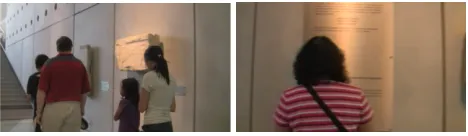
Example 1: The Acropolis Museum
[image:3.612.362.511.93.189.2][In this example an older couple who were approaching retirement age were going round the museum together]
Figure 1: Keeping up with the wife
Both of them are looking at an object on the glass ramp [the first set of displays one encounters in the museum] – They try to peer at it more closely but are asked to step back by a security man – The woman notices an information panel over to one side on the wall relating to the exhibit and points it out to her husband, then she goes over to read it - After a few moments of continuing to look at the exhibit her husband goes over to join her – They stand there reading together for a short while but then the wife finishes and heads off along the display cabinets – The husband glances at his wife then follows her, abandoning reading the panel.
Example 2: The Cite de l’Espace
[image:3.612.319.556.326.400.2][In this example the observations were of a family with 3 children: a boy of 12, a girl of 10 and a younger girl of 5 years old]
Figure 2: Keeping up with the youngest child
The family are walking together down l’Allee de l'Infini [a pathway in the park presenting multiple panels demonstrating shifts in scale towards infinity] – The father and the two older children regularly stop to look at the panels showing increasing scale views – The mother and younger daughter are continually ahead, with the little girl pointing to and eager to get to the Ariane rocket [a full size replica visible at the end of the path] – The father and two older children constantly have to move on from panel to panel to keep pace with the mother and the youngest child.
Example 3: The Acropolis Museum:
[image:3.612.321.553.498.578.2][Here an older woman in her 50s and her daughter in her 20s are going round the museum together]
Figure 3: a) Reading an information panel; b) Being called over;
c) Accounting for the summons
The daughter is stood looking at a part of a frieze in the Roman gallery - Her mother is further down the gallery, reading an information panel (Figure 3a) - The daughter calls out to her mother sotto voce (Figure 3b) - The mother looks round then walks over to her daughter - As she heads over her daughter points to the frieze (Figure 3c) and they both go to look at it together more closely.
Example 4: The Cite de l’Espace
Figure 4: a) Getting left behind & b) Being tacitly summoned by
being visibly waited for
The whole family [see Example 2] are looking at an information panel about the Ariane 5 - The two girls stay looking at the panel as the others move on towards the Astralia building [where they are headed to see a film at the IMAX cinema] (Figure 4a) - The mother waits and looks back towards them as the father and son head on (Figure 4b) - The two girls leave the panel and run to catch up with the mother, who falls in behind them once they have arrived.
Example 5: The Acropolis Museum
[image:3.612.101.250.515.613.2]Figure 5: a) & b) Making sure Mum doesn’t get left behind
All of the family are grouped around an object on the glass ramp – The mother turns and starts to read an information panel to one side – The rest of the group head off – The youngest daughter looks back and her mother hurries on to catch up with them - They stop and look at an object and the father comments on it briefly – The mother is stood at the back trying to see - As the rest move off the mother looks at the object more closely then starts to read about it - Both of the daughters go back and she looks up and joins them and follows along behind the father and son towards the stairs leading up to the next level.
Example 6: The Cite de l’Espace
[Same family as in examples 2 and 4]
Figure 6: Sacrificing your own interests to the kids
The youngest girl and her sister are in an interactive display where they can look at a screen and see themselves as an astronaut at take off – Their mother is reading an adjacent information panel but is called over by the girls - She tries to help the youngest to make the display work but the girl insists on managing it for herself - The father and son come over as well to join them from a jet-pack display and lean in to watch for a while - Everyone tries to move on but the little girl remains, still trying to push various buttons, so the mother returns to stay with her
Apart from Example 2 each of the above examples shows various members of the group being dragged away from information panels adjacent to the objects they relate to. In Example 2 the display conveys information in its own right. Example 6 is subtly different again. Here the mother does not only allow herself to be called away but then also works to support a ‘safe’ bifurcation of the group. This ensures that the youngest child continues to be accompanied by at least one parent. Indeed, in this one instance we might say that it is the child, not the adult, who has successfully resistedbeing moved on. We shall return to this particular matter of handling children later on.
SO WHAT’S GOING ON?
Having introduced the kinds of interactions we are interested in, we shall now proceed to unpack them in more detail. This shall involve teasing out the key interactional features that provide for the ongoing work members of groups engage in to maintain their coherence as a group. As we noted above you can find these sorts of interactions happening, not just in museums, but in pretty well any
public setting where groups of people are attempting to navigate through space together.Key to the associated issue we want to unpack is the way in which the work of coherence can result in a necessary truncation of the consumption of information. This truncation is exacerbated by the physical tying of information to related physical objects. To keep the coherence of the group you are obliged to move on from the object and its physical position in space and to thereby move on from the information as well.
Some grossly observable features:
The interactions we are describing here have several important grossly observable characteristics. First of all, they are all about group dynamics and visible attention to one another’s rights, responsibilities and mutual accountability. This reflects the following social concerns: People are accountable for their actions not only to the group and their understanding of what the group is doing and where it is going, but also to various individuals within the group. In all of the above examples it is specific members of the group who make visible to those who are not keeping up that they are in danger of breaching the group’s coherence. This may be done explicitly or in the course of their own ordinary progression
Some members of a group may consider themselves responsible for the continuing engagement and group orientation of others in the group, e.g. parents/grandparents of younger children. In example 2 the mother keeps up with the youngest child instead of pausing to look at the panels like her husband and her other children. In example 4 the same mother actively takes it upon herself to shepherd her two daughters. And in example 6 she makes even clearer her willingness to defer her own interests to that of keeping the youngest child happy. She does this by abandoning her own reading to accompany the child in the activity she is pursuing. It is in these kinds of doings that a sense of responsibility is made manifest (to just about anyone caring to take notice, in fact). The summons issued by the youngest child in example 6 trades upon this.
Secondly, it is important to note that the need to preserve group coherence is attended to by orientation as well as by being expressly dragged away. In other words, it is frequently the case that members of a group will notice one another’s movements and break engagement with whatever they are doing for themselves so as to maintain suitable proximity. This is made visible in the first two examples, as noted above. What it demonstrates is a careful monitoring of the other members of the group on the part of individual group members. This monitoring is also demonstrated on the occasions where some kind of breach occurs. What happens quite often is that this oriented to expectation of monitoring is disrupted in some way. This can be for a variety of different reasons such as: a) the environment is too dark or cluttered to see what other members of the party are up to; b) because someone gets engrossed in what they are looking at and fails to notice the others have moved away; c) because some other visitor interrupts them to ask them a question; and so on. A to-the-point anecdote was recently provided to the authors where a visitor to the site of Pompeii was following a guided tour wearing a headset through which the guide addressed the members of the party. The visitor in question got involved in looking at some information panels. However, because she could still hear the guide at the same volume within her headset, she did not notice that the rest of the party had moved on. In all of these cases the recognition of the orientation to preserving group coherence is made immediately visible when the breach is recognized. Firstly the individuals concerned look up and then visibly look around with rapid head and body movements in ways that can become increasingly describable as ‘frantic’.
Thirdly, these issues can impact anyone in the group. It should not be considered solely a matter of concern to those leading a group or those with children, etc. All members work to keep with the group in various ways. The above examples show variously spouses, parents, siblings and children attending to the same considerations. In other examples not presented here we also saw grandparents and even friends and couples engaging in the same kinds of monitoring and group preservation activities.
Exploring some specific aspects of the work of group coherence:
In the following material we shall look in closer detail at particular ways in which attention to group coherence can become manifest, and how it can result in interrupted consumption of information. Our primary concern in this section is to provide an outline of the kinds reasoning upon which the work of group coherence in museum visiting might be seen to turn. It is important to understand, therefore, that this explication of certain aspects of commonsense reasoning about group coherence is just that: a set of commonsense, member-recognisable categories. It is not being provided as a formal taxonomy of the interactions in play. Nor is it exhaustive. Rather it is provided as a means of making visible various ways in which people may reason about the work of group coherence, even when it is apparently similar phenomena they are reasoning about. Thus it will be found that different descriptions will sometimes overlap simply because members can reason about what is going on in different ways according to circumstance.
Summoning: This aspect involves the physical drawing of
one person’s attention away from what they are doing by another person. This can be done by means of tapping, gesturing, calling, etc. It is clearly oriented to as a summons and it is visibly difficult for people to ignore a direct summons of this kind. Some members of the group may have special rights of summoning and demand. Parents, for instance, can expressly demand that children ‘come along’. An overt summons, where someone is called by name, is particularly hard to ignore. In example 3, for instance, a daughter looking at one exhibit, calls to her mother, who is some way off and looking at an information panel. Even though the mother is currently occupied and the daughter does not make explicit what she wants, the mother’s orientation to her name being called as a summons is quite clear. Instead of continuing to read she stops what she is doing and goes to join her daughter. From the point of view of the summoner this is also highly economical, requiring a simple utterance and no displacement at all on their part. In this case the mother does not get to finish reading the panel, which may or may not be of concern to her. At the same time there is potential recompense in terms of the proposed interest of the feature her daughter has called her over to see. This, however, is not the only kind of verbal summons one can see, with others being merely callings by name to remind someone to keep up with the group. This is closer to what we see in examples 4 and 5, even if the reminder is accomplished in those examples by other means.
accomplishes the same result of taking potentially interested consumers of information away from its point of consumption. Between interactants of different ages the pressure to move on is accomplished in more subtle ways, such as the rounding-up visible in example 5.
Herding: In example 4 above, as the rest of their family move on two girls remain behind continuing to look at an information display. Their mother then stops and looks directly back at them, waiting. As the two girls notice her they stop reading and hurry off to join the rest of the group, the mother following along behind them. Several features in particular are worth noting about this. First of all as soon as the girls see their mother waiting they become accountable for any continued delay. Not only have they seen their mother waiting but they have seen their mother seeing that they have seen her waiting and it is this mutual witnessability of the situation that plies pressure so effectively. Having seen their mother waiting there and that she has seen that they have noticed her, just ignoring her is no longer an option. Indeed, ignoring people in these situations can produce more direct interventions e.g. utterances such as ‘we've still got loads to see’; ‘the film starts in 10 minutes’ etc., or coughing, tutting, sighing, and so on. In addition, the waiting ensures that they do not ever become truly split off from the group, which would be a risk if she simply continued with the others and assumed they would follow. Finally, the way the mother waits until they have physically passed her enables her to keep them in view from now on. This also ensures that they know that she is behind them, attending to their progress such that further delay can be directly noted and commented upon. Altogether this sequence of interaction, which involves no spoken words at all, accomplishes neatly a restored group coherence and a form of supervised continuation or, what one might call a form of ‘herding’. We also observed instances where members of a group went physically back to loiter next to people in order to achieve the same ends. The use of gaze and spatial position here can equally be seen as a tacit form of summoning. The visible waiting and looking act as the first part of the summons, with movement to re-join counting as the second, compliant part. Of course, what it also ensures is that an ongoing consumption of information is abandoned.
Sidelining: An aspect of group interactions that is related to both pressurizing and herding is the problem of being sidelined. This can lead to the same kinds of tensions between honouring the coherence of the group and trying to get enough time to engage properly with an exhibit. What happens here is that others in the group may block your access to the information/exhibit. We can see this happening in example 5 above. Here a mother who has already been obliged to abandon one exhibit is stuck behind the rest of her family as they look at another one. When they finish and move on she tries to take a look herself, but her daughters come back to ensure she keeps up with them again. This happened at a number of exhibits with this
particular family. The mother repeatedly got stuck in a pattern of being pressurized to keep up but then being the last to arrive at the next exhibit. This resulted in her often being sidelined and unable to look at the exhibit more closely because the rest of the family were in the way. Each time they finished she would try to look herself. However, she would then be forced to cut her perusal short as the trajectory adopted by the rest of the group obliged her to abandon looking or rush the engagement. If she did pause she again became accountable for falling behind and therefore subject to further summoning, pressurizing or herding to ensure she kept up. The husband trailing behind his wife in example 1 and the girls trying to read an information panel the rest of the family have been looking at in example 4 also exhibit similar issues. Here the need to abandon interaction with information about an exhibit is itself a result of not being able to get access to it at the same time as the rest of the group.
Rounding up: Note that our previous discussion of
In particular note here how, as we observed above, accounts for what is going on are not only subject to circumstance but also relate to just who is doing the reasoning:
Following: In examples 1 and 2 the parties who interrupt their own consumption of information in various ways are largely oriented to simply following other members of their party. Should the ‘leading individual’ move on, that stands as sufficient reason for them to abandon what they are doing in order to keep up. In example 1 it was mostly the wife who was directing the visit and her husband simply made a point of keeping up with her. In example 2 the visit was almost entirely organised around keeping the youngest member of the family happy. In many cases the others therefore allowed her to set the pace and lead the way. Her parents did, however, sometimes intervene to structure this in certain ways, depending upon a broader schedule and the overall direction chosen. We shall discuss the particular character of maintaining group coherence where small children are present in due course. However, a strong corollary of this compliance with the lead of some other party (or parties) in the group is a fairly careful monitoring of their movements. In this way those following can, indeed, be actively seen to be following rather than requiring one of the more active forms of management outlined above. There is another aspect of this willingness to subserve one’s interests to someone else when visiting a cultural site such as a museum, however. By abbreviating their own engagement the following parties are potentially seeable as being somehow less interested than the principal party. This is not to ascribe definite preferences to these individuals. Rather it is to say that at least one way of making manifest a lack of interest is to simply follow other members of your party around. The most extreme realization of this is to follow others without showing any manifest engagement with the surrounding exhibits at all.
Skimming: It is, of course, the case that compliance with the lead of other parties can be accomplished without simply abandoning everything the moment you see them moving on. Often the strategies we’ve outlined for keeping the group together are met with more subtle responses. One such response is to not just stop outright but rather to speed up one’s looking at exhibits or consumption of information. This can be accomplished, variously, by rapidly glancing through the rest of the text, rushing through interactions with displays, and so on. Whilst the three others in the family group in example 2 are oriented to keeping up with the mother and youngest child, they do not simply stop looking at the various displays along l’allee d’infini. Instead they manage the situation by ‘skimming’ through the contents, stopping and starting, as they endeavour to keep pace. There is manifest engagement with the displays but also manifest attention being paid to ‘keeping up with the youngest child’ such that no-one could call them to account for falling behind. So skimming is an effective strategy for respecting the coherence of the group without abandoning all semblance of interest in the contents of the site.
Digging-in: Usually there is a strong orientation amongst most groups towards an overall compliance with maintaining the coherence of the group. However, on occasion one does witness people trying to resist the pressure to keep up with the rest of the group as it moves on. Summoning, pressurizing, herding, and rounding-up are all manifestations of efforts to maintain group coherence in the face of someone resisting the interruptions to their engagement with information or exhibits to some degree. In example 4, for instance, the two girls, having been sidelined, exhibit reluctance to move on before having a look at the information panel themselves. This results in the mother’s intervention so as to ensure they do not get left behind. In example 5 the mother is continually being put under pressure to keep up in all sorts of ways, pressure she is also constantly exhibiting resistance to. What is important to note about digging-in behaviour is that it almost invariably leads to more direct callings to account and/or summonses. It also results in increasing escalation of the kinds of ‘bringing to heel’ behaviours adopted, with increasingly evident annoyance on the part of those being obliged to stop. The youngest daughter in the family presented in example 4 ultimately resorted to taking her mother by the hand and occasionally trying to pull her along with the rest of them. Similarly the mother in the family presented in various examples at the cite de l’espace frequently took her youngest daughter by the hand in an effort to keep her with them.
The presence in the group of young children can make the work of preserving group coherence particularly troublesome. This makes both breaches and efforts to manage group coherence more overtly visible. It is therefore a particularly useful scenario for being able to elucidate the orderly practices group coherence turns upon. In the following discussion we elaborate further upon some of the observations we have already made:
Managing young children: Something notable in our
observations of family groups with young children is the extent to which certain shared orientations to their management are visible across the whole of the family group. Thus and for instance, very young children can be understood by the whole party to have a low ‘attention threshold’. In this case members of the group will continually cut short their reading of information / looking at exhibits in order to match their flow to the flow of the child. Example 2 reveals three members of a family doing just this so that they can keep pace with the youngest child and her mother.
Directing the family: Young children can demand a
Thus they can, in a disproportionate sense, come to direct the trajectory of the whole family through spaces like museums. In example 6 the youngest child gets involved in repeating over and over the same engagement with a simple rocket launch interactive. She not only summons over her mother to watch but then also resists everyone’s efforts to move on. Thus, and without any overt discussion, the mother elects to stay with her as she continues to play with the exhibit. The very way in which this election is treated as wholly unremarkable and the group is allowed to bifurcate without discussion speaks volumes. It illustrates just how much this management strategy has become an ordinary aspect of the way this family organizes its days out. And it economically provides for the giving of parental attention when out visiting such that the youngest one will not cause trouble, without simultaneously obliging the whole group to remain by her side.
Preferential rights: What the preceding point makes
visible is the question of rights we have already discussed in our grosser observations above. Young children in many family visiting situations have ongoing preferential rights to summon parents. They will get increasingly difficult if parents do not respond, even resorting to trying to physically drag the parent where they want them to go. Parents, by contrast, rarely directly insist or drag in this way. Resistance to this from young children can become quite ‘vocal’. Thus what we see unfolding in these situations is not just a capacity to direct the family trajectory. Instead it is an unspoken acceptance that they do, for the present at least, have a right to direct the trajectory in this way, rather than have it become a continuing source of trouble. As we shall be discussing further below, this ceding of rights comes with a definite expiry date, though the exact point at which the right expires is something specific to individual family cohorts.
Keeping Up: Young children's consumption of exhibits can
be at high speed, dragging parents / siblings along in their wake. Others in the party may try to look at the information and exhibits as they pass, but, as we have already discussed, they have a primary orientation to accompanying the child. People in this position are accountable also for stopping and looking for themselves and allowing the child to carry on and possibly ‘go missing’. Young children going missing is understood by the whole party as a 'serious matter'. It takes precedence over all other activities and everyone is accountable for showing due attention to finding them again. This was seen during our observations on a number of occasions. This amounts to another implicit pressure to avoiding letting the child become lost in the first place. Thus, with regard to the issue of interrupted engagement with information and exhibits, this means that, for members of families with young children, you have to grab what opportunities you can to look and read. There is, however, a constant expectation that you may be obliged to move on.
Acquiring a sense of coherence: Something we noted
above is the fact that, whilst rights for directing the trajectory of the group are at least partially ceded to young children whilst they are young, this is usually a temporary arrangement. Understandings of how to attend to group coherence are matters children are inducted into as much as anything else. So, we saw in example 4 how the youngest child in that family, albeit in the company of her sister, was effectively called to account for not keeping up. This is at least one way in which young children can begin to acquire a sense of accountability for attending to the coherence of the group. When they themselves breach it they too can be called to account, jollied along, nagged, and a range of other parental herding activities, that stop short of physical dragging along (as observed above). All of these things do, of course, happen, as well as the ceding of certain disproportionate rights for governing the trajectory of the group through space. An upshot of this is that even young children are subject to a certain amount of disruption in their engagement with information and exhibits. Thus the management of such interruptions and the adoption of strategies to minimize their impact is something else into which they are inducted over time.
Beyond the various matters of management and breaching discussed above, the importance of preservation of group coherence is recurrently visible through a range of other phenomena. This includes things such as waiting behaviors, running to catch up, watching where the others go, calling one another together, and so on. It should be noted that separation is allowed within groups but with clear and accountable limits such that your engagement with exhibits and information is continually open to being interrupted by others in the group. This can be in order to bring to your attention things they've noticed (as in example 3). It can also be about keeping you in line for preservation of the group coherence (as was the case in examples 4 and 5). Of particular importance is that separation is rarely tolerated once line of sight is broken. This is made manifest by the way that, if people do fall out of the line of sight, someone will actively say 'where is X?'. Meanwhile, if someone in a group realizes they have fallen behind they will rapidly move to disregarding any potential objects of interest in the environment. At this point they will instead focus their efforts upon trying to locate the rest of their group.
REVISITING GROUP VISITING
The first implication is quite simply to recognize the widespread nature of the challenge: that groups of visitors frequently struggle to interleave their engagement with exhibits and accompanying information with their social interactions with peers. At the very least, it is important to avoid designing experiences that exacerbate this tension. For instance, assuming long dwell times at exhibits or arranging exhibits in a way that requires members of a group to be out of line-of-sight for significant periods may cause trouble. However, such principles are by and large already well known to museum experience designers. What is perhaps more interesting, and certainly more relevant to CSCW, is to consider the implications for new collaboration technologies. We explore various possibilities under two broad approaches: 1) how a more fluid association between information and exhibits might enable visitors to better interleave the informational and social aspects of visiting; and 2) how we might reshape the social nature of the visit.
A fluid association between exhibits and information
Part of the problem here lies in the tight coupling of exhibits to associated information. Placing labels, placards and other informative signs at an exhibit obviously requires visitors to remain there so as to read them. This may even require them to prolong their stay in order to fully engage with both the exhibit and the information. Recently interest has grown in location-based technologies in museums, from QR codes and RFID tags that trigger information when near an exhibit, to full-blown augmented reality with digital images directly overlaid on exhibits. Whilst intended to deliver information when most relevant, our analysis suggests that this may exacerbate the tension we have identified. At the other extreme, visitors can carry both traditional and digital guidebooks with them as they move between exhibits, affording flexibility as to when they access information. However, looking up information while on the move can be challenging and it becomes more difficult to associate detailed information with fine-grained features of an exhibit.
We suggest an alternative approach that involves a more fluid association between information and exhibits, combining elements of delivery in context with access on the move. Recent explorations of designing ‘trajectories’ through a sculpture garden enabled pairs of visitors to receive a multisensory experience of each sculpture before accessing official guide information as they walked away from it [12]. Drawing inspiration from this, we propose that designers should explicitly differentiate (and that mobile technologies should directly support) a fluid approach that distinguishes between four classes of information:
• Information that is delivered in advance of first
encountering an exhibit, for example that advertises it, summarises its relevance, or guides the visitor to it;
• Information delivered while at an exhibit, for example
augmented reality interactions that guide or amplify the immediate viewing experience;
• Information to be carried away from the exhibit and
consumed on the move, especially when visitors are called away by peers. For example, an augmented reality presentation may morph into a virtual reality presentation as the visitor steps away from an exhibit.
• Information to be accessed later on, possibly in a quite
different context such as at home or in a classroom. This might include souvenirs, virtual reconstructions, or access to supplementary sources of information.
This temporally structured approach is firmly grounded in research on the sequential order of visiting [10]. It also reflects existing strands of research in ubiquitous computing that explore ways in which to break the traditional use of proximity to relate exhibits and associated information whilst supporting access over time [31]. We believe it can increase the flexibility with which visitors access information regarding exhibits and enable them to more gracefully interleave information consumption with their engagement with fellow visitors. For examplethey may complete their reading while walking away or resume it some time later on. In short, it may be possible to bridge the physical and digital worlds by associating information with an object rather than it being bound to the object by co-location. This offers the possibility of maintaining a fluid association between the physical and digital worlds. In that way the fixity of an object in space no longer has to equate to fixity of consumption of the information about the object that is first encountered in that space.
Reconfiguring the social nature of visiting
Our second, complementary approach is expressly focused upon the social relationships between the visitors themselves. The importance of supporting collaboration in museums and galleries has been widely recognized in CSCW. The focus of much of this work has been on designing collaboration with and immediately around exhibits. This includes extensive interest in tabletop and tangible interfaces as natural enablers of collaboration [9, 16]. It also includes recognition of the challenges of deploying headphones in group visits. Attempts to overcome such challenges have included techniques like eavesdropping [13 & 35] where awareness of what others are doing can actually serve to ameliorate some of the pressures to maintain proximity. In response to ethnographic studies in museums and galleries [21] there is also a general recognition of the need to design interaction with spectators in mind [30].
This might include things like signaling people are currently busy but will be available in a short while. This may in turn encourage some visitors to delay interruptions until a more opportune moment, although we suspect that this may prove challenging for parent-child interactions. Another possibility that we wish to emphasise is to restructure to the group experience. The professional tour guide is an established feature of many museums and provides a range of services to visiting groups from directly delivering interpretative material, to answering questions, to coordinating the progress of the group. Our studies have revealed examples in which some group members already assume aspects of being a tour guide. Parents, in particular, may take responsibility for coordinating a visit, ensuring that members of the party do not get lost, while also furnishing information about exhibits and answering questions. This raises the prospect as to how we might better support and also reward visitors in this role. Might we provide them with additional information to convey to others or use to help them engage with exhibits, for example, giving parents additional nuggets of information to pass on to children. This, of course, needs to be flexible enough to support a range of different family dynamics with different ages of children also impacting on interaction in various ways [34].
We conclude our discussion of this approach with a further intriguing possibility for future work – that of ‘gifting’ experiences to others. Previous studies have shown the extent to which group visits can be occasioned by special events such as people’s birthdays or anniversaries [10]. This opens up the possibility of visitors customizing aspects of the experience such as information delivered through mobile devices for others in the party. This might include things like choosing their favourite exhibits, highlighting new ones not seen before, or adding personal references. While the idea of personalizing visiting experiences may be familiar, the approach of getting one group member to personalize for another has not been widely discussed. This approach may be particularly appropriate as it could serve to strengthen people’s sense of accountability to one another. Those giving the experience would have a vested interest in seeing it completed, while those receiving would see a need to demonstrate engagement. Thus approaches such as supporting informal guides or gift experiences may mitigate problems with interruption by demanding a greater ‘buy in’ to the experience.
CONCLUSION
An ethnographic study of visitor interactions in two contrasting museums has revealed what would appear to be a widespread, important, and relatively undiscussed tension in group visits to public spaces such as museums. This tension resides in the way that the management of group coherence in public spaces may result in visitors prematurely disengaging from exhibits and/or related information. Through a series of examples, we have
unpacked the various ways in which the maintenance of group coherence becomes manifest. This includes the various ways in which group members attempt to summon, pressurize, herd, sideline, and round up other members of their party. We have also noted, in turn, how those other members are variously seen to respond, by simply following, skimming or sometimes by digging in. We have taken particular note of how this tension between the orientation to group coherence and the interest in engagement with exhibits can be further aggravated by the presence of young children.
Interruptions of engagement are not, of course, inevitably a problem in their own right. Previous research has pointed out the ways in which interruptions can have a range of situated understandings and consequences that preclude from seeing them as necessarily undesirable [37]. Furthermore, as pointed out by [26] short dwell times in front of exhibits does not necessarily mean that information has not been absorbed. However, so much as they do limit the scope for engaging with information about exhibits that might otherwise be considered desirable, we have briefly outlined some strategies that might be pursued in designing future support. These have been grouped under the two complementary and general approaches of creating a more fluid association between information and exhibits while also potentially reconfiguring the social nature of visiting. At this stage these suggestions are necessarily nascent. However, the primary concern to emphasise here is the way in which visitors have to manage multiple matters as they go around museums. For members of groups, group coherence is one of the principal things that have to be managed. Engagement with exhibits is another. In view of the fact that one can regularly witness manifest resistance to being moved on by the group one can see that there clearly is a potential tension here. This alone indicates that there is still plenty of room here for improved support of group visiting in order to enhance the visiting experience. These findings are therefore intended to sensitise designers to the complex challenges of social visiting while also identifying some initial avenues for research into CSCW technologies that may offer some promise.
ACKNOWLEDGMENTS
This research was supported by the EC FP7-IST collaborative project CHESS, No. 270198. Our thanks also to the staff and visitors at the Cite de l’Espace in Toulouse, France and The Acropolis Museum in Athens, Greece.
REFERENCES
1. Bannon, L J, et al (2005) Hybrid design creates
innovative museum experiences. Communications of the ACM 48(3): 62-65
2. Basile, P, et al (2009) SpIteR: A Module for
Recommending Dynamic Personalized Museum Tours,
in Proc WI-IAT '09, IEEE, Washington, DC, 584-587
4. Blöckner, et al (2009) Please touch the exhibits!: using NFC-based interaction for exploring a museum,
MobileHCI '09, ACM
5. Brown, B & Chalmers, M (2003) Tourism and mobile technology, ECSCW'03, 335-354, Kluwer
6. Brown, B, et al (2003) Lessons from the Lighthouse: collaboration in a shared mixed reality system. CHI 2003, pp.577-584
7. Callaway, C, et al (2005) Personal Reporting of a Museum Visit as an Entrypoint to Future Cultural Experience, IUI 05, pp. 275-277
8. Ciolfi, L, & Bannon, L (2002) Designing interactive museum exhibits: Enhancing visitor curiosity through augmented artifacts, in Proc European Conference on Cognitive Ergonomics. (Catania, Italy), 311–317. 9. Correia, N, et al (2010) A multi-touch tabletop for
robust multimedia interaction in museums, in Proc ITS '10, ACM, New York, 117-120
10.Crabtree et al (2013) “How many bloody examples do you want?!” – Fieldwork and Generalisation, ECSCW ‘13, Springer
11.Falk, H J, & Dierking, L D (1992) The Museum
Experience, Whalesback Books, Washington
12.Fockler, P, et al (2005) PhoneGuide: museum guidance supported by on-device object recognition on mobile phones, Proc MUM '05, ACM, New York, 3-10 13.Fosh, L., Benford, S., Reeves, S., Koleva, B., &
Brundell, P. (2013) “See Me, Feel Me, Touch Me, Hear Me”: Trajectories and Interpretation in a Sculpture Garden, CHI '13, Paris, France, ACM.
14.Fuks, H, et al (2012) Collaborative museums: an approach to co-design, CSCW '12, 681-684, ACM 15.Garfinkel, H, (1967) Studies in Ethnomethodology,
Prentice-Hall
16.Geller, T, (2006) Interactive Tabletop Exhibits in Museums and Galleries, IEEE Computer Graphics and Applications (vol. 26 no. 5), pp. 6-11, IEEE Press 17.Grinter, R E, et al (2002) Revisiting the visit:
understanding how technology can shape the museum visit, CSCW '02, ACM, New York, 146-155
18.Hall, T & Bannon, L (2005) Designing ubiquitous computing to enhance children's interaction in museums, Proc IDC '05, ACM, New York, 62-69 19.Hemmings, T, et al (2000) Task, Talk and Closure:
Situated learning and the use of an 'interactive' museum artifact, Local Educational order; ethnomethodological studies of knowledge and action, Benjamins
20.Hensel, K A (1987) Families in a museum: Interactions and conversations at displays, Unpublished Doctoral Dissertation, Columbia University
21.Hindmarsh, J, et al (2005) Creating Assemblies in Public Environments: Social Interaction, Interactive Exhibits and CSCW. CSCW Journal, 14 (1), Kluwer 22.Hope, T, et al (2009) Familial collaborations in a
museum,. CHI 2009, Boston, MA, USA
23.Hornecker E, & Stifter, M (2006) Digital backpacking in the museum with a SmartCard, in Proc CHINZ '06, ACM, New York, 99-107
24.Hsi, S & Fait, H (2005) RFID Enhances Visitors' Museum Experience at the Exploratorium,
Communications of the ACM, Sept 2005/ 48 (9), 60-65
25.Luff, P, et al (2004) Only touching the surface: creating affinities between digital content and paper, CSCW '04, 523-532, ACM
26.McManus, P M (1989) Oh, yes, they do: How museum visitors read labels and interact with exhibit texts,
Curator: The Museum Journal, 32(3), 174-189
27.Naemura, T, et al (2010) Mixed reality technologies for museum experience, Proc VRCAI '10. ACM, New York, 17-20
28.Nardi, B & O’Day, V (1999) Information Ecologies:
Using Technology with Heart, MIT Press
29.Petrelli, D, & Not, E (2005) User-centred Design of Flexible Hypermedia for a Mobile Guide: Reflections on the HyperAudio Experience. User Modelling and User Adapted Interaction. 15 (2005), 303-338
30.Reeves, S., Benford, S., O’Malley, C., (2005) Designing the Spectator Experience, CHI 2005, ACM
31.Semper, R, Exploratorium, & Spasojevic, M (2002) The electronic guidebook: Using portable devices and a wireless web-based network to extend the museum experience, http://www.museumsandtheweb.com/ mw2002/papers/semper/semper.html
32.Serrell, B (1994) The Question of Visitor Styles. In: S. Bitgood (Ed.). Visitor Studies: Theory, Research, and Practice, 6(1), 48-53. Jacksonville AL
33.Sparacino, F (2004) Scenographies of the past and museums of the future: from the wunderkammer to body-driven interactive narrative spaces, in Proc
MULTIMEDIA '04, ACM, New York, 72-79
34.Sterry, P & Beaumont, E (2006) Methods for studying family visitors in art museums: A cross-disciplinary review of current research, Museum Management and Curatorship, 21(3), 222-239
35.Szymanski, M, et al (2008) Sotto Voce: Facilitating Social Learning in a Historic House. Comput. Supported Coop. Work 17, 1 (February 2008), 5-34
36.Taylor, S M (1986) Understanding processes of informal education: a naturalistic study of visitors to a public aquarium, Unpublished Doctoral Dissertation, UC Berkeley
37.Tolmie, P et al (2008) ‘"Are you watching this film or what?": interruption and the juggling of cohorts’. In
Proc. CSCW 2008, ACM, 257-266
38.Véron, E, & Levasseur, M (1983) Ethnographie de l’exposition: l'espace, le corps et le sens, BPI, Centre Georges Pompidou, Paris
39.Wakkary, R, & Hatala, M (2007) Situated play in a tangible interface and adaptive audio museum guide,
Personal and Ubiquitous Computing, v.11 n.3,