VIRTUAL MACHINES FOR VIRTUAL WORLDS
Amirali Sanatinia, Iain A. Oliver, Alan H. D. Miller and Colin Allison
School of Computer Science, University of St Andrews, North Haugh, St Andrews, Scotland{as2354, iao, alan.miller, ca}@st-andrews.ac.uk
Keywords: Multimedia: Performance measurement: Virtual worlds: OpenSim: Virtualization.
Abstract: Multi User Virtual Worlds provide a simulated immersive 3D environment that is similar to the real world. Popular examples include Second Life and OpenSim. The multi-user nature of these simulations means that there are significant computational demands on the processes that render the different avatar-centric views of the world for each participant, which change with every movement or interaction each participant makes. Maintaining quality of experience can be difficult when the density of avatars within the same area suddenly grows beyond a relatively small number. As such virtual worlds have a dynamic resource-on-demand need that could conceivably be met by Cloud technologies. In this paper we make a start to assessing the feasibility of using the Cloud for virtual worlds by measuring the performance of virtual worlds in virtual machines of the type used for Clouds. A suitable benchmark is researched and formulated and the construction of a test-bed for carrying out load experiments is described. The system is then used to evaluate the performance of virtual worlds running in virtual machines. The results are presented and analysed before presenting the design of a system that we have built for managing virtual worlds in the cloud.
1
INTRODUCTION
[image:1.595.311.529.402.532.2]Virtual worlds are 3D environments which enable users to interact through the proxy of avatars. There are no predefined rules in virtual worlds and users can introduce their own goals and rules of play. They can create objects, shape their surrounding environ-ment and program the interactive behaviour of ob-jects. Virtual worlds have applications beyond pro-viding a platform similar to 3D games for arbitrary online social activities. They can be used for educa-tional purposes - for example Getchell et al. (Getchell et al., 2009) describe their use to investigate a Byzan-tine Spartan Basilica based upon real excavations. In another work (Sturgeon et al., 2009) virtual worlds have been used to provide a virtual laboratory for conducting 802.11 wireless (WiFi) experiments. In-deed, our primary motivation for seeking to use vir-tual worlds is educational. This is due in part be-cause of the great potential they offer for creating ex-ploratory learning environments but also because of our experience of student enthusiasm and engagement with virtual world based activities. Second Life (Lin-den Labs, b) and OpenSim (MW et al., ) are two of the most commonly used virtual worlds for educa-tion. Although very similar in their systems design and concepts it has become clear that OpenSim is
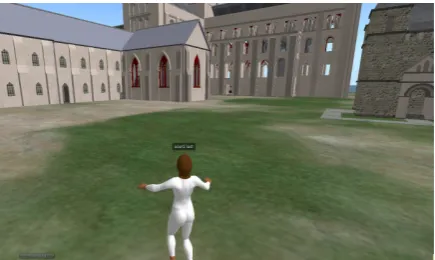
Figure 1: Snapshots of Cathedral. A dense mega-island consist of six island with large number of prims and objects.
much more suitable for educational use (Allison et al., 2010; Allison et al., 2011), and accordingly we use OpenSim for the test-bed and experiments described in this paper. It should be noted that the open source Second Life client is compatible with the OpenSim server, which is also open source.
in the same region the responsiveness and fidelity of the virtual world decreases very noticeably and by the time a hundred avatars are present the environment is unusable. Statically provisioning for a hundred users is both very expensive and wasteful of resources when the average load is more likely to be fewer than five users. Can Cloud technologies be used to address this dynamic scaling requirement? As a starting point we investigate the use of virtual machines, of the types used in Clouds, to host virtual world servers, and as-sess their performance. In order to do this we have researched and formulated a suitable benchmark and have built a test-bed that allows for experiments with varying loads and types of activities.
Related work includes (Barker and Shenoy, 2010; Barham et al., 2003; Gupta et al., 2006; Kinicki and Claypool, 2008)
Section 2 describes the overall approach, the for-mulation of the benchmark and the methodology adopted; section 3 describes the test-bed; section 4 presents an analysis of the experiments run on non-virtualized hardware; section 5 runs the same tests on virtual machines.
2
METHODOLOGY
We know from direct observation and from related work that the higher the number of avatars in an area the higher the load on the server and the poorer the Quality of Experience (QoE) for each user. We there-fore make the general assumption that the QoE for a user is related to the server performance which in turn is related to the load on the server. Accordingly, in or-der to create a test-bed for experimentation we need to: i) find a suitable metric which represents the load on the server proportionate to the number of users; and ii) have a flexible load generator that corresponds to human-controlled avatar behaviour.
2.1
Virtual World Server Load
In order to discover a suitable metric we start by car-rying out experiments with real users. Virtual worlds are typically organised into administrative domains called “islands”. In OpenSim islands can be grouped together into “mega-islands”. Our initial experiments made use of a mega-island called Cathedral (which hosts a reconstruction of a large 14th century cathe-dral) and human-controlled avatars.
Data was collected from both the clients and the server. On the client side we used a modified ver-sion of the Second Life client using libOpenMeta-verse (Baba et al., ). LibOpenMetalibOpenMeta-verse is a
collec-tion of .Net libraries written and developed in C#. The monitor collects data from the server every 3 seconds and logs all the statistics returning from the server. On the server side we collect CPU, memory and network usage. A screen-shot of an avatar on the Cathedral mega-island is shown in Figure 1.
In order to capture typical avatar behaviour two sets of observations were made with 8 users and 33 users respectively. Each test had 3 runs and each run lasted for 10 minutes. In this experiment the users’ avatars spend 80 to 90 percent of their time standing and doing nothing as Varvello et al. (Varvello et al., 2008) describe. The remainder of the time was spent walking around.
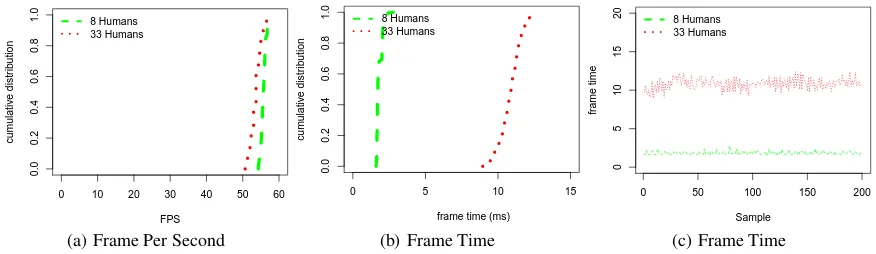
FPS is the simulator frame rate. Higher numbers indicate better performance and smoother experience. This number should be around 55 (Linden Labs, a). FT is the time it takes for the simulator to run each frame. The OpenSim server returns frame time per second to the client. To calculate FT this value is di-vided by FPS. The FPS and FT for 8 and 33 humans is shown in Figure 2. The green line shows the values for 8 humans and the red line shows the values for 33 humans.
The ECDF of the mean Frames Per Second is shown in Figure 2(a). The frame rate changes a little between these different numbers of users. The min-imum frame rate with 8 humans is 53 and with 33 humans is 50. The maximum rate with both 8 and 33 humans is 58. This indicates that the number of frames per second is limited by the server and that at these levels of load, in this setup, it is usually able to render close to the maximum allowed number of frames.
The ECDF of the Frame Time is shown in Fig-ure 2(b). The minimum frame times are 1.6 and 8.9 and maximum frame times are 2.7 and 12.3 with 8 and 33 users. These numbers indicate that frame time does not change with low number of users signifi-cantly, but with increases in the number of users be-sides the minimum and maximum values, the range of change also increases. This pattern is consistent with the frame rate being limited and suggests that frame time is a better measure of user-related system load than FPS and concomitantly on the server per-formance.
0 10 20 30 40 50 60
0.0
0.2
0.4
0.6
0.8
1.0
FPS
cum
ulativ
e distr
ib
ution
8 Humans 33 Humans
(a) Frame Per Second
0 5 10 15
0.0
0.2
0.4
0.6
0.8
1.0
frame time (ms)
cum
ulativ
e distr
ib
ution
8 Humans 33 Humans
(b) Frame Time
0 50 100 150 200
0
5
10
15
20
Sample
fr
ame time
8 Humans 33 Humans
[image:3.595.79.517.92.219.2](c) Frame Time
Figure 2: CDF and Time series plots comparing sessions with human. Sessions with 8 users and 33 users.
avatars.
This data strongly suggests that the Frame Time better reflect the load escalation caused by increases in avatars than the FPS metric. Accordingly we chose a frame time metric as a better representation of the server load generated by numbers of users.
2.2
Creating automated loads
In order to create automated loads we must find a means of approximating to the load generated by numbers of real users controlling avatars. We devised six different types of bots. These bots are modified Second Life clients which use libOpenMetaverse to connect to and interact with the OpenSim server. The bots behave as follows:
Walk-2: 20 second walk followed by 80 second walk in random direction
Walk-Rest 1: 20 second walk in random direction followed by 80 seconds of standing still
In addition, the bots have inventories and are clothed to make the experiment environment closer to a hu-man controlled experience.
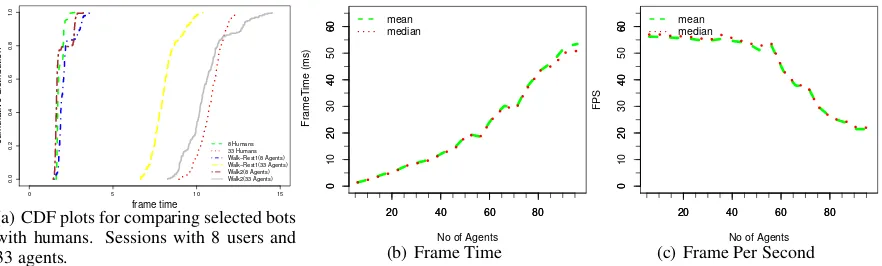
In this section the behaviour of the different types of bots are compared to human-controlled avatars. The frame time is used to compare the bots. The effect on the load of the server of the different types of bots was investigated. The CDF of the frame time for dif-ferent bots and humans are shown in Figure 3(a). The x-axis shows the frame time and the y-axis shows the CDF value. The green and red lines show the human values, the other colours represent different bot types. The ECDF of selected bots Walk-2 (20 second walk followed by 80 second walk) and Walk-Rest-1 (20 second walk in random direction followed by 80 seconds of standing still) and humans with 8 and 33 agents is shown in Figure 3(a). This figure is in-tended to give a better view of the relationship of the bots. With 8 users the differences are subtle but as the number of bots increase, it is clear that Walk-2 is the
closest match to human in terms of its effect and load on simulator.
In summary, the load on the server created by Bots closely matches that of human controlled avatars. The closes match is achieved with the Walk-2 configura-tion. This is used in the test-bed to simulate human-controlled-avatar load.
3
EXPERIMENTAL SETUP
This section describes the experimental setup used and data capture system employed. The server ma-chine had 10GB RAM, and an Intel Xeon 4-core X3430 quad processor running at 2.4 GHz. The OS was Ubuntu version 11.04. Version 0.7.1 of the Open-Sim server was used with a MySQL database in grid mode. The server was started using a script before the bots were connected. The server is latter stopped using a script after the bots are disconnected.
The in-world measures of load were gathered us-ing a customised client built usus-ing the libOpenMeta-verse library. A monitor was run on a separate work-station than the simulator to eliminate overhead on server. This workstation OS was openSUSE 11.3 us-ing Mono to run .Net components. The monitor work-station collected data from the OpenSim server ev-ery 3 seconds. (The statistics gathered by the monitor client are generated by the server and sent out to all clients.)
The bots were distributed over a number of client workstations, so that the load on any one would not effect behaviour of the bots or their load on the server. Through tests it was established that a maximum of 25 bots could be run on a single workstation. The maxi-mum number of bots used in the experiments was 100, which required 4 workstations. The workstations had 4GB RAM and core-2 quad Q6600 processors run-ning at 2.4 GHz.
deter-0 5 10 15
0.0
0.2
0.4
0.6
0.8
1.0
frame time
cum
ulativ
e distr
ib
ution
8 Humans 33 Humans Walk−Rest1(8 Agents) Walk−Rest1(33 Agents) Walk2(8 Agents) Walk2(33 Agents)
(a) CDF plots for comparing selected bots with humans. Sessions with 8 users and 33 agents.
20 40 60 80
0
10
20
30
40
50
60
No of Agents
Fr
ameTime (ms)
20 40 60 80
0
20
40
60
mean median
(b) Frame Time
20 40 60 80
0
10
20
30
40
50
60
No of Agents
FPS
20 40 60 80
0
20
40
60 meanmedian
[image:4.595.79.520.92.225.2](c) Frame Per Second
Figure 3: Summary values against the number of bots with the Walk 2 bot (20 second walk followed by 80 second walk).
mined to most closely approximate the same load on the server as a human-controlled avatar (Walk-2). In the experiments the number of bots was increased by 5 for each iteration. Each run was repeated 3 times. The bots were connected to the server with a 20 sec-ond gap between starting each bot. All of the bots for a run are connected to the server and then the system is allowed to run for 700 seconds, this collects more than 200 values from the monitor. The monitor is then disconnected and the bots are shutdown followed by the server.
4
ANALYSES OF SERVER LOAD
In these experiments each run was repeated three times. This experiment allowed the maximum num-ber of users that can simultaneously log in to simu-lator and use the virtual world smoothly to be deter-mined. The results of these experiments are shown in figure 3. They show frames per second and frame time. The green lines show the mean values and the red points show the median values. The x-axis shows the number of avatars in world.
The frame time against the number of avatars is shown in figure 3(b). The y-axis shows the frame time in milliseconds. With 55 avatars the frame time is 19 ms and with 60 it is 25. The frame time contin-ues to increase with the number of avatars. A frame time over 22 milliseconds indicates that the simulator is overloaded (Linden Labs, a) and the user’s experi-ence is likely to suffer.
The number of frame per second against the num-ber of avatars is shown in figure 3(c). The y-axis shows the FPS. The FPS is quite stable until more than 60 avatars are in world at the same time and then reduces. This is consistent with the system being able to handle the load when the frame time is less than 22 milliseconds.
As it can be seen in these figures, the number of
users has a significant impact on performance. When the number of users reaches 55 there is a significant drop in the frame rate. The rates drop from 53 with 55 users to 43 with 60 users and to 20 with 90. Through a human logging on it was confirmed that the respon-siveness of the system degrades significantly as the frame rate drops below 50 fps.
5
VIRTUALIZING THE VIRTUAL
In this section the use of the test-bed for evaluating the performance of a virtual world in different virtualiza-tion is described. There virtualizavirtualiza-tion systems used in this study were Xen (in privileged mode: dom0; and unprivileged mode: domU), KVM and Virtual Box.
XEN is a paravirtualization system where the op-erating system is modified to be aware that it is being run in virtualized environment so that it makes calls to a hypervisor when it needs to perform privileged instructions. This allows multiple operating systems to run at the same time without emulation.
A XEN based virtual machine on the same hard-ware as the non-virtualized experiments were per-formed was created. This involved installing a XEN 4.0 hypervisor and patched kernel to operate as a privileged domain. A virtual machine was then cre-ated using the same version of the OS and software. The tests were performed in the same pattern with the number of bots increasing from 0 to 100 in steps of 5 and each run repeated three times. The exper-iments were performed in both an unprivileged do-main (domU) and in the privileged dodo-main (dom0) with no other domains running.
The experiments were also performed using a
KVM virtual machine. The KVM virtualization
0 0.2 0.4 0.6 0.8 1
0 20 40 60 80 100
Fra
ctio
n
Frame Time
10 Avatars Metal 10 Avatars XEN dom0 10 Avatars XEN domU 10 Avatars KVM 10 Avatars Virtual Box
(a) 10 bots
0 0.2 0.4 0.6 0.8 1
0 20 40 60 80 100
Fra
ctio
n
Frame Time
30 Avatars Metal 30 Avatars XEN dom0 30 Avatars XEN domU 30 Avatars KVM
[image:5.595.83.513.98.239.2](b) 30 bots
Figure 4: Comprehensive tests using bot Walk 2 (20 second walk followed by 80 second walk). Impact of number of agents on the metrics. (FPS and frame time)
0 10 20 30 40 50 60
0 10 20 30 40 50 60 70 80 90 100
FPS
Avatars
Metal XEN dom0 XEN domU KVM Virtual Box
(a) Frames Per Second
0 50 100 150 200 250
0 10 20 30 40 50 60 70 80 90 100
Fra
me
Tim
e
Avatars Metal
XEN dom0 XEN domU KVM Virtual Box
(b) Frame Time
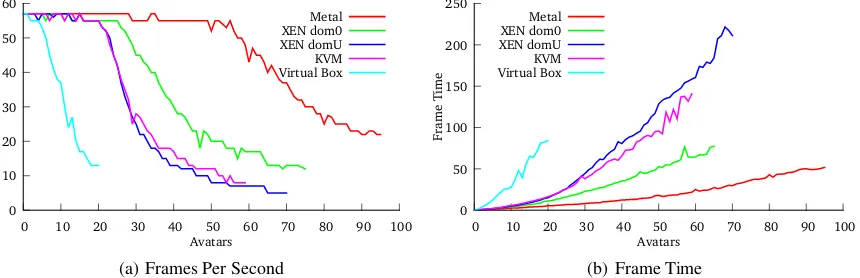
Figure 5: Comprehensive tests using bot Walk 2 (20 second walk followed by 80 second walk). Impact of number of agents on the metrics. (FPS and frame time)
environment was created using the same setup with the same contents as the XEN and non-XEN environ-ments.
Virtual Box is a virtualization environment which is designed primarily for virtualizing GUI system on a desktop computer. It has good graphical support and integrating with the host desktop environment.
The cumulative distribution frequency of the frame time for different numbers of bots is the shown in figure 4. The x-axis shows the frame time in mil-liseconds and the y-axis shows the fraction of the samples where the “from time” was shorter than that time. The red line shows the frame time for the Open-Sim server running in the non virtualized environ-ment. The green line shows the frame time for a priv-ileged XEN domain. The dark blue shows the val-ues for the unprivileged XEN domain. The pink line shows the values for the KVM virtual environment and the light blue shows the values for the Virtual Box virtual environment.
The values for 10 bots in addition to the monitor bot are shown in Figure 4(a). There is a difference
be-tween the different environments with this number of bots. The presence of the XEN hypervisor seems to make a small difference with the privileged domain being slower than the non-virtualized environment. The unprivileged XEN domain and the KVM domain have similar performance. The performance of the Virtual Box environment is not sufficient to produce the preset number of frames per-second.
The values for 30 bots in addition to the moni-tor bot are shown in Figure 4(b). There are no Vir-tual Box values for this number of bots as 20 was the largest number of bots which were able to
con-nect. The difference between the performance is
[image:5.595.86.516.282.421.2]The light blue line shows the Virtual Box values. The number of frame per second for the different virtualization environments are shown in Figure 5(a). The y-axis shows the FPS. The non-virtualized sys-tem is able to maintain its frame rate up until there are 50 avatars in the environment. The XEN dom0 setup is able to maintain a frame rate of 55 up until 25 avatars. The XEN domU and KVM setups are able to maintain a frame rate of 55 until 20 avatars. The Virtual Box setup is only able to maintain a rate of 53 frames with 5 avatars. The frame time for different virtualized setups is shown in Figure 5(b). The y-axis shows the time taken to do each from in milliseconds. The non-virtualized setup has the least steep curve, followed by the XEN dom0 setup, then the KVM setup, followed by the XEN domU setup and last the Virtual Box setup. The KVM and XEN domU setups should be usable with 20 avatars and may be usable with more.
These measurements establish that virtual worlds can run well in a cloud environment, but the num-ber of concurrent users that can be supported is half that can be supported on the same hardware in a non-virtualized environment.
6
CONCLUSIONS
This paper has looked at evaluation of virtual worlds. The effect of the load on an OpenSim server caused by human control of avatars has been observed and bots have been created to produce the same level of load on the server. Different metrics have been in-vestigated, including frame rate and frame time. As the number of users increases frame rate drops, while frame time grows. The frame rate is limited to a max-imum value so does not vary until the load on the server is high.
The test frame work was run with OpenSim run-ning in virtualized environments using the same ver-sion of Linux as the non virtualized verver-sion. The XEN and KVM virtualized environments produce similar results. They are able to produce a frame rate of 55 FPS with 20 or less avatars.
Further experiments are needed to find the best settings for virtualizing virtual worlds and studying their impact on performance. Part of the Cloud com-puting promise is that it enables users to dynamically grow their resources in accordance with demand. This is enabled in part by the use of virtual machines. Now that we have a measure of the “hit” taken by virtu-alizing a virtual world server we can move on to the next stage of developing policies for the management of virtual worlds in the cloud.
REFERENCES
Allison, C., Miller, A., Sturgeon, T., Perera, I., and McCaf-fery, J. (2011). The third dimension in open learn-ing. In41st ASEE/IEEE Frontiers in Education, IEEE Press, pages T2E–1 –T2E–6.
Allison, C., Sturgeon, T., Miller, A., Perera, G., and Nicoll, J. (2010). Educationally enhanced virtual worlds. In
40th IEEE Frontiers in Education Conference, 2010. FIE ’10.Washington: IEEE Pres.
Baba, otakup0pe, jhurliman, Malthus, J., mcortez, McLean, D., Coder, L., Zaius, A., jradford, Lancej, frob, and Khalifa, L. libopenmetaverse. http://www.openmetaverse.org/projects/
libopenmetaverse. [Online; accessed
28-March-2011].
Barham, P., Dragovic, B., Fraser, K., Hand, S., Harris, T., Ho, A., Neugebauer, R., Pratt, I., and Warfield, A. (2003). Xen and the art of virtualization. SIGOPS Oper. Syst. Rev., 37:164–177.
Barker, S. K. and Shenoy, P. (2010). Empirical evalua-tion of latency-sensitive applicaevalua-tion performance in the cloud. In Proceedings of the first annual ACM SIGMM conference on Multimedia systems, MMSys ’10, pages 35–46, New York, NY, USA. ACM. Getchell, K., Miller, A., Allison, C., and Sweetman, R.
(2009). Exploring the second life of a byzantine basil-ica. In Petrovic, O. and Brand, A., editors, Serious Games on the Move, pages 165–180. Springer Vienna. Gupta, D., Cherkasova, L., Gardner, R., and Vahdat, A. (2006). Enforcing performance isolation across virtual machines in xen. In Proceedings of the ACM/IFIP/USENIX 2006 International Conference on Middleware, Middleware ’06, pages 342–362, New York, NY, USA. Springer-Verlag New York, Inc. Kinicki, J. and Claypool, M. (2008). Traffic analysis of
avatars in second life. InProceedings of the 18th In-ternational Workshop on Network and Operating Sys-tems Support for Digital Audio and Video, NOSSDAV ’08, pages 69–74, New York, NY, USA. ACM. Linden Labs. Second Life Statistics Bar Guide
http://wiki.secondlife.com/wiki/ Statistics_Bar_Guide.
Linden Labs. Second Life http://secondlife.
com/.
MW, Frisby, A., MingChen, lbsa71, Dague, S., Tedd, justincc, Teravus, Berntsson, J., Krinke, C., Scofield, D., dahlia, mikem, Thielker, M., Horwitz, H., Brown, I., Lopes, C., nlin, and Valadares, A. R. S. Open-Simulator. http://opensimulator.org. [Online; accessed 29-September-2010].
Sturgeon, T., Allison, C., and Miller, A. (2009). 802.11 wireless experiments in a virtual world.SIGCSE Bull., 41:85–89.