Transimage 2018
Proceedings of the 5th Biennial Transdisciplinary Imaging Conference 2018The Volca Project: A Sensory Experiment in Collaborative
Visualisation
Daniel Buzzo [email protected]
University of West of England, Bristol, BS16 1QY, UK
‘Man on Tram with Bags’ Photo: the author
The Volca Project: a Sensory
Experiment in Collaborative
Visualisation.
Daniel Buzzo
Creative Technology Lab University of The West of England
Bristol, UK
Abstract
The Volca project is a speculative photography research project that is in parts a proposal, a sensory experiment and also continual work in progress. Volca is an experi-mental camera apparatus for recording what Flusser [7, 8] would term ’technical images’, that is, images produced by machines or technical processes. It’s design is to deliber-ately open the discussion of what it is to be photographer, or collaborator or even facilitator of a complex apparatus with a discrete system at it’s core. A system that extends beyond the physical body of the device and reaches into the heart of our human culture of creation, consumption, reflec-tion, storytelling and the active shaping of our identity and self image.
The Camera is seen as a collaborative apparatus, as the camera has ’possibility’ encoded into it. The photographer or ’facilitator’ of the apparatus selects one of these possibil-ities in a collaborative process with the apparatus, and the program of image production encoded within it.
photogra-pher are only a small part of the philosophical whole. This paper and the body of work it describes is aimed at a dis-cussion of what it is to engage with speculative design and what the notion of speculative photography may be.
Author Keywords
[image:3.792.461.702.111.265.2]intelligent collaborative system, RGBD, volumetric imaging, experimental photography, interaction design
Figure 1:Painted and unsurfaced mesh generated from captured point cloud data using Infra Red structured light depth sensor and RGB sensor. Image: D Buzzo.
Introduction
As sensing and visualisation technology moves forward our increasing technically assisted ability to perceive the world has moved beyond the physical human sensoria.
We sense beyond visible light, in multiple dimensions, and in augmented ways through geo-located data sets, and cre-ate new meta data though intelligent processes. Volca is an on-going project in this expanding sensory world that explores these new possibilities through development of experimental camera prototypes, artworks, and academic theory. Disseminating the outputs internationally and con-tributing to discussion of possible imaging techniques of the future.
Volca is a multi-sensory apparatus and volumetric ’depth’ camera that captures red green and blue visible colour im-ages and depth data (RGBD) through visible light stere-oscopy or infra-red structured light technology [5]. The cur-rent configuration of custom software and hardware incor-porates Computer Vision (CV) processing capabilities to analyse and manipulate the image and depth data. This can smooth, define and manipulate the visual material and also applying meta or semantic filtering to generate ’knowl-edge’ of the content captured by the apparatus.
[image:3.792.34.166.124.209.2]This paper describes the core concept of Volca and reports on the ongoing process of disseminating the outputs of the
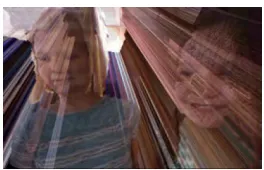
Figure 2:Mother and child, Hong Kong. Filtered volumetric mesh with generated surface normals. Image: D Buzzo.
system. I will suggest a number of strategies for such work and also discuss the opportunities and challenges of evalu-ation of speculative projects such as this.
Software
The current hardware is controlled by custom software writ-ten in C++ using the OpenFrameWorks library/toolkit1. It
incorporates Computer Vision processing capabilities, via the openCV project libraries2to analyse image and depth
data. The meta-data is currently formatted as Extensible Markup Language (XML)3, saved alongside image and
depth data and extends the current Design rule for Cam-era File system (DCF) Exchangeable Image File Format (EXIF) image meta-data standard4. This standard is
[image:4.792.35.165.211.318.2]com-mon acom-mong camera manufacturers and image processing software. The system also incorporates a variety of image analysis routines to assemble a rudimentary ’understand-ing’ of the incoming sensor data. Among them is a Haar Cascade Classifier for face detection and other computer vision techniques for object and boundary analysis. This system identifies edges, contours, movement, objects.
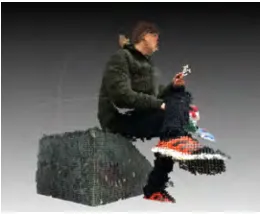
Figure 3:Man smoking at bus stop, Bristol. Coloured point cloud data captured using Infra red Structured Light sensor. Image: D Buzzo.
The inclusion of machine learning and advanced vision techniques is intended to bring a higher degree of semantic understanding inside the program of the apparatus. En-tering into a higher level of dialog with the human operator of the apparatus and the machine and human consumers of the images produced. In other work I investigate the question of what it might be to collaborate with intelligent machines and this projects combines those ideas with an approach to the interaction design based upon collabora-tive dialog with a system. [2] This interaction is philosoph-ically rooted in early dynamic systems modelled on ideas of conversation theory from cybernetician Gordon Pask [12] and the user conceptual modelling approaches of Bill Moggridge [9, 10] et al. The ’speculative framework’ (in the speculative sense of the work of Dunne and Raby et
1http://openframeworks.cc 2https://opencv.org 3https://www.w3.org/XML/ 4https://www.exif.org
al) [6] for the interaction is based upon a collaboration or dialog with an intelligent system where the human opera-tor/facilitator is not the privileged partner in the interaction, but the outside facilitator enabling a system. This is mir-rored in the software in a structural sense in the way func-tions, classes and data structure are written but also in a philosophically in it’s approach to what a camera as a tech-nical apparatusis.
What is a camera?
When embarking on the development of any new appa-ratus, tool, technique or process (and a camera may be described as all of these) it is useful to reflect upon the essence of what it is that one embarks upon re-inventing. Aside from the electro-mechanical object itself (for we are talking of contemporary digital photography in our instance)
Vilem Flusser [7] describes (possibly) the greatest step in human development after writing as the development of what he calls ’the technical image’, essentially any machine made or mechanically derived image. X-Ray, Photograph, video, TV, print. His particular point about the significance of these ’technical images’ is that they are produced by ma-chines(cameras etc) that he termsapparatus. This defini-tion is important as it explains the reladefini-tionship he postulates with human operators of these apparatus to be more clearly defined. He sees operators, photographers etc as facilita-torsof that apparatus, where the decisions and creations are dictated by the apparatus
Speculative Photography
and ideas of visualising the imperceptible [4] we can take the position that the camera is a discrete apparatus. That it is pre-programmed with all the potential images that the camera can create, contained within it’s in-built parame-ters. In this situation the ’photographer’ is a facilitator of this apparatus. In this context it is important to consider, when investigating new means of photographic production, that the forms and means of dissemination and consumption of photographic images is implicit, and inextricably encoded, within the mechanisms and systems of the camera appa-ratus itself. New means of production of images sit hand in hand with new means of dissemination and of consumption of these ’images’.
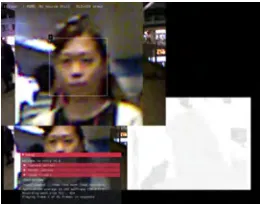
Figure 4:Volca System screen-shot with RGB image and depth map data, showing Haar Cascade Classifier face detection in progress. Image: D Buzzo.
As I discuss in the recent paper [3] describing the first port-folio of images from the Volca Project, when approaching photographic apparatus there are a few key notions that can be borne in mind. A photographic apparatus;
• is a sensor capturing data
• is a mechanism operating over time
• is a machine that generates images
• despite how it is commonly imagined does not ’see’ in any human like way,
When one begins to re-engineer what a camera could be is important to note that a camera contains all possible im-ages that it may take (for it is the camera that decides and takes the images, the ’photographer’ merely facilitating the apparatus). These images are already encoded within it and importantly alsooutside itin society as consumer and definer of product in the relationship. Noting this it becomes a voyage of discovery, not of technical processes, but of systemic processes of consumption, and a move away from
Figure 5:Portable handbuild Volca experiment rig with USB button interface for control, Illustrating sensor array on tripod rather than hand held. with CPU, batteries controls .etc are carried in shoulder bag, similar to early video days of Sony Portapac. Image: D Buzzo.
pre-defined rules of aesthetic, production and diffusion in search of a new type of program - one that originates in a new kind of image in a new apparatus.
[image:5.792.35.166.177.279.2]Figure 6:Girl in Red Sweater. Still of Volca Portrait rendered using Delaunay triangulation. Image: D Buzzo.
for us to need to engage with them.
The Volca project does this, and several other things, in the act of (re)constructing what a camera may be.
Making speculative cameras
This notion of speculative design, more explicitly of specu-lative making, pivots around the camera as an object and artefact. For Flusser it is anapparatusthat contains the
programwhich in itself is only part of the widersystemfor
the production, distribution and consumption of images. By actually building the Volca project we are left to engage in where a novel technology sits within a wider context. Not only must we consider the camera as apparatus but also consider the new roles a photographer of the future may have as facilitator of the novel apparatus. And therefore on to the system of distribution and consumption of these new kind of technical images that will in turn shape the program of production encoded within the apparatus.
Apparatus, distribution, consumption, manufacturing: The cir-cle of circumstance that is photography
In this view of the overall ’system’ the apparatus is a prod-uct of a manufacturer whose design is informed by the pro-cess of dissemination and consumption of technical images by the society as a whole. There is an associated extended philosophical debate on the nature of a photograph as a discrete ’text’ and in how this may be read, on an individual and a societal basis, but I will not go into that in this context.
Testing speculative photographs
Attempting to modify, interrupt or extend any established aesthetic, ie a means of production of images and an equiv-alent system of consumption, one encounters many ob-structions, barriers and stretches of unknown. Without establishing a program for consumption the program for production is vague, ill defined and in some respects near-impossible to conceive of, as Gibson says,
’we can’t see our culture very well, because we see with it.’
Speculative audiences
In this model it is necessary to take these speculative pho-tographs and subsequently exhibit them inspeculative exhi-bitionstospeculative audiences.
We use the current societal program of consumption of photographic images to bound the rules of production of these same images. These rules being encoded into the very apparatus used by photographers to create images. When creating new means of production of images, if one is to createnewimages, rather than new versions of old im-agesby new means, one confronts the challenge that there is no established system or program of consumption. The images fulfil only half their obligation in society and do not fit into any established criteria of the program.
With the Volca project this challenge, that of creating new means of seeing and creating images and of designing new ways for these new kinds of images to be consumed, could be overwhelming and circular in it’s inability to extend an existing and established aesthetic.
By approaching one side of the challenge at a time, that of the apparatus and that of the program in society it has been possible to make progress. By ignoring theuseof the images, and the mode it which they may be used, and instead focusing on the exploration of the instant of capture by the apparatus I have, somewhat, freed myself and the project from otherwise unbearable constraints.
Evaluating speculative designs
So how may we evaluate this speculative cameras when it is an implicitly linked part within a speculative system? By investigating these other elements, of the distribution and consumption of the novel images produced by the Volca project. The distribution and consumption in turn changing the configuration of the program embodied by the camera.
When moving beyond the project of the design of hardware or software it may be best described, as many artists im-plicitly understand, as a search for unknown unseen objects and a form in which to engage people to observe and expe-rience them. Historically the Kodak company, on the devel-opment of the tools of mass market consumer photography, the Box Brownie, were compelled to issue guidelines to would be facilitators of this new apparatus on how it might be employed. Likewise this guidance included education for viewers and consumers of photographs on what they might expect and how they might consume the subsequent photographs. Such was the lack of understanding - not of how to operate - or facilitate - the camera apparatus. With Kodak’s development of processing and distribution was rel-atively easy to understand. But of how to generate ’need’ within the ’program’ (those pre-defined parameters encoded with the apparatus, describing all the things a box brownie may capture and the consumption of the technical image.
An article in a Kodak company magazine from 1920 stated, "From the very start, the idea behind our advertising has been tosell the ideaof photography, and this advertis-ing has been continuous. Millions and millions of people the world over have been reached and influenced to buy through this advertising"5
Conclusion
The central premise of the Volca project is engaging with the sensory and visualisation technologies to augment and extend the sensory perception of the photographer/ appa-ratus. This mirrors development across all aspects of tech-nical engagement where we see repeated forays into the enhancement of humans to perceive the imperceptible. The perceive beyond their biological sensory abilities.
However, not in the hardware or the software or in the use of the system artefacts but in the use of the products of those artefacts do we see the design of speculative pho-tography evaluated.
It is in this observation of the act of speculative consump-tion by as yet unknown speculative audiences that we see the evaluation of our designs realised.
REFERENCES
1. Brain and Hand. 2105. William Gibson, Interview. (2105).https://medium.com/hand-brain/ william-gibson-57e75f87e525
2. Daniel Buzzo. 2015. Collaborating with intelligent machines. InCHI EA ’15 Proceedings of the 33rd Annual ACM Conference Extended Abstracts on Human Factors in Computing Systems. ACM -Association for Computing Machinery, Seoul, Korea, 1–2.
3. Daniel Buzzo. 2018. The Volca Project: A Multi-Sensory Camera for Augmented Reality. In
Conference on Human Factors in Computing Systems -Proceedings, CHI’18 Extended Abstracts,. ACM, Montreal, Canada.DOI:
http://dx.doi.org/10.1145/3170427.3177767
4. Daniel Buzzo and David Jonas. 2015. Designing For The Impossible : Creating A Mobile Application For Time Dilation. InElectronic Visualisation and the Arts. British Computer Society, London.
5. Leandro Cruz, Djalma Lucio, and Luiz Velho. 2012. Kinect and RGBD images: Challenges and applications.Proceedings: 25th SIBGRAPI -Conference on Graphics, Patterns and Images Tutorials, SIBGRAPI-T 2012June 2017 (2012), 36–49.
DOI:
http://dx.doi.org/10.1109/SIBGRAPI-T.2012.13
6. Anthony Dunne and Fiona Raby. 2013. Speculative everything: Design, fiction and social dreaming.The MIT PressIII, 1 (2013).DOI:
http://dx.doi.org/10.1093/jdh/epv001
7. V Flusser. 1983. Towards a philosophy of photography.
English(1983), 1–96.DOI:
http://dx.doi.org/10.1016/S0031-9406(10)62747-2
8. V Flusser. 2011.Into the Universe of Technical Images. Vol. 224. University of Minnesota Press. 225 pages. 9. Bill Moggridge. 1999. Design: Expressing experiences
in design.Interactions6, 4 (1999), 17–25.DOI:
http://dx.doi.org/10.1145/306412.306430
10. Bill Moggridge. 2006. Multisensory and Multimedia.
Designing Interactions(2006), 513–586.
11. OpenCV. 2018. OpenCV. (2018).https://opencv.org
12. Gordon Pask. 1975. Cybernetic theory of cognition and learning.Journal of Cybernetics5, 1 (1975), 1–90.
DOI:http://dx.doi.org/10.1080/01969727508546082
13. Vadim Pisarevsky. 2010. Introduction to OpenCV.
Agenda42 (2010), 433–434.DOI:
http://dx.doi.org/10.1016/j.jenvrad.2010.04.011
14. John Zimmerman, Erik Stolterman, and Jodi Forlizzi. 2010. An Analysis and Critique of Research through Design: towards a formalization of a research approach.Proc. DIS 2010(2010), 310–319.DOI: