Bioblitz
Evaluation Report
October 2009
Summary
The present work is part of a post-doctoral research project, Generic Venues: Researching the impact of science communication in non-traditional locations. This in-depth public engagement research project involves a thorough investigation of best practice in science communication within ʻgenericʼ venues - locations where audiences naturally congregate and have ʻownershipʼ of the site; spaces that are not normally associated with scientific learning. The research is taking place at the Science Communication Unit (SCU) at the University of the West of England, Bristol (UWE, Bristol) and is funded by the Fundação para a Ciência e Tecnologia1, a Portuguese governmental institution.
This report summarises audience-based evaluative data from activities which took place at ʻBioblitzʼ2, an initiative of the Bristol Natural History Consortium3. These activities were used as a case study for the research project mentioned above.
1
http://alfa.fct.mctes.pt/index.phtml.en
Table of Contents
SUMMARY ... 2
1. INTRODUCTION ... 4
1.1. VENUE... 4
1.2. THE ACTIVITY... 4
2. EVALUATION METHODOLOGY... 7
2.1. ETHICAL ISSUES... 8
3. METRICS ... 8
4. QUESTIONNAIRE RESULTS ... 8
4.1. AUDIENCE DEMOGRAPHICS... 8
4.2. ENJOYMENT... 9
4.3. LEARNING... 10
4.4. ATTITUDES TOWARDS SCIENCE... 10
5. ʻSNAPSHOTʼ INTERVIEW RESULTS ... 12
5.1. WHAT ATTRACTED VISITORS... 12
5.2. OVERALL SATISFACTION... 12
5.3. PURPOSE OF THE ACTIVITY... 13
5.4. ATTITUDES TOWARDS SCIENCE/PHYSICS... 13
5.5. FUTURE EVENTS... 14
6. STAFF INTERVIEWS RESULTS... 14
7. SUCCESSES AND CHALLENGES... 15
7.1. SUCCESSES... 15
7.2. CHALLENGES... 15
8. CONCLUSIONS ... 16
APPENDIX I - QUESTIONNAIRE ... 17
APPENDIX III - OBSERVATION SCHEDULE ... 19
1.
Introduction
The BioBlitz ʻis a special type of field study, where a group of scientists and volunteers conduct an intensive 24-hour (or 48 hour) biological inventory, attempting to identify and record all species of living organisms in a given area. The area chosen is often an urban park or a nature reserve of some sort.ʼ4
In June 2009, a BioBlitz took place at the Ashton Court Estate in Bristol. This BioBlitz was ʻa 30-hour race against the clock event where scientists, naturalists, students, members of the public, schools and community groups work together to find and identify as much wildlife as possible in the Ashton Court Estateʼ5
.
1.1. Venue
Ashton Court Estate is a historic area to the west of Bristol. According to Bristol City Council, it is the UKʼs third busiest country park, with around 1.6 million visitors every year. The estate is open every day from 8am, there is no entrance fee and the car park is also free.
1.2. The activity
The BioBlitz ran from 9am Friday 26th June – 3pm Saturday 27th June 2009. The event was open to the public from 9am – 9pm on the Friday and 9am – 3pm on the Saturday as well as on Friday night for evening activities (bat walks and moth trapping).
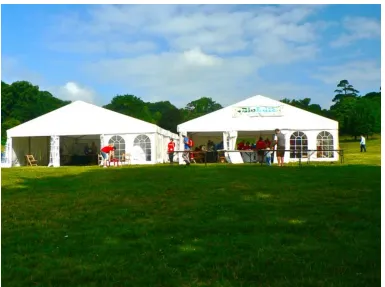
The organisation set up Base Camp near the visitor centre (off the Kennel Lodge Road/Clanage Road (A369) entrance), which consisted of 2 large marquees. One marquee included the Identification (ID) Tent, where was possible to identify species. The other one was the Discovery Tent, which included an exhibition area. Outside Base Camp there were 5 main survey areas (Figure 1, signed with butterflies). There was a relatively long walk between Base Camp and some of the survey areas.
On the Friday, prior arrangements allowed local schools to participate in the event. There was some rain on the Friday but the weather was sunny and bright on the Saturday.
4
http://en.wikipedia.org/wiki/BioBlitz
Figure 1. Map of the BioBlitz site.
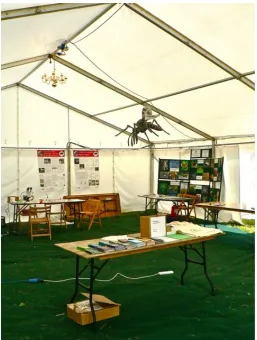
[image:5.595.123.508.363.650.2]Figure 3. Inside the Discovery tent, where it was possible to visit an exibition.
[image:6.595.186.443.69.409.2] [image:6.595.122.504.414.708.2]Figure 5. BioBlitz: naturalist, volunteers and members of the public surveying an area.
2. Evaluation methodology
A variety of evaluative techniques were employed in order to judge the effectiveness of the activity in the chosen venue. Through the application of multiple complementary methodologies a range of both quantitative and qualitative data was collected. The participantsʼ reactions to the event were collected in four ways:
- Exit survey - Participants filled in anonymous self-completion questionnaires throughout the two days of the event. The questionnaires took the form of a single side of A4 and included both open and closed questions. A copy of the questionnaire is included as Appendix I.
- Exit interview - ʻSnapshotʼ interviews (~90 secondsʼ duration) took place with members of
the public across the two days of the event. 'Snapshot' interviews are specifically designed to capture short and immediate feedback from participants in busy locations. A copy of the audience interview schedule is included as Appendix II.
- Observations - The activities were observed by the evaluator, who took extensive contemporaneous notes on the size, composition and reactions of the participants. A copy of the observation schedule is included as Appendix III.
2.1. Ethical issues
Ethical approval for the research element of this project was granted by the University of the West of England, Bristol after the submission of appropriate procedural details to the relevant Ethics committee. Participant anonymity was maintained throughout the data collection and analysis phases, and the interview participants provided informed consent prior to participating. In the case of participants under 16 years of age their parents / carers provided oral informed consent prior to any interviews commencing. In addition, notices were placed in conspicuous locations within the stall area whenever observations were taking place.
3. Metrics
For this activity, 4 schools (3 primary schools and 1 secondary) and 180 students participated. 70 naturalists, scientists and guides, 15 Media team volunteers and 30 general volunteers were involved in the activity over the course of the two days. From the headcounts done during the observations periods there were 101 people engaging with these activities. The observations were only limited periods (5x 15 minutes each) and the activity took place during 2 days.
4. Questionnaire
The questionnaire aimed to evaluate four aspects: a) Audience demographic
b) How the audience enjoyed the activities c) The educational value of the activities
d) Whether the activities had an effect on the audienceʼs attitude towards science
Participantsʼ responses within the questionnaire are included in this section. In total, 17 participants completed questionnaires, and the vast majority was completed by school students (15 questionnaires). This is a low number in relation to the total participants number: the general public participation was lower than expected, which increased the difficulty in recruiting participants for the evaluation.
4.1. Audience demographics
Of the 17 questionnaires completed, 15 participants (88%) were under 15's: 3 participants were 10 years old and 12 participants were 11 years old. An additional 2 participants were within the age range 20-29. The gender balance of respondents was 16 females and 1 male.
Table I. Geographic distribution of the audience.
Postcode area name Frequency
BS3 (Bristol) 2
BS4 (Bristol) 8
BS5 (Bristol) 4
BS7 (Bristol) 1
Missing answer 2
4.2. Enjoyment
The participantsʼ enjoyment of the activity was investigated via a series of inter-related questions:
1. Did you enjoy this activity?
2. Would you recommend this sort of activity to others?
3. Which part of the activity have you enjoyed the MOST?
4. Which part of the activity have you enjoyed the LEAST?
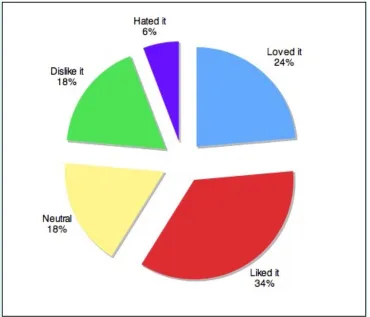
Figure 6. Audience enjoyment of the activity.
Five participants stated they would recommend this activity to others and another 5 said they would not recommend it. Six participants felt they would probably (ʻmaybeʼ) recommend BioBlitz (there was 1 missing answer to this question).
The most enjoyable aspect of the activity was finding bugs and identification (n=8) and going into the woods (n=3). Participants were also invited to leave open comments to explain the aspects they enjoyed the most. Other responses mentioned here included:
ʻHiking and seeing different things.ʼ(11-year-old female) ʻCatching a caterpillar.ʼ(11-year-old female)
ʻBeing outdoors.ʼ (20-29 year-old female)
When asked to identify the aspect of the activity that they enjoyed the least, 3 participants said ʻnothingʼ, while another 3 participants said ʻall of itʼ. Other responses include ʻtoo longʼ (n=2) and ʻwalking through tall grassʼ (n=2). Some comments in the open section of this question included:
ʻLearning about fungi.ʼ (10-year-old female)
ʻWhen I slipped.ʼ (11-year-old female)
ʻMore information tents would be interesting.ʼ (20-29 year-old female)
4.3. Learning
When asked if they had learnt something from the activity, 76% (n=13) said ʻyesʼ (7 out of 13 respondents did not give any further details) and 24% (n=4) ʻnoʼ. Probing this further to investigate what form that learning took resulted in comments including:
ʻAbout lichens.ʼ (20-29-year-old female)
ʻThat lichens are plants.ʼ(11-year-old female) ʻWhat plants are called.ʼ(11-year-old female)
4.4. Attitudes towards science
The participantsʼ attitudes towards science both before and after the activity were investigated via separate questions:
6. What did you think about science before today?
7. Do you think that this activity has changed your attitude towards science? If Yes, in what way?
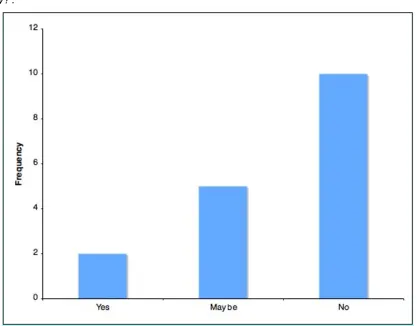
Only 2 participants said that the event had changed the way they felt about science (Figure 8) whilst 10 said it had not and 5 stated ʻmaybe.ʼ When asked to further explain the way in which the event changed participantsʼ attitudes, only one respondent added a comment:
ʻItʼs more fun.ʼ (11-year-old female)
In general, the event served to stimulate those who already enjoyed science. Attitudes towards the activity were generally positive, and the event even succeeded in changing some peopleʼs attitudes towards science, including their dislike.
5. ‘Snapshot’ interview results
Only 10 snapshot interviews were conducted over the course of the event, based on a semi-structured interview schedule and using an audio recorder. Once transcribed the interview contents were analyzed to identify common themes. This low number was due to the low number of general public engaged with the BioBlitz activities. Although there was a fair amount of people visiting Ashton Court on the Saturday, they did not seem to be attracted by the activities.
5.1. What attracted visitors
Members of the public engaged with the activities for different reasons. There were two main reasons that attracted the participants to the activities: either they learnt about it and went there or they went with their school. Some specific comments:
ʻI did know it was on so thatʼs why I came. I heard about it at the nature exhibition [Festival of Nature].ʼ
ʻHeard about it from a colleague I was working with yesterday, who works for the BBC.ʼ
ʻI heard that bug hunting was going on, on the television.ʼ
ʻSomeone from school post it on the group and we got to know.ʼ
5.2. Overall satisfaction
The feedback for the BioBlitz activities was generally positive. Answering the question ʻHow did you enjoy this activity?ʼ participants responded:
• ʻIt was very good, my little boy liked it as well.ʼ
• ʻItʼs great fun.ʼ
• ʻIt was ok, I sort of liked it.ʼ
As their favourite part of the activity, participants pointed out a specific aspect such as being with someone with knowledge, looking at bugs, the practical experiments (such as using the microscopes) and the hands-on factor.
As for their least favourite part of the activity, comments included: ʻNothingʼ (8 out of 10 interviews)
ʻIt just says something like Tally 300 and it would be good to have more or at least to know where you could go to find out what plants, mammals, invertebrates and so on…ʼ
5.3. Purpose of the activity
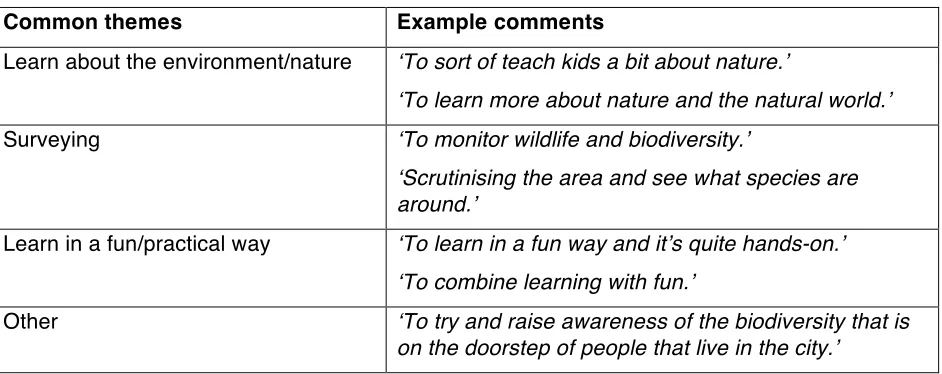
[image:13.595.81.552.311.498.2]During the interviews, audience members were asked what they thought the purpose of the event was. Common themes and specific comments are summarized in Table II.
Table II. Perceived purpose of the activity.
Common themes Example comments
Learn about the environment/nature ʻTo sort of teach kids a bit about nature.ʼ
ʻTo learn more about nature and the natural world.ʼ Surveying ʻTo monitor wildlife and biodiversity.ʼ
ʻScrutinising the area and see what species are around.ʼ
Learn in a fun/practical way ʻTo learn in a fun way and itʼs quite hands-on.ʼ
ʻTo combine learning with fun.ʼ
Other ʻTo try and raise awareness of the biodiversity that is on the doorstep of people that live in the city.ʼ
5.4. Attitudes towards science/physics
Answers to the question ʻHow do you feel about science more generally?ʼ can be grouped into 4 overarching categories:
• Like it
• Itʼs very interesting
• Itʼs important
• Itʼs ok
Some specific comments:
ʻI think itʼs a really important subject, without it half of the things that work we wouldnʼt know why or how.ʼ
5.5. Future events
Nine participants said that they would like to participate in a similar activity again in the future and one said ʻmaybeʼ. Some people expanded their answers:
ʻYeah yeah, I would definitely.ʼ
ʻYes, I would… and quite possible to help volunteering.ʼ
ʻIf itʼs possible with the time and everything, yeah!ʼ
6. Staff interviews results
As part of the evaluation process, 4 staff members were interviewed in order to collect their feedback. The main findings from these interviews were:
• Enjoyment: all staff interviewed enjoyed being involved in the activities, although
for different reasons:
ʻItʼs nice to see the enthusiasm of the children yesterday and the general public today.ʼ
ʻItʼs really nice to see it all coming together.ʼ
ʻBecause there are a lot of professionals sharing their knowledge.ʼ
ʻBecause I like working with children and see them sort of in an out-of-school context.ʼ
• Motivation: staff interviewed had different motivations to participate:
ʻI got asked by my boss!ʼ
ʻMy employer allows me 2 days a year for environmental work, so I choose to attend this event because itʼs quite relevant to what I do at work.ʼ
ʻI would like to be involved in organising this sort of event in the future, so I had to do some experience as a steward first.ʼ
• Purpose: in their opinion the purpose of the activity was public awareness of
biodiversity, what is just around the corner from a major city, to get people outside, to collect useful records and to get children interested in nature.
• Visitorsʼ reactions: staff members were very pleased with the audience reactions
and felt they were very interested in the activities. They also felt it was very easy to engage the audience with the activity and that children were pleased to be outside the classroom.
• Favourite aspect of being involved: Aspects mentioned by staff were meeting
and learning from other experts, to see the naturalists talking to the public and peopleʼs positive reactions.
• Least favourite aspect of being involved: working on a Saturday / arrive early
• Improvement: The main suggestion was better scheduling of the activity and more activities for kids, rather than just survey and identification.
• Future participation: All staff interviewed would like to participate again in similar
activities.
7. Successes and challenges
7.1. Successes
• The activity strengthened the public engagement expertise within the local naturalist community and volunteers and inspired them to become involved in further events in future.
• Staff recruited (volunteers, naturalists and guides) were very committed to the BioBlitz and very happy to share their knowledge and experience with members of the public and students.
• The location of Base Camp was appropriate: passers-by could see it from a distance.
• The layout in the tents and the use of colourful and attractive displays made the visitors want to go inside.
• Participants looked very comfortable while engaging with the activities and with the naturalists, guide and volunteers. Participants did answer questions posed during the activities and also provided their own questions and comments. The overall feeling was that participants wanted to know more and had a very active approach to the experience.
• The number of species found was high, and that number surprised the public: they did not expect that such a high number of different species in a public park like Ashton Court.
7.2. Challenges
• A visual display explaining, in a simple way, what the BioBlitz is would be very helpful. Although there was a big and attractive banner near the entrance of Ashton Court, the information provided was not enough and many people didnʼt understand what was going on.
• Some members of the public were attracted to the marquees, but for several reasons no staff member engaged with them, and they just walked away. The engagement with the general public needs to be improved: e.g. some volunteers could be previously trained to attract and engage passers by with the event.
• A better scheduling of the activity is needed: there were moments where members of the public were interested in going out and surveying, but there was no information about which experts were surveying and where.
8. Conclusions
APPENDIX I - Questionnaire
Thank you for taking the time to complete this questionnaire. Completing this questionnaire indicates that you give consent for this data to be used in this research study. All data will be treated anonymously and confidentially.
1. What attracted you to this event today?
Walking past / happened to be here Learnt about it so came by Other
2. Did you enjoy this activity?
Loved it
Liked it
Neutral
Disliked it
Hated it
3. Would you recommend this sort of activity to others?
Yes Maybe No
4. Which part of the activity have you enjoyed the MOST?
5. Which part of the activity have you enjoyed the LEAST?
6. Did you learn something from the activity?
Yes No If YES, what have you learnt?
7. What did you think about Science before today?
Loved it
Liked it
Neutral
Disliked it
Hated it
8. Do you consider yourself a scientist?
Yes Maybe No
9. Do you think this activity has changed your attitude to Science?
Yes Maybe No If YES, in what way?
10. What is your gender?
Male Female
11. What is the first part of your postcode? 12. What is your age?
Under 15 – please write your age here:
15-19 20-29 30-39 40-49 50+
APPENDIX II - Snapshot Interview Schedule
Thank you very much for agreeing to participate. It won’t take very long and I’d appreciate it if you could be as honest as possible regarding what you think about this activity.
• What attracted you to this event today?
- Where you walking past, happened to be here or did you learn about it and cam by?
• How did you enjoy the activity?
• What was your favourite aspect of the activity?
• What was your least favourite aspect of the activity?
• What do you think the purpose of this activity was?
• How do you feel about science more generally?
• Would you like to participate in this sort of event again?
Thanks very much for participating!
Additional questions:
• Would you like to find out more about anything you did or saw?
• Have you ever participated in a science-related event like this one?
Finally, some quick questions about you:
• Do you have any qualifications in science? (If not, that’s not a problem, I’m just
curious to know the audience)
• What is the first part of your postcode?
• Anything you want to add about the event that hasn’t already been covered?
APPENDIX III - Observation Schedule
Record the following observations over a 10-15 minute time window:
General Problems?
(accessibility, logistics, weather, scheduling, etc)
Audience Males Audience Females
Audience Type (size of groups, multi-generational, age range?)
Staff:
(Age, appearance, confidence, enthusiasm)
Engagement:
(How were they attracted to the stall? Do they get involved or just observe (watching, asking q’s, touching equipment, taking brochures))
Count
Observers: Count Participants:
Dwell time:
(How long are they staying?)
Group dynamics
Are they talking to each other? Is conversation about the activity? Are they working together or as
individuals?
Comments made or questions asked:
(lecture / discussion?)
APPENDIX IV - Staff Interview Schedule
Thank you very much for agreeing to participate in this interview. It won’t take very long and I’d appreciate it if you could be as honest as possible regarding what you think about this activity.
1. Did you enjoy participating in this activity?
Why?
2. What motivated you to participate in this event?
3. What did you think was the purpose of the event?
4. How did the visitors respond?
5. How easy of difficult was it to engage the audience in this activity?
6. What was you favourite aspect of being involved in the activity?
7. What was your least favourite aspect of being involved in this activity?
8. What sort of feedback did you get from the audience?
e.g. did any of them approach you with questions or comments?
9. How would you improve this activity?
10. Would you like to participate in a similar event again in the future?