The International Journal of 3-D Information Modeling is indexed or listed in the following: ACM Digital Library; Bacon’s Media Directory; Cabell’s Directories; DBLP; Google Scholar; INSPEC; JournalTOCs; MediaFinder; ProQuest Advanced Technologies & Aerospace Journals; ProQuest Computer Science Journals; ProQuest Illustrata: Technology; ProQuest SciTech Journals; ProQuest Technology Journals; The Standard Periodical Directory; Ulrich’s Periodicals Directory
Research Articles
1 Building Information Model for Existing Buildings for Facilities Management: RetroBIM Framework; Giulia Carbonari, University of Greenwich, London, UK
Spyridon Stravoravdis, University of Greenwich, London, UK Christine Gausden, University of Greenwich, London, UK
16 Impact of Fidelity in 3D Space Visualisation Across the Construction Asset Lifecycle; Noha Saleeb, Design Engineering Department, Middlesex University, London, UK
29 BIM and Cultural Heritage: Compatibility Tests in an Archaeological Site; Cristiana Achille, Polytechnic University of Milan, Milan, Italy
Nora Lombardini, Polytechnic University of Milan, Milan, Italy Cinzia Tommasi, Polytechnic University of Milan, Milan, Italy
45 Development of OntEIR Framework to Support BIM Clients in Construction; Shadan Dwairi, University of the West of England, Bristol, UK
Lamine Mahdjoubi, University of the West of England, Bristol, UK Mohammed Odeh, University of the West of England, Bristol, UK Mario Kossmann, Airbus, Bristol, UK
67 Three-Dimensional Information Retrieval (3DIR): Exploiting 3D Geometry and Model Topology in Information Retrieval from BIM Environments;
Peter Demian, Loughborough University, Loughborough, UK Kirti Ruikar, Loughborough University, Loughborough, UK Tarun Sahu, Indian Institute of Technology Guwahati, Guwahati, India Anne Morris, Loughborough University, Loughborough, UK
CopyRight
The International Journal of 3-D Information Modeling (IJ3DIM) (ISSN 2156-1710; eISSN 2156-1702), Copyright © 2016 IGI Global. All rights, including translation into other languages reserved by the publisher. No part of this journal may be reproduced or used in any form or by any means without written permission from the publisher, except for noncommercial, educational use including classroom teaching purposes. Product or company names used in this journal are for identification purposes only. Inclusion of the names of the products or companies does not indicate a claim of ownership by IGI Global of the trademark or registered trademark. The views expressed in this journal are those of the authors but not necessarily of IGI Global.
Volume 5 • Issue 1 • January-March-2016 • ISSN: 2156-1710 • eISSN: 2156-1702
DOI: 10.4018/IJ3DIM.2016010104
Development of OntEIR Framework to
Support BIM Clients in Construction
Shadan Dwairi, University of the West of England, Bristol, UK Lamine Mahdjoubi, University of the West of England, Bristol, UK Mohammed Odeh, University of the West of England, Bristol, UK Mario Kossmann, Airbus, Bristol, UK
ABSTRACT
This paper discusses an ongoing research that is conducted to develop a framework that will support employers in making informed and sound decision in defining their requirements. The aim of this research is to develop an ontology-based, BIM enabled framework for EIR (OntEIR), it will examine the ability of this framework in capturing, analysing, and translating these requirements based on an ontology model. This framework will enable the project team to capture requirements and convert them to constructional terms understood by all stakeholders. It is the contention of this research that this process will save time, effort and cost, and will provide an informed basis for delivering a successful project that satisfies both the employer and the supply chain.
KEywORDS BIM, EIR, Ontology
1. INTRODUCTION
The adoption of BIM concepts and workflows is increasing rapidly across the construction industry. A clear and comprehensive Employer Information Requirements (EIR) is considered one of the key components for a successful delivery of construction projects, using Building Information Modelling (BIM). Its importance emerges from the significant information it holds, which is critical for the delivery of the project that include the information to be delivered and the standards and processes adopted.
This paper proposes a radical innovation in assisting construction clients to define their requirements for a project lifecycle. It sought to develop an Ontology-based, BIM-enabled Framework for EIR, to support clients of construction projects in defining complete requirements. It harnesses advances in Requirements Engineering to produce a better quality EIR in terms of completeness, correctness and consistency.
for considering this system to be critical, is in its novelty in being addressed to main key players of the different disciplines involved in the BIM project, it seeks to provide answers and address questions and issues that will be of great importance for the formulating of the project programme for all disciplines.
It is necessary at this point to make a clear distinction between client and employer, which introduced by the PAS 1192. The employer is the legal entity named in the contract, and is responsible for procuring the asset (BSI: PAS 1192-2:2013). The employer could be appointed by the client, who is considered the body which incorporates the interest of the buyer of construction services, prospective users, and other interest groups (Kamara et al, 2000).
As suggested by Kamara et al (2002), types of requirements are:
• Client requirements: requirements of the Client, which describes the facility that satisfies his or her business needs. These incorporate employer requirements, developer requirements, user requirements and the lifecycle requirements of operating, maintaining, and disposing of the facility. • Site requirements: these describe the characteristics of the site on which the facility is to be built. • Environmental requirements: these describe the immediate environmental (climatic factors,
neighbourhood, environment conservation, etc.) surrounding the proposed site of the facility. • Regulatory requirements: building planning, health and safety regulations, and other legal
requirements that influence the acquisition, existence, and demolition of the facility.
• Design requirements: requirements for design which are translation of the employer needs, site and environmental requirements.
• Construction requirements: requirements for actual construction, which derive from design activity
However, there are yet another very important set of requirements, when dealing with BIM projects, which are “information” requirements. They require a great deal of attention in order to be able to achieve the full potential of BIM across the whole lifecycle, for the important information requirements and deliverables information it holds, which are essential to make strategic and operational decisions during the project’s lifecycle. Clear identification of Information requirements along with the project requirements and business requirements, is important for the delivery of a successful BIM project, in other words, a clear and comprehensive EIR is the basis of delivering a successful BIM construction project.
The process of elicitation, analysis, documentation, and management of Employer Information Requirements and communicating them to the various stakeholders is an important process in reaching a more comprehensive, correct and clear set of EIRs, which in turn will enable stakeholders involved in producing a more successful project with less additional cost and overrun. The process is called Requirements Engineering, and has proven its ability in delivering a better quality sets of requirements in product development industries, however none of these studies were EIR related.
This paper capitalises in advances in requirements engineering to produce a robust EIR for BIM projects.
2. SPECIFICATION OF EIR
EIR is an important document, if not the most important document in the BIM process in the construction project, the reason for that if for all the essential information it holds that are needed to deliver a successful project in time and on budget.
Despite the various research efforts, the specification of EIR is still underdeveloped. In order to improve the specification of requirements, Kiviniemi (2005) suggested that is essential to develop IT tools to provide some degree of automation for requirements managements. However, the use of IT in that task poses important challenges, such as the difficulty of capturing both implicit and explicit requirements, maintaining information up to date, and storing different requirements from distinct stakeholders throughout the product development process (Leinonen and Huovila, 2001).
An ontology-based approach has the potential to improve both requirements elicitation and management. Indeed, ontology as defined by Gruber (1995) is a specification of a conceptualization; that is that ontology is a description of the concepts and relationships that can exist in the domain, this definition is consistent with the usage of ontology as set-of-concept-definitions, but more general. The relationships of the concepts existing in the domain is seen through the hierarchy of these concepts, where a domain is fragmented into classes and each class into sub classes until the instances are reached which are at the lowest rank of the hierarchy in the system.
OntEIR is a framework that will incorporate Requirements Engineering methodology, and is formalised by Ontology. Even though Requirements Engineering (RE) is a branch of software engineering and software systems requirements, it has gained a great deal of attention in recent year for what it has to offer in elicitation, refinement, and analysis of requirements.
[image:4.504.62.463.90.394.2]3. BIM AND EIR
Several studies suggest the UK Government’s decision in mandating LEVEL 2 BIM for publicly procured projects by 2019, is to address the fragmentation and complexity of the construction industry (Latham, 1994; Egan, 1998; Cabinet Office, 2011). It is also reported that the UK government is willing to invest in smart construction and digital design by investing in people, in collaboration with the AEC industry, in reference to the report published by the UK government in 2013; Construction 2025 (Bataw et al, 2015).
PAS 1192-3 describes the ultimate purpose of the BIM process is to “provide information into the client Asset Information Model (AIM)” which should be “the single source of approved and validated information related to the asset(s)”. PAS 1192-2 states the start of the BIM process should be a “clear understanding of the client`s OIR and AIR” and that one of the “fundamental principles of level 2 information modelling is the provision of a clear EIR”. It defines the EIR as a “pre-tender document setting out the information to be delivered, and the standards and processes to be adopted by the supplier as part of the project delivery process” and that the “EIR should be incorporated into tender documentation to enable suppliers to produce an initial BIM Execution Plan (BEP)”.
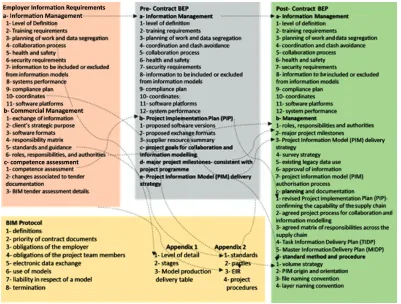
EIR is the first step in the information delivery cycle of the construction project, as shown in Figure 2 below, and is an important element of project BIM implementation, in addition to being the guideline for the BIM protocol implemented through the BEP. EIR documents are designed to be included in the tender documents for the procurement of both the Design Team and the Constructor (Employer’s Information Requirements Guidance notes, 2013).
Although the UK government has provided a template for stakeholders for EIR, which can be found on the NBS website (https://toolkit.thenbs.com/), it is believed that a more client focused template is needed, as will be discussed in section 3.0
3.1. Sources of Information for EIR
EIR is a pre-tender document setting out the information to be delivered, and the standards and processes to be adopted by the supplier as part of the project delivery process. (PAS 1192-2:2013).
The UK government has mandated that all public sector centrally procured construction projects are to be undertaken using Building Information Modelling (BIM) by 2016. Employer Information Requirements (EIR) is seen as central to deliver the BIM agenda. The successful and clear identification of the specifications of the employer and building requirements is an important if not the most important phase in delivering successful construction projects, and is referred to as is called Employer Information Requirements EIR.
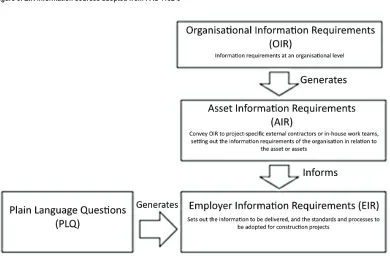
Sources of information for EIR includes, but not limited to, three main sources, as discussed in PAS 1192-3, and illustrated in Figure 3.
3.2. Asset Information Requirements (AIR)
According to PAS 1192-3-2014, EIR is initially informed by information provided by the Asset Information Requirements (AIR). PAS 1192-3 Specification for information management for the operational phase of construction projects using building information modelling states that ‘...specific AIR shall be specified as part of a contract or as an instruction to in-house teams and may use data and information from the AIM relating to the asset management activities being carried out.
The AIR shall also specify data and information to be captured and fed into the AIM. Where the activities relate to major works covered by PAS 1192-2, then the AIR will inform the EIR.’
PAS 1192-3 suggests that, ‘The AIR may start as descriptive text, but should then be developed into a digital plan of deliverables. The effort to complete this should not be underestimated.’
3.3. Plain Language Questions (PLQs)
[image:6.504.65.460.93.278.2]PLQs are a powerful source to develop the EIR. These questions will be answered by the employer at specific stages to asses if the project is developing as required and can proceed to the next stage. In order to be able to answer those questions, specific information is required at these stages, in certain formats and in certain level of details, that will allow the employer to answer those questions. Plain Language Questions (PLQ) is an important source for defining the needs for each stage of the project Figure 2. BIM information deliver cycle (adopted from PAS 1192-2:2013)
[image:6.504.68.458.299.555.2]delivery plan. The answers to these questions will be the high level needs for each stage, from which goals and requirements are derived.
An example of these questions can be found on the NBS website, which have been developed by the BIM task group. Those particular questions were found to be useful in this study, and were able to cover all construction stages, thus will be used as an assistance in developing the OntEIR framework.
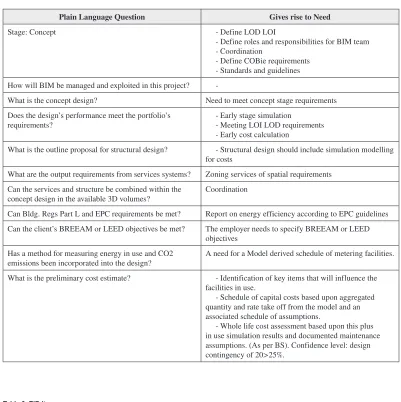
Table 1 below gives an example to the PLQs suggested by the BIM task group, to be answered at the end of stage two; the concept design stage, the design must be able to answer these questions in order to progress to stage three. EIR should hold requirements that will assist the Project Team in delivering the required information.
The below table (Table 1) will give an example on how these questions will assist in deriving the needs for EIR for stage 2.
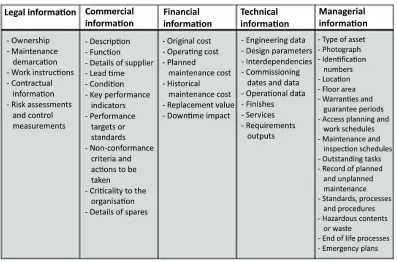
The outcome EIR should be able to define information requires by the employer to ensure the development of the project and the operation of the completed built asset. PAS 1192-2:2013, specifies that the EIR should include:
Items identified in the Table 2 also contain needs that should be satisfied with information requirements enable the construction team in providing a clear plan for the whole construction process, which will result in delivering a more successful project in less time and effort. Satisfying the need of EIR is the initial source of information for other important documents to come, and that will manage the construction process and make sure that it will be delivered in time and on budget, both items and their needs are shown in Table 2 above.
3.4. Plan of work
The BIM lifecycle and digital Plan of work was represented in the BIM Digital Plan of Work and Assemblies document (2013), in which the BIM Task Group brought together a group representing a wide variety of institutions and organisations with a view to creating a coordinated plan of work. The plan of work represented in this document was based on a series of stages numbered from 0-7, and includes the whole project lifecycle. This plan begins with stage 0, which identifies the strategic need of the project, and continues through the operation and end of life stage, consisting of the following stages (BIM Digital Plan of Work and Assemblies, 2013):
0. Strategy, 1. Brief, 2. Concept, 3. Definition, 4. Design, 5. Build & Commission, 6. Handover & Close Out, 7. Operation & End of Life
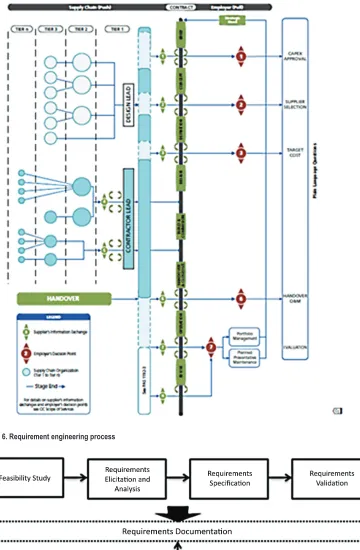
Each stage should be able to answer plain language questions set for it, where the whole supply chain contributes in answering them, as shown by the Figure 4 provided by PAS 1192-2, which will allow transition to the next stage.
As the stage matures, so does the maturity of the data to be delivered at the end of each stage does, this is represented by both the level of detail and level of information of the data; the Level of Detail is the level of geometric information a model should exhibit and the level of Definition is the Level of data maturity a model data set should exhibit (Figure 5).
4. REQUIREMENTS ENGINEERING
The aim of designing the OntEIR framework is to assist in producing successful construction projects, by defining a correct EIR at the beginning of the project. The Requirements Engineering (RE) methodology is a step change to assist in the development of a complete, correct and consistent requirements. In fact, Hooks (1990) argues that cost overrun and delays in software projects are mainly associated with problems with requirements, which are most of the time are incomplete, inconsistent, and incomprehensible. According to her, there are two main reasons for this problem: the inability to write good requirements, and the lack of understanding about the importance of these requirements.
Table 1. Stage two PLQs used to derive needs for that stage
Plain Language Question Gives rise to Need
Stage: Concept - Define LOD LOI
- Define roles and responsibilities for BIM team - Coordination
- Define COBie requirements - Standards and guidelines How will BIM be managed and exploited in this project? -
What is the concept design? Need to meet concept stage requirements Does the design’s performance meet the portfolio’s
requirements? - Early stage simulation - Meeting LOI LOD requirements - Early cost calculation
What is the outline proposal for structural design? - Structural design should include simulation modelling for costs
What are the output requirements from services systems? Zoning services of spatial requirements Can the services and structure be combined within the
concept design in the available 3D volumes? Coordination
Can Bldg. Regs Part L and EPC requirements be met? Report on energy efficiency according to EPC guidelines Can the client’s BREEAM or LEED objectives be met? The employer needs to specify BREEAM or LEED
objectives Has a method for measuring energy in use and CO2
emissions been incorporated into the design? A need for a Model derived schedule of metering facilities. What is the preliminary cost estimate? - Identification of key items that will influence the
facilities in use.
- Schedule of capital costs based upon aggregated quantity and rate take off from the model and an associated schedule of assumptions.
[image:8.504.60.461.83.485.2]- Whole life cost assessment based upon this plus in use simulation results and documented maintenance assumptions. (As per BS). Confidence level: design contingency of 20>25%.
Table 2. EIR items
Technical Management Commercial
Software platforms Data exchange formats Coordinates
Level of detail Training
Standards
Roles and responsibilities Planning work and data segregation Security
Coordination and clash detection process
Collaboration process
Health and safety and construction design management
System performance Compliance plan Delivery strategy for asset information
Data drops and project deliverables Client strategic purpose
specification, and validation of requirements. Requirements Management is an additional requirements engineering activity which is concerned with managing requirements change, see Figure 6.
Requirements engineering is a critical part of the development process. In the construction industry, Requirements Engineering refers to fully understanding the employer’s need and desire for the project, so that the end product of the building will be able to meet the expectations and fulfil the needs of all stakeholders involved in the project.
4.1. Employer Information_ Requirements Engineering
To satisfy the aim of this framework, which is developing a complete and correct EIR, the RE methodology is used as a novel attempt to support OntEIR in producing complete, correct and consistent requirements.
In the construction industry, some studies using RE are evident, Cooper at al (1999) used the definition of requirements engineering (RE) to be the interactive process that embeds the needs and requirements of project stakeholders. Where requirement engineering deals with customer, user and market requirements, design requirements, and technical requirements. Arayici, Amed, & Aoud, (2006) also discussed RE concerns in light of the goals, desired properties and constraints in systems that involve information technology, organisations and people.
OntEIR is an important solution for the integration and collaboration of processes and project team members. A comprehensive and clear EIR will have substantial benefits on the integration process in BIM projects. As suggested by this research, RE is necessary to develop user-oriented and a more practical EIR. Aouad and Arayici (2010) suggest that employing the appropriate requirements techniques will provide the following benefits:
• More practical systems
[image:9.504.46.443.89.351.2]Figure 5. The whole supply chain contributes information to answer the Plain Language
• Configurable systems • Flexible and scalable systems
• Contribution towards closing the gap between the practitioners and the researchers
The OntEIR approach is designed to guide construction clients in defining and specifying Employers’ Information Requirements (EIR) for construction projects. The Requirements Engineering (RE) Methodology was adopted in the development of OntEIR. EIR researchers have had little or no focus on RE system development, which is actually important if we are looking to develop a more client-oriented and more practical EIR, and despite the increasing interest in EIR, there is any research to identify the best practices in RE in the construction industry.
In software systems, as described by Nusaibeh and Easterbook (2000): ‘RE is the process of discovering the purpose by identifying stakeholders and their needs, and documenting these in a form that is amenable to analysis
Another definition for RE is provided by Zave (1997): “Requirements engineering is the branch of software engineering concerned with the real-world goals for, functions of, and constraints on software systems. It is also concerned with the relationship of these factors to precise specifications of software behaviour, and to their evolution over time and across software families.”
These particular definitions were able to sum up the main reasons for using RE for this thesis; first of all, as it is with OntEIR, RE also highlights the importance of real-life goals and situations, which is crucial for the development of the OntEIR framework, because they answer the important question of ‘why’ and ‘what’ of the system. The second reason is the ‘precise specification’, which is the goal to be reached by the analysis and the validation of requirements. And finally, the dealing with the evolution and the reality of changing specifications and the need to re-use partial specifications in a changing world, is also an important aspect introduced by OntEIR, and is supported by the use of RE.
5. FRAMEwORK FOR DEFINING CONSTRUCTION CLIENTS’ REQUIREMENTS Despite the high importance of EIR, there are relatively few attempts to develop a comprehensive framework to assist clients to define their requirements. In an attempt to address this issue, NBS proposed the publically the BIM Toolkit. The BIM toolkit comprises a digital plan of work, a unified classification system, thousands of definition templates and a verification tool (https://toolkit.thenbs. com/).
The BIM toolkit offers Classification and Definition guides which is a single unified classification system that will work across the industry and a Digital Plan of Work tool, to define responsibility for information within a project and clarity as to who is responsible for each part and when. This toolkit is helpful with more experienced clients with BIM, who already know what information they need and when they need it. However, for less experienced clients, a need for a more client focused template/ framework that will assist them in defining and managing the whole construction process is still in need.
A recent study conducted by Hafeez et al (2016) which investigates a framework for delivering EIR in the Qatar construction Industry; “QEIR”. The study resulted in many useful recommendations and tips for delivering quality EIRs, shown in Figure 7 below.
Although the work on the previous studies have been of great effort, there is still a gap to bridge between the client and stakeholders, and the different stakeholders and project teams themselves, a more client oriented framework to improve the delivering of construction projects. It is clear that some developments are still needed to exploit the full potential of BIM.
OntEIR, requirements engineering knowledge- based methodology framework, formalised by ontology, and BIM enabled will capture, analyse, and deliver Employer Information Requirements in a more complete, correct and consistent way, which will improve the quality of the delivered construction projects, and reduce the overrun in time and cost.
Ontology and requirements engineering studies are not evident in construction, and more precisely in EIR, but there are researches on requirements specifications and requirement engineering in other fields such as systems engineering, for what it offers that field in improving the qualities of requirements, terms of correctness, completeness, and consistency, which will have great effects in saving time and cost (Kossmann et al, 2008; Kossmann and Odeh 2010).
OntoREM is a semi-automated methodology developed for creating requirements specifications for systems in less time and at reduced costs, while improving the quality of such specifications (Antonini, 2014), due to what it offers in the elicitation of the domain knowledge field, and the analysis and validation of the needs, goals and requirements with relevant stakeholders and domain experts (Kossman and Odeh, 2010).
[image:12.504.65.459.91.392.2]OntoREM was initially developed to capture and manage reference knowledge and concepts in the domain of RE, which will result in the development of high quality requirements for any specific application domains (Kossmann and Odeh, 2010).
OntoREM (Ontology-Driven Requirements Engineering Methodology) is the product of a joint project between the University of the West of England and Airbus. OntoREM has been applied in case studies in both aerospace industry and space missions, and was a success in both cases (Kossmann and Odeh). OntoREM was able to help in developing quality improvements for the generated requirements specification, it assisted in generating about 100% additional project and system requirements (Antonini, 2014).
Due to the success of this particular framework in specifying and generating requirements in different kinds of projects and system, and the similarities it has with the proposed framework, being both RE Knowledge-based, ontology driven methodologies, OntoREM has been re-used and adapted in the creating of OntEIR.
6. METHODOLOGy
Well-defined EIRs will lead to the production of well written and comprehensive essential documents in the success of construction projects. Due to the large amount of stakeholders and domain experts involved in the collaborative process of the project, in addition to the many types of construction projects, ontology is considered the best option for this process due to what it offers in:
• Semantic heterogeneous description of requirements • The ability to retrace requirements
• The ability to instantiate the framework to any construction project
In construction projects, and to ensure that projects are more employer-oriented; EIRs should be processed rigorously and coherently before the start of conceptual design. This should be done through a structured framework which provides for the definition, analysis, and translation of EIRs, into design specifications that are solutions neutral (Kamara, 1999)
To be able to form a clear an understandable brief by all part of the construction team, EIR should go through a process that begins with eliciting the EIRs in plain language, and converting them into constructional terms to be understood by all members of stakeholders.
The ontology introduced in the research will specify the concepts and relationships in the EIR domain. Ontology will facilitate the sharing of knowledge and understanding between relevant parties, by defining domain terminologies, vocabularies and relationships in the same way for all stakeholders. The Ontology introduced provides the common terms and vocabulary relations for modelling the EIR, where the ontology will lay the semantic understanding foundation.
The OntEIR framework aims at representing the number of concepts that construct EIR, and relations between the different inputs and outputs it, to reduce complexity, and validate the framework’s topics which will result in producing a clear and complete EIR. The term Ontology is actually of philosophical origins, and it refers to the modelling of existence (Gruber, 1995), “it defines a common vocabulary for researchers who need to share information in a domain” (Noy and McGuiness, 2000).
Being a language to represent the EIR framework, OntEIR will act as suggested by Gruber (1995), as “a formal description of the elements and relationships between the elements and relationships between them” within the EIR domain. Other benefits from using ontology will be in the application ok knowledge acquisition tools, techniques and methodologies as suggested by Cottam (1995), it will also assist in facilitating the construction of domain models, as discussed by Studer et al, (1998), and will pave the way for knowledge re-use across domains, as represented by Gruber (1995).
and minimal ontological commitment, which were put for the intention of sharing knowledge and interoperation. OntEIR was developed according to the requirements engineering methodology, in which it comprises of two main domain knowledge: the problem space and the solution space domain. The aim OntEIR is to analyse the domain knowledge, help elicit requirements in the solution knowledge, and visualise the concepts and relations between the different concepts that lead into the specification of the requirements.
In addition, the structuring and decomposition of requirements in a hierarchal way can facilitate the understanding of tracing requirements (Kott and Peasant, 1995, Ulrich and Eppinger, 2008) which will be tracked easier with the use of ontology. To evaluate attributes of criteria as well as compare requirements of each alternative, it is necessary to use an appropriate data modelling and analysis methodology, hence, Ontology-based approach is adopted. This method is one of the fastest growing areas in the last several decades and it is used to support decision-making in challenges related to several disciplines (Chen & Nugent, 2009).
Ontology provides a shared and reusable piece of knowledge about a specific domain, and has been applied in many fields, such as Semantic Web, e-commerce and information retrieval, etc. More and more researchers begin to pay attention to ontology research. Until now, many ontology editors have been developed to help domain experts to develop and manage ontology (Li et al, 2005).
Due to the nature of this research in developing Ontology based framework for EIRs in construction projects, the Design Science Research Methodology (DSRM) was adopted. DSRM focuses on the creation of artifacts, rather than on the mere observation of objects or phenomena, it involves the creation of knowledge through design of novel or innovative artifacts and analysis of the use and\or performance of such artifacts along with reflections and abstractions to improve and understand the behaviour of the system.
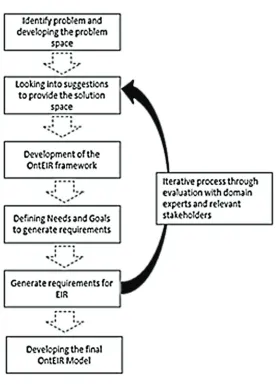
The previous process was adapted to the development on OntEIR, the process includes information gathering through literature review to identify the problem space, which on this case has synthesised in the lack of systems or tools in the construction industry for Employer Information Requirements, that are comprehensive, consistent, understandable by all stake holders an domain experts involved in the construction project, and has the ability to be instantiated to any construction project. An iterative process for reaching the final OntEIR framework is illustrated in Figure 8 below.
The framework described in this study aim to facilitate the identification, clarification, and representation of Employer Information Requirements in construction projects. The framework was evaluated with relevant stakeholders and domain experts in the field, the findings and results of this evaluation is extracted and elicited and thoroughly documented, which was used to improve and update OntEIR.
7. ONTEIR FRAMEwORK
The first stage of the study was to develop a conceptual framework. The proposed conceptual framework identifies the predominant research issues, which have significant implications on EIR, works in the EIR and construction field such as PAS 1192-2:2013, RIBA plan of work, and the EIR guidance notes were studied as reference to the OntEIR framework, this framework seeks to draw together existing research and to provide a foundation for future work in this field. Within each of these categories, a series of attributes are examined
7.1. Generating High-Level Goals
Using mind mapping, the problem domain is elicited and analysed, the data visualized in the mind map is actually a representation of elicitation and analysis of requirements done with relevant stakeholders and domain experts via interviews. High level needs are formulated as result.
The visualization of the initial EIR framework is done through mind mapping that consists of all aspects of the EIR which are broken down to reach high level goals, this will help us in determining and generating requirements more clear and precise, and help the employer body in determining their more specific requirements and concerns regarding the project.
7.2. Requirement Specification
[image:15.504.101.377.87.472.2]After reaching root goals in the goal hierarchy generated by the mind map, requirements are used where relevant. In case the requirements do not cover a root goal, then new requirements will have to be generated.
7.3. Requirements Testing
Goals generated from mind map will be validated with relevant stakeholders and domain experts in the construction industry.
7.4. OntEIR workflows
OntEIR, adapts the requirements Engineering Methodology, which will cover a set of activities to reach the final EIR, these activities include what is shown in Figures 9 and 10.
7.5. Identifying Roles and Responsibilities
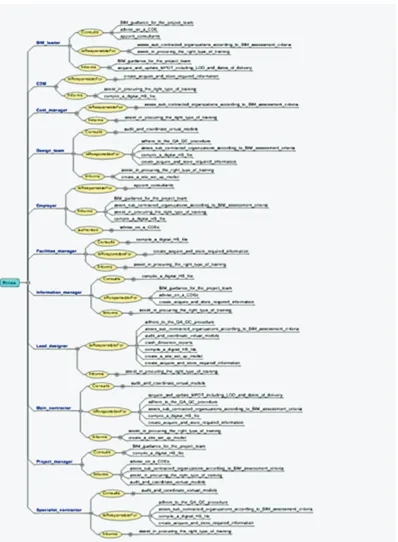
The OntoEIR approach adopts the Requirements Engineering Methodology process in eliciting requirements for EIR. The process starts by identifying the BIM roles and responsibilities. Identifying the responsibilities of each of the roles in the BIM project is essential to ensure these needs and requirements are satisfied completely.
[image:16.504.65.459.354.540.2]Roles and responsibilities include the covering of the responsibilities of the following roles: BIM leader, CDM manager, cost manager, design team, employer, facilities manager, information manager, lead designer, main contractor, project manager, specialist contractor, Architect, structural engineer, MEP, Q.S, Landscape Engineer, Energy consultant, each role has the responsibility of informing and/or consulting and/or leading and/or authorising, a certain responsibility. These roles and responsibilities are visualised in the min map below in Figure 11.
Figure 9. Establishing the domain Ontology for EIR Framework
[image:16.504.69.451.594.661.2]7.6. Defining Lifecycle and Requirements Delivery workflow
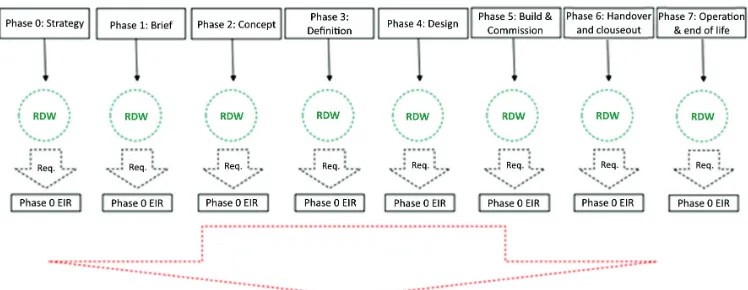
There are two sets of workflows represented in OntEIR, the first is the project lifecycle phases, according to the Digital plan of Work, discussed in section 3.1, and the other is the Requirements Delivery Workflow (RDW) which will feed in requirements for each lifecycle phase. The RDF is responsible of supporting the lifecycle phases with the requirements needed to produce a full and complete EIR, by defining full and complete requirements for each life cycle phase, Figure 12 illustrates the relation between the two workflow and their requirements.
The requirements delivery workflow (RDW) (Figure 13) consists of a group of activities and stages that will ensure complete coverage of the requirements for each lifecycle stage, these activities include: 7.7. Establishing Goal Hierarchies
This workflow consists of a group of activities that will enable OntEIR in identifying requirements and root goals elicited from high level needs, defined from multiple sources which include literature reviews, analysing PLQs, and inputs from domain exerts and stakeholders. According to the requirements engineering methodology, these activities include:
• Eliciting requirements, by breaking down high level needs into goals and root goals • Analysing requirements, to look for any inconsistencies, conflicts, or duplication.
• Negotiate requirements, to resolve any conflicts or duplications found in the previous step • Validate requirements, by validating goal hierarchies with domain experts and relevant
stakeholders.
[image:18.504.70.444.422.567.2]Figure 14 below shows a mind map for the establishing of goal hierarchies using OntEIR, where requirements are elicited from high level needs
Figure 12. The relation between the RDW, and lifecycle phases requirements
7.8. Test Requirements
[image:19.504.119.369.85.597.2]After the iteration process is complete in compliance with feedback from validation process, a set of complete, consistent, and correct Employer Information Requirements are reached, that can be instantiated to any construction project.
8. FINDINGS
The Application of OntEIR framework on Employer Information Requirements resulted in specifying more precise requirements, OntEIR was able to cover all requirements needed in the delivery of a complete EIR, such as Asset Information Requirements and Organisational Information Requirements, in addition to all aspects of Employer Information Requirements. Specified requirements in the resulting EIR document are clear, with no ambiguities and misunderstandings including completeness and consistency. This document is the beginning point for a successful construction project that is able to meet the essential requirements, and be completed on time and within budget.
The following features contributed to the success of OntEIR in delivering better quality EIR:
• Stakeholder and expert contribution to the study assists in understanding the need in construction projects, which leads to defining better requirements in OntEIR to bridge the gap between clients and execution in construction projects;
• OntEIR is able to cover all aspects of a well and complete defined EIR as specified in PAS 1192:2, PAS 1192:3, and PAS 1192:5, in a clear and understandable form for both the employer and the project team.
• Hierarchy and tractability offered by ontology makes it possible for OntEIR to be instantiated for different types of projects;
• OntEIR is able to clearly answer the plain language questions and requirements that are to be met before moving from one stage to the other;
• OntEIR assists employers defining clear and adequate requirements, and at the same time will be easy to be interpreted by the design team and translated into building terms, and thus create better BEP;
• OntEIR saves time in specifying requirements for projects and gives excellent results in terms of quality and consistency.
9. CONCLUSION
REFERENCES
Antonini, K., Lange, C., Kossmnn, M., & Odeh, M. (2014). Applying OntoREM to a Space Mission: Developing Requirements for the MASCOT Lander. Proceedings of IS ’14, INCOSE.
Arayici, Y., Ahmed, V., & Aouad, G. (2006). A requirements engineering framework for integrated systems development for the construction industry. IT in Construction, 11, 35–55.
Arayici, Y., & Aouad, G. (2010). Building information modelling (BIM) for construction lifecycle management. In
Construction and Building: Design, Materials, and Techniques (pp. 99–118). NY, USA: Nova Science Publishers. Bataw, A. (2015). Incorporating Building Information Modelling within the Construction Curriculum in the UK. UK: Birmingham City University.
BIM Task Group. (2013). Employer’s Information Requirements, Version 07 28.02.13, Core Content and Guidance Notes. Retrieved from www.bimtaskgroup.org/bim-eirs/
Chen, L., & Nugent, C. (2009). Ontology‐based activity recognition in intelligent pervasive environments.
International Journal of Web Information Systems, 5(4).
Cooper, R., Bruce, M., & Wootten, A. (1999). Requirements capture as a process of technology market integration.
International Journal of Technology Management, 17(6), 582–596. doi:10.1504/IJTM.1999.002737 Cottam, H. (1999). Ontologies to assist process oriented knowledge acquisition (draft).
Earley, M. (2015). BIM Level 2 Standards for Business. Retrieved from http://www.bim-manager.net/
Egan, J. (1998). Rethinking Construction: Report of the Construction Task Force on the Scope for Improving the Quality and Efficiency of UK Construction. London: Department of the Environment, Transport and the Regions. Gruber, T. R. (1995). Toward Principles for the Design of Ontologies Used for Knowledge Sharing. International Journal of Human-Computer Studies, 43(5/6), 907–928.
Hafeez, A., Carachout, R., Vukovic, V., & Kassem, M. (2016, October 19-21). Investigating the Potential of Delivering Employer Information Requirements in BIM Enabled Construction Projects in Qatar.Proceedings of Doha, Qatar. doi:10.1007/978-3-319-33111-9_15
Hooks, I. (1990). Why Johnny can’t write requirements.Proceedings of AIAA’90.
Kamara, J. (1999). Client Requirments Processing for Concurrent Lifecycle Design and Construction [PhD dissertation]. University of Teesside.
Kamara, J., Anumba, C., & Evbuomwan, N. (2000). Establishing and processing client requirements - a key aspect of concurrent engineering in construction. Engineering, Construction, and Architectural Management, 7, 15–28. Kamara, J., Anumba, C., & Evbuomwan, N. (2002). Capturing Client Requirements in Construction Projects. London: Thomas Telford Ltd.; doi:10.1680/ccricp.31036
Kiviniemi, A. (2005). Requirements Management Interface to Building Product Models. PhD. Stanford University. Konukcu, S., & Koseoglu, O. (2012, October 17–19). Knowledge Management Through BIM in Construction Supply Chains. Proceedings of the 29th International Conference, Beirut, Lebanon. Retrieved from http://itc. scix.net/ data/works/att/w78-2012-Paper-79.pdf
Kossmann, M., & Odeh, M. (2010). Ontology-driven Requirements Engineering: A case study of OntoREM in the aerospace context, IS’10. INCOSE.
Kossmann, M., Odeh, M., Gillies, A., & Wong, R. (2008). From Process-driven to Knowledge-driven Requirements Engineering Using Domain Ontology, IS’08. INCOSE.
Kott, A. and Peasant, J.L. (1995). Representation and Management of Requirements: the RAPID-WS project.
Concurrent Engineering: Research and Applications.
Leinonen, J., & Huovila, P. (2001). Requirements management tool as a catalyst for communication, Construction Informatics Digital Library. Retrieved from http://itc.scix.net/data/works/att/ecce-2001-23.content.pdf Liu, F., Jallow, A., Anumba, C., & Wu, D. (2013). Building knowledge modeling: integrating knowledge in BIM.Proceedings of the 30th International Conference CIB W78, Beijing, China.
Noy, N., & McGuinness, D. (2000). Ontology Development 101: A Guide to Creating Your First Ontology. Stanford University.
Nuseibeh, B., & Easterbrook, S. (2000, June 04-11). Requirements engineering: a roadmap.Proceedings of the Conference on The Future of Software Engineering, Limerick, Ireland (pp. 35-46).
Studer, R., Benjamins, V., & Fensel, D. (1998). Knowledge engineering: Principles and methods. Data & Knowledge Engineering, 25(1–2), 161–197. doi:10.1016/S0169-023X(97)00056-6
The British Standards Institute. (2008). PAS 55-2:2008, Asset Management ICS code: 03.100.01 Part 2: Guidelines for the application of PAS 55-1. Sommerville, I. (2006). Software Engineering (8th ed.). Boston, MA, USA: Addison-Wesley Longman Publishing Co. Inc.
The British Standards Institute. (2013). PAS 1192-2:2013, Specification for information management for the capital/delivery phase of construction projects using building information modelling. .
The British Standards Institute. (2014). [Specification for information management for the operational phase of construction projects using building information modelling. The British Standards Institute.]. PAS, 1192-3, 2014. The British Standards Institute. (2014). [fulfilling employer’s information exchange requirements using COBie.].
PAS, 1192-4, 2014.
The British Standards Institute. (2008). BS 8587:2012 Guide to facility information management.
UK Cabinet Office. (2011). Government Construction Strategy. Retrieved from http://www.gov.uk/government/ uploads/system/uploads/attachment_data/file/61152/Government-ConstructionStrategy_0.pdf
Ulrich, K., & Eppinger, S. (2008). Product Design and Development (4th ed.). New York: McGraw-Hill. Zave, P. (1997). Classification of Research Efforts in Requirements Engineering. ACM Computing Surveys,
Shadan Dwairi is currently a PhD student in the University of the West of England, Architecture Department, she has a Master’s Degree in Architecture from Jordan University of Science and Technology. Shadan holds a 9 year experience as an Architect, 3 of them as senior architect and the head of tender department, she also worked as a lecturer in the department of Architecture. Publications - Re-Assessment of National Energy Codes in Jordan in terms of Energy Consumption and solar right in Residential Buildings- GCREEDER Conference- 2013 - Re-assessment of national energy codes in Jordan in terms of energy consumption and solar right in residential buildings-Sustainable Cities and Societies Journal-2015.
Professor Lamine Mahdjoubi is Director of the Centre for Architecture and Built Environment Research, UWE, Bristol. He leads the interdisciplinary Building Information Modelling Research Group. His research spans the social, health and environmental aspects of the built environment. He has extensive experience in developing novel computer-based simulation techniques, and design decision-support tools to examine user-built environment interaction. He has a proven ability to translate this expertise into the development of tools and techniques to ensure that high quality evidence-based information and solutions are available to support decision-making. His research on developing a new generation of BIM methods and tools led to the creation of novel virtual prototyping techniques, the development of an improved methodology for spatial planning, and a series of tools for evaluation, visualisation and optimisation of built environment solutions.
Mohammed Odeh is a Reader in Software Engineering and leads the Software Engineering Research Group in the Faculty of Environment and Technology of the University of West of England. He has more than 31 years of research and development experience in the engineering of software systems with an in-depth interest in system of systems software engineering, knowledge-driven requirements engineering and bridging the gap between business processes and computer-based systems. He has supervised 13 PhD students to successful completion and is currently supervising further 8 PhD students. Mohammed has been acting as invited PhD examiner externally and internally, and as an invited keynote speaker in international conferences and as associate editor on international journals. He has been the UWE principal investigator on the OntoREM project and as a joint inventor of OntoREM with Dr. Kossmann from Airbus, with US patent. Among other research output include 40 refereed journal papers and books (including books and research work to appear) and 45 conference papers.
Please recommend this Publication to your librarian
For a convenient easy-to-use library recommendation form, please visit: http://www.igi-global.com/IJ3DIM
Volume 5 • Issue 1 • January-March 2016 • ISSN: 2156-1710 • eISSN: 2156-1702
An official publication of the Information Resources Management Association
all inquiries regarding iJ3dim should be directed to the attention of:
Umit Isikdag, Editor-in-Chief • [email protected]
all manuscriPt submissions to iJ3dim should be sent through the online submission system:
http://www.igi-global.com/authorseditors/titlesubmission/newproject.aspx
3D augmented and virtual reality • 3D data collection and reconstruction • 3D GIS standards • 3D interoperability • 3D spatial analysis • 3D spatial information infrastructures • 3D static and dynamic network models • 3D to nD spatial information modeling • 3D/4D visualization and visual analytics • BIM based 4/5/nD modeling and management • BIM based collaborative working • BIM based facilities/asset management • BIM based visualization/simulation/augmented reality • BIM in site automation • BIM maturity/readiness/adoption • BIM standards • Building Information Modeling and Management (BIM) • Disaster Management • Environmental Management • Geo-coding and 3D location based services • Integrated project delivery • Location based scheduling • Management of large 3D datasets • Multi-source and multi-domain 3D data integration • Ontology/ schema/service level integration • Serious Games • Spatial DBMS • Training and education on BIM • Urban planning, management and renewal • Web semantics and knowledge engineering
Coverage and major topiCs
The topics of interest in this journal include, but are not limited to:
The mission of the International Journal of 3-D Information Modeling (IJ3DIM) is to provide a comprehensive and collective body of knowledge in the domains of Building Information Modeling (BIM) and 3D Geographical/ Geospatial Information Models & Systems (3D GIS). The journal stimulates the sharing of knowledge, research approaches and practical experience in domains related to BIM, 3D GIS and Urban Information Fusion and combines the worlds of BIM and GIS toward integrated management and re-use of “3D semantically rich information”. IJ3DIM encourages developments in BIM, 3D GIS, City Modeling (including Indoor Modeling). IJ3DIM focuses on both advanced technologies and soft aspects, including human, process, organizational, industrial level problems, relating to BIM, 3D GIS and Urban Information Fusion. The journal also facilitates the sharing of scientific knowledge related to the development of indoor applications, such as indoor navigation, evacuation, facility management, intelligent buildings, and sustainable buildings.
mission
IDeas For specIal TheMe Issues May be subMITTeD To The eDITor(s)-In-chIeF