TDP Demonstrations Project Report
Road Users
Glenn Lyons, Geoff Dudley, Phil Goodwin,
Sue Clegg and Hebba Haddad
Prepared for the
Department for Transport
Final Version – 31 March 2010
Framework Reference – PPRO 04/045/04 Contract Reference – PPRO 4/006/025
Project team: Centre for Transport & Society (UWE, Bristol) and the British Market Research Bureau
DISCLAIMER: This Report has been independently prepared by its authors. While this has been done in consultation with representatives of the Department for Transport the content does not
Executive summary 1
1 Introduction 7
2 Context and learning approaches 9
3 Insights into user experience and attitudes 13
4 Developing a methodology to examine user experience 27
Queen’s Printer and Controller of Her Majesty’s Stationery Office 2011
Copyright in the typographical arrangement rests with the Crown.
You may re-use this information (not including logos or third-party material) free of charge in any format or medium, under the terms of the Open Government Licence. To view this licence, visit
www.nationalarchives.gov.uk/doc/open-government-licence/ or write to the Information Policy Team, The National Archives, Kew, London TW9 4DU, or e-mail: [email protected].
Road Users’ Responses
Glenn Lyons, Geoff Dudley, Phil Goodwin, Sue Clegg and Hebba Haddad
March 2010
Executive summary
Objectives and context
1. There is currently no plan by Government to introduce any new system of road user charging. The issue has been much discussed in recent years and therefore in 2009 and 2010 the Department for Transport commissioned technical trials to test what methods might be available for charging road user prices that would vary according to ‘time, distance and place’, reflecting different conditions. The demonstrations took place under hypothetical assumptions, made for the purposes of design. These included several road pricing schemes, covering different types of area and roads, and being owned by different authorities. 2. The main focus was on the technology of charging, using systems which were
developed by four (later three) commercial suppliers (referred to as Road User Service Providers – RUSPs). Each ran a live demonstration using their own chosen technology fitted into cars driven by about 100 volunteers, who were recruited from their customers or employees (and, in the case of one RUSP, from a wider consumer base). Prices were not actually charged, but were stated in arbitrary (i.e. not real money) units. The volunteers were tasked with checking records of the actual journeys they had made, and the simulated monthly accounts.
3. In the event of any later full scale application or trial, a form of technical assessment would be necessary which included establishing a detailed
understanding of users’ experiences and responses to the system, for example their views about the in-vehicle equipment, their assessment of the accuracy of the records, and their views about the usefulness and sensitivities of
different levels of privacy. A social research study was undertaken in
conjunction with the Demonstrations Project to design a methodology suitable for possible future research into user experience.
4. The four RUSPS were each responsible for their own trial (framed by requirements and stipulations made by the DfT), with provision for sharing learning outcomes among themselves and with the DfT. The social research study was undertaken by the Centre for Transport & Society (CTS) at the University of the West of England, Bristol (UWE), and the British Market
Research Bureau (BMRB – now TNS-BMRB). In the course of designing a suitable methodology, the social research study involved examination of user
Accordingly, while the focus of the Demonstrations Project itself was
principally to develop learning in relation to technical matters, there are user experience findings that merit reporting. An account of these is provided in this Report.
5. Particular considerations to be accounted for in methodology design were taken to be: the installation, operation and maintenance of equipment; user
confidence in charging and billing processes; user perceptions on the adequacy of privacy and confidentiality; and the potential impact of TDP billing on driving behaviour. Such considerations were investigated through dialogue between the social research study team and the RUSPs, 20 audio-recorded interviews with users and examination of reported insights from the RUSPs concerning their own feedback from their users.
Insights into user experience and attitudes
6. Insights into user experience and attitudes relate to the specific sample of users involved in the Demonstrations Project, analysed as a means to an end of designing an appropriate research methodology in the event of a larger scale application. They are not necessarily reflective of a wider population of road vehicle users. The insights gained are of two sorts: those gained through the responses to the technology presented to users through the Demonstrations Project itself; and those gained through responses to more general questions concerning pricing and travel behaviour. In both cases insights relate to the current contexts examined and such contexts may change.
7. The responses below are broadly in the sequence experienced by users,
reflective of the sort of sequencing considered necessary in terms of capturing user experience within a methodology design.
Motivations for joining the trial
8. Motivations for joining the trial can be categorised into three groups, interest, loyalty and incentive. Interest included gaining a better knowledge of both the technology and the pricing schemes. The majority of users seemed to consider that the actual introduction of a road pricing scheme was likely, perhaps inevitable, and might be relatively soon, the trial itself being interpreted as evidence of that. As a result, there was a sense of being ‘ahead of the game’ through being in the know. Loyalty could be either to help their company equip itself for the business, or as a customer group engaged with existing services provided by the RUSP. There was a financial incentive to participate, and this was acknowledged and appreciated, but more typical as the primary incentive was a curiosity to find out what the TDP scheme involved.
Recruitment
9. In terms of recruitment users were mainly self-selected, being those with an interest in the technology and process of road user charging. For some users sensitivity in joining the trial included a question over whether speeding data could or would be gathered and used to detect speeding offences. This
Installation and use of equipment
10.Installation of equipment on the whole was seen as being efficient. In some cases, users were concerned that the equipment should be installed in an unobtrusive position, chiefly because of fear of theft (and hence damage to their vehicle in the process).
11.In the case of use of equipment, for all RUSPs there were some identified problems in continuity of collection of data by the on-board unit, due to loss of signal, time to first fix, or erroneous signals. However, this was a resolvable issue and one unlikely to have any continued impact in future on user
acceptability and confidence. While the purpose of the Demonstrations Project had been to demonstrate how TDP services might be offered as part of the wider market for telematics services, and RUSPs had been allowed (and even encouraged) to offer the TDP service as part of a package of telematic services, only one of the four RUSPs actually did this, There was some indication that users may have welcomed more information add-ons with regard to the on board units, such as fuel efficiency, carbon emissions etc. This raises the question of the degree to which the acceptability of TDP pricing might be shaped by its incorporation within a wider set of driver information services. 12.For the purposes of the Demonstrations Project itself, all RUSPs used
internet-based methods to communicate with Users, and arrange for presentation of statements, checking, feedback etc. (This was for practical reasons and not intended to reflect necessarily the full scope of any future deployment). Interviewees were required to check their statements on a weekly basis. A tendency was observed among some users to check less thoroughly as time went on, especially in relation to regular journeys, possibly because they learned to trust the information provided, although it should be remembered that there was not real payment of a charge at stake.
Interpreting the statement
13.The majority of users maintained that they understood the statement completely. When probed, this appeared to mean that they understood the statement as well as they thought they needed to, since when discussed in detail it emerged in many cases respondents were unsure of the precise interpretation of some of the figures.
14.In most cases, respondents checked their odometer, as required as part of the Demonstrations Project, on a weekly basis. However, few made the connection between checking the odometer reading and the mileage total on the
statement in order to compare the two. Since the odometer offers a specific alternative and independent source of information for the user, and could potentially act as a means of legal verification or challenge, this could be a subject of more detailed research in future.
be said that perception of accuracy on the part of the user is a different issue from the verifiable absolute accuracy of the statement itself, but not
unimportant.
16.In the early stages of the Demonstrations Project the journey details were presented in the form of travel within administrative areas. This meant little to most users, and as the Demonstrations Project developed, a number of
different forms of depiction of journey traces on a map were tried. It was clear that respondents generally found maps to be a significant help in checking the statement, particularly when driving in less familiar areas. This favouring of maps can be perceived in the context of users much preferring to check discrete journeys, rather than being presented with other representations of their driven miles.
17.It was noticed that most interviewees treated the (arbitrary, dimensionless) numbers set out on the statement as actual sums of money, reading the figures as though they were in £s and pence. This seemed a rather robust pattern, even though they had been told explicitly that this was not the case. Thus they had studied these ‘sums’, and expressed their opinions on their validity and fairness, including some comments about a ‘charge increase’ when the numbers changed. In several cases, they volunteered views about the inevitability and acceptability of road pricing, based on this assumption.
Driving behaviour
18.The Demonstrations Project was not intended to investigate influences on users’ driving behaviour, though the following can be said in this regard. Even when individuals believed their statements reflected figures in £s and pence, they reported that their driving behaviour was not influenced, or even thought about, especially in the early phases. It seems this was partly because they were not actually paying the money, and partly because most users described their current driving patterns as necessary and with little alternative. There were, however, indications of the statements’ representation of their driving behaviour making more conscious to some users their inefficient habitual choices of route. Thus in the trial conditions it was the explicit information about the driving that they were actually doing, rather than the (notional) charge, which seemed closer to any potential reconsideration of travel behaviour.
19.Most interviewees were not particularly concerned about having their driving patterns monitored, although there could be an element of self-selection here. All of the interviewees were either happy with the safeguards of privacy and confidentiality provided by the RUSP, or had not considered it an issue. There was a view that there might well be much greater concern about privacy within the population as a whole, particularly where the individuals had personal reasons for not having their journeys traced (usually described in domestic terms rather than political or social – i.e. a sensitivity about whether one’s partner would see, rather than the government). Several users were more uneasy about a government-run road pricing system, possibly because for them trust in the government seemed lower than trust in their own RUSP
Congestion and road pricing
20.Most interviewees reported that they were affected personally by traffic congestion, though did not spontaneously volunteer road pricing as a solution. There was a fairly even split for and against in attitudes towards road pricing, with most people assuming that revenues would have to take the place of road tax and fuel duty to make it publicly acceptable. It was viewed widely that charging by road usage in the form of TDP seemed a fairer way of charging for road use, if indeed this would be a replacement to already existing systems of road charging. There was a mixed response to the option of TDP road pricing, with advantages seen by some in travelling at off-peak times, while others argued that they had no alternative to making journeys at peak times. Developing a methodology to examine user experience
21.Looking beyond the direct insights into user experience from the
Demonstrations Project itself and its RUSP users, a number of observations emerged relevant to steps that might be taken in the future to further enhance understanding of user experience and understanding relating to TDP services and pricing in the context of a wider population of road vehicle users.
22.A recognition that user experiences and views evolve over time points to the need for a multi-wave approach to consulting users participating in a trial. There would be merit in being able to emulate users being charged real money in terms of being able to investigate user motivations to check statement accuracy and the impact of TDP information on behaviour and behavioural intentions. Users were not exposed during the Demonstrations Project to indications in their actual vehicles of ‘units being consumed’ either before (projected), during (cumulative) or after (total) a journey. Such exposure in a future trial could be fruitful in assessing behavioural responses allied to issues of acceptability. Of course, the potential merit of having in-vehicle feedback to users in the future would have to be reconciled with the preference expressed by some users for the equipment to be fitted covertly. Concerns expressed by some users about the risk of theft of the equipment and resulting damage to their vehicle might be alleviated in the future if the service were able to be fully integrated into the vehicle design.
23.The need to carefully interpret the meaning of privacy to users and how their opinions are assessed cannot be over emphasised if impacts of privacy on acceptability are to be properly understood. The Demonstrations Project through necessity did not expose users to a steady-state TDP offering – yet a steady-state would yield more robust insights into user experience and
1 Introduction
1.1 The Time Distance, Place (TDP) road pricing Demonstrations Project
(hereafter ‘the project’) offered a wide range of learning opportunities, which encompassed not only novel technological concerns (the main focus of the project) but also potentially sensitive and complex social issues of user understanding, experience and acceptability. The Demonstrations Project initially involved four Road User Service Providers (RUSPs), each of which established its own approach (within the framework set by DfT) to
delivering a system that could record driver/vehicle movements by TDP, with the opportunity to use this information as a means of applying a
hypothetical (and unitless) ‘charge’ to users. Each RUSP was required to run a trial of its system, involving around 100 users (‘RUSP users’) who were tasked with providing information and feedback. The Project consisted of two ‘rounds’1 – the first being the development, testing and refinement of a TDP system defined by geographic areas; and the second (involving three of the RUSPs) being the development, testing and refinement of an advanced system defined according to areas and road types. In both rounds the user interface to charging information was also being developed, tested and refined. Hence users involved throughout the project were subject to an evolving offering with the focus being upon learning about technical issues and progressing developments accordingly.
1.2 Alongside the main project, a social research study was commissioned with
the task of developing a research methodology for examining user
experience that could be applied in the event of any larger scale trials with a more substantial cross-section of users from the travelling public. In order to think through issues affecting research design, the social research study involved engagement with the Demonstrations Project itself to gain insights into how users encounter and experience participating in a trial
environment. The study was undertaken by the Centre for Transport & Society (CTS) at the University of the West of England, Bristol (UWE) and the British Market Research Bureau (BMRB – now TNS-BMRB). Accordingly, this Report has been prepared independently by the study team to record what we have learned from the project associated with user experience and to set out future considerations associated with developing an extended understanding.
1.3 User experience examined in this Report reflects insights gained both from
the study team through interviewing of both RUSP representatives and RUSP users and from the RUSPs themselves in their direct communications with users and reporting back to the DfT.
1.4 While forming part of the overall project reporting, this Report is intended
to be able to be read as a standalone document. The following sections provide further contextual information by describing the project and then going on to describe the different learning approaches that have informed
1 “Round 1” formally equates to Stages 1 and 2 of the Project and Round 2 to Stage 3. The formal
the main sections of the Report. The main sections comprise: an account of user experience and attitude; and consideration of issues relevant to future efforts to enhance understanding of user acceptability of TDP pricing, culminating in a proposed methodology. Hence the Report is intended to highlight to the reader: (i) what can be said about user experience of TDP road pricing within the constraints of a principally technical trial involving rather distinct sets of users; (ii) what considerations emerge that could warrant further examination in some future context; and (iii) how such an examination might be conducted. It should be stressed that (i) and (ii) in the context of the Demonstrations Project have been a means to an end in arriving at (iii).
1.5 As will be seen in the remainder of the document, particular issues of
significance include: (i) the motivation for individuals joining and continuing to participate in a (technical) trial; (ii) the challenge of placing TDP pricing in the wider ‘real world’ economic and social context; (iii) the need to carefully interpret and put into perspective matters of privacy and
confidentiality for the user; and (iv) accounting for how user experience and associated attitude can evolve over time through exposure to participation. 1.6 It is important to remember that the project concerned itself with an
experimental environment quite deliberately and had a specific focus upon technical learning. Those insights into user experience from the
2
Context and learning approaches
The TDP Demonstrations Project and the social research study
2.1 In July 2006 the DfT consulted the industry on TDP charging concepts and
approaches to a Demonstrations Project. Two approaches were considered. The first involved DfT in preparing a technical specification, and then procuring systems built to that specification. The second approach involved using the marketplace of telematics services providers to deliver ‘market-driven’ approaches to TDP charging. The second approach was selected for the following reasons:
the timescale for the first approach did not match the timescale of the project;
the policy requirements for TDP charging were not known; and
the resulting technical requirements for TDP systems could not be defined without clear policy requirements.
2.2 The government has confirmed that there is no policy to introduce national
TDP road pricing. Nevertheless, given the perceived complexity and lead time required for the development of TDP road pricing systems, the
government decided to explore the capabilities of industry in order to learn about the feasibility of using a market-based approach if there should be future deployment of TDP road pricing. The trials therefore took place in a hypothetical context, for which some ‘policy-related’ assumptions were made for the purposes of designing the trials, namely that TDP charging could involve or should cater for:
several road pricing schemes in operation;
schemes covering different types of area and roads;
schemes being owned by different authorities;
schemes supporting different local charging policies;
schemes offering different solutions to users;
schemes accepting a TDP solution, either alongside event-based solutions, or as the only (mandatory) solution;
users being able to subscribe to an electronic service for payment of all road pricing charges across all schemes;
TDP solutions being offered by several RUSPs to any road user;
any TDP service provided to road users needing to work with all schemes accepting a TDP solution; and
all schemes accepting TDP solutions being required to accept TDP solutions offered by all accredited TDP service providers.
2.3 These ‘policy’ related requirements were taken as assumptions in designing
technical requirements for TDP charging, the DfT project management team defined:
the range of charging approaches to be tested;
the (functional) capabilities of any TDP service to be tested; and
the service quality targets for the TDP services (e.g. accuracy, reliability).
2.4 In the case of achieving acceptance of the TDP service by users, it was
considered that users would need to be reassured concerning operation of their service in terms of accuracy of charges, preservation of privacy, security of the service, and ‘cost’. The trials therefore investigated how such reassurance might be provided.
2.5 In the project, the RUSPs were asked to provide end-to-end road pricing
services, interfacing as necessary with all the elements in the business model, and particularly owning the interfacing with users. Thus the initial round of the project had hypothetical schemes and charges designed to test the capabilities of the systems and technologies involved. Volunteer users, recruited and incentivised by the RUSPs, were required to verify the perceived accuracy of weekly statements of their recorded driving
behaviour (and associated ‘charging’). The statements issued to users during this round were complex and designed for verification purposes, rather than as prototypes for a future service delivered into the market. The learning from this round provided confidence in the technical performance of the charging and payment services offered. This learning process was an integral part of the design for the project, and resulted in changes for the second round of the project. Thus there is a distinction between the built-in learning and adaptation made as requirements of the project itself, and lessons drawn from the project as a whole about future requirements. 2.6 Consequently, requirements placed by DfT upon the RUSPs were refined and
extended for the second round of the project in order that the RUSPs might operate within a more realistic environment, including offering a user interface with statements which better reflected a possible future
operational context. In this round users (predominantly the same individuals as for the first round) were no longer asked to verify statements (with this being done by a dedicated ‘Verification Contractor’). The chief features of the services to which users were exposed in this round are outlined later in Section 3. However, it should be emphasised that the approaches taken in the first and second rounds of the project are not necessarily those that would be taken involving any future (possibly wider) sample of road vehicle users.
2.7 The DfT took the opportunity offered by the initial stages of the project to
from a later full study. The brief for the social research study, in the context of both learning from the RUSP users and from the current project and looking ahead to future methodological considerations for the study of user experience, had the following objectives:
to determine the perception of users on the adequacy of the privacy offered by the service provider;
to identify and monitor issues expressed by users surrounding the collection and use of data in TDP operations (confidentiality in particular) and how they change over time;
to evaluate the perception of services which they experience during the trial, including the installation, operation and maintenance of any user equipment;
to evaluate the level of confidence of the users in the charging and billing processes offered by different service providers;
to evaluate the attitudes of users on the potential impacts of TDP billing on their driving behaviour; and
to inform the design of future TDP schemes in respect of user requirements.
Learning approaches
2.8 Insights into the experience of RUSP users and their related views came
from both the RUSPs themselves in ongoing liaison with the DfT and from specific user experience research undertaken by the social research study team.
2.9 In the case of the RUSPs, contact with users was chiefly at a number of key
‘touch points’ of user experience, in relation to the timeline of participation in the trials. In the context of learning processes, these ‘touch points’ of user experience included:
selection of users;
on-board unit (OBU) installation and operation;
user training and support;
user response and feedback regarding weekly statements;
statement queries and disputes; and
odometer reading.
2.10 Although these ‘touch points’ were common to all RUSPs, each RUSP had its
information has also been examined and accounted for in the preparation of this Report.
2.11 The central aim of the social research was to develop a methodology that
could identify how in future a more developed understanding of user experience and acceptability of TDP pricing might be established with a wider population of users. In achieving this aim, it was also intended that the social research would contribute to the examination of user experience within the trial, and produce a synthesis of learning outcomes. In seeking to achieve these aims, the social research study involved a number of
elements. Familiarisation
2.12 At an early stage in the first round of the project, interviews with
representatives from each of the RUSPs took place to establish an informed understanding of what users would be encountering in the trials. At an early stage in the second round of the project when revised requirements for service provision were introduced, a workshop was convened between the study team, the RUSPs and the DfT to establish a clear understanding of how touch points had changed. Such exchanges were highly informative, and enabled greater insights into both the project itself, and the heterogeneity of the approaches of the different RUSPs.
User experience
2.13 During the first round of the project the social research study team
interviewed 20 users (five per RUSP) in order to directly probe in depth their experiences and views. The interviews served the primary purpose of
helping to inform consideration of methodological options for, potentially, a wider and more extensive future examination of user experience involving a large cross-section of road vehicle users. The interviews also yielded insights about RUSP user experience.
Methodological development
2.14 Drawing upon the earlier elements, the social research examined, and then
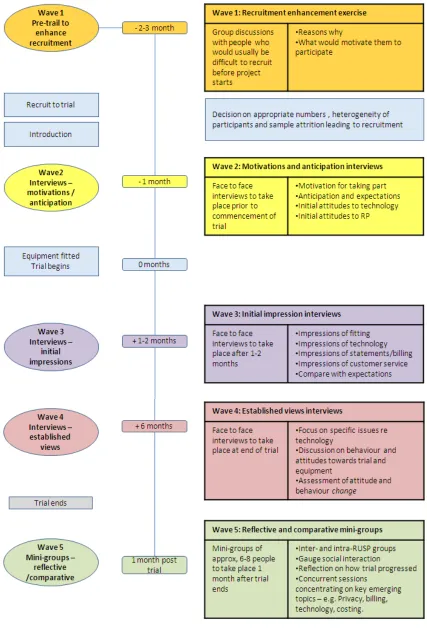
sought to define, what an appropriate methodological approach would be for any future research seeking to study user experience and acceptability of TDP services. The methodology devised is a five-wave design, based on the assumption that it would be applied to a similar trial environment to that used in the project, and involving more than one RUSP (see Section 4 for a summary of the proposed methodology itself).
Synthesising
2.15 Based on learning from the first round of the project the social research
team was tasked with advising upon ongoing RUSP examination of user experience in the second round of the project. In turn the requirement was to synthesis the ongoing learning taking place in the project and combine this with the earlier elements in order to provide a final account of user experience (i.e. this Report).
2.16 The next Section provides the account itself of user experience and
3
Insights into user experience and attitudes
Caveats to the insights presented
3.1 Before moving to the insights into user experience and attitudes it is
important to provide and reinforce some contextual caveats.
3.2 The chief purpose of the project was to gain knowledge and experience of
the relevant technology, and not to conduct social research per se. In the case of the RUSPs, therefore, the social research emphasis was necessarily on how the users responded to the specific technology in question, not to attempt to replicate earlier much larger studies on the social acceptability of road pricing which examined a full range of wider and more long-term questions.
3.3 The RUSP users in the project included a diversity of types of individuals,
comprising a heterogeneous mixture of employees, customers and members of the public. Their selection depended on the character and method of approach to recruitment of the particular RUSP. To a large degree users were self-selecting, being those with an interest in and motivation for participating. Similarly, the 20 interviews conducted within the social research study concerned a sub-set of RUSP users who, upon their original recruitment, had indicated a willingness to be approached. In short, RUSP users were selected for the purposes intended within the project’s technical examination of TDP service delivery – not with an intention of being in any way representative of the wider cross-section of road vehicle drivers. Insights from this specific sample of individuals have to be seen in the context of the large body of existing research material which exists on attitudes to road pricing2. It should also be emphasised that the users were
interviewed at a particular moment in their experience of the project which itself evolved over time in terms of the user experience.
3.4 Taking these considerations and caveats on board, the key findings outlined
below provide insights into the distinctive TDP user perspective and rather more uniquely capture user views in the context of experiencing the operation of a specific driver monitoring and ‘charging’ system.
3.5 The insights gained can broadly be split into two sorts: those concerning
users’ responses to the system presented to them; and those about pricing and travel behaviour generally. These latter issues and responses are of course conditional on future circumstances, in terms of their relevance to TDP pricing.
3.6 The methodology chosen for carrying out interviews with the selected
sample of users involved a roughly chronological approach of taking users through their experience from their first contact with the project to their most recent situation, namely in the sequence: motivations for joining;
2 In particular a major social research study commissioned by the DfT:
initial approach and installation of equipment; receiving and responding to the billing information; response to maps; their (then) current wider views and reflections about the technology and road pricing in general. This approach is also aligned with the emergent thinking on how a social
research methodology would be developed that captures users’ experiences and views as they evolve over time. Accordingly the same chronological time frame is used below to report what insights into user experience have been secured.
3.7 As is normal in reporting the results of qualitative research, a number of
selected quotes using the actual words of the respondents are included which can assist in clearly illustrating how they are thinking.
Motivations for joining the trial
3.8 Motivations for joining the trial can be categorised into three groups -
interest, loyalty and incentive. Interest
3.9 Interest, broadly speaking, means interest in seeing the project, research,
and technology develop. It can be sub-divided into the categories of road policy and pricing; and technology.
3.10 Interest in road policy and pricing encompasses wanting to know how the
technology works, but also a keen interest in getting a better understanding of the pricing structure from the inside. As one user expressed it:
“It was more of an interest and yes if I am going to know, I am going to be one step ahead, and even if it doesn’t come off, or it does come off, I want to be thereabouts and know roughly what it is going to cost me” (Male) 3.11 The majority of users had quite a fatalistic view to the introduction of a
national road pricing scheme, and considered that implementation of a scheme may well be just round the corner, the trial itself being interpreted as evidence of that. Consequently, their perception was that, as road pricing was inevitable, taking part in the project gave them the opportunity to understand better what it entails, in terms of both the technology and the pricing scheme itself. This meant that there was a sense of being ‘ahead of the game’ through being in the know. This inside knowledge, it was felt, would therefore place them in a strong position to deal with any problems encountered in an implemented scheme.
3.12 Some users hoped that their views could make a contribution in shaping the
scheme. Perhaps more significantly for any future development of TDP, some users felt that they wanted to ‘represent’ to government the needs and views of a particular section of society. Those mentioned included: people who have no choice but to drive at peak times; mothers of young children; housewives; and those who travel high mileages as part of their jobs. For example:
3.13 With regard to interest in technology, curiosity tended to be most common
with people who had technological know-how. Thus people in this category had a desire to help develop the technology and understand issues around the trial. There was a belief that, through being in the know, one would have a better basis for critiquing the initiative. One user observed:
“It’s interesting because it’s something new and it’s nice to get involved in something so important, so I was interested in that sense. And also because it’s similar to the line of work we’re in anyway. I understand trackers, how they work and how useful they can be, so I understand the benefits of having a tracker as well, so I did find it interesting…it would be good to be involved. And they also mentioned that they might do research, further research with people like you doing these interviews and things” (Female) Loyalty
3.14 In the case of motivation through loyalty, this could be either company
based or from a customer perspective – i.e. individuals were keen to see ‘their’ RUSP do well in the project.
Financial incentive
3.15 Financial incentive was the main reason for taking part for only a minority
of users. For the majority, this financial incentive was acknowledged and appreciated, but it was not the main motivation for participation.
Initial approach, installation and use of equipment
Recruitment
3.16 As noted earlier, there was a wide variety of methods for recruiting users
amongst the different RUSPS, although in all cases the emphasis was on seeking willing volunteers to assist in testing and developing the technology-based services, rather than obtaining a sample representative of the wider public. It was therefore likely that, by a process of self-selection, users would be those with an interest in the process and implications of road user charging, or the technology involved, or both. In this context, it was
significant that, amongst the respondents, sensitivity in joining the trial included concerns of speeding data being recorded and being reported to the police, and that such data could be used by government to detect speeding offences (one user felt that government would have to deal with this by ensuring automatic speed limiters were fitted to all vehicles). As one user put it:
“If we were caught speeding, could it(TDP data) be used in that sense, or vice versa, if (we) could we use it against the police, so that they knew we weren’t speeding?” (Female)
3.17 This concern indicated that, from the outset, some users were looking
Installation of equipment
3.18 Installation of equipment on the whole was seen as being efficient, with
RUSPs employing a mixture of fitters and users themselves installing the equipment. From the perspective of the users, the fitting of the TDP equipment could arouse feelings of uncertainty, and one RUSP raised the possibility of installers being qualified to answer users’ questions on such issues as use of data. In a similar vein, another RUSP emphasised that the start up of a new system required an extreme ramp up of resources, as no users could be expected to plan ahead. Overall, these conclusions suggested the need to offer users advice and support on a repeated and continuing basis.
3.19 In some cases, users were concerned that the equipment should be installed
in an unobtrusive position, chiefly because of fear of theft (and hence related damage to their vehicle). One RUSP noted that a substantial number of users were found during the trial to have moved the equipment to a different point in their vehicle. It was also reported that one RUSP had asked the installer of the in-vehicle equipment to place it in different positions for different users, such as overt and unobtrusive, and then obtain user feedback. Notwithstanding user concerns about having the equipment in a hidden position, there were no cases where presence of equipment, wherever positioned, appeared to interfere with driving (either physically or psychologically).
3.20 One RUSP provided a summary of its conclusions, based on its own
experiences, with regard to what it believed the majority of users wanted with regard to the OBU. These factors included being able to choose from a range of OBUs. Ideally, the user would like to have an OBU that they
themselves could install easily, but would be satisfied also to have a professional fit it. They would prefer the OBU to be hidden, but would also like it to provide value added services, including the display of the actual road user charges.
Data continuity
3.21 In the case of a few users, the equipment was found during the first round
of the project to have the effect of draining the car battery if the vehicle was not used for a period. Other users had problems when they
inadvertently disconnected the power to the in-vehicle equipment. These are illustrative of teething problems that are usefully identified during such trials concerning both the technology and the way in which the vehicle is used. In response to this for the second round, the RUSP solutions were modified to improve power management. The DfT also stipulated some form of back up battery should be supplied to the in-vehicle equipment, to
ensure continuity of power to the device. This was intended to ensure consistency in the charges to the user.
3.22 Similarly, another reported problem was the continuity of collection of data
such problems. This may not be a substantial issue in terms of revenue loss for an ‘average’ driver, but may be more so for a driver making many short trips with reasonable engine off breaks between them. Hence taxis may benefit most from any ‘grace’ on TTFF, if this approach were chosen. Information add-ons
3.23 While the purpose of the Demonstrations Project had been to demonstrate
how TDP services might be offered as part of the wider market for
telematics services, and RUSPs had been allowed (and even encouraged) to offer the TDP service as part of a package of telematic services, only one of the four RUSPs actually did this. For this RUSP there were signs that users were making comparisons of pros and cons in terms of the package of services as a whole rather than treating TDP in isolation. There were some indications, though not necessarily unprompted, that users would have welcomed more information add-ons with regard to OBUs, such as fuel efficiency, carbon emissions etc. During one interview, the potential for a type of Oyster Card system for road pricing was considered a good idea, which could then incorporate carbon emissions, and payment for parking in London. The Demonstrations Project was not therefore able to fully explore the degree to which TDP pricing might be made more acceptable by
incorporating it within a suite of driver/traveller information functions and services.
Access and presentation of billing information
3.24 For the purposes of ease of technical evaluation, each RUSP provided a
website which users were required to log into in order then to access and check their weekly statement of recorded driving. Participants themselves appeared generally satisfied with this mode of access to user statements. During the first round of the trials RUSPs were required to enable the user to provide feedback on the accuracy of their statement and accordingly RUSPs required their users to check their statements on a weekly basis which most did (although one user had not checked his statement at all). For some users, they were checking their statements in the same way at the point when they were interviewed part-way into the first round of the project as at the start; however, several users did admit that they did not need to check so thoroughly on an ongoing basis, particularly where they travelled regular routes each week, with the emphasis here switching to looking for oddities in the statement, rather than the detail. In this context, one RUSP found that an ‘accept all trips’ facility was welcome for those who travelled many miles, and had many charge records.
3.25 At the same time, a RUSP observed that some users wanted more detail on
their bill, and others less, so that it would not be possible to impose a ‘one size fits all’ billing. RUSPs also noted that the lack of real money in the context of the technical trials was a significant factor in motivating users to check and query their statements.
3.26 In the second round of the project the user was no longer required to
not now required to spend long periods of time checking and verifying the accuracy of their statement. Nevertheless, all the RUSPs continued to encourage feedback from users by a variety of means. They found the feedback from the statement (in terms of the user comments, and the confirmation of accuracy) useful, as it helped them to identify areas where their service could potentially be developed further. In the case of one RUSP, the group of new users recruited for the second round to replace a small number of users from the first round of the project was kept separate, for feedback purposes, from those users who had also experienced the first round before moving into the second. This was in order to identify any differences in responses between the two groups.
Understanding the statement, customer service and odometer readings
Understanding the statement
3.27 In terms of understanding the statement, the majority of users maintained
that they understood it completely. When probed, this appeared to mean that they understood the statement as well as they thought they needed to. In many cases users did not have a clear understanding of what the details actually meant, often making assumptions and saying: ‘Well, it’s pretty obvious this means that…’ whereas in reality they had little or no understanding of what it meant. For example:
“Well, no, the book didn’t say that but I think they’re self-evident. I don’t know, but it says distance all the time so I’m not quite sure…but it’s distance, so that type of measurement, I don’t know…Time, yes, yes, and each section, distance. I don’t know what time class is either. That one, which is interesting. In fact now, you’re making me look at it more closely, it’s the first time I’ve been really been bothered about that column. I’ve noticed the charges but I mean I don’t know, I don’t know what the rate is for the charging, so one can’t verify that…Time and classification, or it must be time classification, I suppose. I could go back and check…” (Male) 3.28 Several users (also) said they would have liked more information and
guidance from RUSPs about reading the statement, and there were indications of the checking process taking much longer than they had anticipated (during the first round of the project). Nevertheless, the
majority of users appeared content with the level of understanding they did have of the statement. In addition, this checking process, as a requirement in the first round, was an inevitable feature of the technical trial, and was also made more difficult because car use was reported (in the first round of the project) according to travel in different geographic areas rather than by specific roads or ‘journeys’.
3.29 In terms of understanding the statement, one RUSP noted that a complex
costs down, e.g. by information on alternative modes, more cost effective routes, scheduling journeys at cheaper times of day, and how the vehicle class may affect charges.
3.30 This dual need for a simplified statement, alongside more general travel
information, again raises the issue of increasing user acceptability by making TDP pricing an integral part of a much larger information system. 3.31 During the first round of the project there had been some user feedback to
RUSPs indicating a preference for being able to relate their driving to journeys, rather than to other types of provided information, such as by district or road. In the second round of the project accordingly there was a requirement to be able to define a charge record according to the beginning and end of a ‘journey’. Each RUSP was left to determine the method for detecting an end of journey event that best fitted their system.
Customer service
3.32 The RUSPs had a variety of customer support methods. Amongst interviewed
users there was, with one or two exceptions, satisfaction with the back-up provided, but with the proviso, noted above, that more information could have been given with regard to understanding the statement etc. However, there were one or two cases where users felt that queries on their
statement had not been satisfactorily answered, or even ignored. It should be noted that the number and intensity of queries would be likely to be greater where actual sums of money were involved in an implemented system and so customer support approaches would come under much greater scrutiny.
Odometer readings
3.33 During the first round of the project, users were expected to record their
odometer readers on a regular basis – this providing a means for the RUSPs and DfT to check weekly records according to the OBU of distance travelled. In most cases, interviewees checked their odometer on a weekly basis. However, few made the connection between checking the odometer reading and the mileage total on the statement in order to compare the two.
Odometers are known to have their own tolerances of inaccuracy and are not therefore robust as a source of precise checking. However, it should be noted that in principle the odometer does offer a specific alternative and independent source of information for the user, in order to check and verify (or challenge) the stated distance travelled on the statement. While this significance appeared not to be picked up by users in the project, in the context of a real system users may be more motivated to rely upon the odometer or other more sophisticated ‘self-tracking’ devices (such as Sat Navs and hand-held devices like the iPhone) as an independent basis for lodging challenges to statements.
Accuracy
3.34 Some respondents were surprised by the accuracy of the data, including
the level of journey detail and its accuracy. In terms of accuracy, there were mixed messages. For example, one participant said the accuracy was “scarily good” (Male). At the same time, several users (in the first round of the project) raised the issue of missing data, such as that caused by
problems with TTFF (as noted above). This observation again emphasises the importance of providing the necessary information to users even if, such as that concerning TTFF, it has negative connotations.
3.35 At the same time, it should be stressed that, in the majority of cases where
it applied, users were not unduly concerned about any gaps in journey data, as they considered these not significant enough to make a major difference to weekly mileage totals (although some stressed this might be different if actual sums of money were to be involved, rather than the assumption of hypothetical monetary values).
3.36 Consequently, overall there was a relatively low number of queries to RUSPs
concerning the contents of the user statement amongst the respondents. In one or two cases, gaps in data had caused users to query each of several statements. On these occasions, users felt that their queries had not been satisfactorily answered by the RUSPs. However, the more typical response accepted the basic accuracy of the statement. For example:
“I’ll find it particularly interesting because I’m surprised how accurate it is, really. And I do look at these every one individually and obviously look at it pretty thoroughly before I tick the box and I really…as I say, I haven’t found anything that I disagree with.” (Male).
3.37 In this context, it could be said that perception of accuracy on the part of
the user can be as important as absolute accuracy on the statement itself. The question of accuracy is therefore closely bound to perceptions of trust.
Maps
3.38 Maps and their accuracy have important implications for questions of both
accuracy and trust. Where available, interviewees generally found maps to be a significant help in checking the statement, particularly when driving in less familiar areas. This favouring of maps can be perceived in the context of users much preferring to check discrete journeys, rather than being split up by crossing local authority boundaries (as was the case in terms of initial technical developments in the first round of the project). Nevertheless, one RUSP highlighted an important trade-off, in that GPS errors become visible when maps are displayed. One source of information can therefore
undermine trust in another, and so influence user perceptions of system accuracy overall.
3.39 In turn, this raises the salient question of the degree of accuracy it is
that in no case are maps likely to be updated more than once a quarter, with the result that occasional anomalies will occur. There is therefore something of a dilemma here for user acceptability, between giving the user more information, but with the risk that its total accuracy cannot be
guaranteed. However, mapping update rates and hence accuracy and completeness may change over time given the advent now of a range of examples of users being able to contribute mapping updates into systems.
Perceptions of pricing
Units of pricing
3.40 It was significant that most interviewees (and indeed quite possibly many of
the users overall according to RUSP feedback) perceived that ‘charge units’ (i.e. the numbers set out on the statement under the headings of journey costs and totals) were in fact actual sums of money, although no such connection between units and money was intended in the project. (Indeed there was evidence, even in the face of explicit attempts to remind users of this at the start of the second round of the project, of users reacting with feedback about the new ‘prices’.) For example, 1.99 was readily taken to mean £1.99, so that users were able to inspect the ‘bill’, compare it with their current expenditure on driving in practice, and consider how these prices would affect them. The numbers chosen in the statements from all RUSPs were of orders of magnitude that made such interpretation credible. In several cases, this seemed to reinforce assumptions for users about the inevitable introduction of road pricing. Thus they had studied these ‘sums’, and in turn expressed their opinions on their validity and fairness.
Accordingly a lot of people found the ‘cost’ column to be the most interesting of the entire user statement. For example:
“If this scheme was to be introduced, and it was to replace road tax, then doing this trial, for me it’s interesting to see if I did this journey every day, how much is it going to cost me over a year, and is that more or less what I am paying now to have my car on the road?” (Male)
3.41 Another quote, noticing the detail:
“Yes, because I am doing an average mileage and you have only got to calculate it, haven’t you, over 52 weeks, that’s what I am doing, not allowing for unforeseen circumstances, then that is what it should be, £156 or something, so it is actually £30 less than the thing, the tax, but that is not calculating for what it is going to be, but you can see what the
difference is going to be roughly.” (Male)
3.42 Most people admitted to not understanding the costs and how they are
worked out, though still take them at face value and make interpretations and judgments based on that.
3.43 In cases where users did not treat total ‘units’ as being real, most would
Driving behaviour
3.44 Even when individuals believed these to be real charges, driving behaviour
was not influenced or current routes thought about (although one interviewee had tried out different routes when she started receiving statements, simply to explore the ‘price’ differences). It seems that (even when viewed as £s and pence) users were not actually paying this money or being charged, although most interviewed users also claimed they saw no practical alternative to their existing regular driving patterns. Meanwhile feedback via the RUSPs suggested that presenting people with records of their driving behaviour can have a rather different effect. People may not previously have been aware of the habits they had formed and the
inefficiencies in their behaviour that they had absorbed and lived with. Being confronted with driving records can bring these ‘bad habits’ back into their consciousness with possibilities for at least intentions for review of changes to their own behaviour. How individuals might respond
behaviourally in the context of a ‘real’ pricing system would be related to a multiplicity of factors possibly including but not necessarily only concerned with price.
Trust, privacy and security
Monitored driving behaviour
3.45 Most interviewees were not particularly concerned about having their
driving behaviour monitored in the project though, as noted above, some did express concerns (or stressed the potential advantages) when
speculating on speeding behaviour being monitored – i.e. being able to be exposed for speeding through data collected on their driving behaviour for the TDP scheme or being able to defend a claim of speeding if the TDP data showed otherwise. The nature of RUSP users and their self-selection may play a part in this insight. In other words people who had privacy and speeding concerns, and who did not have these eased (by themselves, family or the RUSP) early on in recruitment and their joining the project, may not have subsequently joined the project. However, in the absence of further evidence, this is not to suggest that RUSP users are de facto atypical of road users in general in their lack of concern about being monitored. Privacy and confidentiality
3.46 All of the users who were interviewed were either happy with the
safeguards of privacy and confidentiality provided by the RUSP, or had not considered it an issue. This was so even if they were quite uninformed about the technical processes of privacy and security assurance involved. Internal users particularly seemed to trust their company, though when people considered a different (non-specific) RUSP company (i.e. one they did not work for), trust was lower.
3.47 As part of the second round of the project, DfT required RUSPs to provide a
applying a relatively low level of required minimum detail the apparent privacy of the user was enhanced. RUSPs in turn were expected to offer users a choice about whether to have a finer granularity of detail which implied less privacy (at least between the user and the RUSP) and to then investigate user response to this choice. The ability to ‘drill down’ into statement detail is an emerging feature now in other areas of charging such as phone use. It can be argued that demand to drill down may be limited across users but the option to can give reassurance that the RUSP has ‘nothing to hide’.
3.48 Whilst users did not have undue concerns about their regular driving
behaviours being monitored (saying they had nothing to hide) it was
common for them to express the feeling, nonetheless, that being monitored felt ‘a bit Big Brotherish’. The latter suggests perhaps ‘popular wisdom’ which is typical of messages relayed by the media while the former offers an indication that privacy may not after all be the ‘problem’ it can be supposed.
Data security
3.49 In the first round of the project, the DfT did not place any requirements on
the RUSPs in relation to privacy, except to say that any dealings with users should be compliant with the Data Protection Act. Moving into the second round, the DfT included a new requirement to enable the RUSP to offer an enhanced level of privacy to users. The new requirement mandated that the RUSP must not associate the process of calculating the charge with the user’s personal data. It was only when the user statement was prepared that the journey and charge data could be brought together with the user’s personal data. The RUSPs were required to explain the enhanced privacy to users.
3.50 It was already apparent in the first round of the project, before enhanced
technical measures for privacy were introduced, that the technological approaches to data handling did not appear to be a high concern amongst users. Internal users for example seemed happy with the data stored by their company, and trusted the RUSP. On the other hand, trust in the government was not so high. For example:
“Well obviously we are in a trial at the moment, so I know that the company is collecting the data and storing it, and that’s fine, I am quite happy with that. I guess Big Brother phobia possibly would set in, in that I am distrusting the present government. I feel that it could be actually used potentially to plot where people are all the time, because they could actually see from this where you are.” (Female).
3.51 The insights above suggest that an important distinction in terms of
Perceptions
3.52 Contrary to the apparent lack of concern about privacy amongst RUSP users
themselves, there was a view during round one of the project that there might be much greater concern about privacy within the population as a whole, particularly where the individuals had personal reasons for not having their journeys traced. There were indications of users having concerns about system security, especially in the context of a fully
implemented scheme – for example concern about scope for fraud and the criminal element being able to avoid being charged.
3.53 Several users were much more uneasy about a government run road pricing
system than about taking part in a project where they were dealing with RUSPs. Many made reference to recent cases of government being linked to lost or stolen personal data. Consequently, trust in the government seemed lower than trust in the RUSPs. These doubts were widely evident, despite the fact that users accepted that the project was initiated by the
government – but seemingly placed faith in the RUSPs as ‘intermediaries’. 3.54 Where users expressed opinions on a possible trade off between privacy and
provision of journey information, it was generally concluded that much would depend on individual preferences.
Traffic congestion and attitudes to (TDP) road pricing as a solution
Congestion
3.55 It was common for interviewees to have been affected personally by traffic
congestion. The shear amount of traffic on the road was a common reason given, but there were a number of other explanations offered, including a build up of traffic at peak times, lack of public transport, the school run, drivers clogging up motorways by staying in the middle lane, and motorways being closed too easily nowadays because of health and safety concerns. A variety of solutions to congestion were offered by users, including major improvements in public transport, more freight being carried by rail, and an expansion of the road network. Unprompted, many people felt that flexible working could ease congestion. Some people also saw flexible working would give companies more work time coverage from early in the morning to late at night.
3.56 Respondents had not spontaneously thought about road pricing as a
potential solution for congestion. Attitudes to road pricing
3.57 There were a variety of attitudes towards road pricing in general, with a
fairly even split for and against (among users from the different RUSPs). On the whole, people were more sympathetic to specific local or regional toll schemes, such as the M6 Toll and the London Congestion Charge, compared with the concept of a countrywide road pricing scheme.
3.58 Respondents felt that if road pricing were to be implemented the revenue
commonly held view that, in the long run, road pricing would be seen by government as just another tax, and so would disappear into the general pot of public expenditure. Most people, however, assumed that road pricing revenues would have to take the place of road tax and fuel duty in order to make it publicly acceptable.
Attitudes to TDP road pricing
3.59 When asked to consider how TDP road pricing might be used to address
congestion users’ views were mixed:
Some people felt that it could carry advantages in terms of encouraging those on non-essential journeys to travel at off-peak times.
Many people said that this would only work if flexible working were to be introduced more widely.
A common view was that it could not be an effective solution, as most people travelling at peak times had no option but to make their journeys at those times.
Similarly, a frequent concern was that it was likely to be seen as highly unfair if people who had to travel at peak times had to pay more than those able to travel at off peak times, and that the issue would have to be treated with great sensitivity.
Some took the view that this would not be solving the problem but moving it in time (lengthening the ‘peak period’) and space (from major to minor roads).
Thematic summary
3.60 While noting that several points are cross-cutting, some summarising
observations regarding user experience and attitudes can be offered under four themes.
User information and understanding
3.61 Interest in the technology as a motivation for joining the trial can have
implications for user acceptance concerning installation and use of
equipment, and interest in the degree of detail displayed on the statement. 3.62 People fitting OBU equipment could also act as providers of information and
reassurance to users, and so contribute to issues of trust.
3.63 Issues concerning information add-ons to OBUs, raise wider questions of the
degree to which user acceptability may be improved by TDP pricing being one element in an integrated information system.
Privacy and confidentiality
3.64 User perceptions of TDP data in terms of the detection of speeding (as a
sensitivity issue in joining the trial) have implications for the wider issues of data protection and privacy.
3.65 A common response by users was that issues of privacy and confidentiality
society as a whole. This ‘not about me’ reaction can implications for understanding issues of trust and user acceptability.
3.66 There are potential dilemmas in the trade-offs between enhancing trust in
the system as a result of providing a high degree of detailed information, and aggravating concerns about privacy as a result of users studying this detail.
Trust
3.67 The frequency of and time people devote to checking statement can be
closely connected to issues of trust and user acceptance.
3.68 Independent sources of information (such as the odometer) may have
significant implications for any future TDP appeals system.
3.69 Providing a high degree of map detail can enhance user trust in the system,
but can also have negative trust implications in terms of inherent difficulties in maintaining accuracy of maps.
Perceptions of pricing
3.70 Perceptions of pricing can be closely connected to motivations to join the
trial (e.g. a wish to participate because of a strong belief that the
introduction of pricing is likely, can affect perceptions about the reality of the TDP pricing system).
3.71 User perceptions concerning understanding the statement have implications
for the possibility of changing travel behaviour.
3.72 Perceptions concerning trust in the TDP system can be connected to the
4
Developing a methodology to examine user experience
4.1 Efforts within the project centred upon a developmental approach totechnical and user interface delivery issues. User experiences and views related strongly to this context. There may in future be a wish to better understand how the wider population of road vehicle users would react to the provision of TDP services and charging. This would likely be in the context of participating in further trials involving the use such services but services that have reached a more mature and steady-state in terms of their development. The social research study team was tasked with considering this future possibility and accordingly developing, in outline, an appropriate methodological approach. The first part of this section sets out relevant methodological considerations and issues associated with further enhancing understanding. The resulting methodological approach proposed is then set out in the final part of the section.
Methodological considerations and issues Recruitment
4.2 Future research would need to engage with a wide cross section of road
vehicle users to reflect the diversity in: socio-economic characteristics; driving needs and behaviours; affinity with advanced information services; and attitudes towards the concept of road pricing.
Evolving encounters
4.3 Experiences and views and opinions evolve over time. Accordingly these
need to be captured at a number of points during an individual’s
recruitment to and engagement and subsequent conclusion of involvement in a future trial of TDP services.
Implications for driving behaviour
4.4 The project’s trials of TDP schemes and services took place without any