Eiszeitalter und Gegenwart 5 2 AQ^G
3 Abb. Hannover 2003
A wild horse {Equus przewalskii P o l i a k o v 1 8 8 1 ) of Mesolithic age from Kempen
(Germany, Northrhine-Westfalia, Lippe County)
R A I N E R S P R I N G H O R N * )
S P R I N G H O R N , R. (2003): A wild horse (Equusprzewalskii
POLIAKOV 1881) of Mesolithic age from Kempen (Ger
many, Northrhine-Westfalia, Lippe County). - Eiszeitalter und Gegenwart, 52: 4 0 - 4 6 ; Hannover.
Keywords: European wild horse, Mesolithic, anatomy, individual age, systematics
Abstract: New skeletal remains of one specimen of the wild horse Equus przewalskii POLIAKOV 1881 from Kem
pen (City Horn-Bad Meinberg, East-Westfalia, Ger
m a n y ) are presented. Its sedimentary deposition immediately near Mesolithic artefacts suggests an appro
priate age of 10,000-7,000 BP. The grade of teeth abra
sion reveals an individual m i n i m u m age of 19 years. A prominenr lower canine proves male sex. A fourth molar in both lower jaws documents an unusual tooth aberra
tion, and is explained as a genetic aberration. In compar
ison w i t h already d o c u m e n t e d horse skeletons of historical times from other localities of eastern Westfalia lower premolars, and first lower molar are distinctly (4- 10%) longer and wider. Consequently, also the total chewing surface is larger. This is important, because the measurements of limb bones show a height of withers (129-142 cm) of „small shaped" to „middle shaped"
(VITT 1952) for both, the Mesolithic horse from Kempen, and the horses from other eastern Westfalian sites of his
torical times.
[Ein Wildpferd (Equus przewalskii POLIAKOV 1 8 8 1 ) aus dem Mesolithikum von Kempen (Deutschland, Nord
rhein-Westfalen, Kreis Lippe)]
Kurzfassung: Es wird neues Skelettmaterial eines Wildpferd-Individuums Equus przewalskii POLIAKOV
1881 aus Kempen (Stadt Horn-Bad Meinberg, Ost
westfalen, Deutschland) vorgestellt. Seine Lage im Sedi
ment unmittelbar neben Flintabschlägen der Mittelsteinzeit legen ein entsprechendes Alter von 10.000-7.000 Jahren
*) Anschrift des Verfassers: Prof. Dr. Dipl.-Geol. RAINER S P R I N G H O R N , L i p p i s c h e s L a n d e s m u s e u m D e t m o l d , Ameide 4, D-32756 Detmold, Germany. E-mail: Spring- [email protected]
vor der Gegenwart nahe. Der Abkauungsgrad der Zähne ergibt ein Individualaltet von wenigstens 19 Jahren. Ein kräftiger unterer Caninus beweist, dass es sich u m einen Hengst handelt. Die Existenz eines vierten Molaren in beiden Unterkieferhälften ist außergewöhnlich und wird als genetisch bedingte Abnormität gewertet. Im Vergleich mit bereits publizietten Pferden aus historischer Zeit von anderen ostwestfälischen Fundorten sind die unteren Prä
molaren und ersten unteren Molaren deutlich länger u n d breiter ( 4 - 1 0 % ) . Analog hierzu ist die Kaufläche ins
gesamt größer. Dies ist deshalb bedeutsam, weil die M a ß e der Extremitätenknochen eine Widerristhöhe von 1 2 9 - 1 4 2 cm ergeben, die den Kategorien „kleinwüchsig"
bis „mittelwüchsig" (VITT 1952) entsprechen, die sowohl dem mittelsteinzeitlichen Kempener Pferd als auch den Pferden historischen Alters anderer Lokalitäten in Ost
westfalen zugeordnet werden können.
1 Introduction
In Octobet 1 9 8 9 neat the village Kempen in the eastern Westfalian county Lippe, during an excava
tion for a filter bed skeleton remains of the w i l d horse (Equus przewalskii) were found. T h e y had been deposited in a Postglacial earthy marl of a for
mer pool, collecting water of three creeks which had been running into the little river Durbeke.
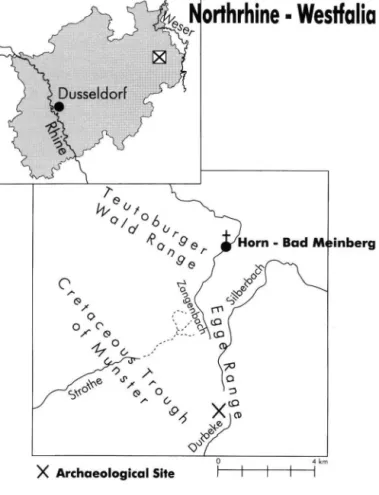
The little archaeological site is situated in the north
ern part of the Egge Range.
The bones lay in a depth of 1 . 8 0 m below sutface niveau. Beside the horse bones, regarding other species, one right metatarsal of a roe-deer (Capreo
lus capreolus) has been identified. Directly at the basis of the bones, in an undistutbed sedimentaty context, was some flint waste flake of Mesolithic age
( L U L E Y 1 9 9 0 : 2 4 - 2 5 ) . T h e finder was J O H A N N E S G L I T Z (Campingplatz Eggewald, 3 2 8 0 5 Horn-Bad Meinberg, Ortsteil Kempen). - The well pteserved lower jaws show significant teeth aberration w h i c h is worthy to be documented. Complete limb bones allowed the calculation of withers height, and a comparison with known historical horses.
Northrhine - Westfalia
Bad Mi tinberg
X Archaeological Site
Fig. 1: M a p with the archaeological site in the notthern Egge Range
Up to now only two horse skeleton complexes from eastern Westfalia with ascertained ages are pub
lished ( S P R I N G H O R N 1 9 8 0 and 1 9 9 1 ) . Both are of historical age. Moreover, the tegion between Rhine and Weser is absolutely lacking in Mesolithic and early Neolithic hotse material ( D Ö H L E 1 9 9 9 : 1 5 2 ) . The assumed Mesolithic age ( 1 0 , 0 0 0 - 7 , 0 0 0 BP) of the material presented in this papei stresses its importance.
Meanwhile, the existence of Equus przewalskii du
ring the early Holocene of Northwest Europe is proved by the well known Mesolithic in the Lower and Centtal Rhineland. Mesolithic sites after 1 0 . 0 0 0 BP of stone tool assemblages tevealed horse remains and indicate "that the Preboreal forest cover was by no means closed" ( S T R E E T & B A A L E S 1 9 9 9 : 2 9 ) . Farther to the Notth, in South Scandinavia,
thete have been found no Mesolithic sites of Preboreal age ( 1 0 , - 9 , 0 0 0 BP) with preserved horse bone material. In this area Equus przewalskii seems to have a rather brief occurrence, "beeing confined to the open birch-pine period of the Preboreal, but with an interest
ing later re-immigration of Equus in the transition between Atlanticum and Sub- boreal" ( A A R I S - S O R E N S E N 1 9 9 2 : 1 4 8 ) .
2 Material and Methods
The here described new horse material is housed in the Lippisches Landes
museum Detmold, Department „Boden
denkmalpflege" (DKZ No. 4 1 1 9 , 1 2 2 ; U-No. 1 5 8 1 ) . Measurements were made to the nearest 0.1 mm by an anthro
pological orifice plate, and a calipet square I N O X from the firm M A U S E R .
Calculations of withers height base upon the works of K I E S E W A L T E R ( 1 8 8 8 ) , V I T T ( 1 9 5 2 ) , and especially the critical revision of v. D . D R I E S C H &
B O E S N E C K ( 1 9 7 4 ) . Anatomical nomen
clature for dentition and skeleton was adopted from A L B E R D I ( 1 9 8 9 ) , N I C K E L , S C H U M M E R & S E I F E R L E ( 1 9 7 7 ) , and S I E G F R I E D ( 1 9 8 3 ) . Individual age detetmination criteria by incisot abra
sion were used in the sense of B R Ö M -
L E R ( 1 9 5 4 ) . The photographic documentation of bones and teeth were made by a digital camera N I K O N C 9 9 0 .
According to the cutrent litetature (cf. V O L F 1 9 7 2 , S I E G F R I E D 1 9 8 3 , N I L S O N 1 9 8 3 , S T A R C K 1 9 9 5 , and
others) for the wild horse the species name Equus przewalskii P O L I A K O V 1 8 8 1 is used, although C O R
B E T ( 1 9 7 8 : 9 4 ) , A A R I S - S O R E N S E N ( 1 9 9 2 : 1 4 7 ) , and C L U T T O N - B R O C K & B U R L E I G H ( 1 9 9 1 ) applied the oldet synonym Equus ferus B O D D A E R T 1 7 8 5 .
T h e excavation of Kempen provided several skele
ton elements of one individual: Also a few small fragments of the upper skull, three isolated incisots ( l 3 s i n . , I2 3 sin.), a right first uppet premolar ( P2) , symphyseal connected lowet jaws with left canine and complete cheek tooth rows, pectotal vertebras
4 2 R A I N E R S P R I N G H O R N
9 - 1 2 , fragments of another pectotal vertebta, the last presacral vertebra, sacrum, fragmentary left pelvis with ischium and acetabulum, fragments of six ribs, fragmentary right shoulder-blade, right tadius with distal part of ulna, left tibia, left metatarsal, and left hind phalanx I.
Description of upper dentition
Only fragmentary disarticulated premaxillas, and negligible remnants of the palate and maxillas imply existence of only a few isolated teeth of the uppet dentition.
The two documented upper incisors ( I2 3s i n . ) show subtriangular outlines; that of the I3 is sideback- wards extended. Tooth crowns are deeply chewed off. On the chewing sutfaces tracks of the enamel core, so called „yellow star", can distinctly be seen.
Due to this amount of abtasion an individual age of at least nineteen years is concluded. The angle of 4 3 degrees formed by the plane of abrasion and the direction of tooth crown and tooth root of incisors suggest also an age of at least more than fourteen years. The first right upper premolar ( P2) is also strongly chewed down; consequently its crown is now very low. The areas of fossa anterior and fossa posterior are nearly fused to a narrow ridge. The back contact usur to P3 is extreme and caused loss of the metalophus.
Description of lower jaws
The incisors bearing frontal region of the muzzle is completely broken up to the canines, but an isolat
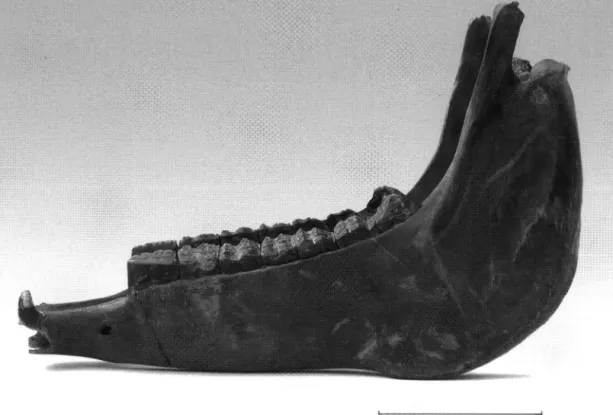
ed l3sin. is documented. Its subtriangular contout is extended sidebackwards, too. The left mandible shows a strong canine, the right one is only repre
sented by its alveole. A wide diastema separates the canine from cheek teeth. Instead of six there are seven cheek teeth. This abnormal phenomenon is documented on both sides of the mandible. The cheek teeth of the left mandible show a stronger abrasion than those of the tight one. Both tooth rows document an increasing grade of abrasion backwards posteriorly. The supernumerary seventh cheek teeth have deeply gtinded off trigonids, and hypoconids. The moderate abtasion of entoconid and talonid of both last molars is possibly referred to the lack of an antagonist on the upper jaws, might, however, be traced back also to the sloping position in the basal part of the ramus ascendens.
Tracks of chewing on tooth surfaces are strictly transverse. M a i n l y the surfaces of P 4 - M 3 are extremely furrowed.
On the right mandible thete is a zig-zag crack latet- ally running down from the irregular molar to the ventral margin of the j a w bone, caused probably by drying after excavation. The medial wall of the ramus ascendens is lightly damaged, the medial p a n of the processus glenoidalis broken. The left man
dible had only been damaged at the uppermost top of processus coronoideus.
3 Results and Discussion
The modern horse Equus przewalskii P O L I A K O V
1 8 8 1 made its appearance known in Europe in 4 - W ü r m II stadial ( K U R T E N 1 9 6 8 : 1 5 0 ) . According to
W I E G A N K ( 1 9 8 3 : 3 5 8 ) and N I L S O N ( 1 9 8 3 : 4 7 8 )
Equus przewalskii already is beside Equus germanicus the relevant horse of the early Weichsel Glacial ( 4 - W i i r m I stadial sensu K U R T E N ) . However, I agree with S T A R C K ( 1 9 9 5 : 9 7 1 ) that, despite of a gradual decrease in size of the wild horse since the Middle Pleistocene ( F O R S T E N 1 9 9 3 , K O E N I G S W A L D et al.
1 9 9 5 ) , there is hardly no real morphological differ
ence to specialize distinct species. That is w h y I do not see any evidence to establish neither a valid more robust species Equus germanicus N E H R I N G
1 8 8 4 nor a medium sized Upper Pleistocene hotse Equus remagensis ( N E H R I N G 1 8 8 4 ) (cf. N O B I S 1 9 7 1 :
4 6 ) . T h e species K przewalskii had been common in the postglacial. The skeleton material presented here is ptesumably of Mesolithic age. Robustness of the left lower canine proves male sex of the speci
men. Corresponding by the amount of incisors abrasion an individual age of at least nineteen yeats is supposed. This is supported by the natrow angle between their abrasion surfaces relative to directions of tooth crowns and roots. Enamel faulting and tooth structure confirm three premolars (P2-4) and three molars (M1.3) as normal elements of lower jaw dentition. The irregular seventh tooth exhibits the same pattern as M 3 , but is anteropostetiotly weakly comptessed. According to its position in the jaw bone thete must have been a lengthening of the molateous motphogenetical compartment duting embtyonic ontogeny. Subsequently thete was a tooth germ installation of a fourth lowet molar.
In comparison with the eatly Mesolithic horse
10 cm Fig. 2a: Lower jaw of Equus przewalskii from Kempen; lateral view of left mandible.
Fig. 2b: Lower jaw of Equus przewalskii from Kempen; occlusal view.
44 R A I N E R S P R I N G H O R N
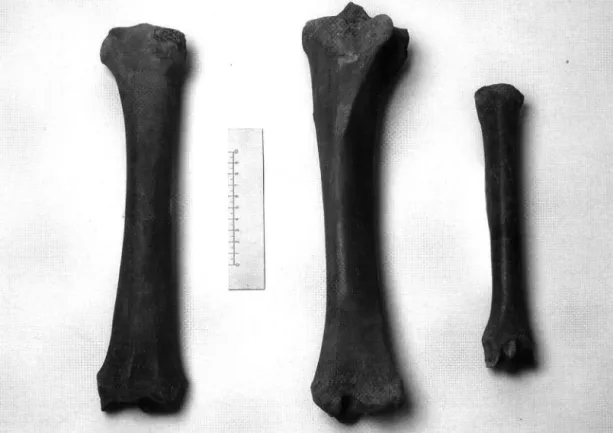
Fig. 3: Limb bones of Equus przewalskii from Kempen; from left to right: Radius dext., tibia sin., and metatarsale sin.
mandible from Seamer Carr (Yorkshire, England) the measurements P2-M3 exhibit modetate differ
ences ( C L U T T O N - B R O C K & B U R L E I G H 1 9 9 1 : 2 4 0 ) . The premolars throughout are somewhat shortet, but on the contrary, the molats are of equal length ( M i ) or slightly longer All cheek teeth are signifi
cantly wider with exception of P3 showing equal width.
The lower jaw teeth of the horse from Kempen, regarding premolars and first molar, are, compared with those of the historical hotses from Wiinnen- berg-Fiirstenbetg, and Lage-Müssen ( S P R I N G H O R N
1980 and 1991) throughout longer and wider (4- 1 0 % ) ; M2 and M 3 are wider but mainly shorter.
This relative shortness certainly is depending on the claiming by M 4 . The total chewing sutface of the tooth row P2-M3 measures 31.38 cm2, that of P2- M4 34.65 cm2. The largest specimen of the historical horses documents a chewing surface of close to 31 cm2. Measurements of the limb bones, modified after
D R I E S C H & B O E S N E C K (1974), yield results which show certain differences regarding height of with- ers. The data of radius (140 cm) and tibia (142 cm)
are approximately equal, but the metatarsal (129.3 cm) is significantly smaller. The corresponding classi
fication of V I T T (1952) assignes horses with height of withers between 136-144 cm to the category
„middle shaped" and those between 128-136 cm to
„small shaped". The discrepancy of about 13 cm and 11 cm, respectively, is important. On the other hand D R I E S C H & B O E S N E C K ( 1 9 7 4 : 3 3 3 - 3 4 ) documented two historical hotse skeletons from the awatian funeral ground of Vienna-Liesing showing differences of 10.3 cm and 9.5 cm. T h e authors communicated also that measurements of one speci
men mostly fall into two categories of V I T T . The ascertained heights of withers coincide completely with those of Przewalski Horse by V O L F (1972: 564):
120-146 cm. Historical horses from the two archae
ological sites in eastern Westfalia ( S P R I N G H O R N
1980 and 1991) d o n ' t differ significantly in abso
lute size, but demonstrate the variability of the domestic successors of Equus przewalskii. In addi
tion, dealing with Mesolithic and Neolithic hotse bones, it is not possible to distinguish between the wild and domestic fotm ( D Ö H L E 1999: 151). Thete
is also a coincidation in heights of withers ( 1 4 1
—145.5 cm) with the Late Pleistocene hotse of Remagen near Bonn ( N O B I S 1 9 7 1 : 4 7 ) . The m e a n height of withers of Merowingian-Karolingian hors
es (6-7th and 9th century) from Wünnenberg- Fürstenberg is 139 cm, and falls into V I T T ' S categoty „middle shaped" hotses. T h e mean height of withers of medieval horses (10-11th and 13th century) from Lage-Müssen is 144 cm and fits just the uppet limit of this categoty.
Measurements in mm:
Length of diastema Cinf. - P2sin. = 59
H e i g h t of r a m u s ascendens u p to processus glenoidalis = 2 0 4
Height of the ramus horizontalis below P4 = 7 2 , M i
= 74.7, M3 = 8 8 . 2 , and M4 = 9 9 Length P2- M3s i n . = 164.3, P2-M4 = 181.4
Left lower teeth: I3 ( 1 0 x l 4 . 2 ) , C (13.5x11.6), P2 (33.3x19), P3 (28.1x20.3), P4 (27.8.x21.8), M i (25.2x19.1), M2 (24.3x18.2), M3 (30.8x17), M4
(25.9x18.2)
Upper teeth: Psin. (12x13.1), P s i n (11.6x14.3), P2dext. (35.8x21)
Radius dext.: length = 326.8, lateral lg. = 3 2 2 . 5 , proximal width = 73.9, distal w d . = 7 1 . 1 , small
est circumference = 111.3
Tibia sin.: lg. 3 4 8 . 2 , It. lg. 332.6, prox. wd. = 9 3 . 2 , dist. wd. = 7 6 . 6 , sm. ccf. = 121.2
Metatatsale tertium sin.: lg. = 2 4 5 . 9 , It. lg. = 2 4 2 . . 6 , prox. wd. = 4 4 . 1 ,
dist. wd. = 4 3 . 5 , sm. ccf. = 83
Phalanx I prox.: lg. = 85, prox. w d . = 56.4, wd. of prox. facies articulatis = 4 7 . 3 , sm. ccf. 34.2, dist.
wd. = 4 5 . 8 , dist. wd. fac. attc. = 4 2 . 2
4 Acknowledgements
I thank P E T E R V O L L M E R M . A . for the incitement of the ptesented paper; he was working about stone age collections of the Lippisches Landesmuseum, and came across the wild horse material from Kem
pen. M y secretary, S O N J A H E L M I N G , who was h e l p ful in managing the computer version of m y manuscript. Photos were taken by my colleague J Ü R G E N I H L E .
I a m also indebted to Mts. A N N E T T E H I B B E L E R for compiling and drawing the map.
5 References
ALBERDI, M.-T. ( 1 9 8 9 ) : A review of O l d World Hippari- onine horses. - In: PROTHERO, D. R & S C H O C H , R. M., [Eds.]: The Evolution of Perissodactyls: 2 3 4 - 2 6 1 , 6 figs.; New York, Oxford (Clarendon Press and Oxford Univ. Press).
A A R I S - S 0 R E N S E N , K. ( 1 9 9 2 ) : Deglaciation chronology and re-immigration of large mammals. A South Scandinavian example from late Weichselian-early Flandrian. - Courier Forsch.-Inst. Senckenberg, 153:
1 4 3 - 1 4 9 , 4 figs., 2 tabs., Frankfurt a.M.
B R Ö M L E R , K. ( 1 9 5 4 ) : Die Altersbestimmung beim Kleinpferd aufgrund der Zahnentwicklung und -abnut- zung. - Diss. Univ. München: 4 7 ps., div. figs, and pits; Munich.
C L U T T O N - B R O C K , J . & B U R L E I G H , R. ( 1 9 9 1 ) : T h e mandible of a Mesolithic Horse from Seamer Carr, Yorkshire, England. - In: M E A D O W , R. H. & U E R P - MANN, H.-P. [Eds.]: Equids in the Ancient World, 2 : 2 3 8 - 2 4 1 , 3 figs., 1 tab.; W i e s b a d e n (Ludwig Reichert).
C O R B E T , G.B. ( 1 9 7 8 ) : The mammals of the Palaearctic Region. A Taxonomic review. - 3 1 4 ps., 1 0 4 maps;
Brit. Mus. (Natur. Hist.), London, Ithaca (Cornell Univ. Press).
DÖHLE, H.-J. ( 1 9 9 9 ) : Pferdenachweise aus dem Meso
lithikum u n d Neolithikum in Deutschland. - In:
BECKER, C. [Ed.]: Historia Animalium ex Ossibus, Internationale Archäologie, 8: Studia honoraria: 1 4 9 - 159, 2 figs., 1 tab.; Rahden/Westf. (Marie Leidorf).
D R I E S C H , A. V. d., & BOESSNECK, J . ( 1 9 7 4 ) : Kritische Anmerkungen zur Widerristhöhenberechnung aus Längenmaßen vor- und frühgeschichtlicher Tier
knochen. - Säugetierkdl. Mitt., 2 2 : 3 2 5 - 3 4 8 , 2 figs., 1 1 tabs.; Munich.
FORSTEN, A. ( 1 9 9 3 ) : Size decrease in Late Pleistocene - Holocene cabbaloid horses (genus Equus), intra- or interspecific Evolution? - Quaternary International, 19: 7 1 - 7 6 ; Oxford.
KIESEWALTER, I. ( 1 8 8 8 ) : Skelettmessungen an Pferden als Beitrag zu einer theoretischen Grundlage der Beurteilungslehre des Pferdes. - Diss. Univ. Leipzig:
3 8 ps., 3 shts., 2 tabs.; Leipzig.
KOENIGSWALD, W . V., W A L D E R S , M. & S A N D E R , M . ( 1 9 9 5 ) : Jungpleistozäne Tierfährten aus der Emscher-Nieder- terrasse von Bottrop-Welheim. - Münchener Geo- wiss. Abh., A 2 7 : 5 - 5 0 , 5 2 figs., 3 7 tabs.; Munich.
KURTEN, B. ( 1 9 6 8 ) : Pleistocene mammals of Europe. - The World Naturalist: 3 1 7 ps., I l l figs., 1 5 tabs.;
London (Weidenfeld & Nicolson).
LULEY, H. ( 1 9 9 0 ) : Ortsteil Kempen, Stadt Horn-Bad Meinberg, Kreis Lippe. - In: Westf. M u s . f. Archäol.
u. Amt f. Bodendenkmalpflege Münster i.W. [Ed.]
1991, Neujahrsgruß: 2 4 - 2 5 ; Münster i.W.
4 6 R A I N E R S P R I N G H O R N
N E H R I N G , A. (1884): Fossile Pferde aus deutschen Dilu- vial-Ablagerungen und ihre Beziehungen zu den lebenden Pferden. - Landwirtschaft!. J b . , 13: 8 1 - 158, Dresden, Leipzig (Arnold).
N I C K E L , R., S C H U M M E R , A. & SEIFERLE, E. ( 1 9 7 7 ) : Lehrbuch der Anatomie der Haustiere: 539 ps., 517 figs.; Berlin, Hamburg (Paul Parey).
N I L S O N , T.(1983): The Pleistocene. Geology and Life in the Quaternary Ice Age. - 65 l p s . , 237 figs.; Stuttgart (Ferdinand Enke).
N O B I S , G. (1971): Vom Wildpferd zum Hauspferd. Stu
dien zur Phylogenie pleistozäner Equiden Eurasiens und das Domestikationsproblem unserer Haus
pferde. - Fundamenta, B 6: 9 6 ps., 7 figs., 6 pits., 58 diagrs., 126 tabs.; Cologne, Vienna (Böhlau).
POLIAKOV, I. S. (1881): Sistematiceskij obzor polevok, vodjascichsja v cibri. - Imperatorskoj Akademii Nauk; Zapiski. Otcet po Fiziko-Matematiceskomu i Istoriko-Filologiceskomu Otdelenijam, Suppl. Vol.
39 ( 2 ) : 92 ps., 9 figs., 1 ph., 11 tabs.; Moscow.
SIEGFRIED, P. (1983): Fossilien Westfalens. Eiszeitliche Säugetiere. - Eine Osteologie pleistozäner Groß
säuger. - Münster. Forsch. Geol. Paläont., 6 0 : 163 ps., 4 0 pits.; Verein d. Geolog. Stud. Münster [Ed.], Münster i.W.
S P R I N G H O R N , R. (1980): Pferdereste eines wikinger
zeitlichen Siedlungsplatzes bei Müssen (Lippe). - Z.
Tierzüchtung u. Züchtungsbiologie, 9 7 : 1 1 6 - 1 2 6 , 5 figs., 4 tabs.; Hamburg, Berlin.
— ( 1 9 9 1 ) : Die Pferde des frühmittelalterlichen Kör
pergräberfriedhofes v o n W ü n n e n b e r g - F ü r s t e n berg. - Bodenaltertümer Westfalens, 2 5 : 1 3 3 - 1 6 0 ; Münster i.W.
STARCK, D . (1995): Lehrbuch der speziellen Zoologie, Vol. II: Wirbeltiere, Part 5/2 Säugetiete. - 1241 ps., 564 figs.; Jena, Stuttgart, New York (Gustav Fischer).
STREET, M . & BAALES, M . ( 1 9 9 9 ) : Pleistocene/Holocene changes in the Rhineland fauna in a northwest Euro
pean context. - In: BENNECKE, N . [Ed.]: T h e Holocene History of the European Vertebrate Fauna.
M o d e r n Aspects of Research. Archäologie in Eurasien, 6: 9-38, 3 figs., 14 tabs.; Rahden/Westf.
(Marie Leidorf).
V I T T , V. O. (1952): Die Pferde der Kurgane von Pasyryk (russisch). - Sovjetskaja Arch., 16: 163-205, 2 3 figs., 9 tabs.; Moscow.
VOLF, J . (1972): Wildpferde. - In: GRZIMEK, B. [Ed.]:
Grzimeks Tierleben 1 2 , Einhufer und Pferde
verwandte: 564-575, 8 figs.; Zurich (Kindler).
WIEGANK, F. (1983): Beitrag zur Chronostratigraphie u n d Entwicklung im jüngeren Känozoikum von Europa auf geochronologischer und magnetostratigraphi- scher Grundlage. - In: HEINRICH, W.-D., [Ed.]:
Wirbeltier-Evolution und Faunenwandel im Käno
zoikum. - Schriftenreihe für Geologische W i s s e n schaften, 19/20: 3 5 5 - 3 6 4 , Berlin (Akademie).