Predicting Tasks in Goal-Oriented Spoken Dialog Systems
using Semantic Knowledge Bases
Aasish Pappu and Alexander I. Rudnicky Language Technologies Institute
Carnegie Mellon University
{aasish, air}@cs.cmu.edu
Abstract
Goal-oriented dialog agents are expected to recognize user-intentions from an utter-ance and execute appropriate tasks. Typi-cally, such systems use a semantic parser to solve this problem. However, semantic parsers could fail if user utterances contain out-of-grammar words/phrases or if the se-mantics of uttered phrases did not match the parser’s expectations. In this work, we have explored a more robust method of task prediction. We define task predic-tion as a classificapredic-tion problem, rather than “parsing” and use semantic contexts to im-prove classification accuracy. Our classi-fier uses semantic smoothing kernels that can encode information from knowledge bases such as Wordnet, NELL and
Free-base.com. Our experiments on two spoken language corpora show that augmenting semantic information from these knowl-edge bases gives about 30% absolute im-provement in task prediction over a parser-based method. Our approach thus helps make a dialog agent more robust to user input and helps reduce number of turns re-quired to detected intended tasks.
1 Introduction
Spoken dialog agents are designed with particular tasks in mind. These agents could provide infor-mation or make reservations, or other such tasks. Many dialog agents often can perform multiple tasks: think of a customer service kiosk system at a bank. The system has to decide which task it has to perform by talking to its user. This problem of identifying what to do based on what a user has said is called task prediction.
Task prediction is typically framed as a parsing problem: A grammar is written to semantically
parse the input utterance from users, and these se-mantic labels in combination are used to decide what the intended task is. However, this method is less robust to errors in user-input. A dialog sys-tem consists of a pipeline of cascaded modules, such as speech recognition, parsing, dialog man-agement. Any errors made by these modules pro-pogate and accumulate through the pipeline. Bo-hus and Rudnicky (2005) have shown that this cascade of errors, coupled with users employ-ing out-of-grammar phrases results in many “non-understanding” and “mis“non-understanding” errors.
There have been other approaches to perform dialog task prediction. Gorin et al. (1997) has pro-posed a salience-phrase detection technique that maps phrases to their corresponding tasks. Chu-Carroll and Carpenter (1999) casted the task de-tection as an information retrieval — detect tasks by measuring the distance between the query vec-tor and representative text for each task. Bui (2003) and Blaylock and Allen (2006) have cast it as a hierarchical sequence labeling problem using Hidden Markov Models (HMM). More recently,
(Bangalore and Stent, 2009) built an incremen-tal parser that gradually determines the task based on the incoming dialog utterances. (Chen and Mooney, 2010) have developed a route instruc-tions frame parser to determine the task in the con-text of a mobile dialog robot. These approaches mainly use local features such as dialog context, speech features and grammar-based-semantic fea-tures to determine the task. However grammar-based-semantic features would be insufficient if an utterance uses semantically similar phrases that are not in the system’s domain or semantics. If the system could explore semantic information be-yond the scope of its local knowledge and use ex-ternal knowledge sources then they will help im-prove the task prediction.
(Cristianini et al., 2002) (Wang and Domeni-coni, 2008) (Moschitti, 2009) found that
domain semantic knowledge resources are use-ful for text classification problems. Their success in limited data scenario is an attractive prospect, since most dialog agents operate in scarce train-ing data scenarios. (Bloehdorn et al., 2006) has proposed a semantic smoothing kernel based ap-proach for text classification. The intuition be-hind their approach is that terms (particularly con-tent words) of two similar sentences or documents share superconcepts (e.g., hypernyms) in a knowl-edge base. Semantic Similarity between two terms can be computed using different metrics (Pedersen et al., 2004) based on resources like WordNet.
Open domain resources such as world-wide-web, had been used in the context of speech recog-nition. (Misu and Kawahara, 2006) and (Creutz et al., 2009) used web-texts to improve the lan-guage models for speech recognition in a target domain. They have used a dialog corpus in or-der to query relevant web-texts to build the target domain models. Although (Araki, 2012) did not conduct empirical experiments, yet they have pre-sented an interesting architecture that exploits an open-domain resource like Freebase.com to build spoken dialog systems.
In this work, we have framed the task prediction problem as a classification problem. We use the user’s utterances to extract lexical semantic fea-tures and classify it into being one of the many tasks the system was designed to perform. We harness the power of semantic knowledge bases by bootstraping an utterance with semantic con-cepts related to the tokens in the utterance. The se-mantic distance/similarity between concepts in the knowledge base is incorporated into the model us-ing a kernel. We show that our approach improves the task prediction accuracy over a grammar-based approach on two spoken corpora (1) Navagati (Pappu and Rudnicky, 2012): a corpus of spo-ken route instructions, and (2) Roomline (Bohus, 2003): a corpus of spoken dialog sessions in room-reservation domain.
This paper is organized as following: Section 2 describes the problem of dialog task predic-tion and the standard grammar based approach to predict the dialog task. Then in Section 3, we describe the open-domain knowledge resources that were used in our approach and their advan-tages/disadvantages. We will discuss our semantic kernel based approach in the Section 4. We report our experiment results on task prediction in
Sec-tion 5. In SecSec-tion 6, we will analyze the errors that occur in our approach, followed by concluding re-marks and possible directions to this work.
2 Parser based Dialog Task Prediction
[image:2.595.311.525.596.710.2]In a dialog system, there are two functions of a semantic grammar — encode linguistic constructs used during the interactions and represent the do-main knowledge terms of concepts and their in-stances. Table 1 illustrates the tasks and the con-cepts used in a navigation domain grammar. The linguistic constructions help the parser to segment an utterance into meaningful chunks. The domain knowledge helps in labeling the tokens/phrases with concepts. The parser uses the labeled tokens and the chunked form of the utterance, to classify the utterance into one of the tasks.
Table 1: Tasks and Concepts in Grammar
Tasks Examples
Imperative GoToPlace, Turn, etc Advisory Instructions You_Will_See_Location Grounding Instructions You_are_at_Location
Concepts Examples
Locations buildings, other landmarks Adjectives-of-Locations large, open, black, small etc. Pathways hallway, corridor, bridge, etc. LiftingDevice elevator, staircase, etc. Spatial Relations behind, above, on left, etc. Numbers turn-angles, distance, etc. Ordinals first, second, etc. floor numbers
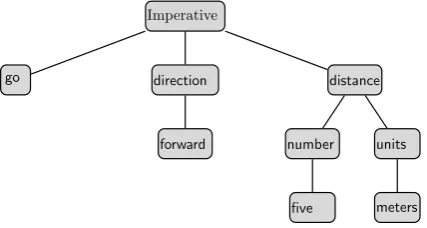
The dialog agent uses the root node of a parser output as the task. Figure 1 illustrates a semantic parser output for a fictitious utterance in the nav-igation domain. The dialog manager would con-sider the utterance as an “Imperative” for this ex-ample.
Imperative
go direction
forward
distance
number
five
units
meters
2.1 Grammar: A Knowledge Resource
Grammar is a very useful resource for a dialog sys-tem because it could potentially represent an ex-pert’s view of the domain. Since knowledge en-gineering requires time and effort, very few di-alog systems can afford to have grammars that are expert-crafted and robust to various artefacts of spoken language. This becomes a major chal-lenge for real world dialog systems. If the sys-tem’s grammar or the domain knowledge does not conform to its users and their utterances, the parser will fail to produce a correct parse, if the parse is incorrect and/or the concept labeling is incor-rect. Lack of comprehensive semantic knowledge is the cause of this problem. An open-domain knowledge base like Wordnet (Miller, 1995), Free-base (Bollacker et al., 2008) or NELL (Carlson
et al., 2010) contains comprehensive information about concepts and their relationships present in the world. If used appropriately, open-domain knowledge resources can help compensate for in-complete semantic knowledge of the system.
3 Open-Domain Semantic Knowledge Bases
Like grammars, open-domain knowledge re-sources contain concepts, instances and relations. The purpose of these resources is to organize common sense and factoid information known to the mankind in a machine-understandable form. These resources, if filtered appropriately, contain valuable domain-specific information for a dialog agent. To this end, we propose to use three knowl-edge resources along with the domain grammar for the task prediction. A brief overview of each of the knowledge resources is given below:
3.1 Wordnet: Expert Knowledge Base
Wordnet (Miller, 1995) is an online lexical database of words and their semantics curated by language experts. It organizes the words and their morphological variants in a hierarchical fash-ion. Every word has at least one synset i.e., sense and a synset has definite meaning and a gloss to illustrate the usage. Synsets are con-nected through relationships such as hypernyms, hyponyms, meronyms, antonyms etc. Each synset can be considered as an instance and their par-ent synsets as concepts. Although Wordnet con-tains several ( 120,000) word forms, some of our domain-specific word forms (e.g., locations in a
navigation domain) will not be present. Therefore, we would like to use other open-domain knowl-edge bases to augment the agent’s knowlknowl-edge.
3.2 Freebase: Community Knowledge Base
Freebase.com (Bollacker et al., 2008) is a col-laboratively evolving knowledge base with the effort of volunteers. It organizes the facts based on types/concepts along with several predi-cates/properties and their values for each fact. The types are arranged in a hierarchy and the hierar-chy is rooted at “domain”. Freebase facts are con-stantly updated by the volunteers. Therefore, it is a good resource to help bootstrap the domain knowl-edge of a dialog agent.
3.3 NELL: Automated Knowledge Base
Never-Ending Language Learner(NELL) (Carlson
et al., 2010) is a program that learns and organizes the facts from the web in an unsupervised fashion.
NELL is on the other end of the knowledge base
spectrum which is not curated either by experts or by volunteers. NELLuses a two-step approach to
learn new facts: (1) extract information from the text using pattern-based, semi-structured relation extractors (2) improve the learning for next itera-tion based on the evidence from previous iteraitera-tion. Every belief/fact in its knowledge base has con-cepts, source urls, extraction patterns, predicate, the surface forms of the facts and a confidence score for the belief. Although the facts could be noisy in comparison to ones in other knowledge bases, NELL continually adds and improves the
facts without much human effort.
4 Semantic Kernel based Dialog Task Prediction
incor-porate apriori knowledge from existing knowledge bases. The semantic dependencies between terms, dependencies between concepts and instances, can be encoded in these kernels. The semantic kernels can be easily plugged into a kernel based classi-fier help us predict the task from the goal-oriented dialog utterances.
In our experiments, we used an implementation of Semantic Kernel from (Bloehdorn et al., 2006) and plugged it into a Support Vector Machine (SVM) classifier (SVMlight) (Joachims, 1999). As
a part of experimental setup, we will describe the details of how did we extract the semantic depen-dencies from each knowledge base and encoded them into the kernel.
5 Experiments
Our goal is to improve the task prediction for a given spoken dialog utterance by providing addi-tional semantic context to the utterance with the help of relevant semantic concepts from the se-mantic knowledge bases. The baseline approach would use the Phoenix parser’s output to deter-mine the intended task for an utterance. From our experiments, we show that our knowledge-driven approach will improve upon the baseline perfor-mance on two corpora (1) Navagati Corpus: a nav-igation directions corpus (2) Roomline Corpus: a room reservation dialog corpus.
5.1 Setup
We have divided each corpus into training and test-ing datasets. We train our task classification mod-els on the manual transcriptions of the training data and evaluated the models on the ASR output
of the testing data. Both Navagati and Roomline corpora came with manually annotated task labels and manual transcriptions for the utterances. We filtered out the non-task utterances such as “yes”, “no” and other clarifications from the Roomline corpus. We obtained theASRoutput for the
Nava-gati corpus by running the test utterances through PocketSphinx (Huggins-Daines et al., 2006). The Roomline corpus already had the ASR output for
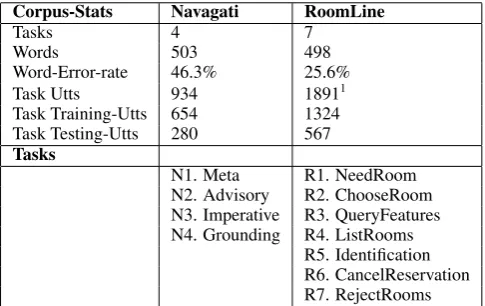
the utterances. Table 2 illustrates some of the statistics for each corpus.
Our baseline model for the task detection is the Phoenix (Ward, 1991) parser output, which is the default method used in the Ravenclaw/Olympus dialog systems (Bohus et al., 2007). For the Nava-gati Corpus we have obtained the parser output
us-ing the grammar and method described in (Pappu and Rudnicky, 2012). For the Roomline corpus, we extracted the parser output from the session logs from the the corpus distribution.
Corpus-Stats Navagati RoomLine
Tasks 4 7
Words 503 498
Word-Error-rate 46.3% 25.6%
Task Utts 934 18911
Task Training-Utts 654 1324 Task Testing-Utts 280 567 Tasks
N1. Meta R1. NeedRoom N2. Advisory R2. ChooseRoom N3. Imperative R3. QueryFeatures N4. Grounding R4. ListRooms
[image:4.595.307.550.128.281.2]R5. Identification R6. CancelReservation R7. RejectRooms
Table 2: Corpus Statistics
5.1.1 Semantic Facts to Semantic Kernel
The semantic kernel takes a term proximity ma-trix as an input, then produces a positive semidef-inite matrix which can be used inside the kernel function. In our case, we build a term proxim-ity matrix for the words in the recognition vocabu-lary. (Bloehdorn et al., 2006) found that using the term-concept pairs in the proximity matrix is more meaningful following the intuition that terms that share more number of concepts are similar as op-posed to terms that share fewer concepts. We have used following measures to compute the proximity valueP and some of them are specific to respec-tive knowledge bases:
• gra: No weighting for term-concept pairs in the Grammar, i.e.,
P = 1, for all conceptsci oft,P = 0
other-wise.
• fb: Weighting using normalized Free-base.com relevance score, i.e.,
P = f bscore(t, ci)−f bscore(t, cmin)
f bscore(t, cmax)−f bscore(t, cmin)
(1)
• nell: Weighting for theNELLterm-concept
pairs using the probability for a belief i.e.,
P =nellprob(t, ci) (2)
, for all conceptscioft,P = 0otherwise.
• wnpath: Weighting for the term-concept pairs in the Wordnet based on the shortest path, i.e.,
P =wnP AT H(t, ci) (3)
for all conceptscioft,P = 0otherwise.
• wnlch: Weighting for the term-concept pairs in the Wordnet based on the Leacock-Chodorow Similiarity, i.e.,
P =wnLCH(t, ci) (4)
for all conceptscioft,P = 0otherwise.
• wnwup: Weighting for the term-concept pairs in the Wordnet based on the Wu-Palmer Similarity, i.e.,
P =wnW U P(t, ci) (5)
for all conceptscioft,P = 0otherwise.
• wnres: Weighting for the term-concept pairs in the Wordnet based on the Resnik Similarity using Information Content, i.e.,
P =wnRES(t, ci) (6)
for all conceptscioft,P = 0otherwise.
To create a grammar-based proximity matrix, we extracted the concept-token pairs from the parser output on the reference transcriptions in both corpora. In order to create a wordnet-based proximity matrix, we retrieve the hypernyms for the corresponding from Wordnet using the Word-net 3.0 database2. For the freebase concept-token
pairs, we query tokens for a list of types with the help of the MQLquery interface3 to the freebase.
To retrieve beliefs from NELL we downloaded a
tsv formatted database called every-belief-in-the-KB4 and then queried for facts using unixgrep
command.
5.2 Results
Our objective is to evalute the effect of augmented semantic features on the task detection. As noted earlier, we divided both corpora into training and testing datasets. We build our models on the man-ual transcriptions from the training data and eval-uate on the ASR hypotheses of the testing data.
2http://www.princeton.edu/wordnet/download/ 3https://www.googleapis.com/freebase/v1/search 4http://rtw.ml.cmu.edu/rtw/resources
For the Navagati corpus, we use the same training-testing split that we used in our previous work be-cause the grammar was developed based on the training data. For the Roomline corpus, we ran-domly sample 30% of the testing data from the entire corpus.
Our first semantic-kernel based model SEM -GRA uses the domain grammar as a “knowledge
base”. This is a two step process: (1) we extract the concept-token pairs from the parse output of the training data. (2) Then, assign a uniform prox-imity score (1.0) for all pairs of words that ap-pear under a particular concept otherwise 0.0 (gra
as mentioned in the previous section). We aug-ment the grammar concepts to the utterances in the datasets, learn SEM-GRA model and classify
the test-hypotheses. For all our models we use a fixed C = 0.07 value (soft-margin parameter)
for theSVMclassifiers. This model achieved
high-est performance at this value during a parameter-sweep.SEM-GRAmodel outperformed the
parser-baseline on both datasets (see Table 3). It clearly takes advantage of the domain knowledge encoded in the form of semantic-relatedness between con-cepts and token pairs.
What if a dialog system does not have gram-mar to begin with? We use the same two step pro-cess to build semantic-kernel based models using one open-domain knowledge base at a time. We built Wordnet based models (SEM-WNWUP,SEM -WNPATH, SEM-WNLCH, SEM-WNRES) using
dif-ferent proximity measures described in the previ-ous section. From Table 3 SEM-WNRES model,
one that uses information content performs the best among all wordnet based models. In order to compute the information content we used the pair-wise mutual information scores available for brown-corpus.dat in the NLTK (Bird et al., 2009)
distribution. Other path based scores were also computed usingNLTK APIfor Wordnet.
We observed that our wordnet-based models capture relatedness between most-common nouns (e.g., room numbers) and their concepts but not for some of the less-common ones (e.g., loca-tion names). To compensate this imbalance, we use larger knowledge resources freebase.com and
NELL. First we searched for the facts in each of
Table 3: F1 (in %) comparison of parse baseline against semantic-kernel models with their corresponding similarity metrics
Corpus baseline SEMGRA SEMWNWUP SEMWNPATH SEMWNLCH SEMWNRES SEMFBASE SEMNELL
Navagati 40.1 65.8 67.1 67.7 66.4 69 68.7 66.2
Roomline 54.3 79.7 77.3 79.5 79.6 80.6 83.3 81.1
about 100 concepts that are relevant to the vocab-ulary and in the NELL model we have about 250
concepts that are relevant to the vocabulary in each of the corpora. The models based onNELL(SEM -NELL) and Freebase (SEM-FBASE) capture
relat-edness between less-common nouns and their con-cepts. We can see that both of these models per-form comparable to the domain grammar model
SEM-GRAwhich also captures the relatedness
be-tween less-common nouns and their concepts. We believe that both freebase and NELL has a
supe-rior performance because of wider-range of con-cept coverage and non-uniform proximity mea-sures used in the semantic kernel, which gives a better judgement of relatedness than a uniform measure used in theSEM-GRAmodel.
Since we observed that an individual model is good at capturing a particular aspect of an utter-ance, we extended the individual semantic models by combining the proximity matrices from each of them and augmenting their semantic concepts to the training and testing datasets. We built four combined models as shown in Table 4 by varying the wordnet’s proximity metric to identify which one of them works best in combination with other semantic metrics. Thewnresmetric performs the best both in standalone and combination settings. (Bloehdorn et al., 2006) also found that wnres
[image:6.595.310.526.417.592.2]particularly performs well for lower values of the soft-margin parameter in their experiments.
Table 4: F1-Score (in %): Models with semantics combined from different KBs (ALL-KB)
Model Navagati Roomline
GRA+WNWUP+FBASE+NELL 70.8 82.2 GRA+WNPATH+FBASE+NELL 70.1 81.4 GRA+WNLCH+FBASE+NELL 70.8 81.3 GRA+WNRES+FBASE+NELL 73.4 83.7
6 Discussion
We have built a model that exploits different se-mantic knowledge bases and predicts the task on both corpora with high accuracy. But how is it
af-fected by factors like misrecognition and context ambiguity?
6.1 Influence of Recognition Errors
When the recognition is bad, it is obvious that the accuracy would go down. We would like to know which of these knowledge resources can augment useful semantics despite misrecognitions. Table 2 shows that WERon the Navagati corpus is about
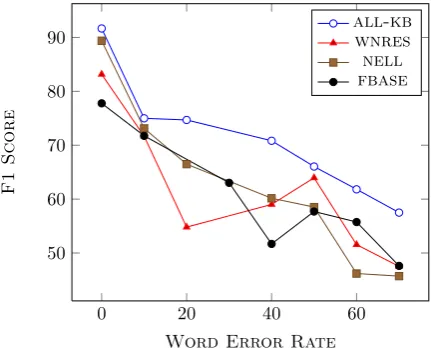
46% and the Roomline corpus is about 25%. We compared the F1-score of different models on ut-terances for different ranges of WERas shown in
the Figure 2 on the Navagati Corpus. We notice that the model built using all knowledge bases is more robust even at higher WER. We did similar
analysis on the Roomline corpus and did not no-tice any differences across models due to relatively lowerWER(25.6%).
0 20 40 60
50 60 70 80 90
Word Error Rate
F1
Score
all-kb wnres nell fbase
Figure 2: Word Error Rate vs F1-Score for KB-based Models on Navagati Corpus
6.2 Confusion among Tasks
We found that a particular pair of tasks are more confusing than others. Here we present an analysis of such confusion pairs for both corpora for dif-ferent classification models. Table 5 and Table 6 show the pairs of tasks that are most confused in the experiments. TheALL-KBmodel (a
Table 5: Most confusable pairs of tasks in Navagati Corpus for KB based classification models (See Table 2 for task labels)
KBType ALL-KB SEM-WNRES SEM-NELL SEM-FBASE
ActualTask N2 N4 N2 N4 N2 N4 N1 N2 N4
Predicted N3 N1 N3 N3 N3 N3 N3 N3 N3
ConfusionPerTask 10.5% 27.7% 26.3% 33.3% 26.3% 38.8% 22.2% 28.9% 44.4%
Table 6: Most confusable pairs of tasks in Roomline Corpus for KB based classification models (See Table 2 for task labels)
KBType ALL-KB SEM-WNRES SEM-NELL SEM-FBASE
ActualTask R4 R4 R6 R4 R6 R3 R4 R5 R6
Predicted R3 R5 R5 R1 R1 R1 R3 R1 R1
ConfusionPerTask 36.6% 48.7% 44.4% 25.6% 44.5% 32.5% 23% 53.4% 55.5%
confusion pairs among all the models. This is due to more relevant concepts are augmented to an ut-terance compared to fewer relevant concepts that augmented while using individual models.
We inspected the confused tasks by examin-ing the feature vectors of misclassified examples. While using theALL-KB model 10% of the
utter-ances from N2 (Advisory) were confused for N3 (Imperative) because of phrases like “your left”, “your right”. These phrases were often associated with N3 utterances. To recovery from such ambi-guities, the agent could ask a clarification question e.g., “are we talking about going there or find it on the way?” to resolve the differences between these tasks. The system could not only get clar-ification but also bootstrap the original utterance of the user with the clarification to gather addi-tional context to retrain the task detection models. The individual models were also confused about N2 and N3 tasks, where we could use similar clar-ification strategies to improve the task prediction. 27% of the N4 (grounding about current robot’s position) utterances were confused for N1 (meta comments about the robot’s rounavigation route) because these utterances shared more number of freebase concepts with the N1 model. The system could resolve such utterances by asking a clarifi-cation question “are we talking about the current position?”. Individual models i.e., SEM-WNRES, SEM-FBASEandSEM-NELLsuffered mostly from
the lack of concepts capturing semantics related to all types of entities (e.g., most common nouns, less common entities etc.,) found in an utterance.
We examined the confusion pairs in the Room-line corpus and observed that R4 (ListRooms) and R3 (Queries) tasks were most confused in the
ALL-KB model. On closer inspection, we found
that R4 utterances are about listing the rooms that are retrieved by the system. Whereas, R3 utter-ances are about asking whether a room has a facil-ity (e.g., projector availabilfacil-ity). In the ambiguous utterances, often the R4 utterances were about fil-tering the list of rooms by a facility type.
7 Conclusion
We proposed framing the dialog task prediction problem as a classification problem. We used an
SVM classifier with semantic smoothing kernels
that incorporate information from external knowl-edge bases such as Wordnet,NELL, Freebase. Our
method shows good improvements over a parser-based baseline. Our analysis also shows that our proposed method makes task prediction be more robust to moderate recognition errors.
We presented an analysis on task ambiguity and found that these models can confuse one task for another. We believe that this analysis highlights the need for dialog based clarification strategies that cannot only help the system for that instance but also help the system improve its task predic-tion accuracy in future dialog sessions.
8 Future Work
not seen in the context of “restaurant”. The agent somewhat predicts this utterance is related to “Go-ToRestaurant” using the approach described in this paper. It could ask the user an elicitation question: “You used diner in the context of a restaurant, is diner really a restaurant?”. The answer to this question will help the system gradually understand what parts of an open-domain knowledge base can be added into its own domain knowledge base. We believe that the holistic approach of learning from automated processes and learning through dialog, will help the dialog systems get better interaction by interaction.
References
Masahiro Araki. 2012. Rapid development process of spoken dialogue systems using collaboratively
con-structed semantic resources. In Proceedings of the
13th Annual Meeting of the Special Interest Group on Discourse and Dialogue, pages 70–73, Seoul, South Korea, July. Association for Computational Linguistics.
Srinivas Bangalore and Amanda J Stent. 2009. In-cremental parsing models for dialog task structure. InProceedings of the 12th Conference of the Euro-pean Chapter of the Association for Computational Linguistics, pages 94–102. Association for Compu-tational Linguistics.
Steven Bird, Ewan Klein, and Edward Loper. 2009.
Natural language processing with Python. O’Reilly Media.
Nate Blaylock and James Allen. 2006. Hierarchical instantiated goal recognition. InProceedings of the AAAI Workshop on Modeling Others from Observa-tions.
Stephan Bloehdorn, Roberto Basili, Marco Cammisa, and Alessandro Moschitti. 2006. Semantic ker-nels for text classification based on topological
mea-sures of feature similarity. In Data Mining, 2006.
ICDM’06. Sixth International Conference on, pages 808–812. IEEE.
Dan Bohus and Alexander I Rudnicky. 2005.
Sorry, I didn’t catch that!-an investigation of non-understanding errors and recovery strategies. In6th SIGdial Workshop on Discourse and Dialogue.
Dan Bohus, Antoine Raux, Thomas K Harris, Maxine Eskenazi, and Alexander I Rudnicky. 2007. Olym-pus: an open-source framework for conversational
spoken language interface research. InProceedings
of the workshop on bridging the gap Academic and industrial research in dialog technologies, number April, pages 32–39. Association for Computational Linguistics.
Dan Bohus. 2003. Roomline. http://www.cs.
cmu.edu/~dbohus/RoomLine.
Kurt Bollacker, Colin Evans, Praveen Paritosh, Tim Sturge, and Jamie Taylor. 2008. Freebase: a col-laboratively created graph database for structuring
human knowledge. SIGMOD 08 Proceedings of the
2008 ACM SIGMOD international conference on Management of data, pages 1247–1249.
Hung H Bui. 2003. A general model for online proba-bilistic plan recognition. InInternational Joint Con-ference on Artificial Intelligence, volume 18, pages 1309–1318. Citeseer.
Andrew Carlson, Justin Betteridge, Bryan Kisiel, Burr Settles, Estevam R Hruschka Jr., and Tom M Mitchell. 2010. Toward an Architecture for Never-Ending Language Learning. Artificial Intelligence, 2(4):1306–1313.
D.L. Chen and R.J. Mooney. 2010. Learning to in-terpret natural language navigation instructions from observations. Journal of Artificial Intelligence Re-search, 37:397–435.
Jennifer Chu-Carroll and Bob Carpenter. 1999.
Vector-based natural language call routing.
Compu-tational linguistics, 25(3):361–388.
Mathias Creutz, Sami Virpioja, and Anna Kovaleva. 2009. Web augmentation of language models for continuous speech recognition of sms text messages. InProceedings of the 12th Conference of the Euro-pean Chapter of the Association for Computational Linguistics, pages 157–165. Association for Com-putational Linguistics.
Nello Cristianini, John Shawe-Taylor, and Huma
Lodhi. 2002. Latent semantic kernels. Journal of
Intelligent Information Systems, 18(2):127–152.
Allen L Gorin, Giuseppe Riccardi, and Jeremy H
Wright. 1997. How may i help you? Speech
com-munication, 23(1-2):113–127.
D. Huggins-Daines, M. Kumar, A. Chan, A.W. Black, M. Ravishankar, and A.I. Rudnicky. 2006. Pocket-sphinx: A free, real-time continuous speech recogni-tion system for hand-held devices. InICASSP, vol-ume 1. IEEE.
Thorsten Joachims. 1999. Making large-scale support
vector machine learning practical. In Advances in
kernel methods, pages 169–184. MIT Press.
George A Miller. 1995. WordNet: a lexical
database for English. Communications of the ACM,
38(11):39–41.
Alessandro Moschitti. 2009. Syntactic and semantic kernels for short text pair categorization. In Pro-ceedings of the 12th Conference of the European Chapter of the ACL (EACL 2009), pages 576–584.
Aasish Pappu and Alexander I Rudnicky. 2012. The Structure and Generality of Spoken Route
Instruc-tions. Proceedings of the 13th Annual Meeting of
the Special Interest Group on Discourse and Dia-logue, pages 99–107.
Ted Pedersen, Siddharth Patwardhan, and Jason Miche-lizzi. 2004. WordNet:: Similarity: measuring the
relatedness of concepts. InDemonstration Papers
at HLT-NAACL 2004, pages 38–41. Association for Computational Linguistics.
Georges Siolas and Florence d’Alché Buc. 2000. Sup-port vector machines based on a semantic kernel
for text categorization. In Neural Networks, 2000.
IJCNN 2000, Proceedings of the IEEE-INNS-ENNS International Joint Conference, volume 5, pages 205–209. IEEE.
Pu Wang and Carlotta Domeniconi. 2008. Build-ing semantic kernels for text classification usBuild-ing
wikipedia. InProceeding of the 14th ACM SIGKDD
international conference on Knowledge discovery and data mining, pages 713–721. ACM.
W. Ward. 1991. Understanding spontaneous speech: