A Three-Layer Architecture for Automatic Post-Editing System Using
Rule-Based Paradigm
Mahsa Mohaghegh
Unitec
Auckland, New Zealand [email protected]
Abdolhossein Sarrafzadeh
Unitec
Auckland, New Zealand [email protected]
Mehdi Mohammadi
SheikhBahaee University Isfahan, Iran
Abstract
This paper proposes a post-editing model in which our three-level rule-based automatic post-editing engine called Grafix is presented to refine the output of machine translation sys-tems. The type of corrections on sentences va-ries from lexical transformation to complex syntactical rearrangement. The experimental results both in manual and automatic evalua-tions show that the proposed system is able to improve the quality of our state-of-the-art English-Persian SMT system.
1 Introduction
The overall success of well-designed statistical machine translation (SMT) systems has made SMT one of the most popular machine translation (MT) approaches (Callison-Burch, Koehn, Monz, & Zaidan, 2011). Currently however, MT output is often seriously grammatically incorrect. This is more often the case in SMT than other approaches due to the absence of linguistic rules for the lan-guage pair on which it is being applied. Grammati-cal error not only weakens the fluency of the translation, but in certain cases it completely changes the meaning of a sentence. In morphologi-cally rich languages, grammatical accuracy is of more significance, as the interpretation of syntactic relations depends heavily on morphological agreements within the sentences. Since our sys-tem’s approach is SMT, and deals with Persian, a morphologically rich language, post-editing the output is an important step in maintaining the flu-ency of the translation, and as we will show, this can yield to higher evaluation scores and more flu-ent translation. Due to the repetitive nature of ma-chine translation mistakes (Allen & Hogan, 2000) and the similarity of automatic post-editing (APE) process to machine translation process (Simard,
Goutte, & Isabelle, 2007) certain MT systems can carry out the task of an APE component.
The SMT approach to MT is useful in that it operates on numerical data extracted from parallel corpus. This approach tends to reduce human cost at translation stage. However, the search cost is expensive, and the system has no linguistic back-ground (although generally it is this that enables the system to be applied to any language pair after training on language-specific data). Most systems of this approach also encounter difficulties when capturing long distance phenomena.
RBMT approaches are categorized under three different types: Direct Systems, Transfer RBMT Systems that employ morphological and syntactic-al ansyntactic-alysis, and Interligusyntactic-al RBMT Systems that use an abstract meaning. The Grafix APE system fol-lows the pattern of Transfer-based systems. The aim of development of Grafix system is to correct some grammatical SMT system errors frequently occur in English-to-Persian translations.
2 Related Works
Ahsan, Kolachina, Kolachina, Sharma, and Sangal (2010) document work using a modular RBMT system which is able to combine the two translation approaches at different stages in the RBMT system’s pipeline. In this way, exploration of rules for both local and long distance reordering could be performed independently, and such reor-dering leading to improved translation output could be identified and utilized. In their paper, the au-thors show an increase in the output score for each stage of combination.
Recently however, there has been more interest in the use of RBMT as the base for an APE system. Marecek, Rosa, and Bojar (2011) report their expe-riments in correcting the output of an English-Czech MT system. They performed a rule-based grammatical correction module, DEPFIX, on sen-tences parsed to dependency trees. Their baseline SMT system relies on Moses, a phrase-based trans-lation system. Their two-step transtrans-lation is a setup in which the English source is translated into sim-plified Czech. Then the simsim-plified Czech is mono-tonically transferred to a fully inflected Czech. In 2012, Rosa, Marecek, and Duˇsek (2012) enhanced DEPFIX by enriching the rule set and using a mod-ified version of MST Parser. These two modifica-tions, based on their results, led to higher scores.
3 Description of the System
In this study, we couple the PeEn-SMT system previously developed by Mohaghegh, Sarrafzadeh, and Moir (2011) with an RBMT-based APE. The architecture of our system differs from common approaches like Simard, et al. (2007) and Lagarda, et, al. (2009). Because of its use of language and translation models over large corpora, together with better lexical selection, SMT would be capa-ble of consistently providing fluent translation. This approach, however, lacks linguistic knowl-edge, which we believe is more important when it comes to an APE. In this area we believe RBMT is
a superior base due to its strengths in linguistic knowledge.
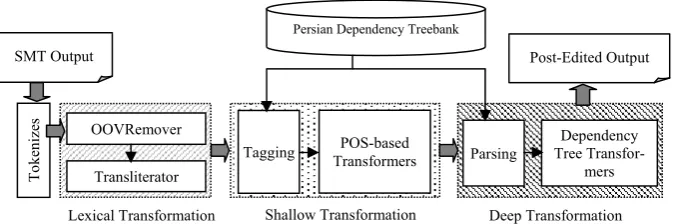
Three levels of transformations as shown in Figure 1, constitute the overal design of the Transfer-based APE module: lexical transformers, shallow transformers and deep transformers. The output of the SMT system is passed to the APE as input. This is then run through a series of trans-formers and fine-tuned in an effort to achieve a more accurate translation.
3.1 The Underlying SMT System
Persian is a morphologically rich language, so word disordering is a common issue that we face. Hierarchical SMT (D. Chiang, 2005) as an exten-sion to phrase-based translation takes syntax into account to some extent, with phrases being used to learn word reordering. This improvement is due to the word order differences between Persian and English, which are better handled with a hierarchi-cal phrase based system than a standard phrase-based approach. These advantages of hierarchical SMT encouraged us to conduct our study on Joshua after numerous experiments with Moses.
Hierarchical phrase-based translation allows phrases with gaps to be modeled as synchronous context-free grammars (SCFGs). In effect, it is grammars that are used, not phrase tables. The hi-erarchical approach does not detract from the strengths of phrase-based approaches, but uses them to its advantage. Phrases are used in order to learn word reordering. In a hierarchical approach, this principle is taken a step further, and phrases are used for phrase reordering, using SCFGs to compose the hierarchical phrases from words and sub-phrases and represent translation models. Joshua (Li, Callison-Burch, Khudanpur, & Thornton, 2009), a hierarchical phrase based ma-chine translation toolkit, was a reimplementation of the Hiero MT system (D. Chiang, 2007), and is able to support formalisms such as SAMT
Tagging Parsing
Post-Edited Output Persian Dependency Treebank
Lexical Transformation
OOVRemover
Transliterator
Shallow Transformation
POS-based Transformers
Deep Transformation
Dependency Tree
Transfor-mers SMT Output
T
oke
nize
[image:2.595.134.472.608.720.2]s
(Zollmann & Venugopal, 2006). More recent ef-forts introduced the Thrax module, an extensible Hadoop-based extraction toolkit for synchronous context free grammars (Weese, Ganitkevitch, Callison-Burch, Post, & Lopez, 2011).
In Joshua, an SCFG can be represented as a set of rules given as:
Ci→<αi , γi , ~i , φi> (1)
where Ci is a non-terminal symbol of the grammar, αi and γi are sequences of terminal and non-terminal symbols for the source and target sides respectively, ~i is a correspondence between the non-terminals of αi and γi, and φi is a feature vector defining the probability of translation from αi to γi.
3.2 Training Data Source
Grammatical relations may be represented by de-pendency structures. Compared to syntactic trees, dependency structures are more specific in regard to semantics rather than strict word order (Ambati, 2008). The structure of sentence dependency tree represents the relationship between words as either modifying or being modified, and the root in each tree being the only word which does not modify any other word.
The Persian Dependency Treebank1, containing over 12500 sentences and 189000 tokens, is our main source of training data for POS-tagging and dependency parsing. Its data format is based on CoNLL Shared Task on Dependency Parsing (Buchholz & Marsi, 2006).
3.3 Pre-Processing and Tagging
We pre-process input Persian sentences using our implemented tokenizer component. It eliminates whitespace, semi-space, tab and new line in order to tokenize the text. We also considered punctua-tion marks in sentences in cases where punctuapunctua-tion marks were attached to other words.
POS-tagging the input text is a pre-requisite process for both shallow and deep transformation levels. The Maximum Likelihood Estimation (MLE) is the underlying algorithm in the POS-tagger component for our APE method and is trained with the Persian Dependency Treebank data. Evaluation showed that the use of this ap-proach for tagging the Persian language yielded
1 http://dadegan.ir/en
promising results (Raja et al., 2007). Tagging tests showed the best accuracy to be 95.43%.
3.4 Parsing
There has recently been increasing interest in the use of dependency models for a number of applica-tions in NLP, particularly since certain characteris-tics of the dependency structure prove to be advantageous over other syntactic representations (Ding & Palmer, 2005). In a dependency parsing tree, words are linked to their arguments by depen-dency representations (Hudson, 1984).
We used an implementation of Dependency Parsing named MSTParser. MSTParser’s main algorithm is Maximum Spanning Tree in which the maximum spanning tree should be found in order to find the best parse tree (Kübler, McDonald, & Nivre, 2009).
3.5 Three-Level Rule-based Transformers
We acquired translation rules manually by investi-gating a broad range of incorrect translations and determining frequent wrong patterns among them. In order to determine incorrect patterns and define correction rules for them, it is necessary to parse both the MT output and the reference text.
By investigating the incorrect and incomplete translation outputs and considering the dependency parser output for these sentences, a number of in-correct patterns were identified in the POS se-quence and Dependency parse tree of these sentences. These patterns are compared against the Persian Dependency Treebank to ensure that they do not match a known correct sequence.
Lexical Transformation: Two components
are serving in the first level of transformations. OOV2 remover is a substitution rule like E→ F1, F2…Fn where E is an English word and Fi= F1, F2…Fn are different translations of the word in Persian. This rule replaces a remained English word in the MT output with the correct translation in Persian. Since no Word Sense Disambiguation (WSD) component is present, it is assumed that the first meaning found for the English word in the dictionary used is the most frequent translation of the word, so it is used as replacement for the Eng-lish word. A transliterator also is used to comple-ment the operation of OOV remover in cases that
OOV remover could not find any equivalent Per-sian translation for English words in the output. A transliterator works based on training an amount of prepared data to produce the most likely Persian word for the English word remaining in the sen-tence. The result is the English word appearing composed with Persian character scripts. The train-ing data set for transliterator contains over 4600 of the most frequently used Persian words and named entities written using English letters, and also the equivalent in Persian script. In order to implement the transliterator component we used some libra-ries from Virastyar3 software.
Shallow Transformers: The second stage of
the system involves a shallow transfer module which is based on some POS patterns identified as incorrect. Incorrect or incomplete POS sequence patterns will be controlled for each sentence, and appropriate rules executed to revise them. Descrip-tion of some shallow rules comes in following sec-tion.
IncompleteDependentTransformer: Relative pronouns such as «ﻪآ» in Persian (English “that”) which POS-tagged as SUBR, suggest continuation of the phrase by a dependent clause. If it occurred in a POS sequence without a consequent verb, an incomplete dependent sentence would be identified and a verb should complete the sentence. Current-ly, in most instances the verb «ﺖﺳا» (English “is”)
is suggested.
IncompleteEndedPREMTransformer: Pre-modifiers (denoted by PREM) are noun Pre-modifiers. According to the definition, modifiers should cede nouns, so a POS sequence in which a pre-modifier located at the end of a sentence deemed as incorrect. These sequences were removed from the sentence altogether since there is no logical translation for given input.
AdjectiveArrangementTransformer: In the Per-sian language, adjectives usually come after the nouns they describe. For instance (English “heavy bag”) «ﻦﻴﮕﻨﺳ ﻒﻴﻛ» is translated literally as “bag heavy”. The only exception in this group is super-lative adjectives, which are identified by the suffix
» ﻦﻳﺮﺗ
« attached to the adjective. In this special case,
the adjective comes before the noun to define it. The appearance of non-superlative adjectives be-fore their described nouns indicates incorrect
3 http://sourceforge.net/projects/virastyar/
position which must be corrected by this transfor-mer.
Deep Transformers: In this type of
transfor-mations, the input is parsed by a dependency pars-er. Once the text is POS-tagged, some preparation is performed to parse the input, according to the parsing input format (McDonald, Pereira, Ribarov, & Hajic, 2005). The rules here examine dependen-cy tree of each sentence to verify it bounds to some syntactical and grammatical constraints. The tree structure of each parsed sentence will be analyzed, and those sentences with incorrect parse tree struc-tures will be evaluated to determine if correction is necessary. Some deep rules are described in sec-tions below.
NoSubjectSentenceTransformer: Compared to known translation reference sentences, it was seen in some cases that what was parsed as the object in the sentence was actually the subject. Such sen-tences have a third person verb, no definite subject and an object tagged as POSTP (postposition) in the POS sequence. This transformer is designed to revise the sentence by removing the postposition
»
ار
« which is the indicator of a direct object in the sentence. Removal of this postposition changes the sentence to one with a subject.
PluralNounsTransformer: Unlike English, in the Persian language the word coming after a num-ber is always singular. In SMT output there are instances where plural nouns are located after a number (< PRENUM> POS). This is corrected by removing the plural symbol of Persian words. The suffix«ﺎه» (/hã/) is the most common plural
indica-tor, which is removed in this rule.
reordered by moving the root verb and its NVE4 dependants (in the case of compound verbs) to the end of the sentence, just before the period punctua-tion mark.
MissingVerbTransformer: Sometimes sentences from SMT output can occur with missing verbs specifically in the case of compound verbs. We used the Persian [verb] Valency Lexicon (Rasooli, Moloodi, Kouhestani, & Minaei-Bidgoli, 2011) to determine the proper verb for a non-verbal element in the sentence. All obligatory and optional non-verbal elements (main-verb dependents) are listed in this lexicon. For example, the verb «ندﺮﮐفﺮﺼﻣ»
(English “to consume”) is composed of two ele-ments. Searching for «فﺮﺼﻣ» in this lexicon will
return «ندﺮﮐ» as the main part of that particular
compound. We find the correct root of the verb (past or present) by examining the other verbs in a sentence which could show the correct tense in-tended for that sentence. The present tense is cho-sen by default if there are no other verbs in the sentence. Any subject with a referred verb preced-ing the subject in the dependency tree is identified as an incorrect linked subject to any verb due to violence of standard SOV structure. In this case, the last word in the sentence is considered as a candidate of non-verbal element in the Verb Va-lency Lexicon. If a corresponding verb is found, the correct tense of that verb will be inserted into the space of the missing verb.
4 Experiments and Results
4.1 Baseline SMT
We used Joshua 4.0 as our baseline system using default settings. Training data was extracted from a parallel corpus based on the NSPEC corpus tested by (Mohaghegh & Sarrafzadeh, 2012). After some modification to remove inconsistencies in the translation output, the final corpus (names NPEC) consisted of almost 85,000 sentence pairs of 1.4 million words, originating mostly from bilingual news sites. There are a number of different do-mains covered in this corpus, but the majority of the texts were in literature, science and conversa-tion. The language model used in the tests was
4 Non-Verbal Element: Many Persian verbs are compound
verbs. They consist of two parts; one verbal and one non-verbal element.
tracted from IRNA5 website, covering news sto-ries, and comprised over 66 million words.
4.2 Test Data Set
Our evaluation is based on eight test sets extracted from certain bilingual websites. Randomly se-lected, test sentences cover different domains such as art, medicine, economics and news. The direc-tion of transladirec-tion is English-Persian. In the evalua-tion process, the Persian side of the test sets was used as the translation reference to score the output quality of both the baseline system and the final post-APE output. The size of the test data varies from one paragraph of text (more than 100 words) to a complete page or more (up to 600 words). The number of sentences in both sides is equal. The total number of test sentences is 153. The reason the number of test sentences was less than what would normally be preferred is that finding per-fectly correct human translations for sentences for scoring purposes covering a number of domains is a very difficult task and manual evaluation by an-notators would be much more labor-intensive.
4.3 Automatic Evaluation
We used both BLEU and NIST to evaluate the ef-fect of APE system on translation quality. The re-sults of translation before and after APE are shown in Table 1.
As Figures 2 and 3 also demonstrate, the results generally show increases in both metrics. The greatest increase in BLEU score due to the APE was achieved in test set #3, with an increase of about 0.15 BLEU, while the greatest NIST score increase was in test set #1, with a 0.16 increase.
However, in certain test sets the scoring metrics report a decrease in output quality, the worst BLEU score being at a difference of -0.0151, and the worst NIST at -0.27. The main reason behind weakened results is lack of training data for the Transliterator module, as it scripted some proper names and terms incorrectly in Persian. The large difference between the BLEU scores of data sets is due to each data set genre and the type of training data set. The quality of statistical translation (in terms of BLEU metric score) affects the APE module directly. The test set is in the news story domain, the same domain as the parallel corpus
used. In test set #4, in the religious genre, the de-crease in both BLEU and NIST is attributed to a lack of data in this genre.
4.4 Manual Evaluation
As suggested by (Marecek et al., 2011), grammati-cal correctness of sentences cannot be measured appropriately with BLEU metrics. Because of this, we evaluated the output manually. The same test sets in automatic evaluation containing 153 sen-tences are evaluated here. We assigned the APE
output of test sentences to two separate annotators, instructing them to rank the APE output sentences based on whether the output showed improvement, decrease, or no change in fluency compared to the original SMT output. Table 2 summarizes the re-sults of this manual evaluation.
Annotator/
Rank Improved
No
Change Weakened
Annotator 1 47 95 11 Annotator 2 43 99 11
Table 2. Manual evaluation scores for 153 test sentences
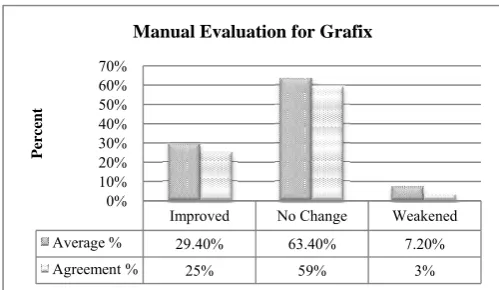
Both annotators, who completed the evaluation without discussing or consulting with each other, had very similar judgment of the APE system’s output. The results show that the APE system has been successful in improving the quality of the baseline SMT system output by 29.4%. The cur-rent developed rules for the APE system are effec-tive for about 37% of the SMT translated sentences.
We also identified both annotator agreements on ranked sentences. Based on their agreement, the quality improvement from the APE system is 25% and weakened by 3%. The comparison of the aver-age percent of manual scores is shown in Figure 4.
5 Conclusion and Future Work
We presented an uncommon automatic
post-Input Size(words) Before APE After APE BLEU Difference NIST Difference
En Fa BLEU NIST BLEU NIST
#1 163 158 0.6523 6.5740 0.6770 6.7349 0.0247 0.1609
#2 218 222 0.2232 1.0870 0.2187 1.0935 -0.0045 0.0065
#3 371 403 0.5914 6.1083 0.7388 6.1089 0.1474 0.0006
#4 362 337 0.1365 0.7962 0.1214 0.7064 -0.0151 -0.0898
#5 101 115 0.7925 5.7332 0.8716 5.4624 0.0791 -0.2708
#6 354 386 0.2738 1.8922 0.2779 1.9196 0.0041 0.0274
#7 555 653 0.2945 2.0457 0.2951 2.0333 0.0006 -0.0124
[image:6.595.65.526.109.233.2]#8 259 297 0.4048 2.3940 0.4089 2.4052 0.0041 0.0112
Table 1. Scores of APE based on SMT Joshua version 4.0
0 0.2 0.4 0.6 0.8 1
#1 #2 #3 #4 #5 #6 #7 #8
BL
EU
Test Set
[image:6.595.55.292.125.417.2]Before APE After APE
Figure 2. Difference of BLEU score after applying APE on eight test sets
0 1 2 3 4 5 6 7 8
#1 #2 #3 #4 #5 #6 #7 #8
NI
ST
Test Set
Before APE
After APE
Figure 3. Difference of NIST score after applying APE
Improved No Change Weakened Average % 29.40% 63.40% 7.20%
Agreement % 25% 59% 3%
0% 10% 20% 30% 40% 50% 60% 70%
Perc
ent
[image:6.595.53.294.450.575.2] [image:6.595.302.552.603.748.2]editing model for English-Persian statistical ma-chine translation developed using a rule-based ap-proach in different levels of transformation. The automatic evaluation results in terms of BLEU me-tric show that 75% of the test sets have been im-proved as far as the quality of the translation is concerned after post-editing. Although is affected by the quality of SMT system output, our APE ap-proach is shown to be able to improve the SMT output up to 0.15 BLEU. On the other hand we faced some decrease in quality of translation by applying the system. We found that these results came from the lexical transformer level. We be-lieve that this is due to OOV words remaining in the original script, and that the application of OO-VRemover and Transliterator only produced a new unknown (incorrect) word as the original word equivalent. This phenomenon has decreased the BLEU score in one case by up to -0.015 BLEU.
Our results in terms of NIST and BLEU show that automatic evaluation could not reveal the qual-ity of grammatical changes appropriately. Howev-er, manual evaluation scores show that a rule-based approach for an APE system is useful for improv-ing at least 25% of the translation with a loss of at most 7%. To increase the improvement and de-crease the loss of accuracy, we intend to enrich the bilingual dictionary used in OOVRemover as well as training data for Transliterator. Extending the rules in both shallow and deep levels is another task we plan to focus on. We also intend to inves-tigate the use of an automatic rule induction mod-ule using text mining or similar approaches.
References
Ahsan, A., Kolachina, P., Kolachina, S., Sharma, D. M., & Sangal, R. (2010). Coupling statistical machine translation with rule-based transfer and generation. In Proceedings of the 9th Conference of the Association for Machine Translation in the Americas. Denver, Colorado.
Allen, J., & Hogan, C. (2000). Toward the Development of a Post-editing Module for Raw Machine Translation Output: A Controlled Language Perspective. Third International Controlled Language Applications Workshop (CLAW-00)
(pp. 62-71).
Ambati, V. (2008). Dependency Structure Trees in Syntax Based Machine Translation. In Advanced MT Seminar Course Report.
Buchholz, S., & Marsi, E. (2006). CoNLL-X shared task on multilingual dependency parsing. In
Proceedings of the Tenth Conference on Computational Natural Language Learning
(pp. 149-164). New York City, USA: Association for Computational Linguistics. Callison-Burch, C., Koehn, P., Monz, C., & Zaidan, O.
F. (2011). Findings of the 2011 workshop on statistical machine translation.
Chiang, D. (2005). A hierarchical phrase-based model for statistical machine translation In Proceedings of the 43rd Annual Meeting on Association for Computational Linguistics (pp. 263-270). University of Michigan, USA.: Association for Computational Linguistics. Chiang, D. (2007). Hierarchical phrase-based
translation. Computational Linguistics, 33(2), 201-228.
Crystal, D. (2004). The Cambridge Encyclopedia of English Language: Ernst Klett Sprachen. Ding, Y., & Palmer, M. (2005). Machine translation
using probabilistic synchronous dependency insertion grammars In Proceedings of the 43rd Annual Meeting on Association for Computational Linguistics (pp. 541-548). Ann Arbor, USA: Association for Computational Linguistics.
Hudson, R. A. (1984). Word grammar: Blackwell Oxford.
Isabelle, P., Goutte, C., & Simard, M. (2007). Domain adaptation of MT systems through automatic post-editing In Proceedings of Machine Translation Summit XI (pp. 255-261). Phuket, Thailand.
Kübler, S., McDonald, R., & Nivre, J. (2009). Dependency parsing Synthesis Lectures on Human Language Technologies (Vol. 1, pp. 1-127).
Lagarda, A. L., Alabau, V., Casacuberta, F., Silva, R., & Diaz-de-Liano, E. (2009). Statistical post-editing of a rule-based machine translation system. Proceedings of Human Language Technologies: The 2009 Annual Conference of the North American Chapter of the Association for Computational Linguistics, Companion Volume: Short Papers (pp. 217-220). Boulder, Colorado: Association for Computational Linguistics.
Li, Z., Callison-Burch, C., Khudanpur, S., & Thornton, W. (2009). Decoding in Joshua. Prague Bulletin of Mathematical Linguistics, 91, 47-56.
Marecek, D., Rosa, R., & Bojar, O. (2011). Two-step translation with grammatical post-processing.
McDonald, R., Pereira, F., Ribarov, K., & Hajic, J. (2005). Non-projective dependency parsing using spanning tree algorithms. In Proceedings of the conference on Human Language Technology and Empirical Methods in Natural Language Processing (pp. 523-530). Vancouver, B.C., Canada: Association for Computational Linguistics.
Mohaghegh, M., & Sarrafzadeh, A. (2012). A hierarchical phrase-based model for English-Persian statistical machine translation.
Mohaghegh, M., Sarrafzadeh, A., & Moir, T. (2011).
Improving Persian-English Statistical Machine Translation: Experiments in Domain Adaptation.
Pilevar, A. H. (2011). USING STATISTICAL POST-EDITING TO IMPROVE THE OUTPUT OF RULE-BASED MACHINE TRANSLATION SYSTEM. Training, 330, 330,000.
Raja, F., Amiri, H., Tasharofi, S., Sarmadi, M., Hojjat, H., & Oroumchian, F. (2007). Evaluation of part of speech tagging on Persian text.
University of Wollongong in Dubai-Papers, 8. Rasooli, M. S., Moloodi, A., Kouhestani, M., & Minaei-Bidgoli, B. (2011). A syntactic valency lexicon for Persian verbs: The first steps towards Persian dependency treebank. In Proceedings of 5th Language & Technology Conference (LTC): Human Language Technologies as a Challenge for Computer Science and Linguistics (pp. 227-231).
Rosa, R., Marecek, D., & Duˇsek, O. (2012). DEPFIX: A System for Automatic Correction of Czech MT Outputs. In Proceedings of the Seventh Workshop on Statistical Machine Translation,
. Montreal, Canada: Association for Computational Linguistics.
Simard, M., Goutte, C., & Isabelle, P. (2007). Statistical phrase-based post-editing In Human LanguageTechnologies 2007: The Conference of the North American Chapter of the Association for Computational Linguistics; Proceedings of the Main Conference (pp. 508-515). Rochester, USA.
Weese, J., Ganitkevitch, J., Callison-Burch, C., Post, M., & Lopez, A. (2011). Joshua 3.0: Syntax-based machine translation with the thrax grammar extractor.
Xuan, H., Li, W., & Tang, G. (2011). An Advanced Review of Hybrid Machine Translation (HMT). Procedia Engineering, 29, 3017-3022. Zollmann, A., & Venugopal, A. (2006). Syntax
augmented machine translation via chart parsing. In Proceedings of the Workshop on Statistical Machine Translation (pp. 138-141).