Towards a Generation-Based Semantic Web Authoring Tool
Richard Power Department of Computing
Open University Milton Keynes, UK
Abstract
Widespread use of Semantic Web tech-nologies requires interfaces through which knowledge can be viewed and edited with-out deep understanding of Description Logic and formalisms like OWL and RDF. Several groups are pursuing approaches based on Controlled Natural Languages (CNLs), so that editing can be performed by typing in sentences which are automat-ically interpreted as statements in OWL. We suggest here a variant of this approach which relies entirely on Natural Language Generation (NLG), and propose require-ments for a system that can reliably gen-erate transparent realisations of statements in Description Logic.
1 Introduction
We describe here a simple prototype of an edit-ing tool that allows a user to create an ontology through an open-ended Natural Language inter-face. By ‘open-ended’ we mean that when intro-ducing class or property names into the ontology, the user also decides how they should be expressed linguistically: thus the lexicon of the Natural Lan-guage interface is not predetermined. The purpose of such a tool is to support knowledge editing on the Semantic Web, which at present requires train-ing in graphical user interfaces like Prot´eg´e (Rec-tor et al., 2004), or direct coding in OWL and RDF. Linking OWL to Controlled Natural Language is currently the topic of an OWL1-1 task force, and several groups are already working in this area (Schwitter and Tilbrook, 2004; Thompson et al., 2005; Bernstein and Kaufmann, 2006; Pool, 2006; Dongilli, 2007); the novelty in our approach is that we rely entirely on Natural Language Generation (NLG), extending the WYSIWYM(or Conceptual Authoring) method (Power and Scott, 1998;
Hal-lett et al., 2007) so that it supports knowledge edit-ing for ontologies as well as for assertions about individuals.
The idea of linking formal and natural lan-guages can be traced back to Frege (1879), who observed that mathematical proofs were made up of formulae interspersed with passages in natu-ral language, and invented formal logic as a way of rendering these passages in a precise notation. With the arrival of Artificial Intelligence in the 1950s, formal logic became the foundation for knowledge representation and automatic reason-ing — a trend leadreason-ing to the recent concept of a ‘semantic web’ that would open up knowledge en-coding and utilisation to a world-wide community (Berners-Lee et al., 2001). However, accessible knowledge management requires accessible pre-sentation: hence the current interest in methods of ‘sugaring’ formal logic into natural language text (Ranta, 1994; Horacek, 1999), thus in a sense turn-ing Frege upside-down.
1.1 Description Logic
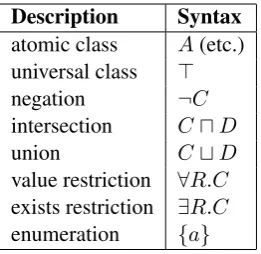
The theoretical underpinning of OWL (and hence of the semantic web) is a discipline that evolved under various names in the 1980s and 1990s and is now called Description Logic (Baader et al., 2003). This refers not to a single logical language, but to a family of languages. All of these lan-guages allow statements to be built from individu-als, classes and properties, but they differ in the re-sources provided in order to construct classes and properties, thus allowing different balances to be drawn between the conflicting demands of expres-siveness and tractability (i.e., decidability and ef-ficiency of reasoning).
pro-Description Syntax
atomic class A(etc.) universal class >
negation ¬C
intersection CuD
union CtD
[image:2.595.117.248.61.188.2]value restriction ∀R.C exists restriction ∃R.C enumeration {a}
Table 1: Class constructors
gressively more constructors, not only for classes but also for properties and axioms. Having cho-sen the desired logic, the ontology builder is free to introduce new atomic classes (and also properties and individuals), which can be given any name consistent with the RDF naming con-ventions (i.e., names must be Unique Resource Identifiers). Thus a new class might be named
http://myontology.net/parent and a new
propertyhttp://myontology.net/hasChild,
al-though for brevity we will henceforth omit names-paces (i.e.,parent,hasChild). Statements about classes can then be expressed by axioms, the most important of which areC vD(C is subsumed by D) andC ≡D(C is equivalent to D). For instance:
(1)parent≡personu ∃hasChild.> (2)personv ∀hasChild.person
The meanings are probably obvious: (1) a parent is defined as a person with one or more children; (2) every person only has persons as children. Note that expressing these axioms in clear English is not trivial — for instance, in (2) we must take care not to imply that every person has children.
A collection of such axioms is called a TBox: intuitively, a TBox expresses concept defini-tions and generalisadefini-tions. Description Logics also contain names for individual instances (e.g., Abraham, Isaac) and formulas expressing facts about individuals: thusf ather(Abraham)would express class membership (‘Abraham is a father’), and hasChild(Abraham, Isaac) a relationship between individuals (‘Isaac is Abraham’s child’). A collection of such assertions is called an ABox, and TBox and ABox together make up a Knowl-edge Base (KB).
1.2 Reasoning services
The reason for proposing Description Logic as the foundation for the Semantic Web is that it allows
for efficient reasoning services. Much effort is still going into the mathematical task of proving decid-ability and efficiency results for increasingly ex-pressive dialects. Informally, the standard reason-ing services are as follows:
1. Class Satisfiability: Checking whether in a given KB it is possible for a class to have at least one member.
2. Subsumption: Checking whether a given KB implies a specified subsumption relation-ship between two classes.
3. Consistency: Checking whether a given KB is consistent.
4. Instance Checking: Checking whether a given KB implies a specified ABox assertion that an individualabelongs to a classC.
Consider for instance the following miniature KB:
mantwoman≡person manv ¬woman
man(Abraham)
In respect to this KB, a reasoning engine should be able to show (1) that the classmanuwomanis unsatisfiable, (2) thatmanis subsumed byperson (man v person), (3) that the KB is consis-tent, and (4) that the assertionperson(Abraham) holds.
The ability to perform these reasoning tasks ef-ficiently can be exploited not only in applications that utilize knowledge in problem-solving, but in knowledge editing and natural language genera-tion. For instance, when an ontology builder adds a new axiom to a KB, the editor can run the sub-sumption and consistency checks and give feed-back on whether the axiom is informative, redun-dant, or inconsistent. Or when producing a natural language gloss for the class∃hasChild.f emale, the generator could choose between ‘something with at least one female child’ and ‘someone with at least one female child’ by checking the subsumption relationship ∃hasChild.f emale v person.
2 Aligning DL to CNL
are interpreted through a relatively simple model-theoretic semantics (Baader et al., 2005). They also include efficient algorithms for performing reasoning tasks. We now turn to issues in the design of Controlled Natural Languages (CNLs) which can be aligned with specific DLs, and thus serve as useful interfaces for working with com-plex formalisms like OWL and RDF.
As a provisional list of requirements, we would suggest the following:
1. Completeness: A sentence (or text) can be generated for any axiom permitted by the DL.
2. Uniqueness: Different sentences are gener-ated for different axioms.
3. Transparency: Sentences in the CNL are ac-curately interpreted by human readers.
4. Fluency: Sentences in the CNL are inter-preted easily by human readers and judged natural.
5. Interpretability: Sentences conforming to the CNL can be automatically interpreted to recover the corresponding DL axiom.
6. Editability: Interactive texts in the CNL can be manipulated by domain experts in order to extend and revise the KB.
7. Extensibility: Domain experts can extend the CNL by linking lexical entries to new in-dividuals, classes or properties in the KB.
Note that these are essentially practical require-ments, which concern the CNL’s role as an inter-face for a particular DL. We see no reason to insist that the alignment between DL and CNL should conform to general theories of natural language se-mantics.
2.1 Completeness
If we propose to use generated CNL as an inter-face to a knowledge base, it is important that gen-eration should be reliable. A minimal test of re-liability is that the grammar and lexicon are com-plete, in the sense that they produce a text for any well-formed semantic input. Elsewhere, we have described a generation method that allows com-pleteness to be checked by a computer program (Hardcastle and Power, 2008). For any non-trivial DL the set of classes is infinite (e.g., through recur-sion onCuDor∃R.C); however, completeness
can be proved through an enumeration of all local contexts for which a linguistic realisation rule is needed. As well as guaranteeing reliability, com-pleteness checking is obviously useful as an aid to grammar development.
2.2 Uniqueness
Although necessary, completeness is not a suffi-cient condition on the grammar of a CNL, since it could be trivially met by generating the same string (perhaps ‘Hallo World’) for any semantic in-put. It would also be useful to have an automatic check that the same sentence is not generated for two different semantic inputs — i.e., that every sentence in the CNL has a unique meaning. This seems a harder problem than completeness, and we have not seen any proposals on how it could be done.
To pose this problem precisely we would need to define what is meant by ‘different’ semantic in-puts. Complex class descriptions can be manipu-lated by well-known logical equivalences like De Morgan’s laws: for instance,¬(C uD)is equiv-alent to(¬C)t(¬D). Should these be treated as different inputs or the same input? We think users would probably prefer them to be treated as differ-ent, but the issue needs to be investigated further.
2.3 Transparency
Transparency is obviously at the heart of the en-terprise: completeness and uniqueness proofs are no help if the generated texts are unclear to human readers. Unlike the preceding requirements, trans-parency is a matter of degree: we cannot expect, far less prove, that every sentence in the CNL will be accurately understood by all target users on all occasions. Transparency can only be assessed, and gradually improved, through experiments and user feedback.
2.4 Fluency
2.5 Interpretability
This is an essential requirement for knowledge ed-itors that rely on automatic parsing and interpreta-tion of texts typed in by human authors (Schwit-ter and Tilbrook, 2004; Bernstein and Kaufmann, 2006). A recent innovation has been to pursue the goal of ‘roundtripping’ (Davis et al., 2008), so that a CNL text can be generated from an existing on-tology, revised in a text editor, and then interpreted automatically to obtain an updated ontology in the original format. For our approach, which relies en-tirely on generation, automatic interpretability is not essential (although one can imagine contexts in which it would be useful, for instance to allow knowledge encoding outside the NLG-based edit-ing environment).
2.6 Editability
The key feature of Conceptual Authoring (WYSI -WYM) is that editing operations are defined on the semantic input, not the text. This means that au-thors cannot produce a text in the normal way by typing in words from left to right. Some kind of non-specific initial configuration has to be grad-ually refined through semantic distinctions made by choices from menus (an example will be given later). To validate the approach, it has to be shown that this editing process is efficient and eas-ily learned. Usability results from ABox editing applications have been encouraging (Hallett et al., 2007), but whether similar results can be achieved for KB editing (TBox as well as ABox) remains unproven.
2.7 Extensibility
Ontology development requires that authors should be able to introduce new terms for indi-viduals, classes and properties. The designer of a CNL-based editor cannot foresee what these terms will be, and therefore cannot provide a mapping to suitable lexical entries. This must be done by the ontology developer, and take-up accordingly de-pends on making this task not only feasible but easy (Hielkema et al., 2007). We will explore two ideas on how this might be done: (a) providing a wide-coverage lexicon from which users can se-lect words to extend the CNL, and (b) using con-ventions for controlling the naming of classes and properties, so that the two decisions (term name, CNL lexical entry) become essentially a single de-cision.
3 Editing process
As a first experiment we have written a Prolog program which allows a KB to be built up from scratch for a very simple DL with only one kind of statement (C v D), four class constructors (A, >, ∃R.C, {a}), and one property construc-tor (property inversion, which will be explained shortly). Using just these resources we can formu-late ABox assertions as well as TBox axioms by the trick of representing individuals through enu-merated classes. For instance, man(Abraham) can be asserted through the axiom{Abraham} v man(the class containing only Abraham is a sub-class of the sub-class of men).
A generic grammar is provided for realising axioms and complex class descriptions (a hand-ful of rules suffices); the grammar assumes that the words for realising individuals, atomic classes and properties will conform to the following (very strict) regulations:
1. Individuals are realised by proper names
2. Atomic classes are realised by count nouns
3. Properties are realised either by transitive verbs or by count nouns
We also simplify by assuming that the name of ev-ery atomic term in the DL is identical to the root form of the word realising the term — for instance, the count noun realising the classpersonwill be ‘person’.
When the editor is launched there are no indi-viduals, atomic classes or properties, and the only word in the lexicon is ‘thing’, which denotes the class>(i.e., the class containing all individuals). The KB is construed as a sequence of axioms, and to start the ball rolling it is seeded with a single vacuous axiom> v >. The program generates a sentence expressing this axiom and adds a list of editing options as follows:
1: Every thing/1 is a thing/2.
t Add a new term a Add a new axiom
A/C Edit class C in axiom A A/d Delete axiom A
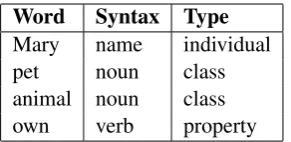
Word Syntax Type
Mary name individual
pet noun class
[image:5.595.110.256.61.132.2]animal noun class own verb property
Table 2: Lexical entries for terms
The user should therefore choose optiontto add
a new term. This is done by specifying three things: a word (any string), a syntactic category (either name, noun, or verb), and a logical type
(individual, class, or property). In this way
the user might define the set of terms in figure 2 from the people+pets domain, which will be fa-miliar to students of Description Logic.
Editing of the axiom > v >can now begin. Assuming that the target is pet v animal, the user first selects the first class in the first axiom by typing1/1(in a GUI this would be done
sim-ply by clicking on the word). The program re-turns a menu of substitutions computed from the current ontology and expressed in English phrases adapted to the context of the selected class:
1 Mary 2 Every pet 3 Every animal
4 Everything that owns one or more things 5 Everything owned by one or more things
These phrases express respectively the classes {M ary}, pet, animal, ∃own.>and∃own−1.> which can be formed from the terms in figure 2. Note that the last class results from the inversion of the propertyown: ifown(a, b)means thataowns b, the inverseown−1(a, b)means thatbownsa— a relationship that can conveniently be expressed by passivisation (ais owned byb).
When the user chooses option 2 (in a GUI this would of course be done by clicking on the menu item), the program updates the knowledge base and regenerates:
1: Every pet/1 is a thing/2
Selecting the second class by typing 1/2 now
yields the same menu of options, differently phrased to suit the different context of the class in the axiom:
1 Mary 2 a pet 3 an animal
4 owns one or more things
5 is owned by one or more things
Choosing option 3 completes the first axiom, after
which the user can use the optiona(see above) to
obtain a second default axiom for editing:
1: Every pet/1 is an animal/2 2: Every thing/1 is a thing/2
A similar series of operations on the second ax-iom (starting by selecting 2/1) might then yield
the following:
1: Every pet/1 is an animal/2 2: Mary/1 owns/2 one or more pets/3
Even in such a simple example, we can see how editing could be supported by the reasoning ser-vices. For instance, if the user added a third ax-iom ‘Mary owns one or more animals’, the pro-gram could point out that this is redundant, since {M ary} v ∃own.animal can be deduced from petvanimaland{M ary} v ∃own.pet.
4 Discussion
We have shown through a small prototype how a KB could be built up from scratch using an NLG-based authoring tool, with the lexicon almost en-tirely specified by the ontology developer. Al-though modest in scope, the prototype extends previous work on Conceptual Authoring (WYSI -WYM) in several ways:
• It allows editing of the TBox as well as the ABox, by defining editing operations on classes rather than individuals (with individ-uals treated as singleton enumerated classes).
• It allows users to extend the CNL through the constrained choice of words/phrases to ex-press new individuals, classes and properties.
• It allows feedback based on reasoning ser-vices (e.g, on whether a new axiom is incon-sistent, informative or redundant).
expressed by a phrase. Probably there are solu-tions to this problem — one could imagine for instance an algorithm that builds new entries in a phrasal lexicon from examples — but they remain to be demonstrated and tested.
More generally, an important question is whether such a method will scale up. It seems to work reasonably well in the above example with a handful of class constructors, terms and axioms, but what happens when we tackle an expressive DL like OWL Full, and support the editing of a KB with thousands of terms and axioms?
As regards more expressive DLs, we have al-ready cited promising work on developing CNLs for OWL. As one might expect, the Boolean class constructors (CuD,CtD,¬C) can lead to prob-lems of structural ambiguity, e.g. in a description likeoldu(mantwoman). Here an NLG-based editor should have the advantage over one that re-quires human authoring of texts, since it can apply the best available aids of punctuation and format-ting (Hallett et al., 2007), a task that would require great care and skill from human authors.
Increasing the number of terms would mean that during editing, classes had to be selected from thousands of alternatives; some kind of search mechanism would therefore be needed. A simple solution already used in WYSIWYMapplications (Bouayad-Agha et al., 2002; Hallett et al., 2007; Evans et al., 2008) is a menu equipped with a text field allowing users to narrow the focus by typ-ing in some characters from the desired word or phrase. In an ontology editor this search mech-anism could be enhanced by using the ontology itself in order to pick options that are concep-tual rather than orthographic neighbours — for in-stance on typing in ‘dog’ the user would obtain a focussed list containing ‘poodle’ and ‘pekingese’ as well as ‘doggerel’.
Increasing the number of axioms has no ef-fect on the editing process, since we are assum-ing that axioms will be realised by separate sen-tences, each generated without regard to context. However, a text comprising a long list of unor-ganised axioms hardly makes for easy reading or navigation. There is therefore potential here for a more interesting application of NLG technology that would draw on topics like generation of refer-ring expressions, pronominalisation, aggregation, discourse planning, and summarisation. Present-ing a KB through a fluent and well-organised
re-port would give users a valuable return on their ef-forts in linking terms to lexical entries, and would address a pressing problem in ontology building — how to maintain trasparency in an ontology as it expands, possibly through contributions from multiple users.
In a word, the advantage of applying NLG in this area is flexibility. Once we have a mapping from logical terms to lexical entries in English or another natural language, we can tailor gener-ated texts to different tasks in knowledge manage-ment, using fluent organised reports for purposes of overview and navigation, and short pedantically precise sentences for editing — backed up if nec-essary with footnotes explaining unintuitive log-ical implications in detail, or painstakingly for-matted Boolean constructions that avoid potential structural ambiguities.
References
Franz Baader, Diego Calvanese, Deborah L. McGuin-ness, Daniele Nardi, and Peter F. Patel-Schneider, editors. 2003. The Description Logic Handbook: Theory, Implementation, and Applications. Cam-bridge University Press.
F. Baader, I. R. Horrocks, and U. Sattler. 2005. De-scription logics as ontology languages for the se-mantic web. Lecture Notes in Artificial Intelligence, 2605:228–248.
T. Berners-Lee, J. Hendler, and O. Lassila. 2001. The semantic web. Scientific American, 284(5):34–43.
A. Bernstein and E. Kaufmann. 2006. GINO – a guided input natural language ontology editor. In Proceedings of the 5th International Semantic Web Conference, Athens, Georgia.
Nadjet Bouayad-Agha, Richard Power, Donia Scott, and Anja Belz. 2002. PILLS: Multilingual gener-ation of medical informgener-ation documents with over-lapping content. In Proceedings of the Third In-ternational Conference on Language Resoures and Evaluation (LREC 2002), pages 2111–2114, Las Palmas.
Brian Davis, Ahmad Ali Iqbal, Adam Funk, Valentin Tablan, Kalina Bontcheva, Hamish Cunningham, and Siegfried Handschuh. 2008. Roundtrip ontol-ogy authoring. InInternational Semantic Web Con-ference, volume 5318 ofLecture Notes in Computer Science, pages 50–65. Springer.
R. Evans, P. Piwek, L. Cahill, and N. Tipper. 2008. Natural Language Processing in CLIME, a Multi-lingual Legal Advisory System. Journal of Natural Language Engineering, 14(1):101–132.
Gottlob Frege. 1879.Begriffsschrift. Halle.
Catalina Hallett, Donia Scott, and Richard Power. 2007. Composing queries through conceptual au-thoring. Computational Linguistics, 33(1):105–133.
D. Hardcastle and R. Power. 2008. Fast, Scalable and Reliable Generation of Controlled Natural Lan-guage. InProceedings of SETQA-NLP Workshop at the 46th Annual Meeting of the Association for Com-putational Linguistics, Ohio, US.
F. Hielkema, C. Mellish, and P. Edwards. 2007. Using WYSIWYM to create an open-ended interface for the semantic grid. InProceedings of the 11th Eu-ropean Workshop on Natural Language Generation, Schloss Dagstuhl.
Helmut Horacek. 1999. Presenting Proofs in a Human-Oriented Way. InProceedings of the 16th International Conference on Automated Deduction, pages 142–156, London, UK. Springer-Verlag.
J. Pool. 2006. Can controlled languages scale to the web? In5th International Workshop on Controlled Language Applications (CLAW’06), Boston, USA.
R. Power and D. Scott. 1998. Multilingual authoring using feedback texts. InProceedings of the 17th In-ternational Conference on Computational Linguis-tics and 36th Annual Meeting of the Association for Computational Linguistics, pages 1053–1059, Mon-treal, Canada.
Aarne Ranta. 1994. Type theory and the informal lan-guage of mathematics. InProceedings of the 1993 Types Worshop, Nijmegen, LNCS 806, pages 352– 365. Spinger Verlag.
Alan Rector, Nick Drummond, Matthew Horridge, Jeremy Rogers, Holger Knublauch, Robert Stevens, Hai Wang, and Chris Wroe. 2004. OWL Pizzas: Practical Experience of Teaching OWL-DL: Com-mon Errors and ComCom-mon Patterns. In14th Interna-tional Conference on Knowledge Engineering and Knowledge Management, pages 63–81.
R. Schwitter and M. Tilbrook. 2004. Controlled nat-ural language meets the semantic web. In Pro-ceedings of the Australasian Language Technology Workshop, pages 55–62, Macquarie University.