KYOTO: an open platform for mining facts
Piek Vossen
VU University Amsterdam
[email protected]
German Rigau
Eneko Agirre
Aitor Soroa
University of the Basque
Country
german.rigau/e.a-girre/[email protected]
Monica Monachini
Roberto Bartolini
Istituto di Linguistica
Computazionale, CNR
monica.monachini/r
[email protected]
Abstract
This document describes an open text-mining system that was developed for the Asian-European project KYOTO. The KYOTO system uses an open text representation format and a central onto-logy to enable extraction of knowledge and facts from large volumes of text in many different languages. We implemen-ted a semantic tagging approach that per-forms off-line reasoning. Mining of facts and knowledge is achieved through a flexible pattern matching module that can work in much the same way for different languages, can handle efficiently large volumes of documents and is not restric-ted to a specific domain. We applied the system to an English database on estuar-ies.
1 Introduction
Traditionally, Information Extraction (IE) is the task of filling template information from previ-ously unseen text which belongs to a predefined domain (Peshkin & Pfeffer 2003). Most systems in the Message Understanding Conferences (MUC, 1987-1998) and the Automatic Content Extraction program (ACE)1 use a pipeline of tools to achieve this, ranging from sophisticated NLP tools (like deep parsing) to shallower text-processing (e.g. FASTUS (Appelt 1995)).
Standard IE systems are based on lan-guage-specific pattern matching (Kaiser &
1http://www.itl.nist.gov/iad/mig//tests/ace
Miksch 2005), where each pattern consists of a regular expression and an associated mapping from syntactic to logical form. In general, the ap-proaches can be categorized into two groups: (1) the Knowledge Engineering approach (Appelt et al.1995), and (2) the learning approach, such as AutoSlog (Appelt et al. 1993), SRV (Freitag 1998), or RAPIER (Califf & R. Mooney 1999). Another important system is GATE (Cunning-ham et al.2002), which is a platform for creating IE systems. It uses regular expressions, but it can also use ontologies to perform semantic infer-ences to constrain linguistic patterns semantic-ally. The use of ontologies in IE is an emerging field (Bontcheva & Wilks 2004): linking text in-stances with elements belonging to the ontology, instead of consulting flat gazetteers.
The major disadvantage of traditional IE sys-tems is that they focus on satisfying precise, nar-row, pre-specified requests from small homogen-eous corpora (e.g., extract information about ter-rorist events). Likewise, they are not flexible, are limited to specific types of knowledge and need to be built by knowledge engineers for each spe-cific application and language. In fact most text mining systems are developed for a single do-main and a single language, and are not able to handle knowledge expressed in different lan-guages or expressed and conceptualized differ-ently across cultures.
on-tology that is shared across languages. Ontolo-gical implications are inserted in the text through off-line reasoning and ontological tagging. The events and facts are extracted from large amounts of text using a flexible pattern-matching module, as specified by profiles which comprise ontolo-gical and shallow linguistic patterns. The system is developed in the Asian-European project KYOTO2.
In the next section, we describe the general architecture of the KYOTO system. In section 3, we specify the knowledge structure that is used. Section 4, describes the off-line reasoning and ontological tagging. In section 5, we describe the module for mining knowledge from the text that is enriched with ontological statements. Finally in section 6, we describe the first results of ap-plying the system to databases on Estuaries.
2 KYOTO overview
The KYOTO project allows communities to model terms and concepts in their domain and to use this knowledge to apply text mining on docu-ments. The knowledge cycle in the KYOTO sys-tem starts with a set of source documents pro-duced by the community, such as PDFs and web-sites. Linguistic processors apply tokenization, segmentation, morpho-syntactic analysis and se-mantic processing to the text in different lan-guages. The semantic processing involves the de-tection of named-entities (persons, organizations, places, time-expressions) and determining the meaning of words in the text according to the given wordnet.
The output of the linguistic processors is stored in an XML annotation format that is the same for all the languages, called the KYOTO Annotation Format (KAF, Bosma et al 2009). This format incorporates standardized proposals for the linguistic annotation of text and represents them in an easy-to-use layered structure, which is compatible with the Linguistic Annotation Frame-work (LAF, Ide and Romary 2003). In KAF, words, terms, constituents and syntactic depend-encies are stored in separate layers with refer-ences across the structures. This makes it easier to harmonize the output of linguistic processors
2 Http://www.kyoto-project.eu
for different languages and to add new semantic layers to the basic output, when needed (Bosma et al. 2009, Vossen et al. 2010). All modules in KYOTO draw their input from these structures. In fact, the word-sense disambiguation process is carried out to the same KAF annotation in differ-ent languages and is therefore the same for all the languages (Agirre et al. 2009). In the current sys-tem, there are processors for English, Dutch, Italian, Spanish, Basque, Chinese and Japanese.
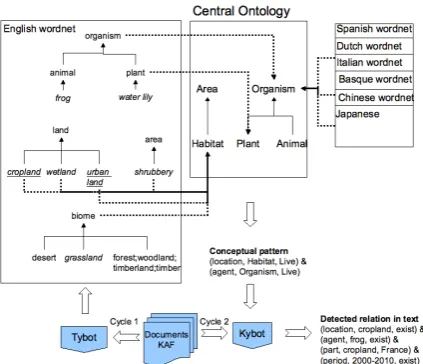
The KYOTO system proceeds in 2 cycles (see Figure 1). In the 1st cycle, the Tybot (Term Yield-ing Robot) extracts the most relevant terms from the documents. The Tybot is another generic pro-gram that can do this for all the different lan-guages in much the same way. The terms are or-ganized as a structured hierarchy and, wherever possible, related to generic semantic databases, i.e. wordnets for each language. In the left part of Figure 1, we show those terms in the input docu-ment and their classification in wordnet. Terms in italics are present in the original wordnet, while underlined terms correspond to terms which were not in the original wordnet but were automatic-ally discovered and linked to wordnet by Tybots. Straight terms correspond to hyperonyms in wordnet that do not necessarily occur in the text but are linked to ontological classes. The result of this 1st cycle is a domain wordnet for the target language.
3 Ontological and lexical background
knowledge
As a semantic background model, we defined a 3-layered knowledge architecture following the principle of the division of labour (Putnam 1975). In this model, the ontology does not need to be the central hub for all terms in a domain in all languages. Following the division of labour principle, we can state that a computer does not need to distinguish between instances of a European Tree Frog and a Glass Tree frog. We assume that rigid concepts (as defined by Guarino and Welty 2002) are known to the do-main experts and do not need to be defined form-ally in the ontology but can remain in the avail-able background resources, such as databases with millions of species. Terms in the documents are mostly non-rigid, e.g. endangered frogs, in-vasive frogs. Such non-rigid terms refer to in-stances of species in contextual circumin-stances. The processes and states are the important pieces of information that matter to the users and are useful for mining text. The model therefore dis-tinguishes between background vocabularies, do-main terms, wordnets and the central ontology. The background vocabularies are automatically aligned to wordnet, where we assume that hyponymy relations to rigid synsets in wordnet declare those subconcepts as rigid subtypes too, without the necessity to include them in the onto-logy. For non-rigid terms, we defined a set of mapping relations to the ontology through which we express their non-rigid involvement in these
processes and states. Likewise, the ontology has been extended with processes and states for the domain and verbs and adjectives have been mapped to be able to detect expressions in text.
The 3-layered knowledge model combines the efforts from 3 different communities:
1.Domain experts in social communities that continuously build background vocabularies; 2.Wordnet specialists that define the basic se-mantic model for general concepts for a lan-guage
3.Semantic Web specialists that define top-level and domain-specific ontologies that capture formal definitions of concepts;
We formalized the relations between these repos-itories so that they can developed separately but combined within KYOTO to form a coherent and formal model.
3.1 Ontology
The KYOTO ontology currently consists of 1149 classes divided over three layers. The top layer is based on DOLCE (DOLCE-Lite-Plus version 3.9.7, Masolo et al 2003) and OntoWordNet. This layer of the ontology has been modified for our purposes (Herold et. al. 2009). The second layer consists of so-called Base Concepts (BCs) derived from various wordnets (Vossen 1998, Izquierdo et al. 2007). Examples of BCs are:
building, vehicle, animal, plant, change, move, size, weight. The BCs are those synsets in Word-Net 3.0 that have the most relations with other synsets in the wordnet hierarchies and are selec-ted in a way that ensures complete coverage of the nominal and verbal part of WordNet. This has been completed for the nouns (about 500 synsets). The ontology has also been adapted to include important concepts in the domain. Spe-cial attention has been paid to represents the pro-cesses (perdurants) in which objects ( endur-ants) of the domain are involved and qualities they may have. This is typically the information that is found in documents on the environment. We thus added 40 new event classes for repres-enting important verbs (e.g. pollute, absorb,
[image:3.595.73.285.72.254.2]damage, drain) and 115 new qualities and qual-ity-regions for representing important adjectives (e.g. airborne, acid, (un)healthy, clear). The full
ontology can be downloaded from the KYOTO website, free for use. A considerable set of gener-al verbs and adjectives (relevant for for the do-main) have then been mapped to ontological classes: 189 verbal synsets and 222 adjectival synsets.
The 500 nominal BCs are connected to the complete WordNet hierarchy, whereas the 189 verbs represent 5,978 more specific verbal syn-sets and the 222 adjectives represent 1,081 ad-jectival synsets through the wordnet relations.
This basic ontology and the mapping to Word-Net are used to model the shared and lan-guage-neutral concepts and relations in the do-main. Instances are excluded from the ontology. Instances will be detected in the documents and will be mapped to the ontology through instance to ontology relations (see below). Likewise, we make a clear separation between the ontological model and the instantiation of the model as de-scribed in the text.
3.2 Wordnet to ontology mappings
In addition to the ontology, we have wordnets for each language in the domain. In addition to the regular synset to synset relations in the wordnet, we will have a specific set of relations for map-ping the synsets to the ontology, which are all prefixed with sc_ standing for synset-to-concept. We differentiate between rigid and non-rigid con-cepts in the wordnets through the mapping rela-tions:
• sc_equivalenceOf: the synset is fully equi-valent to the ontology Type & inherits all proper-ties; the synset is Rigid
• sc_ subclassOf: the synset is a proper sub-class of the ontology Type & inherits all proper-ties; the synset is Rigid
• sc_domainOf: the synset is not a proper sub-class of the ontology Type & is not disjoint (therefore orthogonal) with other synsets that are mapped to the same Type either through sc_sub-classOf or sc_domainOf; the synset is non-Rigid but still inherits all properties of the target onto-logy Type; the synset is also related to a Role with a sc_playRole relation
• sc_playRole: the synset denotes instances for which the context of the Role applies for some period of time but this is not essential for the existence of the instances, i.e. if the context
ceases to exist then the instances may still exist (Mizoguchi et al. 2007).3
• sc_participantOf: instances of the concept (denoted by the synset) participate in some en-durant, where the specific role relation is indic-ated by the playRole mapping.
• sc_hasState: instances of the concept are in a particular state which is not essential and can be changed. There is no need to represent the role for a stative perdurant.
This model extends existing WordNet to onto-logy mappings. For instance, in the SUMO to Wordnet mapping (Niles and Pease 2003), only the sc_equivalenceOf and sc_subclassOf rela-tions are used, represented by the symbols ‘=’ and ‘+’ respectively. The SUMO-Wordnet map-ping likewise does not systematically distinguish rigid from non-rigid synsets. In our model, we separate the linguistically and culturally specific vocabularies from the shared ontology while us-ing the ontology to interface the concepts used by the various communities.
Using these mapping relations, we can express that the synset for duck (which has a hypernym relation to the synset bird, which, in its turn, has an equivalence relation to the ontology class
bird) is thus a proper subclassOf the ontology class bird:
wn:duck hypernym wn:bird
wn:bird sc_equivalenceOf ont:bird
For a concept such as migratory bird, which is also a hyponym of bird in wordnet but not a proper subclass as a non-rigid concept, we thus create the following mapping:
wn:migratory bird
→ sc_domainOf ont:bird
→ sc_playRole ont:done-by
→ sc_participantOf ont:migration
This mapping indicates that the synset is used to refer to instances of endurants (not subclasses!), where the domain is restricted to birds. Further-more, these instances participate in the process of
3 Some terms involve more than one role, e.g. gas-powered-vehicle. Secondary participants are related through sc_hasCoParticipant and sc_playCoRole
migration in the role of done-by. The properties of the process migration are further defined in the ontology, which indicates that it is a act-ive-change-of-location done-by some endurant, going from a source, via a path to some destina-tion. The mapping relations from the wordnet to the ontology, need to satisfy the constraints of the ontology, i.e. only roles can be expressed that are compatible with the role-schema of the process in which they participate.
For implied non-essential states, we use the
sc_hasState relation to express that a synset such as wild dog refers to instances of dogs that life in the wild but can stop being wild:
wn:wild dog → sc_domainOf ont:dog wn:wild dog → sc_hasState ont:wild
Ideally, all processes and states that can be ap-plied to endurants should be defined in the onto-logy. This may hold for most verbs and adject-ives in languages, which do not tend to extend in specific domains and are part of the general vocabulary (e.g. to pollute, to reduce, wild). However, domain specific text contain many new nominal terms that refer to domain-specific pro-cesses and states, e.g. air pollution, nitrogen pol-lution, nitrogen reduction. These terms are equally relevant as their counter-parts that refer to endurants involved in similar processes, e.g.
polluted air, polluting nitrogen or reduced nitro-gen. We therefore use the reverse participant and role mappings to be able to define such terms for processes as subclasses of more general pro-cesses involving specific participants in a spe-cified role:
wn:air pollution
→ sc_subcassOf ont:pollution (perdurant)
→ sc_hasParticipant ont:air
→ sc_hasRole ont:patient wn:nitrogen pollution
→ sc_subcassOf ont:pollution (perdurant)
→ sc_hasParticipant ont:nitrogen → sc_hasRole ont:done-by
Further mapping relations are described in the documentation on the KYOTO website. Through the mapping relations, we can keep the ontology relatively small and compact whereas we can still define the richness of the vocabularies of
lan-guages in a precise way. The classes in the onto-logy can be defined using rich axioms that model precise implications for inferencing. The wordnet to synset mappings can be used to define rather basic relations relative to the given ontology that still captures the semantics of the terms. The term definitions capture both relevance and per-spective (those relations that matter from the point of the view of the term), on the one hand, and some semantics with respect to the concepts that are involved and their (role) relation on the other hand. Likewise, the KYOTO system can model the linguistic and cultural diversity of lan-guages in a domain but at the same time keep a firm anchoring to a basic and compact ontology.
3.3 Domain wordnet
4 Off-line reasoning and ontological
tag-ging
The ontological tagging represents the last phase in the KYOTO Linguistic Processor annotation pipeline. It consists of a three-step module de-vised to enrich the KAF documents with know-ledge derived from the ontology. For each synset connected to a term, the first step adds the Base Concepts to which the synset is related through
the wordnet taxonomical relations. Then, through the synset to ontology mapping, it adds the cor-responding ontology type with appropriate rela-tions. Once each synset is specified as to its onto-logy type, the last ontotagging step inserts the full set of ontological implications that follow from the explicit ontology. The explicit ontology is a new data structure consisting of a table with all ontology nodes and all ontological implica-tions expressed. The main purpose is to optimize <term lemma="pollution" pos="N" tid="t13444" type="open">
<externalReferences>
<externalRef reference="eng-30-00191142-n" reftype="baseConcept" resource="wn30g"/>
<externalRef reference="Kyoto#change-eng-3.0-00191142-n" reftype="sc_subClassOf" resource="ontology"> <externalRef reftype="SubClassOf" reference="DOLCE-Lite.owl#contamination_pollution"/>
<externalRef reftype="SubClassOf" reference="DOLCE-Lite.owl#accomplishment" status="implied"/> <externalRef reftype="SubClassOf" reference="DOLCE-Lite.owl#event" status="implied"/> <externalRef reftype="SubClassOf" reference="DOLCE-Lite.owl#perdurant" status="implied"/> <externalRef reftype="DOLCE-Lite.owl#part" reference="DOLCE-Lite.owl#perdurant" status="implied"/> <externalRef reftype="DOLCE-Lite.owl#specific-constant-constituent" reference="DOLCE-Lite.owl#perdurant" status="implied"/>
<externalRef reftype="DOLCE-Lite.owl#has-quality" reference="DOLCE-Lite.owl#temporal-quality" status="implied"/> <externalRef reftype="SubClassOf" reference="DOLCE-Lite.owl#spatio-temporal-particular" status="implied"/> <externalRef reftype="DOLCE-Lite.owl#participant" reference="DOLCE-Lite.owl#endurant" status="implied"/> <externalRef reftype="DOLCE-Lite.owl#has-quality" reference="DOLCE-Lite.owl#temporal-location_q" status="im-plied"/>
<externalRef reftype="SubClassOf" reference="DOLCE-Lite.owl#particular" status="implied"/> </externalRef>
</externalReferences> </term>
Figure 2: An example of an OntoTagged output
<kprofile> <variables>
<var name="x" type="term" pos="N"/> <var name="y" type="term"
lemma="produce | generate | release | ! create"/> <var name="z" type="term"
reference="DOLCE-Lite.owl#contamination_pollution" reftype="SubClassOf"/>
</variables> <relations> <root span="y"/>
<rel span="x" pivot="y" direction="preceding"/> <rel span="z" pivot="y" direction="following"/> </relations>
<events>
<event target="$y/@tid" lemma="$y/@lemma" pos="$y/@pos"/> <role target="$x/@tid" rtype="agent" lemma="$x/@lemma"/> <role target="$z/@tid" rtype="patient"lemma="$z/@lemma"/>$ </events>
</kprofile>
Figure 3: An example of a Kybot profile <kybotOut>
<doc name="11767.mw.wsd.ne.onto.kaf">
<event eid="e1" lemma="generate" pos="V" target="t3504"/>
<role rid="r1" lemma="industry" rtype="agent" target="t3493" pos="N" event="e1"/> <role rid="r2" lemma="pollution" rtype="patient" target="t3495" pos="N" event="e1"/> </doc>
<doc name="16266.mw.wsd.ne.onto.kaf">
<event eid="e2" lemma="release" pos="V" target="t97"/>
<role rid="r3" lemma="fuel" rtype="agent" target="t96" pos="N" event="e2"/>
<role rid="r4" lemma="exhaust_gas" rtype="patient" target="t101" pos="V" event="e2"/> </doc>
</kybotOut>
the performance of the mining module over large quantities of documents. The advantage for Ky-bots from ontotagging are many. First of all, they are able to run and apply pattern-matching to Base Concepts and ontological classes rather than just to words or synsets. Moreover, by mak-ing explicit the implicit ontological statements, Kybots are able to find the same relations hidden in different expressions with different surface realizations: fish migration, migratory fish, mi-gration of fish, fishes that migrate, that directly or indirectly express the same relations. With on-totagging, they share the same ontological im-plications which will allow Kybots to apply the same patterns and perform the extraction of facts. The implications will be represented in the same way across different languages, thus facilitating cross-lingual extraction of facts. Lastly, ontotag-ging is a kind of off-line ontological reasoning: without doing reasoning over concepts, Kybots substantially improve their performance. Figure 2 shows the result of onto-tagging for the term
pollution.
5 Event and fact extraction
Kybots (Knowledge Yielding Robots) are com-puter programs that use the mined concepts and the generic concepts already con-nected to the language wordnets and the KYOTO ontology to extract actual concept instances and relations in KAF documents. Kybots incorporate technology for the extraction of relationships, either eventual or not, relative to the general or domain concepts already captured by the Tybots. That is, the extraction of factual knowledge is be-ing carried out by the Kybot server by processbe-ing Kybot profiles on the linguistically enriched doc-uments.
Kybots are defined following a declarative
format, the so called Kybot
profiles, which describe general morpho-syntact-ic and semantmorpho-syntact-ic conditions on sequences of terms. Profiles are compiled to generate the Ky-bots, which scan over KAF documents searching for the patterns and extract the relevant informa-tion from each matching.
Linguistic patterns include morphologic con-straints and also semantic conditions the matched terms must hold. Kybot are thus able to search for term lemmas or part-of-speech tags but also for terms linked to ontological process and states
using the mappings described in Section 3.2. Thus, it is possible to detect similar eventual in-formation across documents in different lan-guages, even if expressed differently.
5.1 Example of a Kybot Profile
Kybot Profiles are described using XML syn-tax. Figure 3 presents an example of a profile. Kybot profiles consist of three main parts:
•Variable declaration (<variables> element): In this section the search entities are defined. The example defines three variables: x (denoting terms whose part-of-speech is noun), y (which are terms whose lemma is “release”, “produce” or “generate” but not “create”) and z (terms linked to the ontological endurant “DOLCE-L-ite.owl#contamination_pollution”, meaning ``be-ing contaminated with harmful substances'').
•Declarations of the relations among variables
(<rel> element): specify the relations among the previously defined variables. The example pro-file specifies y as the main pivot, and states that variable x must be preceding variable y in the same sentence, and that variable z must be fol-lowing variable y. Thus, the Kybot will search for patterns like 'x → y → z' in a sentence.
•Output template (<events> element): describes the output to be produced on every matching. In the example, each match generates a new event targeting term y, which becomes the main term of the event. It also fills two roles of the event, the 'agent' role filled by term x and 'patient' role, filled by z.
Figure 4 presents the output of the Kybot when applied against the benchmark documents. The Kybot output follows the stand-off architec-ture when producing new information, and it thus forms a new KAF layer on the original docu-ments.
6 Experimental results
the documents have been processed by the lin-guistic processor for English, which generated KAF representations for all the documents. From this database, 3 documents were selected for benchmarking.
The documents were processed by applying multiword tagging, word-sense-disambiguation, named-entity-recognition and the ontological tagging to the 3 documents and to the complete database; This was done twice: once without the domain model and once with the domain model. We thus created 4 datasets: 3 benchmark docu-ments processed with and without the domain model; the complete database processed with and without the domain model.
Furthermore, we created Kybot profiles based on the type of information represented in the do-main model. We applied the Kybots to all 4 data sets. We generate the following data files through an WN-LMF export of the domain wordnet:
1. a set of domain multiwords for the multi-word tagger
2. an extension of the lexicon and the graph of concepts that is used by the WSD module
3. an extension of the wordnet-to-ontology mappings for the ontotagger
In addition, we constructed mapping lists for all WordNet 3.0 synsets to Base Concepts and to ad-jective and verbs that are matched to the onto-logy. These mappings provide the generic con-ceptual model based on wordnet and on the onto-logy.
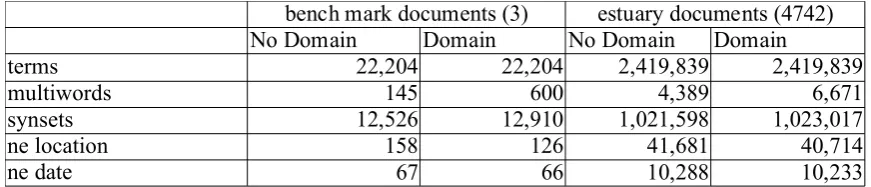
Table 1 shows the effects of using the domain model for the first 3 modules. We can see that the domain model has a clear effect on the multi-word detection in the 3 evaluation documents. Using the domain model, 600 multiwords have been detected, against 145 with just the generic wordnet. This is obvious since the terms are ex-tracted from the same documents. However,
when applying it to the complete database, we see that still over 2,300 more multiwords have been detected using the domain wordnet. Note that the domain wordnet has only 97 multiwords and the generic wordnet has 19,126 multiwords. So 0.5% of the multiwords in the domain word-net add 1.5 times more multiword tokens in the database. The third row specifies the number of synsets that have been assigned. We can see that for the domain model almost 400 more synsets have been detected. In the case of the full estuary database, we see that relatively few more have been detected, almost 1,500 while the database is 80 times as big. If we look more closely at the numbers of actual domain synsets detected, we see the following results. In the benchmark docu-ments 637 (or 5%) of the synsets is a domain wordnet synset, whereas 5,353 synsets are do-main synsets in the full estuary database, which is only 0.52%. Note that in KAF multiwords are represented both as a single terms and in terms of their elements. The WSD module assigns synsets to both. The domain model can thus only add synsets compared to the processing without the domain.
[image:8.595.76.512.624.717.2]Finally, if we look at the named-entity-recogni-tion module, we see a slight negative effect for the detection of named-entities due to the domain model. The named-entity-recognition module does not consider the elements of multiwords but just the multiword terms as a whole. Grouping terms as multiwords thus leads to less named-entities being detected. This is not necessarily a bad things, since the detection heavily over-gen-erates and could have now more precision.
Table 1: Statistics on processing the estuary documents with and without domain model
bench mark documents (3) estuary documents (4742)
No Domain Domain No Domain Domain
terms 22,204 22,204 2,419,839 2,419,839
multiwords 145 600 4,389 6,671
12,526 12,910 1,021,598 1,023,017
158 126 41,681 40,714
67 66 10,288 10,233
Table 2 shows the effect of inserting ontologic-al implications into the text representation.For the benchmark documents, we see that more than half a million ontological implications have been inserted. Of these, 82% are implied references, that are extracted from the explicit ontology on the basis of a direct mapping to the ontology. About 8% of the mappings are synset-to-onto-logy mappings (sc) and 9.5% are mappings rep-resenting the subclass hierarchy. The differences between using the domain model and not-using the domain model are minimal. For the complete database, the implications are 80 times as much but the proportions are similar.
Table 3 shows the type of sc-relations that oc-cur. Obviously, sc_subClassOf and sc_equival-entOf are the most frequent. Nevertheless, we still find about 500 mappings that present the participation in a process or state.
30 reftype="sc_playCoRole" 32 reftype="sc_hasCoParticipant" 42 reftype="sc_partOf"
59 reftype="sc_stateOf" 92 reftype="sc_playRole" 94 reftype="sc_hasRole" 97 reftype="sc_participantOf" 105 reftype="sc_hasParticipant" 128 reftype="sc_domainOf" 169 reftype="sc_hasState" 312 reftype="sc_hasPart" 3637 reftype="sc_equivalentOf" 42048 reftype="sc_subClassOf"
Table 3: Type of relations for the wordnet to ontology mappings using the domain model
The table clearly shows the impact of role rela-tions that are encoded in the domain wordnet. When we extract the mappings for the files without the domain model (ony using the map-pings to the generic wordnet), we get only equi-valence and subclass mappings.
Finally to complete the knowledge cycle, we cre-ated a few Kybot profiles for extracting events from the onto-tagged documents. As an initial test, 3 profiles have been created:
1. events of destruction 2. destructions of locations 3. destruction of objects
Using these profiles, we extracted 211 events from the 3 benchmark documents with 396 roles. The profiles are created to run over the ontolo-gical types inserted by the ontotagger, e.g. re-stricted to events and change_of_integrity. Des-pite the generality of the profiles, we still see a clear signature of the domain in the output. This is a good indication that we will be able to ex-tract valuable events from the data, even though the ontotagger generates a massive amount of implications. Especially events that combine multiple roles appear to give rich information. For example, the following sentence:
"One of the greatest challenges to restoration is con-tinued population growth and development, which destroys forests, wetlands and other natural areas"
yielded the following output:
<event target="t1471" lemma="destroy" pos="V" eid="e74"/>
<role target="t1477" rtype="patient" lemma="area" pos="N" event="e74" rid="r138"/>
<role target="t1472" rtype="patient"
lemma="forest" pos="N" event="e74" rid="r151"/> <role target="t1469" rtype="actor" lemma="devel-opment" pos="N" event="e74" rid="r180"/>
[image:9.595.79.503.77.153.2]Running the full set of profiles on the complete data-base with almost 60 million ontological statements took about 2 hours. This shows that our approach is scalable and efficient.
Table 2: Ontological implications for the four data sets
bench mark documents (3) estuary documents (4272
No Domain Domain Domain
ontology references 555,677 576,432 48,708,300
implied ontology references 457,332 82.30% 474,916 82.39% 40,523,452 83.20% direct ontology references 53,178 9.57% 54,769 9.50% 4,377,814 8.99%
45,167 8.13% 46,747 8.11% 3,807,034 7.82%
7 Conclusions
In this paper, we described an open platform for text-mining using wordnets and a central onto-logy. The system can be used across different languages and can be tailored to mine any type of conceptual relations. It can handle semantic im-plications that are expressed in very different lin-guistic expressions and yield systematic output. As future work, we will carry out benchmarking and testing of the mining of events, both for Eng-lish and for the other languages in the KYOTO project.
Acknowledgements
The KYOTO project is co-funded by EU - FP7 ICT Work Programme 2007 under Challenge 4 - Digital libraries and Content, Objective ICT-2007.4.2 (ICT-2007.4.4): Intelligent Contsent and Semantics (challenge 4.2). The Asian part-ners from Tapei and Kyoto are funded from na-tional funds. This work has been also supported by Spanish project KNOW-2 (TIN2009-14715-C04-01).
References
Agirre, E., & Soroa, A. (2009) Personalizing PageR-ank for Word Sense Disambiguation. Proceedings of the 12th EACL, 2009. Athens, Greece.
Agirre, E., Lopez de Lacalle, O., & Soroa, A. (2009) Knowledge-based WSD and specific domains: per-forming over supervised WSD. Proceedings of IJ-CAI. Pasadena, USA. http://ixa.si.ehu.es/ukb Álvez J., Atserias J., Carrera J., Climent S., Laparra
E., Oliver A. and Rigau G. (2008) Complete and Consistent Annotation of WordNet using the Top Concept Ontology. Proceedings of LREC'08, Mar-rakesh, Morroco. 2008.
Appelt Douglas E., Jerry R. Hobbs, John Bear, David Israel, Megumi Kameyama, Andrew Kehler, David Martin, Karen Myers and Mabry Tyson. Descrip-tion of the FASTUS System Used for MUC-6. In Proceedings of MUC-6, pages 237–248. San Mateo, Morgan Kaufmann, 1995.
Auer A., C. Bizer, G. Kobilarov, J. Lehmann, R. Cy-ganiak and Z. Ives. DBpedia: A Nucleus for a Web of Open Data. In Proceedings of the International Semantic Web Conference (ISWC), volume 4825 of Lecture Notes in Computer Sci-ence, pages 722-735. 2007.
Bosma, W., Vossen, P., Soroa, A. , Rigau, G., Tesconi, M., Marchetti, A., Monachini, M., & Apiprandi, C. (2009) KAF: a generic semantic annotation format. In Proceedings of the 5th International Conference on Generative Approaches to the Lexicon Sept 17-19, 2009, Pisa, Italy.
Fellbaum, C. (Ed.) (1998) WordNet: An Electronic Lexical Database. Cambridge, MA: MIT Press. Freitag, D. (1998) Information extraction from html:
Application of a general machine learning ap-proach. In Proceedings of the Fifteenth National Conference on Artificial Intelligence, 1998.
Gangemi A., Guarino N., Masolo C., Oltramari A., Schneider L. (2002) Sweetening Ontologies with DOLCE. Proceedings of EKAW. 2002
Ide, N. and L. Romary. 2003. Outline of the inter- na-tional standard Linguistic Annotation Framework. In Proceedings of ACL 2003 Workshop on Lin-guistic Annotation: Getting the Model Right, pages 1–5.
Izquierdo R., Suárez A. & Rigau G. Exploring the Automatic Selection of Basic Level Concepts. Pro-ceedings of RANLP'07, Borovetz, Bulgaria. September, 2007.
Masolo, C., Borgo, S., Gangemi, A., Guarino, N. & Oltramari, A. (2003) WonderWeb Deliverable D18: Ontology Library, ISTC-CNR, Trento, Italy. Mizoguchi R., Sunagawa E., Kozaki K. & Kitamura
Y. (2007 A Model of Roles within an Ontology De-velopment Tool: Hozo. Journal of Applied Onto-logy, Vol.2, No.2, 159-179.
Niles, I. & Pease, A. (2001) Formal Ontology in In-formation Systems. Proceedings of the internation-al Conference on Forminternation-al Ontology in Information Systems – Vol. 2001 Ogunquit, Maine, USA Niles, I. and A. Pease. Linking lexicons and
ontolo-gies: Mapping WordNet to the Suggested Upper Merged Ontology. In Proc. IEEE IKE, pages 412– 416, 2003.
Vossen, P. (Ed.) (1998) EuroWordNet: a multilingual database with lexical semantic networks for European Languages. Kluwer, Dordrecht.