Overview of the Bacteria Biotope Task at BioNLP Shared Task 2016
1Louise Del´eger,1Robert Bossy,1Estelle Chaix,1Mouhamadou Ba,1,2Arnaud Ferr´e, 1Philippe Bessi`eres,1Claire N´edellec
1MaIAGE, INRA, Universit Paris-Saclay, 78350 Jouy-en-Josas, France 2LIMSI, CNRS, Universit Paris-Saclay, 91405 Orsay, France
Abstract
This paper presents the Bacteria Biotope task of the BioNLP Shared Task 2016, which follows the previous 2013 and 2011 editions. The task focuses on the extrac-tion of the locaextrac-tions (biotopes and geo-graphical places) of bacteria from PubMed abstracts and the characterization of bac-teria and their associated habitats with respect to reference knowledge sources (NCBI taxonomy, OntoBiotope ontology). The task is motivated by the importance of the knowledge on bacteria habitats for fundamental research and applications in microbiology. The paper describes the dif-ferent proposed subtasks, the corpus char-acteristics, the challenge organization, and the evaluation metrics. We also provide an analysis of the results obtained by partici-pants.
1 Introduction
Since 2009, BioNLP Shared Task is a community-wide effort on the development of fine-grained information extraction methods in biomedicine (Kim et al., 2009; Kim et al., 2011; N´edellec et al., 2013). The tasks provide a sound framework for the comparison and evaluation of the technologies on a manually curated benchmark with the aim to contribute to progress by drawing general lessons from the individual contributions and assessment of the participants. In this paper, we present the third edition of the Bacteria Biotope task that has been first introduced in 2011 with the ambition to use information extraction from scientific docu-ments at a large scale in order to automatically fill knowledge bases (Bossy et al., 2012).
Information about bacteria biotopes (e.g., habi-tats of bacteria) is critical for studying the interac-tion and associainterac-tion mechanisms between
organ-isms and their environments from genetic, phylo-genetic and ecological points of view. This infor-mation is not only highly useful in all fields of ap-plied microbiology such as food processing and safety, health sciences and waste processing, but also in fundamental research (e.g., metagenomics, phylogeography, phyloecology).
Currently, there is no centralized resource gath-ering the state of knowledge on habitats of bacteria in a comprehensive and normalized way. A large part of this knowledge is scattered in numerous scientific papers and databases, such as genomics databases (e.g., GenBank1, GOLD2), international microorganism culture collections (e.g., ATCC3, DSMZ4), and biodiversity surveys (e.g. , GBIF5). The information on bacteria biotopes is mostly ex-pressed in free text (e.g., articles or free-text fields of databases) describing very diverse locations (any physical location may be a bacteria habitat) in many different ways. The need for information processing is not only the extraction of habitats and microorganisms relationships from text, but also their normalization with respect to a common referential so that they can be integrated and com-pared. This need has been acknowledged by pre-vious work on habitat classifications for metage-nomic samples (Ivanova et al., 2010), microisms (Floyd et al., 2005) and other living organ-isms (Buttigieg et al., 2013) and text-mining tools for mapping textual descriptions to habitat classi-fication (Pignatelli et al., 2009).
The aim of Bacteria Biotope (BB) task is to pro-vide a framework for the evaluation and
compari-1http://www.ncbi.nlm.nih.gov/genbank 2https://gold.jgi.doe.gov/(Genomes Online
Database)
3http://www.atcc.org/ (American Type Culture
Collection)
4https://www.dsmz.de/(Deutsche Sammlung von
Mikroorganismen und Zellkulturen)
5http://www.gbif.org/ (Global Biodiversity
In-formation Facility)
son of such methods for Bacteria organism habi-tats. More specifically, the BB task consists in the extraction of bacteria and their locations (habi-tats or geographical places) from the text, their categorization according to dedicated knowledge sources, and the linking of bacteria to their loca-tions through so-called localization events named ” Lives in”. The widely used NCBI taxonomy6 (Federhen, 2012) is the resource used for Bac-teria entity categorization. The OntoBiotope on-tology7, which is dedicated to the description of microorganism habitats, is used for biotope cat-egorization. Previous work has shown the rele-vance of OntoBiotope for bacteria habitat detec-tion (Ratkovic et al., 2012). The first two edi-tions of the task (Bossy et al., 2012; Bossy et al., 2015) used general-purpose documents, mostly web pages of genomics projects that can be un-derstood by non-specialists. However, scientific literature is the major source of detailed and ac-curate information on bacteria for biologists. This edition focuses then on scientific paper abstracts from the PubMed database, which offers a twofold advantage, open access and easier readability than full-text. We also introduce this year a new sub-task of knowledge base extraction, in which sys-tems are evaluated by measuring how much infor-mation content can be extracted from the corpus.
2 Task Description
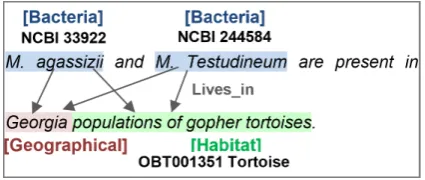
[image:2.595.75.288.593.683.2]The BB task involves three types of entities, Bac-teria, Habitats and Geographical places. It also in-volves a single type of event, the Lives in event, which is a relation between two mandatory argu-ments, the bacterium and the location where it lives, either a Habitat or a Geographical entity. Figure 1 displays an example of entities and events in the BB task.
Figure 1: Example of entities andLives inevents in the BB task
6http://www.ncbi.nlm.nih.gov/taxonomy 7http://2016.bionlp-st.org/tasks/bb2/
OntoBiotope_BioNLP-ST-2016.obo
We proposed three subtasks with two modalities each. Each subtask had a plain modality where named entities were given as input, thus partici-pants were not required to perform entity recogni-tion. In the second modality, entities werenot pro-vided, thus methods had to perform named entity recognition and submissions are partly evaluated on the accuracy of entity boundaries. Our purpose is to assess independently the quality of the meth-ods when dealing with different sub-goals and to assess the impact of predictions made at a given step on the predictions made at the next steps.
2.1 Bacteria and Habitat Categorization
The first subtask focused on the categorization ofBacteriaandHabitatentity occurrences in the text with categories from the NCBI Taxonomy for
Bacteria and from the OntoBiotope ontology for
Habitat entities. In the first modality of the sub-task (referred to as BB-cat), entity mentions were given and participants had only to perform cate-gorization. In the second modality (BB-cat+ner), systems had to perform bacteria and habitat entity detection as well as categorization.
2.2 Entity and Event Extraction
The second subtask consists in the extraction of
Lives inevents amongBacteria,Habitatand Ge-ographicalentities. In the BB-event modality, en-tity mentions were given and participant systems only had to perform event extraction. In the BB-event+ner modality, systems had to perform Bac-teria,HabitatandGeographicalentity recognition as well as event extraction.
2.3 Knowledge Base Extraction
The third subtask aims at building a knowledge base using information extracted from the corpus. The knowledge base is composed of the set of dis-tinctLives in events between categorized Bacte-ria andHabitats. This subtask can be seen as a combination of the entity categorization and event extraction subtasks. In contrast with the two previ-ously described subtasks, this task does not eval-uate text-bound annotations. All pieces of infor-mation extracted from the text are gathered and merged into a single knowledge base, without du-plicate events. The focus of this task is the knowl-edge itself (which types of bacteria and habitat are linked through a Lives In event) and not the individual text-bound annotations (whereLives In
In the first modality, BB-kb, entity mentions were given and participating systems perform catego-rization and event extraction. In the second modal-ity, BB-kb+ner, systems had to performBacteria
andHabitatentity detection and categorization as well as event extraction.
3 Corpus Construction
3.1 Corpus Selection
The BB corpus consists of titles and abstracts of PubMed entries. We followed a four step pro-cedure to build a representative reference corpus for the task from the whole PubMed database. It started from the set of all PubMed references and successively selected a subset of references while preserving the distribution of bacteria and habitat categories.
In the first step, we selected PubMed entries relevant to bacteria, relying on the MeSH in-dex provided by the NLM. We selected all en-tries that were indexed by any term of the Organ-isms/Bacteria subtree (B03). PubMed contained 27,872,481 entries, of which 1,156,824 indexed by a term in the Bacteria subtree (4%).
In the second step, we automatically annotated
Bacteria,GeographicalandHabitatentities in the title and abstract of these selected entries (see the corpus annotation subsection for details about this automatic approach). We found 6.8 million habi-tat occurrences, 3.7 million occurrences of bacte-ria taxon names, and 374 thousand geographical names. This gave us a broad idea of the quantity and diversity of the entries in terms of bacterial taxa and bacterial habitats.
However this collection is too large to be man-ageable by human annotators. Therefore in the third step, we built a sub-collection of 1,000 en-tries. We selected the most representative in 2,000 random samples of 1,000 entries. The representa-tiveness was evaluated by the mean squared error (MSE) between the sample and the original col-lection. We selected the sample with the lowest MSE. The observations from which we computed the MSE included the number of words, the num-ber of occurrences of taxon names for each bacte-rial family and the number of occurrences of habi-tat mentions for each top-level concept of Onto-Biotope. As expected from a PubMed sample, the majority of entries were biomedical studies. Even though habitats related to human health and wel-fare are important, the sample does not convey the
full diversity of bacteria habitats.
In the fourth step we manually annotated the title and abstract of references from the sample (see section 3.2). As it would require too much human resources the manual annotation of 1,000 PubMed entries is not an option. We randomly picked entries as we finished annotating the pre-vious ones in order to preserve the distribution. The random selection used the same method as the sampling, however we deliberately biased against clinical habitats in order to leave room for more diverse and less frequent habitats.
3.2 Corpus Annotation
Manual annotation was performed by seven anno-tators with diverse backgrounds: biology, com-puter science, linguistics, and bioinformatics. Three annotators had annotated documents in the previous editions of the BB task. Each document was annotated by two annotators in a double-blind manner and an adjudication phase resolved dis-agreements. Annotators relied on detailed guide-lines which were revised and clarified when ques-tions arose during the annotation process. The guideline document is available on the BB task website8.
Annotators used the AlvisAE annotation edi-tor (Papazian et al., 2012). In order to speed up the annotation process, we used Alvis Suite (Ba and Bossy, 2016) to automatically pre-annotate the corpus. It included the Stanford NER tool (Finkel et al., 2005) to annotate Geographical locations and the ToMap method (Golik et al., 2011) to de-tect and categorizeHabitatentities. Bacteria en-tity automatic recognition and categorization were performed with a rule-based approach relying on a customized dictionary of taxon names,i.e. NCBI taxonomy names augmented with typographical variations. Events were extracted using manu-ally defined trigger words and rules in a similar way as Ratkovic et al. (2012). Table 1 gives pre-annotation performance for habitat and bacteria recognition and categorization (cat+ner) and for entity and Lives In event extraction (event+ner). Performance is low, especially for event extrac-tion, which calls into question the benefit of us-ing automatic pre-annotation for these tasks. The low performance of pre-annotation compared to the final gold standard is also an indication that text pre-annotation did not much bias manual
notation, since the annotators did not hesitate to make extensive changes in the pre-annotation. We computed the inter-annotator agreement by com-paring the individual manual annotations with the consensus, using the same evaluation framework as for the evaluation of participant systems (Sec-tion 5). We did not compute any Kappa statis-tics, since this type of metric is not well-suited for the annotation of textual entities (Hripcsak and Rothschild, 2005). Moreover, even in the case of event annotation, computing Kappa would have been difficult, because event annotation is based on entity annotation. Table 2 shows the agree-ment of entity boundaries and categorization com-puted with BB-cat+ner scores and the agreement of entity boundaries andLives Inevents computed with BB-event+ner scores. The high precision demonstrates that there was not much disagree-ment among annotators on the entity boundaries and categorization, or in theLives Inevents. The consensus consisted mostly in annotation merg-ing. The lower recall stresses the necessity of mul-tiple annotators in order to ensure that the refer-ence is complete.
SER Recall Precision F1 cat+ner 1.167 0.287 0.341 0.312 event+ner 1.749 0.187 0.158 0.171
Table 1: Pre-annotation performance (SER = Stan-dard Error Rate)
Recall Precision F1 Entity recog. 0.621 0.955 0.753 Lives Inevent 0.311 0.952 0.468
Table 2: Inter-annotator agreement
3.3 Corpus Statistics
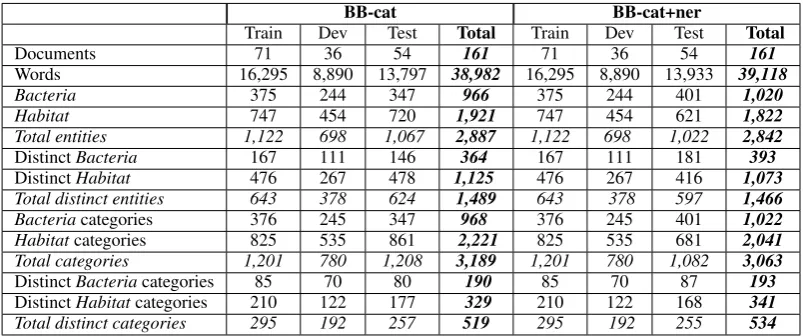
Tables 3, 4 and 5 provide descriptive statistics of the corpus for the three subtasks respectively.
They show the distributions of entities, cate-gories, and events among the different datasets (training, development and test) of each subtask. We analyzed these statistics in order to study the characteristics of the BB corpora with respect to the tasks. Each distinct entity surface form has only two occurrences on average in the cor-pus, which makes the recognition task more dif-ficult than with highly repeated mentions: there are 1,489 and 1,466 distinct entity mentions (i.e., strings or surface forms) out of a total 2,887 and 2,842 annotated entity mentions in the BB-cat and
BB-cat+ner datasets, respectively (see Table 3). In comparison, there is less variety in entity cat-egories, since the number of distinct categories is only 519 out of a total of 3,189 occurrences. The combination of these two observations indi-cates that there is quite a lot of variation in the surface forms of entities, i.e., the same category can be expressed in several different ways in the text. This is particularly true forHabitat entities for which there is a higher proportion of distinct surface forms than for Bacteria names (59% vs. 38% in the combined BB-cat datasets).
Additionally, we computed the proportion of di-rect mappings (i.e., exact string matches) between
Habitat surface forms from the training and de-velopment datasets of BB-cat and BB-cat+ner and the ontology labels. We found that respectively 24% and 27% Habitat entity occurrences exactly matched with an ontology label. As expected, proportions were similar in the test sets of these two tasks, with respectively 25% and 27% exact matches. This finding emphasizes the fact that there is much variation in the expression of Habi-tat entities, and thus simple methods based on ex-act string matching are not sufficient to automati-cally categorize entities with high quality.
Multiple categories may be assigned to a given entity mention, as can be seen in Table 3, which is more challenging than single categories. This is the case mainly forHabitatentities, since there is a total of 1,921 distinctHabitatentities for a total of 2,221 assignedHabitatcategories in the BB-cat datasets.
The number ofGeographicalentities in the BB-event+ner sets is much lower than the other en-tity types with 101 Geographical entities only in total, which may make machine-learning ap-proaches less efficient for this type of entity.
Not surprisingly, the majority ofLives inevents linksBacteriaentities toHabitatentities and only a small number of events involves Geographical
entities in the BB-event datasets (e.g., 98 out of a total of 890 events (11%)).
Table 4 also shows the number of intra-sentence
However the extraction of inter-sentence events is a major challenge, since they are notably more dif-ficult to predict and may require co-reference res-olution.
Table 5 details statistics for the knowledge base extraction subtask (BB-kb and BB-kb+ner). Its goal is to build a knowledge base composed of all distinct pairs of Bacteria and Habitat categories linked through the Lives in relation that can be ex-tracted from the corpus. The number of linked pairs of distinct categories is high with respect to the total number of pairs. There are 185 distinct events out of a total of 312 events in the test set of the BB-kb task (last row of Table 5). This re-flects the richness of the information content of the corpus.
4 Shared Task Organization
The BB task schedule was divided in a training period of two months and a test period of twelve days. After the test, detailed evaluation of the sys-tem performances was provided to the participat-ing teams and published on the BioNLP-ST 2016 website.
Supporting resources were made available to the participants. These resources are the output of state-of-the-art automated corpus analysis tools applied to the BB datasets. They were generated in the same way as for the SeeDev task of BioNLP-ST (see Chaix et al. (2016) for further details). In addition to the information available on the web-site, we maintained a set of community web tools. They included a dedicated forum that allowed par-ticipants to interact directly with each other and with the organizers, and an online evaluation ser-vice the participants could use to evaluate their predictions during the training phase. This service also keeps track of multiple runs allowing partici-pants to monitor their experiments and to compare their predictions to other participant predictions in an anonymous way.
5 Evaluation
The metrics used to evaluate systems depend on the subtasks. When possible we reused metrics from the previous editions so that the results re-main comparable.
5.1 BB-cat and BB-cat+ner
BB-cat. For each entity the metrics measures the similarity between the reference category and the
predicted category. The overall score is equal to the mean of the similarities for all entities. For
Bacteria entities the similarity is defined as fol-lows, if the predicted taxon identifier is identical to the reference taxon identifier, then it is set to 1, otherwise 0. For Habitat entities we used the same similarity measure as for the 2013 edition of the BB task (Bossy et al., 2013): it is the semantic similarity defined by Wang et al. (2007) with the weight parameter set to 0.65.
BB-cat+ner. The BB subtask was evaluated us-ing the Slot Error Rate (SER), the same method as BioNLP-ST 2013 BB task 1 (Bossy et al., 2013) since the two tasks are the same.
5.2 BB-event and BB-event+ner
The metrics for the evaluation of the BB-event and BB-event+ner subtasks are recall, precision and F-score as for BioNLP-ST 2013 BB task 2 and 3 for the same reasons (Bossy et al., 2013).
5.3 BB-kb and BB-kb+ner
The evaluation of BB-kb submissions is based on the comparison of the reference knowledge base to the one that each participant system has built. The knowledge base associates bacterial taxa with habitat categories. The taxon-habitat category as-sociations are obtained from text-boundLives In
event arguments assigned to taxa and habitat cate-gories. Duplicate associations are removed to gen-erate the knowledge base so that a single associa-tion remains between a given taxon and a given habitat category. We applied this procedure to the set of reference events and categories to generate the reference knowledge base and to the events and categories predicted by the participant systems in the same way.
The goal of the BB-kb is to assess how much knowledge a system can extract from a collection of documents. The measure of the exact match be-tween the predicted knowledge base and the ref-erence knowledge base would be too strict and would not satisfy this goal. Thus we designed a measure that evaluate the similarity between the two knowledge bases
paired to any prediction, then its accuracy is zero, otherwise the accuracy is the mean of the similar-ity to each prediction. The submissions are evalu-ated by the mean accuracy for each reference asso-ciation (mean references). The ” mean references” score computes how much the predicted knowl-edge base maps into the reference knowlknowl-edge base. Since the evaluation does not rely on text-bound annotations, the BB-kb+ner was evaluated with the same metrics as BB-kb.
6 Results
A total of 14 teams participated in Bacteria Biotope 2016. They were from several coun-tries: Turkey (BOUN), France (LIMSI), Denmark (TagIt), Canada (VERSE), Finland (TurkuNLP, UTS, UMS) and China (DUTIR, WhuNlpRE, HK, whunlp, WXU). Two participants retracted their submissions (they correspond to blank lines in re-sult tables). We present the rere-sults obtained by the participating teams. Detailed results are available on the task page9.
6.1 Performance on BB-cat / BB-cat+ner
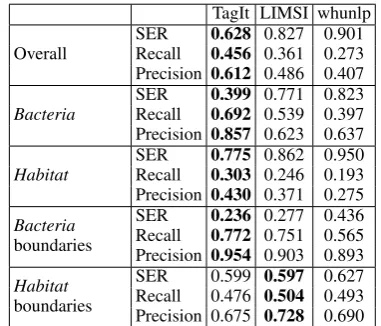
The results of systems that participated to BB-cat (2 teams) and BB-cat+ner subtasks (3 teams) are given in Table 6 and 7, respectively.
Team Prec.
all BacteriaPrec. HabitatPrec. Multi cat.Prec.
BOUN 0.679 0.801 0.620 0.486
[image:6.595.82.282.443.487.2]LIMSI 0.503 0.637 0.438 0.516
Table 6: Team results for the BB-cat task (” Prec.” = ” Precision”; ” Multi cat.” = ” Multiple catego-rizations”)
BOUN achieved the best performance for the categorization task (BB-cat) with 0.679 precision. As expected, performance was much higher for the categorization of Bacteria entities (0.801 for the best precision) than for that of Habitat enti-ties (0.62). Bacteria are usually referred to us-ing names from the NCBI taxonomy with a few variations, while Habitats are mainly noun and ad-jectival phrases that are expressed in many ways and may be very different from their concept la-bel form. Moreover, Habitats may be catego-rized using several ontology concepts, which cre-ates an additional difficulty. The last column of Table 6 shows results for multiple categorization
9http://2016.bionlp-st.org/tasks/bb2/
bb3-evaluation
cases. The LIMSI team obtained stable perfor-mance while the BOUN team performed signifi-cantly lower than for all entities (0.486vs. 0.679). When taking into account entity recognition in addition to categorization (BB-cat+ner, Table 7), TagIt achieved the best SER (0.628), and the dif-ference between the top and last teams is signif-icant (0.27 points). As for the BB-cat task, sys-tems performed better on Bacteria entities than on Habitat entities. We also assessed the perfor-mance of entity recognition (without taking into account categorization),i.e., systems are evaluated for their ability to predict entity boundaries in the text (see the bottom part of Table 7). The results of boundary detection also reflect the difference in difficulty betweenHabitatandBacteriaentities.
Compared to the Bacteria Biotope 2013 edition, the performance seems to have dropped. The best SER forHabitatentity recognition and categoriza-tion was 0.661 (Bossy et al., 2015), while it is 0.775 this year. This may be due to the change of document source,i.e.,scientific dense documents instead of general purpose web pages. It may also be due to the higher proportion of cases of multiple category assignments, while these cases remained marginal in the 2013 edition. Another reason may be the high number of clinical studies where the distinction between categories (e.g., treated and non-treated patients, pediatric and adult pa-tients) may require a more thorough analysis of the event context. Therefore the task also entails co-reference resolution.
TagIt LIMSI whunlp Overall SERRecall 0.6280.456 0.827 0.9010.361 0.273
Precision 0.612 0.486 0.407
Bacteria SERRecall 0.3990.692 0.771 0.8230.539 0.397 Precision 0.857 0.623 0.637
Habitat SERRecall 0.7750.303 0.862 0.9500.246 0.193 Precision 0.430 0.371 0.275 Bacteria
boundaries
SER 0.236 0.277 0.436 Recall 0.772 0.751 0.565 Precision 0.954 0.903 0.893 Habitat
boundaries
SER 0.599 0.597 0.627 Recall 0.476 0.504 0.493 Precision 0.675 0.728 0.690
Table 7: Team results for the BB-cat+ner task
6.2 Performance on BB-event / BB-event+ner
[image:6.595.320.511.503.666.2]differ-ent teams, three of which participated in the BB-event+ner subtask and eleven in the BB-event sub-task. Tables 8 and 9 show team performances on BB-event and BB-event+ner tasks respectively.
VERSE obtained the highest F1 score for the BB-event task (0.558). The difference between the top and last teams is only 0.10 points and par-ticipants ranked 4th to 11th obtained very simi-lar results (ranging from 0.474 to 0.455 F1 score). All participants achieved better performance when predicting Lives in events with Geographical ar-guments than events withHabitat arguments (5th and 6th columns of Table 8), although events with
Geographical arguments are less frequent. The reason could be that most of Geographical enti-ties are linked to a Bacteriaentity, which makes the decision easier than for Habitat entities, for which there are many occurrences that are not in-volved in anyLives inevent.
Not surprisingly systems had less trouble pre-dicting intra-sentence events than inter-sentence events, as all yielded significantly higher F1 score on intra-sentence events (see last column of Ta-ble 8). Detailed analysis of the predictions made by the systems shows that LIMSI was the only team to consistently predict inter-sentence events. Other systems predicted roughly the same num-ber of events when considering only intra-sentence events or all events together in the evaluation.
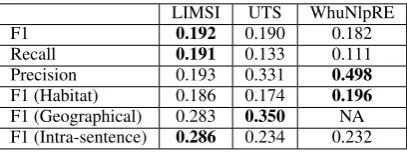
There is a drastic drop in performance when adding entity recognition to the event extraction task (BB-event+ner task, see Table 9). All three participating teams obtained very similar results in terms of F1 score, although the balance be-tween precision and recall differs. The LIMSI team (ranked 1st) achieved a perfect balance be-tween precision and recall, while UTS and the WhuNlpRE team obtained much higher precision but lower recall. As for the BB-event task, per-formances are significantly higher for Lives in
events involvingGeographicalentities, and intra-sentence events.
For both tasks, systems performed better in av-erage than in the 2013 edition. Indeed, the best F1 scores (Bossy et al., 2015) were 0.49 for the detec-tion of localizadetec-tion events (vs. 0.558 forLives in
events in this edition) and 0.14 for the combi-nation of entity recognition and event extraction (vs. 0.19). This suggests that participant methods have improved and become more accurate. How-ever, the F1-score for BB-event+ner remains
rel-atively low, which directly results from the com-bined complexity of the two sub-problems in the same task.
6.3 Performance on BB-kb / BB-kb+ner
Only the LIMSI team participated in the knowl-edge base extraction subtask. Results are given in Table 10 for both the BB-kb and BB-kb+ner tasks. The LIMSI system for BB-cat (Table 6) and BB-event (Table 8) provides a good reconstruc-tion of the knowledge base (BB-kb) which high-lights the fact that automatic categorization and event extraction methods are already efficient for the task of knowledge base construction. How-ever, the performance is significantly lower when reference entities are not provided. This large gap in performance may be explained by the difficulty of recognizing entities (as also shown in the BB-cat+ner task), and the fact that a fair amount of en-tities is not repeated in the corpus. Consequently the false negatives in entity detection have a strong impact on the end-to-end task of knowledge base construction.
LIMSI UTS WhuNlpRE
F1 0.192 0.190 0.182
Recall 0.191 0.133 0.111
Precision 0.193 0.331 0.498
F1 (Habitat) 0.186 0.174 0.196
[image:7.595.315.519.385.461.2]F1 (Geographical) 0.283 0.350 NA F1 (Intra-sentence) 0.286 0.234 0.232
Table 9: Team results for the BB-event+ner task
BB-kb BB-kb+ner LIMSI 0.771 0.202
Table 10: Results for BB-kb and BB-kb+ner (mean-references measure)
6.4 Systems
Systems used different resources and methods de-pending on the sub-tasks.
2013), the OntoBiotope ontology, and WordNet (Fellbaum, 1998). The TagIt system performed dictionary matching coupled with acronym detec-tion and heuristic rules to adjust entity bound-aries. The LIMSI team used conditional random fields (CRFs) and the WhuNlpRE team used neu-ral networks. Both these teams generated rich fea-tures for their machine-learning algorithms: lical, morpho-syntactic, dictionary projection, ex-isting named entity recognition tools, Brown clus-tering, and word embeddings. The UTS team relied on Support Vector Machines (SVM) with features based on the output of existing NER tools provided by the organizers as supporting re-sources. The rule-based approach of the TagIt sys-tem achieved the highest performance in entity de-tection and categorization (BB-cat+ner), although the CRF approach of the LIMSI system was the most accurate in Habitat boundary detection.
Teams relied on rule-based (TagIt, LIMSI) and similarity-based (BOUN) approaches to catego-rize entities in the BB-cat and BB-cat+ner sub-tasks. The TagIt system performed entity cate-gorization jointly with entity detection using dic-tionaries and rules. The BOUN team combined approximate string matching (edit distance) with an Information Retrieval based bag-of-word ap-proach (cosine similarity of word vectors weighted with the tf-idf). This approach was the most suc-cessful in the BB-cat.
Prediction of Events. All systems used machine-learning to predictLives in events. The most popular algorithms are SVM (VERSE, HK, UTS, LIMSI) and neural networks (TurkuNLP, WhuNlpRE, DUTIR). UMS combined predictions from a SVM and a neural network. Most sys-tems rely on syntactic parsing to generate features (VERSE, TurkuNLP, UMS, HK, DUTIR, UTS). Other common features included part-of-speech tags, word embeddings (trained on large corpora,
e.g., large sets of PubMed abstracts), and entity recognition. Rankings do not show any correlation to the machine learning algorithm, for instance the top ranking is based on SVM and the second is based on neural networks. Therefore, no conclu-sion can be drawn on the most appropriate class of methods. The quality of the predictions seems to rely mainly on the feature design,i.e., what types of feature were used by the systems. To this re-spect the two top ranking systems have syntac-tic parsing-based features. More specifically, they
both generate features based on the dependency path between entities.
7 Conclusion
The interest for the Bacteria Biotope Task keeps growing with a total of 14 teams participating in this third edition, and showing very promising re-sults. 11 teams participated in the event extrac-tion task (BB-event), demonstrating the interest of the NLP community for this challenging subject. For this event detection task, the most commonly used methods were SVMs and neural networks, and they yielded higher performance than during the 2013 edition of the task. However, a detailed analysis of the results showed that inter-sentence events still remain a challenge and are ignored by most systems. The other BB tasks,i.e. entity de-tection and categorization and knowledge base ex-traction, attracted fewer participants in compari-son to event extraction. Knowledge base popu-lation was the most challenging task, since it re-quired a large range of skills.
BB-cat BB-cat+ner
Train Dev Test Total Train Dev Test Total
Documents 71 36 54 161 71 36 54 161
Words 16,295 8,890 13,797 38,982 16,295 8,890 13,933 39,118
Bacteria 375 244 347 966 375 244 401 1,020
Habitat 747 454 720 1,921 747 454 621 1,822
Total entities 1,122 698 1,067 2,887 1,122 698 1,022 2,842
DistinctBacteria 167 111 146 364 167 111 181 393
DistinctHabitat 476 267 478 1,125 476 267 416 1,073
Total distinct entities 643 378 624 1,489 643 378 597 1,466
Bacteriacategories 376 245 347 968 376 245 401 1,022
Habitatcategories 825 535 861 2,221 825 535 681 2,041
Total categories 1,201 780 1,208 3,189 1,201 780 1,082 3,063
DistinctBacteriacategories 85 70 80 190 85 70 87 193
DistinctHabitatcategories 210 122 177 329 210 122 168 341
[image:9.595.98.500.63.231.2]Total distinct categories 295 192 257 519 295 192 255 534
Table 3: Descriptive statistics of the corpus for BB-cat and BB-cat+ner
BB-event BB-event+ner
Train Dev Test Total Train Dev Test Total
Documents 61 34 51 146 71 36 54 161
Words 13,850 8,491 13,039 35,380 16,295 8,890 13,933 39,118
Bacteria 358 238 336 932 375 244 401 1,020
Habitat 687 454 720 1,861 747 454 621 1,822
Geographical 35 38 37 110 36 38 27 101
Total entities 1,080 730 1,093 2,903 1,158 736 1,049 2,943
Lives inevents (Habitat) 294 186 312 792 294 186 288 768
Lives inevents (Geog.) 33 37 28 98 33 37 26 96
Intra-sentence events 240 165 248 653 240 165 231 636
Inter-sentence events 87 58 92 237 87 58 83 228
Total Lives in events 327 223 340 890 327 223 314 864
Table 4: Descriptive statistics of the corpus for BB-event and BB-event+ner
BB-kb BB-kb+ner
Train Dev Test Total Train Dev Test Total
Documents 61 34 50 145 71 36 54 161
Words 13,850 8,491 12,758 35,099 16,295 8,890 13,933 39,118
Bacteria 358 238 330 926 375 244 401 1,020
Habitat 687 454 720 1,861 747 454 621 1,822
Total entities 1,045 692 1,050 2,787 1,122 698 1,022 2,842
Bacteriacategories 359 239 330 928 376 245 401 1,022
Habitatcategories 765 535 861 2,161 825 535 681 2,041
Total categories 1,124 774 1,191 3,089 1,201 780 1,082 3,063
DistinctBacteriacategories 81 69 77 183 85 70 87 193
DistinctHabitatcategories 197 122 177 317 210 122 168 341
Total distinct categories 278 191 254 500 295 192 255 534
Lives inevents 294 186 312 792 294 186 288 768
Distinct Lives in events 204 156 185 522 204 156 183 524
Table 5: Descriptive statistics of the corpus for BB-kb and BB-kb+ner
Team F1 Recall Precision F1 (Habitat) F1 (Geo.) F1 (Intra-sentence)
VERSE 0.558 0.615 0.510 0.545 0.714 0.634
TurkuNLP 0.521 0.448 0.623 0.499 0.755 0.620
LIMSI 0.485 0.646 0.388 0.482 0.525 0.636
HK 0.474 0.392 0.599 0.452 0.708 0.567
WhuNlpRE 0.471 0.407 0.559 0.471 0.465 0.561
UMS 0.463 0.399 0.551 0.439 0.704 0.550
DUTIR 0.456 0.382 0.566 0.451 0.512 0.544
WXU 0.455 0.383 0.560 0.445 0.578 0.540
UTS 0.451 0.382 0.551 0.425 0.704 0.537
References
Mouhamadou Ba and Robert Bossy. 2016.
In-teroperability of corpus processing work-flow en-gines: the case of alvisnlp/ml in openminted. In Richard Eckart de Castilho, Sophia Ananiadou, Thomas Margoni, Wim Peters, and Stelios Piperidis,
editors, Proceedings of the Workshop on
Cross-Platform Text Mining and Natural Language Pro-cessing Interoperability (INTEROP 2016) at LREC
2016, pages 15–18, Portoroz, Slovenia, May.
Euro-pean Language Resources Association (ELRA). Robert Bossy, Julien Jourde, Alain-Pierre Manine,
Philippe Veber, Erick Alphonse, Maarten Van De Guchte, Philippe Bessi`eres, and Claire N´edellec.
2012. Bionlp shared task-the bacteria track. BMC
bioinformatics, 13(11):1.
Robert Bossy, Wiktoria Golik, Zorana Ratkovic, Philippe Bessi`eres, and Claire N´edellec. 2013. Bionlp shared task 2013–an overview of the bacteria
biotope task. InProceedings of the BioNLP Shared
Task 2013 Workshop, pages 161–169.
Robert Bossy, Wiktoria Golik, Zorana Ratkovic, Di-alekti Valsamou, Philippe Bessi`eres, and Claire N´edellec. 2015. Overview of the gene regulation network and the bacteria biotope tasks in bionlp’13 shared task.BMC bioinformatics, 16(10):1. Pier Luigi Buttigieg, Norman Morrison, Barry Smith,
Christopher J Mungall, and Suzanna E Lewis. 2013. The environment ontology: contextualising biolog-ical and biomedbiolog-ical entities. Journal of biomedical semantics, 4(1):1.
Estelle Chaix, Bertrand Dubreucq, Abdelhak Fatihi, Dialekti Valsamou, Robert Bossy, Mouhamadou Ba, Louise Del´eger, Pierre Zweigenbaum, Philippe Bessi`eres, Loic Lepiniec, and Claire N´edellec. 2016. Overview of the regulatory network of plant seed development (seedev) task at the bionlp shared
task 2016. InProceedings of the 4th BioNLP Shared
Task workshop, Berlin, Germany, August. Associa-tion for ComputaAssocia-tional Linguistics.
Scott Federhen. 2012. The ncbi taxonomy database. Nucleic acids research, 40(D1):D136–D143. C Fellbaum. 1998. Wordnet: An on-line lexical
database and some of its applications.
Jenny Rose Finkel, Trond Grenager, and Christopher Manning. 2005. Incorporating non-local informa-tion into informainforma-tion extracinforma-tion systems by gibbs
sampling. InProceedings of the 43rd Annual
Meet-ing on Association for Computational LMeet-inguistics, pages 363–370. Association for Computational Lin-guistics.
Melissa Merrill Floyd, Jane Tang, Matthew Kane, and David Emerson. 2005. Captured diversity in a cul-ture collection: case study of the geographic and habitat distributions of environmental isolates held at the american type culture collection. Applied and Environmental Microbiology, 71(6):2813–2823.
Wiktoria Golik, Pierre Warnier, and Claire N´edellec. 2011. Corpus-based extension of termino-ontology by linguistic analysis: a use case in biomedical event
extraction. InWS 2 Workshop Extended Abstracts,
9th International Conference on Terminology and Artificial Intelligence, pages 37–39.
Marion Gremse, Antje Chang, Ida Schomburg, An-dreas Grote, Maurice Scheer, Christian Ebeling, and Dietmar Schomburg. 2011. The brenda tissue on-tology (bto): the first all-integrating onon-tology of all
organisms for enzyme sources. Nucleic acids
re-search, 39(suppl 1):D507–D513.
George Hripcsak and Adam S Rothschild. 2005.
Agreement, the f-measure, and reliability in
infor-mation retrieval. Journal of the American Medical
Informatics Association, 12(3):296–298.
Natalia Ivanova, Susannah G Tringe, Konstantinos Lio-lios, Wen-Tso Liu, Norman Morrison, Philip Hugen-holtz, and Nikos C Kyrpides. 2010. A call for stan-dardized classification of metagenome projects. En-vironmental microbiology, 12(7):1803–1805. Jin-Dong Kim, Tomoko Ohta, Sampo Pyysalo,
Yoshi-nobu Kano, and Jun’ichi Tsujii. 2009. Overview of bionlp’09 shared task on event extraction. In Proceedings of the Workshop on Current Trends in Biomedical Natural Language Processing: Shared Task, pages 1–9. Association for Computational Lin-guistics.
Jin-Dong Kim, Sampo Pyysalo, Tomoko Ohta, Robert Bossy, Ngan Nguyen, and Jun’ichi Tsujii. 2011.
Overview of bionlp shared task 2011. In
Proceed-ings of the BioNLP Shared Task 2011 Workshop, pages 1–6. Association for Computational Linguis-tics.
Claire N´edellec, Robert Bossy, Jin-Dong Kim, Jung-Jae Kim, Tomoko Ohta, Sampo Pyysalo, and Pierre Zweigenbaum. 2013. Overview of bionlp shared
task 2013. In Proceedings of the BioNLP Shared
Task 2013 Workshop, pages 1–7.
Fr´ed´eric Papazian, Robert Bossy, and Claire N´edellec. 2012. Alvisae: a collaborative web text
annota-tion editor for knowledge acquisiannota-tion. In
Proceed-ings of the Sixth Linguistic Annotation Workshop, pages 149–152. Association for Computational Lin-guistics.
Aidan C Parte. 2013. Lpsnlist of prokaryotic names
with standing in nomenclature. Nucleic acids
re-search, page gkt1111.
Miguel Pignatelli, Andr´es Moya, and Javier Tamames. 2009. Envdb, a database for describing the envi-ronmental distribution of prokaryotic taxa. Environ-mental Microbiology Reports, 1(3):191–197. Zorana Ratkovic, Wiktoria Golik, and Pierre Warnier.
2012. Event extraction of bacteria biotopes: a
knowledge-intensive nlp-based approach. BMC