Improving Temporal Relation Extraction with Training Instance
Augmentation
Chen Lin and Timothy Miller
Boston Children’s Hospital Informatics Program and Harvard Medical School
{first.last}@childrens.harvard.edu
Dmitriy Dligach Loyola University Chicago
Steven Bethard
University of Alabama at Birmingham [email protected]
Guergana Savova
Boston Children’s Hospital Informatics Program and Harvard Medical School
[email protected] Abstract
Temporal relation extraction is important for understanding the ordering of events in narrative text. We describe a method for increasing the number of high-quality training instances available to a temporal relation extraction task, with an adaptation to different annotation styles in the clinical domain by taking advantage of the Unified Medical Language System (UMLS). This method notably improves clinical tempo-ral relation extraction, works beyond fea-turizing or duplicating the same informa-tion, can generalize between-argument sig-nals in a more effective and robust fashion. We also report a new state-of-the-art result, which is a two point improvement over the best Clinical TempEval 2016 system.
1 Introduction
Temporal relation extraction is important for under-standing ordering of events from a narrative text. Recent years have seen annotated corpora created for temporal information extraction, from newspa-per text (Pustejovsky et al., 2003; Verhagen et al., 2007; Verhagen et al., 2010; UzZaman et al., 2013), to clinical narratives (Savova et al., 2009; Sun et al., 2013; Styler et al., 2014), all with the aim of de-veloping systems for building event timelines from textual descriptions of events. Such narrative time-lines are important for information extraction tasks such as question answering (Kahn et al., 1990), clinical outcomes prediction (Schmidt et al., 2005; Lin et al., 2014), and the identification of temporal patterns (Zhou and Hripcsak, 2007) among many. In a typical supervised approach to the temporal relation extraction task, argument pairs consist of pairs of events or temporal expressions. Corpora differ in their syntactic annotation of such
expres-sions. For example, the THYME corpus, consisting of oncology, pathology and radiology notes, anno-tated only event headwords (Styler et al., 2014), while the i2b2 corpus, consisting of discharge sum-maries, annotated entire noun phrases as events (Sun et al., 2013). As a result, it is necessary to account for these differences when implementing a generalizable relation extraction system.
However, the annotations of the temporal rela-tions between the events remain unaffected by the choice of headwords or phrases for the event an-notation. For example, in a relation between the temporal expressionyesterdayand the eventsevere lower abdominal pain, if the argument had been the head wordpainit still would have been an in-stance of the same temporal relation. Thus, we can automatically create additional training examples by varying the extent of headword expansion. For example, the relation betweenyesterdayandsevere lower abdominal paincan automatically generate four valid relations of the same type where the sec-ond arguments arepain,abdominal pain, andlower abdominal pain.
In this paper, we describe an automatic method that generates more temporal training instances by semantically expanding gold medical events based on a clinical ontology, the Unified Medical Lan-guage System (UMLS) (Lindberg et al., 1993). It bridges the gap between different syntactic anno-tations of events in clinical corpora. We show that this method is superior to representing the same information as additional features, that it differs from plain upsampling, and that the primary mech-anism of improvement is in the better representa-tion of between-argument features. Our method can be viewed as a new form of data augmenta-tion, akin to the generation of image variants for vision recognition (Krizhevsky et al., 2012) or the generation of word substitutions for information extraction (Kolomiyets et al., 2011).
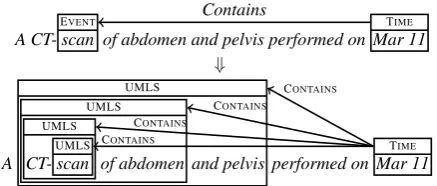
A CT-Escan of abdomen and pelvis performed onVENT Mar 11TIME
⇓
A
UMLS UMLS UMLS
CT-UMLSscan of abdomen and pelvis performed onMar 11TIME Contains
CONTAINS
CONTAINS
CONTAINS
[image:2.595.71.290.56.149.2]CONTAINS
Figure 1: Example expansion of the event “scan”
2 Method
First, the text was scanned for any medical concepts from the UMLS Metathesaurus (http://www. nlm.nih.gov/research/umls/), a collec-tion of concepts from different biomedical termi-nologies. Apache cTAKES (http://ctakes. apache.org) was used to extract such UMLS concepts. Next, we use these UMLS concepts and gold standard events to expand relation argu-ments. For a gold standard eventeannotated by the headword, we define EXPAND(e) as the set
of UMLS entities whose spans cover e. Ife is involved in a temporal relation r, we assume u
(u∈EXPAND(e)) is involved in the same relation
and therefore we generate a new temporal relation that is identical torbut with the eventereplaced by a UMLS entityu. Figure 1 shows an example of expanding the gold event “scan” to its covering UMLS entities and generating related relations.
We differentiate temporal relations into event-time and event-event, and expand relations as de-tailed in Algorithm 1 and Algorithm 2, respectively. For event-event, we ensure the event spans do not overlap after expansion. Our event-time model clas-sifies all relations – CONTAINS, BEFORE, OVER -LAP, BEGINS-ON, ENDS-ONand NONE, while
our event-event model classifies only CONTAINS
and NONE relations due to the very low
inter-annotator agreement for the other relation types in our evaluation corpus (Styler et al., 2014). For both models, NONEis used to indicate that there is
no relation between a pair of arguments.
Algorithm 1Expansion for event-time relations
1: Given a gold-standard annotated event-time relation r(e,t), whereeis an event,tis a temporal expression, r∈ {CONTAINS,BEFORE, . . . ,NONE}
2: forUMLS entityu∈EXPAND(e)do
3: Create relationr0(u,t),r0←r
4: Addr0to training data
5: end for
Algorithm 2Expansion for event-event relations
1: Given a gold-standard annotated event-event relation r(ea,eb), where ea, eb are events, r∈ {CONTAINS,NONE}
2: forUMLS entityua∈EXPAND(ea)do
3: if notoverlaps(span(ua), span(eb))then 4: Create relationr0(ua,eb),r0←r
5: Addr0to training data
6: end if 7: end for
8: forUMLS entityub∈EXPAND(eb)do 9: if notoverlaps(span(ea,ub))then 10: Create relationr0(ea,ub),r0←r
11: Addr0to training data
12: end if 13: end for
3 Experiments
3.1 Dataset
We tested our event expansion technique on a pub-licly available clinical corpus: the colon cancer set of the THYME corpus (Styler et al., 2014) used in SemEval 2015 Task 6 (Bethard et al., 2015) and SemEval 2016 Task 12: Clinical TempEval (Bethard et al., 2016). It contains 600 documents (400 oncology notes and 200 pathology notes) of 200 colon cancer patients. The gold standard an-notations contain events (including both medical and general events, all annotated by head words), temporal expressions (e.g. tomorrow, postopera-tive, andMarch-11-2009), and temporal relations. We used the same training/development/test split as Clinical TempEval. The development set was used for testing research questions and building final models. Once the models were deemed final-ized, they were rebuilt on the combined training and development sets and tested on the test set.
3.2 Models
We built two within-sentence temporal-relation classification models, one for event-time relations and one for event-event relations. We paired every gold event with every gold time expression within the same sentence to form candidate instances for the event-time classifier. We paired all gold events within a sentence to form candidates for the event-event classifier. For training, gold relations were also expanded by calculating the closure sets of all possible relations in a clinical document.
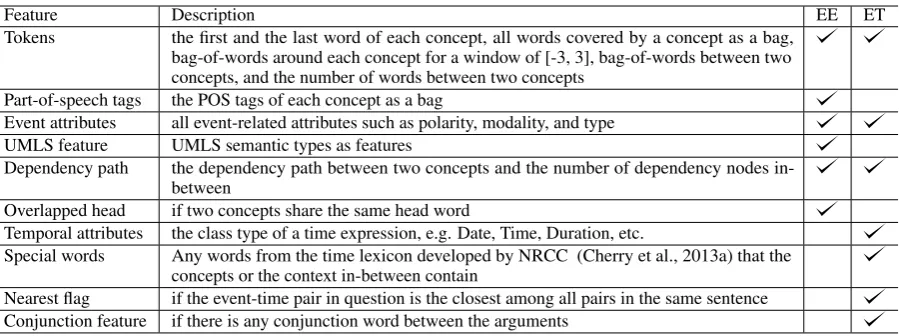
Feature Description EE ET Tokens the first and the last word of each concept, all words covered by a concept as a bag,
bag-of-words around each concept for a window of [-3, 3], bag-of-words between two concepts, and the number of words between two concepts
Part-of-speech tags the POS tags of each concept as a bag
Event attributes all event-related attributes such as polarity, modality, and type UMLS feature UMLS semantic types as features
Dependency path the dependency path between two concepts and the number of dependency nodes in-between
Overlapped head if two concepts share the same head word
Temporal attributes the class type of a time expression, e.g. Date, Time, Duration, etc.
Special words Any words from the time lexicon developed by NRCC (Cherry et al., 2013a) that the concepts or the context in-between contain
[image:3.595.76.526.60.228.2]Nearest flag if the event-time pair in question is the closest among all pairs in the same sentence Conjunction feature if there is any conjunction word between the arguments
Table 1: Features used for event-event (EE) and event-time (ET) classifiers
3.3 Research questions
We investigate the following questions:
1. Can the effect of the UMLS expansion tech-nique be replicated using additional features? One may wonder if adding instances via UMLS expansion is isomorphic to adding more features that capture the UMLS information. To answer this question, we find all covering UMLS enti-ties, but instead of creating new instances, ex-tract token features from these entities and add those to the other features for the instance. 2. Is it better to expand to the longest UMLS
en-tity or to expand to all possible spans? In our Figure 1 example, the longest UMLS entity covering “scan” is “CT-scan of abdomen and pelvis”. But we could also create instances for the UMLS entities “scan”, scan” and “CT-scan of abdomen”. We also compare against a purely linguistic expansion to the immediate enclosing noun phrase (NP).
3. Is the improvement due to the replication of in-stances? Our expansion technique creates many similar relations, and in cases where a UMLS entity has the same span as a gold event, the technique creates true duplicate instances. For example, the relation CONTAINS(scan, March
11) is duplicated in Figure 1. Thus we also compare our UMLS-informed expansion of in-stances to simple duplication of inin-stances1. 4. Which types of features benefit most from the
expansion? There are three groups of token
1In SVM classification, duplicating training instances can
affect the cost penalty by altering the number of instances within the margin. It is thus critical to tune cost parameterC for all experiments, which we do on development data.
features: within each argument, between the ar-guments, and the preceding and following three words (context) of an argument. We test the performance one feature group at a time, with and without the event expansion.
We test all research questions by training on the training set and testing on the development set with token-based features for the event-time relations. Note that expansion is applied only to the training set, not to the development or test set.
3.4 Evaluation
For results on the development set, we calculate closure-enhanced precision, recall and F1-score (UzZaman and Allen, 2011) on just the within-sentence relations (since that’s what our models are able to predict). Precision is the percentage of system-generated relations that can be verified in the transitive closure of the gold standard rela-tions. Recall is the percentage of gold standard relations that can be found in the transitive clo-sure of the system-generated relations. The final F1-score is the harmonic mean of the transitive-closure-processed precision and recall.
For results on the test set, we used the official Clinical TempEval evaluation scripts so that our results are directly comparable with the outcomes of Clinical TempEval 2016 (Bethard et al., 2016). These scripts use similar definitions of closure-enhanced precision, recall and F1-score, but evalu-ate only CONTAINSrelations in oncology notes.
4 Results on the development set
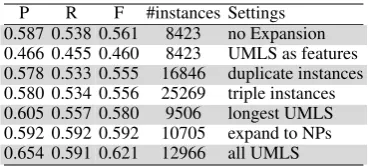
perfor-P R F #instances Settings 0.587 0.538 0.561 8423 no Expansion 0.466 0.455 0.460 8423 UMLS as features 0.578 0.533 0.555 16846 duplicate instances 0.580 0.534 0.556 25269 triple instances 0.605 0.557 0.580 9506 longest UMLS 0.592 0.592 0.592 10705 expand to NPs 0.654 0.591 0.621 12966 all UMLS
Table 2: Results on the development set. No expan-sion vs. encoding UMLS as features; duplicating and triplicating training instances; expand to the longest UMLS span, expand to the immediate en-closing NP vs. expand to all UMLS spans.
P R F #instances Settings 0.359 0.155 0.217 8423 (A) no expansion 0.582 0.206 0.304 12966 (A) with expansion 0.087 0.116 0.099 8423 (B) no expansion 0.600 0.546 0.572 12966 (B) with expansion 0.587 0.254 0.355 8423 (C) no expansion 0.648 0.264 0.375 12966 (C) with expansion
Table 3: Results on the development set. Compari-son of improvement for feature groups: (A) words covered by the arguments; (B) words in between the arguments; (C) words around the arguments.
mance as UMLS expansion, and in fact decreases performance. Question 2 is addressed in the last three rows: expanding to all possible UMLS spans works better than expanding only to the longest span or to the immediate enclosing NP. Expand-ing to NPs achieved the second best result, sug-gesting that when a domain-specific ontology is unavailable, expansion via syntax might provide a viable alternative. Question 3 is answered by rows 1, 3 and 4: when the cost parameter is properly tuned, doubling or tripling instances (rows 3 and 4) does not improve performance over no expansion (row 1). Question 4 is addressed by Table 3: fea-tures extracted between the two arguments achieve the biggest gain from our expansion method. 5 Results on the test set
Once the parameters were fine-tuned, we trained both event-time and event-event models on the com-bined training and developments sets, and tested them on the test set. All features described in Ta-ble 1 are used. The first two rows of TaTa-ble 4 eval-uate both event-event and event-time models, the next two rows evaluate only the event-time model, and the last two rows evaluate only the event-event model. Statistical significance is computed via Wilcoxon signed-rank tests over document-by-document comparisons, as in (Cherry et al., 2013b).
P R F Settings P-value
0.635 0.549 0.589 (1) no Expansion 0.117 0.669 0.534 0.594 (1) with Expansion 0.673 0.291 0.407 (2) no Expansion 0.708 0.287 0.408 (2) with Expansion 0.594 0.252 0.354 (3) no Expansion 0.628 0.243 0.351 (3) with Expansion
Table 4: Results on the test set with all features. (1) Evaluate both Event-Time and Event-Event mod-els; (2) Evaluate Event-Time model only; (3) Eval-uate Event-Event model only. See Section 3.4 for explanation for why shaded scores are different from their counterparts in Table 2.
6 Discussion
Our experiments show our method is helpful for the time model, and not harmful for the event-event model. We hypothesize that the multiple in-stances capture the important surrounding context between arguments and allow more generalization over it. For the example in Figure 1, the most im-portant features are “performed on.” Our method weeds out less discriminative features by strength-ening the important contextual signals that appear across many different entity boundaries. This is supported by the results of Table 3 (B). We sus-pect that the small improvement seen on the test data may be a result of the additional development examples canceling the benefit of augmented exam-ples. This suggests that this method may be most effective in tasks with limited training instances.
Event-event relations are more complicated, first in that they have lower annotation quality than event-time relations (see Table 5 from (Styler et al., 2014)). And while almost every temporal ex-pression in a sentence is important, not all events in a sentence are, creating many potential “distractor” events (e.g.,showed) in the context of the clinical domain. We performed some exploratory exper-iments (not shown), restricting the data to only adjacent medical events in notes with high inter-annotator agreement, and saw significant perfor-mance improvements. But further study is needed to generalize this to all event-event relations.
[image:4.595.70.255.61.144.2]cTAKES2(Savova et al., 2010). 7 Acknowledgements
Thanks to Sean Finan for technically supporting the experiments. The study was funded by R01 LM 10090 (THYME), R01GM103859 (PGx), and U24CA184407 (DeepPhe). The content is solely the responsibility of the authors and does not nec-essarily represent the official views of the National Institutes of Health.
References
Steven Bethard, Leon Derczynski, Guergana Savova, James Pustejovsky, and Marc Verhagen. 2015. SemEval-2015 task 6: Clinical TempEval. In Pro-ceedings of the 9th International Workshop on Se-mantic Evaluation (SemEval 2015), pages 806–814, Denver, Colorado, June. Association for Computa-tional Linguistics.
Steven Bethard, Guergana Savova, Wei-Te Chen, Leon Derczynski, James Pustejovsky, and Marc Verhagen. 2016. Semeval-2016 task 12: Clinical tempeval. In
Proceedings of the 10th International Workshop on Semantic Evaluation (SemEval 2016), San Diego, California, June. Association for Computational Lin-guistics.
Colin Cherry, Xiaodan Zhu, Joel Martin, and Berry de Bruijn. 2013a. `A la recherche du temps perdu: extracting temporal relations from medical text in the 2012 i2b2 NLP challenge. Journal of the Amer-ican Medical Informatics Association, 20(5):843– 848.
Colin Cherry, Xiaodan Zhu, Joel Martin, and Berry de Bruijn. 2013b. la recherche du temps perdu: ex-tracting temporal relations from medical text in the 2012 i2b2 nlp challenge. Journal of the American Medical Informatics Association, 20(5):843–848. Rong-En Fan, Kai-Wei Chang, Cho-Jui Hsieh,
Xiang-Rui Wang, and Chih-Jen Lin. 2008. Liblinear: A library for large linear classification. The Journal of Machine Learning Research, 9:1871–1874.
Michael G Kahn, Larry M Fagan, and Samson Tu. 1990. Extensions to the time-oriented database model to support temporal reasoning in medical ex-pert systems. Methods of Information in Medicine, 30(1):4–14.
Oleksandr Kolomiyets, Steven Bethard, and Marie-Francine Moens. 2011. Model-portability experi-ments for textual temporal analysis. InProceedings of the 49th Annual Meeting of the Association for Computational Linguistics: Human Language Tech-nologies, pages 271–276, Portland, Oregon, USA, June. Association for Computational Linguistics.
2http://ctakes.apache.org
Alex Krizhevsky, Ilya Sutskever, and Geoffrey E Hin-ton. 2012. Imagenet classification with deep con-volutional neural networks. InAdvances in neural information processing systems, pages 1097–1105. Chen Lin, Elizabeth W Karlson, Dmitriy Dligach,
Monica P Ramirez, Timothy A Miller, Huan Mo, Natalie S Braggs, Andrew Cagan, Vivian Gainer, Joshua C Denny, and Guergana K Savova. 2014. Automatic identification of methotrexate-induced liver toxicity in patients with rheumatoid arthritis from the electronic medical record. Journal of the American Medical Informatics Association.
Donald A Lindberg, Betsy L Humphreys, and Alexa T McCray. 1993. The unified medical language system. Methods of information in Medicine, 32(4):281–291.
James Pustejovsky, Patrick Hanks, Roser Sauri, An-drew See, Robert Gaizauskas, Andrea Setzer, Dragomir Radev, Beth Sundheim, David Day, Lisa Ferro, et al. 2003. The timebank corpus. InCorpus linguistics, volume 2003, page 40.
Guergana Savova, Steven Bethard, Will Styler, James Martin, Martha Palmer, James Masanz, and Wayne Ward. 2009. Towards temporal relation discovery from the clinical narrative. InAMIA annual sympo-sium proceedings, volume 2009, page 568. Ameri-can Medical Informatics Association.
Guergana K. Savova, James J. Masanz, Philip V. Ogren, Jiaping Zheng, Sunghwan Sohn, Karin C. Kipper-Schuler, and Christopher G. Chute. 2010. Mayo clinical text analysis and knowledge extraction sys-tem (cTAKES): architecture, component evalua-tion and applicaevalua-tions. J Am Med Inform Assoc, 17(5):507–513.
Reinhold Schmidt, Stefan Ropele, Christian Enzinger, Katja Petrovic, Stephen Smith, Helena Schmidt, Paul M Matthews, and Franz Fazekas. 2005. White matter lesion progression, brain atrophy, and cog-nitive decline: the austrian stroke prevention study.
Annals of neurology, 58(4):610–616.
William Styler, Steven Bethard, Sean Finan, Martha Palmer, Sameer Pradhan, Piet de Groen, Brad Erick-son, Timothy Miller, Chen Lin, Guergana Savova, and James Pustejovsky. 2014. Temporal annotation in the clinical domain. Transactions of the Associa-tion for ComputaAssocia-tional Linguistics, 2:143–154. Weiyi Sun, Anna Rumshisky, and Ozlem Uzuner. 2013.
Evaluating temporal relations in clinical text: 2012 i2b2 challenge. Journal of the American Medical Informatics Association, 20(5):806–813.
Naushad UzZaman, Hector Llorens, Leon Derczyn-ski, James Allen, Marc Verhagen, and James Puste-jovsky. 2013. SemEval-2013 task 1: TempEval-3: Evaluating time expressions, events, and tempo-ral relations. In Second Joint Conference on Lexi-cal and Computational Semantics (*SEM), Volume 2: Proceedings of the Seventh International Work-shop on Semantic Evaluation (SemEval 2013), pages 1–9, Atlanta, Georgia, USA, June. Association for Computational Linguistics.
Marc Verhagen, Robert Gaizauskas, Frank Schilder, Mark Hepple, Graham Katz, and James Pustejovsky. 2007. Semeval-2007 task 15: Tempeval temporal re-lation identification. InProceedings of the 4th Inter-national Workshop on Semantic Evaluations, pages 75–80. Association for Computational Linguistics. Marc Verhagen, Roser Sauri, Tommaso Caselli, and
James Pustejovsky. 2010. Semeval-2010 task 13: Tempeval-2. InProceedings of the 5th International Workshop on Semantic Evaluation, pages 57–62. As-sociation for Computational Linguistics.