Proceedings of EMNLP 2011, Conference on Empirical Methods in Natural Language Processing, pages 72–81,
Unsupervised Concept Annotation using Latent Dirichlet Allocation and
Segmental Methods
Nathalie Camelin, Boris Detienne, St´ephane Huet, Dominique Quadri and Fabrice Lef`evre LIA - University of Avignon, BP 91228
84911 Avignon Cedex 09, France
{nathalie.camelin,boris.detienne,stephane.huet,dominique.quadri,fabrice.lefevre}@univ-avignon.fr
Abstract
Training efficient statistical approaches for natural language understanding generally re-quires data with segmental semantic annota-tions. Unfortunately, building such resources is costly. In this paper, we propose an ap-proach that produces annotations in an unsu-pervised way. The first step is an implementa-tion of latent Dirichlet allocaimplementa-tion that produces a set of topics with probabilities for each topic to be associated with a word in a sentence. This knowledge is then used as a bootstrap to infer a segmentation of a word sentence into topics using either integer linear optimisation or stochastic word alignment models (IBM models) to produce the final semantic anno-tation. The relation between automatically-derived topics and task-dependent concepts is evaluated on a spoken dialogue task with an available reference annotation.
1 Introduction
Spoken dialogue systems in the field of information query are basically used to interface a database with users using speech. When probabilistic models are used in such systems, good performance can only be reached at the price of collecting a lot of field data, which must be transcribed and annotated at the se-mantic level. It becomes then possible to train effi-cient models in a supervised manner. However, the annotation process is costly and as a consequence represents a real difficulty hindering the widespread development of these systems. Therefore any means to avoid it would be profitable as portability to new
tasks, domains or languages would be greatly facili-tated.
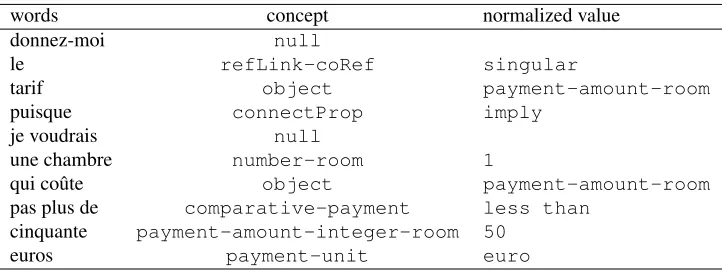
To give a full description of the architecture of a dialogue system is out of the scope of this paper. In-stead we limit ourselves to briefly recall that once a speech recognizer has transcribed the signal it is common (though avoidable for very simple tasks) to use a module dedicated to extract the meaning of the user’s queries. This meaning representation is then conveyed to an interaction manager that decides upon the next best action to perform considering the current user’s input and the dialogue history. One of the very first steps to build the spoken language understanding (SLU) module is the identification of literal concepts in the word sequence hypothesised by the speech recogniser. An example of a semantic representation in terms of literal concept is given in Figure 1. Once the concepts are identified they can be further composed to form the overall meaning of the sentence, for instance by means of a tree repre-sentation based on hierarchical semantic frames.
To address the issue of concept tagging several techniques are available. Some of these techniques now classical rely on probabilistic models, that can be either discriminative or generative. Among these, the most efficiently studied this last decade are: hid-den Markov models, finite state transducers, max-imum entropy Markov models, support vector ma-chines, dynamic fields (CRF). In (Hahn et al., 2010) it is shown that CRFs obtain the best performance on a tourist information retrieval task in French (ME -DIA (Bonneau-Maynard et al., 2005)), but also in two other comparable corpora in Italian and Polish.
words concept normalized value
donnez-moi null
le refLink-coRef singular
tarif object payment-amount-room
puisque connectProp imply
je voudrais null
une chambre number-room 1
qui coˆute object payment-amount-room
pas plus de comparative-payment less than
cinquante payment-amount-integer-room 50
[image:2.612.126.487.70.205.2]euros payment-unit euro
Figure 1: Semantic concept representation for the query“give me the rate since I’d like a room charged not more than fifty euros”.
cept units have to be defined by an expert. In the best case, most of these concepts can be derived straight-forwardly from the pieces of information lurking in the database tables (mainly table fields but not ex-clusively). Some others are general (dialogic units but also generic entities such as number, dates, etc). However, to provide an efficient and usable informa-tion to the reasoning modules (the dialogue manager in our case) concepts have to be fine-grained enough and application-dependent (even general concepts might have to be tailored to peculiar uses). To that extent it seems out of reach to derive the concept definitions using a fully automatic procedure. Any-how the process can be bootstrapped, for instance by induction of semantic classes such as in (Siu and Meng, 1999) or (Iosif et al., 2006). Our assumption here is that the most time-consuming parts of con-cept inventory and data tagging could be obtained in an unsupervised way even though a final (but hope-fully minimal) manual procedure is still required to tag the classes so as to manually correct automatic annotation.
Unlike the previous attempts cited above which developed ad hoc approaches, we investigate here the use of broad-spectrum knowledge extraction methods. The notion most related to that of concept in SLU is the topic, as used in information retrieval systems. Anyhow for a long time, the topic detec-tion task was limited to associate a single topic to a document and thus was not fitted to our require-ments. The recently proposed LDA technique al-lows to have a probabilistic representation of a doc-ument as a mixture of topics. Then multiple topics can co-occur inside a document and the same topic
can be repeated. From these characteristics it is pos-sible to consider the application of LDA to unsu-pervised concept inventory and concept tagging for SLU. A shortcoming is that LDA does not modelize at all the sequentiality of the data. To address this is-sue we propose to conclude the procedure with a fi-nal step to introduce specific constraints for a correct segmentation of the data: the assignments of topics proposed by LDA are modified to be more segmen-tally coherent.
The paper is organised as follows. Principles of automatic induction of semantic classes are pre-sented in Section 2, followed by the presentation of an induction system based on LDA. The additional step of segmentation is presented in Section 3 with two variants: stochastic word alignment (GIZA) and integer linear programming (ILP). Then evaluations and results are reported in Section 4 on the French MEDIAdialogue task.
2 Automatic induction of semantic classes
2.1 Context modeling
In (Siu and Meng, 1999) and (Pargellis et al., 2001), iterative systems are presented. Their im-plementations differ in the metrics chosen to eval-uate the similarity during the generation of syntactic rules and semantic classes, but also in the number of words taken into account in a word context and the order of successive steps (which ones to gener-ate first: syntactic rules or semantic classes?). An iterative procedure is executed to obtain a sufficient set of rules in order to automatically extract knowl-edge from the data.
While there may be still room for improvement in these techniques we decided instead to investigate general knowledge extraction approaches in order to evaluate their potential. For that purpose a global strategy based on an unsupervised machine learning technique is adopted in our work to produce seman-tic classes.
2.2 Implementation of an automatic induction system based on LDA
Several approaches are available for topic detection in the context of knowledge extraction and informa-tion retrieval. They all more or less rely on the pro-jection of the documents of interest in a semantic space to extract meaningful information. However, as the considered spaces (initial document words and latent semantics) are discrete the performance of the proposed approaches for the topic extraction tasks are pretty unstable, and also greatly depend on the quantity of data available. In this work we were motivated by the recent development of a very at-tractive technique with major distinct features such as the detection of multiple topics in a single docu-ment. LDA (Blei et al., 2003) is the first principled description of a Dirichlet-based model of mixtures of latent variables. LDA will be used in our work to annotate the dialogue data in terms of topics in an unsupervised manner. Then the relation between automatic topics and expected concepts will be ad-dressed manually.
Basically LDA is a generative probabilistic model for text documents. LDA follows the assumption that a set of observations can be explained by latent variables. More specifically documents are repre-sented by a mixture of topics (latent variables) and topics are characterized by distributions over words. The LDA parameters are{α, β}. α represents the
Dirichlet parameters of K latent topic mixtures as
α= [α1, α2, . . . , αK]. β is a matrix representing a
multinomial distribution in the form of a conditional probability tableβk,w=P(w|k). Based on this
rep-resentation, LDA can estimate the probability of a new documentdofN wordsd= [w1, w2, . . . , wN]
using the following procedure.
A topic mixture vectorθis drawn from the Dirich-let distribution (with parameterα). The correspond-ing topic sequenceκ= [k1, k2, . . . , kN]is generated
for the whole document accordingly to a multino-mial distribution (with parameter θ). Finally each word is generated by the word-topic multinomial distribution (with parameterβ, that isp(wi|ki, β)).
After this procedure, the joint probability ofθ,κand
dis then:
p(θ, κ, d|α, β) =p(θ|α)
N
Y
i=1
p(ki|θ)p(wi|ki, β)
(1) To obtain the marginal probability ofd, a final in-tegration overθ and a summation over all possible topics considering a word is necessary:
p(d|α, β) =
Z
p(θ|α)
N
Y
i=1
X
ki
p(ki|θ)p(wi|ki, β)
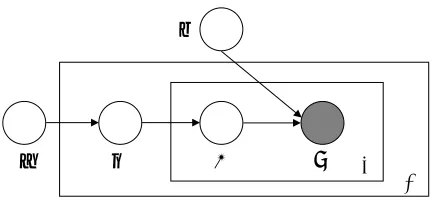
(2) The framework is comparable to that of probabilis-tic latent semanprobabilis-tic analysis, but the topic multino-mial distribution in LDA is assumed to be sampled from a Dirichlet prior and is not linked to training documents. This approach is illustrated in Figure 2. Training of theαandβparameters is possible us-ing a corpus of documents, with a fixed number of topics to predict. A variational inference procedure is described in (Blei et al., 2003) which alleviates the intractability due to the coupling betweenθand
βin the summation over the latent topics. Once the parameters for the Dirichlet and multinomial distri-butions are available, topic scores can be derived for any given document or word sequence.
LATENTDIRICHLETALLOCATION
α θ k w
β
[image:4.612.77.294.75.175.2]M N
Figure 1: Graphical model representation of LDA. The boxes are “plates” representing replicates. The outer plate represents documents, while the inner plate represents the repeated choice of topics and words within a document.
wherep(zn|θ)is simplyθifor the uniqueisuch thatzin=1. Integrating overθand summing over
z, we obtain the marginal distribution of a document:
p(w|α,β) = Z
p(θ|α)
N
∏
n=1∑
znp(zn|θ)p(wn|zn,β)
!
dθ. (3)
Finally, taking the product of the marginal probabilities of single documents, we obtain the proba-bility of a corpus:
p(D|α,β) = M
∏
d=1Z
p(θd|α) Nd
∏
n=1∑
zdnp(zdn|θd)p(wdn|zdn,β)
!
dθd.
The LDA model is represented as a probabilistic graphical model in Figure 1. As the figure makes clear, there are three levels to the LDA representation. The parametersαandβare corpus-level parameters, assumed to be sampled once in the process of generating a corpus. The variables
θdare document-level variables, sampled once per document. Finally, the variableszdnandwdnare word-level variables and are sampled once for each word in each document.
It is important to distinguish LDA from a simple Dirichlet-multinomial clustering model. A classical clustering model would involve a two-level model in which a Dirichlet is sampled once for a corpus, a multinomial clustering variable is selected once for each document in the corpus, and a set of words are selected for the document conditional on the cluster variable. As with many clustering models, such a model restricts a document to being associated with a single topic. LDA, on the other hand, involves three levels, and notably the topic node is sampledrepeatedlywithin the document. Under this model, documents can be associated with multiple topics.
Structures similar to that shown in Figure 1 are often studied in Bayesian statistical modeling, where they are referred to ashierarchical models(Gelman et al., 1995), or more precisely as
con-ditionally independent hierarchical models(Kass and Steffey, 1989). Such models are also often referred to asparametric empirical Bayes models, a term that refers not only to a particular model structure, but also to the methods used for estimating parameters in the model (Morris, 1983). In-deed, as we discuss in Section 5, we adopt the empirical Bayes approach to estimating parameters such asαandβin simple implementations of LDA, but we also consider fuller Bayesian approaches as well.
997
Figure 2: Graphical representation for LDA variables (from (Blei et al., 2003)). The grey circle is the only ob-servable variable.
In our work LDA is employed to annotate each user’s utterance of a dialogue corpus with topic. Ut-terances longer than one word are included in the training set as its sequence of words. Once the model has been trained, inference on data corpus as-signs the topic with the highest probability to each word in a document. This probability is computed from the probability of the topic to appear in the doc-ument and the probability of the word to be gener-ated by the topic. As a consequence we obtain a full topic annotation of the utterance.
Notice that LDA considers a user utterance as a bag of words. This implies that each topic is as-signed to a word without any consideration for its immediate context. An additional segmental process is required if we want to introduce some context in-formation in the topic assignment.
3 Segmental annotation
3.1 Benefits of a segmental annotation
The segmental annotation of the data is not a strict requirement for language understanding. Up to quite recently, most approaches for literal interpretation were limited to lexical-concept relations; for in-stance this is the case of the Phoenix system (Ward, 1991) based on the detection of keywords. However in an NLP perspective, the segmental approach al-lows to connect the various levels of sentence analy-sis (lexical, syntactic and semantic). Even though, in order to simplify its application, segments are gen-erally designed specifically for the semantic anno-tation and do not have any constraint on their rela-tion with the actual syntactic units (chunks, phrasal groups, etc). To get relieved of such constraints not
only simplifies the annotation process itself but as ultimately the interpretation module is to be used in-side a spoken dialogue system, data will be noisy and generally bound the performance of the syn-tactic analysers (due to highly spontaneous and un-grammatical utterances from the users, combined with errors from the speech recognizer).
Another interesting property of segmental ap-proach is to offer a convenient way to dissociate the detection of a conceptual unit from the extraction of its associated value. The value corresponds to the normalisation of the surface form (see last column in 1); for instance if the segment “not more than” is associated to the concept comparative-payment, its value is “less than”. The same value would be associated to “not exceeding” or “inferior to”. Value extraction requires a link between concepts and words based on which the normalisation prob-lem can be addressed by means of regular expres-sions or concept-dependent language models (even allowing integrated approaches such as described in (Lef`evre, 2007)). In the case of global approaches (not segmental), value extraction must be dealt with directly at the level of the conceptual unit tagging, as in (Mairesse et al., 2009). This additional level is very complex (as some values may not be enumer-able, such as numbers and dates) and is only afford-able when the number of authorised values (for the enumerable cases) is low.
3.2 Alignment with IBM models (GIZA)
Once topic assignments for the documents in the corpus have been proposed by LDA, a filtering pro-cess is done to keep only the most relevant topics of each document. The χmax most probable
top-ics are kept according to the probabilityp(k|wi, d)
that topickgenerated the wordwi of the document
d. χmax is a value fixed empirically according to
the expected set of topics in a sentence. Then, the obtained topic sequences are disconnected from the words. At this point, the topic and word sequences can be considered as a translation pair to produce a word-topic parallel corpus. These data can be used with classical approaches in machine transla-tion to align source and target sentences at the word level. Since these alignment models can align sev-eral words with a single topic, only the first occur-rence is kept for consecutive repetitions of the same topic. These models are expected to correct some er-rors made by LDA, and to assign in particular words previously associated with discarded topics to more likely ones.
In our experiments the statistical word alignment toolkit GIZA++ (Och and Ney, 2003) is used to train the so-called IBM models 1-4 as well as the HMM model. To be able to train the most informa-tive IBM model 4, the following training pipeline was considered: 5 iterations of IBM1, 5 iterations of HMM, 3 iterations of IBM3 and 3 iterations of IBM4. The IBM4 model obtained at the last iter-ation is finally used to align words and topics. In order to improve alignment, IBM models are usu-ally trained in both directions (words towards con-cepts andvice versa) and symmetrised by combin-ing them. For this purpose, we resorted to the default symmetrization heuristics used by MOSES, a widely used machine translation system toolkit (Koehn et al., 2007).
3.3 Alignment with Integer Linear Programming (ILP)
Another approach to the re-alignment of LDA out-puts is based on a general optimisation technique. ILP is a widely used tool for modelling and solv-ing combinatorial optimisation problems. It broadly aims at modelling a decision process as a set of equa-tions or inequaequa-tions (called constraints) which are
linear with regards to so-called decision variables. An ILP is also composed of a linearobjective func-tion. Solving an ILP consists in assigning values to decision variables, such that all constraints are sat-isfied and the objective function is optimised. We refer to (Chen et al., 2010) for an overview of appli-cations and methods of ILP.
We provide two ILP formulations for solving the topic assignment problem related to a given docu-ment. They both take as input data an ordered setd
of wordswi,i= 1...N, a set ofK available topics
and, for each wordwi ∈ d and topic k = 1...K,
the natural logarithm of the probability p(k|wi, d)
thatkis assigned towi in the considered document
d. Model[ILP]simply finds the highest-probability assignment of one topic to each word in the doc-ument, such that at most χmax different topics are
assigned.
[ILP] : max
N
X
i=1 K
X
k=1
log(p(k|wi, d))xik(3)
PK
k=1xik = 1 i (4)
yk−xik ≥0 i, k (5)
PK
k=1yk≤χmax (6)
xik ∈ {0,1} i, k
yk∈ {0,1} k
In this model, decision variablexikis equal to1if
topickis assigned to wordwi, and equal to0
other-wise. Constraints (4) ensure that exactly one topic is assigned to each word. Decision variableykis equal
to 1 if topick is used. Constraints (5) force vari-able yk to take a value of1if at least one variable
xik is not null. Moreover, Constraints (6) limit the
total number of topics used. The objective function (3) merely states that we want to maximize the total probability of the assignment. Through this model, our assignment problem is identified as a p-centre
problem (see (ReVelle and Eiselt, 2005) for a survey on such location problems).
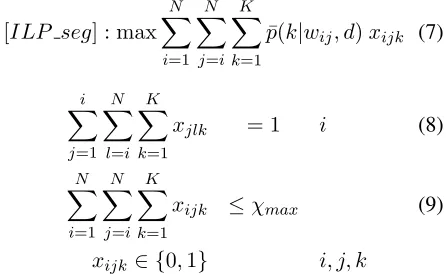
words. Model [ILP seg]partitions the document into segments of consecutive words, and assigns one topic to each segment, such that at mostχmax
seg-ments are created. For the sake of convenience, we denote by p¯(k|wij, d) = Pl=ij log(p(k|wl, d)) the
logarithm of the probability that topickis assigned to all words fromitojin the current document.
[ILP seg] : max
N
X
i=1 N
X
j=i K
X
k=1
¯
p(k|wij, d)xijk (7)
i
X
j=1 N
X
l=i K
X
k=1
xjlk = 1 i (8)
N
X
i=1 N
X
j=i K
X
k=1
xijk ≤χmax (9)
xijk∈ {0,1} i, j, k
In this model, decision variable xijk is equal to 1
if topic kis assigned to all words from itoj, and
0otherwise. Constraints (8) ensure that each word belongs to a segment that is assigned a topic. Con-straints (9) limit the number of segments. Due to the small size of the instances considered in this pa-per, both[ILP]and[ILP seg]are well solved by a direct application of an ILP solver.
4 Evaluation and results
4.1 MEDIAcorpus
The MEDIA corpus is used to evaluate the pro-posed approach and to compare the various con-figurations. MEDIA is a French corpus related to the domain of tourism information and hotel book-ing (Bonneau-Maynard et al., 2005). 1,257 dia-logues were recorded from 250 speakers with a wiz-ard of Oz technique (a human agent mimics an auto-matic system). This dataset contains 17k user utter-ances and 123,538 words, for a total of 2,470 distinct words.
The MEDIAdata have been manually transcribed and semantically annotated. The semantic annota-tion uses 75 concepts (e.g. location, hotel-state, time-month. . .). Each concept is supported by a se-quence of words, theconcept support. Thenull con-cept is used to annotate every words segment that does not support any of the 74 other concepts (and
does not bear any information wrt the task). On aver-age, a concept support contains 2.1 words, 3.4 con-cepts are included in a utterance and 32% of the ut-terances are restrained to a single word (generally “yes” or “no”). Table 1 gives the proportions of ut-terances according to the number of concepts in the utterance.
# concepts 1 2 3 [4,72]
[image:6.612.77.300.181.318.2]% utterances 49.4 14.1 7.9 28.6
Table 1: Proportion of user utterances as a function of the number of concepts in the utterance.
Notice that each utterance contains at least one concept (thenull label being considered as a con-cept). As shown in Table 2, some concepts are sup-ported by few segments. For example, 33 concepts are represented by less than 100 concept supports. Considering that, we can foresee that finding these poorly represented concepts will be hard for LDA.
[1,100[ [100,500[ [500,1k[ [1k,9k[ [9k,15k]
33 21 6 14 1 (null)
Table 2: Number of concepts according to their occur-rence range.
4.2 Evaluation protocol
Unlike previous studies, we chose a fully automatic way to evaluate the systems. In (Siu and Meng, 1999), a manual process is introduced to reject in-duced classes or rules that are not relevant to the task and also to name the semantic classes with the appropriate label. Thus, they were able to evaluate their semi-supervised annotation on the ATIS cor-pus. In (Pargellis et al., 2001), the relevance of the generated semantic classes was manually evaluated giving a mark to each induced semantic rule.
To evaluate the unsupervised procedure it is nec-essary to associate each induced topic with a MEDIA concept. To that purpose, the reference annotation is used to align topics with MEDIA concepts at the word level. A co-occurrence matrix is computed and each topic is associated with its most co-occurring concept.
hier-archy containing 18 clusters of concepts. For ex-ample, a high-level conceptpaymentis created from the 4 conceptsmeansOfPayment, payment-currency, payment-total-amount, payment-approx-amount; a high-level concept locationcorresponds to 12 concepts (location-country, location-district, location-street, . . .). Thus, two levels of concepts are considered for the evaluation: high-level and
fine-level.
The evaluation is presented in terms of the classi-cal F-measure, defined as a combination of precision and recall measures. Two levels are also considered to measure topic assignment quality:
• alignment corresponds to a full evaluation where each word is considered and associated with one topic;
• generationcorresponds to the set of topics gen-erated for a turn (no order, no word-alignment).
4.3 System descriptions
Four systems are evaluated in our experiments.
[LDA]is the result of the unsupervised learning of LDA models using GIBBSLDA++ tool1. It as-signs the most probable topic to each word occur-rence in a document as described in Section 2.2. This approach requires prior estimation of the num-ber of clusters that are expected to be found in the data. To find an optimal number of clusters, we ad-justed the number K of topics around the 75 ref-erence concepts. 2k training iterations were made using default values forαandβ.
[GIZA] is the system based on the GIZA++
toolkit2 which re-aligns for each sentence the topic sequence assigned by [LDA] to word sequence as described in Section 3.2.
[ILP]and [ILP seg]systems are the results of the ILP solver IBM ILOG CPLEX3applied to the models described in Section 3.3.
For the three last systems, the value χmax has to
be fixed according to the desired concept annota-tion. As on average a concept support contains 2.1 words,χmaxis defined empirically according to the
number of words: with i = [[2,4]]:χmax = iwith
1
http://gibbslda.sourceforge.net/
2
http://code.google.com/p/giza-pp/
3
http://www-01.ibm.com/software/integration/optimization/cplex-optimizer/
56 57 58 59 60 61 62 63 64 65 66 67
50 100 150 200
Fmeasure
Number of topics GIZA
[image:7.612.328.511.85.223.2]ILP ILP_seg LDA
Figure 3: F-measure of the high-level concept generation as a function of the number of topics.
44 46 48 50 52 54 56
50 100 150 200
Fmeasure
Number of topics GIZA
ILP ILP_seg LDA
Figure 4: F-measure of the high-level concept alignment as a function of the number of topics.
i= [[5,10]]words:χmax =i−2and for utterances
containing more than 10 words:χmax =i/2.
For the sake of simplicity, single-word utterances are processed separately with prior knowledge. City names, months, days or answers (e.g. “yes”, “no”, “yeah”) and numbers are identified in these one-word utterances.
4.4 Results
Examples of topics generated by[LDA], withK = 100topics, are shown in Table 3.
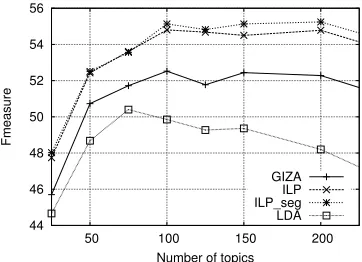
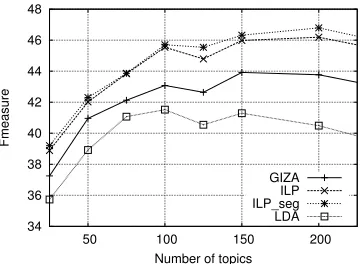
Plots comparing the different systems imple-mented w.r.t. the different evaluation levels in terms of F-measure are reported in Figures 3, 4, 5 and 6 (high-levelvsfine-level,alignmentvsgeneration).
[image:7.612.330.511.299.430.2]Topic 0 Topic 13 Topic 18 Topic 35 Topic 33 Topic 43
information time-date sightseeing politeness location answer-yes
words prob. words prob. words prob. words prob. words prob. words prob.
d’ 0.28 du 0.16 de 0.30 au 0.31 de 0.30 oui 0.62
plus 0.17 au 0.11 la 0.24 revoir 0.27 Paris 0.12 et 0.02
[image:8.612.331.511.264.396.2]informations 0.16 quinze 0.08 tour 0.02 madame 0.09 la 0.06 absolument 0.008 autres 0.10 dix-huit 0.07 vue 0.02 merci 0.08 pr`es 0.06 autre 0.008 d´etails 0.03 d´ecembre 0.06 Eiffel 0.02 bonne 0.01 proche 0.05 donc 0.007 obtenir 0.03 mars 0.06 sur 0.02 journ´ee 0.01 Lyon 0.03 jour 0.005 alors 0.01 dix-sept 0.04 mer 0.01 villes 0.004 aux 0.02 Notre-Dame 0.004 souhaite 0.003 nuits 0.04 sauna 0.01 bientˆot 0.003 gare 0.02 d’accord 0.004
Table 3: Examples of topics discovered by LDA (K= 100).
47 48 49 50 51 52 53 54 55 56 57 58
50 100 150 200
Fmeasure
Number of topics GIZA
[image:8.612.89.272.264.395.2]ILP ILP_seg LDA
Figure 5: F-measure of the fine-level concept generation as a function of the number of topics.
correctly correlated with thehigh-levelconcepts. It can be observed that the bag of 75 topics reaches an F-measure of 61.5% (Fig. 3). When not enough topics are required from[LDA], induced topics are too wide to fit the fine-grained concept annotation of MEDIA. On the other hand if too many topics are re-quired, the performance of bag of high-level topics stays the same while a substantial decrease of the F-measure is observed in the alignment evaluation (Fig. 4). This effect can be explained by the auto-matic alignment method chosen to transpose topics into reference concepts. Indeed, the increase of the number of topics makes them co-occur with many concepts, which often leads to assign them to the most frequent conceptnullin the studied corpus.
From the high-leveltofine-level concept evalua-tions, results globally decrease by 10%. An addi-tional global loss of 10% is also observed for both thegeneration andalignmentscorings. In the
34 36 38 40 42 44 46 48
50 100 150 200
Fmeasure
Number of topics GIZA
ILP ILP_seg LDA
Figure 6: F-measure of the fine-level concept alignment as a function of the number of topics.
level evaluation, a maximum F-measure of 52.2% is observed for thegeneration of 75 topics (Fig. 5) whereas the F-measure decreases to 41.5% in the
alignmentevaluation (Fig. 6).
To conclude on the[LDA]system, we can see that it generates topics having a good correlation with the
high-levelconcepts, seemingly the best representa-tion level between topics and concepts. From these results it seems obvious that an additional step is needed to obtain a more accurate segmental annota-tion, which is expected with the following systems.
Systems based on the ILP technique perform bet-ter than other systems whatever the evaluation. Con-sidering[LDA]as the baseline, we can expect sig-nificant gains of performance. For example, an F-measure of 66% is observed for the ILP systems considering thehigh-levelconceptgenerationfor 75 topics (Figure 4), where the maximum for [LDA]
was 61.5%, and an F-measure of 55% is observed (instead of 50.5% for[LDA]) considering the high-levelconceptalignment.
No significant difference was finally measured be-tween both ILP models for the concept generation evaluations. Even though [ILP seg]seems to ob-tain slightly better results in the alignment evalua-tion. This could be expected since[ILP seg] intrin-sically yields alignments with grouped topics, closer to the reference alignment used for the evaluation.
It is worth noticing that unlike[LDA]system be-haviour, the results of[ILP]are not affected when more topics are generated by[LDA]. A large num-ber of topics enables[ILP]to pick up the best topic for a given segment among in a longer selection list. As for [LDA], the same losses are observed be-tweenhigh-levelandfine-levelconcepts and gener-ationandalignmentparadigms. Nevertheless, an F-measure of 54.8% is observed at thehigh-level con-cept inalignementevaluation (Figure 4) that corre-sponds to a precision of 56.2% and a recall of 53.5%, which is not so low considering a fully-automatic high-level annotation system.
5 Conclusions and perspectives
In this paper an unsupervised approach for con-cept extraction and segmental annotation has been proposed and evaluated. Based on two steps (topic inventory and assignment with LDA, then re-segmentation with either IBM alignment models or ILP) the technique has been shown to offer perfor-mance above 50% for the retrieval of reference con-cepts. It confirms the applicability of the technique to practical tasks with an expected gain in data pro-duction.
Future work will investigate the use of n-grams to increase LDA accuracy to provide better hypothe-ses for the following segmentation method. Besides, other levels of data representation will be examined (use of lemmas, a priori semantic classes like city
names. . . ) in order to better generalise on the data.
ACKNOWLEDGEMENTS
This work is supported by the ANR funded project PORT-MEDIA (www.port-media.org) and the LIA OptimNLP project (www.lia.univ-avignon.fr).
References
D.M. Blei, A.Y. Ng, and M.I. Jordan. 2003. Latent dirichlet allocation. The Journal of Machine Learning Research, 3:993–1022.
H. Bonneau-Maynard, S. Rosset, C. Ayache, A. Kuhn, and D. Mostefa. 2005. Semantic annotation of the french media dialog corpus. InProceedings of the 9th European Conference on Speech Communication and Technology.
A. Celikyilmaz, D. Hakkani-Tur, and G. Tur. 2010. Lda based similarity modeling for question answering. In
Proceedings of the NAACL HLT 2010 Workshop on Se-mantic Search, pages 1–9. Association for Computa-tional Linguistics.
Der-San Chen, Robert G. Batson, and Yu Dang. 2010.
Applied Integer Programming: Modeling and Solu-tion. Wiley, January.
Stefan Hahn, Marco Dinarelli, Christian Raymond, Fab-rice Lefvre, Patrick Lehnen, Renato De Mori, Alessan-dro Moschitti, Hermann Ney, and Giuseppe Riccardi. 2010. Comparing stochastic approaches to spoken language understanding in multiple languages. IEEE Transactions on Audio, Speech and Language Pro-cessing, PP(99):1.
E. Iosif, A. Tegos, A. Pangos, E. Fosler-Lussier, and A. Potamianos. 2006. Unsupervised combination of metrics for semantic class induction. InProceedings of the IEEE Spoken Language Technology Workshop, pages 86–89.
Philipp Koehn, Hieu Hoang, Alexandra Birch, Chris Callison-Burch, Marcello Federico, Nicola Bertoldi, Brooke Cowan, Wade Shen, Christine Moran, Richard Zens, Chris Dyer, Ondrej Bojar, Alexandra Con-stantin, and Evan Herbst. 2007. Moses: Open source toolkit for statistical machine translation. In Pro-ceedings of ACL, Companion Volume, pages 177–180, Prague, Czech Republic.
F. Lef`evre. 2007. Dynamic bayesian networks and discriminative classifiers for multi-stage semantic in-terpretation. In Proceedings of ICASSP, Honolulu, Hawai.
understanding from unaligned data using discrimina-tive classification models. InProceedings of ICASSP, Taipei, Taiwan.
Franz Josef Och and Hermann Ney. 2003. A system-atic comparison of various statistical alignment mod-els. Computational Linguistics, 29(1):19–51.
A. Pargellis, E. Fosler-Lussier, A. Potamianos, and C.H. Lee. 2001. Metrics for measuring domain indepen-dence of semantic classes. In Proceedings of the 7th European Conference on Speech Communication and Technology.
X.H. Phan, L.M. Nguyen, and S. Horiguchi. 2008. Learning to classify short and sparse text & web with hidden topics from large-scale data collections. In
Proceeding of the 17th international conference on World Wide Web, pages 91–100. ACM.
C. S. ReVelle and H. A. Eiselt. 2005. Location analysis: A synthesis and survey. European Journal of Opera-tional Research, 165(1):1–19, August.
K.C. Siu and H.M. Meng. 1999. Semi-automatic acqui-sition of domain-specific semantic structures. In Pro-ceedings of the 6th European Conference on Speech Communication and Technology.
Y.C. Tam and T. Schultz. 2006. Unsupervised language model adaptation using latent semantic marginals. In
Proceedings of INTERSPEECH, pages 2206–2209. W Ward. 1991. Understanding Spontaneous Speech.