CuteForce – Deep Deterministic HPSG Parsing
Gisle Ytrestøl
Department of Informatics / University of Oslo
Abstract
We present a deterministic HPSG parser ca-pable of processing text incrementally with very fast parsing times. Our system demon-strates an efficient data-driven approach that achieves a high level of precision. Through a series of experiments in different config-urations, we evaluate our system and com-pare it to current state-of-the-art within the field, and show that high quality determin-istic parsing is realdetermin-istic even for a ‘deep’ unification-based precision grammar.
1 Motivation
The traditional chart parsing paradigm for text parsing has been to process one sentence at a time, and through some type of dynamic programming algorithm derive the most probable analysis. For a formalism like HPSG, even short sentences can license hundreds of valid (i.e. grammatical) analy-ses, and at some point a statistical model has to be employed to reduce and pin down an n-best candidate list. In order to circumvent a costly ex-traction of the full parse forest, deterministic in-cremental parsing has enjoyed an increased inter-est in the research community. Deterministic pars-ing can mitigate both the time and space complex-ity challenges often associated with probabilistic chart parsing methods. The deterministic incre-mental approach is attractive both from a compu-tational and a cognitive standpoint. Whereas tra-ditional chart parsing approaches require the entire sentence as input before producing an analysis, an incremental algorithm will incrementally expand a syntactic/semantic derivation as it reads the input sentence one word/token at a time. There are sev-eral attractive features to this approach. The time-complexity will be linear when the algorithm is deterministic, i.e. when it does not allow for later changes to the partial derivation. For a number of applications, e.g. speech recognition, the ability to
process input on the fly per word, and not per sen-tence, can also be vital.
This paper introduces a ‘deep’ incremental de-terministic HPSG parser, dubbed CuteForce. It has an optional unification mode, ensuring that all parse derivations are valid HPSG analyses. Uni-fication is a costly operation, and for certain ap-plications it may be a desirable trade-off to gain a significant speed-up by replacing unification with less expensive constraint checking.
2 Related Work
While there is a rich research tradition in statistical parsing, the predominant approach derives from chart parsing and is inherently non-deterministic. In the following, we review alternative approaches to statistical parsing, with a focus on deterministic and incremental processing.
2.1 Deterministic Parsing
Deterministic parsing aims to derive one single analysis provided the input string and the gram-mar. As almost any medium to long sentence car-ries substantial inherent ambiguity given even a moderately simple grammar, this would in prac-tice mean to disambiguate on the fly by making a sequence of local choices that continuously pursue the globally optimal derivation.
Dependency Grammar Kudo and Matsumoto
(2002) introduced an efficient deterministic de-pendency parser for Japanese. Their parser out-performed previous probabilistic models with re-spect to accuracy and efficiency. Yamada and Mat-sumoto (2003) applied a similar method for En-glish, and received a near state of the art accuracy compared to other dependency grammar parsers.
The method was further investigated with Malt-Parser (Nivre et al., 2007; Nivre and Scholz, 2004). MaltParser is a platform for data-driven dependency parsing, which can induce a parsing
model from treebank data and parse new input us-ing a pre-compiled parsus-ing model. The parser is formalized as a transition-based instantiation of a shift-reduce parser. It has been applied to a range of different languages, and Nivre et al. (2007) re-port that dependency accuracy consistently ranges from 80 to 90 %, “usually with less than a 5% increase in error rate compared to state-of-the art parsers for the language in question.”
CFG Sagae and Lavie (2005) present a de-terministic CFG parser grounded in the same classifier-based strategy that was pursued by Malt-Parser. Given that the search-space of constituent trees is larger than for dependency trees, the poten-tial efficiency gain of deterministic parsing could be higher than for dependency parsing, but the margin of error would also be larger, given that a deterministic CFG parse is likely to reach more decision points, with more alternative paths than the same sentence would have encountered in de-pendency parsing. Although they do not reach the same precision/accuracy as ‘classic’ state-of-the-art parsers (e.g. Collins (1997), Charniak (2000), Charniak and Johnson (2005)), “the simplicity and efficiency of deterministic parsers make them at-tractive in a number of situations requiring fast, light-weight parsing, or parsing of large amounts of data.” (Sagae and Lavie, 2005)
HPSG The increased complexity of unification-based grammars like HPSG could potentially li-cense a substantial increase in efficiency by pars-ing deterministically, but the inherent hard con-straints of unification-based grammar could cause a high number of parse failures. Parallel to the development of the CuteForce parser, Ninomiya et al. (2010; 2009) provide a deterministic shift-reduce parser for HPSG where this issue is ad-dressed. To mitigate the problem of parse failures, they suggest default unification (Ninomiya et al., 2002; Copestake, 1993; Carpenter, 1993) by over-writing inconsistent constraints in the grammar, outlining a deterministic and a non-deterministic configuration.
Ninomiya et al. (2010) evaluate their parser on Enju2.3ß, an HPSG for English, which is ex-tracted from Section 02-21 of the Penn Treebank (Miyao and Tsujii, 2005; Miyao et al., 2004). Their deterministic parser using default unification reaches a coverage of 95%. They further conclude that “[t]he experiments revealed that
determinis-tic parsing with default unification achieved a high degree of accuracy of 87.6 per cent for the Penn Treebank with gold part-of-speech (POS) tags.” (Ninomiya et al., 2010)
Further, Matsuzaki et al. (2007) provide a fast, partially deterministic shift-reduce HPSG parser. The parser requires a preceding non-deterministic supertagging and CFG-filtering stage prior to the unification-based parsing which is done through a deterministic shift-reduce algorithm, and gives “comparable accuracy with a speed-up by a factor of six (30 msec/sentence) compared with the best published result using the same grammar.” (Mat-suzaki et al., 2007)
2.2 Traditional Unification-Based Parsing
Whereas the parser proposed by Ninomiya et al. (2010; 2009) is to our knowledge the only other effort to deterministically parse HPSG, traditional chart parsing approaches for unification-based grammars have been presented in a number of re-search efforts (e.g. Riezler et al. (2000), Kaplan et al. (2004), Malouf and van Noord (2004), Miyao and Tsujii (2005), Toutanova et al. (2005)). Since unification is a destructive, hence non-reversible operation, a non-deterministic parsing algorithm will need to preserve the original feature struc-ture in order to keep the entire parse forest intact. Keeping the parse forest intact is crucial when constructing an n-best list over the most probable HPSG analyses that is licensed by the grammar, as the individual parse tree will contain diverg-ing feature structures. This has been addressed in several research papers, as this could poten-tially be a major bottleneck for non-deterministic HPSG parsing (Callmeier, 2000; Oepen and Car-roll, 2000; Zhang et al., 2007).
PET HPSG Parser The PET platform was
developed as a tool for experimentation with HPSG processing and implementation techniques (Callmeier, 2000). It has further been developed through subsumption-based packing (Oepen and Carroll, 2000), selective unpacking and statistical parse ranking (Zhang et al., 2007). It is main-tained by DELPH-IN1, which is a cooperation be-tween academic institutions and researchers work-ing with deep lwork-inguistic processwork-ing in HPSG.
The PET HPSG Parser will for each input sen-tence use a hand-crafted grammar (e.g. LinGO ERG) to retrieve the candidate analyses that are
grounded in the grammar, thus being well-formed. During parsing it attempts to create the full packed parse forest for each input sentence, and produces an n-best list based on statistical parse ranking. Parsing will fail if the full parse forest cannot be constructed within a preset time limit (normally 60 seconds).
3 LinGO ERG and Redwoods Treebank
There exists a number of different HPSG gram-mars used for automatic parsing. The parser pre-sented in this paper uses LinGO (Linguistic Gram-mars Online) ERG (English Resource Grammar), which is a broad-coverage, linguistically pre-cise handcrafted grammar for English (Flickinger, 2000). It is continuously being developed and ex-panded to increase coverage for new domains.
The Redwoods treebank is a collection of an-notated corpora from a variety of domains, in-cluding tourism guides, transcribed scheduling di-alogs, ecommerce emails and Wikipedia articles (Oepen et al., 2002). Each analysis in the treebank is manually disambiguated and assigned an HPSG analysis in accordance with ERG. Its use in this project is recorded in Table 1. HPSG signs corre-sponding to lexical types are developed manually and assigned in accordance with the lexical cover-age of the grammar. Each derivation within Red-woods is grounded in ERG, ensuring that the anal-yses from each individual treebank are kept con-sistent with the overall grammar.
WikiWoods WikiWoods is a collection of au-tomatically annotated Wikipedia articles, in to-tal 1.3 million articles and 55 million utterances. WeScience (ws) can be seen as a manually an-notated subset of WikiWoods (Flickinger et al., 2010; Ytrestøl et al., 2009). The WikiWoods cor-pus is parsed with the PET HPSG parser using the 1010 release of ERG, and will contain a propor-tion of incorrect analyses. In a manual inspec-tion of 1,000 random utterances, roughly 82 % of the analyses were deemed correct or nearly correct (Flickinger et al., 2010).
In this paper we augment the training data with derivations from WikiWoods, using the deriva-tions from Section 2000 and onwards. As demon-strated in this paper, both the supertagger as well as CuteForce benefits greatly from the augmented training data.
[image:3.595.308.480.117.220.2]3.1 Statistics and Example
Table 1 provides an overview of the Redwoods treebanks which are used in this paper.
Name #Sent ∼Length Usage
ws1-11 7636 14.4 train
ws12 601 15.6 dev
ws13 785 14.1 test
logon 8501 13.3 train
vm 11116 6.8 train
sc 2564 15.1 train
Table 1: The corpora in Redwoods treebank used for training and testing in this paper.
#Sent refers to the number of sentences. ∼Length is the average number of tokens per sentence for the treebank.
ws – WeScience, Wikipedia articles logon – Tourism guides
vm – Verbmobil corpus, transcribed dialogs sc – SemCor, subset of English Brown Corpus
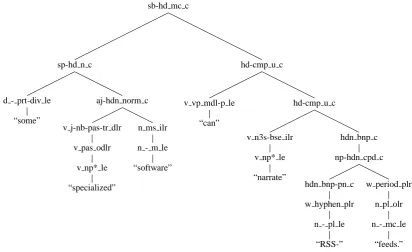
Figure 1 presents an HPSG derivation for a simple sentence. This tree of ERG rules can be presented as a feature structure, and a semantic MRS representation can be derived directly from its structure.
Lexical Rules and Lexical Types The deriva-tion in Figure 1 is composed of lexical and syn-tactic rules. Further, each token is assigned a lexi-cal type, which is conceptually equivalent to a su-pertag (see Section 4). From the leaves in Figure 1 we see that punctuation is considered a part of the token, e.g. for RSS-. The lexical types end with the le suffix. The lexical type for “RSS-”,
n - pn le, provides the HPSG sign template for a
proper noun. The conceptual sign is further aug-mented by the lexical ERG rules, which end with
*lr. The hyphen in “RSS-” is hence annotated with w hyphen plr.
For “specialized” the lexical type v np* le de-notes the lexical category verb (v), with an op-tional noun phrase subcategorization argument.
v pas odlr denotes a passive verb, and v j-nb-pas-tr dlr derives an atj-nb-pas-tributive adjective from a j-nb-pas-
tran-sitive passive verb. Altogether there are 50 lexical rules in the ERG, and around 1,000 lexical types.
sb-hd mc c
sp-hd n c
d - prt-div le
“some”
aj-hdn norm c
v j-nb-pas-tr dlr
v pas odlr
v np* le
“specialized”
n ms ilr
n - m le
“software”
hd-cmp u c
v vp mdl-p le
“can”
hd-cmp u c
v n3s-bse ilr
v np* le
“narrate”
hdn bnp c
np-hdn cpd c
hdn bnp-pn c
w hyphen plr
n - pl le
“RSS-”
w period plr
n pl olr
n - mc le
[image:4.595.91.504.62.314.2]“feeds.”
Figure 1: HPSG derivation from WeScience.
turn connecting a head+specifier (sp-hd n c) and a head+complement (hd-cmp u c) phrase in a bi-nary production. There are in total 145 bibi-nary and 55 unary syntactic rules in the ERG.
4 Preprocessing and Supertagging
CuteForce assumes an input buffer consisting of the tokenized words, part-of-speech tags and lex-ical types. For tokenization we use the gold stan-dard ERG tokenization provided by the treebank. HPSG lexical types are supertags providing a lex-ical template for the input token (Bangalore and Joshi, 1999). Currently, there are 1186 lexical types in the grammar, and these templates can be seen as an extension to the token, enriching the word with HPSG lexical information, correspond-ing to the HPSG sense of a word sign.2 Dri-dan (2009) showed that supertagging contributes to both speed-up and increased coverage for the PET HPSG Parser. Although it would be feasible to integrate supertagging into the parsing oracle, assigning supertags incrementally during parsing, we have opted for a pre-processing stage for per-formance reasons, a design choice which is paral-lel to MaltParser.
Dridan (2009) investigated supertagging of lex-ical types within ERG. The thesis concludes that the TnT tagger (Brants, 2000) performs better than C&C Tagger (Clark and Curran, 2007) when
2892 different lexical types are found in the training data.
trained on the limited training data that was avail-able in 2009. However, the learning curve for the TnT tagger seemed to flatten out at around 150,000 tokens, whereas the learning curve for C&C was still rising.
We trained the C&C tagger on the Redwoods treebank, and augmented it with sentences from the WikiWoods corpus (see Table 1). The find-ings in Dridan (2009) suggest that non-gold stan-dard data may improve the C&C tagger. Addi-tionally we developed a customized feature model trained with SV Mhmm, which is an implemen-tation of structural SVMs for sequence tagging which learns a hidden Markov model (Joachims et al., 2009). Whereas the C&C tagger is optimized for supertagging, and has a relatively fixed config-uration, SV Mhmmrequires that the user designs features specifically aimed for the classification task. This allows the user to address certain un-conventional aspects of ERG supertagging, most especially the tokenization that includes punctua-tion. On smaller sets of training data,SV Mhmm outperformed C&C. However, C&C trains much faster, and is capable of training on much larger amounts of data thanSV Mhmm.
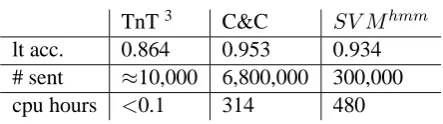
best configurations for SV Mhmm and the C&C tagger, along with the best single lexical type accu-racy for WeScience 2 reported in Dridan (2009). #
sent refers to the number of sentences in the
train-ing data, and cpu hours is the number of hours it took to train the model. Although we were able to train even larger models for the C&C tagger, the accuracy seemed to flatten out at approximately 6,800,000 tokens on our development set, so we have applied this model. For the C&C tagger, we used the default parameter settings.
TnT3 C&C SV Mhmm
lt acc. 0.864 0.953 0.934
# sent ≈10,000 6,800,000 300,000
[image:5.595.72.294.218.280.2]cpu hours <0.1 314 480
Table 2: Single tag accuracy on WeScience Section 2 (TnT) and Section 13 (C&C andSV Mhmm).
Consistent with the assumption in Dridan (2009), augmenting the training data contributes substantially to the performance of the tagger. C&C and SV Mhmm (Table 2) are trained on 6,800,000 and 300,000 sentences respectively, ap-proximately 94 million/4 million tokens. C&C has a comparatively low accuracy when the amount of training data is limited. We assume the punctu-ation regime in ERG works is C&C’s disadvan-tage when the training data is limited, since it will result in a large lexicon with comparatively low frequency per lexical entry. When increasing the training data, this sparsity problem will have less impact – it is even plausible that this contributes to the overall performance of C&C when the amount of training data is high, because the punctuation provides enriched information about the token.
Part-of-speech tags are assigned prior to su-pertagging. POS tags are not part of the final HPSG derivation, but are used both by the pars-ing oracle in CuteForce and by the supertagger. The POS tags used in training and test data are tagged using the TnT POS tagger, applying the pre-compiled English WSJ model bundled with the tagger.
3
From the best single tag accuracy reported in Dridan (2009) on Section 2 of ws. Training time is not stated in Dri-dan (2009), but in TnT it should only be a matter of minutes for such a small data set. This model is trained on 1,941 sen-tences from WeScience, and additional data from the Red-woods treebank, approximately 10,000 sentences, and We-Science should hence be considered (mostly) out-of-domain for this model, compared to the models used in the training of the C&C andSV Mhmm
tagger.
5 CuteForce – Deterministic Incremental HPSG Parsing
Our parser, CuteForce, employs a classifier-based
oracle to guide the shift-reduce parser that
in-crementally builds a syntactic/semantic HPSG derivation that conforms to the LinGO English Re-source Grammar (ERG).
Parser Layout The sentence input bufferβ is a list of tuples with token, part-of-speech tags and HPSG lexical types (supertags).
Given a set of ERG rules R and a sentence buffer β, a parser configuration is a tuple c = (α, β, ι, π) where:
• αis a stack of “active” edges4
• β is a list of tuples of word forms W, part of speech tags P OS and lexical types LT derived from a sentence x = ((W1, P OS1, LT1), ...(Wn, P OSn, LTn)).
• ιis the current input position inβ
• π is a stack of passive edges instantiating an ERG rule
The stack of passive edges π makes up the full HPSG representation of the input string if the string is accepted.
Transition System The shift-reduce parser has four different transitions, two of which are param-eterized with a unary or binary ERG rule, which are added to the passive edges, hence building the HPSG structure. The four transitions are:
• ACTIVE – (adds an active edge to stack α, and incrementsι)
• UNIT(R1) – (adds unary passive edge to π instantiating unary ERG rule(R1))
• PASSIVE(R2) – (pops α and adds binary passive edge to π instantiating binary ERG rule(R2))
• ACCEPT – (terminates the parse of the sen-tence. π represents the HPSG derivation of the sentence)
4
Parsing Configuration Mode The parser can operate in three oracle configurations: HPSG Uni-fication mode, CFG approximation mode and un-restricted mode.
In HPSG Unification mode, the parser validates that each transition implies a valid unification. This is done through an XML-RPC interface to LKB (Copestake, 2002). We expect that a substan-tial speedup could be obtained if this implementa-tion was done natively in CuteForce5. All UNIT and PASSIVE transitions are implicit unifications. For each parsing stage, the parsing oracle returns a ranked list of transitions. The highest-ranked tran-sition not violating a unification constraint will be executed. If no transitions yield a valid unifica-tion, parsing fails for the given sentence. All non-failing parses (i.e. parses that terminates with the ACCEPT transition) are ensured to produce a valid HPSG derivation.
In CFG mode, a naive CFG approximation of the ERG is employed to guide the oracle. The CFG approximation consists of CFG rules harvested from the parser’s training data, aug-mented with derivations from WikiWoods, in total 300,000 sentences. Each ERG rule instantiation, using the identifiers shown in Figure 1 as non-terminal symbols, will be treated as a CFG rule, and each parser action will be validated against the set of CFG rules. If the parser action yields a CFG projection not found among the valid CFG rules in the CFG approximation, the CFG filter will block this transition. If the parser arrives at a state where the CFG filter blocks all further transitions, pars-ing fails.
In unrestricted mode, the oracle chooses the highest scoring transition without any further re-strictions imposed. In this setting, the parser typ-ically reaches close to 100 % coverage – the only sentences not covered in this setting are instances where the parser enters an infinite unit production loop, and the sentence is dismissed.6
5
Specifically, the current unification back-end performs non-destructive unification, i.e. it does not take advantage of the deterministic nature of CuteForce.
6
One would require additional heuristics to avoid unary loops in an incremental parsing scheme that allows for such productions. In Sagae and Lavie (2005) they force a non-unary production after three consecutive non-unary transitions in order to break a potential loop.
5.1 Machine Learning Model
A discriminative machine learning model is used to predict the parser action. The model is trained and tested on the WeScience Treebank, a branch of the hand-annotated LinGO Redwoods treebank (Ytrestøl et al., 2009; Oepen et al., 2002). Section 1-11 is used for training, Section 12 is used in de-velopment and Section 13 is held-out for testing. The training data is further augmented with addi-tional sentences from other Redwoods treebanks (see Table 1), and derivations from the automati-cally annotated Wikiwoods corpus. Parsing results for CuteForce initially improve when the size of the training data increases, but the full extent of the effect of training on partially incorrect training data is not yet clear. Section 3 provides a more in-depth presentation of the training data used in this paper. The parsing is reduced to a classifica-tion problem. Each HPSG analysis is a derivaclassifica-tion from one unique sequence of parser actions T = t1, t2. . . tnThe input histories are feature vectors representing a parser state, and the output class is a transition t. This can be seen as a deterministic implementation of a History-based model, intro-duced by Black et al. (1993). Formally, a deriva-tionDis a sequence of the highest scoring transi-tionsT:
arg maxti P(ti|Φ(t1, .., ti−1))
The function Φmaps the current state, or
his-tory, to a feature vector. The vector is further
de-fined through a set of feature functions, see Sec-tion 5.2.
For training we use LibLinear (Fan et al., 2008), which provides a number of solvers. In CuteForce, we have used the implementation of SVM multi-class multi-classification of Crammer and Singer’s for-mula (Vapnik, 1995; Keerthi et al., 2008; Cram-mer and Singer, 2002), which has given better re-sults than other learners evaluated during the de-velopment.
5.2 Feature Model
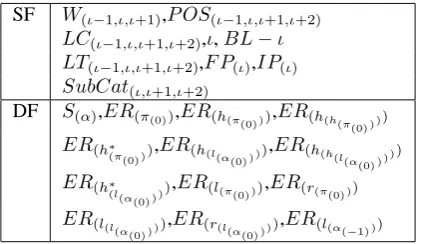
to parsing and only depend on the properties of the input buffer, whereas the dynamic features are defined by the HPSG derivation that is partially built during parsing. Part-of-speech tags and ERG lexical types (supertags) are annotated in a prepro-cessing stage.
For the history-based model, we expand the for-mal parser definition in Section 5 with a position indexjforαandπ, where 0 denotes the top of the stack, -1 denotes the next stack element etc.
Feature Functions We define a set of feature functions to describe the features used in the fea-ture vector:
• β(ι)is theιthW/P OS/LT tuple in the input buffer, whereιdenotes the current buffer po-sition.
• BLis the length of bufferβ
• W(ι)is theιth word form inβ.
• LT(ι)is theιth lexical type inβ.
• P OS(ι)is theιth Part-of-Speech tag inβ, an-notated by the preprocessor (TNT).
• LC(ι)is the lexical category tag derived from LT(ι).
• SubCat(ι) is the Subcategorization field
de-rived fromLT(ι).
• IP(ι) and F P(ι) denote word-initial and word-final punctuation in the wordW(ι), re-spectively.
• α(j) is the jth unification candidate edge
from the top of the active edge stack.
• π(j)is thejth edge from the top of the passive edge stack.
• l(e)is the left-branched daughter of the edge e.
• r(e) is the right-branched daughter of the (passive) edgee.
• h(e) is the HPSG head of the edge e. h∗ (e)
denotes the head-relation down to the pre-terminal.
• ER(e) is the ERG rule of the (passive) edge e.
• S(α/π)denotes the size of theαandπstacks.
Feature Templates Each training instance maps 70 features to the feature vector. In this paper we limit ourselves to presenting the feature functions corresponding to the atomic features extracted for each parsing state (see Table 3). In the feature vec-tor, most of the atomic features occur in conjunc-tion with other features, and only a few of the fea-tures will occur by themselves. A combination of two or more features is necessary to represent the inherent dependence many features have on one another, given that we train the model linearly. For our model derived from 150,000 sentences, we ex-tracted approximately 6 million features, using a frequency cutoff of 3.
SF W(ι−1,ι,ι+1),P OS(ι−1,ι,ι+1,ι+2)
LC(ι−1,ι,ι+1,ι+2),ι,BL−ι
LT(ι−1,ι,ι+1,ι+2),F P(ι),IP(ι)
SubCat(ι,ι+1,ι+2)
DF S(α),ER(π(0)),ER(h(π
(0) )),ER(h(h(π
(0) )))
ER(h∗
(π(0) )),ER(h(l(α
(0) )))
,ER(h(h(l
(α
(0) ))) )
ER(h∗
(l(α
(0) ))
),ER(l(π(0) )),ER(r(π(0) ))
ER(l(l(α
(0) ))
),ER(r(l(α
(0) ))
[image:7.595.307.518.262.384.2]),ER(l(α( −1) ))
Table 3: Static and dynamic features.
5.3 Training Data
Given the available treebanks and corpora we have at our disposal (see Section 3), we evaluated a number of different training data configurations. In addition to corpora from the Redwoods tree-bank, we can extend the training model with Wiki-Woods data.
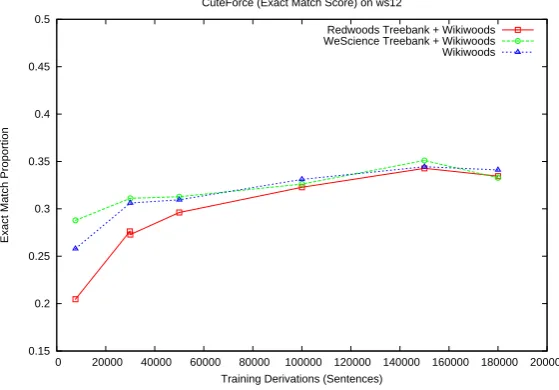
In Figure 2 we observe that the accuracy of CuteForce improves when extending the number of training derivations. Figure 2 presents results for parsing without CFG or Unification filtering using gold standard lexical types.
Training data from the WeScience treebank amounts to 7,636 sentences. When training on the same amount of sentences from other (out of do-main) treebanks from Redwoods, we see a clear drop in precision – both the in-domain WeScience treebank, and maybe more surprisingly, the an-notated WikiWoods corpus is a better source for training than the out-of-domain, yet gold standard, Redwoods data.
0.15 0.2 0.25 0.3 0.35 0.4 0.45 0.5
0 20000 40000 60000 80000 100000 120000 140000 160000 180000 200000
Exact Match Proportion
Training Derivations (Sentences) CuteForce (Exact Match Score) on ws12
[image:8.595.158.438.70.265.2]Redwoods Treebank + Wikiwoods WeScience Treebank + Wikiwoods Wikiwoods
Figure 2: The exact match proportion (proportion of sentences with an HPSG analysis identical to the gold stan-dard) increases when adding more training sentences. The WeScience Treebank augumented with WikiWoods derivations, totally 150,000 sentences, reaches the highest accuracy.
formance for the two in-domain configurations. There are at least two trends in Figure 2 that seem obvious: First, in-domain data is a better training source than out-of-domain data – even when the training data contains a proportion of er-rors. Second, when the amount of training data is very limited, training on the WeScience treebank yields the best results. However, when we ex-tend the amount of WikiWoods derivations in the training data, these differences diminish, and from 100,000 training sentences onwards, there seems to be no substantial differences between the train-ing data configurations. At about 150,000 deriva-tions, the curve appears to flatten out, and even starting to decline. For the remainder of the pa-per, we continue using the model trained on We-Science, augmented with Wikiwoods annotation, totally 150,000 derivations, as this configuration achieved the highest accuracy on the development data set.
In this iteration we have indiscriminately used WikiWoods sentences from Section 2000 and on-wards. It could prove beneficial to reject sentences in the training data that are obvious outliers. This could be very short (one word) sentences, very long sentences, sentences partially or completely in a foreign language7, or sentences that have other properties that may imply that they are unsuited to use as training data. This will be subject for
fur-7Certain articles in the English Wikipedia contain large
amount of foreign texts, for example articles concerning a specific language.
ther research.
6 Evaluation
CuteForce is evalutated on Section 13 from We-Science (ws13), and the experiments were carried out on an Intel Xenon(R) server with 2 GHz CPU.
6.1 Deterministic HPSG Parsers
To our knowledge, the parser outlined in Ni-nomiya et al. (2010) is the only effort in incremen-tal deterministic unification-based parsing, along side with CuteForce. However, a complete head-to-head comparison of the parse analyses pro-duced by the parsers is not possible due to formal and technical difference in the underlying gram-mars. Whereas the HPSG Enju grammar used by Ninomiya et al. (2010) is induced from the Penn Treebank, the ERG is a handcrafted mar. Where the granularity of an induced gram-mar like Enju is largely determined by informa-tion available in the treebank, the ERG includes more fine-grained and richer analyses, for example with respect to subcategorization patterns (includ-ing relational nouns and adjectives), multi-word expressions and other subtle linguistic properties that cannot easily be extracted from a treebank with heuristics alone.
one could opt for a partial evaluation of the analy-ses generated by the two parsers, e.g. by extracting dependency relations (Clark and Curran (2007), Cahill et al. (2008)). This would be subject for further investigation.
Instead of directly comparing the two determin-istic parsers, we can however see how they relate to traditional non-deterministic parsers. Ninomiya et al. (2010) present an extensive evaluation of their deterministic parser, compared to other non-deterministic Enju HPSG parsers. In the follow-ing, we will compare CuteForce to the PET HPSG Parser, which is the de facto HPSG parser for the DELPH-IN consortium.
6.2 CuteForce vs PET HPSG Parser
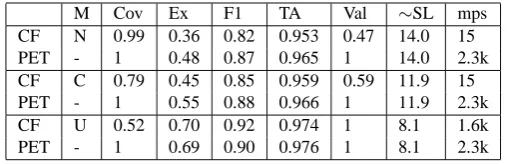
The PET HPSG Parser is the most widely used parser for ERG. Its design is distinctly different from CuteForce (see Section 2.2). Comparing the two parsers based on available testing data is non-trivial: Whereas Ytrestøl et al. (2009) re-port a parsing coverage of 86 % for the sentences annotated in WeScience, it is only the sentences that were actually covered that appear in the We-Science Treebank. Hence, the PET Parser will have a 100 % coverage in all the test sentences we are able to evaluate. To accommodate for this, we have evaluated the parsers on test sentences where the coverage overlaps for both parsers, hence we have divided the results according to the parser mode in which CuteForce is operating. Table 4 presents the parser scores on ws13 when Cute-Force is using gold standard supertags, whereas Table 5 presents the same score when CuteForce is applying supertagged input.
6.3 Parsing Results
The oracle mode determines the coverage for CuteForce, hence the subset of the test data that is evaluated for each configuration. M in Table 4 and 5 refers to the CuteForce oracle mode, where
N in unrestricted, C is CFG approximation mode,
and U is unification mode. Ex is the proportion of sentences that was parsed identically to the gold standard derivation. Cov refers to the correspond-ing coverage, only relevant for CuteForce8. F1 is the Parseval F1-score when treating the gold stan-dard and the parsed analysis as a CFG tree
struc-8Since the treebanks only consist of sentences that the
PET parser was able to parse, PET will have 100 % cover-age in all configurations.
ture. TA is the lexical type (supertag) accuracy. All tree derivation scores are computed by evalb9.
Val is the proportion of the parsed analyses that
are valid HPSG derivations, and∼SL refers to the
average sentence length for the subset. mps is the average number of millisecond per sentence used by the parser (this excludes preprocessing time done by the supertagger).
In Table 4 and 5 we see that with gold stan-dard supertags, CuteForce is comparable, and even more accurate than PET in certain validation ma-trices. When parsing with supertagged input, PET is in overall better. However, when considering the F1-score, it seems clear that the parse derivations produced by CuteForce have high quality. Pars-ing time is consistently 15 msec/sentence unless we apply unification. This is to our knowledge the fastest parsing time reported by a parser on a ma-jor HPSG grammar.
We see that the proportion of sentences that are well-formed HPSG derivations are in the range from 0.47-0.59, depending on the configuration. Although a fairly high share of the derivations will not yield a unifiable HPSG derivation, it is how-ever likely that one could extract a partially well-formed semantic structure through robust unifica-tion (Fouvry, 2003). This is also addressed in Zhang and Krieger (2011), and will be evaluated in further studies.
7 Future Work
There are alternative paths that could be pursued to attempt to improve on the current configura-tion. Instead of using single tags, one could let the supertagger assign multiple supertags. Zhang and Clark (2011) present a shift-reduce parser for CCG where the parsing oracle chooses between a set of candidate supertags assigned by the supertagger. Hence they are able to take syntactic information into account when choosing the supertag. A simi-lar approach could be beneficial for CuteForce.
Allowing for non-determinism would open for a number of strategies. Ytrestøl (2011) evaluated a backtracking algorithm where ranking is applied to locate and redo an incorrect transition done by CuteForce. Alternatively, one could consider a beam-search strategy in line with Ninomiya et al. (2010). This will be subject for further study.
M Cov Ex F1 TA Val ∼SL mps
[image:10.595.171.428.61.143.2]CF N 0.99 0.42 0.86 1 0.51 14.1 15 PET - 1 0.48 0.87 0.965 1 14.1 2.3k CF C 0.81 0.52 0.89 1 0.59 12.0 15 PET - 1 0.55 0,88 0.966 1 12.0 2.3k CF U 0.57 0.77 0.94 1 1 8.6 1.6k PET - 1 0.66 0.90 0.972 1 8.6 2.3k
Table 4: Parsing results for CuteForce (gold standard lexical types) and PET HPSG Parser on ws13, evaluated on sentences where the coverage overlaps for both parsers.
M Cov Ex F1 TA Val ∼SL mps CF N 0.99 0.36 0.82 0.953 0.47 14.0 15 PET - 1 0.48 0.87 0.965 1 14.0 2.3k CF C 0.79 0.45 0.85 0.959 0.59 11.9 15 PET - 1 0.55 0.88 0.966 1 11.9 2.3k CF U 0.52 0.70 0.92 0.974 1 8.1 1.6k PET - 1 0.69 0.90 0.976 1 8.1 2.3k
Table 5: Parsing results for CuteForce (supertagged lexical types) and PET HPSG Parser on ws13, evaluated on sentences where the coverage overlaps for both parsers.
8 Concluding Remarks
We have presented an efficient deterministic pars-ing approach to HPSG. Whereas unification-based parsing traditionally has been associated with non-deterministic parsers, we have demonstrated a de-terministic system capable of achieving a high level of precision with very fast parsing times. Al-though it is questionable if a deterministic sys-tem could ever reach the same precision-level as state-of-the-art non-deterministic systems, deter-ministic parsing would be attractive for applica-tions where it is desirable to trade some precision for high-speed incremental parsing.
Acknowledgement
The author would like to thank the anonymous re-viewers for their helpful suggestions, and Stephan Oepen (University of Oslo) and Joakim Nivre (Up-psala University) for their valued input and inspir-ing feedback durinspir-ing the writinspir-ing of this paper, and in the PhD project in general. Experimentation and engineering was made possible through access to the TITAN high-performance computing facil-ities at the University of Oslo (UiO), and we are grateful to the Scientific Computation staff at UiO, as well as to the Norwegian Metacenter for Com-putational Science.
References
Srinivas Bangalore and Aravind K. Joshi. 1999. Supertagging: an approach to almost parsing.
Computational Linguistics, pages 237–265.
Ezra Black, Fred Jelinek, John Lafferty, David M. Magerman, Robert Mercer, and Salim Roukos. 1993. Towards history-based grammars: Using richer models for probabilistic parsing. In
Pro-ceedings of the 31st Meeting of the Association for Computational Linguistics, pages 31–37.
Thorsten Brants. 2000. TnT - a statistical part-of-speech tagger. In Proceedings of the 6th ACL
Conference on Applied Natural Language Pro-cessing, pages 224–231.
Aoife Cahill, Michael Burke, Ruth O’Donovan, Stefan Riezler, Josef van Genabith, and Andy Way. 2008. Wide-coverage deep statistical parsing using automatic dependency structure annotation. 34:81–124.
Ulrich Callmeier. 2000. PET — A platform for experimentation with efficient HPSG process-ing techniques. Natural Language Engineer-ing, 6 (1) (Special Issue on Efficient Processing
with HPSG):99 – 108.
Bob Carpenter. 1993. Skeptical and credulous de-fault unification with applications to templates and inheritance. In Inheritance, defaults and
the lexicon, pages 13–37. Cambridge University
Press.
[image:10.595.172.426.183.265.2]43th Meeting of the Association for Computa-tional Linguistics, pages 173–180.
Eugene Charniak. 2000. A maximum-entropy-inspired parser. In Proceedings of the 1st
Con-ference of the North American Chapter of the ACL, pages 132–139. Morgan Kaufmann
Pub-lishers Inc.
Stephen Clark and James Curran. 2007. Formalism-independent parser evaluation with ccg and depbank. In Proceedings of the 45th
Meeting of the Association for Computational Linguistics, pages 248–255.
Michael Collins. 1997. Three generative, lexi-calised models for statistical parsing. In
Pro-ceedings of the 35th Meeting of the Association for Computational Linguistics and the 7th Con-ference of the European Chapter of the ACL,
pages 16–23.
Ann Copestake. 1993. Defaults in lexical rep-resentation. In Inheritance, defaults and the
lexicon, pages 223–245. Cambridge University
Press.
Ann Copestake. 2002. Implementing Typed
Fea-ture StrucFea-ture Grammars. CSLI Publications.
Koby Crammer and Yoram Singer. 2002. On the algorithmic implementation of multiclass kernel-based vector machines. The Journal of
Machine Learning Research, 2:265–292.
Rebecca Dridan. 2009. Using Lexical Statistics to
Improve HPSG Parsing. Ph.D. thesis, Saarland
University.
Rong-En Fan, Kai-Wei Chang, Cho-Jui Hsieh, Xiang-Rui Wang, and Chih-Jen Lin. 2008. Li-blinear: A library for large linear classifica-tion. The Journal of Machine Learning Re-search, 9:1871–1874.
Dan Flickinger, Stephan Oepen, and Gisle Ytrestøl. 2010. Wikiwoods: Syntacto-semantic annotation for english wikipedia. In
Proceed-ings of the 7th International Conference on Language Resources and Evaluation. European
Language Resources Association (ELRA).
Dan Flickinger. 2000. On building a more ef-ficient grammar by exploiting types. Natural
Language Engineering, 6 (1):15 – 28.
Frederik Fouvry. 2003. Robust Processing for
Constraint-Based Grammar Formalisms. Ph.D.
thesis, Univeristy of Essex.
Thorsten Joachims, Thomas Finley, and Chun-Nam John Yu. 2009. Cutting-plane training of structural SVMs. Machine Learning, 77:27–59.
Ronald M. Kaplan, Stefan Riezler, Tracy H. King, John T. Maxwell III, and Er Vasserman. 2004. Speed and accuracy in shallow and deep stochastic parsing. In Proceedings of the main
conference on Human Language Technology Conference of the North American Chapter of the Association of Computational Linguistics.
S. Sathiya Keerthi, S. Sundararajan, Kai-Wei Chang, Cho-Jui Hsieh, and Chih-Jen Lin. 2008. A sequential dual method for large scale multi-class linear SVMs. In Proceeding of the
14th ACM SIGKDD international conference on Knowledge discovery and data mining, KDD
’08, pages 408–416. ACM.
Taku Kudo and Yuji Matsumoto. 2002. Japanese dependency analysis using cascaded chunking. In Proceedings of the 6th conference on
Natu-ral language learning - Volume 20,
COLING-02, pages 1–7. Association for Computational Linguistics.
Robert Malouf and Gertjan van Noord. 2004. Wide coverage parsing with stochastic attribute value grammars. In Proceedings of the IJCNLP
workshop Beyond Shallow Analysis.
Takuya Matsuzaki, Yusuke Miyao, and Jun’ichi Tsujii. 2007. Efficient HPSG parsing with su-pertagging and cfg-filtering. In Proceedings of
the 20th International Joint Conference on Ar-tificial Intelligence, pages 1671–1676.
Yusuke Miyao and Jun’ichi Tsujii. 2005. Probabilistic disambiguation models for wide-coverage hpsg parsing. In Proceedings of the
43rd Annual Meeting on Association for Com-putational Linguistics, pages 83–90.
Associa-tion for ComputaAssocia-tional Linguistics.
Proceedings of the 1nd International Joint Con-ference on Natural Language Processing, pages
684–693.
Takashi Ninomiya, Yusuke Miyao, and Jun’ichi Tsujii. 2002. Lenient default unification for ro-bust processing within unification based gram-mar formalisms. In Proceedings of the 19th
In-ternational Conference on Computational Lin-guistics, pages 1–7.
Takashi Ninomiya, Nobuyuki Shimizu, Takuya Matsuzaki, and Hiroshi Nakagawa. 2009. De-terministic shift-reduce parsing for unification-based grammars by using default unification. In
Proceedings of the 12th Conference of the Eu-ropean Chapter of the ACL, pages 603–611.
As-sociation for Computational Linguistics.
Takashi Ninomiya, Takuya Matsuzaki, Nobuyuki Shimizu, and Hiroshi Nakagawa. 2010. De-terministic shift-reduce parsing for unification-based grammars. Natural Language
Engineer-ing, pages 1–35.
Joakim Nivre and Mario Scholz. 2004. Deter-ministic dependency parsing of English text. In
Proceedings of the 20th International Confer-ence on Computational Linguistics. Association
for Computational Linguistics.
Joakim Nivre, Johan Hall, Jens Nilsson, Atanas Chanev, G ¨ulsen Eryigit, Sandra K ¨ubler, Sve-toslav Marinov, and Erwin Marsi. 2007. Malt-parser: A language-independent system for data-driven dependency parsing. Natural
Lan-guage Engineering, 13(2):95–135.
Stephan Oepen and John Carroll. 2000. Ambi-guity packing in constraint-based parsing. Prac-tical results. In Proceedings of the 1st
Confer-ence of the North American Chapter of the ACL,
pages 162 – 169.
Stephan Oepen, Kristina Toutanova, Stuart Shieber, Chris Manning, Dan Flickinger, and Thorsten Brants. 2002. The LinGO Redwoods treebank. Motivation and preliminary applica-tions. In Proceedings of the 19th International
Conference on Computational Linguistics.
Stefan Riezler, Detlef Prescher, Jonas Kuhn, and Mark Johnson. 2000. Lexicalized stochastic modeling of constraint-based grammars using
log-linear measures and EM training. In
Pro-ceedings of the 38th Meeting of the Association for Computational Linguistics, pages 480 – 487.
Kenji Sagae and Alon Lavie. 2005. A classifier-based parser with linear run-time complexity. In Proceedings of the 9th International
Work-shop on Parsing Technologies, pages 125–132.
Association for Computational Linguistics.
Kristina Toutanova, Christopher D. Manning, Dan Flickinger, and Stephan Oepen. 2005. Stochas-tic HPSG Parse Disambiguation using the Red-woods Corpus. In Research in Language and
Computation.
Vladimir N. Vapnik. 1995. The nature of
statisti-cal learning theory. Springer.
Hiroyasu Yamada and Yuji Matsumoto. 2003. Statistical dependency analysis with support vector machines. In Proceedings of the 8th
In-ternational Workshop on Parsing Technologies,
pages 195–206.
Gisle Ytrestøl, Dan Flickinger, and Stephan Oepen. 2009. Extracting and Annotating Wikipedia Sub-Domains — Towards a New eScience Community Resource. In
Proceed-ings of the 8th Workshop on Treebanks and Lin-guistic Theories, pages 185 – 197.
Gisle Ytrestøl. 2011. Optimistic backtracking: a backtracking overlay for deterministic incre-mental parsing. In Proceedings of the ACL
2011 Student Session, HLT-SS ’11, pages 58–
63.
Yue Zhang and Stephen Clark. 2011. Shift-reduce ccg parsing. In Proceedings of the 49th Meeting
of the Association for Computational Linguis-tics, pages 683–692.
Yi Zhang and Hans-Ulrich Krieger. 2011. Large-scale corpus-driven pcfg approximation of an hpsg. In Proceedings of the 12th International
Workshop on Parsing Technologies.
Yi Zhang, Stephan Oepen, and John Carroll. 2007. Efficiency in unification-based n-best parsing. In Proceedings of the 10th
Inter-national Workshop on Parsing Technologies,