Combining Hierarchical Reinforcement Learning and Bayesian Networks
for Natural Language Generation in Situated Dialogue
Nina Dethlefs Department of Linguistics,
University of Bremen [email protected]
Heriberto Cuay´ahuitl
German Research Centre for Artificial Intelligence (DFKI), Saarbr¨ucken
Abstract
Language generators in situated domains face a number of content selection, utterance plan-ning and surface realisation decisions, which
can be strictly interdependent. We
there-fore propose to optimise these processes in a joint fashion using Hierarchical Reinforce-ment Learning. To this end, we induce a re-ward function for content selection and utter-ance planning from data using the PARADISE framework, and suggest a novel method for inducing a reward function for surface reali-sation from corpora. It is based on genera-tion spaces represented as Bayesian Networks. Results in terms of task success and human-likeness suggest that our unified approach per-forms better than a baseline optimised in iso-lation or a greedy or random baseline. It re-ceives human ratings close to human authors.
1 Introduction
Natural Language Generation (NLG) systems that work in situated domains and need to generate ut-terances during an interaction are faced with a num-ber of challenges. They need to adapt their deci-sions to a continuously changing interaction history and spatial context as well as to the user’s proper-ties, such as their individual information needs and verbal or nonverbal responses to each generated ut-terance. Decisions involve the tasks of content se-lection, utterance planning and surface realisation, which can be in many ways related and interdepen-dent. For the former two tasks, e.g., there is a trade-off between how much information to include in an utterance (to increase task success), and how much a
user can actually comprehend online. With regard to surface realisation, decisions are often made accord-ing to a language model of the domain (Langkilde and Knight, 1998; Bangalore and Rambow, 2000; Oh and Rudnicky, 2000; White, 2004; Belz, 2008). However, there are other linguistic phenomena, such as alignment (Pickering and Garrod, 2004), consis-tency (Halliday and Hasan, 1976), and variation, which influence people’s assessment of discourse (Levelt and Kelter, 1982) and generated output (Belz and Reiter, 2006; Foster and Oberlander, 2006). We therefore argue that it is important to optimise con-tent selection, utterance planning and surface real-isation in a unified fashion, and we suggest to use Hierarchical Reinforcement Learning (HRL) with Bayesian networks to achieve this. Reinforcement learning (RL) is an attractive framework for opti-mising NLG systems, where situations are mapped to actions by maximising a long term reward sig-nal (Rieser et al., 2010; Janarthanam and Lemon, 2010). HRL has the additional advantage of scal-ing to large search spaces (Dethlefs and Cuay´ahuitl, 2010). Since an HRL agent will ultimately learn the behaviour it is rewarded for, the reward function is arguably the agent’s most crucial component. Previ-ous work has therefore suggested to learn a reward function from human data as in the PARADISE framework (Walker et al., 1997). We will use this framework to induce a reward function for content selection and utterance planning. However, since PARADISE relies heavily on task success metrics, it is not ideally suited for surface realisation, which de-pends more on linguistic phenomena like frequency, consistency and variation. Linguistic and
logical studies (cited above) show that such phenom-ena are worth modelling in an NLG system. The contribution of this paper is therefore to induce a re-ward function from human data, specifically suited
for surface generation. We obtain Bayesian
Net-works (BNs) (Jensen, 1996) from a human corpus and use them to inform the agent’s learning process. We compare their performance against a greedy and a random baseline. In addition, we suggest to opti-mise content selection, utterance planning and sur-face realisation decisions in a joint, rather than iso-lated, fashion in order to correspond to their inter-related nature. Results in terms of task success and human-likeness show that our combined approach performs better than baselines that were optimised in isolation or act on behalf of the language model alone. Since generation spaces in our approach can be obtained for any domain for which corpus data is available, it generalises to different domains with limited effort and reduced development time.
2 Related Work
Related approaches using graphical models for NLG include Barzilay and Lee (2002) and Mairesse et al. (2010). Barzilay and Lee use multiple sequence alignment to obtain lattices of surface form variants for a semantic concept. Mairesse et al. use Dynamic Bayesian networks and learn surface form variants from semantically aligned data. Both approaches demonstrated that graphical models can yield good results for surface realisation.
Related work has also shown the benefits of
treat-ing interrelated decisions jointly. Lemon (2010)
suggests to use RL to jointly optimise dialogue man-agement and language generation for information presentation, where the system needs to learn when presentation is most advantageous. Cuay´ahuitl and Dethlefs (2011b) use HRL for the joint optimisation of spatial behaviours and dialogue behaviours in an agent that learns to give route instructions by taking the user’s individual prior knowledge into account. Angeli et al. (2010) treat content selection and sur-face realisation in a joint fashion using a log-linear classifier, which allows each decision to depend on all decisions made previously. These recent investi-gations show that jointly optimised policies outper-form policies optimised in isolation.
3 The Generation Domain
We address the generation of navigation instructions in a virtual 3D world in the GIVE scenario (Koller et al., 2010). In this task, two people engage in a ‘trea-sure hunt’, where one participant instructs the other in navigating through the world, pressing a sequence of buttons and completing the task by obtaining a trophy. The GIVE-2 corpus (Gargett et al., 2010) provides 63 English and 45 German transcripts of such dialogues. We complemented the English di-alogues with a set of semantic annotations, please see Sec. 5.1 for the knowledge base of the learning agent, which corresponds to the annotation scheme. A key feature of the situated approach to gener-ation we are addressing is a tight coupling of sys-tem and user behaviour as is also standard in
dia-logue management.1 It allows the system to
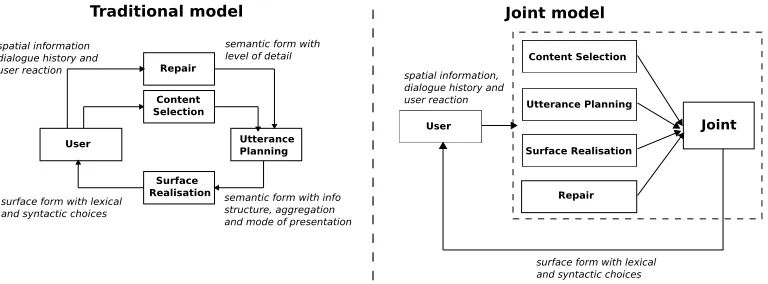
con-stantly monitor the user’s behaviour and change its strategy as soon as the user shows signs of confu-sion. Since the user needs to process system utter-ances online, we face a tradeoff between generating few utterances (preferred by users) and generating utterances which are easy to comprehend online (in-creasing task success). Figure 1 contrasts the dy-namics of two possible NLG system architectures, a traditional pipeline and the joint architecture sug-gested here. In the traditional model, an interaction always starts with information about the user, the di-alogue history and the spatial setting being sent to the content selection (CS) component. Here, the system chooses whether to use a high-level (e.g, ‘go to the next room’ ) or a low-level navigation strategy (e.g., ‘go straight, turn left’). High-level instructions are forms of contracted low-level instructions. CS also determines a level of detail for an instruction based on the number of present objects, lengths of instructions and confusion of the user. A first
se-mantic form2 is constructed here and passed on to
utterance planning (UP). Here, the system decides
whether to use temporal markers, conjunctions, a marked or unmarked theme as well as a mode of presentation (all together or one by one). It then
1In fact, some content selection decisions we treat as part of
NLG here concerning the user or next system utterance may be shared with a dialogue manager in a complete dialogue system.
2
Content Selection Repair
Utterance Planning
Surface Realisation User
surface form with lexical and syntactic choices
semantic form with info structure, aggregation and mode of presentation semantic form with level of detail spatial information
dialogue history and
user reaction spatial information, dialogue history and user reaction
surface form with lexical and syntactic choices
Traditional model Joint model
Content Selection
Utterance Planning
Surface Realisation
Repair
Joint
Content Selection
Utterance Planning
[image:3.612.116.500.59.201.2]Surface Realisation User
Figure 1: Left: traditional pipeline architecture of an NLG system for CS, UP and SR. Right: an architecture for joint decision making among these tasks. Information passed between components is given in cursive fonts.
consults surface realisation (SR) for a final realisa-tion. The SR component addresses the one-to-many relationship between a semantic form and its possi-ble realisations. It optimises the tradeoff between alignment and consistency (Pickering and Garrod, 2004; Halliday and Hasan, 1976) on the one hand, and variation (to improve text quality and readabil-ity) on the other (Belz and Reiter, 2006; Foster and Oberlander, 2006). The SR component produces a string of words and presents it to the user whose action is observed. The utterance is then either re-paired (if the user hesitates or performs an undesired action) or the next one is generated. Note that CS, UP and SR are closely related in this setting. For successful CS, we may wish to be as detailed as pos-sible in an utterance. On the other hand, redundant detail may confuse the user and make it difficult to process utterances online. In UP, we may want to generate as few utterances as possible and thus ag-gregate them. However, if instructions are too many, a one by one presentation may ease comprehension. In SR, a short utterance is often most likely accord-ing to a language model, but it may not be ideal when the user needs more detail. In the joint archi-tecture, there is thus no sequential order on decision making. Instead, one best utterance is generated by considering all variables jointly across subtasks.
4 HRL with Bayesian Networks for NLG
4.1 Hierarchical Reinforcement Learning
The concept of language generation as an
optimi-sation problem is as follows: given a set of
genera-tion states, a set of acgenera-tions, and an objective reward function, an optimal generation strategy maximises the objective function by choosing the actions lead-ing to the highest reward for every reached state. Such states describe the system’s knowledge about the generation task (e.g. CS, UP, SR). The action set describes the system’s capabilities (e.g. ‘use high
level navigation strategy’, ‘use imperative mood’,
etc.). The reward function assigns a numeric value for each action taken. In this way, language genera-tion can be seen as a finite sequence of states, acgenera-tions and rewards {s0, a0, r1, s1, a1, ..., rt−1, st}, where
the goal is to induce an optimal strategy. To do that we use HRL in order to optimise a hierarchy of gen-eration policies rather than a single policy. We
de-note the hierarchy of RL agents asMji, where the
in-dexesiandjonly identify a model in a unique way,
they do not specify the execution sequence of sub-tasks because that is learnt. Each agent of the hier-archy is defined as a Semi-Markov Decision Process (SMDP) consisting of a 4-tuple< Sij, Aij, Tji, Rij >.
Si
jis a set of states,Aijis a set of actions, andTjiis a
probabilistic state transition function that determines
the next states′from the current statesand the
per-formed actiona. Ri
j(s′, τ|s, a)is a reward function
that specifies the reward that an agent receives for
taking an actionain stateslastingτ time steps
(Di-etterich, 1999). Since actions in SMDPs may take a variable number of time steps to complete, the
ran-dom variableτrepresents this number of time steps.
Root
Path Destination Direction
Orientation Straight
Low-Level High-Level
Repair
System Act Navigation
C
S
a
n
d
U
P
(H
R
L)
C
S+S
R
(HRL+BNs)
S
R
(BN
s)
Destination Verb Destination
Direction Values: {left/right, straight, empty}
Values: {go, keep going, walk, continue, return, get, you need, you want, empty, ... }
Information
Need Values: {high, low}
Destination Preposition
Values:{into, in, to, towards, until, empty, ...} Destination Relatum
[image:4.612.88.529.67.208.2]Values:{landmark, room} Plan Utterance
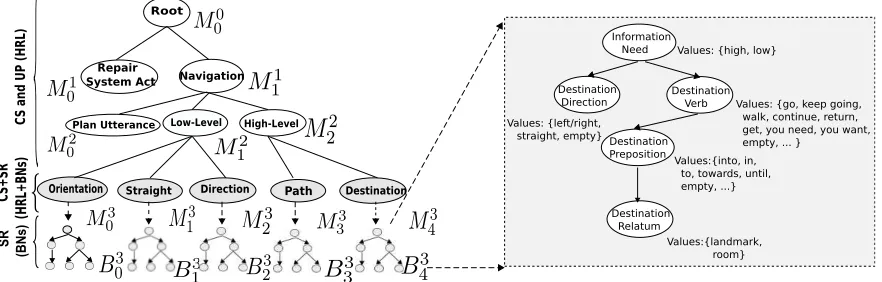
Figure 2: Hierarchy of learning agents (left). The top three layers are responsible for decisions of content selection (CS) and utterance planning (UP), and use HRL. The shaded agents in the bottom use HRL with a Bayesian Network-based reward function and joint optimisation of CS and surface realisation (SR). The BNs represent generation spaces for SR. An example BN, representing the generation space of ‘destination’ instructions, is shown on the right.
each SMDP is to find an optimal policyπ∗that
max-imises the reward for each visited state, according toπ∗ij(s) = arg maxa∈AQ∗ij(s, a),whereQij(s, a)
specifies the expected cumulative reward for
execut-ing action a in state sand then following π∗. For
learning NLG policies, we use HSMQ-Learning, see (Cuay´ahuitl, 2009), p. 92.
4.2 Bayesian Networks for Surface Realisation
We can represent a surface realiser as a BN which models the dynamics between a set of semantic con-cepts and their surface realisations. A BN models a joint probability distribution over a set of random variables and their dependencies based on a directed acyclic graph, where each node represents a
vari-ableYj with parentspa(Yj)(Jensen, 1996). Due to
the Markov condition, each variable depends only on its parents, resulting in a unique joint
probabil-ity distribution p(Y) = Πp(Yj|pa(Yj)), where
ev-ery variable is associated with a conditional
prob-ability distribution p(Yj|pa(Yj)). We use random
variables to represent semantic concepts and their values as corresponding surface forms. A random variable with the semantics ‘destination process’ e.g. can have different values ‘go’, ‘walk’, ‘elided sur-face form’ (empty) etc. The BNs were constructed manually so as to capture two main dependencies. First, the random variable ‘information need’ should influence the inclusion of all optional semantic con-stituents (on the right of Figure 2, e.g., ‘destination direction’) and the process of the utterance
(‘desti-nation verb’). Second, a sequence of dependencies spans from the verb to the end of the utterance. In Figure 2, this is from the verb over the preposition to the relatum. The first dependency is based on the in-tuition that whenever the user’s information need is high, optional semantic information is more likely to
be included than when the information need is low.3
Also, we assume that high frequency verb forms are preferable in cases of a high information need. The second dependency is based on the hypothesis that the value of one constituent can be estimated based on the previous constituent. In the future, we may compare different configurations and designs as well as effects of word order. Since BNs allow for prob-abilistic reasoning, that is the calculation of poste-rior probabilities given a set of query variable-value pairs, we can perform reasoning over surface forms. Given the word sequence represented by linguistic
variablesY0...Yn(lexical and syntactic information),
and context and situation-based variables Y0...Ym,
we can compute the posterior probability of a
ran-dom variableYj. We use efficient implementations
of the variable elimination and junction tree algo-rithms (Cozman, 2000) for probabilistic reasoning. Initial prior and conditional probability tables were estimated from the GIVE corpus using Maximum Likelihood Estimation.
3This is key to the joint treatment of CS and SR: if an
5 Experimental Setting
[image:5.612.315.548.66.711.2]5.1 Hierarchy of Agents: State and Action Sets
Figure 2 shows a (hand-crafted) hierarchy of learn-ing agents for navigatlearn-ing and actlearn-ing in a situated en-vironment. Each agent represents an individual gen-eration task. The models shown in the bottom of
the figure represent the BNsB03...B43that inform SR
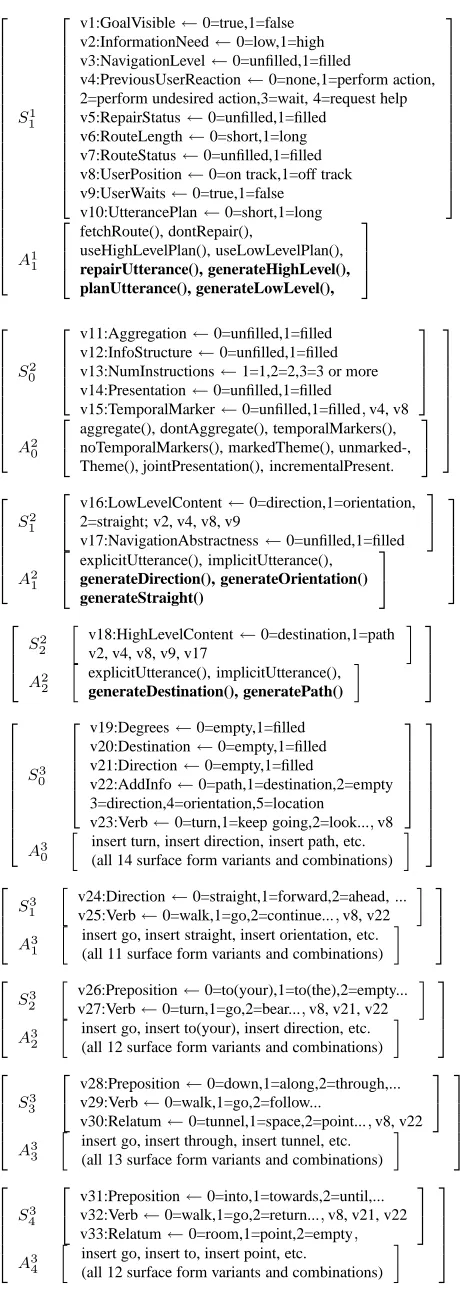
decisions. The state representation contains all situ-ational and linguistic knowledge the agent requires for optimal decision making. The following are the state and action sets of the agents in Figure 2 (see
the corresponding feature structures). Model M00
is the root agent, it decides whether to generate the
next instruction, repair a previous utterance (M01),
or confirm the user’s behaviour. Model M11 is
re-sponsible for navigation instruction generation.4 It
has information about the situational context (e.g., visible objects, route length), the status of the ut-terance, and the user. It chooses a navigation level,
and an utterance plan.5 State variable names can
be reused in later agents. The value ‘filled’ means that a decision has been made, ‘unfilled’ means it
is still open. ModelM02 performs UP. It makes
de-cisions concerning aggregation, info structure, tem-poral markers and utterance presentation. Decisions are based on the user’s information need, and the number of instructions, and do not exclude each
other. Model M2
1 generates low level instructions
(direction, orientation, ‘straight’) based on the user’s
information need and waiting behaviour. ModelM22
generates high-level instructions (destination, path).
Model M03 is responsible for orientation
instruc-tions. It chooses surface forms for semantic con-stituents based on the user’s information need and behaviour. State variables correspond to semantic concepts, their values to realisation variants.
Sim-ilarly, model M3
1 generates ‘straight’, and model
M23direction instructions. They represent low-level
navigation. Model M33 generates path, and model
M3
4 destination instructions. They realise high-level
navigation. The hierarchical agent has |S ×A| =
P
i,j|Sji| × |Aij|= 2.5million state-action pairs.
4
Models M00 andM01 are omitted, since we focus on the right branch of the hierarchy in this paper, i.e. fromM1
1 down.
5
Bold-face (composite) actions pass control between agents. Each time an agent is called, it takes between7and10 (com-posite or primitive) actions, the exact number varies per agent.
S1 1
v1:GoalVisible←0=true,1=false v2:InformationNeed←0=low,1=high v3:NavigationLevel←0=unfilled,1=filled
v4:PreviousUserReaction←0=none,1=perform action, 2=perform undesired action,3=wait, 4=request help v5:RepairStatus←0=unfilled,1=filled
v6:RouteLength←0=short,1=long v7:RouteStatus←0=unfilled,1=filled v8:UserPosition←0=on track,1=off track v9:UserWaits←0=true,1=false
v10:UtterancePlan←0=short,1=long
A1 1 fetchRoute(), dontRepair(), useHighLevelPlan(), useLowLevelPlan(), repairUtterance(), generateHighLevel(), planUtterance(), generateLowLevel(), S2 0
v11:Aggregation←0=unfilled,1=filled v12:InfoStructure←0=unfilled,1=filled v13:NumInstructions←1=1,2=2,3=3 or more v14:Presentation←0=unfilled,1=filled
v15:TemporalMarker←0=unfilled,1=filled,v4, v8
A2 0
aggregate(), dontAggregate(), temporalMarkers(), noTemporalMarkers(), markedTheme(), unmarked-, Theme(), jointPresentation(), incrementalPresent.
S2 1
v16:LowLevelContent←0=direction,1=orientation, 2=straight; v2, v4, v8, v9
v17:NavigationAbstractness←0=unfilled,1=filled
A2 1 explicitUtterance(), implicitUtterance(), generateDirection(), generateOrientation() generateStraight() S2 2
v18:HighLevelContent←0=destination,1=path v2, v4, v8, v9, v17
A2 2 explicitUtterance(), implicitUtterance(), generateDestination(), generatePath() S3 0
v19:Degrees←0=empty,1=filled v20:Destination←0=empty,1=filled v21:Direction←0=empty,1=filled
v22:AddInfo←0=path,1=destination,2=empty 3=direction,4=orientation,5=location
v23:Verb←0=turn,1=keep going,2=look...,v8
A3 0
insert turn, insert direction, insert path, etc. (all 14 surface form variants and combinations)
S3 1
v24:Direction←0=straight,1=forward,2=ahead, ... v25:Verb←0=walk,1=go,2=continue...,v8, v22
A3 1
insert go, insert straight, insert orientation, etc. (all 11 surface form variants and combinations)
S3 2
v26:Preposition←0=to(your),1=to(the),2=empty... v27:Verb←0=turn,1=go,2=bear...,v8, v21, v22
A3 2
insert go, insert to(your), insert direction, etc. (all 12 surface form variants and combinations)
S3 3
v28:Preposition←0=down,1=along,2=through,... v29:Verb←0=walk,1=go,2=follow...
v30:Relatum←0=tunnel,1=space,2=point...,v8, v22
A3 3
insert go, insert through, insert tunnel, etc. (all 13 surface form variants and combinations)
S3 4
v31:Preposition←0=into,1=towards,2=until,... v32:Verb←0=walk,1=go,2=return...,v8, v21, v22 v33:Relatum←0=room,1=point,2=empty,
A3 4
insert go, insert to, insert point, etc.
(all 12 surface form variants and combinations)
5.2 A Reward Function for CS and UP
According to the PARADISE framework (Walker et al., 2000), the performance of a system can be mod-elled as a weighted function of task success and dia-logue cost measures (e.g., number of turns, interac-tion time). We argue that PARADISE is also use-ful to assess the performance of an NLG system. To identify the strongest predictors of user satisfac-tion (US) in situated dialogue/NLG systems, we per-formed an analysis of subjective and objective di-alogue metrics based on PARADISE. In a human evaluation study in a real setting (Dethlefs et al., 2010), 26 participants were asked to interact with a route-giving dialogue system and follow the sys-tem’s instructions. Subsequently, participants pro-vided subjective ratings of the system’s performance to indicate their US. The study revealed that users prefer short interactions at maximal task success. We also found that task success metrics that penalise the degree of task difficulty correlate higher with
US than binary (success/failure) metrics.6 We
there-fore define graded task success (GTS) by assigning
a value of 1 for finding the target location (FTL)
without problems,2/3for FTL with small problems
and0for FTL with severe problems. The value with
small problems was assigned for short confusions of the user, the value for severe problems was assigned if the user got lost at least once. More specifically, in order to identify the relative contribution that differ-ent factors have on the variance found in US scores, we performed a standard multiple regression analy-sis on the data. First results showed that ‘user turns’
(U T) and ‘graded task success‘ (GT S) (which are
negatively correlated) were the only predictors. In a second multiple regression analysis involving only these metrics we obtained the performance function
P erf ormance = 0.38N(GT S) − 0.87N(U T),
where 0.38 is a weight on the normalised value of
GT S and0.87is a weight on the normalised value
ofU T. This result is significant atp <0.01and
ac-counts for62%of the variation found in US. Using
this reward function (and−1for each other action),
the agent is rewarded for short interactions (few user turns) at maximal (graded) task success. User turns correspond to the behaviour with which a user reacts
6Graded metrics show a high correlation with user
satisfac-tion, binary metrics only show a moderate correlation.
to an utterance. If the user reacts positively (carries
out the instructions), task success is rated with1; if
they hesitate, it is2/3and if they get lost (carry out
a wrong instruction), it is0. In this way the agent
receives the highest rewards for the shortest possi-ble utterance followed by a positive user reaction. This reward function is used by all CS and UP agents
M0
0. . . M22. Rewards are assigned after each system instruction presented to the user and the user’s reac-tion. This reward is propagated back to all agents that contributed to the sequence of decisions leading to the instruction.
5.3 A Reward Function for Surface Realisation
Due to its unique function in an RL framework, we suggest to induce a reward function for SR
from human data. To this end, we use BNs to
provide feedback to an agent learning to optimise SR decisions. Whenever the agent has generated a word sequence (and reaches a goal state), it
re-ceives P(w0...wn) as a reward. This corresponds
to PP(Yj = vx|pa(Yj) = vy), the sum of
pos-terior probabilities given the chosen values vx and
vy of random variables and their dependencies. It
receives a reward of +1 for maintaining an equal
distribution of alignment and variation. In this way, the agent learns to balance the most likely surface forms against the benefits of variation and
nonlin-guistic context. 7 The agent receives a reward of
−1 for any other action (to encourage efficiency).
AgentsM3
0...4use this reward function.
6 Experiments and Results
6.1 The Simulated Environment
The simulated environment has two parts: ing the spatial context of an utterance and simulat-ing the user’s reaction to it. The first part was de-signed using unigrams modeling features of the
con-text8 and the user. 9 This lead to23thousand
dif-7The distribution of alignment and variation is measured by
dividing the number of surface variants used before by the total number of variants used. The agent is then rewarded for keeping the resulting number around0.5, i.e. for a middle way between alignment and variation (Dethlefs and Cuay´ahuitl, 2010).
8
previous system act, route length, route status (known/unknown), objects within vision, objects within dialogue history, number of instructions, alignment(proportion)
9previous user reaction, user position, user
102
103
104
105
−30 −25 −20 −15 −10 −5
Average Reward
Episodes
[image:7.612.95.273.63.179.2]CS+UP+SR CS+SR CS+UP SR+UP Isolated
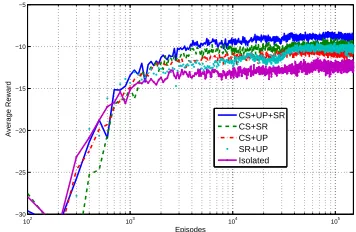
Figure 3: Performance of navigation instruction genera-tion policies, jointly optimised and in isolagenera-tion. See ex-planation in Section 6.2 and sample dialogue in Table 2.
Compared Instructions F-Measure KL-Divergence
Real1 - Real2 0.58 1.77
Real - ‘HRL with BNs’ 0.38 2.83
Real - ‘HRL with greedy’ 0.49 4.34
Real - ‘HRL with random’ 0.0 10.06
Table 1: Evaluation of generation behaviours with
Precision-Recall and KL-divergence.
ferent configurations which we estimated from the GIVE corpus to ensure the system is trained under multiple circumstances. Since the corpus contains three different worlds, we estimated the training en-vironment from worlds 1 and 2, and the test envi-ronment from world 3. We addressed the simula-tion of user reacsimula-tions with a Naive Bayes Classifier. It is passed a set of features describing the current context and user and a set of semantic features
de-scribing the generated utterance.10 Based on this,
the classifier returns the most likely user reaction of
perform desired action, perform undesired action, wait
and request help. It reached 82% of accuracy in a 10-fold cross validation. Simulating user reactions helps to assess the quality of instructions and pro-vides feedback to the agent’s learning process.
6.2 Comparison of Learnt Policies
We have made two main claims in this paper: (1) that CS, UP and SR decisions should all be learnt in a joint fashion to achieve optimal performance, and
10navigation level(high / low), repair(yes / no), instruction
type(destination / direction / orientation / path / straight), aggre-gation(yes / no), info structure(marked / unmarked), presenta-tion(joint / incremental), temporal markers(yes / no)
(2) that BNs can prove beneficial for learning SR variants. To address the first claim, Figure 3 shows
the performance (in terms of average rewards)11 of
our agent with (a) isolated optimisation of CS, UP and SR, (b) joint optimisation of CS and SR, (c) joint optimisation of CS and UP, (d) joint optimi-sation of SR and UP and (e) joint optimioptimi-sation of
all subtasks. All policies were trained12 for 150
thousand episodes, where one episode corresponds to one generated utterance. We can see that learn-ing a joint policy for all three subtasks achieves the best performance. In terms of content selection, the agent learns to prefer high level navigation strate-gies, which allow more efficient instruction giving, and switch to low level whenever the user gets
con-fused. Regarding utterance planning, the agent
prefers incremental displays for three or more in-structions, and joint presentations otherwise. For
surface realisation, the agent learns to choose a
(short) most likely surface form when the user has a low information need, but include more information otherwise. It learns to balance variation and align-ment in an about equal proportion. Trained in iso-lation, a non-optimal behaviour is learnt. The rea-son is that all three components have a repertoire of actions, which are different in nature, but can have similar effects. For example, assume that for a user with medium information need the CS compo-nent makes a decision favouring an efficient instruc-tion giving. It chooses a high-level navigainstruc-tion strat-egy, which contracts several low-level instructions. The next component, UP, should now take an action to balance the earlier efficiency decision and corre-spond to the user’s increased cognitive load. How-ever, without access to the earlier decision, it may it-self make an efficiency choice, and thus increase the likelihood of the user hesitating or requesting help.
The second claim concerning the advantage of
BNs for SR is addressed by Table 1. Here, we
tested the human-likeness of SR decisions by
com-11Since the reward function assigns a reward of
−1for each action taken, rewards stay in negative values.
12For training, the step-size parameterα(learning rate) was
initiated with1and then reduced over time byα=1+1t, where
[image:7.612.66.308.254.325.2]Conv. Policy Action (composite in italics) Utterance
USR request route (low info need, on track) ‘How do I get to the trophy?’ π00 CS: navigation, dontConfirm
π11 generateHighLevel, planUtterance, dontRepair π2
2 generateDestination, generateDirection
π02 UP: jointPresentation, noTempMarkers
π23 SR: turnVP, emptyPP, insertLocation
π3
4 emptyVP, emptyPP, pointRelatum Turn left at the end of the hall.
USR [waits]
SYS π00 CS: navigation,
π1
1 generateLowLevel, planUtterance, repairUtterance
π01 switchNavigationStrategy
π12 generateDirection, generatePath π2
0 UP: aggregateClauses, incrementalPresentation
π23 SR: turnVP, emptyPP, noLocation Turn right,
π33 goVP, downPrep, pathRelatum and go down the hallway.
USR [executes navigation instructions]
SYS π00 CS: navigation, dontConfirm
π11 generateLowLevel, planUtterance, dontRepair π2
1 generateDirection
π02 UP: incrementalPresentation, tempMarkers
π23 SR: bearVP, emptyPP Now bear left.
USR [executes navigation instructions]
[image:8.612.77.545.58.387.2]SYS π00 confirmation Well done.
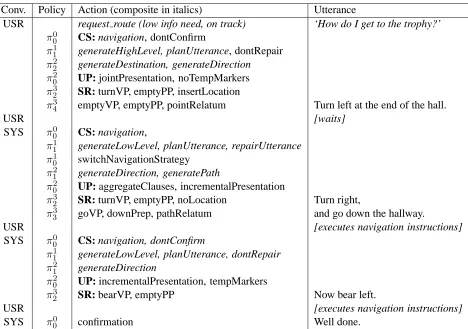
Table 2: Sample dialogue for the jointly learnt policy. See Section 5.1 for corresponding policies and actions. The agent starts using a high level navigation strategy. When the user gets confused, it temporarily switches back to low level; nonverbal behaviour is given in square brackets.
paring them with the human-authored instructions
from the GIVE corpus. We compare our jointly
learnt policy (‘HRL with BNs’) with a greedy base-line (‘HRL with greedy’, where SR decisions are made purely based on frequency) and a random baseline (‘HRL with random’ where SR decisions only aim to produce a grammatical form). For the comparison we use Precision-Recall based on the F-Measure score, and dialogue similarity based on the Kullback-Leibler (KL) divergence (Cuay´ahuitl et al., 2005), which computes the difference be-tween two probability distributions. In all cases, we compared word strings of human-authored instruc-tions against word strings of instrucinstruc-tions generated by each of our policies. Table 1 shows results of the comparison of two human data sets ‘Real1’ vs ‘Real2’ and both of them together, as the gold stan-dard, against our policies. While ‘HRL with greedy’ receives higher F-Measure scores, the learnt policy
is more similar to the human data. This is due to variation: in contrast to the greedy baseline, which always exploits the most likely variant, the ‘HRL with BNs’ policy learns to vary surface forms. This leads to lower F-Measure scores, but achieves higher similarity with human authors. This ultimately is a desirable property, since it enhances the quality and naturalness of our instructions. The ‘HRL with
ran-dom’ baseline, which generates random variation,
performs worst according to both metrics.
Conv. Utterance
USR ‘How do I get to the trophy?’
SYS Go to the end of the hall and then turn left.
USR [waits]
SYS Turn right, go straight and follow the
corridor. Then turn left. USR [turns right, requests help]
SYS Go to the end of the hall and turn left.
USR [undesired action: turns left]
SYS Wait! Go back, then straight and then
follow the corridor. USR [executes instructions]
SYS Very good. Turn left.
USR [executes instructions]
[image:9.612.78.295.72.274.2]SYS Very good.
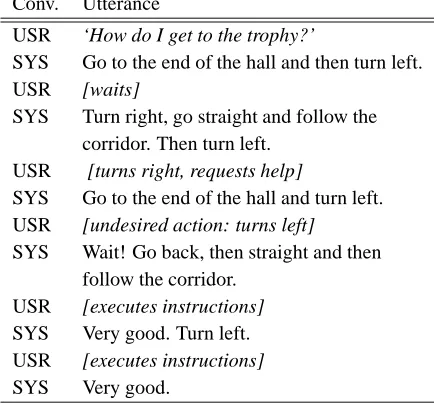
Table 3: Sample dialogue using policy optimised in iso-lation. In terms of CS and UP, the agent prefers efficient instruction giving. There is no variation in surface forms.
Now bear left’). It also chose to aggregate the mes-sages using the conjunction ‘and’ (to minimise the number of instructions), and present them in a one-by-one fashion (to ease comprehensibility). This in-terrelated decision making is possible due to their joint optimisation. In contrast, Table 3 shows a di-alogue for the same situation using the policy op-timised in isolation, where the user gets confused several times. Since decision making is not interre-lated, all components prefer efficiency decisions (a high-level navigation strategy, aggregation and joint presentation whenever possible). There is no vari-ation in surface forms, and repair strategies affect only the immediately preceding utterance.
6.3 Human Evaluation Study
To get a more reliable idea of the quality and hu-man acceptance of our instructions, we asked 12
participants13 to rate 96 sets of instructions. Each
set contained a spatial graphical scene with a per-son, mapped with one human, one jointly learnt, and one instruction learnt in isolation. Participants were asked to rate navigation instructions to an ob-ject, e.g. ‘go left and press the yellow button’, on a 1-5 Likert scale (where 5 is the best) for their help-fulness on guiding the displayed person to the
refer-13
7 female, 5 male with an age average of25.6.
ent. Scenes were presented in a random order. We then asked the participants to circle the object they thought was the intended referent. Human
instruc-tions were rated with a mean of 3.86 (with a
stan-dard deviation (SD) of0.89). The jointly learnt
in-structions were rated with a mean of3.57(SD=1.07)
and instructions learnt in isolation with a mean of
2.35(SD=0.85). The difference between human and
jointly learnt is not significant (p <0.29) according
to a t-test. The effect sizer is0.14. The difference
between human and learnt in isolation is significant atp < 0.001 with an effect size r of0.65 and the difference between jointly learnt and learnt in
isola-tion is significant atp <0.003and has an effect size
r of0.53. Users were able to identify the intended
referent in96%of all cases.
7 Conclusion
We have presented a novel approach to optimising NLG for situated interactions using HRL with BNs. We also suggested to jointly optimise the tasks of CS, UP and SR using reward functions induced from human data. For the former two, we used the PARADISE framework to obtain a reward function that favours short interactions at maximal task success. We then proposed a method for inducing a reward function for SR from human data: it uses BNs to represent the surface realiser and inform the HRL agent’s learning process. In this way, we are able to address a number of challenges arising with situated NLG and correspond to the interrelated nature of different NLG tasks. Results showed that our jointly learnt policies outperform policies learnt in isolation and received human ratings similar to human instructions. We also found that our hybrid approach to SR using HRL with BNs generates language more similar to human data than a greedy or random baseline enhancing language quality and naturalness. Future work can transfer our approach to different domains, or address the effects of SR variants on human ratings in a more detailed study.
Other graphical models, e.g. Dynamic Bayesian
Acknowledgements Thanks to the German Research Foundation DFG, the SFB/TR8 ‘Spatial Cognition’ and the EU-FP7 project ALIZ-E (ICT-248116) for partial support of this work.
References
Gabor Angeli, Percy Liang, and Dan Klein. 2010. A simple domain-independent probabilistic approach to
generation. In Proceedings of the Conference on
Empirical Methods in Natural Language Processing (EMNLP).
Srinivas Bangalore and Owen Rambow. 2000. Exploit-ing a probabilistic hierarchical model for generation. In Proceedings of the 18th Conference on
Computa-tional Linguistics (ACL) - Volume 1, pages 42–48.
Regina Barzilay and Lillian Lee. 2002.
Bootstrap-ping lexical choice via multiple-sequence alignment. In Proceedings of the 2002 Conference on Empirical
Methods in Natural Language Processing (EMNLP),
pages 164–171.
Anja Belz and Ehud Reiter. 2006. Comparing Automatic and Human Evaluation of NLG Systems. In
Proceed-ings of the European Chapter of the Association for Computational Linguistics (EACL), pages 313–320.
Anja Belz. 2008. Automatic generation of
weather forecast texts using comprehensive probabilis-tic generation-space models. Natural Language
Engi-neering, 1.
Fabio G. Cozman. 2000. Generalizing variable elim-ination in Bayesian networks. In IBERAMIA/SBIA,
Workshop on Probabilistic Reasoning in Artificial In-telligence, pages 27–32, Sao Paulo, Brazil.
Heriberto Cuay´ahuitl and Nina Dethlefs. 2011a. Opti-mizing Situated Dialogue Management in Unknown
Environments. In Proceedings of INTERSPEECH,
Florence, Italy.
Heriberto Cuay´ahuitl and Nina Dethlefs. 2011b.
Spatially-aware dialogue control using hierarchical re-inforcement learning. ACM Transactions on Speech
and Language Processing (Special Issue on Machine Learning for Robust and Adaptive Spoken Dialogue Systems, 7(3).
Heriberto Cuay´ahuitl, Steve Renals, Oliver Lemon, and Hiroshi Shimodaira. 2005. Human-Computer Dia-logue Simulation Using Hidden Markov Models. In
Proceedings of the Automatic Speech Recognition and Understanding Workshop ASRU, pages 290–295.
Heriberto Cuay´ahuitl. 2009. Hierarchical Reinforcement
Learning for Spoken Dialogue Systems. Ph.D. thesis,
School of Informatics, University of Edinburgh.
Nina Dethlefs and Heriberto Cuay´ahuitl. 2010.
Hi-erarchical Reinforcement Learning for Adaptive Text Generation. Proceeding of the 6th International
Con-ference on Natural Language Generation (INLG).
Nina Dethlefs, Heriberto Cuay´ahuitl, Kai-Florian
Richter, Elena Andonova, and John Bateman. 2010. Evaluating task success in a dialogue system for indoor navigation. In Proceedings of the Workshop on
the Semantics and Pragmatics of Dialogue (SemDial), Poznan, Poland.
Thomas G. Dietterich. 1999. Hierarchical Reinforce-ment Learning with the MAXQ Value Function
De-composition. Journal of Artificial Intelligence
Re-search, 13:227–303.
Mary Ellen Foster and Jon Oberlander. 2006.
Data-driven generation of emphatic facial displays. In
Pro-ceedings of the European Chapter of the Association for Computational Linguistic (EACL), pages 353–360.
Andrew Gargett, Konstantina Garoufi, Alexander Koller, and Kristina Striegnitz. 2010. The GIVE-2 corpus of giving instructions in virtual environments. In
Pro-ceedings of the 7th International Conference on Lan-guage Resources and Evaluation (LREC).
Michael A. K. Halliday and Ruqaiya Hasan. 1976.
Co-hesion in English. Longman, London.
Srinivasan Janarthanam and Oliver Lemon. 2010. Learn-ing to adapt to unknown users: referrLearn-ing expression generation in spoken dialogue systems. In
Proceed-ings of the Annual Meeting of the Association for Com-putational Linguistics (ACL), pages 69–78.
Finn V. Jensen. 1996. An Introduction to Bayesian
Net-works. Springer Verlag, New York.
Alexander Koller, Kristina Striegnitz, Donna Byron, Jus-tine Cassell, Robert Dale, Johanna Moore, and Jon Oberlander. 2010. The first challenge on generat-ing instructions in virtual environments. In M. The-une and E. Krahmer, editors, Empirical Methods
on Natural Language Generation, pages 337–361,
Berlin/Heidelberg, Germany. Springer.
Irene Langkilde and Kevin Knight. 1998. Generation that exploits corpus-based statistical knowledge. In
Proceedings of the 36th Annual Meeting of the As-sociation for Computational Linguistics (ACL), pages
704–710.
Oliver Lemon. 2010. Learning what to say and how to say it: joint optimization of spoken dialogue man-agement and natural language generation. Computer
Speech and Language, 25(2).
Willem J. M. Levelt and S Kelter. 1982. Surface form and memory in question answering. Cognitive
Psy-chology, 14.
2010. Phrase-based statistical language generation us-ing graphical models and active learnus-ing. In
Proceed-ings of the Annual Meeting of the Association for Com-putational Linguistics (ACL), pages 1552–1561.
Alice H. Oh and Alexander I. Rudnicky. 2000. Stochas-tic language generation for spoken dialogue systems. In Proceedings of the 2000 ANLP/NAACL Workshop
on Conversational systems - Volume 3, pages 27–32.
Martin J. Pickering and Simon Garrod. 2004. Toward a mechanistc psychology of dialog. Behavioral and
Brain Sciences, 27.
Verena Rieser, Oliver Lemon, and Xingkun Liu. 2010. Optimising information presentation for spoken dia-logue systems. In Proceedings of the Annual
Meet-ing of the Association for Computational LMeet-ingustics (ACL), pages 1009–1018.
Richard S. Sutton and Andrew G. Barto. 1998.
Re-inforcement Learning: An Introduction. MIT Press,
Cambridge, MA, USA.
Marilyn A. Walker, Diane J. Litman, Candace A. Kamm, and Alicia Abella. 1997. PARADISE: A framework for evaluating spoken dialogue agents. In Proceedings
of the Annual Meeting of the Association for Compu-tational Linguistics (ACL), pages 271–280.
Marilyn Walker, Candice Kamm, and Diane Litman. 2000. Towards developing general models of usabil-ity with PARADISE. Natural Language Engineering, 6(3):363–377.
Michael White. 2004. Reining in CCG chart realiza-tion. In Proceedings of the International Conference
on Natural Language Generation (INLG), pages 182–