Syntactic transformations for Swiss German dialects
Yves Scherrer LATL
Universit´e de Gen`eve Geneva, Switzerland [email protected]
Abstract
While most dialectological research so far fo-cuses on phonetic and lexical phenomena, we use recent fieldwork in the domain of dia-lect syntax to guide the development of mul-tidialectal natural language processing tools. In particular, we develop a set of rules that transform Standard German sentence struc-tures into syntactically valid Swiss German sentence structures. These rules are sensitive to the dialect area, so that the dialects of more than 300 towns are covered. We evaluate the transformation rules on a Standard German treebank and obtain accuracy figures of 85% and above for most rules. We analyze the most frequent errors and discuss the benefit of these transformations for various natural language processing tasks.
1 Introduction
For over a century, dialectological research has fo-cused on phonetic, lexical and morphological phe-nomena. It is only recently, since the 1990s, that syntax has gained the attraction of dialectologists. As a result, syntactic data from field studies are now available for many dialect areas. This paper explores how dialect syntax fieldwork can guide the develop-ment of multidialectal natural language processing tools. Our goal is to transform Standard German sentence structures so that they become syntactically valid in Swiss German dialects.1
1
Here, we do not take into account the phonetic, morpholog-ical and lexmorpholog-ical changes involved in generating the actual Swiss German word forms. For such a model, see for example Scher-rer and Rambow (2010a).
These transformations are accomplished by a set of hand-crafted rules, developed and evaluated on the basis of the dependency version of the Standard German TIGER treebank. Ultimately, the rule set can be used either as a tool for treebank transduction (i.e. deriving Swiss German treebanks from Stan-dard German ones), or as the syntactic transfer mod-ule of a transfer-based machine translation system.
After the discussion of related work (Section 2), we present the major syntactic differences between Standard German and Swiss German dialects (Sec-tion 3). We then show how these differences can be covered by a set of transformation rules that ap-ply to syntactically annotated Standard German text, such as found in treebanks (Section 4). In Section 5, we give some coverage figures and discuss the most common errors that result from these transfor-mations. We conclude in Section 6.
2 Related work
One line of research in natural language processing deals with parsing methods for dialects. Chiang et al. (2006) argue that it is often easier to manually create resources that relate a dialect to a standard language than it is to manually create syntactically annotated resources for the dialect itself. They in-vestigate three approaches for parsing the Levantine dialect of Arabic, one of which consists of transduc-ing a Standard Arabic treebank into Levantine with the help of hand-crafted rules. We agree with this point of view: we devise transformation rules that relate Swiss German dialects to Standard German.
In the case of closely related languages,2different
2In any case, it is difficult to establish strict linguistic criteria
types of annotation projection have been proposed to facilitate the creation of treebanks. See Volk and Samuelsson (2004) for an overview of the problem.
In a rather different approach, Vaillant (2008) presents a hand-crafted multi-dialect grammar that conceives of a dialect as some kind of “agreement feature”. This allows to share identical rules across dialects and differentiate them only where neces-sary. We follow a similar approach by linking the transformation rules to geographical data from re-cent dialectological fieldwork.
Another line of research is oriented towards ma-chine translation models for closely related lan-guages. It is common in this field that minor syn-tactic differences are dealt with explicitly. Corb´ı-Bellot et al. (2005) present a shallow-transfer sys-tem for the different Romance languages of Spain. Structural transfer rules account for gender change and word reorderings. Another system (Homola and Kuboˇn, 2005) covers several Slavonic languages of Eastern Europe and confirms the necessity of shal-low parsing except for the most similar language pair (Czech-Slovak).
In contrast, statistical machine translation systems have been proposed to translate closely related lan-guages on a letter-by-letter basis (Vilar et al., 2007; Tiedemann, 2009). However, the word reordering capabilities of a common phrase-based model are still required to obtain reasonable performances.
3 The main syntactic features of Swiss German dialects
A general description of the linguistic particularities of Swiss German dialects, including syntax, can be found, for example, in L¨otscher (1983). Some syn-tactic case studies within the framework of Genera-tive Grammar are presented in Penner (1995). Cur-rently, a dialectological survey, under the name of SADS (Syntaktischer Atlas der deutschen Schweiz), aims at producing a syntactic atlas of German-speaking Switzerland (Bucheli and Glaser, 2002). Some preliminary results of this project are de-scribed in Klausmann (2006).3
to distinguish “dialects” from “closely related languages”.
3We thank Elvira Glaser and her team for providing us
ac-cess to the SADS database. This work could not have been carried out without these precious data.
There are two main types of syntactic differences between Swiss German dialects and Standard Ger-man. Some of the differences are representative of the mainly spoken use of Swiss German. They do not show much interdialectal variation, and they are also encountered in other spoken varieties of Ger-man. Other differences are dialectological in nature, in the sense that they are specific to some subgroups of Swiss German dialects and usually do not occur outside of the Alemannic dialect group. This second type of differences constitutes the main research ob-ject of the SADS proob-ject. In the following subsec-tions, we will show some examples of both types of phenomena.
3.1 Features of spoken language
No preterite tense Swiss German dialects do not have synthetic preterite forms and use (analytic) per-fect forms instead (1a).4 Transforming a Standard German preterite form is not trivial: the correct aux-iliary verb and participle forms have to be generated, and they have to be inserted at the correct place (in the right verb bracket).
Standard German pluperfect is handled in the same way: the inflected preterite auxiliary verb is transformed into an inflected present auxiliary verb and an auxiliary participle, while the participle of the main verb is retained (1b). The resulting con-struction is called double perfect.
(1) a. Wir gingen ins Kino.
→Wir sind ins Kino gegangen. ‘We went to the cinema.’ b. als er gegangen war
→als er gegangen gewesen ist ‘when he had gone’
No genitive case Standard German genitive case is replaced by different means in Swiss German. Some prepositions (e.g. wegen, w¨ahrend ‘because, during’) use dative case instead of genitive. Other prepositions become complex through the addi-tion of a second preposiaddi-tion von (e.g. innerhalb
‘within’). Verbs requiring a genitive object in Stan-dard German generally use a dative object in Swiss
4Throughout this paper, the examples are given with
German unless they are lexically replaced. Geni-tive appositions are converted to PPs withvon ‘of’ in the case of non-human NPs (2a), or to a dative-possessive construction with human NPs (2b).
(2) a. der Schatzmeister der Partei
→der Schatzmeister von der Partei ‘the treasurer of the party’
b. das Haus des Lehrers
→dem Lehrer sein Haus ‘the teacher’s house’,
litt. ‘to the teacher his house’
Determiners with person names A third differ-ence is the prevalent use of person names with deter-miners, whereas (written) Standard German avoids determiners in this context:
(3) a. Hans→der Hans ‘Hans’ b. Frau M¨uller→die Frau M¨uller ‘Miss M.’
3.2 Dialect-specific features
Verb raising When two or more verbal forms ap-pear in the right verb bracket, their order is often reversed with respect to Standard German. Several cases exist. In Western Swiss dialects, the auxil-iary verb may precede the participle in subordinate clauses (4a). In all but Southeastern dialects, the modal verb precedes the infinitive (4b).
Verb raising also occurs for full verbs with infini-tival complements, like lassen ‘to let’ (4c). In this case, the dependencies betweenlassen and its com-plements cross those between the main verb and its complements:
mich einen Apfel l¨asst essen
Verb projection raising In the same contexts as above, the main verb extraposes to the right along with its complements (4d), (4e).
(4) a. dass er gegangen ist
→dass er ist gegangen ‘that he has gone’
b. dass du einen Apfel essen willst
→dass du einen Apfel willst essen ‘that you want to eat an apple’
c. dass du mich einen Apfel essen l¨asst
→dass du mich einen Apfel l¨asst essen ‘that you let me eat an apple’
d. dass du einen Apfel essen willst
→dass du willst einen Apfel essen ‘that you want to eat an apple’ e. dass du mich einen Apfel essen l¨asst
→dass du mich l¨asst einen Apfel essen ‘that you let me eat an apple’
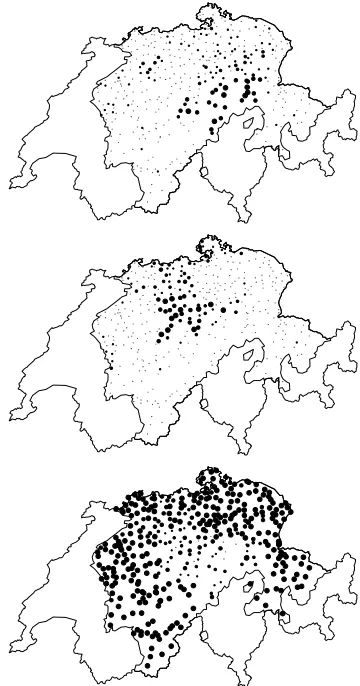
Prepositional dative marking In Central Swiss dialects, dative objects are introduced by a dummy prepositioni ora (5a). However, this preposition is not added if the dative noun phrase is already part of a prepositional phrase (5b).
(5) a. der Mutter→i/a der Mutter ‘the mother (dative)’
b. mit der Mutter→mit (*i/a) der Mutter ‘with the mother’
Article doubling In adjective phrases that contain an intensity adverb likeganz, so‘very, such’, the de-terminer occurs either before the adverb as in Stan-dard German, or after the adverb, or in both posi-tions, depending on the dialect:
(6) ein ganz lieber Mann
→ganz ein lieber Mann
→ein ganz ein lieber Mann ‘a very dear man’
Complementizer in wh-phrases Interrogative subordinate clauses introduced by verbs likefragen
‘to ask’ may see the complementizerdass attached after the interrogative adverb or pronoun.
Relative pronouns Nominative and accusative relative pronouns are substituted in most Swiss Ger-man dialects by the uninflected particlewo. In da-tive (7a) or prepositional (7b) contexts, the particle
woappears together with an inflected personal pro-noun:
(7) a. dem→wo . . . ihm
b. mit dem→wo . . . mit ihm, wo . . . damit
is rendered asf¨ur . . . z. In Eastern dialects, a single particlezumis used. An intermediate formzum . . . z
also exists.
Pronoun sequences In a sequence of accusative and dative pronouns, the accusative usually precedes in Standard German, whereas the dative precedes in many Swiss German dialects:
(8) es ihm→ihm es ‘it to him’
Predicative adjectives In Southwestern dialects, predicative adjectives agree in gender and number with the subject:
(9) er / sie / es ist alt
→er / sie / es ist alter / alte / altes ‘he / she / it is old’
Copredicative adjectives A slightly different problem is the agreement of copredicative adjec-tives. A copredicative adjective5 relates as an at-tribute to a noun phrase, but also to the predicate of the sentence (see example below). In Northeast-ern dialects, there is an invariableer-ending6for all genders and numbers. In Southern dialects, the co-predicative adjective agrees in gender and number. Elsewhere, the uninflected adjective form is used, as in Standard German.
(10) Sie sollten die Milch warm trinken.
→ Sie sollten die Milch warmeFem.Sg /
warmerInvartrinken.
‘You should drink the milk warm.’
3.3 The SADS data
The SADS survey consists of four written tionnaires, each of which comprises about 30 ques-tions about syntactic phenomena like the ones cited above. They were submitted to 3185 informants in 383 inquiry points.7 For each question, the infor-mants were asked to write down the variant(s) that they deemed acceptable in their dialect.
5This phenomenon is also known as depictive secondary predicate construction.
6This (reconstructed) ending is thought to be a frozen
mas-culine inflection marker; in practice, it is pronounced[@]or[a]
in the corresponding dialects.
7
[image:4.612.335.515.56.399.2]http://www.ds.uzh.ch/dialektsyntax/ eckdaten.html, accessed 8.6.2011.
Figure 1: The three maps show the geographical distribu-tion of preposidistribu-tional dative marking witha(top) and with i (center). The bottom map shows the inquiry points in which no preposition is added to dative NPs. The maps are based on SADS question I/7. Larger circles represent larger proportions of informants considering the respec-tive variant as the most natural one.
• Which variants are acceptable in your dialect?
• Which variant do you consider the most natural one in your dialect?
In the first case, multiple mentions were allowed. Usually, dialect speakers are very tolerant in accept-ing also variants that they would not naturally utter themselves. In this sense, the first set of questions can be conceived as a geographical model of dialect perception, while the second set of questions rather yields a geographical model of dialect production. According to the task at hand, the transformation rules can be used with either one of the data sets.
4 Transformation rules
4.1 The Standard German corpus
The transformation rules require morphosyntacti-cally annotated Standard German input data. There-fore, we had to choose a specific annotation format and a specific corpus to test the rules on. We selected the Standard German TIGER treebank (Brants et al., 2002), in the CoNLL-style dependency format (Buchholz and Marsi, 2006; K¨ubler, 2008).8 This format allows a compact representation of the syn-tactic structure. Figure 2 shows a sample sentence, annotated in this format.
While we use the TIGER corpus for test and eval-uation purposes in this paper, the rules are aimed to be sufficiently generic so that they apply correctly to any other corpus annotated according to the same guidelines.
4.2 Rule implementation
We have manually created transformation rules for a dozen of syntactic and morphosyntactic phenomena. These rules (i) detect a specific syntactic pattern in a sentence and (ii) modify the position, content and/or dependency link of the nodes in that pattern. The rules are implemented in the form of Python scripts. As an example, let us describe the transformation rule for article doubling. This rule detects the fol-lowing syntactic pattern:9
8
Thanks to Yannick Versley for making this version avail-able to us.
9
X symbolizes any type of node that possesses an article and an adjective as dependents. In practice, X usually is a noun.
ART ADV
{ganz, sehr, so. . .}
ADJA X
The rule then produces the three valid Swiss Ger-man patterns – as said above, the transformation rules may yield different output structures for dif-ferent dialects. One of the three variants is identical to the Standard German structure produced above. In a second variant, the positions of the article and the adverb are exchanged without modifying the de-pendency links:
ADV ART ADJA X
This transformation yields non-projective depen-dencies (i.e. crossing arcs), which are problematic for some parsing algorithms. However, the original TIGER annotations already contain non-projective dependencies. Thus, there is no additional complex-ity involved in the resulting Swiss German struc-tures.
The third variant contains two occurrences of the determiner, before and after the intensity adverb. We chose to make both occurrences dependents of the same head node:
ART ADV ART ADJA X
As mentioned previously, the SADS data tell us which of the three variants is accepted in which of the 384 inquiry points. This mapping is non-deterministic: more than one variant may be ac-cepted at a given inquiry point.
5 Evaluation
5.1 Corpus frequencies
ID FORM LEMMA CPOSTAG POSTAG FEATS HEAD DEPREL
1 f¨ur f¨ur APPR PREP – 4 PP
2 eine eine ART ART Acc.Sg.Fem 3 DET
3 Statistik Statistik NN N Acc.Sg.Fem 1 PN 4 reicht reichen VVFIN V 3.Sg.Pres.Ind 0 ROOT
5 das das PDS PRO Nom.Sg.Neut 4 SUBJ
6 nicht nicht PTKNEG PTKNEG – 4 ADV
[image:6.612.105.512.53.166.2]7 . . $. $. – 0 ROOT
Figure 2: Example of a CoNLL-style annotated sentence. Each word (FORM) is numbered (ID), lemmatized (LEMMA), annotated with two levels of part-of-speech tags (CPOSTAG and POSTAG), annotated with morpho-logical information (FEATS) and with dependency relations. HEAD indicates the ID of the head word, and DEPREL indicates the type of dependency relation. For example, the word at position 1 (f¨ur) depends on the word at position 4 (reicht) by a PP relation.
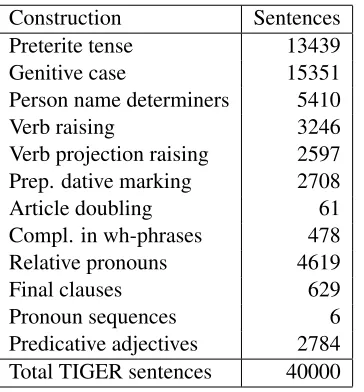
[image:6.612.98.280.254.450.2]Construction Sentences Preterite tense 13439 Genitive case 15351 Person name determiners 5410 Verb raising 3246 Verb projection raising 2597 Prep. dative marking 2708 Article doubling 61 Compl. in wh-phrases 478 Relative pronouns 4619 Final clauses 629 Pronoun sequences 6 Predicative adjectives 2784 Total TIGER sentences 40000
Table 1: Number of sentences in the TIGER corpus that trigger the mentioned transformation rule.
of the respective phenomena.10
This preliminary study led us to exclude phe-nomena that could not be detected reliably because the morphosyntactic annotations in TIGER were not precise enough. For example, TIGER does not dis-tinguish between copredicative (11a) and adverbial (11b) uses of adjectives. Therefore, it is impossible to automatically count the number of copredicative adjectives, let alone perform the necessary dialectal transformations.
10
These figures should be taken with a grain of salt. First, the TIGER corpus consists of newspaper text, which is hardly rep-resentative of everyday use of Swiss German dialects. Second, it is difficult to obtain reliable recall figures without manually inspecting the entire corpus.
(11) a. Blitzblank h¨angen die T¨opfe an der K¨uchenwand.
‘The pots are hanging sparkling clean on the kitchen wall.’
b. H¨aufig h¨angen die T¨opfe an der K¨uchen-wand.
‘The pots frequently hang on the kitchen wall.’
5.2 Results
For each syntactic construction, a development set and a test set were extracted from the TIGER tree-bank, each of them comprising at most 100 sen-tences showing that construction. After achieving fair performance on the development sets, the held-out test data was manually evaluated.
We did not evaluate the accusative-dative pro-noun sequences because of their small number of occurrences. Predicative adjective agreement was not evaluated because the author did not have native speaker’s intuitions about this phenomenon.
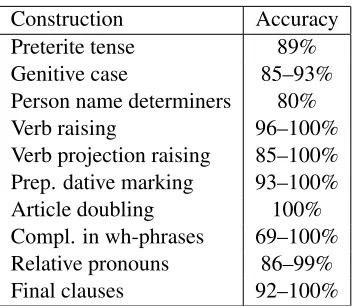
Table 2 shows the accuracy of the rules on the test data. Recall that some rules cover different dialec-tal variants, each of which may show different types of errors. In consequence, the performance of some rules is indicated as an interval. Moreover, some di-alectal variants do not require any syntactic change of the Standard German source, yielding figures of 100% accuracy.
Construction Accuracy Preterite tense 89% Genitive case 85–93% Person name determiners 80% Verb raising 96–100% Verb projection raising 85–100% Prep. dative marking 93–100% Article doubling 100% Compl. in wh-phrases 69–100% Relative pronouns 86–99% Final clauses 92–100%
Table 2: This table shows the accuracy of the transforma-tions, manually evaluated on the test set.
The overall performance of the transformation rules lies at 85% accuracy and above for most rules. Four major error types can be distinguished.
Annotation errors The annotation of the TIGER treebank has been done semi-automatically and is not exempt of errors, especially in the case of out-of-vocabulary words. These problems degrade the performance of rules dealing with proper nouns. In (12), the first nameTraute is wrongly analyzed as a preterite verb formtraute ‘trusted, wedded’, leading to an erroneous placement of the determiner.
(12) Traute M¨uller
→*traute die M¨uller / die Traute M¨uller
Imperfect heuristics Some rules rely on a syntac-tic distinction that is not explicitly encoded in the TIGER annotation. Therefore, we had to resort to heuristics, which do not work well in all cases. For example, the genitive replacement rule needs to dis-tinguish human from non-human NPs. Likewise, adding a complementizer to wh-phrases overgener-ates because the TIGER annotation does not reliably distinguish between clause-adjoined relative clauses and interrogative clauses introduced as complement of the main verb.
Conjunctions Many rules rely on the dependency relation type (the DEPREL field in Figure 2). Ac-cording to the CoNLL guidelines, the dependency type is only encoded in the first conjunct of a con-junction, but not in the second. As a result, the trans-formations are often only applied to the first
con-junct. However, it should not be too difficult to han-dle the most frequent types of conjunctions.
Word order errors Appositions and quotation marks sometimes interfere with transformation rules and lead to typographically or syntactically unfor-tunate sentences. In other cases, the linguistic de-scription is not very explicit. For example, in the verb projection raising rule, we found it difficult to decide which constituents are moved and which are not. Moving polarity items is sometimes blocked due to scope effects. Different types of adverbs also tend to behave differently.
5.3 An example
In the previous section, we evaluated each syntac-tic transformation rule individually. It is also pos-sible to apply all rules in cascade. The following example shows an original Standard German sen-tence (13a) along with three dialectal variants, ob-tained by the cascaded application of our transfor-mation rules. The M¨orschwil dialect (Northeast-ern Switzerland, Canton St. Gallen) shows geni-tive replacement and relageni-tive pronoun replacement (13b). The Central Swiss dialect of Sempach (Can-ton Lucerne) additionally shows prepositional dative marking (13c), while the Guttannen dialect (South-western Switzerland, Canton Berne) shows an in-stance of verb raising (13d). All transformations are underlined. Note again that the transformation rules only produce Swiss German morphosyntactic struc-tures, but do not include word-level adaptations. For illustration, the last example (13e) includes word-level translations and corresponds thus to the “real” dialect spoken in M¨orschwil.
(13) a. Original: Einen besonderen Stellen-wert verdient dabei die alarmierende Zahl junger Menschen, die der PDS ihre Stimme gegeben haben.
‘Special importance should be paid to the alarming number of young people who have given their vote to the PDS.’
b. M¨orschwil: Einen besonderen Stellen-wert verdient dabei die alarmierende Zahl von jungen Menschen, wo der PDS ihre Stimme gegeben haben.
Stellen-wert verdient dabei die alarmierende Zahl von jungen Menschen, wo i der PDS ihre Stimme gegeben haben.
d. Guttannen: Einen besonderen Stellen-wert verdient dabei die alarmierende Zahl von jungen Menschen, wo der PDS ihre Stimme haben gegeben.
e. M¨orschwil (“real”): En bsondere Stelle-wert vedient debii di alarmierend Zahl vo junge Mensche, wo de PDS iri Stimm ggee hend.
6 Conclusion and future work
We have shown that a small number of manually written transformation rules can model the most im-portant syntactic differences between Standard Ger-man and Swiss GerGer-man dialects with high levels of accuracy. Data of recent dialectological fieldwork provides us with a list of relevant phenomena and their respective geographic distribution patterns, so that we are able to devise the unique combination of transformation rules for more than 300 inquiry points.
A large part of current work in natural language processing deals with inferring linguistic structures from raw textual data. In our setting, this work has already been done by the dialectologists: by de-vising questionnaires of the most important syntac-tic phenomena, collecting data from native dialect speakers and synthesizing the results of the survey in the form of a database. Relying on this work al-lows us to obtain precise results for a great variety of dialects, where machine learning techniques would likely run into data sparseness issues.
The major limitation we found with our ap-proach is the lacking precision (for our purposes) of the Standard German treebank annotation. Indeed, some of the syntactic distinctions that are made in Swiss German dialects are not relevant from a purely Standard German point of view, and have therefore not been distinguished in the annotation. Additional annotation could be added with the help of semantic heuristics. For example, in the case of copredicative adjectives (11), a semantic resource could easily tell that pots can be sparkling clean but not frequent.
The purpose of our work is twofold. First, the rule set can be viewed as part of a transfer-based
machine translation system from Standard German to Swiss German dialects. In this case, one could use a parser to analyze any Standard German sen-tence before applying the transformation rules. Sec-ond, the rules allow to transform the manually anno-tated sentences of a Standard German treebank in or-der to automatically or-derive Swiss German treebanks. Such treebanks – even if they are of lower quality than manually annotated ones – could then be used to train statistical models for Swiss German part-of-speech tagging or full parsing. Moreover, they could be used to train statistical machine translation mod-els to translate out of the dialects into Standard Ger-man.11
Both lines of research will be tested in future work. In addition, the rules presented here only deal with syntactic transformations. Word-level transfor-mations (phonetic, lexical and morphological adap-tations) will have to be dealt with by other means.
Furthermore, we would like to test if syntactic patterns can be used successfully for dialect identi-fication, as this has been done with lexical and pho-netic cues in previous work (Scherrer and Rambow, 2010b).
Another aspect of future research concerns the type of treebank used. The TIGER corpus consists of newspaper texts, which is hardly a genre fre-quently used in Swiss German. Spoken language texts would be more realistic to translate. The T¨uBa-D/S treebank (Hinrichs et al., 2000) provides syntac-tically annotated speech data, but its lack of morpho-logical annotation and its diverging annotation stan-dard have prevented its use in our research for the time being.
References
Sabine Brants, Stefanie Dipper, Silvia Hansen, Wolfgang Lezius, and George Smith. 2002. The TIGER Tree-bank. InProceedings of the Workshop on Treebanks and Linguistic Theories, Sozopol.
Claudia Bucheli and Elvira Glaser. 2002. The syn-tactic atlas of Swiss German dialects: empirical and
11While nearly all speakers of Swiss German also understand
methodological problems. In Sjef Barbiers, Leonie Cornips, and Susanne van der Kleij, editors, Syntac-tic Microvariation, volume II. Meertens Institute Elec-tronic Publications in Linguistics, Amsterdam. Sabine Buchholz and Erwin Marsi. 2006. CoNLL-X
shared task on multilingual dependency parsing. In Proceedings of the 10th Conference on Computational Natural Language Learning (CoNLL-X), pages 149– 164, New York City.
David Chiang, Mona Diab, Nizar Habash, Owen Ram-bow, and Safiullah Shareef. 2006. Parsing Arabic di-alects. InEACL’06: Proceedings of the Eleventh Con-ference of the European Chapter of the Association for Compuational Linguistics, pages 369–376, Trento. Antonio M. Corb´ı-Bellot, Mikel L. Forcada, Sergio
Ortiz-Rojas, Juan Antonio P´erez-Ortiz, Gema Ram´ırez-S´anchez, Felipe S´anchez-Mart´ınez, I˜naki Alegria, Aingeru Mayor, and Kepa Sarasola. 2005. An open-source shallow-transfer machine translation engine for the Romance languages of Spain. InProceedings of EAMT’05, pages 79–86, Budapest.
Erhard W. Hinrichs, Julia Bartels, Yasuhiro Kawata, Valia Kordoni, and Heike Telljohann. 2000. The T¨ubingen treebanks for spoken German, English, and Japanese. In Wolfgang Wahlster, editor,Verbmobil: Foundations of Speech-to-Speech Translation. Springer, Berlin. Petr Homola and Vladislav Kuboˇn. 2005. A machine
translation system into a minority language. In Pro-ceedings of RANLP’05, Borovets.
Hubert Klausmann, editor. 2006. Raumstrukturen im Alemannischen. Neugebauer, Graz/Feldkirch.
Sandra K¨ubler. 2008. The PaGe 2008 shared task on parsing German. InProceedings of the Workshop on Parsing German, pages 55–63, Columbus, Ohio. Andreas L¨otscher. 1983. Schweizerdeutsch. Geschichte,
Dialekte, Gebrauch. Huber, Frauenfeld.
Zvi Penner, editor. 1995. Topics in Swiss German Syn-tax. Peter Lang, Bern.
Yves Scherrer and Owen Rambow. 2010a. Natural lan-guage processing for the Swiss German dialect area. InProceedings of KONVENS’10, Saarbr¨ucken. Yves Scherrer and Owen Rambow. 2010b. Word-based
dialect identification with georeferenced rules. In Pro-ceedings of EMNLP 2010, Cambridge, MA.
J¨org Tiedemann. 2009. Character-based PSMT for closely related languages. In Proceedings of EAMT’09, pages 12 – 19, Barcelona.
Pascal Vaillant. 2008. A layered grammar model: Using tree-adjoining grammars to build a common syntactic kernel for related dialects. InTAG+9 2008 – The Ninth International Workshop on Tree Adjoining Grammars and Related Formalisms, pages 157–164, T¨ubingen.
David Vilar, Jan-Thorsten Peter, and Hermann Ney. 2007. Can we translate letters? InProceedings of the Second Workshop on Statistical Machine Translation, pages 33–39, Prague.