Rich Morphology Generation
Using Statistical Machine Translation
Ahmed El Kholy and Nizar Habash
Center for Computational Learning Systems, Columbia University 475 Riverside Drive New York, NY 10115
{akholy,habash}@ccls.columbia.edu
Abstract
We present an approach for generation of mor-phologically rich languages using statistical machine translation. Given a sequence of lem-mas andanysubset of morphological features, we produce the inflected word forms. Testing on Arabic, a morphologically rich language, our models can reach 92.1% accuracy starting only with lemmas, and 98.9% accuracy if all the gold features are provided.
1 Introduction
Many natural language processing (NLP) applica-tions, such as summarization and machine trans-lation (MT), require natural language generation (NLG). Generation for morphologically rich lan-guages, which introduce a lot of challenges for NLP in general, has gained a lot of attention recently, es-pecially in the context of statistical MT (SMT). The common wisdom for handling morphological rich-ness is to reduce the complexity in the internal ap-plication models and then generate complex word forms in a final step.
In this paper,1 we present a SMT-based approach for generation of morphologically rich languages. Given a sequence of lemmas andanysubset of mor-phological features, we produce the inflected word forms. The SMT model parameters are derived from a parallel corpus mapping lemmas and morphologi-cal features to the inflected word forms.
As a case study, we focus on Arabic, a mor-phologically rich language. Our models can reach 92.1% accuracy starting only with tokenized lem-mas and predicting some features, up from 55.0% accuracy without inflecting the lemmas. If all of the gold morphological features are provided as input, our best model achieves 98.9% accuracy.
1This work was funded by a Google research award.
2 Related Work
In the context of morphological generation for MT, the state-of-the-art factored machine translation ap-proach models morphology using generation factors in the translation process (Koehn et al., 2007). One of the limitations of factored models is that gen-eration is based on the word level not the phrase level and the context is only captured through a lan-guage model. Minkov et al. (2007) and Toutanova et al. (2008) model translation and morphology inde-pendently for English-Arabic and English-Russian MT. They use a maximum entropy model to predict inflected word forms directly. Clifton and Sarkar (2011) use a similar approach for English-Finnish MT where they predict morpheme sequences. Un-like both approaches, we generate the word forms from the deeper representation of lemmas and fea-tures.
As for using SMT in generation, there are many previous efforts. Wong and Mooney (2007) use SMT methods for tactical NLG. They learn through SMT to map meaning representations to natural lan-guage. Quirk et al. (2004) apply SMT tools to gen-erate paraphrases of input sentences in the same lan-guage. Both of these efforts target English, a mor-phologically poor language. Our work is conceptu-ally closer to Wong and Mooney (2007), except that we focus on the question of morphological genera-tion and our approach includes an opgenera-tional feature prediction component. In a related publication, we integrate our generation model as part of end-to-end English-Arabic SMT (El Kholy and Habash, 2012). In that work, we make use of English features in the Arabic morphology prediction component, e.g., En-glish POS and parse trees.
3 Arabic Challenges
Arabic is a morphologically complex language. One aspect of Arabic’s complexity is its orthography which often omits short vowel diacritics. As a re-sult, ambiguity is rampant. Another aspect is the various attachable clitics which include conjunction proclitics, e.g., +
ð
w+‘and’, particle proclitics, e.g., +È
l+‘to/for’, the definite article +È@
Al+‘the’, and the class of pronominal enclitics, e.g.,Ñë
+ +hm‘their/them’. Beyond these clitics, Arabic words inflect for person (PER), gender (GEN), number
(NUM), aspect (ASP), mood (MOD), voice (VOX),
state (STT) and case (CAS). Arabic inflectional
features are realized as affixes as well as templatic changes, e.g.,broken plurals.2
These three phenomena, optional diacritics, at-tachable clitics and the large inflectional space, lead to thousands of inflected forms per lemma and a high degree of ambiguity: about 12 analyses per word, typically corresponding to two lemmas on average (Habash, 2010). The Penn Arabic Treebank (PATB) tokenization scheme (Maamouri et al., 2004), which we use in all our experiments, separates all clitics except for the determiner cliticAl+(DET). As such we consider the DETas an additional morphological feature.
Arabic has complex morpho-syntactic agreement rules in terms of GEN, NUM and definiteness. Ad-jectives agree with nouns in GENand NUMbut plu-ral irrational nouns exceptionally take feminine sin-gular adjectives. Moreover, verbs agree with sub-jects in GEN only in VSO order while they agree
in GEN and NUM in SVO order (Alkuhlani and Habash, 2011). The DETin Arabic is used to dis-tinguish different syntactic constructions such as the possessive or adjectival modification. These agree-ment rules make the generation of correctly inflected forms in context a challenging task.
4 Approach
In this section, we discuss our approach in gener-ating Arabic words from Arabic lemmas (LEMMA) using a pipeline of three steps.
1. (Optional) Morphology Predictionof linguis-tic features to inflect LEMMAs.
2The Arabic NLP tools we use in this paper do not model all templatic inflectional realizations.
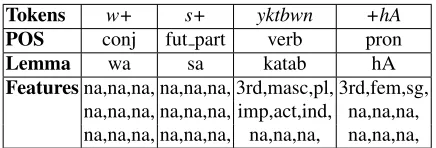
Tokens w+ s+ yktbwn +hA
POS conj fut part verb pron
Lemma wa sa katab hA
[image:2.612.318.536.53.127.2]Featuresna,na,na, na,na,na, 3rd,masc,pl, 3rd,fem,sg, na,na,na, na,na,na, imp,act,ind, na,na,na, na,na,na, na,na,na, na,na,na, na,na,na,
Figure 1: An example
Aë
+KñJ.JºK
+
+ð
w+s+yktbwn +hA‘and they will write it’. Features’ order of presentation is: PER, GEN, NUM, ASP, VOX, MOD, DET, CAS, and STT. The value ‘na’ is for ‘not-applicable’.2. Morphology Generation of inflected Arabic tokens from LEMMAs and any subset of Ara-bic linguistic features.
3. Detokenizationof inflected Arabic tokens into surface Arabic words.
Morphology generation is the main contribution of this paper which in addition to detokenization rep-resents an end-to-end inflection generator. The mor-phology prediction step is an optional step that com-plements the whole process by enriching the input of the morphology generation step with one or more predicted morphological features.
We follow numerous previously published efforts on the value of tokenization for Arabic NLP tasks (Badr et al., 2008; El Kholy and Habash, 2010). We use the best performing tokenization scheme (PATB) in machine translation in all our experiments and fo-cus on the question of how to generate Arabic in-flected words from LEMMAs and features. Figure 1 shows an example of a tokenized word and its de-composition into a LEMMAand morphological fea-tures.
Morphology Prediction This optional step takes a sequence of LEMMAs and tries to enrich them
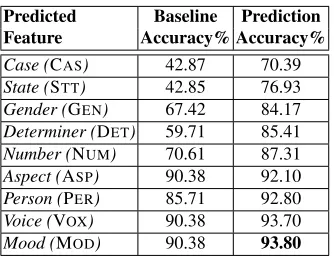
by predicting one or more morphological features. It is implemented using a supervised discriminative learning model, namely Conditional Random Fields (CRF) (Lafferty et al., 2001). Table 1 shows the accuracy of the CRF module on a test set of 1000 sentences compared to using the most common fea-ture value baseline. Some feafea-tures, such as CASand STTare harder to predict but they also have very low baseline values. GEN, DET and NUM have a mod-erate prediction accuracy while ASP, PER, VOXand MODhave high prediction accuracy (but also very
Predicted Baseline Prediction Feature Accuracy% Accuracy%
[image:3.612.103.270.52.180.2]Case (CAS) 42.87 70.39 State (STT) 42.85 76.93 Gender (GEN) 67.42 84.17 Determiner (DET) 59.71 85.41 Number (NUM) 70.61 87.31 Aspect (ASP) 90.38 92.10 Person (PER) 85.71 92.80 Voice (VOX) 90.38 93.70 Mood (MOD) 90.38 93.80
Table 1:Accuracy (%) of feature prediction starting from Ara-bic lemmas (LEMMA). The second column shows the baseline for prediction using the most common feature value. The third column is the prediction accuracy using CRF.
except that it starts with lemmas as opposed to in-flected forms (Habash and Rambow, 2005; Alkuh-lani and Habash, 2012). As such, we expect it to perform worse than a comparable POS tagging task. For example, Habash and Rambow (2005) report 98.2% and 98.8% for GEN and NUM, respectively, compared to our 84.2% and 87.3%.
In the context of a specific application, the per-formance of the prediction could be improved us-ing information other than the context of provided LEMMAs. For example, in MT, source language
lex-ical, syntactic and morphological information could be used in the prediction module (El Kholy and Habash, 2012).
The morphology prediction step produces a lat-tice with all the possible feature values each having an associated confidence score. We filter out options with very low confidence scores to control the expo-nential size of the lattice when combining more than one feature. We tried some experiments using only one or two top values but got lower performance. The morphology generation step takes the lattice and decides on the best target inflection.
Morphology Generation This step is imple-mented using a SMT model that translates from a deeper linguistic representation to a surface repre-sentation. The model parameters are derived from a parallel corpus mapping LEMMAs plus morphologi-cal features to Arabic inflected forms. The model is monotonic and there is neither reordering nor word deletion/addition. We plan to consider these varia-tions in the future. The main advantage of this ap-proach is that it only needs monolingual data which
is abundant.
The morphology generation step can take a se-quence of LEMMAs and a subset of morphological features directly or after enriching the sequence with one or more morphological features using the mor-phology prediction step.
Detokenization Since we work on tokenized Ara-bic, we use a detokenization step which simply stitches the words and clitics together as a post-processing step after morphology generation. We use the best detokenization technique presented by El Kholy and Habash (2010).
5 Evaluation
Evaluation Setup All of the training data we use is available from the Linguistic Data Consortium (LDC).3 For SMT training and language modeling
(LM), we use 200M words from the Arabic Giga-word corpus (LDC2007T40). We use 5-grams for all LMs implemented using the SRILM toolkit (Stol-cke, 2002).
MADA+TOKAN (Habash and Rambow, 2005; Habash et al., 2009) is used to preprocess the Arabic text for generation and language modeling. MADA+TOKAN tokenizes, lemmatizes and selects all morphological features in context.
All generation experiments are conducted using the Moses phrase-based SMT system (Koehn et al., 2007). The decoding weight optimization is done using a set of 300 Arabic sentences from the 2004 NIST MT evaluation test set (MT04). The tuning is based on tokenized Arabic without detokenization. We use a maximum phrase length of size 4. We report results on the Arabic side of the 2005 NIST MT evaluation set (MT05), our development set. We use the Arabic side of MT06 NIST data set for blind test. We evaluate using BLEU-1 and BLEU-4 (Papineni et al., 2002). BLEU is a precision-based evaluation metric commonly used in MT research. Given the way we define our generation task to ex-clude reordering and word deletion/addition, BLEU-1 can be interpreted as a measure of word accuracy. BLEU-4 is the geometric mean of unigram, bigram, trigram and 4-gram precision.4 Since Arabic text
3http://www.ldc.upenn.edu 4
is generally written without diacritics, we evaluate on undiacritized text only. In the future, we plan to study generation into diacritized Arabic, a more challenging goal.
Baseline We conducted two baseline experiments. First, as a degenerate baseline, we only used deto-kenization to generate the inflected words from LEMMAs. Second, we used a generation step be-fore detokenization to generate the inflected tokens from LEMMAs. The BLEU-1/BLEU-4 scores of the two baselines on the MT05 set are 55.04/24.51 and 91.54/82.19. We get a significant improvement (∼35% BLEU-1 & ∼58% BLEU-4) by using the generation step before detokenization.
[image:4.612.318.538.52.288.2]Generation with Gold Features We built several SMT systems translating from LEMMAs plus one or more morphological features to Arabic inflected to-kens. We then use the detokenization step to recom-bine the tokens and produce the surface words.
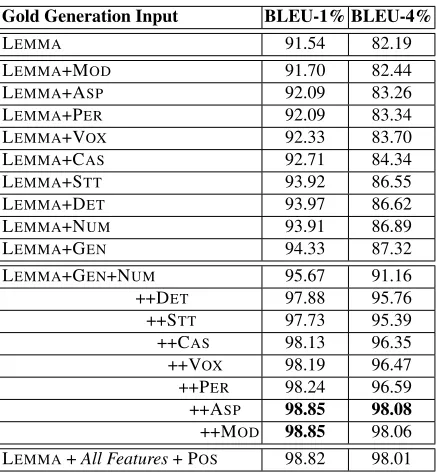
Table 2 shows the BLEU scores for MT05 set as LEMMAs plus different morphological features and their combinations. We greedily combined the fea-tures based on the performance of each feature sep-arately. Features with higher performance are com-bined first. As expected, the more features are in-cluded the better the results. Oddly, when we add the POSto the feature combination, the performance drops. That could be explained by the redundancy in information provided by the POSgiven all the other features and the added sparsity.
Although STT and MOD features hurt the per-formance when added incrementally to the feature combination, removing them from the complete fea-ture set led to a drop in performance. We suspect that there are synergies in combining different fea-tures. We plan to investigate this point extensively in the future. BLEU scores are very high because the input is golden in terms of word order, lemma choice and features. These scores should be seen as the upper limit of our model’s performance. Most of the errors are detokenization and word form under-specification errors.
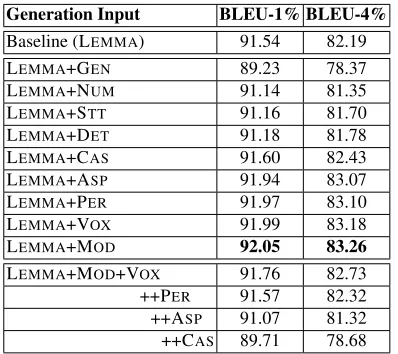
Generation with Predicted Features We com-pare results of generation with a variety of predicted features (see Table 3). The results show that us-ing predicted features can help improve the gener-ation quality over the baseline in some cases, e.g.,
Gold Generation Input BLEU-1% BLEU-4%
LEMMA 91.54 82.19
LEMMA+MOD 91.70 82.44
LEMMA+ASP 92.09 83.26
LEMMA+PER 92.09 83.34
LEMMA+VOX 92.33 83.70
LEMMA+CAS 92.71 84.34
LEMMA+STT 93.92 86.55
LEMMA+DET 93.97 86.62
LEMMA+NUM 93.91 86.89
LEMMA+GEN 94.33 87.32
LEMMA+GEN+NUM 95.67 91.16
++DET 97.88 95.76
++STT 97.73 95.39
++CAS 98.13 96.35
++VOX 98.19 96.47
++PER 98.24 96.59 ++ASP 98.85 98.08 ++MOD 98.85 98.06 LEMMA+All Features+ POS 98.82 98.01
Table 2: Results of generation from gold Arabic lemmas (LEMMA) plus different sets of morphological features. Results are in (BLEU-1 & BLEU-4) on our MT05 set. ”++” means the feature is added to the set of features in the previous row.
when the LEMMAs are enriched with CAS, ASP, PER, VOXor MODfeatures. Our best performer is LEMMA+MOD. Unlike gold features, greedily com-bining predicted features hurts the performance and the more features added the worse the performance. One explanation is that each feature is predicted in-dependently which may lead to incompatible feature values. In the future, we plan to investigate ways of combining features that could help performance such predicting more than one feature together and filtering out bad feature combinations. The feature prediction accuracy (Table 1) does not always cor-relate with the generation performance, e.g., CAS
has lower accuracy than GEN, but has a relatively higher BLEU score. This may be due to the fact that some features are mostly realized as diacritics (CAS) which are ignored in our evaluation.
Blind Test Set To validate our results, we ap-plied different versions of our system to a blind test set (MT06). Our results are as follows (BLEU-1/BLEU-4): detokenization without inflec-tion (55.64/24.92), generainflec-tion from LEMMAs only (86.70/72.69), generation with gold MOD feature (87.00/73.31), and generation with predicted MOD
Generation Input BLEU-1% BLEU-4%
Baseline (LEMMA) 91.54 82.19
LEMMA+GEN 89.23 78.37
LEMMA+NUM 91.14 81.35
LEMMA+STT 91.16 81.70
LEMMA+DET 91.18 81.78
LEMMA+CAS 91.60 82.43
LEMMA+ASP 91.94 83.07
LEMMA+PER 91.97 83.10
LEMMA+VOX 91.99 83.18
[image:5.612.87.286.53.230.2]LEMMA+MOD 92.05 83.26 LEMMA+MOD+VOX 91.76 82.73 ++PER 91.57 82.32 ++ASP 91.07 81.32 ++CAS 89.71 78.68
Table 3:Results of generation from LEMMAplus different sets of predicted morphological features. Results are in (BLEU-1 & BLEU-4) on our MT05 set. ”++” means the feature is added to the set of features in the previous row.
lower than our development set, but the trends and conclusions are consistent.
6 Conclusion and Future Work
We present a SMT-based approach to generation of morphologically rich languages. We evaluate our approach under a variety of settings for Arabic. In the future, we plan to improve the quality of feature prediction and test our approach on other languages.
References
Sarah Alkuhlani and Nizar Habash. 2011. A Corpus for Modeling Morpho-Syntactic Agreement in Arabic: Gender, Number and Rationality. InProc. of ACL’11, Portland, OR.
Sarah Alkuhlani and Nizar Habash. 2012. Identifying Broken Plurals, Irregular Gender, and Rationality in Arabic Text. InProc. of EACL’12, Avignon, France. Ibrahim Badr, Rabih Zbib, and James Glass. 2008.
Seg-mentation for English-to-Arabic Statistical Machine Translation. InProc. of ACL’08, Columbus, OH. Ann Clifton and Anoop Sarkar. 2011.
Combin-ing morpheme-based machine translation with post-processing morpheme prediction. InProc. of ACL’11, Portland, OR.
Ahmed El Kholy and Nizar Habash. 2010. Orthographic and Morphological Processing for English-Arabic Sta-tistical Machine Translation. In Proc. of TALN’10, Montr´eal, Canada.
Ahmed El Kholy and Nizar Habash. 2012. Translate, Predict or Generate: Modeling Rich Morphology in
Statistical Machine Translation. InProc. of EAMT’12, Trento, Italy.
Nizar Habash and Owen Rambow. 2005. Arabic To-kenization, Part-of-Speech Tagging and Morphologi-cal Disambiguation in One Fell Swoop. In Proc. of ACL’05, Ann Arbor, MI.
Nizar Habash, Owen Rambow, and Ryan Roth. 2009. MADA+TOKAN: A toolkit for Arabic tokenization, diacritization, morphological disambiguation, pos tag-ging, stemming and lemmatization. Proc. of MEDAR, Cairo, Egypt.
Nizar Habash. 2010. Introduction to Arabic Natural Language Processing. Morgan & Claypool Publish-ers.
Philipp Koehn, Hieu Hoang, Alexandra Birch, Christo-pher Callison-Burch, Marcello Federico, Nicola Bertoldi, Brooke Cowan, Wade Shen, Christine Moran, Richard Zens, Christopher Dyer, Ondrej Bo-jar, Alexandra Constantin, and Evan Herbst. 2007. Moses: open source toolkit for statistical machine translation. In Proc. of ACL’07, Prague, Czech Re-public.
J. Lafferty, A. McCallum, and F.C.N. Pereira. 2001. Conditional random fields: Probabilistic models for segmenting and labeling sequence data. In Proc. of the International Conference on Machine Learning. Mohamed Maamouri, Ann Bies, Tim Buckwalter, and
Wigdan Mekki. 2004. The Penn Arabic Treebank: Building a Large-Scale Annotated Arabic Corpus. In Proc. of NEMLAR’04, Cairo, Egypt.
Einat Minkov, Kristina Toutanova, and Hisami Suzuki. 2007. Generating complex morphology for machine translation. In Proc. of ACL’07, Prague, Czech Re-public.
Kishore Papineni, Salim Roukos, Todd Ward, and Wei-Jing Zhu. 2002. BLEU: a Method for Automatic Eval-uation of Machine Translation. In Proc. of ACL’02, Philadelphia, PA.
Chris Quirk, Chris Brockett, and William Dolan. 2004. Monolingual machine translation for paraphrase gen-eration. In Dekang Lin and Dekai Wu, editors,Proc. of EMNLP’04, Barcelona, Spain.
Andreas Stolcke. 2002. SRILM - an Extensible Lan-guage Modeling Toolkit. InProc. of ICSLP’02, Den-ver, CO.
Kristina Toutanova, Hisami Suzuki, and Achim Ruopp. 2008. Applying morphology generation models to machine translation. InProc. of ACL’08, Columbus, OH.