Exploring Grammatical Error Correction with
Not-So-Crummy Machine Translation
∗Nitin Madnani Joel Tetreault Educational Testing Service
Princeton, NJ, USA
{nmadnani,jtetreault}@ets.org
Martin Chodorow Hunter College of CUNY
New York, NY, USA
Abstract
To date, most work in grammatical error cor-rection has focused on targeting specific er-ror types. We present a probe study into whether we can use round-trip translations ob-tained from Google Translate via8 different pivot languages forwhole-sentence grammat-ical error correction. We develop a novel alignment algorithm for combining multiple round-trip translations into a lattice using the TERp machine translation metric. We further implement six different methods for extract-ing whole-sentence corrections from the lat-tice. Our preliminary experiments yield fairly satisfactory results but leave significant room for improvement. Most importantly, though, they make it clear the methods we propose have strong potential and require further study.
1 Introduction
Given the large and growing number of non-native English speakers around the world, detecting and correcting grammatical errors in learner text cur-rently ranks as one of the most popular educational NLP applications. Previously published work has explored the effectiveness of usinground-trip ma-chine translation (translating an English sentence to some foreign language F, called the pivot, and then translating the F language sentence back to En-glish) for correcting preposition errors (Hermet and D´esilets, 2009). In this paper, we present a pilot study that explores the effectiveness of extending
∗
cf.Good Applications for Crummy Machine Translation. Ken Church & Ed Hovy. Machine Translation, 8(4). 1993
this approach to whole-sentence grammatical error correction.
Specifically, we explore whether using the con-cept of round-trip machine translation via multi-ple—rather than single—pivot languages has the po-tential of correcting most, if not all, grammatical errors present in a sentence. To do so, we de-velop a round-trip translation framework using the Google Translate API. Furthermore, we propose a novel combination algorithm that can combine the evidence present in multiple round-trip translations and increase the likelihood of producing a whole-sentence correction. Details of our methodology are presented in§3 and of the dataset we use in§4. Since this work is of an exploratory nature, we conduct a detailed error analysis and present the results in§5. Finally, §6 summarizes the contributions of this pi-lot study and provides a discussion of possible future work.
2 Related Work
To date, most work in grammatical error detection has focused on targeting specific error types (usu-ally prepositions or article errors) by using rule-based methods or statistical machine-learning clas-sification algorithms, or a combination of the two. Leacock et al. (2010) present a survey of the com-mon approaches. However, targeted errors such as preposition and determiner errors are just two of the many types of grammatical errors present in non-native writing. One of the anonymous reviewers for this paper makes the point eloquently: “Given the frequent complexity of learner errors, less holistic, error-type specific approaches are often unable to
disentangle compounded errors of style and gram-mar.” Below we discuss related work that uses ma-chine translation to address targeted errors and some recent work that also focused on whole-sentence er-ror correction.
Brockett et al. (2006) use information about mass noun errors from a Chinese learner corpus to engi-neer a “parallel” corpus with sentences containing mass noun errors on one side and their corrected counterparts on the other. With this parallel corpus, the authors use standard statistical machine transla-tion (SMT) framework to learn a translatransla-tion (correc-tion) model which can then be applied to unseen sen-tences containing mass noun errors. This approach was able to correct almost 62% of the errors found in a test set of 150 errors. In our approach, we do not treat correction directly as a translation problem but instead rely on an MT system to round-trip translate an English sentence back to English.
Park and Levy (2011) use a noisy channel model to achieve whole-sentence grammar correction; they learn a noise model from a dataset of errorful sen-tences but do not rely on SMT. They show that the corrections produced by their model generally have higher n-gram overlap with human-authored refer-ence corrections than the original errorful sentrefer-ences. The previous work that is most directly rele-vant to our approach is that of Hermet and D´esilets (2009) who focused only on sentences containing pre-marked preposition errors and generated a sin-gle round-trip translation for such sentences via a single pivot language (French). They then simply posited this round-trip translation as the “correc-tion” for the original sentence. In their evaluation on sentences containing 133 unique preposition er-rors, their round-trip translation system was able to correct 66.4% of the cases. However, this was out-performed by a simple method based on web counts (68.7%). They also found that combining the round-trip method with the web counts method into a hy-brid system yielded higher performance (82.1%).
In contrast, we use multiple pivot languages to generate several round-trip translations. In addition, we use a novel alignment algorithm that allows us to combine different parts of different round-trip trans-lations and explore a whole new set of corrections that go beyond the translations themselves. Finally, we do not restrict our analysis to any single type of
error. In fact, our test sentences contain several dif-ferent types of grammatical errors.
Outside of the literature on grammatical error de-tection, our combination approach is directly related to the research on machine translation system com-bination wherein translation hypotheses produced by different SMT systems are combined to allow the extraction of a better, combined hypothesis (Ban-galore et al., 2001; Rosti et al., 2007; Feng et al., 2009). However, our combination approach is dif-ferent in that all the round-trip translations are pro-duced by a single system but via different pivot lan-guages.
Finally, the idea of combining multiple surface renderings with the same meaning has also been ex-plored in paraphrase generation. Pang et al. (2003) propose an algorithm to align sets of parallel sen-tences driven entirely by the syntactic representa-tions of the sentences. The alignment algorithm out-puts a merged lattice from which lexical, phrasal, and sentential paraphrases could simply be read off. Barzilay and Lee (2003) cluster topically related sentences into slotted word lattices by using mul-tiple sequence alignment for the purpose of down-stream paraphrase generation from comparable cor-pora. More recently, Zhao et al. (2010) perform round-trip translation of English sentences via dif-ferent pivot languages and difdif-ferent off-the-shelf SMT systems to generate candidate paraphrases. However, they do not combine the candidate para-phrases in any way. A detailed survey of paraphrase generation techniques can be found in (Androut-sopoulos and Malakasiotis, 2010) and (Madnani and Dorr, 2010).
3 Methodology
The basic idea underlying our error correction tech-nique is quite simple: if we can automatically gen-erate alternative surface renderings of the meaning expressed in the original sentence and then pick the one that is most fluent, we are likely to have picked a version of the sentence in which the original gram-matical errors have been fixed.
Trans-Original Both experience and books are very importantabout living. Swedish Both experience and books are very important in live.
Italian Both books are very important experience and life.
Russian And the experience, and a very important book about life. French Both experience and the books are very important in life. German Both experience and books are very important about life. Chinese Related to the life experiences and the books are very important. Spanish Both experience and the books are very important about life.
[image:3.612.147.463.53.163.2]Arabic Both experience and books are very important for life.
Figure 1: Illustrating the deficiency in using ann-gram language model to select one of the 8 round-trip translations as the correction for the Original sentence. The grammatical errors in the Original sentence are shown in italics. The round-trip translation via Russian is chosen by a 5-gram language model trained on the English gigaword corpus even though it changes the meaning of the original sentence entirely.
late API. We then take the resulting Chinese sen-tence C and translate it back to English. Since the translation process is designed to be meaning-preserving, the resultinground-trip translationE’ can be seen as an alternative formulation of the orig-inal sentence E. Furthermore, if additional pivot lan-guages besides Chinese are used, several alterna-tive formulations of E can be generated. We use 8 different pivot languages: Arabic, Chinese, Span-ish, French, Italian, German, SwedSpan-ish, Russian. We chose these eight languages since they are frequently used in SMT research and shared translation tasks. To obtain the eight round-trip translations via each of these pivot languages, we use the Google Trans-late research API.1
3.1 Round-Trip Translation Combination
Once the translations are generated, an obvious so-lution is to pick the most fluent alternative, e.g., using an n-gram language model. However, since the language model has no incentive to preserve the meaning of the sentence, it is possible that it might pick a translation that changes the meaning of the original sentence entirely. For example, consider the sentence and its round-trip translations shown in Figure 1. For this sentence, a 5-gram language model trained on gigaword picks the Russian round-trip translation simply because it hasn-grams that were seen more frequently in the English gigaword corpus.
Given the deficiencies in statistical phrase-based translation, it is also possible that no single
round-1
http://research.google.com/university/ translate/
trip translation fixes all of the errors. Again, con-sider Figure 1. None of the 8 round-trip transla-tions is error-free itself. Therefore, the task is more complex than simply selecting the right round-trip translation. We posit that a better approach will be to combine the evidence of correction produced by each independent translation model and increase the likelihood of producing a final whole-sentence cor-rection. Additionally, by engineering such a combi-nation, we increase the likelihood that the final cor-rection will preserve the meaning of the original sen-tence.
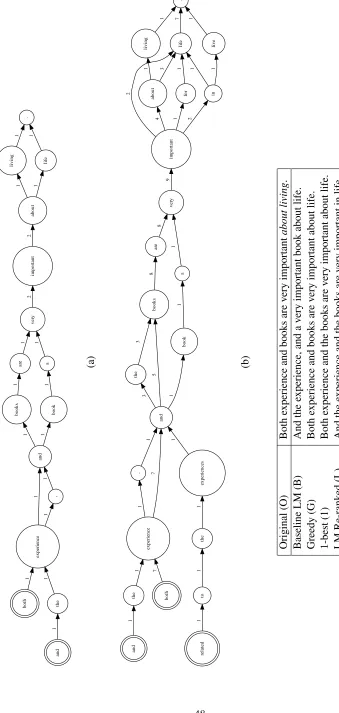
In order to combine the round-trip translations, we developed a heuristic alignment algorithm that uses the TERp machine translation metric (Snover et al., 2009). The TERp metric takes a pair of sen-tences and computes the least number of edit opera-tions that can be employed to turn one sentence into the other.2 As a by-product of computing the edit sequence, TERp produces analignmentbetween the two sentences where each alignment link is defined by an edit operation. Figure 2 shows an example of the alignment produced by TERp between the orig-inal sentence from Figure 1 and its Russian round-trip translation. Note that TERp also allows shifting words and phrases in the second sentence in order to obtain a smaller edit cost (as indicated by the as-terisk next to the wordbookwhich has shifted from its original position in the Russian round-trip trans-lation).
Our algorithm starts by treating the original sen-tence as the backbone of a lattice. First, it
cre-2
ates a node for each word in the original sentence and creates edges between them with a weight of
1. Then, for each of the round-trip translations, it computes its TERp alignment with the original sen-tence and aligns it to the backbone based on the edit operations in the alignment. Specifically, each in-sertion, substitution, stemming, synonymy and para-phrase operation lead to creation of new nodes that essentially provide an alternative formulation for the aligned substring from the backbone. Any duplicate nodes are merged. Finally, edges produced by dif-ferent translations between the same pairs of nodes are merged and their weights added. Figure 3(a) shows how our algorithm aligns the Russian round-trip translation from Figure 1 to the original sentence using the TERp alignment from Figure 2. Figure 3(b) shows the final lattice produced by our algo-rithm for the sentence and all the round-trip transla-tions from Figure 1.
-- and [I]
both -- the [S]
experience -- experience [M]
-- , [I]
and -- and [M]
books -- book [T] [*]
are -- a [S]
very -- very [M]
important -- important [M]
about -- about [M]
living -- life [Y]
. -- . [M]
Figure 2: The alignment produced by TERp between the original sentence from Figure 1 and its Russian round-trip translation. The alignment operations are indicated in square brackets after each alignment link:I=insertion, M=match,S=substitution,T=stemming andY=WordNet synonymy. The asterisk next to the workbook denotes that TERp chose to shift its position before computing an edit operation for it.
3.2 Correction Generation
For each original sentence, we computed six possi-ble corrections from the round-trip translations and the combined lattice:
1. Baseline LM (B). The most fluent round-trip translation out of the eight as measured by a 5-gram language model trained on the English
gigaword corpus.
2. Greedy (G). A path is extracted from the TERp lattice using a greedy best-first strategy at each node, i.e., at each node, the outgoing edge with the largest weight is followed.
3. 1-Best (1): The shortest path is extracted from the TERp lattice by using the OpenFST toolkit.3. This method assumes that, likeG, the combined evidence from the round-trip trans-lations itself is enough to produce a good final correction and no external method for measur-ing fluency is required.4
4. LM Re-ranked (L). An n-best (n=20) list is extracted from the lattice using the OpenFST toolkit and re-ranked using the 5-gram giga-word language model. The 1-best reranked item is then extracted as the correction. This method assumes that an external method of measuring fluency—the 5-gram language model—can help to bring the most grammati-cal correction to the top of then-best list.
5. Product Re-ranked (P). Same as L except the re-ranking is done based on the product of the cost of each hypothesis in then-best list and the language model score, i.e., both the evi-dence from the round-trip translations and the language model is weighted equally.
6. Full LM Composition (C). The edge weights in the TERp lattice are converted to probabil-ities. The lattice is then composed with a tri-gram finite state language model (trained on a corpus of 100,000high-scoring student es-says).5 The shortest path through the composed lattice is then extracted as the correction. This method assumes that using ann-gram language model during the actual search process is better than using it as a post-processing tool on an al-ready extracted n-best list, such as for L and
P.
3
http://www.openfst.org/
4
Note that the edge weights in the lattice must be converted into costs for this method (we do so by multiplying the weights by−1).
5We adapted the code available at http://www.
bo th ex pe rie nc e 1 an d 1 , 1 bo ok s 1 bo ok 1 ar e 1 ve ry 1 im po rta nt 2 ab ou t 2 liv in g 1 lif e 1 . 1 an d th e 1 1 1 a 1 1 1 (a) bo th ex pe rie nc e 7 an d 7 , 1 bo ok s 5 bo ok 1 th e 3 ar e 8 ve ry 8 im po rta nt 9 ab ou t 4 in 2 lif e
2 for
[image:5.612.96.435.17.730.2]No. of Errors Sentences Avg. Length
1 61 14.4
2 45 19.9
3 29 24.2
4 14 29.4
[image:6.612.90.280.53.130.2]>4 13 38.0
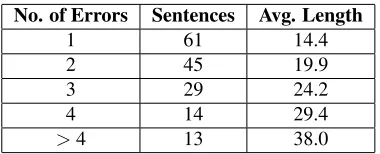
Table 1: The distribution of grammatical errors for the 162 errorful sentences.
Figure 3(c) shows these six corrections as computed for the sentence from Figure 1.
4 Corpus
To assess our system, we manually selected 200 sentences from a corpus of essays written by non-native English speakers for a college-level English proficiency exam. In addition to sentences contain-ing grammatical errors, we also deliberately sam-pled sentences that contained no grammatical errors in order to determine how our techniques perform in those cases. In total, 162 of the sentences con-tained at least one error, and the remaining 38 were perfectly grammatical. For both errorful as well as grammatical sentences, we sampled sentences of different lengths (under 10 words, 10-20 words, 20-30 words, 20-30-40 words, and over 40 words). The 162 errorful sentences varied in the number and type of errors present. Table 1 shows the distribution of the number of errors across these 162 sentences.
Specifically, the error types found in these sen-tences included prepositions, articles, punctuation, agreement, collocations, confused words, etc. Some only contained a handful of straightforward errors, such as “In recent day, transportation is one of the most important thing to support human activity”, where dayand thingshould be pluralized. On the other hand, others were quite garbled to the point where it was difficult to understand the meaning, such as “Sometimes reading a book is give me in-formation about the knowledge of life so that I can prevent future happened but who knows that when it will happen and how fastly can react to that hap-pen.” During development, we noticed that the round-trip translation process could not handle mis-spelled words, so we manually corrected all spelling mistakes which didnotresult in a real word.6
6A total of 82 spelling errors were manually corrected.
5 Evaluation
In order to evaluate the six techniques for generating corrections, we designed an evaluation task where the annotators would be shown a correction along with the original sentence for which it was gener-ated. Since there are 6 corrections for each of the
200sentences, this yields a total of1,200units for pairwise preference judgments. We chose two anno-tators, both native English speakers, each of whom annotated half of the judgment units.
Given the idiosyncrasies of the statistical machine translation process underlying our correction tech-niques, it is quite possible that:
• A correction may fix some, but not all, of the grammatical errors present in the original sen-tence, and
• A correction may be more fluent but might change the meaning of the original sentence.
• A correction may introduce a new disfluency, even though other errors in the sentence have been largely corrected. This is especially likely to be the case for longer sentences.
Therefore, the pairwise preference judgment task is non-trivial in that it expects the annotators to con-sider two dimensions: that of grammaticality and of meaning. To accommodate these considerations, we designed the evaluation task such that it asked the annotators to answer the following two questions:
1. Grammaticality. The annotators were asked to choose between three options: “Original sentence sounds better”, “Correction sounds better” and “Both sound about the same”.
C > O C=O C < O
Meaning = 1 S D F
[image:7.612.91.280.53.93.2]Meaning = 0 F F F
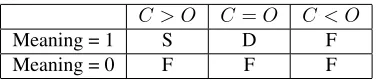
Table 2: A matrix illustrating the Success-Failure-Draw evaluation criterion for the 162 errorful sentences. The rows represent the meaning dimension (1 = meaning pre-served, 0 = meaning changed) and the columns represent the grammaticality dimension (C > O denotes correc-tion being more grammatical than the original, C = O
denotes they are about the same andC < Odenotes that the correction is worse). Such a matrix is computed for each of the six techniques.
5.1 Effectiveness
First, we concentrate our analysis on the original sentences which contain at least one grammatical er-ror. We aggregated the results of the pairwise pref-erence judgments for each of the six specific correc-tion generacorrec-tion techniques and applied the strictest evaluation criterion by computing the following, for each technique:
• Successes. Only those sentences for which the correction generated by method is not only more grammatical but also preserves the mean-ing.
• Failures.All those sentences for which the cor-rection is either less grammatical or changes the original meaning.
• Draws. Those sentences for which the correc-tion preserves the meaning but sounds about the same as the original.
Table 2 shows a matrix of the six possible com-binations of grammaticality and meaning for each method and demonstrates which cells of the matrix contribute to which of the above three measures: Successes (S), Failures (F) and Draws (D).
In addition to the six techniques, we also posit an oracle in order to determine the upper bound on the performance of our round-trip translation approach. The oracle picks the most accurate correction gen-eration method for each individual sentence out of the 6 that are available. For sentences where none of the six techniques produce an adequate correction, the oracle just picks the original sentence. Table 3
shows how the various techniques (including the or-acle) perform on the 162 errorful sentences as mea-sured by this criterion. Based on this criterion, the greedy technique performs the best compared to the others since it has a higher success rate (36%) and a lower failure rate (31%). The oracle shows that 60% of the errorful sentences are fixed by at least one of the six correction generation techniques. We show examples of success and failure for the greedy technique in Figure 4.
5.2 Effect of sentence length
From our observations on development data (not part of the test set), we noticed that Google Trans-late, like most statistical machine translation sys-tems, performs significantly better on shorter sen-tences. Therefore, we wanted to measure whether the successes for the best method were biased to-wards shorter sentences and the failures toto-wards longer ones. To do so, we measured the mean and standard deviation of lengths of sentences compris-ing the successes and failures of the greedy tech-nique. Successful sentences had an average length of approximately 18 words with a standard devia-tion of9.5. Failed sentences had an average length of 23 words with a standard deviation of 12.31. These numbers indicate that although the failures are somewhat correlated with larger sentence length, there is no evidence of a significant length bias.
5.3 Effect on grammatical sentences
Method Success Draw Failure Baseline LM (B) 21% (34) 9% (15) 70% (113) Greedy (G) 36% (59) 33% (52) 31% (51)
1-best (1) 32% (52) 30% (48) 38% (62) LM Re-ranked (L) 30% (48) 17% (27) 54% (87) Product Re-ranked (P) 23% (37) 38% (61) 40% (64) LM Composition (C) 19% (31) 12% (20) 69% (111) Oracle 60% (97) 40% (65)
-Table 3: The success, draw and failure rates for the six correction generation techniques and the oracle as computed for the 162 errorful sentences from the test set. The oracle picks the method that produces the most meaning-preserving and grammatical correction for each sentence. For sentences that have no adequate correction, it picks the original sentence. Numbers in parentheses represent counts.
Success
That’s why I like tomake travel byusing my own car. That’s why I like to travel using my own car.
Having discuss all thisI must say that Imust rather preferto be a leader than just a member. After discussing all this, I must say that I would prefer to be a leader than a member.
Failure
And simplythereis fantastic for everyone All magical and simply there is fantastic for all
I hope thatshare a room with she can be certainly kindle, because sheis likely me and sowill not be problems with she.
[image:8.612.178.434.54.156.2]I hope that sharing a room with her can be certainly kindle, because it is likely that I and so there will be no problems with it.
Figure 4: Two examples of success and failure for the Greedy (G) technique. Original sentences are shown first followed by the corrections in bold. Grammatical errors in the original sentences are in italics.
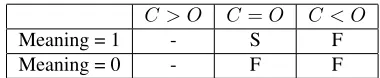
the grammatical sentences.7
C > O C=O C < O
Meaning = 1 - S F
[image:8.612.95.523.220.345.2]Meaning = 0 - F F
Table 4: A matrix illustrating the Success-Draw-Failure evaluation criterion for the 38 grammatical sentences. There are no draws and sentences for which corrections preserve meaning and are not grammatically worse count as successes. The rest are failures.
6 Discussion & Future Work
In this paper, we explored the potential of a novel technique based on round-trip machine translation for the more ambitious and realistic task of whole-sentence grammatical error correction. Although the idea of round-trip machine translation (via a single pivot language) has been explored before in the con-text of just preposition errors, we expanded on it sig-nificantly by combining multiple round-trip
transla-7
An oracle for this setup is uninteresting since it will simply return the original sentence for every sentence.
Method Success Failure
Baseline LM (B) 26% (10) 74% (28) Greedy (G) 79% (30) 21% (8)
1-best (1) 61% (23) 39% (15) LM Re-ranked (L) 34% (13) 66% (25) Product Re-ranked (P) 42% (16) 58% (22) LM Composition (C) 29% (11) 71% (25)
Table 5: The success and failure rates for the six correc-tion generacorrec-tion techniques as computed for the 38 gram-matical sentences from the test set.
tions and developed several new methods for pro-ducing whole-sentence error corrections. Our oracle experiments show that the ideas we explore have the potential to produce whole-sentence corrections for a variety of sentences though there is clearly room for improvement.
[image:8.612.327.529.392.482.2] [image:8.612.88.278.418.457.2]renderings is likely to retain at least some of mean-ing of the original sentence.
Most of the problems with our techniques arise due to the introduction of new errors by Google Translate. One could use an error detection sys-tem (or a human) to explicitly identify spans con-taining grammatical errors and constrain the SMT system to translate only these errorful spans while still retaining the rest of the words in the sentence. This approach should minimize the introduction of new errors. Note that Google Translate does not currently provide a way to perform such selective translation. However, other open-source SMT sys-tems such as Moses8 and Joshua9do. Furthermore, it might also be useful to exploitn-best translation outputs instead of just relying on the 1-best as we currently do.
As an alternative to selective translation, one could simply extract the identified errorful spans and round-trip translate each of them individually. For example, consider the sentence: “Most of all, luck isnull prepno use withoutahard work.” where the prepositionofis omitted and there is an extraneous article a before “hard work”. With this approach, one would simply provide Google Translate with the two phrasal spans containing the errors, instead of the entire sentence.
More generally, although we use Google Trans-late for this pilot study due to its easy availability, it might be more practical and useful to rely on an in-house SMT system that trades-off translation quality for additional features.
We also found that the language-model based techniques performed quite poorly compared to the other techniques. We suspect that this is due to the fact that Google Translate already employs large-order language models trained on trillions of words. Using lower-order models trained on much smaller corpora might simply introduce noise. However, a detailed analysis is certainly warranted.
In conclusion, we claim that our preliminary ex-ploration of large-scale round-trip translation based techniques yielded fairly reasonable results. How-ever, more importantly, it makes it clear that, with additional research, these techniques have the
poten-8http://www.statmt.org/moses 9https://github.com/joshua-decoder
tial to be very effective at whole-sentence grammat-ical error correction.
Acknowledgments
We would like to thank Aoife Cahill, Michael Heil-man and the three anonymous reviewers for their useful comments and suggestions. We would also like to thank Melissa Lopez and Matthew Mulhol-land for helping with the annotation.
References
Ion Androutsopoulos and Prodromos Malakasiotis. 2010. A Survey of Paraphrasing and Textual Entail-ment Methods.J. Artif. Int. Res., 38(1):135–187. Srinivas Bangalore, German Bordel, and Giuseppe
Ric-cardi. 2001. Computing Consensus Translation from Multiple Machine Translation Systems. In Proceed-ings of ASRU, pages 351–354.
Regina Barzilay and Lillian Lee. 2003. Learning to Para-phrase: An Unsupervised Approach Using Multiple-Sequence Alignment. InProceedings of HLT-NAACL 2003, pages 16–23.
Chris Brockett, William B. Dolan, and Michael Gamon. 2006. Correcting ESL Errors Using Phrasal SMT Techniques. InProceedings of the 21st International Conference on Computational Linguistics and 44th Annual Meeting of the Association for Computational Linguistics, pages 249–256.
Yang Feng, Yang Liu, Haitao Mi, Qun Liu, and Ya-juan L¨u. 2009. Lattice-based System Combination for Statistical Machine Translation. InProceedings of the 2009 Conference on Empirical Methods in Natu-ral Language Processing: Volume 3 - Volume 3, pages 1105–1113.
Matthieu Hermet and Alain D´esilets. 2009. Using First and Second Language Models to Correct Preposition Errors in Second Language Authoring. InProceedings of the Fourth Workshop on Innovative Use of NLP for Building Educational Applications, pages 64–72. Claudia Leacock, Martin Chodorow, Michael Gamon,
and Joel Tetreault. 2010. Automated Grammatical Error Detection for Language Learners. Synthesis Lectures on Human Language Technologies. Morgan Claypool.
Nitin Madnani and Bonnie J. Dorr. 2010. Generating Phrasal and Sentential Paraphrases: A Survey of Data-driven Methods. Computational Linguistics, 36(3). Bo Pang, Kevin Knight, and Daniel Marcu. 2003.
Y. Albert Park and Roger Levy. 2011. Automated Whole Sentence Grammar Correction using a Noisy Channel Model. In Proceedings of the 49th Annual Meeting of the Association for Computational Linguistics: Hu-man Language Technologies - Volume 1, pages 934– 944.
Antti-Veikko Rosti, Necip Fazil Ayan, Bing Xiang, Spy-ros Matsoukas, Richard Schwartz, and Bonnie Dorr. 2007. Combining Outputs from Multiple Machine Translation Systems. InHuman Language Technolo-gies 2007: The Conference of the North American Chapter of the Association for Computational Linguis-tics; Proceedings of the Main Conference, pages 228– 235.
Matthew Snover, Nitin Madnani, Bonnie Dorr, and Richard Schwartz. 2009. Fluency, Adequacy, or HTER? Exploring Different Human Judgments with a Tunable MT Metric. In Proceedings of the Fourth Workshop on Statistical Machine Translation at the 12th Meeting of the European Chapter of the Associa-tion for ComputaAssocia-tional Linguistics (EACL-2009). Shiqi Zhao, Haifeng Wang, Xiang Lan, and Ting Liu.