Linguistically-Adapted Structural Query Annotation for Digital
Li-braries in the Social Sciences
Carol ine Brun Vassilina Nikoulina Nikolaos Lagos
Xerox Research Centre Europe 6, chemin de Maupertuis
38240, Meylan France
{firstname.lastname}@xrce.xerox.com
Abstrac t
Query processing is an essential part of a range of applications in the social sciences and cultural heritage do main. However, out-of-the-box natural language processing tools originally developed for full phrase analysis are inappropriate for query analysis. In this paper, we propose an approach to solving this proble m by adapting a co mplete and in-tegrated chain of NLP tools, to ma ke it suit-able for queries analysis. Using as a case study the automatic translation of queries posed to the Europeana libra ry, we de mon-strate that adapted linguistic processing can lead to improve ments in translation quality.
1 Introduction
Query processing tools are essential components of digital libraries and content aggregators. Their operation varies from simple stop word removal and stemming to advanced parsing, that treats queries as a collection of phrases rather than sin-gle terms (Mothe and Tanguy, 2007). They are used in a range of applications, from information retrieval (via search engines that provide access to the digital collections) to query analysis.
Current query processing solutions tend to use out-of-the-box Natural Language Processing (NLP) tools that were originally developed for full phrase analysis, being inappropriate for query analysis.
Correct query annotation and interpretation is even more important in the cultural heritage or social sciences domain, as a lot of the content can be in multimedia form and only metadata (most of the times in the form of tags) is exploit-able by traditional text-oriented information re-trieval and analysis techniques.
Furthermore, as recent studies of user query-ing behavior mention, queries in these domains are not only very short but are also quite specific
in terms of content: they refer to artist names, titles, dates, and objects (Koolen and Kamps, 2010; Ireson and Oomen, 2007). Take the exam-ple of a query like “coupe apollon” (“bowl apol-lon”). While in standard analysis “coupe” would be identified as a verb (“couper”, i.e. “to cut”), in the context of a query it should be actually tagged as a noun, which refers to an object. Such a difference may lead to different preprocessing and worse retrieval.
In this paper, we propose an approach to solv-ing this problem by adaptsolv-ing a complete and in-tegrated chain of NLP tools, based on the Xerox Incremental Parser (XIP), to make it suitable for queries’ analysis. The adaptation includes recapi-talization, adapted Part of Speech (PoS) tagging, adapted chunking and Named Entities (NE) rec-ognition. We claim that several heuristics espe-cially important for queries’ analysis, such as favoring nominal interpretations, result in im-proved linguistic structures, which can have an impact in a wide range of further applications (e.g. information retrieval, query translation, in-formation extraction, query reformulation etc.).
2 Prior art
The problem of adapted query processing, often referred to as structural query annotation, in-cludes capitalization, NEs detection, PoS tagging and query segmentation. Most of the existing works treat each of these steps independently and address only one of the above issues.
Many works address the problem of query segmentation. According to Tan and Peng (2008), query segmentation is a problem which is close to the chunking problem, but the chunking problem is directly linked to the PoS tagging re-sults, which are often noisy for the queries. Thus, most of the works on query segmentation are based on the statistical interaction between a pair of query words to identify the border between the segments in the query (Jones et al., 2006; Guo et
al., 2008). Tan and Peng (2008) propose a gen-erative language model enriched with Wikipedia to identify “concepts” rather than simply “fre-quency-based” patterns. The segmentation pro-posed by Bergsma and Wang (2007) is closer to the notion of NP chunking. They propose a ma-chine-learned query segmentation system trained on manually annotated set of 500 AOL queries. However, in this work PoS tagging is used as one of the features in query segmentation and is done with a generic PoS tagger, non adapted for que-ries.
PoS tagging is an important part of query processing and used in many information ana-lytics tasks (query reformulation, query segmen-tation, etc.). However very few works address query-oriented PoS tagging. Allan and Raghavan (2002) consider that PoS tagging might be am-biguous for short queries and propose to interact with the user for disambiguation. Barr et al. (2008) produce a set of manually annotated que-ries, and then train a Brill tagger on this set in order to create an adapted PoS tagger for search queries.
A notable work is the one by Bendersky et al. (2010), which addresses the capitalization, PoS tagging and query segmentation in the same pa-per. However, this approach proposes for each of the above steps a probabilistic model that relies on the document corpus rather on the query it-self. Such an approach is not applicable for most digital content providers who would reluctantly give access to their document collection. More-over, the query expansion, which is the central idea of the described approach, is not possible for most of digital libraries that are organized in a database. Secondly, Bendersky et al. (2010) pro-poses adapting each processing step independ-ently. Although this is not mentioned in the paper, these three steps can be applied in a se-quence, where PoS tagging can profit from the recapitalization, and chunking from the PoS tag-ging step. However, once the recapitalization is done, it can not be changed in the following steps. This work doesn’t address the adaptation of the NE recognition component, as we do, and which might change the final chunking and PoS tagging in certain cases.
In our approach, part of the recapitalization is done during the PoS tagging, in interaction with the NE recognition, which allows us to consider these two steps as interleaved. Moreover, the linguistic processing we propose is generic: cor-pus-independent (at least most of its parts except
for NE recognition) and doesn’t require access to the document collection.
3 Data
This work is based on search logs from Euro-peana1
4 Motivation
. These are real users’ queries, where Named Entities are often lowercased and the structures are very different from normal phrase structure. Thus, this data is well adapted to dem-onstrate the impact of adapted linguistic process-ing.
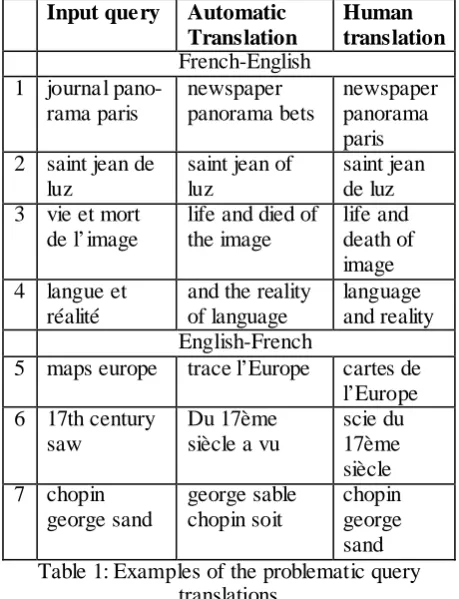
We show the importance of the adapted linguistic query processing using as example the task of query translation, a real need for today’s digital content providers operating in a multilingual en-vironment. We took a sample of Europeana que-ries and translated them with different MT systems: in-house (purely statistical) or available online (rule-based). Some examples of problem-atic translations are shown in the Table 1.
Input query Automatic
Translation
Human translation
French-English 1 journal
pano-rama paris
newspaper panorama bets
newspaper panorama paris 2 saint jean de
luz
saint jean of luz
saint jean de luz 3 vie et mort
de l’image
life and died of the image
life and death of image 4 langue et
réalité
and the reality of language
language and reality English-French
5 maps europe trace l’Europe cartes de l’Europe 6 17th century
saw
Du 17ème siècle a vu
scie du 17ème siècle 7 chopin
george sand
george sable chopin soit
[image:2.595.298.528.377.677.2]chopin george sand Table 1: Examples of the problematic query
translations
1
A portal that acts as an interface to millions of digitized records, allowing users to explore Europe’s cultural heri-tage. For more information please visit
Although in general, the errors done by statis-tical and rule-based models are pretty different, there are some common errors done in the case of the query translation. Both models, being de-signed for full-sentence translation, find the query structure very unnatural and tend to repro-duce the full sentence in the output (ex. 1, 3, 4, 5, 6). The errors may come either from a wrong PoS tagging (for rule-based systems), or from the wrong word order (statistical-based systems), or from the choice of the wrong translation (both types of systems).
One might think that the word order problem is not crucial for queries, because most of the IR models use the bag of words models, which ig-nore the order of words. However, it might mat-ter in some cases: for example, if and/or are interpreted as a logical operator, it is important to place them correctly in the sentence (examples3, 4).
Errors also may happen when translating NEs (ex.1, 2, 7). The case information, which is often missing in the real-life queries, helps to deal with the NEs translation.
The examples mentioned above illustrate that adapted query processing is important for a task such as query translation, both in the case of rule-based and empirical models. Although the empirical models can be adapted if an appropri-ately sized corpus exists, such a corpus is not always available.
Thus we propose adapting the linguistic proc-essing prior to query translation (which is further integrated in the SMT model). We demonstrate the feasibility and impact of our approach based on the difference in translation quality but the adaptations can be useful in a number of other tasks involving query processing (e.g. question answering, query logs analysis, etc.).
5 Linguistic Processing Adaptat ion
As said before, queries have specific linguistic properties that make their analysis difficult for standard NLP tools. This section describes the approach we have designed to improve query chunking. Following a study of the corpus of query logs, we rely on the specific linguistic properties of the queries to adapt different steps of linguistic analysis, from preprocessing to chunking.
These adaptations consist in the following very general processes, for both English and French:
Recapitalization: we recapitalize, in a preproc-essing step, some uncapitalized words in queries that can be proper nouns when they start with a capital letter.
Part of Speech disambiguation
• the part of speech tagging favors nominal interpretation (whereas standard part of speech taggers are designed to find a verb in the input, as PoS tagging generally applies on complete sentences);
:
• the recapitalization information transmitted from the previous step is used to change the PoS interpretation in some contexts.
Chunking
• considering that a full NE is a chunk, which is not the case in standard text processing, where a NE can perfectly be just a part of a chunk;
: the chunking is improved by:
• grouping coordinated NEs of the same type; • performing PP and AP attachment with the
closest antecedent that is morphologically compatible
These processes are very general and may ap-ply to queries in different application domains, with maybe some domain-dependent adaptations (for example, NEs may change across domains).
These adaptations have been implemented within the XIP engine, for the French and Eng-lish grammars. The XIP framework allows inte-grating the adaptations of different steps of query processing into a unified framework, where the changes from one step can influence the result of the next step: the information performed at a given step is transmitted to the next step by XIP through linguistic features.
5.1 Preprocessing
Queries are often written with misspelling errors, in particular for accents and capital letters of NEs. See the following query examples extracted from our query log corpus:
lafont Robert (French query)
henry de forge et jean mauclère (French query)
muse prado madrid (French query) carpaccio queen cornaro (English query)
man ray (English query)
recognition, which often use capital letter infor-mation as a triggering feature.
Recapitalizing these words at the preprocess-ing step of a lpreprocess-inguistic analysis, i.e. durpreprocess-ing the morphological analysis, is technically relatively easy, however it would be an important generator of spurious ambiguities in the context of full sen-tence parsing (standard context of linguistic pars-ing). Indeed, considering that all lower case words that can be proper nouns with a capital letter should also have capitalized interpretation, such as price, jean, read, us, bush, lay, etc., in English or pierre, médecin, … in French) would be problematic for a PoS tagger as well as for a NE recognizer. That’s why it is not performed in a standard analysis context, considering also that misspelling errors are not frequent in “standard” texts. In the case of queries however, they are frequent, and since queries are far shorter in av-erage than full sentences the tagging can be adapted to this context (see next section), we can afford to perform recapitalization using the fol-lowing methodology, combining lexical informa-tion and contextual rules:
1. The preprocessing lexicon integrates all words starting with a lower case letter which can be first name (henry, jean,
isaac …), family and celebrity name (chirac, picasso...) and place names (paris, saint pétersbourg, …) when capi-talized.
2. When an unknown word starting with a lower case letter is preceded by a first name and eventually by a particle (de,
van, von …), it is analyzed as a last name, in order to be able to trigger stan-dard NE recognition. This is one exam-ple of interleaving of the processes: here part-of-speech interpretation is condi-tioned by the recapitalization steps which transmits information about recapitaliza-tion (via features within XIP) that trig-gers query-specific pos disambiguation rules.
The recapitalization (1) has been imple-mented within the preprocessing components of XIP within finite state transducers (see (Kart-tunen, 2000)). The second point (2) is done di-rectly within XIP in the part-of-speech tagging process, with a contextual rule. For example, the analysis of the input query “jean mauclère” gets the following structure and dependency output with the standard French grammar.
Query: jean mauclère NMOD(jean, mauclère)
0>GROUP[NP[jean] AP[mauclère]]
Because jean is a common noun and mauclère is an unknown word which has been guessed as an adjective by the lexical guesser.
It gets the following analysis with the pre-processing adaptations described above:
NMOD(jean,mauclère)
PERSON_HUM(jean mauclère) FIRSTNAME(jean,jean mauclère) LASTNAME(mauclère,jean mauclère) 0>GROUP[NP[NOUN[jean mauclère]]]
Because jean has been recognized as a first name and consequently the unknown word after has been inferred has a proper noun (last name) by the pos tagging contextual rule; the recapitali-zation process and part-of-speech interpretation are therefore interleaved.
5.2 Part of speech disambiguation
In the context of query analysis, part-of-speech tagging has to be adapted also, since standard part-of-speech disambiguation strategies aim generally at disambiguating in the context of full sentences. But queries are very different from full sentences: they are mostly nominal with sometimes infinitive, past participial, or gerun-dive insertions, e.g.:
statuettes hommes jouant avec un chien (French query)
coupe apollon (French query)
architecture musique (French query)
statue haut relief grecque du 5 siecle (French query)
david playing harp fpr saul (Eng-lish query)
stained glass angel (English query)
be-tween noun and verbs, which has to be solved differently than in the context of a standard sen-tence.
The approach we adopt to correct the tagging with the main following contextual rules:
• If there is a noun/verb ambiguity:
• If the ambiguity is on the first word of the query (e.g. “coupe apollon”, “oil
• If the ambiguity is on the second word of the query, prefer the noun interpretation if the query starts with an adjective or a noun (e.g. in “young
flask”), select the noun interpretation;
people
• Select noun interpretation if there is no person agreement with one of the previ-ous nouns (e.g. “les frères
social com-petences”, select the noun interpretation for people, instead of verb)
bissons
• For a verb which is neither at the past participle form nor the infinitive form, select the noun interpretation if it is not followed by a determiner (e.g. “ tremble-ment
”,
frères belongs to the 3rd person but bis-sons to the 1st one of the verb “bisser”)
terre
• Choose the noun interpretation if the word is followed by a conjunction and a noun or preceded by a noun and a con-junction (e.g. in “gauguin
lisbonne”, terre is disambigu-ated as a noun”))
moon and earth”, choose the noun interpretation for moon, instead of verb2
• In case of ambiguity between adjective and past participle verb, select the adjective in-terpretation if the word is followed by a noun (e.g. “stained glass angel”, stained is disambiguated as an adjective instead of a past participle verb)
).
5.3 Chunking
The goal of chunking is to assign a partial structure to a sentence and focuses on easy to parse pieces in order to avoid ambiguity and re-cursion. In the very specific context of query analysis, and once again since queries have spe-cific linguistic properties (they are not sentences but mostly nominal sequences), chunking can be improved along several heuristics. We propose here some adaptations to improve query
2
To moon about
ing to deal with AP and PP attachment, and co-ordination, using also NE information to guide the chunking strategy.
AP and PP attachment
In standard cases of chunking, AP and PP at-tachment is not considered, because of attach-ment ambiguity problems that cannot be solved at this stage of linguistic analysis.
Considering the shortness of queries and the fact that they are mostly nominal, some of these attachments can be solved however in this con-text.
For the adjectival attachment in French, we attach the post modifier adjectival phrases to the first previous noun with which there is agreement in number and gender. For example, the chunk-ing structure for the query “Bibliothèque eu-ropeenne numerique” is:
NP[ [Bibliothèque AP[europeenne] AP[numerique] ]
while it is
NP[Bibliothèque] AP[europeenne] AP[numerique]
with our standard French grammar.
For PP attachment, we simply consider that the PP attaches systematically to the previous noun. For example, the chunking structure for “The history of the University of Oxford” is:
NP[the history PP[of the University PP[of Oxford] ] ]
instead of:
NP[The history] PP[of the Univer-sity] PP[of Oxford ]
Coordination
Some cases of coordination, usually very com-plex, can be solved in the query context, in par-ticular when NEs are involved. For both English and French, we attach coordinates when they belong to the same entity type (person conj per-son, date conj date, place conj place, etc.), for example, “vase achilles et priam” :
NP[vase] NP[Achille et Priam]
instead of:
We also attach coordinates when the second is introduced by a reflexive pronoun, such as in: “[Le laboureur et ses enfants] La Fontaine” and attach coordinates within a PP when they are in-troduced by the preposition “entre” in French and “between” in English.
Use of NE information to guide the chunking strategy
We also use information about NEs present in the queries to guide the query chunking strategy. In standard analysis, NEs are generally part of larger chunking units. In queries, however, be-cause of their strong semantic, they can be iso-lated as separate chunking units. We have adapted our chunking strategy using this infor-mation: when the parser detects a NE (including a date), it chunks it as a separate NP. The follow-ing examples show the chunkfollow-ing results for this adapted strategy versus the analysis of standard grammar:
• “Anglo Saxon 11th century” (English) Adapted chunking:
NP[Anglo Saxon] NP[ 11th century]
Standard chunking:
NP[Anglo Saxon 11th century ]
• “Alexandre le Grand Persepolis” (French) Adapted chunking:
NP[Alexandre le Grand] NP[Perspolis]
Standard chunking:
NP[Alexandre le Grand Perspolis]
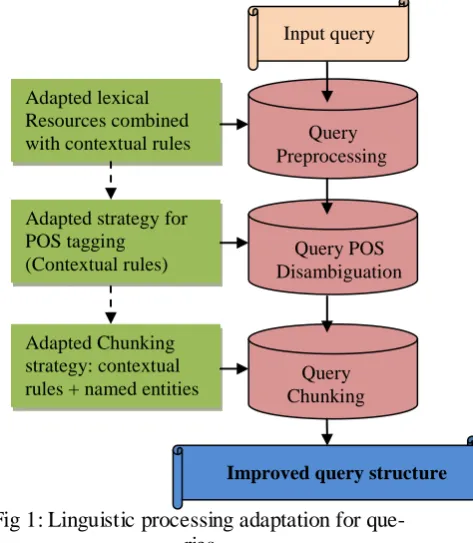
The whole process is illustrated in Figure 1.
When applying the full chain on an example query like “gauguin moon and earth”, we have the following steps and result:
Preprocessing: gauguin is recognized as Gauguin
(proper noun of celebrity);
Part of speech tagging: moon is disambiguated as a noun instead of a verb);
Chunking:
So we get the following structure:
moon and earth are grouped together in a coordination chunk, gauguin is a NE chunked separately.
NP[Gauguin] NP[moon and earth]
and gauguin is recognized as a person name, instead of
SC 3 [NP[gauguin] FV 4
Input query
Query Preprocessing
Query POS Disambiguation
Query Chunking Adapted lexical
Resources combined with contextual rules
Improved query structure
Adapted strategy for POS tagging (Contextual rules)
Adapted Chunking strategy: contextual rules + named entities
[moon]] and NP[earth],
[image:6.595.313.550.157.429.2]gauguin remaining unknown, with the standard English grammar.
Fig 1: Linguistic processing adaptation for que-ries
5.4 Examples of query structures
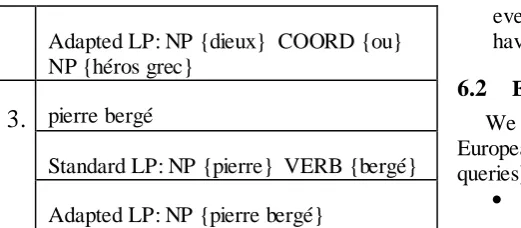
The following table shows the differences of query structures obtained with the standard lin-guistic processing and with the adapted linlin-guistic processing.
1.
Albert Camus la pesteStandard LP: NP {albert} AP {camus} NP {la peste}
Adapted LP: NP {albert camus} NP {la peste}
2.
dieux ou héros grecStandard LP: NP {dieux} COORD {ou} NP {héros} AP {grec}
3 SC: chunk tag for sentential clause 4
Adapted LP: NP {dieux} COORD {ou} NP {héros grec}
3.
pierre bergéStandard LP: NP {pierre} VERB {bergé}
Adapted LP: NP {pierre bergé}
Table 2: So me e xa mp les of query structure produced by standard and adapted linguistic processing.
The evaluation of this customization is done indirectly through query translation, and is de-scribed in the next section
6 Experime nts
6.1 Experimental settings
In our experiments we tried to enrich our base-line SMT system with an adapted linguistic proc-essing in order to improve the query translation. These experiments have double goal. First, to show that the adapted linguistic processing al-lows to improve query translation compared to a standard linguistic processing, and second, to show that enriching an SMT model with a lin-guistic processing (adapted) is helpful for the translation.
We use an open source toolkit Moses (trained on Europarl) as a baseline model for query trans-lations. Based on the examples from the section 5, we choose to integrate the chunking and NE information in the translation. We integrate this knowledge in the following way:
• Chunking: We check whether the query
matches one of the following patterns: “NP1 and NP2”, “NP1 or NP2”, “NP1 NP2”, “NP1, NP2”, etc. If it is the case, the NPs are translated independently. Thus, we make sure that the output query will preserve the logical structure, if “and/or” are treated as logical operators. Also, translating NPs inde-pendently might result at different (hopefully better) lexical choices.
• Named entities: We introduce XML tags for person names where we propose a possible translation. During the translation process the proposed translation competes with the pos-sible translations from a bi-phrase library. The translation maximizing internal transla-tion score is chosen. In these experiments we propose not to translate an NE at all,
how-ever in more general case we could imagine having an adapted NE dictionary.
6.2 Evaluation
We have translated the totality of available Europeana French logs to English (8870 distinct queries), with the following translation models:
• Moses trained on Europarl (Baseline MT)
• Baseline MT model enriched with lin-guistic processing (as defined in 6.1) based on basic grammar (Baseline MT + basic grammar)
• Baseline MT enriched with linguistic processing based on adapted grammar (Baseline MT + adapted grammar)
Our approach brings two new aspects com-pared to simple SMT system. First, an SMT sys-tem is enriched with linguistic processing as opposed to system without linguistic processing (baseline system), second: usage of an adapted linguistic processing as opposed to standard lin-guistic processing. Thus, we evaluate:
1. The impact of linguistic processing on the final query translations;
2. The impact of grammar adaptation (adapted linguistic processing) in the context of query translation.
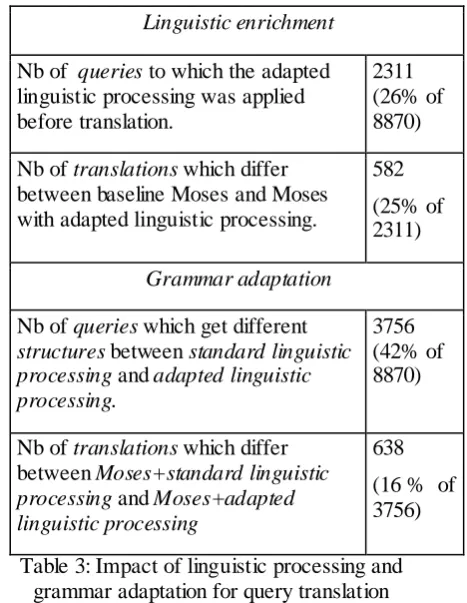
First, we measure the overall impact of each of the two aspects mentioned above. Table 3 re-flects the general impact of linguistic enrichment and grammar adaptation on query structure and translation.
First, we note that the linguistic processing as defined in 6.1 won’t be applied to all queries. Thus, we count an amount of queries out of our test set to which this processing can actually be applied. This corresponds to the first line of the Table 3 (26% of all queries).
Second, we compare the queries translation with and without linguistic processing. This is shown in the second line of the Table 3: the amount of queries for which the linguistic proc-essing lead to different translation (25% of que-ries for which the linguistic processing was applied).
[image:7.595.76.337.67.181.2]actually get different translation (~16% queries with new structure obtained after adaptation get different translations).
These numbers show that the linguistic knowledge that we integrated into the SMT framework may impact a limited portion of que-ries’ translations. However, we believe that this is due, to some extent, to the way the linguistic knowledge was integrated in SMT, which ex-plores only a small portion of the actual linguis-tic information that is available. We carried out these experiments as a proof of concept for the adapted linguistic processing, but we believe that a deeper integration of the linguistic knowledge into the SMT framework will lead to more sig-nificant results. For example, integrating such an adapted linguistic processing in a rule-based MT system will be straightforward and beneficial, since the linguistic information is explored di-rectly by a translation model (e.g. in the example 6 in Table 1 tagging "saw" as a noun will defi-nitely lead to a better translation).
Next, we define 2 evaluation tasks, where the goal of each task is to compare 2 translation models. We compare:
1. Baseline MT versus linguistically en-riched translation model (Baseline MT+adapted adapted linguistic processing). This task evalu-ates the impact of linguistic enrichment in the query translation task with SMT.
2. Translation model using standard lin-guistic processing versus translation model using
adapted linguistic processing. This task evalu-ates the impact of the adapted linguistic process-ing in the query translation task.
For each evaluation task we have randomly selected a sample of 200 translations (excluding previously the identical translations for the 2 models compared) and we perform a pairwise evaluation for each evaluation task. Thus, for the first evaluation task, a baseline translation (per-formed by standard Moses without linguistic processing) is compared to the translation done by Moses + adapted linguistic processing. In the second evaluation task, the translation performed by Moses + standard linguistic processing is compared to the translation performed by Moses + adapted linguistic processing.
The evaluation has been performed by 3 evaluators. However, no overlapping evaluations have been performed to calculate intra-evaluators agreement. We could observe, however, the simi-lar tendency for improvement in each on the evaluated sample (similar to the one shown in the Table 2).
[image:8.595.307.541.110.412.2]We evaluate the overall translation perform-ance, independently of the task in which the translations are going to be used afterwards (text
Table 3: Impact of linguistic processing and grammar adaptation for query translation
understanding, text analytics, cross-lingual in-formation retrieval etc.)
The difference between slight improvements and important improvements as in the examples below has been done during the evaluation.
src1: max weber t1:max mr weber
t2:max weber (slight improvement)
src2: albert camus la peste t1:albert camus fever
t2:albert camus the plague (impor-tant improvement)
Thus, each pair of translations (t1, t2) re-ceives a score from the scale [-2, 2] which can be:
• 2, if t2 is much better than t1, • 1, if t2 is better than t1, • 0, if t2 is equivalent to t1, • -1, if t1 is better than t2, • -2, if t1 is much better than t2,
Linguistic enrichment
Nb of queries to which the adapted linguistic processing was applied before translation.
2311 (26% of 8870)
Nb of translations which differ between baseline Moses and Moses with adapted linguistic processing.
582
(25% of 2311)
Grammar adaptation
Nb of queries which get different
structures between standard linguistic processing and adapted linguistic processing.
3756 (42% of 8870)
Nb of translations which differ between Moses+standard linguistic processing and Moses+adapted linguistic processing
638
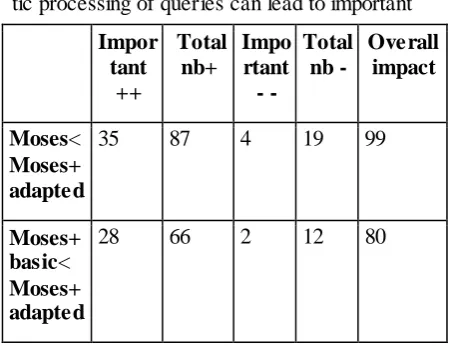
Table 4 presents the results of translation evaluation.
Note, that a part of slight decreases can be corrected by introducing an adapted named enti-ties dictionary to the translation system. For ex-ample, for the source query “romeo et juliette”, keeping NEs untranslated results at the following translation: “romeo and juliette”, which is con-sidered as a slight decrease in comparison to a baseline translation: “romeo and juliet”. Creating an adapted NEs dictionary, either by crawling Wikipedia, or other parallel resources, might be helpful for such cases.
Often, the cases of significantly better transla-tions could potentially lead to the better retrieval. For example, a better lexical choice (don juan moliere vs. donation juan moliere, the plague vs.
fever) often judged as significant improvement may lead to a better retrieval.
Based on this observation one may hope that the adapted linguistic processing can indeed be useful in the query translation task in CLIR con-text, but also in general query analysis context.
7 Conclusion
Queries posed to digital library search engines in the cultural heritage and social sciences domain tend to be very short, referring mostly to artist names, objects, titles, and dates. As we have il-lustrated with several examples, taken from the logs of the Europeana portal, standard NLP analysis is not well adapted to treat that domain. In this work we have proposed adapting a com-plete chain of linguistic processing tools for query processing, instead of using out-of-the-box tools designed to analyze full sentences.
Focusing on the cultural heritage domain, we translated queries from the Europeana portal us-ing a state-of-the-art machine translation system and evaluated translation quality before and after applying the adaptations. The impact of the lin-guistic adaptations is quite significant, as in 42% of the queries the resulting structure changes. Subsequently, 16% of the query translations are also different. The positive impact of the adapted linguistic processing on the translation quality is evident, as for 99 queries the translation (out of 200 sample evaluated) is improved when com-pared to having no linguistic processing. We ob-serve also that 78 queries are better translated after adapting the linguistic processing compo-nents.
Our results show that customizing the linguis-tic processing of queries can lead to important
improvements in translation (and eventually to multilingual information retrieval and data min-ing). A lot of the differences are related to the ability of properly identifying and treating do-main-specific named entities. We plan to further research this aspect in future works.
Acknowledge ments
This research was supported by the European Union’s ICT Policy Support Programme as part of the Competitiveness and Innovation Frame-work Programme, CIP ICT-PSP under grant agreement nr 250430 (Project GALATEAS).
References
Bin Tan and Fuchun Peng. 2008. Unsupervised query segmentation using generative language models and wikipedia. In Proceedings of the 17th interna-tional conference on World Wide Web (WWW '08). ACM , New York, NY, USA, 347-356.
Cory Barr, Rosie Jones, Moira Regelson. 2008. The Linguistic Structure of EnglishWeb-Search Que-ries, Proceedings of ENM LP'08, pp 1021– 1030, Octobre 2008, Honolulu.
James Allan and Hema Raghavan. 2002. Using part-of-speech patterns to reduce query ambiguity. In Proceedings of the 25th annual international ACM SIGIR confe rence on Research and development in informat ion retrieval (SIGIR '02). ACM, New Yo rk, NY, USA, 307-314.
Jeann-Pierre Chanod, Pasi Tapanainen. 1995. Tag-ging French - comparing a statistical and a con-straint-based method. Proc. Fro m Te xts To Tags:
Impor tant
++
Total nb+
Impo rtant
- -
Total nb -
Overall impact
Moses<
Moses+ adapted
35 87 4 19 99
Moses+ basic<
Moses+ adapted
28 66 2 12 80
Issues In Multilingual Language Analysis, EA CL SIGDAT workshop. Dublin, 1995.
Jiafeng Guo, Gu Xu, Hang Li, Xueqi Cheng. 2008. A Unified and Discriminative Model for Que ry Re-fine ment. Proc. SIGIR’08, July 20– 24, 2008, Sin-gapore.
Josiane Mothe and Ludovic Tanguy. 2007. Linguistic Analysis of Users' Queries: towards an adaptive In-formation Retrieval System. International Confe r-ence on Signal-Image Technology & Internet– Based Systems, Shangai, China, 2007.
http://halshs.archives-ouvertes.fr/halshs-00287776/ fr/ [Last accessed March 3, 2011] Lauri Ka rttunen. 2000. Applications of Finite-State
Transducers in Natural Language Processing. Pro-ceedings of CIAA-2000. Lecture Notes in Co m-puter Science. Springer Verlag.
Marijn Koolen and Jaap Kamps. 2010. Searching cul-tural heritage data: does structure help expert searchers?. In Adaptivity, Personalizat ion and Fu-sion of Heterogeneous Information (RIAO '10). Le centre des hautes etudes internationals d’informat ique documentaire, Pa ris, France, 152-155.
Michael Bendersky, W. Bruce Croft and David A. Smith. 2010. Structural Annotation of Search Que-ries Using Pseudo-Relevance Feedback. Proceed-ings of CIKM'10, October 26-29, 2010, Toronto, Ontario, Canada
Neil Ireson and Johan Oomen. 2007. Capturing e-Culture : Metadata in MultiMatch., J. In Proc. DELOS-Mu ltiMatch workshop, February 2007, Tirrenia, Italy.
Rosie Jones, Ben ja min Rey, Omid Madani, and Wiley Gre iner. 2006. Generating query substitutions. In Proceedings of the 15th international conference on World Wide Web (WWW '06). A CM, Ne w York, NY, USA, 387-396.