A Comparison of MT Methods for Closely Related Languages: a Case
Study on Czech – Slovak Language Pair
∗Vladislav Kuboˇn
11
Institute of Formal and Applied Linguistics
Faculty of Mathematics and Physics
Charles University in Prague
[email protected]
Jernej Viˇciˇc
2,3 2FAMNIT
University of Primorska,
3
Fran Ramovˇs Institute of the
Slovenian Language, SRC SASA,
[email protected]
Abstract
This paper describes an experiment compar-ing results of machine translation between two closely related languages, Czech and Slovak. The comparison is performed by means of two MT systems, one representing rule-based ap-proach, the other one representing statistical approach to the task. Both sets of results are manually evaluated by native speakers of the target language. The results are discussed both from the linguistic and quantitative points of view.
1 Introduction
Machine translation (MT) of related languages is a spe-cific field in the domain of MT which attracted the at-tention of several research teams in the past by promis-ing relatively good results through the application of classic rule-based methods. The exploitation of lexi-cal, morphological and syntactic similarity of related languages seemed to balance the advantages of data-driven approaches, especially for the language pairs with smaller volumes of available parallel data.
This simple and straightforward assumption have led to the construction of numerous rule-based translation systems for related (or similar) natural languages. The following list (ordered alphabetically) includes several examples of those systems:
• (Altintas and Cicekli, 2002) for Turkic languages. • Apertium (Corbi-Bellot et al., 2005) for Romance
languages.
• (Dyvik, 1995; Bick and Nygaard, 2007; Ahren-berg and Holmqvist, 2004) for Scandinavian lan-guages.
• ˇCes´ılko (Hajiˇc et al., 2000), for Slavic languages with rich inflectional morphology, mostly lan-guage pairs with Czech lanlan-guage as a source. • Ruslan (Oliva, 1989) full-fledged transfer based
RBMT system from Czech to Russian. ∗
This work has been using language resources devel-oped and/or stored and/or distributed by the LINDAT-Clarin project of the Ministry of Education of the Czech Republic (project LM2010013).
• (Scannell, 2006) for Gaelic languages; Irish (Gaeilge) and Scottish Gaelic (G‘aidhlig).
• (Tyers et al., 2009) for the North Sami to Lule Sami language pair.
• Guat (Viˇciˇc, 2008) for Slavic languages with rich inflectional morphology, mostly language pairs with Slovenian language.
Many of the systems listed above had been created in the period when it was hard to obtain a good qual-ity data-driven system which would enable comparison against these systems. The existence of Google Trans-late1which nowadays enables the automatic translation
even between relatively small languages made it possi-ble to investigate advantages and disadvantages of both approaches. This paper introduces the first step in this direction - the comparison of results of two different systems for two really very closely related languages -Czech and Slovak.
2 State of the art
There has already been a lot of research in Machine Translation evaluation. There are quite a few confer-ences and shared tasks devoted entirelly to this problem such as NIST Machine Translation Evaluation (NIST, 2009) or Workshop on Statistical Machine Translation (Bojar et al., 2013). (Weijnitz et al., 2004) presents a research on how systems from two different MT paradigms cope with a new domain. (Kolovratnık et al., 2009) presents a research on how relatedness of languages influences the translation quality of a SMT sytem.
The novelty of the presented paper is in the focus on machine translation for closely related languages and in the comparison of the two mostly used paradigms for this task: shallow parse and transfer RBMT and SMT paradigms.
3 Translation systems
The translation systems selected for the experiment are:
• Google Translate
1Google Translate:https://translate.google.
com/.
• ˇCes´ılko (Hajiˇc et al., 2003)
Google Translate was selected as the most used trans-lation system. ˇCes´ılko belongs to the shallow-parse and shallow-transfer rule based machine translation paradigm which is by many authors the most suitable for translation of related languages.
ˇCes´ılko (Hajiˇc et al., 2003) was used as a representa-tive of rule-based MT systems, the translation direction from Czech to Slovak was naturally chosen because this is the only direction this system supports for this particular language pair.
The on-line publicly available versions of the sys-tems sere used in the experiment to ensure the repro-ducibility of the experiment. All the test data is pub-licly available at the language technologies server of the University of Primorska2.
Let us now introduce the systems in a more detail.
3.1 Google Translate
This system is currently probably the most popular and most widely used MT system in the world. It belongs to the Statistical Machine Translation – SMT paradigm. SMT is based on parametric statistical models, which are constructed on bilingual aligned corpora (training data). The methods focus on looking for general pat-terns that arise in the use of language instead of ana-lyzing sentences according to grammatical rules. The main tool for finding such patterns is counting a variety of objects – statistics. The main idea of the paradigm is to model the probability that parts of a sentence from the source language translate into suitable parts of sen-tence in the target language.
The system takes advantage of the vast parallel re-sources which Google Inc. has at their disposal and it is therefore able to translate a large number of lan-guage pairs. Currently (July 2014), this system offers automatic translation among 80 languages. This makes it a natural candidate as a universal quality standard for MT, especially for pairs of smaller (underrepresented) languages for which there are very few MT systems.
3.2 ˇCes´ılko
One of the first systems which fully relied on the simi-larity of related languages, ˇCes´ılko (Hajiˇc et al., 2003), had originally a very simple architecture. Its first im-plementation translated from Czech to Slovak. It used the method of direct word-for-word translation (after necessary morphological processing). More precisely, it translated each lemma obtained by morphological analysis and morphological tag provided by a tagger to a lemma and a corresponding tag in the target language. For the translation of lemmas it was necessary to use a bilingual dictionary, the differences in morphology of both languages, although to a large extent regular, did not allow to use a simple transliteration. The translation
2 Test data: http://jt.upr.si/research_
projects/related_languages/
of lemmas was necessary due to differences in tagsets of the source and target language.
The syntactic similarity of both languages allowed the omission of syntactic analysis of the source lan-guage and syntactic synthesis of the target one, there-fore the dictionary phase of the system had been im-mediately followed by morphological synthesis of the target language. No changes of the word order were necessary, the target language order of words preserved the word order of the source language.
Later versions of the system experimented with the architecture change involving the omission of the source language tagger and the addition of a stochas-tic ranker of translation hypothesis at the target lan-guage side. The purpose of this experiment was to eliminate tagging errors at the beginning of the transla-tion process and to enable more variants of translatransla-tion from which the stochastic ranker chose the most prob-able hypothesis. This change has been described for example in (Homola and Kuboˇn, 2008). For the pur-pose of our experiment we are using the original ver-sion of the system which has undergone some minor improvements (better tagger, improved dictionary etc.) and which is publicly available for testing at the web-site of the LINDAT project3. The decision to use this
version is natural, given the fact that this is the only publicly available version of the system.
4 Methodology
In the planning phase of our experiment it was neces-sary to make a couple of decisions which could cause certain bias and invalidate the results obtained. First of all, the choice of the language pair (Czech to Slo-vak) was quite natural. These languages show very high degree of similarity at all levels (morphological, syntactic, semantic) and thus they constitute an ideal language pair for the development of simplified rule-based architecture. We are of course aware that for a complete answer to this question it would be necessary to test more systems and more language pairs, but in this phase of our experiments we do not aim at obtain-ing a complete answer, our main goal is to develop a methodology and to perform some kind of pilot testing showing the possible directions of future research.
The second important decision concerned the method of evaluation. Our primary goal was to set up a method which would be relatively simple and fast, thus allowing to manually (the reasons for manual evalua-tion are given in 4.2.1 subsecevalua-tion) process reasonable volume of results. The second goal concerned the en-deavor to estimate evaluator’s confidence in their judg-ments.
4.1 Basic properties of the language pair
The language pair used in our experiment belongs to western Slavic language group. We must admit that
3ˇCes´ılko: http://lindat.mff.cuni.cz/
the reason for choosing this language group was purely pragmatic – there is an extensive previous experience with the translation of several language pairs from this group, see, e.g. (Hajiˇc et al., 2003), (Homola and Kuboˇn, 2008) or (Homola and Viˇciˇc, 2010). On top of that, the availability of the ˇCes´ılko demo in the LIN-DAT repository for the free translation of up to 5000 characters naturally led to the decision to use this sys-tem (although it is in fact the original version of the system with very simple architecture).
Czech and Slovak represent the closest language pair among the western Slavic languages. Their morphol-ogy and syntax are very similar, their lexicons slightly differ, their word order is free (and also similar). In the former Czechoslovakia it was quite common that people understood both languages very well, but after the split of the country the younger people who don’t have regular contact with the other language experience certain difficulties because the number of the words un-known to them is not negligible.
However, the greatest challenge for the word-for-word translation approach is not the lexicon (the dif-ferences in the lexicon can be handled by a bilingual dictionary), but the ambiguity of word forms. These are typically not part-of-speech ambiguities, they are quite rare although they do exist (st´at[to stay/the state],
ˇzena[woman/chasing] ortˇri[three/rub(imper.)]), how-ever, the greatest challenge is the ambiguity of gender, number and case (for example, the form of the adjec-tive jarn´ı[spring] is 27-way ambiguous). Resolving this ambiguity is very important for translation because Czech has very strict requirements on agreement (not only subject - predicate agreement, but also agreement in number, gender and case in nominal groups). Even though several Slavic languages including Slovak ex-hibit similar richness of word forms, the morphological ambiguity is not preserved at all or it is preserved only partially, it is distributed in a different manner and the “form-for-form” translation is not applicable.
For example, if we want to translate the Czech ex-pression jarn´ı louka [a spring meadow] into Slovak word for word, it is necessary to disambiguate the ad-jective which has the same form in Czech for all four genders (in Czech, there are two masculine genders -animate and in-animate) while in Slovak, there are three different forms for masculin, feminin and neutral gen-der - jarn´y, jarn´a, jarn´e. The disambiguation is per-formed by a state-of-the art stochastic tagger. Although this brings a stochastic factor into the system, we still consider ˇCes´ılko to be primarily rule based system.
4.2 Experiment outline
The aim of the experiment was double: to show the quality of the simple RBMT methods (shallow-parse and shallow transfer RBMT) in comparison to the state-of-the-art SMT system. The second part of the exper-iment was to outline the most obvious and most chal-lenging errors produced by each translation paradigm.
4.2.1 Translation quality evaluation
This part of the experiment relied on the methodology similar to that used in the 2013 Workshop on Statisti-cal Machine Translation (Bojar et al., 2013). We ducted manual evaluation of both systems’ outputs con-sisting of ranking individual translated sentences ac-cording to the translation quality (the evaluators had access to the original sentence). Unlike the ranking of the SMT Workshop which worked always with 5 trans-lations, our task was much simpler and the ranking nat-urally consisted of ranking translated sentences of both systems. The evaluator indicated which of the two sys-tems is better, having also the chance to indicate that both translations are identical, because the systems pro-duced relatively large number of identical results - see section 5).
The reason why we didn’t automatic measures of translation quality was quite natural. After a period of wide acceptance of automatic measures like BLEU (Papineni et al., 2001) or NIST (NIST, 2009), re-cent MT evaluation experiments seem to prefer man-ual methods. Many papers such as Callison-Burch et al. (2006) and authors of workshops such as WMT 2013 (Bojar et al., 2013) contend that automatic mea-sures of machine translation quality are an imperfect substitute for human assessments, especially when it is necessary to compare different systems (or, even worse, the systems based on different paradigms).
4.2.2 Test data
Our evaluation is based upon a small, yet relevant, test corpus. Because one of the systems undergoing the evaluation has been developed by Google, the creation of the test set required special attention. We could not use any already existing on-line corpus as Google reg-ularly enhances language models with new language data. Any on-line available corpus could have already been included in the training data of Google Translate, thus the results of the evaluation would have been bi-ased towards the SMT system. Therefore we have de-cided to use fresh newspaper texts which cannot be part of any training data set used by Google.
We have selected 200 sentences from fresh newspa-per articles of the biggest Czech on-line daily news-papers. Several headline news were selected in order to avoid author bias although the the domain remained daily news. We have selected articles from ”iDnes”4,
”Lidovky”5 and ”Novinky”6. The test set was created
from randomly selected articles on the dates between
14.7.2014and18.7.2014.
All the test-data is publicly available at the language technologies server of the University of Primorska2.
This part of the experiment consisted in manually ex-amining the translated data from the translation quality evaluation task (described in section 4.2.1). As we have
expected, the most common errors of ˇCes´ılko were out of the vocabulary errors. The dictionary coverage of the system has apparently been inadequate for a wide variety of topics from daily news. The results are pre-sented in section 5.1.
5 Results
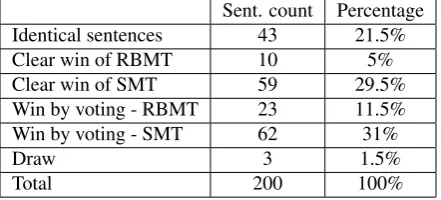
The results of our experiment are summarized in Ta-ble 1. The evaluation has been performed by 5 na-tive speakers of Slovak, the sentences have been ran-domized so that no evaluator could know which of the two systems produced which translation. The evalua-tors were asked to mark which translation they consider to be better. Ties were not allowed, but the evaluators were also asked to mark identical sentences. This re-quirement served also as a kind of thoroughness check, too many unrecognized identical sentences could in-dicate that the evaluator lost concentration during the task.
Sent. count Percentage Identical sentences 43 21.5% Clear win of RBMT 10 5% Clear win of SMT 59 29.5% Win by voting - RBMT 23 11.5% Win by voting - SMT 62 31%
Draw 3 1.5%
[image:4.595.72.293.309.409.2]Total 200 100%
Table 1: Evaluation of results
The rows of Table 1 marked asClear winof one of the systems represent the sentences where none of the evaluators marked the other system as thebetter one. Win by voting does not distinguish how many evalua-tors were against the system marked by the majority as being the better of the two. The 3 sentences in the Draw row represent the cases when 1 or 3 evaluators mistak-enly marked the pair of translations as being identical and there was no majority among the remaining ones.
The results clearly indicate that the quality of Google Translate is better, although it clearly dominates in less than one third of translations. The large number of identical sentences also means that although ˇCes´ılko produced only 5% of translations which were clearly better than those of Google, it reached absolutely iden-tical quality of translation in yet another 21.5%. This actually means that the top quality translations have been achieved in 26.5% by ˇCes´ılko and in 51% by Google Translate. According to our opinion, this ra-tio (approximately 2:1 in favor of the SMT approach) more realistically describes the difference in quality than the ratio of clear wins (approx. 6:1 for Google Translate).
5.1 Errors
This section presents the most obvious errors detected in the evaluation of both systems.
First of all, before we’ll look at individual types of errors of both systems, it is necessary to men-tion one very surprising fact concerning the transla-tions. Although we have expected substantial differ-ences between the corresponding sentdiffer-ences, the trans-lations produced by both systems are surprisingly sim-ilar, 21.5% of them being absolutely identical. On top of that, when we have compared the first 100 translated sentences, we have discovered that the edit distance be-tween the two sets is only 493 elementary operations. Given that the translations produced by Google Trans-late contain 9.653 characters in the first 100 sentences of the test set, this actually represents only about 5% difference.
This looks much more like the results of two variants of the same system than the results of two different sys-tems based upon two completely different paradigms. Because no details about the Google translate for this language pair have been published, it is impossible to judge the reasons for such a similarity. The following example demonstrates this similarity, it represents quite typical example of a long sentence with very few differ-ences between both translations. Errors in translations are stressed by a bold font.
Example 1.
Source: ”V momentˇe, kdy by tˇreba Praha chtˇela pˇrev´est syst´em na Plzeˇnskou kartu ˇci kartu ˇCesk´ych drah, musela by poruˇsit autorsk´y z´akon, protoˇze jedinˇe autor m˚uˇze se softwarem nakl´adat,“ vysvˇetluje mluvˇc´ı EMS.
Google: ”V momente, kedy bypotrebn´ePraha chcela previesˇt syst´em na Plzeˇnsk´u kartu ˇci kartu ˇCesk´ych dr´ah, musela by poruˇsiˇt autorsk´y z´akon, pretoˇze jedine autor mˆoˇze so softv´erom zaobch´adzaˇt,“ vysvetˇluje hovorca EMS.
ˇCes´ılko: ”V momente, kedy by napr´ıklad Praha chcela previesˇt syst´em na Plzensk´u karta ˇci karta ˇCesk´y
dr´ah, musela by poruˇsiˇt autorsk´y z´akon, pretoˇze
jedinˇeautor mˆoˇze so softwaromnakladaˇt,“ vysvetˇluje hovorca EMS.
English translation: ”In the moment when Prague would like for example to transfer the system to Pilsen card or the Czech railways card, it would have to violate the copyright law, because the author is the only person which can modify the software,” explains the speaker of the EMS.
these identical errors simply happen, seems to be too simplistic. Example 2 clearly shows that both systems misinterpreted the Czech adjectivepr´avn´ı(legal) in the context which allowed reading the first three words of the source sentence as ”It is legal” without the regard to the context of the rest of the sentence.
Example 2.
Source:Je to pr´avn´ı, ale i technologick´y probl´em.
Both systems: Je to pr´avne, ale aj technologick´y probl´em.
English:It is a legal, but also a technological problem.
Let us now look at individual categories of errors.
Lexical errors
The most frequent lexical errors are untranslated words. This happens solely in the translations performed by the RBMT system ˇCes´ılko due to inadequate coverage of the wide domain of newspaper articles. Some of the cases of untranslated words may have escaped the evaluator´s attention simply because ˇCes´ılko leaves out-of-the-vocabulary words unchanged. Because Czech and Slovak are really very close also at the lexical level, some of the word forms used in both languages are identical, and thus they fit into the target sentence. Increasing the coverage of the bilingual dictionary (it currently contains about 40,000 lemmas) would definitely improve the translation quality.
Another lexical error produced entirely by the RBMT system is a wrong translation of some irregular words, as in the following example.
Example 3.
Source: Mnoz´ı lid´e si t´emˇeˇr neumˇej´ı pˇredstavit, ˇze by zapomnˇeli sv˚uj rodn´y jazyk.
Google: Mnoh´ıˇludiasi takmer nevedia predstaviˇt, ˇze by zabudli svoj rodn´y jazyk.
ˇCes´ılko: Mnoh´ı ˇcloveksi takmer nevedia pˇredstavit, ˇze by zabudli svoj rodn´y jazyk.
English translation: Many people cannot imagine that they could forget their native language.
The plural of ˇclovˇek [human] is irregular in Czech (lid´e[people]). Although this error looks like a lexical error, it is more likely caused by the conceptual differences between the morphological analysis of Czech (which recognizes the form as a plural of the lemmaˇclovˇek) and the synthesis of Slovak which uses two lemmas instead of one, one for singular (ˇclovek) and one for plural (ˇludia). The Czech plural word form is then never correctly translated to the Slovak plural form.
Much more serious errors are mistranslated words produced by Google Translate. Such errors are quite typical for phrase-based SMT systems. Let us present an example which appeared a couple of times in our
test corpus.
Example 4.
Source: ˇCesk´a veˇrejnost si na omezen´ı zvykla a
vˇetˇsinou je respektuje.
Google:Slovensk´averejnosˇt si na obmedzenie zvykla a v¨aˇcˇsinou je reˇspektuje.
ˇCes´ılko: ˇCesk´yverejnosˇt si na obmedzenie zvykla a v¨aˇcˇsinou ich reˇspektuje.
English translation:Czech public got used to the limits and mostly accepts them.
The incorrect translation of the adjective ˇCesk´a [Czech] as Slovensk´a [Slovak] has most probably been caused by the language model based upon target language text where the occurrences of the adjective Slovak probably vastly outnumber the occurrences of the word Czech. The same incorrect translations appeared also in different contexts in other sentences of the test corpus.
Morphological errors
Both languages are very similar also with regard to the number of inflected word forms derived from one lemma. This property seems to cause certain problems to both systems, as we can see in the Example 5, where both systems use an incorrect (but different) form of the same adjective. It is interesting that in this specific case the correct translation actually means no transla-tion at all because the correct Czech and Slovak forms are identical in this context.
Example 5.
Source: V bˇreznu malajsijsk´e aerolinky pˇriˇsly o Boeing 777 s 239 lidmi na palubˇe, kter´y se ztratil z leteck´ych radar˚u cestou z Kuala Lumpuru do Pekingu.
Google: V marci malajzijsk´eho aerolinky priˇsli o Boeing 777 s 239 ˇluˇdmi na palube, ktor´y sa stratil z leteck´ych radarov cestou z Kuala Lumpur do Pekingu. ˇCes´ılko: V marcimalajsijsk´yaerolinky priˇsli o Boeing 777 s 239 ˇclovek na palube, ktor´y sa stratil z leteck´ych radarov cestou z Kuala Lumpuru do Pekingu.
English translation: In March, Malaysian Airlines lost Boeing 777 with 239 people on board, which got lost from air radars on the way from Kuala Lumpur to Bei-jing.
Although the morphological errors have a negative influence on automatic measures like BLEU or NIST (incorrect form of a correct word influences the score to the same extent as completely incorrect word), they usually do not change the meaning of the translated sentence and the speakers of the target language can easily reconstruct their correct form and understand the translation. From this point of view both systems perform very well because the relatively low number of incorrect word forms produced by both systems doesn’t reach the threshold when the sentence as a whole would be unintelligible.
Word order
of source sentences. This is not surprising in the case of the RBMT system, because its simple architecture is exploiting the fact that the word order of both lan-guages is extremely similar. As we have already men-tioned in the section 3, ˇCes´ılko translates word by word. The strict correspondence of the word order of source and target sentences is a bit more surprising in the case of the SMT system, whose language model is probably based on a large volume of texts with a wide variety of word order variants. Czech and Slovak lan-guages both have very few restrictions on the order of words and thus we have supposed that the translated sentences might have an altered word order compared to the source sentences. The only difference in the or-der of words appeared in the sentence presented below, where the RBMT system followed the original word or-der strictly, while the SMT system made changes (ac-ceptable ones) to the order of clitics.
Example 6.
Source:Aˇckoli vyˇsetˇrovatel´e uˇz jsou si jisti, ˇze stroj se odklonil ze sv´e trasy a zˇr´ıtil se pravdˇepodobnˇe po dlouh´em letu nad Indick´ym oce´anem, nevˇed´ı dodnes, co bylo pˇr´ıˇcinou nehody a nenaˇsli ani trosky stroje.
Google: Hoci vyˇsetrovatelia s´u si uˇz ist´ı, ˇze stroj sa odklonil zo svojej trasy a zr´util sa pravdepodobne po dlhom lete nad Indick´ym oce´anom, nevedia dodnes, ˇco bolo pr´ıˇcinou nehody a nenaˇsli ani trosky stroja.
ˇCes´ılko: B´ars vyˇsetrovatelia uˇz s´u si ist´ı, ˇze stroj sa odklonil zo svojej trasy a zr´util sa pravdepodobne po dlhom lete nad Indick´ym oce´anom, nevedia dodnes, ˇco bolo pr´ıˇcinou nehody a nenaˇsli ani trosky stroja. English translation:Although the investigators are now sure that the plane swerved from its path and fell down probably after a long flight over the Indian ocean, they didn’t find out till today what was the cause of the accident and they even didn’t find any remains of the plane.
Syntactic errors
There are no errors which could be classified as purely violating the syntax of the target language. The use of an incorrect form of direct or indirect object can be attributed to the category of morphological errors, be-cause neither of the two systems deals with syntax di-rectly. The RBMT system ignores syntax on the basis of the fact that both languages are syntactically very similar; the SMT system probably primarily relies on phrases discovered in large volumes of training data and thus it takes the syntactic rules into account only indirectly.
Errors in meaning
There were very few errors in incorrectly translated meaning of the source sentence into the target one. Although some SMT systems are infamous for issues related to the preservation of negated expressions, the only two examples of such errors were produced by the RBMT system in our tests. The sentence which was affected by this error to a greater extent is listed below.
No other errors in the translation of the original mean-ing have been encountered in our tests.
Source: Veden´ı ˇskoly odpov´ıd´a na nˇekter´e ofici´aln´ı dotazy rodiˇc˚u aˇz po opakovan´e urgenci a chov´an´ı ˇreditelky Kozohorsk´e je podle slov rodiˇc˚u alibistick´e, nevstˇr´ıcn´e a nezˇr´ıdka arogantn´ı.
Google: Vedenie ˇskoly odpoved´a na niektor´e ofici´alne ot´azky rodiˇcov aˇz po opakovanej urgencii a spr´avanie riaditeˇlky Kozohorsk´y je podˇla slov rodiˇcov alibistick´e,
nevstˇr´ıcn´e a nezriedkaarogantn´y.
ˇCes´ılko: Vedenie ˇskoly odpoved´a na niektor´ych ofici´alne ot´azky rodiˇcov aˇz po opakovanej urgencii a chovan´ı ˇreditelka Kozohorsk´y je podˇla slov rodiˇcov alibistick´e,vstˇr´ıcn´y a zriedkaarogantn´ı.
English translation: The school management answers some official questions of parents after repeated reminders and the behavior of director Kozohorsk´a is, in the words of parents, buck-passing, unresponsive and often arrogant.
The sentence produced by ˇCes´ılko has lost two nega-tions making the behavior of the director responsive and seldom arrogant. This is probably caused by the fact that both the positive and negative forms have the same lemma - the negation constitutes only a small part of the morphological tag7and thus it may easily be
for-gotten or lost in the process of transfer of a Czech tag into a Slovak one (a different system of tags is used for Slovak).
6 Conclusions and further work
Although our experiment represents only the first step in systematic evaluation of machine translation re-sults between closely related languages, it has already brought very interesting results. It has shown that con-trary to a popular belief that RBMT methods are more suitable for MT of closely related languages, Google Translate outperforms the RBMT system ˇCes´ılko. The similarity of source and target language apparently not only allows much simpler architecture of the RBMT system, it also improves the chances of SMT systems to generate good quality translation, although this re-sults need further examination.
The most surprising result of our experiment is the high number of identical translations produced by both systems not only for short simple sentences, but also for some of the long ones, as well as very similar results produced for the rest of the test corpus. The minimal differences between two systems exploiting different paradigms deserve further experiments. These exper-iments will involve a phrase-based SMT system based on Moses (in this way we are going to guarantee that we are really comparing two different paradigms) and we will investigate its behavior on the same language pair. A second interesting experimental direction will
7ˇCes´ılko exploits a positional system of morphological
be the investigation whether the results for another pair of languages related not so closely as Czech and Slovak would confirm the results obtained in this experiment.
References
Lars Ahrenberg and Maria Holmqvist. 2004. Back to the Future? The Case for English-Swedish Direct Machine Translation. InProceedings of The Confer-ence on Recent Advances in Scandinavian Machine Translation. University of Uppsala.
Kemal Altintas and Ilyas Cicekli. 2002. A Machine Translation System between a Pair of Closely Re-lated Languages. InProceedings of the 17th Inter-national Symposium on Computer and Information Sciences (ISCIS 2002), page 5. CRC Press.
Eckhard Bick and Lars Nygaard. 2007. Using Danish as a CG Interlingua: A Wide-Coverage Norwegian-English Machine Translation System. In Proceed-ings of NODALIDA, Tartu. University of Tartu.
Ondˇrej Bojar, Christian Buck, Chris Callison-Burch, Christian Federmann, Barry Haddow, Philipp Koehn, Christof Monz, Matt Post, Radu Soricut, and Lucia Specia. 2013. Findings of the 2013 Work-shop on Statistical Machine Translation. In 2013 Workshop on Statistical Machine Translation, pages 1–44.
Chris Callison-Burch, Miles Osborne, and Philipp Koehn. 2006. Re-evaluating the role of BLEU in machine translation research. InProceedings of EACL, pages 249–256. Association for Computa-tional Linguistics.
Antonio M Corbi-Bellot, Mikel L Forcada, and Ser-gio Ortiz-Rojas. 2005. An open-source shallow-transfer machine translation engine for the Romance languages of Spain. In Proceedings of the EAMT conference, pages 79–86. HITEC e.V.
Helge Dyvik. 1995. Exploiting Structural Similarities in Machine Translation. Computers and Humani-ties, 28:225–245.
Jan Hajiˇc, Jan Hric, and Vladislav Kuboˇn. 2000. Machine translation of very close languages. In
Proceedings of the 6th Applied Natural Language Processing Conference, pages 7–12. Association for Computational Linguistics.
Jan Hajiˇc, Petr Homola, and Vladislav Kuboˇn. 2003. A simple multilingual machine translation system. In Eduard Hovy and Elliott Macklovitch, editors,
Proceedings of the MT Summit IX, pages 157–164, New Orleans, USA. AMTA.
Petr Homola and Vladislav Kuboˇn. 2008. A method of hybrid MT for related languages. InProceedings of the IIS, pages 269–278. Academic Publishing House EXIT.
Petr Homola and Jernej Viˇciˇc. 2010. Com-bining MT Systems Effectively. In Proceed-ings of the 23th International Florida-Artificial-Intelligence-Research-Society Conference (FLAIRS 2010), pages 198–203, Daytona Beach, Florida, USA. Florida{AI}Research Society, Florida AI Re-search Society.
David Kolovratnık, Natalia Klyueva, and Ondrej Bo-jar. 2009. Statistical machine translation between related and unrelated languages. InProceedings of the Conference on Theory and Practice on Informa-tion Technologies, pages 31–36.
NIST. 2009. NIST 2009 Open Machine Translation Evaluation (MT09). Technical report, NIST. Karel Oliva. 1989. A Parser for Czech Implemented in
Systems Q.MFF UK Prague.
Kishore Papineni, Salim Roukos, Todd Ward, and Wei-Jing Zhu. 2001. BLEU: a method for automatic evaluation of machine translation. Technical report, IBM.
Kevin P Scannell. 2006. Machine translation for closely related language pairs. In Proceedings of the Workshop Strategies for developing machine translation for minority languages, pages 103–109. Genoa, Italy.
Francis M Tyers, Linda Wiechetek, and Trond Trosterud. 2009. Developing prototypes for ma-chine translation between two S´ami languages. In
Proceedings of EAMT. HITEC e.V.
Jernej Viˇciˇc. 2008. Rapid development of data for shallow transfer RBMT translation systems for highly inflective languages. InLanguage technolo-gies: proceedings of the conference, pages 98–103. Institut Joˇzef Stefan, Ljubljana.