Is the Stanford Dependency Representation Semantic?
Rachel Rudinger1 and Benjamin Van Durme1,2Center for Language and Speech Processing1 Human Language Technology Center of Excellence2
Johns Hopkins University
[email protected], [email protected]
Abstract
The Stanford Dependencies are a deep syntactic representation that are widely used for semantic tasks, like Recognizing Textual Entailment. But do they capture all of the semantic information a meaning representation ought to convey? This pa-per explores this question by investigating the feasibility of mapping Stanford depen-dency parses to Hobbsian Logical Form, a practical, event-theoretic semantic rep-resentation, using only a set of determin-istic rules. Although we find that such a mapping is possible in a large number of cases, we also find cases for which such a mapping seems to require information be-yond what the Stanford Dependencies en-code. These cases shed light on the kinds of semantic information that are and are not present in the Stanford Dependencies.
1 Introduction
The Stanford dependency parser (De Marneffe et al., 2006) provides “deep” syntactic analysis of natural language by layering a set of hand-written post-processing rules on top of Stanford’s sta-tistical constituency parser (Klein and Manning, 2003). Stanford dependency parses are commonly used as a semantic representation in natural lan-guage understanding and inference systems.1 For
example, they have been used as a basic meaning representation for the Recognizing Textual Entail-ment task proposed by Dagan et al. (2005), such as by Haghighi et al. (2005) or MacCartney (2009) and in other inference systems (Chambers et al., 2007; MacCartney, 2009).
Because of their popular use as a semantic rep-resentation, it is important to ask whether the Stan-ford Dependencies do, in fact, encode the kind of 1Statement presented by Chris Manning at the
*SEM 2013 Panel on Language Understanding http://nlpers.blogspot.com/2013/07/the-sem-2013-panel-on-language.html.
information that ought to be present in a versa-tile semantic form. This paper explores this ques-tion by attempting to map the Stanford Depen-dencies into Hobbsian Logical Form (henceforth, HLF), a neo-Davidsonian semantic representation designed for practical use (Hobbs, 1985). Our ap-proach is to layer a set of hand-written rules on top of the Stanford Dependencies to further trans-form the representation into HLFs. This approach is a natural extension of the Stanford Dependen-cies which are, themselves, derived from manually engineered post-processing routines.
The aim of this paper is neither to demonstrate the semantic completeness of the Stanford Depen-dencies, nor to exhaustively enumerate their se-mantic deficiencies. Indeed, to do so would be to presuppose HLF as an entirely complete seman-tic representation, or, a perfect semanseman-tic standard against which to compare the Stanford Dependen-cies. We make no such claim. Rather, our intent is to provide a qualitative discussion of the Stanford Dependencies as a semantic resource through the lens of this HLF mapping task. It is only necessary that HLF capture some subset of important seman-tic phenomena to make this exercise meaningful.
Our results indicate that in a number of cases, it is, in fact, possible to directly derive HLFs from Stanford dependency parses. At the same time, however, we also find difficult-to-map phenomena that reveal inherent limitations of the dependen-cies as a meaning representation.
2 Background
This section provides a brief overview of the HLF and Stanford dependency formalisms.
2.1 Hobbsian Logical Form
The key insight of event-theoretic semantic repre-sentations is the reification of events (Davidson, 1967), or, treating events as entities in the world. As a logical, first-order representation, Hobbsian
Logical Form (Hobbs, 1985) employs this ap-proach by allowing for the reification ofany pred-icate into an event variable. Specifically, for any predicatep(x1,· · · , xn), there is a corresponding predicate, p0(E, x1,· · ·, xn), where E refers to the predicate (or event)p(x1,· · ·, xn). The reified predicates are related to their non-reified forms with the following axiom schema:
(∀x1· · ·xn)p(x1· · ·xn) ↔ (∃e)Exist(e) ∧
p0(e, x1· · ·xn)
In HLF, “A boy runs” would be represented as:
(∃e, x)Exist(e)∧run0(e, x)∧boy(x)
and the sentence “A boy wants to build a boat quickly” (Hobbs, 1985) would be represented as:
(∃e1, e2, e3, x, y)Exist(e1) ∧want0(e1, x, e2)∧
quick0(e2, e3)∧build0(e3, x, y)∧boy(x)∧boat(y)
2.2 Stanford Dependencies
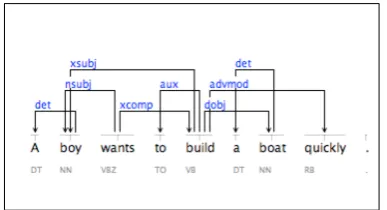
[image:2.595.85.279.501.606.2]A Stanford dependency parse is a set of triples consisting of two tokens (agovernorand a depen-dent), and a labeled syntactic or semantic relation between the two tokens. Parses can be rendered as labeled, directed graphs, as in Figure 1. Note that this paper assumes the collapsed version of the Stanford Dependencies.2
Figure 1: Dependency parse of “A boy wants to build a boat quickly.”
3 Mapping to HLF
We describe in this section our deterministic algo-rithm for mapping Stanford dependency parses to HLF. The algorithm proceeds in four stages:event 2The collapsed version is more convenient for our
pur-poses, but using the uncollapsed version would not signifi-cantly affect our results.
extraction, argument identification, predicate-argument assignment, and formula construction. We demonstrate these steps on the above example sentence “A boy wants to build a boat quickly.”3
The rule-based algorithm operates on the sen-tence level and is purely a function of the depen-dency parse or other trivially extractible informa-tion, such as capitalization.
3.1 Event Extraction
The first step is to identify the set of event predi-cates that will appear in the final HLF and assign an event variable to each. Most predicates are gen-erated by a single token in the sentence (e.g., the main verb). For each token tin the sentence, an event(ei, pt)(whereeiis the event variable andpt is the predicate) is added to the set of events if any of the following conditions are met:
1. t is the dependent of the relation root,
ccomp, xcomp, advcl, advmod, or
partmod.
2. tis the governor of the relationnsubj,dobj,
ccomp, xcomp, xsubj, advcl, nsubjpass,
oragent.
Furthermore, an event(ei, pr)is added for any triple (rel, gov, dep) where rel is prefixed with “prep ” (e.g.,prep to,prep from,prep by, etc.). Applying this step to our example sentence “A boy wants to build a boat quickly.” yields the fol-lowing set:
(e1, wants),(e2, quickly),(e3, build)
3.2 Argument Identification
Next, the set of entities that will serve as predicate arguments are identified. Crucially, this set will include some event variables generated in the pre-vious step. For each token,t, an argument(xi, t) is added to the set of arguments if one of the fol-lowing conditions is met:
1. t is the dependent of the relation nsubj,
xsubj, dobj, ccomp, xcomp, nsubjpass,
agent, oriobj.
2. t is the governor of the relation advcl,
advmod, orpartmod.
3Hobbs (1985) uses the example sentence “A boy wanted
Applying this step to our example sentence, we get the following argument set:
(x1, boat),(x2, build),(x3, boy)
Notice that the token buildhas generated both an event predicate and an argument. This is be-cause in our final HLF,buildwill be both an event predicate that takes the arguments boy and boat, as well as an argument to the intensional predicate
want.
3.3 Predicate-Argument Assignment
In this stage, arguments are assigned to each pred-icate. pt.argi denotes the ith argument of pred-icatept andarg(t) denotes the argument associ-ated with tokent. For example, arg(boy) = x2
andarg(quickly) = e3. We also say that if the
tokent1 governst2 by some relation, e.g. nsubj,
thent1nsubj-governst2, ort2nsubj-depends on
t1. Note thatargirefers to any slot pastarg2. Ar-guments are assigned as follows.
For each predicate pt (corresponding to token
t):
1. If there is a token t0 such that t nsubj-,
xsubj-, oragent-governst0, thenpt.arg1 =
arg(t0).
2. If there is a tokent0such thatt dobj-governs
t0, thenp
t.arg2=arg(t0).
3. If there is a tokent0 such thatt nsubjpass -governst0, thenpt.argi =arg(t0).
4. If there is a token t0 such that t partmod -depends ont0, thenpt.arg2=arg(t0). 5. If there is a tokent0 such thatt iobj-governs
t0, thenpt.argi=arg(t0).
6. If there is a token t0 such that t ccomp- or
xcomp-governst0, thenp
t.argi=arg(t0) (a) UNLESS there is a token t00 such that
t0 advmod-governs t00, in which case
pt.argi=arg(t00).
7. If there is a tokent0 such thatt advmod- or
advcl-depends ont0, thenpt.argi =arg(t0).
And for each pr generated from relation
(rel, gov, dep)(i.e. all of the “prep ” relations):
1. pr.arg1=arg(gov) 2. pr.argi=arg(dep)
After running this stage on our example sen-tence, the predicate-argument assignments are as follows:
wants(x3, e2), build(x3, x1), quickly(e3)
Each predicate can be directly replaced with its reified forms (i.e.,p0):
wants0(e
1, x3, e2),build0(e3, x3, x1),
quickly0(e2, e3)
Two kinds of non-eventive predicates still need to be formed. First, every entity (xi, t) that is neither a reified event nor a proper noun, e.g.,
(x3, boy), generates a predicate of the formt(xi).
Second, we generate Hobbs’s Exist predicate, which identifies which event actually occurs in the “real world.” This is simply the event generated by the dependent of therootrelation.
3.4 Formula Construction
In this stage, the final HLF is pieced together. We join all of the predicates formed above with the and conjunction, and existentially quantify over every variable found therein. For our example sen-tence, the resulting HLF is:
A boy wants to build a boat quickly.
(∃e1, e2, e3, x1, x3)[Exist(e1)∧boat(x1)∧
boy(x3)∧wants0(e1, x3, e2)∧build0(e3, x3, x1)
∧quickly0(e
2, e3)]
4 Analysis of Results
This section discusses semantic phenomena that our mapping does and does not capture, providing a lens for assessing the usefulness of the Stanford Dependencies as a semantic resource.
4.1 Successes
Formulas 1-7 are correct HLFs that our mapping rules successfully generate. They illustrate the di-versity of semantic information that is easily re-coverable from Stanford dependency parses.
with arbitrary combinations of the above phenom-ena.
A boy builds a boat.
(∃e1, x1, x2)[Exist(e1)∧boy(x2)∧boat(x1)
∧builds0(e
1, x2, x1)] (1)
A boat was built by a boy.
(∃e1, x1, x2)[Exist(e1)∧boat(x2)∧boy(x1)
∧built0(e
1, x1, x2)] (2)
John gave Mary a boat.
(∃e1, x1)[Exist(e1)∧boat(x1)
∧gave0(e1, John, x1, Mary)]
(3)
John built a boat quickly.
ORJohn quickly built a boat.
(∃e1, e2, x1)[Exist(e1) ∧ boat(x1) ∧
quickly(e2, e1)∧built0(e1, John, x1)] (4)
John told Mary that a boy built a boat.
(∃e1, e2, x1, x4)[Exist(e1)∧boy(x1)∧boat(x4)∧
built0(e2, x1, x4)∧told0(e1, John, Mary, e2)]
(5)
John told Mary that Sue told Joe that Adam loves Eve.
(∃e1, e2, e3)[Exist(e1)∧told0(e2, Sue, Joe, e3)∧
loves0(e
3, Adam, Eve) ∧
told0(e1, John, Mary, e2)] (6)
John was told by Mary that Sue wants Joe to build a boat quickly.
(∃e1, e2, e3, e4, x7)[Exist(e1) ∧ boat(x7) ∧
build0(e
2, Joe, x7)∧told0(e1, Mary, John, e4)∧
wants0(e4, Sue, e3)∧quickly0(e3, e2)]
(7)
4.2 Limitations
Though our mapping rules enable us to directly ex-tract deep semantic information directly from the Stanford dependency parses in the above cases, there are a number of difficulties with this ap-proach that shed light on inherent limitations of the Stanford Dependencies as a semantic resource. A major such limitation arises in cases of event nominalizations. Because dependency parses are syntax-based, their structures do not distinguish between eventive noun phrases like “the bombing of the city” and non-eventive ones like “the mother of the child”; such a distinction, however, would be found in the corresponding HLFs.
Certain syntactic alternations also prove prob-lematic. For example, the dependency structure does not recognize that “window” takes the same semantic role in the sentences “John broke the mir-ror.” and “The mirror broke.” The use of addi-tional semantic resources, like PropBank (Palmer et al., 2005), would be necessary to determine this.
Prepositional phrases present another problem for our mapping task, as the Stanford dependen-cies will typically not distinguish between PPs indicating arguments and adjuncts. For exam-ple, “Mary stuffed envelopes with coupons” and “Mary stuffed envelopes with John” have identical dependency structures, yet “coupons” and “John” are (hopefully for John) taking on different seman-tic roles. This is, in fact, a prime example of how Stanford dependency parses may resolve syntactic ambiguity without resolving semantic ambiguity.
Of course, one might manage more HLF cov-erage by adding more rules to our system, but the limitations discussed here are fundamental. If two sentences have different semantic interpretations but identical dependency structures, then there can beno deterministic mapping rule (based on depen-dency structure alone) that yields this distinction.
5 Conclusion
We have presented here our attempt to map the Stanford Dependencies to HLF via a second layer of hand-written rules. That our mapping rules, which are purely a function of dependency struc-ture, succeed in producing correct HLFs in some cases is good evidence that the Stanford Depen-dencies do contain some practical level of seman-tic information. Nevertheless, we were also able to quickly identify aspects of meaning that the Stan-ford Dependencies did not capture.
Our argument does not require that HLF be an optimal representation, only that it capture worth-while aspects of semantics and that it not be read-ily derived from the Stanford representation. This is enough to conclude that the Stanford Dependen-cies are not complete as a meaning representation. While not surprising (as they are intended as a syntactic representation), we hope this short study will help further discussion on what the commu-nity wants or needs in a meaning representation: what gaps are acceptable, if any, and whether a more “complete” representation is needed.
Acknowledgments
References
Nathanael Chambers, Daniel Cer, Trond Grenager, David Hall, Chloe Kiddon, Bill MacCartney, Marie-Catherine de Marneffe, Daniel Ramage, Eric Yeh, and Christopher D Manning. 2007. Learning align-ments and leveraging natural logic. InProceedings of the ACL-PASCAL Workshop on Textual Entail-ment and Paraphrasing, pages 165–170. Associa-tion for ComputaAssocia-tional Linguistics.
Ido Dagan, Oren Glickman, and Bernardo Magnini. 2005. The pascal recognising textual entailment challenge. In Proceedings of the PASCAL Chal-lenges Workshop on Recognising Textual Entail-ment.
Donald Davidson. 1967. The logical form of action sentences. In The Logic of Decision and Action, pages 81–120. Univ. of Pittsburgh Press.
Marie-Catherine De Marneffe, Bill MacCartney, and Christopher D Manning. 2006. Generating typed dependency parses from phrase structure parses. In Proceedings of LREC, volume 6, pages 449–454. Aria D Haghighi, Andrew Y Ng, and Christopher D
Manning. 2005. Robust textual inference via graph matching. InProceedings of the conference on Hu-man Language Technology and Empirical Methods in Natural Language Processing, pages 387–394. Association for Computational Linguistics.
Jerry R Hobbs. 1985. Ontological promiscuity. In Proceedings of the 23rd annual meeting on Associ-ation for ComputAssoci-ational Linguistics, pages 60–69. Association for Computational Linguistics.
Dan Klein and Christopher D Manning. 2003. Ac-curate unlexicalized parsing. InProceedings of the 41st Annual Meeting on Association for Computa-tional Linguistics-Volume 1, pages 423–430. Asso-ciation for Computational Linguistics.
Bill MacCartney. 2009. Natural language inference. Ph.D. thesis, Stanford University.