Parallel FDA5 for Fast Deployment of Accurate
Statistical Machine Translation Systems
Ergun Bic¸iciCentre for Next Generation Localisation School of Computing Dublin City University
Qun Liu
Centre for Next Generation Localisation School of Computing
Dublin City University [email protected]
Andy Way
Centre for Next Generation Localisation School of Computing
Dublin City University [email protected]
Abstract
We use parallel FDA5, an efficiently pa-rameterized and optimized parallel im-plementation of feature decay algorithms for fast deployment of accurate statistical machine translation systems, taking only about half a day for each translation di-rection. We build Parallel FDA5 Moses SMT systems for all language pairs in the WMT14 translation task and obtain SMT performance close to the top Moses systems with an average of 3.49 BLEU points difference using significantly less resources for training and development.
1 Introduction
Parallel FDA5 is developed for fast deployment of accurate statistical machine translation systems using an efficiently parameterized and optimized parallel implementation of feature decay algo-rithms (Bic¸ici and Yuret, 2014). Parallel FDA5 takes about half a day for each translation direc-tion. We achieve SMT performance that is on par with the top constrained Moses SMT systems.
Statistical machine translation (SMT) is a data intensive problem. If you have the translations for the source sentences you are translating in your training set or even portions of it, then the trans-lation task becomes easier. If some tokens are not found in the training data then you cannot trans-late them and if some transtrans-lated word do not ap-pear in your language model (LM) corpus, then it becomes harder for the SMT engine to find its cor-rect position in the translation. The importance of parallel FDA5 increases with the proliferation of training material available for building SMT sys-tems. Table 2 presents the statistics of the avail-able training and LM corpora for the constrained (C) systems as well as the statistics of the Parallel FDA5 selected training and LM corpora.
Parallel FDA5 runs separate FDA5 models on randomized subsets of the training data and com-bines the selections afterwards. We run parallel FDA5 SMT experiments using Moses (Koehn et al., 2007) in all language pairs in WMT14 (Bojar et al., 2014) and obtain SMT performance close to the top constrained Moses systems training using all of the training material. Parallel FDA5 allows rapid prototyping of SMT systems for a given tar-get domain or task and can be very useful for MT in target domains with limited resources or in dis-aster and crisis situations (Lewis et al., 2011).
2 Parallel FDA5 for Instance Selection 2.1 FDA5
FDA is developed mainly for building high per-formance SMT systems using fewer yet relevant data that is selected for increasing the coverage of the test set features while maximizing their diver-sity (Bic¸ici and Yuret, 2011; Bic¸ici, 2011). Par-allel FDA parPar-allelize instance selection and sig-nificantly reduces the time to deploy accurate MT systems in the presence of large training data from weeks to half a day and still achieve state-of-the-art SMT performance (Bic¸ici, 2013). FDA5 is developed for efficient parameterization, opti-mization, and implementation of FDA (Bic¸ici and Yuret, 2014). FDA5 can be used in both trans-ductive learning scenarios where test set is used to select the training data or in active learning sce-narios where training set itself is used to obtain a sorting of the training data and select.
We run transductive learning experiments in this work such that the instance selection is per-formed for the given test set. According to SMT experiments performed on the2million sen-tence English-German section of the Europarl cor-pus (Bic¸ici and Yuret, 2014), FDA5 can increase the performance by0.41BLEU points compared to using all of the available training data and by
Algorithm 1:Parallel FDA5
Input: Parallel training sentencesU, test set featuresF, and desired number of training instancesN.
Output: Subset of the parallel sentences to be used as the training dataL ⊆ U. 1 U ←shuffle(U)
2 UUU, M ←split(U, N) 3 L← {}
4 foreachUi∈ UUU do
5 hLi,sii ←FDA5(Ui,F, M) 6 L←L∪ hLi,sii
7 L ←merge(L)
3.22BLEU points compared to random selection. FDA5 is also used for selecting the training set in the WMT14 medical translation task (Calixto et al., 2014) and the tuning set in the WMT14 German-English translation task (Li et al., 2014).
FDA5 has 5 parameters that effect the instance scores based on the three formulas used:
• Initialization:
init(f) = log(|U|/CU(f))i|f|l (1)
• Decay:
decay(f) =init(f)(1+CL(f))−cdCL(f)
(2)
• Sentence score:
sentScore(S) = |S1|s X
f∈F(S)
fvalue(f)
(3)
CL(f) returns the count of feature f inL. d
is the feature score polynomial decay factor,cis the feature score exponential decay factor, s is the sentence score length exponent,iis the initial feature score idf exponent, and l is the initial feature score n-gram length exponent. FDA5 is available at http://github.com/bicici/FDA
and the FDA5 optimizer is available at
http://github.com/bicici/FDAOptimization.
2.2 Parallel FDA5
Parallel FDA5 (ParFDA5) is presented in Algo-rithm 1, which first shuffles the training sentences,
U and runs individual FDA5 models on the multi-ple splits from which equal number of sentences,
M, are selected. We use ParFDA5 for select-ing parallel trainselect-ing data and LM data for build-ing SMT systems. merge combinesksorted ar-rays,Li, into one sorted array inO(Mklogk)
us-ing their scores,si, whereMkis the total number
of elements in all of the input arrays.1 ParFDA5
makes FDA5 more scalable to domains with large training corpora and allows rapid deployment of SMT systems. By selecting from random splits of the original corpus, we work with differentn-gram feature distributions in each split and prevent fea-ture values from becoming negligible, which can enhance the diversity.
2.3 Language Model Data Selection
We select the LM training data with ParFDA5 based on the following observation (Bic¸ici, 2013):
No word not appearing in the training set can appear in the translation.
It is impossible for an SMT system to translate a word unseen in the training corpus nor can it trans-late it with a word not found in the target side of the training set 2. Thus we are only interested
in correctly ordering the words appearing in the training corpus and collecting the sentences that contain them for building the LM. At the same time, a compact and more relevant LM corpus is also useful for modeling longer range dependen-cies with higher order n-gram models. We use 1-gram features for LM corpus selection since we don’t know which phrases will be generated by the translation model. After the LM corpus selection, the target side of the parallel training data is added to the LM corpus.
3 Results
We run ParFDA5 SMT experiments for all lan-guage pairs in both directions in the WMT14 translation task (Bojar et al., 2014), which include English-Czech (en-cs), English-German (en-de), English-French (en-fr), English-Hindi (en-hi), and English-Russian (en-ru). We true-case all of the corpora, use 150-best lists during tuning, set the LM order to a value between7and10for all lan-guage pairs, and train the LM using SRILM (Stol-cke, 2002). We set the maximum sentence length filter to126and for GIZA++ (Och and Ney, 2003),
S→T Data #word S (M) #word T (M)Training Data#sent (K) SCOV TCOV #word (M)LM DataTCOV
en-cs C 253.5 223.4 16068 0.8282 0.7046 717.0 0.8539
en-cs ParFDA5 22.0 19.6 1205 0.8161 0.6062 325.8 0.8238
cs-en C 223.4 253.5 16068 0.7046 0.8282 5541.9 0.9552
cs-en ParFDA5 19.3 22.0 1205 0.7046 0.7581 351.0 0.9132
en-de C 116.0 109.5 4511 0.812 0.7101 1573.8 0.8921
en-de ParFDA5 16.7 16.8 845 0.8033 0.6316 206.9 0.8184
de-en C 109.5 116.0 4511 0.7101 0.812 5446.8 0.9525
de-en ParFDA5 17.8 19.6 845 0.7087 0.753 339.5 0.9082
en-fr C 1096.1 1287.8 40344 0.8885 0.9163 2534.5 0.9611
en-fr ParFDA5 22.6 26.6 1008 0.8735 0.8412 737.4 0.9491
fr-en C 1287.8 1096.1 40344 0.9163 0.8885 6255.8 0.9675
fr-en ParFDA5 20.9 19.3 1008 0.8963 0.7845 463.4 0.9282
en-hi C 3.4 5.0 306 0.5467 0.5986 36.3 0.7972
en-hi ParFDA5 3.3 4.9 254 0.5467 0.5976 41.2 0.8115
hi-en C 5.0 3.4 306 0.5986 0.5467 5350.4 0.9473
hi-en ParFDA5 5.0 3.3 284 0.5985 0.5466 966.8 0.9209
en-ru C 49.6 46.1 2531 0.7992 0.6823 590.8 0.8679
en-ru ParFDA5 19.6 18.6 1107 0.7991 0.6388 282.1 0.8447
ru-en C 46.1 49.6 2531 0.6823 0.7992 5380.6 0.9567
[image:3.595.97.506.61.285.2]ru-en ParFDA5 16.6 19.4 1107 0.6821 0.7586 225.1 0.9009
Table 2: The data statistics for the available training and LM corpora for the constrained (C) submissions compared with the ParFDA5 selected training and LM corpora statistics. #words is in millions (M) and #sents is in thousands (K).
S→T d c s i l
Training,
n
=
2
en-de 1.0 0.5817 1.4176 5.0001 -3.154 de-en 1.0 1.0924 1.3604 5.0001 -4.341 en-cs 1.0 0.0676 0.8299 5.0001 -0.8788 cs-en 1.0 1.5063 0.7777 3.223 -2.3824 en-ru 1.0 0.6519 1.6877 5.0001 -1.1888 ru-en 1.0 1.607 3.0001 0.0 -1.8247 en-hi 1.0 3.0001 3.0001 1.5701 -1.5699 hi-en 1.0 0.0 1.1001 5.0001 -0.8264 en-fr 1.0 0.8143 0.801 3.5996 -1.3394 fr-en 1.0 0.19 1.0106 5.0001 1.238
LM,
n
=
1
en-de 1.0 0.1924 1.0487 5.0001 4.9404 de-en 1.0 1.7877 3.0001 3.1213 -0.4147 en-cs 1.0 0.4988 1.1586 5.0001 -5.0001 cs-en 0.9255 0.2787 0.7439 3.7264 -2.0564 en-ru 1.0 1.4419 2.239 1.5543 -0.5097 ru-en 1.0 2.4844 3.0001 4.6669 3.7978 en-hi 1.0 0.0 0.0 5.0001 -4.944 hi-en 1.0 0.3053 3.0001 5.0001 4.1216 en-fr 1.0 3.0001 2.0452 3.0229 3.4364 fr-en 1.0 0.7467 0.7641 5.0001 5.0001
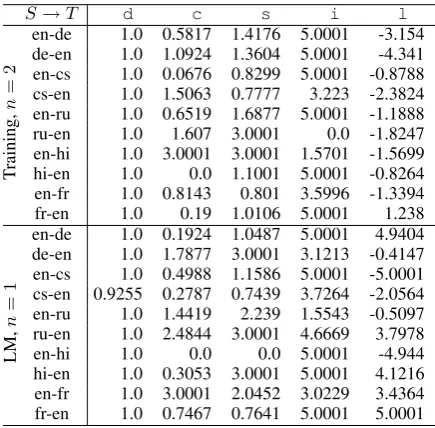
Table 1: Optimized ParFDA5 parameters for se-lecting the training set using 2-grams or the LM corpus using1-grams.
max-fertility is set to 10, with the number of itera-tions set to 7,3,5,5,7 for IBM models 1,2,3,4, and the HMM model and 70 word classes are learned over 3 iterations with the mkcls tool during train-ing. The development set contains5000sentences, 2000 of which are randomly sampled from pre-vious years’ development sets (2008-2012) and 3000come from the development set for WMT14.
3.1 Optimized ParFDA5 Parameters
Table 1 presents the optimized ParFDA5 parame-ters obtained using the development set. Transla-tion direcTransla-tion specific differences are visible. A negative value for l shows that FDA5 prefers shorter features, which we observe mainly when the target language is English. We also observe higher exponential decay rates when the target lan-guage is mainly English. For optimizing the pa-rameters for selecting LM corpus instances, we still use a parallel corpus and instead of optimiz-ing for TCOV, we optimize for SCOV such that we select instances that are relevant for the target training corpus but still maximize the coverage of source features and be able to represent the source sentences within a translation task. The selected LM corpus is prepared for a translation task.
3.2 Data Selection
[image:3.595.71.289.350.564.2]se-S→T ParFDA5 Time (Min)Moses Overall Space (MB)Moses Train LM Total Train Tune Total PT LM ALL en-cs 5 28 34 375 702 1162 1196 1871 5865 19746 cs-en 7 65 72 358 448 867 939 1808 4906 18650 en-de 8 29 38 302 1059 1459 1497 1676 2923 18313 de-en 8 85 93 358 474 924 1017 1854 5219 19247 en-fr 23 60 84 488 781 1372 1456 2309 9577 24362 fr-en 21 99 120 315 490 897 1017 1845 4888 17466
en-hi 2 9 11 91 366 511 522 269 817 4292
hi-en 1 36 37 91 330 467 504 285 9697 3845
en-ru 11 25 35 358 369 837 872 2174 4770 21283 ru-en 10 62 71 309 510 895 966 1939 2735 19537
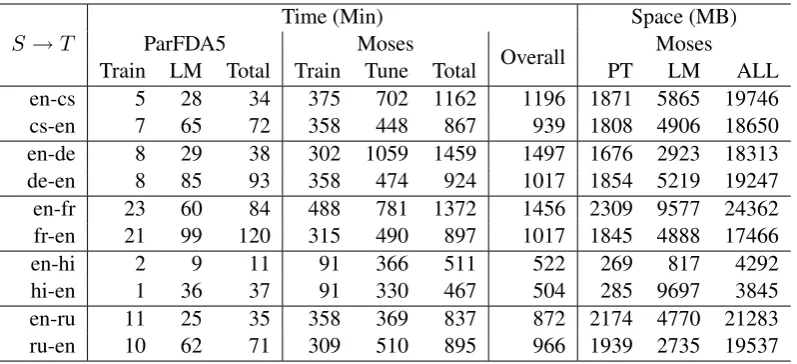
Table 3: The space and time required for building the ParFDA5 Moses SMT systems. The sizes are in MB and time in minutes. PT stands for the phrase table. ALL does not contain the size of the LM.
BLEUc cs-en de-en fr-enS→en hi-en ru-en en-cs en-de en-fren→T en-hi en-ru WMT14C 0.288 0.28 0.35 0.139 0.318 0.21 0.201 0.358 0.111 0.287 ParFDA5 0.256 0.239 0.319 0.105 0.282 0.172 0.168 0.325 0.07 0.257 diff 0.032 0.041 0.031 0.034 0.036 0.038 0.033 0.033 0.041 0.03
[image:4.595.101.500.61.243.2]LM order 9 9 9 9 9 9 9 7 10 9
Table 4: BLEUc for the top constrained result in WMT14 (WMT14C) and for ParFDA5 results, their difference to WMT14C, and the LM order used are presented. Average difference is3.49BLEU points.
lected training set, which is added later. The statis-tics of the ParFDA5 selected training data and the available training data for the constrained transla-tion task is given in Table 2. The size of the LM corpora includes both the LDC and the monolin-gual LM corpora provided by WMT14. Table 2 shows the significant size differences between the constrained dataset (C) and the ParFDA5 selected data. Table 2 also present the source and target coverage (SCOV and TCOV) in terms of the 2 -grams of the test set observed in the training data or the LM data. The quality of the training cor-pus can be measured by TCOV, which is found to correlate well with the BLEU performance achiev-able (Bic¸ici and Yuret, 2011; Bic¸ici, 2011).
3.3 Computing Statistics
We quantify the time and space requirements for running ParFDA5 SMT systems for each trans-lation direction. The space and time required for building the ParFDA5 Moses SMT systems are given in Table 3 where the sizes are in MB and the time in minutes. PT stands for the phrase table. We used Moses version 2.1.1, from
www.statmt.org/moses. Building a ParFDA5
Moses SMT system takes about half a day. 3.4 Translation Results
The results of our two ParFDA5 SMT experiments for each language pair and their tokenized BLEU performance, BLEUc, together with the LM order used and the top constrained submissions to the WMT14 are given in Table 43, which use
phrase-based Moses for comparison4. We observed
sig-nificant gains (+0.23BLEU points) using higher order LMs last year (Bic¸ici, 2013) and therefore we use LMs of order 7 to 10. The test set con-tains 10,000 sentences and only 3000 of which are used for evaluation, which can make the transduc-tive learning application of ParFDA5 harder. In the transductive learning setting, ParFDA5 is se-lecting target test task specific SMT resources and therefore, having irrelevant instances in the test set may decrease the performance by causing FDA5 to select more domain specific data and less task specific. ParFDA5 significantly reduces the time required for training, development, and deploy-ment of an SMT system for a given translation
3We use the results from matrix.statmt.org.
ppl
OOV logOOV =−19 logOOV =−11
Translation T order train FDA5 FDA5 LM % red. train FDA5 FDA5 LM % red. train FDA5 FDA5 LM % red. en-cs en
3
866 1205 525 0.39
1764 1731 938 0.47 1370 1218 805 0.41
4 1788 1746 877 0.51 1389 1229 753 0.46
5 1799 1752 868 0.52 1398 1233 745 0.47
6 1802 1753 867 0.52 1400 1234 744 0.47
cs-en cs 3
557 706 276 0.5
480 419 333 0.31 408 342 307 0.25
4 487 422 292 0.4 415 344 269 0.35
5 495 424 285 0.42 421 346 263 0.38
6 497 425 284 0.43 423 346 262 0.38
en-de en 3
1666 2116 744 0.55
1323 1605 747 0.44 831 890 607 0.27
4 1307 1596 689 0.47 821 885 560 0.32
5 1307 1596 680 0.48 822 885 553 0.33
6 1308 1596 679 0.48 822 885 552 0.33
de-en de 3
691 849 417 0.4
482 498 394 0.18 386 379 345 0.11
4 470 490 344 0.27 376 373 301 0.2
5 470 490 336 0.29 377 373 293 0.22
6 471 490 334 0.29 377 373 292 0.23
en-fr en 34 270 411 153 0.43 185170 167160 135173 0.210.07 159173 144151 130166 0.040.19
5 171 160 126 0.27 160 145 121 0.24
fr-en fr 34 306 604 179 0.42 349338 325321 235275 0.30.21 310320 271275 224261 0.190.28
5 342 322 228 0.33 314 272 217 0.31
en-hi en 3
2035 2123 950 0.53
242 246 114 0.53 168 168 96 0.43
4 237 241 87 0.63 164 165 73 0.55
5 238 242 78 0.67 165 165 66 0.6
6 239 242 75 0.68 165 165 64 0.62
hi-en hi 3
1842 1860 623 0.66
1894 1898 482 0.75 915 911 377 0.59
4 1910 1914 398 0.79 923 919 312 0.66
5 1915 1919 378 0.8 925 921 296 0.68
6 1915 1919 378 0.8 926 921 296 0.68
en-ru en 3
959 1176 585 0.39
1067 1171 668 0.37 814 840 566 0.3
4 1053 1159 603 0.43 803 831 511 0.36
5 1052 1159 591 0.44 802 831 501 0.38
6 1052 1159 588 0.44 802 831 498 0.38
ru-en ru 3
558 689 340 0.39
385 398 363 0.06 334 334 333 0.0
4 377 391 325 0.14 327 328 298 0.09
5 378 392 318 0.16 328 329 292 0.11
[image:5.595.70.544.65.478.2]6 378 392 318 0.16 328 329 291 0.11
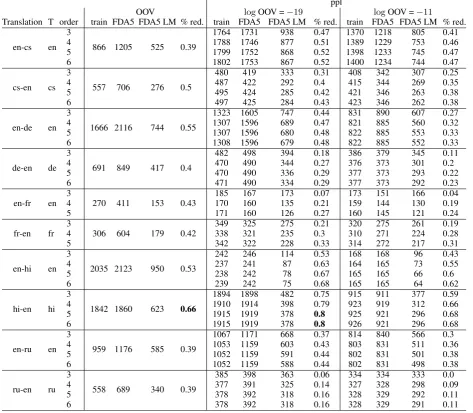
Table 5: Perplexity comparison of the LM built from the training corpus (train), ParFDA5 selected training corpus (FDA5), and the ParFDA5 selected LM corpus (FDA5 LM). %red. column lists the percentage of reduction.
task. The average difference to the top constrained submission in WMT14 is3.49BLEU points. For en-ru and en-cs, casing the LM using a true-caser trained on all of the available training data decreased the performance by 0.5 and 0.9 BLEU points respectively and for cs-en and fr-en, in-creased the performance by 0.2 and 0.5 BLEU points. We use the true-cased LM results using a true-caser trained on all of the available train-ing data for all language pairs where for hi-en, the true-caser is trained on the ParFDA5 selected training data.
3.5 LM Data Quality
A LM training data selected for a given transla-tion task allows us to train higher order language
BLEUc cs-en de-enS→enfr-en ru-en en-cs en-deen→en-frT en-ru ParFDA5 0.256 0.239 0.319 0.282 0.172 0.168 0.325 0.257 ParFDA 0.243 0.241 0.254 0.223 0.171 0.179 0.238 0.173 diff 0.013 -0.002 0.065 0.059 0.001 -0.011 0.087 0.084
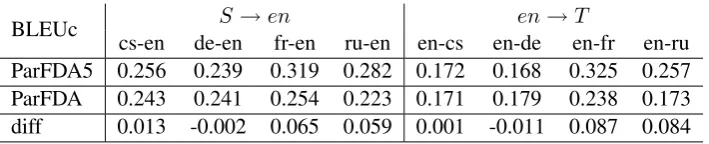
Table 7: Parallel FDA5 WMT14 results compared with parallel FDA WMT13 results. Training set sizes are given in millions (M) of words on the target side. Average difference is3.7BLEU points.
[image:6.595.123.478.61.133.2]BLEUc cs-enS →enfr-en en-csen→en-frT ParFDA5 0.256 0.319 0.172 0.325 ParFDA515% 0.248 0.321 0.178 0.333 diff -0.008 0.002 0.006 0.008
Table 6: ParFDA5 results, ParFDA5 results using 15%of the training set, and their difference.
3.6 Using15%of the Available Training Set In the FDA5 results (Bic¸ici and Yuret, 2014), we found that selecting 15% of the best train-ing set size maximizes the performance for the English-German out-of-domain translation task and achieves0.41BLEU points improvement over a baseline system using all of the available train-ing data. We run additional experiments select-ing 15% of the training data for fr-en and cs-en language pairs to see the effect of increased train-ing sets selected with ParFDA5. The results are given in Table 6 where most of the results improve. The slight performance decrease for cs-en may be due to using a true-caser trained on only the se-lected training data. We observe larger gains in theen→T translations.
3.7 ParFDA5 versus Parallel FDA
We compare this year’s results with the results we obtained last year (Bic¸ici, 2013) in Table 7. The task setting is different in WMT14 since the test set contains 10,000 sentences but only 3000 of these are used as the actual test set, which can make the transductive learning application of ParFDA5 harder. We select the same number of instances for the training sets but 5million more instances for the LM corpus this year. The aver-age difference to the top constrained submission in WMT13 was2.88BLEU points (Bic¸ici, 2013) and this has increased to 3.49 BLEU points in WMT14. On average, the performance improved 3.7BLEU points when compared with ParFDA re-sults last year. For the fr-en, en-fr, and en-ru
trans-lation directions, we observe increases in the per-formance. This may be due to better modeling of the target domain by better parameterization and optimization that FDA5 is providing. We observe some decrease in the performance in en-de and de-en results. Since the training material remained the same for WMT13 and WMT14 and the mod-eling power of FDA5 increased, building a domain specific rather than a task specific ParFDA5 model may be the reason for the decrease.
4 Conclusion
We use parallel FDA5 for solving computational scalability problems caused by the abundance of training data for SMT models and LMs and still achieve SMT performance that is on par with the top performing SMT systems. Parallel FDA5 raises the bar of expectations from SMT with highly accurate translations and lower the bar to entry for SMT into new domains and tasks by al-lowing fast deployment of SMT systems in about half a day. Parallel FDA5 enables a shift from gen-eral purpose SMT systems towards task adaptive SMT solutions.
Acknowledgments
This work is supported in part by SFI (07/CE/I1142) as part of the CNGL Centre for Global Intelligent Content (www.cngl.org) at Dublin City University and in part by the European Commission through the QTLaunchPad FP7 project (No: 296347). We also thank the SFI/HEA Irish Centre for High-End Computing (ICHEC) for the provision of computational facilities and support.
References
Ed-inburgh, Scotland, July. Association for Computa-tional Linguistics.
Ergun Bic¸ici and Deniz Yuret. 2014. Optimizing in-stance selection for statistical machine translation with feature decay algorithms. IEEE/ACM Transac-tions On Audio, Speech, and Language Processing (TASLP).
Ergun Bic¸ici. 2011. The Regression Model of Machine Translation. Ph.D. thesis, Koc¸ University. Supervi-sor: Deniz Yuret.
Ergun Bic¸ici. 2013. Feature decay algorithms for fast deployment of accurate statistical machine transla-tion systems. InProceedings of the Eighth Work-shop on Statistical Machine Translation, Sofia, Bul-garia, August. Association for Computational Lin-guistics.
Ondˇrej Bojar, Christian Buck, Christian Federmann, Barry Haddow, Philipp Koehn, Matouˇs Mach´aˇcek, Christof Monz, Pavel Pecina, Matt Post, Herve Saint-Amand, Radu Soricut, and Lucia Specia. 2014. Findings of the 2014 workshop on statisti-cal machine translation. InProc. of the Ninth Work-shop on Statistical Machine Translation, Balrimore, USA, June. Association for Computational Linguis-tics.
Iacer Calixto, Ali Hosseinzadeh Vahid, Xiaojun Zhang, Jian Zhang, Xiaofeng Wu, Andy Way, and Qun Liu. 2014. Experiments in medical translation shared task at wmt 2014. InProceedings of the Ninth Work-shop on Statistical Machine Translation, Baltimore, USA, June. Association for Computational Linguis-tics.
Thomas H. Cormen, Charles E. Leiserson, Ronald L. Rivest, and Clifford Stein. 2009. Introduction to Algorithms (3. ed.). MIT Press.
David Graff, ˆAngelo Mendonc¸a, and Denise DiPersio. 2011. French Gigaword third edition, Linguistic Data Consortium.
Philipp Koehn, Hieu Hoang, Alexandra Birch, Chris Callison-Burch, Marcello Federico, Nicola Bertoldi, Brooke Cowan, Wade Shen, Christine Moran, Richard Zens, Chris Dyer, Ondrej Bojar, Alexandra Constantin, and Evan Herbst. 2007. Moses: Open source toolkit for statistical machine translation. In
ACL, pages 177–180, Prague, Czech Republic, June. William Lewis, Robert Munro, and Stephan Vogel. 2011. Crisis mt: Developing a cookbook for mt in crisis situations. In Proceedings of the Sixth Workshop on Statistical Machine Translation, pages 501–511, Edinburgh, Scotland, July. Association for Computational Linguistics.
Liangyou Li, Xiaofeng Wu, Santiago Cortes Vaillo, Jun Xie, Jia Xu, Andy Way, and Qun Liu. 2014. The dcu-ictcas-tsinghua mt system at wmt 2014 on german-english translation task. In Proceedings of
the Ninth Workshop on Statistical Machine Transla-tion, Baltimore, USA, June. Association for Compu-tational Linguistics.
Franz Josef Och and Hermann Ney. 2003. A sys-tematic comparison of various statistical alignment models. Computational Linguistics, 29(1):19–51. Robert Parker, David Graff, Junbo Kong, Ke Chen, and
Kazuaki Maeda. 2011. English Gigaword fifth edi-tion, Linguistic Data Consortium.