Detecting Missing Hyphens in Learner Text
Aoife Cahill∗, Martin Chodorow†, Susanne Wolff∗ and Nitin Madnani∗
∗
Educational Testing Service, 660 Rosedale Road, Princeton, NJ 08541, USA
{acahill, swolff, nmadnani}@ets.org
†
Hunter College and the Graduate Center, City University of New York, NY 10065, USA
Abstract
We present a method for automatically de-tecting missing hyphens in English text. Our method goes beyond a purely dictionary-based approach and also takes context into account. We evaluate our model on artificially gener-ated data as well as naturally occurring learner text. Our best-performing model achieves high precision and reasonable recall, making it suitable for inclusion in a system that gives feedback to language learners.
1 Introduction
While errors of punctuation are not as frequent, nor often as serious, as some of the other typical mis-takes that learners make, they are nevertheless an important consideration for students aiming to im-prove the overall quality of their writing. In this pa-per we focus on the error of missing hyphens. The following example is a typical mistake made by a student writer:
(1) Schools may have more after school sports.
In this case the tokensafterandschoolshould be hy-phenated as they modify the nounsports. However, in Example (2) a hyphen betweenafter andschool
would be incorrect, since in this instanceafter func-tions as as the head of a prepositional phrase modi-fyingwent.
(2) I went to the dentist after school today.
These examples illustrate that purely dictionary-based approaches to detecting missing hyphens are not likely to be sophisticated enough to differentiate
the contexts in which a hyphen is required. In addi-tion, learner text frequently contains other grammat-ical and spelling errors, further complicating auto-matic error detection. Example (3) contains an error
father likeinstead offather likes to. This causes dif-ficulty for automated hyphenation systems because
like is a frequent suffix of hyphenated words and
playcan function as a noun.
(3) My father like play basketball with me.
In this paper, we propose a classifier-based approach to automatically detecting missing hyphen errors. The goal of our system is to detect missing hyphen errors and provide feedback to language learners. Therefore, we place more importance on the preci-sion of the system than recall. We train our model on features that take the context of a pair of words into account, as well as other discriminative features. We present a number of evaluations on both artificially generated errors and naturally occurring learner er-rors and show that our classifiers achieve high preci-sion and reasonable recall.
2 Related Work
The task of detecting missing hyphens is related to previous work on detecting punctuation errors. One of the classes of errors in the Helping Our Own (HOO) 2011 shared task (Dale and Kilgarriff, 2011) was punctuation. Comma errors are the most fre-quent kind of punctuation error made by learners. Is-rael et al. (2012) present a model for detecting these kinds of errors in learner texts. They train CRF mod-els on sentences from unedited essays written by high-level college students and show that they per-forms well on detecting errors in learner text. As
far as we are aware, the HOO 2011 system descrip-tion of Rozovskaya et al. (2011) is the only work to specifically reference hyphen errors. They use rules derived from frequencies in the training corpus to determine whether a hyphen was required between two words separated by white space.
The task of detecting missing hyphens is related to the task of inserting punctuation into the output of unpunctuated text (for example, the output of speech recognition, automatic generation, machine transla-tion, etc.). Systems that are built on the output of speech recognition can obviously take features like prosody into account. In our case, we are deal-ing only with written text. Gravano et al. (2009) present an n-gram-based model for automatically adding punctuation and capitalization to the output of an ASR system,withouttaking any of the speech signal information into account. They conclude that more training data, rather than wider n-gram con-texts leads to a greater improvement in accuracy.
3 Baselines
We implement three baseline systems which we will later compare to our classification approach. The first baseline is a na¨ıve heuristic that predicts a miss-ing hyphen between bigrams that appear hyphenated in the Collins Dictionary.1 As a somewhat less-na¨ıve baseline, we implement a heuristic that pre-dicts a missing hyphen between bigrams that occur hyphenated more than 1,000 times in Wikipedia. A third baseline is a heuristic that predicts a missing hyphen between bigrams where the probability of the hyphenated form as estimated from Wikipedia is greater than 0.66, meaning that the hyphenated bigram is twice as likely as the non-hyphenated bi-gram. This baseline is similar to the approach taken by Rozovskaya et al. (2011), except that the proba-bilities are estimated from a much larger corpus.
4 System Description
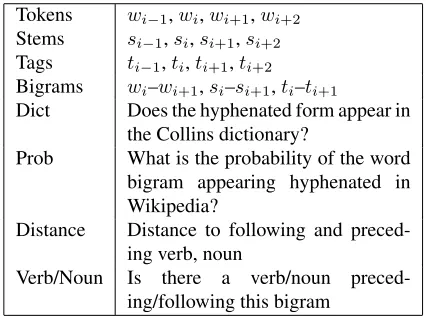
Using the features in Table 1, we build a logis-tic regression model which assigns a probability to the likelihood of a hyphen occurring between two words,wi andwi+1. As we are primarily interested
in using this system for giving feedback to language learners, we require very high precision. Therefore,
1
LDC catalog number LDC93T1
Tokens wi−1,wi,wi+1,wi+2
Stems si−1,si,si+1,si+2
Tags ti−1,ti,ti+1,ti+2
Bigrams wi–wi+1,si–si+1,ti–ti+1
Dict Does the hyphenated form appear in the Collins dictionary?
Prob What is the probability of the word bigram appearing hyphenated in Wikipedia?
Distance Distance to following and preced-ing verb, noun
[image:2.612.320.533.59.217.2]Verb/Noun Is there a verb/noun preced-ing/following this bigram
Table 1: Features used in all models. Positive in-stances are those where there was a hyphen between
wiandwi+1 in the data. Stems are generated using
NLTK’s implementation of the Lancaster Stemmer, and tags are obtained from the Stanford Parser.
we only predict a missing hyphen error when the probability of the prediction is>0.99.
We experiment with two different sources of training data, in addition to their combination. We first train on well-edited text, using almost 1.8 mil-lion sentences from the San Jose Mercury News cor-pus.2 For training, hyphenated words are automati-cally split (i.e. well-known becomes well known). The positive examples for the classifier are all bi-grams where a hyphen was removed. Negative ex-amples consist of bigrams where there was no hy-phen in the training data. Since this is over 99% of the data, we randomly sample 3% of the negative examples for training. We also restrict the negative examples to only the most likely contexts, where a context is defined as a part-of-speech bigram. A list of possible contexts in which hyphens occur is ex-tracted from the entire training set. Only contexts that occur more than 20 times are selected during training. All contexts are evaluated during testing. Table 2 lists some of the most frequent contexts with examples of when they should be hyphenated and when they should remain unhyphenated.
The second data source for training the model comes from pairs of revisions from Wikipedia ar-ticles. Following Cahill et al. (2013), we automati-cally extract a corpus of error annotations for
miss-2
Context Hyphenated Unhyphenated NN NN terrific truck-stop
waitress
a quake insurance
surcharge CD CD Twenty-two
thou-sand
the 126 million
Americans JJ NN an early-morning
blaze
an entire practice
session
CD NN atwo-yearcontract about600 tankcars NN VBN a court-ordered
program
[image:3.612.303.536.59.176.2]aletter delivered to-day
Table 2: Some frequent likely POS contexts for hy-phenation, with examples from the Brown corpus.
ing hyphens. This is done by extracting the plain text from every revision to every article and com-paring adjacent pairs of revisions. For each article, chains of errors are detected, using the surrounding text to identify them. When a chain begins and ends with the same form, it is ignored. Only the first and last points in an error chain are retained for train-ing. An example chain is the following: It has been an ancient {focal point → location → focal point
→ focal-point} of trade and migration., where we would extract the correction focal point → focal-point. In total, we extract a corpus of 390,298 sen-tences containing missing hyphen error annotations.
Finally, we combine both data sources.
5 Evaluating on Artificial Data
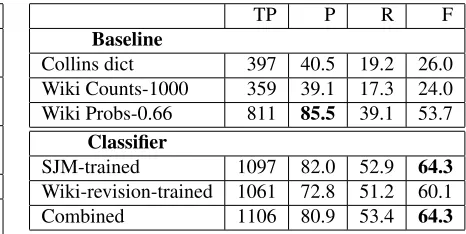
Since there are large corpora of well-edited text readily available, it is easy to evaluate on artifi-cial data. For testing, we take 24,243 sentences from the Brown corpus and automatically remove hyphens from the 2,072 hyphenated words (but not free-standing dashes). Each system makes a predic-tion for all bigrams about whether a hyphen should appear between the pair of words. We measure the performance of each system in terms of precision, P, (how many of the missing hyphen errors predicted by the system were true errors), recall, R, (how many of the artificially removed hyphens the system de-tected as errors) and f-score, F, (the harmonic mean of precision and recall). The results are given in Table 3, and also include the raw number of true positives, TP, detected by each system. The results show that the baseline using Wikipedia probabilities obtains the highest precision, however with low re-call. The classifiers trained on newswire text and the
TP P R F
Baseline
Collins dict 397 40.5 19.2 26.0
Wiki Counts-1000 359 39.1 17.3 24.0 Wiki Probs-0.66 811 85.5 39.1 53.7
Classifier
SJM-trained 1097 82.0 52.9 64.3
Wiki-revision-trained 1061 72.8 51.2 60.1
Combined 1106 80.9 53.4 64.3
Table 3: Results of evaluating on the Brown Corpus with hyphens removed
combined news and Wikipedia revision text achieve the highest overall f-score. Figure (1a) shows the Precision Recall curves for the Wikipedia baselines and the three classifiers. The curves mirror the re-sults in the table, showing that the classifier trained on the newswire text, and the classifier trained on the combined data perform best. The Wikipedia counts baseline performs worst.
6 Evaluating on Learner Text
We carry out two evaluations of our system on learner text. We first evaluate on the missing hyphen errors contained in the CLC-FCE (Yannakoudakis et al., 2011). This corpus contains 1,244 exam scripts written by learners of English as part of the Cam-bridge ESOL First Certificate in English. In total, there are 173 instances of missing hyphen errors. The results are given in Table 4, and the precision recall curves are displayed in Figure (1b).
The results show that the classifiers consistently achieve high precision on this data set. This is as expected, given the high threshold set. Looking at the curves, it seems that a slightly lower threshold in this case may lead to better results. The curves show that the combined classifier is performing slightly better than the other two classifiers. The baselines are clearly not performing as well on this dataset.
[image:3.612.95.531.59.180.2]base-0.0 0.2 0.4 0.6 0.8
0.0
0.2
0.4
0.6
0.8
1.0
Recall
Precision
combined sjm wiki
baseline−wiki−counts baseline−wiki−probs
(a) Brown Corpus
0.2 0.4 0.6 0.8 1.0
0.0
0.2
0.4
0.6
0.8
1.0
Recall
Precision
combined sjm wiki
baseline−wiki−counts baseline−wiki−probs
[image:4.612.112.495.62.487.2](b) CLC-FCE Corpus
Figure 1: Precision Recall curves for the Wikipedia baselines and the three classifiers.
TP P R F
Baseline
Collins dict 131 64.5 75.7 69.7 Wiki Counts-1000 141 73.1 81.5 77.0
Wiki Probs-0.66 36 92.3 20.8 34.0
Classifier
SJM-trained 60 84.5 34.7 49.2
Wiki-revision-trained 71 98.6 41.0 58.0
Combined 66 98.5 38.2 55.0
Table 4: Results of evaluating on the CLC-FCE dataset
[image:4.612.78.294.542.657.2]gen-eral than the low frequency of an error type, such as missing hyphens. The more general problem is that of non-independence among errors, which oc-curs when an individual writer contributes multiple times to an error count or when a particular prompt gives rise to many occurrences of the same error, as in the current case of “make-up”.
Despite the problem of non-independent errors, a more accurate picture of system performance may nonetheless emerge with more evidence. Therefore, we evaluate system precision on a data set of 1,000 student GRE and TOEFL essays written by both na-tive and nonnana-tive speakers, across a wide range of proficiency levels and prompts. The essays, drawn from 295 prompts, ranged in length from 1 to 50 sentences, with an average of 378 words per essay.
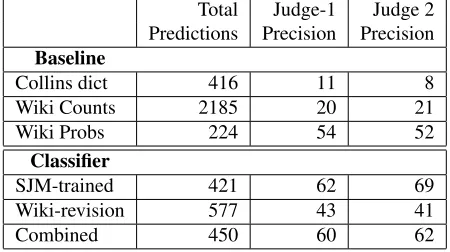
We manually inspect a random sample of 100 in-stances where each system detected a missing hy-phen. Two native-English speakers judged the cor-rectness of the predictions using the Chicago Man-ual of Style as a guide.3 Inter-annotator agreement on the binary classification task for 600 items was 0.79κ, showing high agreement. The results are given in Table 5.
Total Judge-1 Judge 2 Predictions Precision Precision
Baseline
Collins dict 416 11 8
Wiki Counts 2185 20 21
Wiki Probs 224 54 52
Classifier
SJM-trained 421 62 69
Wiki-revision 577 43 41
[image:5.612.73.298.401.527.2]Combined 450 60 62
Table 5: Precision results on 1000 student responses, estimated by randomly sampling 100 hyphen predic-tions of each system and manually evaluating them.
The results show that the first two baseline sys-tems do not perform well on this essay data. This is mainly because they do not take context into ac-count. Many of the errors made by these systems in-volved verb + preposition bigrams, as in Examples (4) and (5). Restricting the detection by probability clearly improves precision, but at the cost of recall
3
http://www.chicagomanualofstyle.org
(only 224 total instances of missing hyphen errors detected, the lowest of all 6 systems). In the man-ual evaluation, the system trained on the SJM corpus achieves the highest precision, though all precision figures are lower than the previous evaluations. Ex-ample (6) is a typical exEx-ample of the kinds of false positives made by the classifier models.
(4) If these men were required to step-down after a limited number of years, the damage would be contained.
(5) These families may even choose to eat at-home than outside.
(6) The wellness program will save money in the long-term.
Future work will explore additional features that may help improve performance. A more thorough study will also be carried out to fully understand the differences in performance of the classifiers across corpora. Another direction to explore in future work is the related task of identifying extraneous hyphens in learner text. These are even less frequent than missing hyphens (87 annotated cases in the CLC-FCE corpus), but we believe a similar classification approach could be successful.
7 Conclusion
References
Aoife Cahill, Nitin Madnani, Joel Tetreault, and Diane Napolitano. 2013. Robust Systems for Preposition Error Correction Using Wikipedia Revisions. In Pro-ceedings of the Conference of the North American Chapter of the Association for Computational Linguis-tics: Human Language Technologies, Atlanta, GA. Robert Dale and Adam Kilgarriff. 2011. Helping Our
Own: The HOO 2011 Pilot Shared Task. In Pro-ceedings of the Generation Challenges Session at the 13th European Workshop on Natural Language Gener-ation, pages 242–249, Nancy, France, September. As-sociation for Computational Linguistics.
Agustin Gravano, Martin Jansche, and Michiel Bacchi-ani. 2009. Restoring punctuation and capitalization in transcribed speech. InAcoustics, Speech and Signal Processing, 2009. ICASSP 2009. IEEE International Conference on, pages 4741–4744. IEEE.
Ross Israel, Joel Tetreault, and Martin Chodorow. 2012. Correcting Comma Errors in Learner Essays, and Restoring Commas in Newswire Text. In Proceed-ings of the 2012 Conference of the North American Chapter of the Association for Computational Lin-guistics: Human Language Technologies, pages 284– 294, Montr´eal, Canada, June. Association for Compu-tational Linguistics.
Alla Rozovskaya, Mark Sammons, Joshua Gioja, and Dan Roth. 2011. University of Illinois System in HOO Text Correction Shared Task. In Proceedings of the Generation Challenges Session at the 13th Eu-ropean Workshop on Natural Language Generation, pages 263–266, Nancy, France, September. Associa-tion for ComputaAssocia-tional Linguistics.