Structured vs. Flat Semantic Role Representations
for Machine Translation Evaluation
Chi-kiuLo and DekaiWu
HKUST
Human Language Technology Center Dept. of Computer Science and Engineering Hong Kong University of Science and Technology
{jackielo|dekai}@cs.ust.hk
Abstract
We argue that failing to capture the degree of contribution of each semantic frame in a sen-tence explains puzzling results in recent work on the MEANT family of semantic MT eval-uation metrics, which have disturbingly in-dicated that dissociating semantic roles and fillers from their predicates actually improves correlation with human adequacy judgments even though, intuitively, properly segregat-ing event frames should more accurately re-flect the preservation of meaning. Our anal-ysis finds that both properly structured and flattened representations fail to adequately ac-count for the contribution of each seman-tic frame to the overall sentence. We then show that the correlation of HMEANT, the hu-man variant of MEANT, can be greatly im-proved by introducing a simple length-based weighting scheme that approximates the de-gree of contribution of each semantic frame
to the overall sentence. The new results
also show that, without flattening the struc-ture of semantic frames, weighting the degree of each frame’s contribution gives HMEANT higher correlations than the previously best-performing flattened model, as well as HTER.
1 Introduction
In this paper we provide a more concrete answer to the question: what would be a better represen-tation, structured or flat, of the roles in semantic frames to be used in a semantic machine transla-tion (MT) evaluatransla-tion metric? We compare recent studies on the MEANT family of semantic role la-beling (SRL) based MT evaluation metrics (Lo and Wu, 2010a,b, 2011a,b) by (1) contrasting their vari-ations in semantic role representation and observing
disturbing comparative results indicating that segre-gating the event frames in structured role representa-tion actuallydamagescorrelation against human ad-equacy judgments and (2) showing how SRL based MT evaluation can be improved beyond the current state-of-the-art compared to previous MEANT vari-ants as well as HTER, through the introduction of a simple weighting scheme that reflects the degree of contribution of each semantic frame to the overall sentence. The weighting scheme we propose uses a simple length-based heuristic that reflects the as-sumption that a semantic frame that covers more to-kens contributes more to the overall sentence transla-tion. We demonstrate empirically that when the de-gree of each frame’s contribution to its sentence is taken into account, the properly structured role rep-resentation is more accurate and intuitive than the flattened role representation for SRL MT evaluation metrics.
For years, the task of measuring the performance of MT systems has been dominated by lexical n-gram based machine translation evaluation met-rics, such as BLEU (Papineni et al., 2002), NIST (Doddington, 2002), METEOR (Banerjee and Lavie, 2005), PER (Tillmannet al., 1997), CDER (Leusch
et al., 2006) and WER (Nießenet al., 2000). These metrics are excellent at ranking overall systems by averaging their scores over entire documents. How-ever, as MT systems improve, the shortcomings of such metrics are becoming more apparent. Though containing roughly the correct words, MT output at the sentence remains often quite incomprehensible, and fails to preserve the meaning of the input. This results from the fact that n-gram based metrics are not as reliable at ranking the adequacy of transla-tions of individual sentences, and are particularly
poor at reflecting translation quality improvements involving more meaningful word sense or semantic frame decisions—which human judges have no trou-ble distinguishing. Callison-Burchet al.(2006) and Koehn and Monz (2006), for example, study situ-ations where BLEU strongly disagrees with human judgment of translation quality.
Newer avenues of research seek substitutes for n-gram based MT evaluation metrics that are bet-ter at evaluating translation adequacy, particularly at the sentence level. One line of research emphasizes more the structural correctness of translation. Liu and Gildea (2005) propose STM, a metric based on syntactic structure, that addresses the failure of lex-ical similarity based metrics to evaluate translation grammaticality. However, the problem remains that a grammatical translation can achieve a high syntax-based score yet still make significant errors arising from confusion of semantic roles. On the other hand, despite the fact that non-automatic, manually evalu-ated metrics, such as HTER (Snoveret al., 2006), are more adequacy oriented exhibit much higher correla-tion with human adequacy judgment, their high labor cost prohibits widespread use. There has also been work on explicitly evaluating MT adequacy by ag-gregating over a very large set of linguistic features (Gim´enez and M`arquez, 2007, 2008) and textual en-tailment (Padoet al., 2009).
2 SRL based MT evaluation metrics
A blueprint for more direct assessment of mean-ing preservation across translation was outlined by Lo and Wu (2010a), in which translation utility is manually evaluated with respect to the accuracy of semantic role labels. A good translation is one from which human readers may successfully understand at least the basic event structure—“who did what to whom, when, where and why” (Pradhan et al., 2004)–which represents the most essential meaning of the source utterances. Adopting this principle, the MEANT family of metrics compare the seman-tic frames in reference translations against those that can be reconstructed from machine translation out-put.
Preliminary results reported in (Lo and Wu, 2010b) confirm that the blueprint model outper-forms BLEU and similar n-gram oriented
evalu-ation metrics in correlevalu-ation against human ade-quacy judgments, but does not fare as well as HTER. The more complete study of Lo and Wu (2011a) introduces MEANT and its human variants HMEANT, which implement an extended version of blueprint methodology. Experimental results show that HMEANT correlates against human adequacy judgments as well as the more expensive HTER, even though HMEANT can be evaluated using low-cost untrained monolingual semantic role annotators while still maintaining high inter-annotator agree-ment (both are far superior to BLEU or other sur-face oriented evaluation metrics). The study also shows that replacing the human semantic role la-belers with an automatic shallow semantic parser yields an approximation that is still vastly superior to BLEU while remaining about 80% as closely cor-related with human adequacy judgments as HTER. Along with additional improvements to the accu-racy of the MEANT family of metrics, Lo and Wu (2011b) study the impact of each individual seman-tic role to the metric’s correlation against human ade-quacy judgments, as well as the time cost for humans to reconstruct the semantic frames and compare the translation accuracy of the role fillers.
In general, the MEANT family of SRL MT eval-uation metrics (Lo and Wu, 2011a,b) evaluate the translation utility as follows. First, semantic role labeling is performed (either manually or automat-ically) on both the reference translation (REF) and the machine translation output (MT) to obtain the semantic frame structure. Then, the semantic pred-icates, roles and fillers reconstructed from the MT output are compared to those in the reference trans-lations. The number of correctly and partially cor-rectly annotated arguments of each type in each frame of the MT output are collected in this step:
Ci,j ≡ # correct ARG i of PRED i in MT
Pi,j ≡ # partially correct ARG j of PRED i in MT
Mi,j ≡ total # ARG j of PRED i in MT
Ri,j ≡ total # ARG j of PRED i in REF
accu-Figure 1: The structured role representation for the blueprint SRL-based MT evaluation metric as proposed in Lo and Wu (2010a,b), with arguments aggregated into core and adjunct classes.
rate flattened-role implementation of HMEANT and MEANT.
2.1 Structured core vs. adjunct role
representation
Figure 1 depicts the semantic role representation in the blueprint model of SRL MT evaluation metric proposed by Lo and Wu (2010a,b). Each sentence consists of a number of frames, and each frame con-sists of a predicate and two classes of arguments, ei-ther core or adjunct. The frame precision/recall is the weighted sum of the number of correctly trans-lated roles (where arguments are grouped into the core and adjunct classes) in a frame normalized by the weighted sum of the total number of all roles in that frame in the MT/REF respectively. The sen-tence precision/recall is the sum of the frame preci-sion/recall for all frames averaged by the total num-ber of frames in the MT/REF respectively. The SRL evaluation metric is then defined in terms of f-score in order to balance the sentence precision and recall. More precisely, assuming the above definitions of
Ci,j,Pi,j,Mi,j andRi,j, the sentence precision and
recall are defined as follows.
precision=
∑
i wpred+
∑ twt
(∑
j∈t(Ci,j+wpartialPi,j) )
wpred+ ∑
twt (∑
j∈tMi,j )
# frames in MT
recall= ∑
i
wpred+∑
twt (∑
j∈t(Ci,j+wpartialPi,j) )
wpred+ ∑
twt (∑
j∈tRi,j )
[image:3.612.78.540.54.178.2]# frames in REF
Figure 2: The structured role representation for the
MEANT family of metrics as proposed in Lo and Wu (2011a).
where wpred is the weight for predicates, and wt
wheret ∈ {core,adj} is the weight for core argu-ments and adjunct arguargu-ments. These weights rep-resent the degree of contribution of the predicate and different classes of arguments (either core or ad-junct) to the overall meaning of the semantic frame they attach to. In addition,wpartialis a weight
control-ling the degree to which “partially correct” transla-tions are penalized. All the weights can be automat-ically estimated by optimizing the correlation with human adequacy judgments.
We conjecture that the reason for the low correla-tion with human adequacy judgments of this model as reported in Lo and Wu (2010b) is that the ab-straction of arguments actually reduces the repre-sentational power of the original predicate-argument structure in SRL. Under this representation, all the arguments in the same class, e.g. all adjunct argu-ments, are weighted uniformly. The assumption that all types of arguments in the same class have the same degree of contribution to their frame is obvi-ously wrong, and the empirical results confirm that the assumption is too coarse.
2.2 Structured role representation
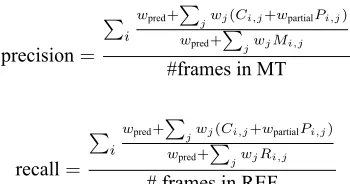
[image:3.612.306.541.54.176.2]the weight vector is increased to allow an indepen-dent weight to be assigned to each type of argument. Unlike the previous representation in the blueprint model, there is no aggregation of arguments into core and adjunct classes. Each sentence consists of a number of frames, and each frame consists of a pred-icate and a number of arguments of typej.
Under the new approach, the frame preci-sion/recall is the weighted sum of the number of cor-rectly translated roles in a frame normalized by the weighted sum of the total number of all roles in that frame in the MT/REF respectively. Similar to the previous blueprint representation, the sentence pre-cision/recall is the sum of the frame prepre-cision/recall for all frames averaged by the total number of frames in the MT/REF respectively. More precisely, fol-lowing the previous definitions of Ci,j, Pi,j, Mi,j,
Ri,j,wpredandwpartial, the sentence precision and
re-call are redefined as follows.
precision=
∑
i
wpred+∑
jwj(Ci,j+wpartialPi,j)
wpred+ ∑
jwjMi,j
#frames in MT
recall= ∑
i wpred+
∑
jwj(Ci,j+wpartialPi,j)
wpred+ ∑
jwjRi,j
# frames in REF
wherewjis the weight for the arguments of typej.
These weights represent the degree of contribution of different types of arguments to the overall meaning of their semantic frame.
[image:4.612.87.262.331.423.2]2.3 Flat role representation
Figure 3 depicts the flat role representation used in the more accurate variants of MEANT as proposed in Lo and Wu (2011b). This representation is motivated by the studies of the impact of individual seman-tic role. The highly significant difference between this flat representation and both of the previous two structured role representations is that the semantic frames in the sentence are no longer segregated.
The flat role representation desegregates the frame structure, resulting in a flat, single level structure. Therefore, there is no frame precision/recall. The sentence precision/recall is the weighted sum of the number of correctly translated roles in all frames nor-malized by the weighted sum of the total number of
roles in all frames in the MT/REF respectively. More precisely, again assuming the previous definitions of
Ci,j,Pi,j,Mi,j,Ri,j andwpartial, the sentence
preci-sion and recall are redefined as follows.
Cpred ≡ total # correctly translated predicates
Mpred ≡ total # predicates in MT
Rpred ≡ total # predicates in REF
precision=wpredCpred+
∑
jwj
(∑
i(Ci,j+wpartialPi,j)
)
wpredMpred+
∑
jwj
(∑
iMi,j
)
recall= wpredCpred+
∑
jwj
(∑
i(Ci,j+wpartialPi,j)
)
wpredRpred+
∑
jwj
(∑
iRi,j
)
Note that there is a small modification of the defini-tion ofwpredandwj. Instead of the degree of
contri-bution to the overall meaning of the semantic frame that the roles attached to,wpredandwjnow represent
the degree of contribution of the predicate and the ar-guments of typejto the overall meaning of theentire
sentence.
It is worth noting that the semantic role features in the ULC metric proposed by Gim´enez and M`arquez (2008) also employ a flat feature-based represen-tation of semantic roles. However, the definition of those semantic role features adopts a different methodology for determining the role fillers’ transla-tion accuracy, which prevents a controlled consistent environment for the comparative experiments that the present work focuses on.
3 Experimental setup
The evaluation data for our experiments consists of 40 sentences randomly drawn from the DARPA GALE program Phase 2.5 newswire evaluation cor-pus containing Chinese input sentence, English ref-erence translations, and the machine translation from three different state-of-the-art GALE systems. The Chinese and the English reference translation have both been annotated with gold standard PropBank (Palmer et al., 2005) semantic role labels. The weightswpred,wcore,wadj,wjandwpartialcan be
Figure 3: The flat role representation for the MEANT family of metrics as proposed in Lo and Wu (2011b) .
Wu (2011b), the correlations of all individual roles with the human adequacy judgments were found to be non-negative, therefore we found grid search to be quite adequate for estimating the weights. We use linear weighting because we would like to keep the metric’s interpretation simple and intuitive.
Following the benchmark assessment in NIST MetricsMaTr 2010 (Callison-Burchet al., 2010), we assess the performance of the semantic MT evalua-tion metric at the sentence level using the summed-diagonal-of-confusion-matrix score. The human ad-equacy judgments were obtained by showing all three MT outputs together with the Chinese source input to a human reader. The human reader was in-structed to order the sentences from the three MT systems according to the accuracy of meaning in the translations. For the MT output, we ranked the sentences from the three MT systems according to their evaluation metric scores. By comparing the two sets of rankings, a confusion matrix is formed. The summed diagonal of confusion matrix is the per-centage of the total count when a particular rank by the metric’s score exactly matches the human judg-ments. The range of possible values of summed di-agonal of confusion matrix is [0,1], where 1 means all the systems’ ranks determined by the metric are identical with that of the human judgments and 0 means all the systems’ ranks determined by the met-ric are different from that of the human judgment.
Since the summed diagonal of confusion matrix scores only assess the absolute ranking accuracy, we also report the Kendall’s τ rank correlation co-efficients, which measure the correlation of the pro-posed metric against human judgments with respect to their relative ranking of translation adequacy. A higher the value for τ indicates the more similar the ranking by the evaluation metric to the human judg-ment. The range of possible values of correlation
Table 1: Sentence-level correlations against human ade-quacy judgments as measured by Kendall’s τ and summed diagonal of confusion matrix as used in MetricsMaTr 2010. “SRL - blueprint” is the blueprint model described in section 2.1. “HMEANT (structured)” is HMEANT us-ing the structured role representation described in sec-tion 2.2. “HMEANT (flat)” is HMEANT using the flat role representation described in section 2.3.
Metric Kendall MetricsMaTr
HMEANT (flat) 0.4685 0.5583
HMEANT (structured) 0.4324 0.5083 SRL - blueprint 0.3784 0.4667
coefficient is [-1,1], where 1 means the systems are ranked in the same order as the human judgment and -1 means the systems are ranked in the reverse order as the human judgment.
4 Round 1: Flat beats structured
Our first round of comparative results quantita-tively assess whether a structured role representation (that properly preserves the semantic frame struc-ture, which is typically hierarchically nested in com-positional fashion) outperforms the simpler (but less intuitive, and certainly less linguistically satisfying) flat role representation.
Figure 4: The new proposed structured role representa-tion, incorporating a weighting scheme reflecting the de-gree of contribution of each semantic frame to the overall sentence.
HMEANT using a structured role representation (0.4324 and 0.5083 respectively) and the blueprint model (0.3784 and 0.4667 respectively).
Error analysis, in light of these surprising results, strongly suggests that the problem lies in the design which uniformly averages the frame precision/recall over all frames in a sentence when computing the sentence precision/recall. This essentially assumes that each frame in a sentence contributes equally to the overall meaning in the sentence translation. Such an assumption is trivially wrong and could well hugely degrade the advantages of using a structured role representation for semantic MT evaluation. This suggests that the structured role representation could be improved by also capturing the degree of contri-bution of each frame to the overall sentence transla-tion.
5 Capturing the importance of each frame
To address the problem in the previous models, we introduce a weighting scheme to reflect the degree of contribution of each semantic frame to the overall sentence. However, unlike the contribution of each role to a frame, the contribution of each frame to the overall sentence cannot be estimated across sen-tences. This is because unlike semantic roles, which can be identified by their types, frames do not neces-sarily have easily defined types, and their construc-tion is also different from sentence to sentence so that the positions of their predicates in the sentence are
the only way to identify the frames. However, the degree of contribution of each frame does not depend on the position of the predicate in the sentence. For example, the two sentencesI met Tom when I was go-ing homeandWhen I was walking home, I saw Tomhave similar meanings. The verbs met and saw are the predicates of the key event frames which contribute more to the overall sentences, whereas going and
walkingare the predicates of the minor nested event frames (in locative manner roles of the key event frames) and contribute less to the overall sentences. However, the two sentences are realized with differ-ent surface constructions, and the two key frames are in different positions. Therefore, the weights learned from one sentence cannot directly be applied to the other sentence.
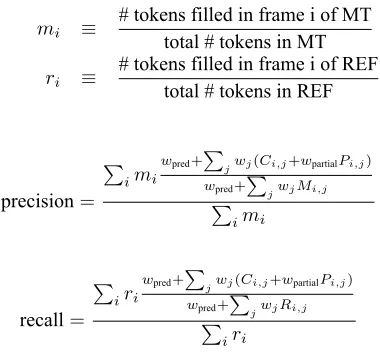
Instead of estimating the weight of each frame us-ing optimization techniques, we make an assumption thata semantic frame filled with more word tokens expresses more concepts and thus contributes more to the overall sentence. Following this assumption, we determine the weights of each semantic frame by its span coverage in the sentence. In other words, the weight of each frame is the percentage of word tokens it covers in the sentence.
Figure 4 depicts the structured role representa-tion with the proposed new frame weighting scheme. The significant difference between this representa-tion and the structured role representarepresenta-tion in the MEANT variants proposed in Lo and Wu (2011a) is that each frame is now assigned an independent weight, which is its span coverage in the MT/REF when obtaining the frame precision/recall respec-tively.
ear-lier definitions of Ci,j, Pi,j, Mi,j, Ri,j, wpred and
wpartialin section 2, the sentence precision and recall
are redefined as follows.
mi ≡
# tokens filled in frame i of MT total # tokens in MT
ri ≡
# tokens filled in frame i of REF total # tokens in REF
precision=
∑
imi
wpred+∑
jwj(Ci,j+wpartialPi,j)
wpred+∑
jwjMi,j ∑
imi
recall= ∑
iri wpred+
∑
jwj(Ci,j+wpartialPi,j)
wpred+ ∑
jwjRi,j ∑
iri
wheremi andri are the weights for framei, in the
MT/REF respectively. These weights estimate the degree of contribution of each frame to the overall meaning of the sentence.
6 Round 2: Structured beats flat
We now assess the performance of the new pro-posed structured role representation, by comparing it with the previous models under the same experi-mental setup as in section 4. We have also run con-trastive experiments against BLEU and HTER un-der the same experimental conditions. In addition, to investigate the consistency of results for the au-tomated variants of MEANT, we also include com-parative experiments where shallow semantic pars-ing (ASSERT) replaces human semantic role label-ers for each model of role representation.
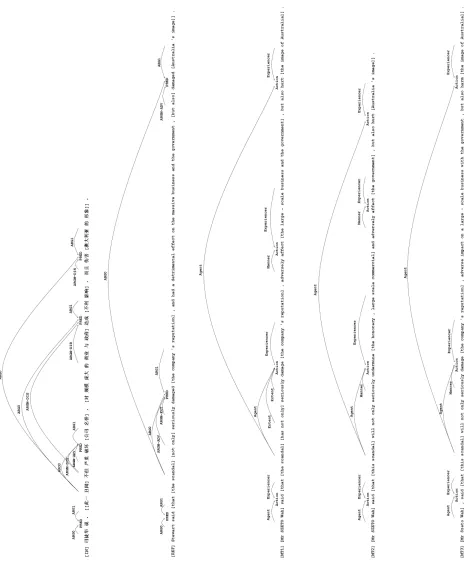
Figure 5 shows an example where HMEANT with the frame weighting scheme outperforms HMEANT using other role representations in correlation against human adequacy judgments. IN is the Chinese source input. REF is the corresponding refer-ence translation. MT1, MT2 and MT3 are the three corresponding MT output. The human ade-quacy judgments for this set of translation are that MT1>MT3>MT2. HMEANT with the proposed frame weighting predicts the same ranking order as the human adequacy judgment, while HMEANT with the flat role representation and HMEANT with the structured role representation without frame
weighting both predict MT3>MT1>MT2. There are four semantic frames in IN while there are only three semantic frames in the REF. This is because the predicate造成in IN is translated in REF ashad
[image:7.612.81.271.113.289.2]which is not a predicate. However, for the same frame, both MT1 and MT2 translated ARG1不利影 响into the predicateaffect, while MT3 did not trans-late the predicate造成and translated the ARG1不 利影响into the noun phraseadverse impact. There-fore, using the flat role representation or the previ-ous structured role representation which assume all frames have an identical degree of contribution to the overall sentence translation, MT1’s and MT2’s sen-tence precision is greatly penalized for having one more extra frame than the reference. In contrast, ap-plying the frame weighting scheme, the degree of contribution of each frame is adjusted by its token coverage. Therefore, the negative effect of the less important extra frames is minimized, allowing the positive effect of correctly translating more roles in more important frames to be more appropriately re-flected.
Table 2 shows that HMEANT with the proposed new frame weighting scheme correlates more closely with human adequacy judgments than HMEANT using the previous alternative role representations. The results from Kendall’s tau correlation coeffi-cient and MetricsMaTr’s summed diagonal of con-fusion matrix analysis are consistent. HMEANT using the frame-weighted structured role represen-tation achieved a Kendall’s tau correlation coef-ficient and summed diagonal of confusion matrix score of 0.2865 and 0.575 respectively, bettering both HMEANT using the flat role representation (0.4685 and 0.5583) and HMEANT using the pre-vious un-frame-weighted structured role representa-tion (0.4324 and 0.5083).
HMEANT using the improved structured role rep-resentation also outperforms other commonly used MT evaluation metrics. It correlates with human ad-equacy judgments more closely than HTER (0.4324 and 0.425 in Kendall’s tau correlation coefficient and summed diagonal of confusion matrix, respectively). It also correlates with human adequacy judgments significantly more closely than BLEU (0.1982 and 0.425).
Figure 5: Example input sentence along with reference and machine translations, annotated with semantic frames in Propbank format. The MT output is annotated with semantic frames by minimally trained humans. HMEANT with the new frame-weighted structured role representation successfully ranks the MT output in an order that matches with
human adequacy judgments (MT1>MT3>MT2), whereas HMEANT with a flat role representation or the previous
Table 2: Sentence-level correlations against human ade-quacy judgments as measured by Kendall’s τ and summed diagonal of confusion matrix as used in MetricsMaTr 2010. “SRL - blueprint”, “HMEANT (structured)” and “HMEANT (flat)” are the same as in table 1. “MEANT (structured)” and “MEANT (flat)” use automatic rather than human SRL. “MEANT (frame)” and “HMEANT (frame)” are MEANT/HMEANT using the structured role representation with the frame weighting scheme de-scribed in section 5.
Metric Kendall MetricsMaTr
HMEANT (frame) 0.4865 0.575
HMEANT (flat) 0.4685 0.5583 HMEANT (structured) 0.4324 0.5083
HTER 0.4324 0.425
SRL - blueprint 0.3784 0.4667 MEANT (frame) 0.3514 0.4333 MEANT (structured) 0.3423 0.425 MEANT (flat) 0.3333 0.425
BLEU 0.1982 0.425
using the new frame-weighted structured role repre-sentation yields an approximation that is about 81% as closely correlated with human adequacy judgment as HTER, and is better than all previous MEANT variants using alternative role representations. All results consistently confirm that using a structured role representation with the new frame weighting scheme, which captures the event structure and an approximate degree of contribution of each frame to the overall sentence, outperforms using a flat role representation for SRL based MT evaluation met-rics.
7 Conclusion
We have shown how the MEANT family of SRL based MT evaluation metrics is significantly im-proved beyond the state-of-the-art for both HTER and previous variants of MEANT, through the in-troduction of a simple but well-motivated weight-ing scheme to reflect the degree of contribution of each semantic frame to the overall sentence trans-lation. Following the assumption that a semantic frame filled with more word tokens tends to express more concepts, the new model weight each frame by its span coverage. Consistent experimental re-sults have been demonstrated under conditions
uti-lizing both human and automatic SRL. Under the new frame weighted representation, properly nested structured semantic frame representations regain an empirically preferred position over the less intuitive and linguistically unsatisfying flat role representa-tions.
One future direction of this work will be to com-pare MEANT against the feature based and string based representations of semantic relations in ULC. Such a comparison could yield a more complete credit/blame perspective on the representation model when operating under the condition of using auto-matic SRL.
Another interesting extension of this work would be to investigate the discriminative power of the MEANT family of metrics to distinguish distances in translation adequacy. In this paper we confirmed that the MEANT family of metrics are stable in cor-relation with human ranking judgments of transla-tion adequacy. Further studies could focus on the correlation of the MEANT family of metrics against human scoring. We also plan to experiment on meta-evaluating MEANT on a larger scale in other genres and for other language pairs.
Acknowledgments
This material is based upon work supported in part by the Defense Advanced Research Projects Agency (DARPA) under GALE Contract Nos. HR0011-06-C-0022 and HR0011-06-C-0023 and by the Hong Kong Research Grants Council (RGC) research grants GRF621008, GRF612806, DAG03/04.EG09, RGC6256/00E, and RGC6083/99E. Any opinions, findings and conclusions or recommendations ex-pressed in this material are those of the authors and do not necessarily reflect the views of the Defense Advanced Research Projects Agency.
References
Satanjeev Banerjee and Alon Lavie. METEOR: An Automatic Metric for MT Evaluation with Im-proved Correlation with Human Judgments. In
Confer-ence of the European Chapter of the Association for Computational Linguistics (EACL-06), pages 249–256, 2006.
Chris Callison-Burch, Philipp Koehn, Christof Monz, Kay Peterson, Mark Pryzbocki, and Omar Zaidan. Findings of the 2010 Joint Workshop on Statistical Machine Translation and Metrics for Machine Translation. In Joint 5th Workshop on Statistical Machine Translation and Metric-sMATR, pages 17–53, Uppsala, Sweden, 15-16 July 2010.
G. Doddington. Automatic Evaluation of Machine Translation Quality using N-gram Co-occurrence Statistics. In2nd International Conference on Hu-man Language Technology Research (HLT-02), pages 138–145, San Francisco, CA, USA, 2002. Morgan Kaufmann Publishers Inc.
Jes´us Gim´enez and Llu´is M`arquez. Linguistic Fea-tures for Automatic Evaluation of Heterogenous MT Systems. In2nd Workshop on Statistical Ma-chine Translation, pages 256–264, Prague, Czech Republic, June 2007. Association for Computa-tional Linguistics.
Jes´us Gim´enez and Llu´is M`arquez. A Smorgas-bord of Features for Automatic MT Evaluation. In
3rd Workshop on Statistical Machine Translation, pages 195–198, Columbus, OH, June 2008. Asso-ciation for Computational Linguistics.
Philipp Koehn and Christof Monz. Manual and Automatic Evaluation of Machine Translation be-tween European Languages. In Workshop on Statistical Machine Translation, pages 102–121, 2006.
Gregor Leusch, Nicola Ueffing, and Hermann Ney. CDer: Efficient MT Evaluation Using Block Movements. In13th Conference of the European Chapter of the Association for Computational Lin-guistics (EACL-06), 2006.
Ding Liu and Daniel Gildea. Syntactic Features for Evaluation of Machine Translation. InACL Work-shop on Intrinsic and Extrinsic Evaluation Mea-sures for Machine Translation and/or Summariza-tion, page 25, 2005.
Chi-Kiu Lo and Dekai Wu. Evaluating Machine Translation Utility via Semantic Role Labels. In
7th International Conference on Language Re-sources and Evaluation (LREC-2010), 2010.
Chi-Kiu Lo and Dekai Wu. Semantic vs. Syntac-tic vs. N-gram Structure for Machine Translation Evaluation. In Proceedings of the 4th Workshop on Syntax and Structure in Statistical Translation (SSST-4), 2010.
Chi-Kiu Lo and Dekai Wu. MEANT: An Inexpen-sive, High-Accuracy, Semi-Automatic Metric for Evaluating Translation Utility based on Seman-tic Roles. InJoint conference of the 49th Annual Meeting of the Association for Computational Lin-guistics : Human Language Technologies (ACL HLT 2011), 2011.
Chi-Kiu Lo and Dekai Wu. SMT vs. AI redux: How semantic frames evaluate MT more accurately. In
To appear in 22nd International Joint Conference on Artificial Intelligence, 2011.
Sonja Nießen, Franz Josef Och, Gregor Leusch, and Hermann Ney. A Evaluation Tool for Machine Translation: Fast Evaluation for MT Research. In
2nd International Conference on Language Re-sources and Evaluation (LREC-2000), 2000.
Sebastian Pado, Michel Galley, Dan Jurafsky, and Chris Manning. Robust Machine Translation Evaluation with Entailment Features. In Joint conference of the 47th Annual Meeting of the As-sociation for Computational Linguistics and the 4th International Joint Conference on Natural Language Processing of the Asian Federation of Natural Language Processing (ACL-IJCNLP-09), 2009.
Martha Palmer, Daniel Gildea, and Paul Kings-bury. The Proposition Bank: an Annotated Cor-pus of Semantic Roles. Computational Linguis-tics, 31(1):71–106, 2005.
Kishore Papineni, Salim Roukos, Todd Ward, and Wei-Jing Zhu. BLEU: A Method for Auto-matic Evaluation of Machine Translation. In
40th Annual Meeting of the Association for Com-putational Linguistics (ACL-02), pages 311–318, 2002.
In 2004 Conference on Human Language Tech-nology and the North American Chapter of the Association for Computational Linguistics (HLT-NAACL-04), 2004.
Matthew Snover, Bonnie J. Dorr, Richard Schwartz, Linnea Micciulla, and John Makhoul. A Study of Translation Edit Rate with Targeted Human An-notation. In7th Conference of the Association for Machine Translation in the Americas (AMTA-06), pages 223–231, 2006.
Christoph Tillmann, Stephan Vogel, Hermann Ney, Arkaitz Zubiaga, and Hassan Sawaf. Accelerated DP Based Search For Statistical Translation. In