Talebob - an interactive speech trainer for Danish
Peter Juel Henrichsen
DanCAST - Danish Center for Applied Speech Technology
Copenhagen Business School
[email protected]
Abstract
Talebob ("Speech Bob") is an interactive language learning tool for pupils (10+ years) helping them practice their pronunciation of simple, highly frequent phrases in Danish. Talebob's feedback is based on acoustic measurements (for pitch and intensity), presented to the user as helpful instructions for improvement. Talebob is currently being tested in schools in Nuuk, Hafnarfjörður and Tórshavn where Danish is taught as a second language (L2); we present some preliminary results. We conclude with a discussion of the didactic relevance of Talebob and computer-assisted language learning in general, exploiting the IT-curiosity of modern pupils.
1 Introduction
Talebob - presented to the public for the first time in this paper - is an internet-based language learning tool assisting Nordic pupils train their spoken Danish. Talebob helps students (from 10 years) practice the pronunciation of short phrases frequently occurring in everyday conversation. Such informal phrases are often rich in function words (such as pronouns, connectives, adverbs and prepositions). Their pronunciation may be highly conventionalized and are often in conflict with the general and productive rules of Danish pronunciation. For this reason they are often difficult to master for the L2 learner, who will nevertheless be confronted with them in any informal conversation. Many Greenlandic, Faroese, and Icelanding children report the Danes to be unexpectedly difficult to understand at their first encounter, even after several years of Danish studies, especially because the informal phrases occur so frequently. Unfortunately, West-Nordic teachers of Danish report that no teaching materials are available training this particular aspect of spoken Danish.
Talebob is meant as a remedy. It is conceived and designed by Danish computational linguists in cooperation with Icelandic researchers in didactics and West-Nordic school teachers. Talebob (ver. 1) is currently being tested in public schools in Nuuk, Hafnarfjörður and Tórshavn. Early experiments are also being carried out in Denmark with adult L2-learners. Sections 2-5 below cover the technological and linguistic aspects of Talebob's design (front-end, back-end, and system architecture). In section 6 we report from the practical test sessions (mainly in Iceland) and discuss the linguistic properties and cross-language portability of Talebob. We conclude in section 7 with some remarks on Talebob (and interactive language learning tools in general) as an approach to screening large populations of pupils.
A note for the reader: Pronouns he/she are used randomly for the generic pupil and teacher. Example phrases are quoted in Danish and (being highly idiomatic) translated only when strictly necessary.
2 Talebob as a CALL tool
One of our main goals with Talebob is to take the language lab a step further towards interactivity such that each language production will yield an informed comment, either an appreciation or a constructive correction. In other words, Talebob should give the pupil a feeling of being heard.
3 Talebob's front-end (hello, pupil!)
School children are used to computer games with a visual side approaching virtual reality. Rather than competing on graphics we wanted to attract our users through a carefully designed interactivity offering meaningful replies on all contacts. Talebob should thus behave as an attentive listener and competent evaluator.The Talebob challenge consists of 30 tasks, each focused on a specific Danish phrase such as greeting formulae (godmorgen), common requests (gi'r du en kop kaffe?), and emotional expressions (er du rigtig klog?!). Common to such phrases is that their communicative effects may change radically with the smallest twists of the pronunciation. An inconspicuously looking phrase like "tak skal du have" (thank you) may be perceived as being ironic, impressed, tired, cordial, hateful, or just plainly informative depending on subtle prosodic modifications (e.g. changing the relative weight of the main stresses slightly). Being able to control such details is an intrinsic part of one's L1 competence, but is often difficult for L2 learners to acquire. Talebob allows the pupil to repeat each phrase as many times as needed, informed by Talebob's feedback. The phrase prompts are produced by a native speaker aiming for an 'ecological' pronunciation that no Dane would object to. For each Talebob-task the pupil
1. selects a phrase,
2. listens to the phrase prompt (using the Lyt-Til-Frasen button),
3. reproduces the prompt orally (using Optag/Stop buttons for recording), mimicking it closely wrt. articulation, prosody, and tempo,
4. compares prompt and own production auditorily (pressing Lyt-Til-Optagelsen),
5. repeats steps 2-4 until entirely satisfied, then presses Send for evaluation,
6. consults the returned Talebob comment (either a success message sending the pupil to the next task, or a try-again advising the pupil how to improve)
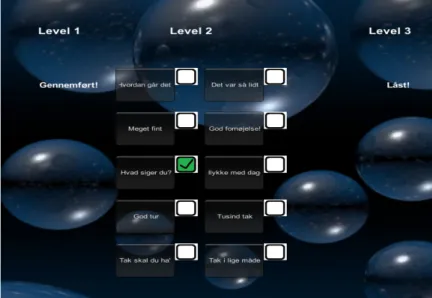
Pressing Send invokes the Talebob acoustic analyzer, returning a smiley, either happy, neutral, or sad. With a happy smiley :-) the pupil has completed the task and may continue with the next phrase. Level-1 is done when the first five tasks are completed, level-2 has ten tasks, and level-3 fifteen. The phrases are ordered progressively, from single words and simple phrases in level-1 (godmorgen, værsgo!), frequent idioms in level-2 (hvordan går det?, tak i lige måde), to more expressive phrases in level-3 (det siger du ikke?, hellere end gerne!). When all tasks in level-3 are done, the Talebob challenge is passed.
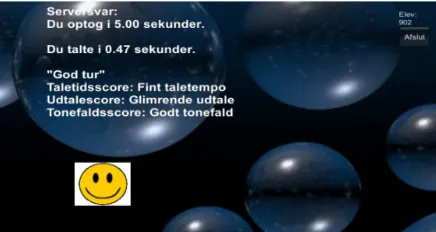
Talebob's front-end is illustrated in fig. 1-3.
[image:2.595.307.523.417.566.2]Figure 2. Screenshot (excerpt) from Talebob return-page, level 2, not-passed.
Figure 3. Screenshot (excerpt) from Talebob return-page, level 2, passed.
4 Talebob's back-end
(acoustic analysis) The two sound files submitted (with the Send button) are evaluated in the Talebob back-end application. The acoustic analysis compares the prompt version (P) and the user's own production (U) sampling both files for F0 (pitch in Hz) and INT (intensity in dB), being uanimously considered as the most relevant parameters for acoustic-phonetic evaluation.1 The linguisticevaluation is focused on the concordance of P and U wrt. speech tempo, global prosody, and articulation.
The speech tempo factor (STF) is determined as the ratio of durations for P and U,
STF = duration(P) : duration(U)
1 F0 and INT are measured using the Praat toolkit
(www.fon.hum.uva.nl/praat), window size 5 ms, filter settings = Pitch (ac)... 0.005 75 15 yes 0.03 0.45 0.01 0.4 0.14 600; Intensity... 75 0.005 yes. We also experimented with HNR (harmonicity-to-noise ratio) and various spectral filterings, but found them to be too noise sensitive. Classrooms are not quiet places!
STF is calculated from INT data. First the zero level for INT in U is estimated, corresponding to 'no speech' in the given signal (this calibration can be tricky, especially for noise-prone samples, and is always a matter of heuristics). Then the zero level (0 dB after calibration) is used to delimit the speech production in U. By definition the optimum value for STF is 1.0, and productions approaching this value will trigger the comment "Meget fint taletempo" (excellent speech tempo). Lesser or greater values return instructions to speak faster or slower, respectively.
Prosody and articulation analyses are based on F0 measurements. Only the 'sonorant' parts of P and U are sampled - that is, the segments of the speech signals where a pitch value can be meaningfully estimated, thus excluding obstruent sounds and moments of silence (e.g. between words). All frequency data are stored as logarithmic values (more convenient for statistical use). Many of Talebob's users are children, and their speech productions will often be higher-pitched than the phrase prompt on average. This global difference in pitch is of course irrelevant to the Talebob evaluation, so the F0 dataset for U is normalized (each sample multiplied with a derived constant) equalizing the average pitch of U and P.
After these preparatory steps, the prosodic evaluation is done. The calculation is based on 10 qualified datapoints for each (normalized) dataset U and P, in a procedure best explained by an example. Say 130 valid pitch samples were derived from P; the first datapoint for P (call it f1,P) is then derived as the mean value for the first
13 samples; the 2nd datapoint (f2,P) for samples
14..26, et cetera, up to (f10,P) and (f10,U). Finally
the prosodic deviation (ProsDev) of U wrt. P is calculated by summation of 'errors',
ProsDev = |f1,P-f1,U| + |f2,P-f2,U| + .. + |f10,P-f10,U|
[image:3.595.72.290.94.207.2] [image:3.595.71.289.285.401.2]tonefald er fint", and otherwise an instruction how to improve, e.g. "Prøv at tale mere livligt" (try speaking more lively).
The articulation is evaluated (ArtEval) along the same lines, but focusing on local incongruities rather than the phrase as a whole. First 30 qualified datapoints are derived following the procedure above, using numerical interpolation if necessitated by data sparseness. Error analyses (calculated as for ProsDev, mutatis mutandis) are done for datapoints 1..10, 11..20, and 21..30,
ArtEval
(
a,b)
=∑
n=a b
(
Fn,P−Fn,U)
,
F being is the 30-point dataset (otherwise as f above). The results for ArtEval(1,10), ArtEval(11,20), and ArtEval(21,30) represents the first, middle, and last part of the utterance as reflected in the returned comments: "Prøv at tale tydeligere i de første/midterste/sidste ord" (try to speak more clearly in the first/middle/final/all words). Such a message is, admittedly, a very blunt linguistic description, but faced with the impatience and limited academic vocabulary of pupils, we had to prioritize didactive effect over descriptive accuracy.
Summing up, feedback from Talebob consists in three comments, one for each of the evaluation criteria (tempo, prosody, and pronunciation), and in addition a smiley representing the overall performance. The happy smiley ('task completed') is given when each of the three evaluation results has met a (pre-set) acceptable limit, the sad smiley is given if none of the limits are met, and the medium smiley otherwise. See the discussion below on the linguistic relevance and scientific testability of the Talebob acoustic-phonetic design.
4.1 An example - phrase "hej med dig"
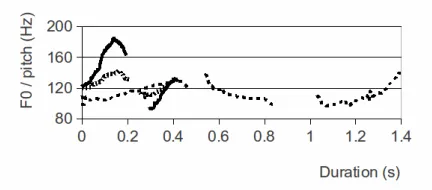
The graphs in fig. 4 and 5 both cover the phrase hej med dig in three speech productions, (i) the prompt, (ii) an Islandic pupil (boy, 7th grade) on 2nd attempt, and (iii) same pupil on 5th attempt. Notice that INT graphs are continuous, intensity being defined everywhere, while F0 graphs are interruped at non-sonorant passages (e.g. the stopped [d] in dig).
The huge difference in speech tempo between
[image:4.595.310.526.477.573.2]2nd and 5th attempt is easily appreciated in fig. 4. The very slow tempo in #2 (2nd attempt) triggered the Talebob comment "Du taler alt for langsomt" (you speak much too slowly); the pupil sped up and - as seen - eventually matched the prompt's tempo in #5. His pronunciation had also become more fluent, without the unwarranted separation of hej and med (cf. the INT dip around t=0.45" in the #2 graph, absent from both #5 and the prompt). Concerning the prosodic contour, notice that the F0 envelope for #2 and #5 (cf. fig. 5) both match the prompt quite closely when abstracting away from the different tempi: two stable pitch inclinations with an intervening resetting, corresponding to the two stress groups in the (most common) Danish pronunciation. Consequently, ProsDev is relatively low in both cases, having Talebob praise the pronunciation in both cases: "Meget fint tonefald" (very good tone-of-voice). At the same time, though, the ArtEval-based analysis shows a 'lack' of pitch modulation in #2 (preceived as mumbling, and producing a relatively poor ArtEval value), in this case triggering the comment for #2: "Prøv at tale tydeligere" (try to pronounce the words more clearly). Through his next attempts, the pupil improved his pronunciation gradually, and by #5, the ArtEval value passed the accept limit, allowing Talebob to issue a happy smiley (notice though in fig. 5 that the pitch range is still somewhat limited for #5).
Figure 4. Phrase "hej med dig", intensity data; prompt (solid line), Icelandic pupil's 2nd/5th attempt (close/dispersed dots)
[image:4.595.309.525.630.725.2]5 System architecture
The Talebob development had three phases. First an appropriate set of phrases was selected and recorded, largely recycling materials and selection criteria from earlier CALL projects including Allwood et al. (2005), Selsøe et al. (2004), Henrichsen (2004, 2004b). Then the back-end was programmed and tested (Perl-code and standard open-source modules). The front-end, however, presented us with an unexpected challenge. Nobody could update us on the IT situation in West-Nordic schools, neither for hardware, software, operating system, local IT-assistance, or even internet connectivity. Yet we did not want any potential user to go down on equipment. Also we did not want to preclude any working places. Some pupils prefer to train in the privacy of their home while others like to share. We did not want to force any limitations on the user on purely technical grounds. This led us to consider three front-end/back-end architectures.
A1. Stand-alone (program installed on user's own hardware: pc, tablet, or smartphone)
PRO:
• Independent of internet connectivity • Quick query-response cycle
CON:
• Programming/maintenance of back-end for a range of unknown hardware is demanding • Technical support (from developer to pupil,
teacher and/or local IT helpdesk) is hard due to physical and time-zone distance
• Monitoring of users' performance and progress is difficult
• System updates are hard to communicate
A2. Browser-based PRO:
• Contacts between users and server can be logged (easier maintenance & development) • Developers can make performance data
available to teachers and others online • Browser-based front-end using HTML5 and
CSS is hardware independent (well, almost!)
CON:
• Stands or falls with user's connectivity • 100% server uptime is mandatory
• HTML5 audio, especially for recording, is currently not fully supported in all browsers
A3. Internet-based, but dedicated front-end
The advantages are the same as for A2, and in addition the HTML5 problem can be avoided. Also we do not need to instruct users to download this or that internet-browser. The main hurdle is that users have to install a dedicated program prior to their first positive Talebob experience.
Even if A2 seemed to us to be the best alternative overall, we settled on A3 for practical reasons. Many potential users are Explorer fans and did not care to install a new browser with better HTML5 support, such as Chrome, Firefox, or even IE 9+.
As the developer team had some experience with Unity4 (www.unity4.com), in particular its strong audio support and graphics drivers, we settled for this programming workbench. Unity4 is freely available (in the open-source version) and so does not compromize Talebob as a shareable application. Unity4 programs compile to all common operating systems (even older versions) including Linux, Mac, Win, Android, etc. The flip side of the coin is that potential Talebob users have to download an executable (via Dropbox, as explained in the Taleboblen homepage, www.taleboblen.hi.is), unzip it, and invoke it using their own operating system. Simple as these procedures may be for skilled IT-users, they showed to be problematic for many language teachers and even local IT-helpdesks. We intend to launch a purely browser-based Talebob-version in the near future, as a supplement to the current version.
6 Talebob meets the world
Before launching our test programme in Iceland, Greenland, and the Faroese Islands we wanted to assess Talebob's competence as a Danish language teacher, so we evaluated Talebob with a panel of native Danish speakers (18 pupils aged 9-18), in surroundings chosen to match the typical Talebob user's (school, car, living room). 16 out of 18 panel members completed the 30 phrases in less than 50 attempts, meaning that most tasks were completed on the first attempt. This seemed to be a satisfactory result.
For comparison, our current log of L2 users at the time of writing shows an average of 84 attempts for the Talebob challenge as a whole (2.80 attempts per phrase), with a global best-score of 55 attempts. Danes and non-Danes thus seem to be clearly distinguished, suggesting that Talebob's automatic feedback is linguistically non-arbitrary as well as didactically useful.
6.1 The case of Iceland
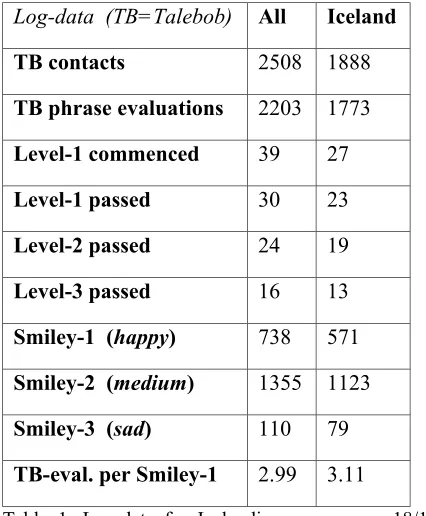
Table 1 summarizes all contacts made to the Talebob back-end during our (still ongoing) test period. For technical and practical reasons, Greenland and the Faroes have only been able to access Talebob systematically for a considerably shorter time than Iceland. We therefore have to postpone cross-country comparisons to a later paper.2
The pupils taking part in the experiment were not urged to finish the Talebob challenge. They were simply invited by their teacher to try it out. It's
2The cross-country study could be an interesting
one given the extremely different attitudes towards Danish as an L2 encountered in the West-Nordic area. Running a risk of premature generalization, we observe that Greenlandic pupils are highly motivated learners (being heavy users of Danish media) as opposed to the Icelandic children who may have an easier time pronouncing the Danish sounds, but are generally much less motivated anyway (Iceland being in some respects more culturally self-sufficient). Faroese children don't seem to question the necessity of learning Danish at all (many of them preparing for studies in mainland Denmark).
therefore interesting to notice that approximately half of the users who have taken up the Talebob challenge (i.e. passed at least one phrase task), do finish the course as well. In other words, we don't see signs of 'early fatigue'.
When consulting the performance data, we see that level-1 phrases took 2.64 attemps to pass on average, level-2 took 2.54, and level-3 took 3.48. As level-3 puts the user under much heavier demand (15 several-word phrases, compared to level-1's 5 very short phrases), we conclude that pupils, in general, are not scared off by the harder struggle. Out of 19 pupils entering level-3, almost 70% completed the level as well. This is an encouraging result, convincing us that Talebob - even in it's earliest version, with crude graphics, canned messages, an adult prompt voice, and no personalization at all - can be appreciated as a fun and meaningful challenge by young children used to the far more advanced interaction of computer games.
Log-data (TB=Talebob) All Iceland
TB contacts 2508 1888
TB phrase evaluations 2203 1773 Level-1 commenced 39 27
Level-1 passed 30 23
Level-2 passed 24 19
Level-3 passed 16 13
Smiley-1 (happy) 738 571
Smiley-2 (medium) 1355 1123 Smiley-3 (sad) 110 79 TB-eval. per Smiley-1 2.99 3.11
Table 1. Log-data for Icelandic users as per 18/12 2013. Column 'All' includes Faeroese and Greenlandic contacts.
6.2 What's Danish about Talebob?
[image:6.595.305.518.378.636.2]parts. Hence no re-programming will be needed when porting Talebob to new L2 scenaria, only an editorial process of selecting 30 (or more) suitable phrases followed by a recording session with one or more native speakers with a flair for 'ecological pronunciation'. The technical integration of these materials are fairly trivial (though some languages may require slight changes in the acoustic setup). In this respect, Talebob's simplistic speech evaluation differs from the technologically far more sophisticated CALL tools for L2 conversational training available in the market, such as Guiliana (2004), Wang (2011), de Vries (2014), and Mirzaei et al. (2014), and commercial CALL-programs like Cooori (www.cooori.com), all including a fully-fledged ASR component (automatic speech recognition).
6.3 Talebob as a scientific enterprise
Our current evaluation regime (based on STF, ProsDev, and ArtEval) has worked well, providing a useful compromise between linguistic precision and communicable (age-appropriate) advise. However, we are aware that this particular setup has not proved itself in a strict scientific sense. Maybe different formulae or new scoring procedures would allow even more useful feedback from Talebob. For example, we suspect that ProsDev and ArtEval definitions based on standard deviation rather than numerical distance may allow more specific corrections. New batteries of formulae is constantly being tested - still without this being driven by ideal linguistic criteria, but rather as a pragmatic and feedback-informed activity.
Actually, it's not clear to us that an 'ideal' configuration could be obtained at all. The most effective evaluation procedures, from a didactic point of view, would not rely solely on ideal linguistic criteria, but include the personal profiles of the pupils (degree of motivation, prior knowledge of Danish, own first language, general IT-experience, and more).
7 Concluding remarks
Our perhaps most significant conclusion is that pupil users like Talebob and spend far more time (at home and in school) training Danish
pronunciation than ever before (Hauksdottir and Henrichsen, in prep.). We have not performed any objective evaluations of the didactic effects yet, and so we do not know whether Talebob can actually teach pupils a better Danish. Nevertheless, teachers in our test group (especially Icelanders) report that most of their pupils never practiced spoken Danish before unless forced. A majority of pupils report that they feel more confident now when using Danish speech productively (Hauksdottir 2015). This seems to be an important result in itself.
Finally we wish to point to Talebob as an example of CALL-based screening of large groups of pupils. Access to statistical information about the progress of individual pupils, classes, or even populations of classes may of course be useful for teachers, but perhaps even more so for researchers and political decision-makers.
Such considerations are highly relevant in Denmark right now, the 2014 school reform being currently implemented. For the first time ever English is now taught from first grade. Spokesmen for the teachers are constantly expressing concerns about the lack of training programmes for teachers new to the challenge of teaching English to minors. Objective means for assessing the learning patterns are frequently called for in the press and in the parliament. We believe that cleverly designed CALL-tools could play a decisive role in this debate.
We are currently working preparing a Talebob version adapted for English phrases, planning experiments with first graders in late 2015, hopefully laying the ground for a longitudinal study. We do hope that Nordic researchers and Danish politicians will pick up on this unique historical opportunity.
Acknowledgments
Tórshavn (visit http://www.taleboblen.hi.is). Many have thus contributed, from a geographical area spanning five time zones. One, however, outshines all others: project leader and initiator Auður Hauksdóttir. Thanks to Auður for her many years as a powerstation in Nordic L2 didactics.
References
Allwood, J., Henrichsen, P. J. (eds). 2005. SweDanes for CALL - A corpus and computer-based student's aid for comparison of Swedish and Danish spoken language. NorFA CALL NET (cd med manual)
Appel, C., Robbins, J., Moré, J., Mullen, T. 2012.
Task and Tool Interface Design for L2 Speaking Interaction Online. EUROCALL 2012
Giuliani, D., Mich, O., Gerosa, M. 2004. Parling, a CALL System for Children. InSTIL/ICALL2004 – NLP and Speech Technologies in Advanced Language Learning Systems
González, J.F. 2012. Can Apple's iPhone Help to Improve English Pronunciation Autonomously? State of the App. EUROCALL 2012
Hauksdottir, A., Henrichsen, P.J. (in prep.) Dansk som Fremmedsprog i Vestnorden
Henrichsen, P. J. 2004b. "CALL for the Nordic Languages - tools and methods for Computer Assisted Language Learning; Cph. Studies in Language 30/2004
Mbah, E.E., Mhab, B.M., Iloene, M.I., Iloene, G.O.
2013. Podcasts for Learning English Pronunciation
in Igboland: Students' Experiences and Expectations. EUROCALL 2013
Mirzaei (2014) Partial and synchronized captioning: A new tool for second language listening development; EUROCALL 2014.
Henrichsen, P. J. 2004. The Twisted Tongue; Tools
for Teaching Danish Pronunciation Using a Synthetic Voice; in Henrichsen 2004b
Selsøe Sørensen, H., Henrichsen, P. J., Hansen, C. 2004. NorFA CALL net: Nordisk Netværk om Computerstøttet Unvervisning i Nordiske Sprog; Nordisk Sprogteknologisk Forskningsprogram 2000-2004, Samfundslitteratur Press, 224pp
Thorborg, L. 2003. Dansk Udtale - Øvebog. Synope,
ISBN 87-988509-4-6 (cd and book)
Thorborg, L. 2006. Dansk Udtale i 49 Tekster. Synope, ISBN 87-91909-01-5 (cd and book)
de Vries, B. P., Cucchiarini, C., Bodnar, S.. 2014.
Automatic Feedback on Spoken Dutch of Low-Educated Learners: An ASR-based CALL study. Proceed. of EUROCALL 2014 (to appear)
Wang, H., T. Kawahara and Y. Wang. 2011.