Proceedings of The 9th International Natural Language Generation conference, pages 217–221,
Ranking Automatically Generated Questions Using Common Human
Queries
Yllias Chali and Sina Golestanirad University of Lethbridge
Alberta Canada
Abstract
In this paper, we challenge a form of paragraph-to-question generation task. We propose a question generation system which can generate a set of comprehensive questions from a body of text. Besides the tree kernel functions to assess the grammatically of the generated questions, our goal is to rank them by using community-based question answer-ing systems to calculate the importance of the generated questions. The main assumption be-hind our work is that each body of text is re-lated to a topic of interest and it has a compre-hensive information about the topic.
1 Introduction
Human beings are not very good at asking ques-tions about topics. They are often forgetful, which causes difficulties in expressing what is in their minds (Hasan, 2013). Also sometimes, Humans, in front of a search engine, have difficulties to express their needs and intents as query terms. Imagine that you want to find out what was the first logo for Ap-ple Inc. You may use a search engine such asGoogle
and the search queryApple Logos, the result might have the exact information that you need. How-ever, they may also include other information, such as who designed the logo or where it was designed or any other information that you are not interested in. We believe if before showing the list of web-sites the search engine had shown some suggested queries you would benefit from this question gener-ation (QG) system. This way search engines’ users will be able to use right queries to gain what they
are looking for. Suggestions could be questions like:
What is the logo of Apple Inc.? What was the first logo designed for Apple Inc.? Do we have any infor-mation about where Apple’s logo was designed?etc. In this paper, we address the challenge of generating questions from topics, which is motivated by the fact that people do not always obtain the desired results from search engines. In this task, we assume that for each search-engine user’s query there is a body of text having useful information about it. Our goal is to generate and show a few questions to the user in order to help her/him to find exactly what she/he is looking for. We need to rank the questions because the number of generated questions could be many to be shown and we may have to show only top-ranked ones.
between each question and the text from which the question is generated. This way we can determine the correctness of the grammatically of the gener-ated questions. Then, the questions are ranked by their importance and grammatical correctness.
2 Related Work
An automated question generation system can also be used for educational purposes, and some works address the task of automatically generating ques-tions from reading materials in order to advance ed-ucational assessment and practice (Mitkov and Ha, 2003; Wang et al., 2008; Xu et al., 2009; Rus and Graesser, 2009; Heilman and Smith, 2010a; Agar-wal and Mannem, 2011; AgarAgar-wal et al., 2011). Heil-man and Smith (2010b) proposed a system that over-generates some questions and then uses a model, which has been trained on a dataset in order to rank the generated questions. Liu et al. (2010) proposed an automatic question generation system which helps students to write literature reviews. Gate (2008) developed a question generation sys-tem that generates questions in order to help stu-dents while reading an article rather than afterwards. Lindberg et al. (2013) introduced a sophisticated template based system which merges semantic role labels into a system that automatically generates nat-ural language questions to support online learning. Mazidi and Nielsen (2014) proposed an automatic question generator which benefits from semantic pattern recognition to generate questions which have different depth and type for tutoring or self-study purposes. Rokhlenko and Szpektor (2013) chal-lenged the task of automatically generating ques-tions which are relevant to a given text but do not exist in the text. Labutov et al. (2015) developped an approach for generating deep (i.e, high-level) com-prehension questions from novel text. Chali and Hasan (2015) addressed the problem of automati-cally generating questions from topics.
3 Question Generation
Our question generation approach is built in five steps. In the first step, we tag named entities from a text which is related to the query. In the next step, we use question templates to generate basic questions, based on the tags from the previous step. In the third
step, we apply a text simplifier to all of the sentences in the text and then we use a semantic role tagger to tag all of the arguments and predicates in these sen-tences. Fourth step is about applying another set of question rules to the extracted arguments and pred-icates in order to generate specific questions. In the final step, we use our proposed algorithm to rank all of the generated questions.
3.1 Generating Basic Questions
The named entities, which are in the topic and its rel-evant text are tagged using the Illinois Named Entity Tagger. Then, we apply our general rules to gener-ate the basic questions. At this level, the answers to these questions may not be in the text and the reason for generating these questions is to have more diver-sity in our question pool. We designed 265 question templates and an algorithm that generates the basic questions with regard to the tagged named entities.
3.2 Generating Specific Questions
The grammar of the sentences in the body of the text may be complicated, that is why the sentences have to be simplified before we can generate more ac-curate questions. To do the task of simplification, we use the simplified factual statement extraction toolkit (Heilman and Smith, 2010a). This model simplifies sentences by changing semantic and syn-tactic structures, eliminating phrase types, etc.
For the next step, we need to parse sentences in the text semantically. To this end, we use Auto-matic Statistical SEmantic Role Tagger (ASSERT)1. When a sentence is given to ASSERT, it applies a full syntactic analysis of that sentence, identifies all of the verb predicates, then extracts features for con-stituents within the parse tree relative to the pred-icate, and eventually identifies and tags the con-stituents with the appropriate semantic arguments. The outputs contain verbs (predicates) with their ar-guments (semantic roles). Those arar-guments can be used to generate specific questions.
In order to generate the specific questions, we used 350 rules to transform the tagged sentences into questions. These rules are designed in a way that the answer words in a sentence could be discovered and replaced by question words.
4 Ranking of the Questions
As the number of generated questions is usually too
large, we have to rank and show the top N ones.
We score the questions regarding to their importance and syntactic correctness. We give equal weight to both importance and correctness.
4.1 Importance of the Generated Questions
In Chali and Hasan (2015), the importance of the generated questions was estimated by their similar-ities to the text. We believe that there is another source to use in order to do the task of ranking the importance of the generated questions. Nowadays, it is becoming a common habit for people to ask their questions in online forums, which are called community-based question answering (CQA) sys-tems, such as Yahoo! Answers’ web site. We be-lieve that there are many common questions being asked by people that can be used to study what peo-ple need and what they are mostly curious about. The key point is that people using CQA systems use more informative sentences to ask and so if these sentences are similar to the search engines’ queries then we can extract additional information about the users’ probable interests. Our algorithm predicts what the user might be looking for by investigat-ing other questions asked by other people, then this knowledge can be used to rank the importance of the generated questions.
4.1.1 Database
Our algorithm needs a CQA system, we use then Yahoo! Answers dataset. Yahoo! Answers is grow-ing quickly, it is suggested that researchers increas-ingly use Yahoo! Answers dataset and it is becom-ing a popular source of information, such as advice or opinion (Liu and Agichtein, 2008). The data that we use in our experiments is Yahoo! Answers cor-pus as of 10/25/2007. In Yahoo! Answers people usually ask their questions in two steps. First, they ask a short and informative question which is called
subject. Then, they try to explain the question in a few sentences, which is calledcontent. The content part does not often provide more information.
4.1.2 Ranking Algorithm
1. To begin, we extract all subjects from Yahoo! Answers database.
2. When a user performs a Search Engine Query (SEQ), we calculate the semantic similarity be-tween the SEQ and each extracted subject.
3. Then we store the top scored subjects in an ar-ray, named Top-Subjects and also the scores of these Subjects in another array called Top-Subjects-Scores.
4. At this step, we find the similarity scores of the first generated question with all Top-Subjects.
5. We store these scores in an array called Generated-Question-Similarities-to-Top-Subjects.
6. To obtain an overall score we take the aver-age of all scores in both vectors Top-Subjects-Scores & Generated-Question-Similarities-to-Top-Subjects.
At this point, we have one score showing us how similar the generated question is to the questions that people have asked in Yahoo! Answers. The same steps will be taken for each generated question re-sulting in one similarity score per generated ques-tion. Then we sort the generated questions by these scores and show the user as many top ones as re-quired.
In our experiments, we use the semantic similarity toolkit SEMILAR2. It has different methods for cal-culating the semantic similarity scores (Rus et al., 2013a; Rus et al., 2013b). We use LDA-Optimal method as its accuracy is quite acceptable.
4.2 Judging Syntactic Correctness
It is strongly believed that a question has a simi-lar syntactic structure to the sentences from where it is generated (Chali and Hasan, 2015). Therefore, to judge the syntactic correctness of each generated question, we apply tree kernel functions (Collins and Duffy, 2001) in order to compute the syntactic similarity between each question and its associated body of text. To measure the syntactic similarity be-tween two sentences, we first parse them syntacti-cally which results in a parse tree for each sentence, then we apply tree kernel functions to these trees.
The tree kernel function produces the syntactic simi-larity score between each sentence in the given body of text and the generated question. Each sentence contributes a score to the questions and then the questions are ranked by considering the average of their similarity scores.
5 Experiments
5.1 Corpus
In our experiments, we use the dataset from the Question Generation Shared Task and Evaluation Challenge (Rus and Graesser, 2009; Rus et al., 2010) to tackle the task of automatically generating questions. The dataset consists of 60 paragraphs, each related to 60 topics. They are originally selected from several articles such as OpenLearn, Wikipedia and Yahoo!Answers. The paragraphs are constructed from approximately 57 sentences, a total number of 100,200 tokens including punc-tuations. As mentioned before, to do our task, we assume that there exists a text related to each query containing useful information about it, so we consider the topics as queries and treat paragraphs as the associated body of the texts.
5.2 Evaluation Setup
Our methodology to evaluate the performance of our automated question generation system is inspired by Hasan (2013). Three unknown native English speak-ers were chosen to judge the result of our system. They were asked to score the generated questions according to two criteria: syntactic correctness and topic relevance. Judges give scores between 1 (very poor) and 5 (very good). There were four scores for each generated question. To evaluate the topic rele-vance criterion, judges were given three aspects, and they score each question according to each aspect. Aspects were: 1) questions’ semantic correctness 2) question type correctness and 3) clarity of referen-tial. For syntactic correctness, they score the gen-erated questions considering if they are grammati-cally correct or not. Then the average of the judges’ scores is calculated for each question.
To evaluate our system, we compare it with the state-of-the-art question generation system proposed by Chali and Hasan (2015). To do so, we use a
pub-licly available question generation system by Heil-man and Smith (2010a) as a benchmark. In our evaluation, we generated the questions from 20 ran-domly chosen texts and then select the top10ranked questions. We also generate the questions for the same texts by Heilman and Smith (2010a) question generation toolkit and again select top 10 ranked ones. The human judges were presented with 20 questions per text, top10 from our system and top
10from the system proposed by Heilman and Smith
(2010a). We have 20 texts for the total number
of400 questions for each judge. After comparing
our system with Heilman and Smith (2010a) system, we calculate our system advancement in comparison with the one created by Chali and Hasan (2015).
[image:4.612.321.532.479.524.2]5.3 Results and Discussion
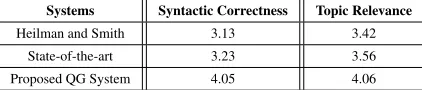
Table 2 lists the average of syntactic correctness and topic relevance scores for each system. These results confirm that our proposed automated question gen-eration system outperforms the Heilman and Smith system (2010a) by 29.39%, and 18.71%, and over the Chali and Hasan system (2015) by 25.38%, and 14.04%, respectively. In this paper, we have shown that by using semantic similarity between a topic of interest and a group of pre-asked questions we can extract related ones to the concept of the topic and then we can use them to find the importance of a new generated question.
Systems Syntactic Correctness Topic Relevance
Heilman and Smith 3.13 3.42
State-of-the-art 3.23 3.56
Proposed QG System 4.05 4.06
Table 1:Syntactic correctness and topic relevance scores
6 Conclusion
correct. We believe that there might be some ways in which this research could be continued, for ex-ample, our proposed system is rule-based, however, one of the ways to scale up these rules is learning them using learning techniques, in other words, the templates may be learned / acquired from a corpus of CQA data.
References
M. Agarwal and P. Mannem. 2011. Automatic gap-fill question generation from text books. InProceedings of the 6th Workshop on Innovative Use of NLP for Building Educational Applications, pages 56–64. M. Agarwal, R. Shah, and P. Mannem. 2011. Automatic
question generation using discourse cues. In Proceed-ings of the 6th Workshop on Innovative Use of NLP for Building Educational Applications, pages 1–9. Y. Chali and S. Hasan. 2015. Towards topic-to-question
generation. Computational Linguistics.
M. Collins and N. Duffy. 2001. Convolution kernels for natural language. InAdvances in neural information processing systems, pages 625–632.
D. M. Gates. 2008. Automatically generating reading comprehension look-back strategy: Questions from expository texts. Technical report, DTIC Document. S. Hasan. 2013. Complex question answering:
minimiz-ing the gaps and beyond. Ph.D. thesis, University of Lethbridge, Alberta, Canada.
M. Heilman and N. A. Smith. 2010a. Extracting simpli-fied statements for factual question generation. In Pro-ceedings of QG2010: The Third Workshop on Ques-tion GeneraQues-tion.
M. Heilman and N. A. Smith. 2010b. Good question! statistical ranking for question generation. InHuman Language Technologies: The 2010 Annual Conference of the North American Chapter of the Association for Computational Linguistics, pages 609–617.
I. Labutov, S. Basu, and L. Vanderwende. 2015. Deep questions without deep understanding. In Proceed-ings of the 53rd Annual Meeting of the Association for Computational Linguistics and the 7th Interna-tional Joint Conference on Natural Language Process-ing, pages 889–898.
D. Lindberg, F. Popowich, J. Nesbit, and P. Winne. 2013. Generating natural language questions to sup-port learning on-line. InProceedings of the 14th Eu-ropean Workshop on Natural Language Generation, pages 105–114, Sofia, Bulgaria.
Y. Liu and E. Agichtein. 2008. On the evolution of the yahoo! answers qa community. InProceedings of the 31st annual international ACM SIGIR conference
on Research and development in information retrieval, pages 737–738.
M. Liu, R. A. Calvo, and V. Rus. 2010. Automatic ques-tion generaques-tion for literature review writing support. InIntelligent Tutoring Systems, pages 45–54.
K. Mazidi and R. D. Nielsen. 2014. Linguistic consider-ations in automatic question generation. In Proceed-ings of the 52nd Annual Meeting of the Association for Computational Linguistics, pages 321–326.
R. Mitkov and L. A. Ha. 2003. Computer-aided gen-eration of multiple-choice tests. InProceedings of the HLT-NAACL 03 workshop on Building educational ap-plications using natural language processing-Volume 2, pages 17–22.
O. Rokhlenko and I. Szpektor. 2013. Generating syn-thetic comparable questions for news articles. In Pro-ceedings of the 51st Annual Meeting of the Association for Computational Linguistics, pages 742–751. V. Rus and A. C. Graesser. 2009. The question
genera-tion shared task and evaluagenera-tion challenge. The Uni-versity of Memphis. National Science Foundation. V. Rus, B. Wyse, P. Piwek, M. Lintean, S. Stoyanchev,
and C. Moldovan. 2010. The first question genera-tion shared task evaluagenera-tion challenge. InProceedings of the 6th International Natural Language Generation Conference, pages 251–257.
V. Rus, M. C. Lintean, R. Banjade, N. B. Niraula, and D. Stefanescu. 2013a. Semilar: The semantic similar-ity toolkit. InProceedings of the 51st Annual Meet-ing of the Association for Computational LMeet-inguistics, pages 163–168.
V. Rus, N. Niraula, and R. Banjade. 2013b. Similarity measures based on latent dirichlet allocation. In Pro-ceedings of the Computational Linguistics and Intelli-gent Text Processing, pages 459–470.
W. Wang, T. Hao, and W. Liu. 2008. Automatic ques-tion generaques-tion for learning evaluaques-tion in medicine. In
Advances in Web Based Learning – ICWL, pages 242– 251.