Universal dependencies for Uyghur
Mairehaba Aili
Xinjiang University,China
[email protected]
Weinila Mushajiang
Xinjiang University,China
[email protected]
Tuergen Yibulayin
Xinjiang University, China
[email protected]
Kahaerjiang A.
Yan Liu
Xinjiang University
[email protected]
Xinjiang University
[email protected]
Abstract
The Universal Dependencies (UD) Project seeks to build a cross-lingual studies of treebanks, linguistic structures and parsing. Its goal is to create a set of multilingual harmonized treebanks that are designed according to a universal annotation scheme. In this paper, we report on the conversion of the Uyghur dependency treebank to a UD version of the treebank which we term the Uyghur Universal Dependency Treebank (UyDT). We present the mapping of the Uyghur dependency treebank’s labelling scheme to the UD scheme, along with a clear description of the structural changes required in this conversion.
1
Introduction
Treebanks can be used for statistical learning as well as evaluation and are available for an increasing number of languages. For instances: Czech (Hajičová, 1998), Danish (Kromann, 2003), Turkish (Oflazer, 2003) Slovene (Džeroski et al., 2006), and Finnish (Haverinen et al., 2010). However, be-cause of having been built with language-related specific schema, it leads to different treebanks with different structure. It seems reasonable, but this has hampered to perform sound comparative evalua-tions and cross-lingual learning experiments. It is reported that statistical parser output in one language cannot be easily compared or transferred to another when using two training data which labelled with different annotation schemes (McDonald et al, 2011; Søgaard, 2011). Mcdonald et al. (2013) reported improved results on cross-lingual transfer parsing using 10 uniformly annotated treebanks.
The Universal Dependencies (UD) seeks to develop cross-linguistically consistent treebank annota-tion guidelines and apply them to many languages to create treebank annotaannota-tions, aiming to capture similarities as well as idiosyncrasies among typologically different languages, and released guideline to assist with the creation of new UD treebanks, or mapping and conversions of existing treebanks to a new universal scheme. The UD scheme is built on the Google Universal part-of-speech (POS) tagset (Petrov et al., 2012), the interset interlingua of morphosyntactic features (Zeman, 2008), and Stanford Dependencies( Tsarfaty, 2013; de Marneffe et al., 2014). In addition to the abstract annotation scheme, UD defines also a treebank storage format, CoNLL-U. The UD scheme accounts for varying linguistic differences across language by providing the option of defining language–specific label sub-types when the prescribed list of labels do not adequately cover all linguistic features of a given language. Nivre (2015) explains the motivation behind the project. Since then, a large number of additional tree-banks have been either built or converted from existing treetree-banks to form new UD treetree-banks. To date, there are 54 treebanks representing 40 languages listed in the UD project.
We have mapped the Uyghur dependency Treebank (UyDT) ( S.Mamitimin et al., 2013; M.Aili et al., 2016 ) to the UD scheme (Version 1) for purposes of cross-lingual studies and parser improvement. The UyDT is a corpus of Uyghur sentences that have been annotated manually. This paper summariz-es the conversion and mapping of the UyDT to Uyghur Universal Dependency Treebank (UyUD), as part of the Universal Dependencies (UD) Project.
This work is licensed under a Creative Commons Attribution 4.0 International Licence. Licence details: http://creativecommons.org/licenses/by/4.0/
2
Brief introduction for UyDT
Uyghur is a Ural-Altaic language, has rich and complex morphological structure. As a typical aggluti-native language, Uyghur displays rather different characteristics compared to those more well-studied languages in the parsing literature. On the syntactic side, Uyghur has SOV constituent order, and con-sidered a free-constituent order language. Uyghur is also a pro-drop language, as the subject can be elided if necessary, and recovered from the agreement markers on the verb.
We aim at building a dependency treebank to provide basic resources for future NLP researches. Morphological structure plays an important role in finding syntactic relations between words in Uy-ghur sentences. So all texts are morphologically analysed by UyUy-ghur Morphological Analyser (UMA) software (M. Aili et al., 2012), There are 13 basic POS tags as shown in Table 1.
No tags POS No tags POS
1 N Noun 7 I Imitative
2 A Adjective 8 C Conjunction
3 M Numeral 9 T Particle
4 Q Quantifier 10 E Exclamation
5 D Adverb 11 V Verb
[image:2.595.163.431.218.326.2]6 P Pronoun 12 R Postposition 13 Y Punctuation
Table 1. Basic Post Tags in Uyghur Languages
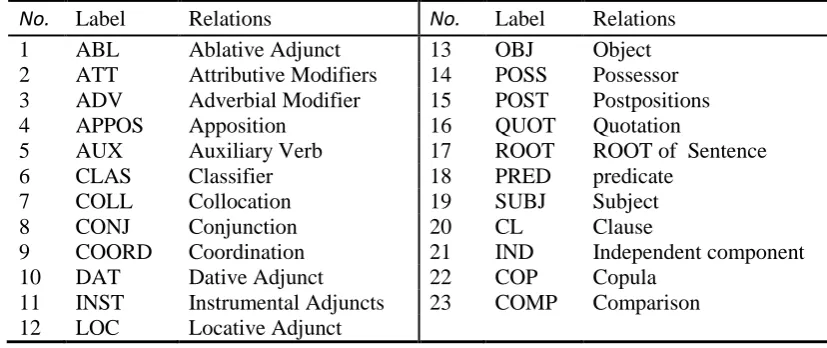
There are 23 dependency relations scheme in UyDT as general as possible which are listed in Table 2.
No. Label Relations No. Label Relations
1 ABL Ablative Adjunct 13 OBJ Object
2 ATT Attributive Modifiers 14 POSS Possessor 3 ADV Adverbial Modifier 15 POST Postpositions
4 APPOS Apposition 16 QUOT Quotation
5 AUX Auxiliary Verb 17 ROOT ROOT of Sentence
6 CLAS Classifier 18 PRED predicate
7 COLL Collocation 19 SUBJ Subject
8 CONJ Conjunction 20 CL Clause
9 COORD Coordination 21 IND Independent component
10 DAT Dative Adjunct 22 COP Copula
11 INST Instrumental Adjuncts 23 COMP Comparison 12 LOC Locative Adjunct
Table 2. Dependency relation tags in Uyghur Dependency Treebank
3
mapping
3.1
mapping POS-tagset
The UD part-of-speech (POS) tagset is an extension of The Google Universal POS tagset (Petrov et al., 2012) and contains 17 POS tags, whereas, in UyDT, there are only 13 POS tags. Fortunately, we could map most of them to Universal POS tags (e.g. N Noun, AADJ).
[image:2.595.81.495.387.561.2]UyDT (exclamation and imitative) matched with it. We provide a mapping from the Uyghur POS tagset to the UD tagset in Table 3.
UD UyDT UD UyDT
tag POS tag POS
ADJ A Adjective NUM M Numeral
ADV D Adverb PART T Particle
ADP R Postposition PRON P Pronoun
* Q Quantifier PUNCT Y Punctuation
CONJ C Conjunction VERB V Verb
INTJ E
I
Exclamation
Imitative NOUN N Noun
PROPN * X *
AUX * SYM *
[image:3.595.93.503.108.264.2]SCONJ * DET *
Table 3: Mapping of the UyDT’s POS tagset to the UD’s POS tagset
3.2
mapping relations
UD defines a set of 40 broadly applicable dependency relations, further allowing language – specific subtypes of these to be defined to meet the needs of specific resources. However, there are only 23 types of dependent relations in UyDT. The conversion from UyDT dependency annotation to UD re-quired not only relabelling types, but also changes to the tree structure, obviously, it isn’t a straight-forward mappings. We use three steps to finish the conversing: rule based automatic label mappings; structural changes; manual checking. The details are as follows:
3.2.1
rule based automatic label mapping
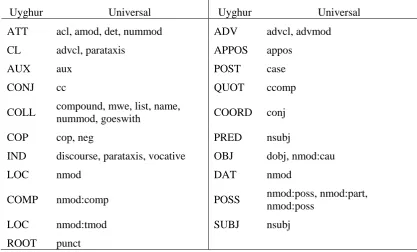
Most of the dependency relations which defined in UyDT are included in the UD, but isn’t one by one mapping. After comparing the Uyghur treebank relation description with UD description, we mapped Uyghur DT dependent relations to UD as following table. The relation ‘ATT’, for instance, could map to ‘acl, amod, det, nummod’, which of them should be chosen is another problem. To tackle with this problem, we settled priority and some limited rules on them according to our corpus features to choose one of them.
Uyghur Universal Uyghur Universal
ATT acl, amod, det, nummod ADV advcl, advmod
CL advcl, parataxis APPOS appos
AUX aux POST case
CONJ cc QUOT ccomp
COLL compound, mwe, list, name,
nummod, goeswith COORD conj
COP cop, neg PRED nsubj
IND discourse, parataxis, vocative OBJ dobj, nmod:cau
LOC nmod DAT nmod
COMP nmod:comp POSS nmod:poss, nmod:part,
nmod:poss
LOC nmod:tmod SUBJ nsubj
ROOT punct
[image:3.595.88.506.496.748.2]For example, the dependent relation ‘OBJ’ in UyDT could map to ‘dobj, dobj:cau, nmod:cau’ in UD, considering that the rate of using causative word is less than using non-causative word, we decid-ed map all the dependent relation ‘OBJ’ to ‘dobj’; the dependent relation ‘ATT’ in UyDT could map to ‘acl, amod, det, nummod’. After adding some limitation on the dependent relation ‘ATT’, such as when the word is tagged ‘NOUN’, map it to ‘amod’, when it is tagged ‘NUM’ map it ‘amod’, and tagged ‘PRON’ map it to ‘det’. After rule based mapping, most of the dependent relations are trans-formed correctly, certainly including some wrong labels as well. Then, we manually checked and cor-rected them.
3.2.2
structural changes
The UD syntactic annotation is based on the universal Stanford Dependencies (SD) scheme (de Marneffe et al., 2014). One of the key properties of these schemes is that they emphasizes direct rela-tion between content words, treating funcrela-tion words as dependents of content words rather than as their heads. However, it is not all the case in UyDT. Some function words such as copula or auxiliary words were head of the predicative, for when a copula or auxiliary attaching a word, it would indicate a grammatical meaning as well as get certain morphological forms. For example: ‘u hetni yezip boldi (he had written the letter); yezip bolghan hetni oqudi (he read the letter which had been written)’. In these examples, the word with bold font, generated from one stem bol, has different morphological form in each sentences to combine these words around it. Though it is auxiliary verb, produce relation ‘aux’ and marked as the head of the relation in UyDT. It contrasts with UD and needs to make some structural changes. We done this changes with manually, for structural changes were not easily auto-mated. The following structural changes were made manually:
aux & cop
In the UyDT, the auxiliary and copula are treated similarly to a verb, and can function as the root of a sentence. However, the UD scheme analyses copula constructions differently: the predicate is regarded as the head of the phrase, and the auxiliary or copula is its dependent, as labelled by the ‘aux’ or ‘cop’. See Figure.1 (a) and (b) for comparison.
Gëpimni (my word)
anglap (listen)
bol (completely)
OBJ AUX
Listen to me
. ROOT
(a)
Gëpimni (my word)
anglap (listen)
bol (completely)
dobj aux
Listen to me
. punct
(b)
Figure 1: UD aux analysis
punct
In the UyDT, the punctuations which appeared in the sentence was not considered in depend-ent relation, instead, the last punctuation which appeared the end of a sdepend-entence was regarded as the head of the sentence and labelled as ‘ROOT’. However, the UD defines a punctuation de-pend on content word which it always attached to with the relation of ‘punct’ and can never have dependents. It is need to change the relation structure and the label of the relation ‘ROOT’ in UyDT. (Figure 1)
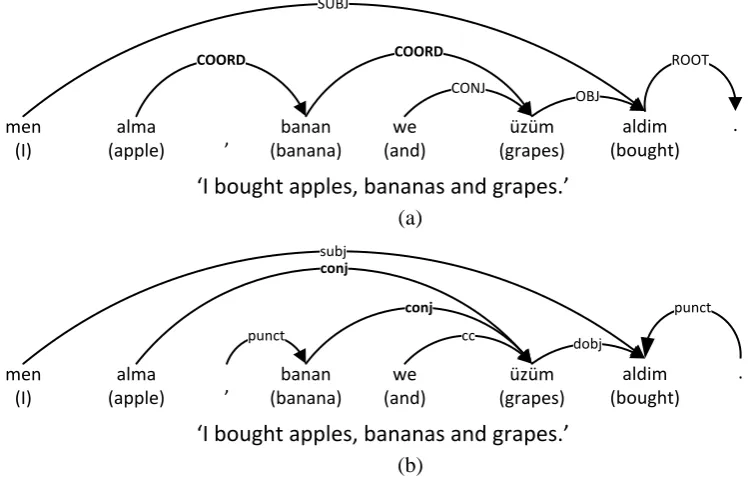
conj & cc
the head of them with the label of ‘COORD’ . Meanwhile, the conjunction was depend on the coordinate word which it attached to with the label as ‘CONJ’ (Figure 2 (a)). The UD annota-tion scheme, on the other hand, uses right-adjuncannota-tions, where the first coordinate is the head of them, and the rest of phrase is adjoined to the right. We diverge from UD specification by marking the last conjunct as the head of the relation. All the other conjuncts depend on the last via labelling subsequent coordinates as ‘conj’ (Figure 2 (b))
men (I)
alma (apple)
banan (banana) COORD
I bought apples, bananas and grapes. we
(and) COORD
, üzüm
(grapes) SUBJ
aldim (bought)
CONJ OBJ
ROOT
.
(a)
men (I)
alma (apple)
banan (banana)
conj
I bought apples, bananas and grapes. we
(and) conj
, üzüm
(grapes) subj
aldim (bought) cc
dobj
punct
punct
.
[image:5.595.98.473.168.409.2](b)
Figure 2: Coordination structure in the UD
3.2.3
Uyghur-specific relations
The UD
schemeprovides scope to include language-specific subtype labels. The label naming
format is
unversal:extention,
which ensures that the core UD relation remains identifiable,
making it possible to revert to this coarse label for cross-lingual analysis. During the
conver-sion of the UyDT, we defined some labels required to represent Uyghur syntax more
concise-ly. These labels are discussed below:
advmod:emph
Some adverbial modifiers in Uyghur has served as the emphasizer or intensifier. We use the subtype label ‘advmod:emph’ in cases where modifiers emphasize or intensify their heads. It is also used in the Turkish, Ancient Greek, Arabic, Czech, Latin, Portuguese and Tamil scheme as well. (Figure 3)
yene (again)
tirishmisang (study hard)
hetta (even)
advcl:cond
If you didn t study hard futher, you even couldn t graduate mektepnimu
(school) advmod:emph
, püttürelmeysen
(couldn t graduate)
advmod dobj pucnt
.
Figure 3: UD advmod and advcl analysis
advcl:cond
It is
usedfor
conditionalclauses. It is also used in Turkish scheme. (Figure 3)
[image:5.595.133.476.602.680.2]In Uyghur, a question sentence is built by adding one of question particle to predicate (auxilia-ry verb or copula). We use ‘aux:q’ for all uses of the question particle. It also used in He-brew, Turkish. (see Figure 4)
shü (that)
küni (day)
qelem (pen) nmod:tmod
at that day, have you bought stationaries? elip
(buy) dobj
depter (notebook)
boldingizmu (already)
advmod aux:q pucnt
[image:6.595.133.457.127.194.2]? compund:redup
Figure 4: UD aux, compound and nmod analysis
compound:redup
Reduplication is a common process especially for adverbs, adjectives, nouns in Uyghur. Re-duplication typically involves two identical words, but some morpho- phonological alterna-tions are possible. The forms of the reduplicate words in Uyghur are various, this subtype of compound covers a range of reduplicated forms in Uyghur. It is also used in Turkish as well. An example is given in Figure 4.
dobj:cau & nmod:cau
We mark direct objects of causative verbs with ‘dobj:cau’, since the interpretation is different in comparison to a direct object of a non-causative verb. In general, if the verb is intransitive, direct object indicates the “causee”, the subject of the content verb, or the entity that performs the action. If the verb is transitive, the direct object is the entity that is acted upon as in the non-causative case use the subtype ‘nmod:cau’ . They are also used in Turkish as well.
nmod:tmod
Temporal modifiers specifying time, in nominal form, are labelled as ‘nmod:tmod’. English, Chinese, Danish, Russian etc. also uses this subtype label. See the Figure 4 for example.
nmod:poss
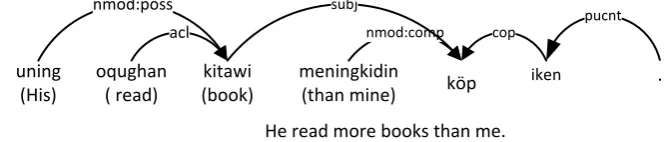
This subtype is used in possessive constructions, typically, the head of the construction is a possessive noun phrase, and the dependent is in genitive case. Danish, English, French, Ger-man, Kazakh etc. also use the subtype. An example is giben in Figure 5.
nmod:comp
This subtype of ‘nmod’ is used for marking comparative modifier of an adjective or adverb. The specific feature of it is a nominal word or phrase which attached ablative case suffix and an adjective or adverb. This subtype is also used in Turkish as well. See the Figure 5 for ex-ample.
uning (His)
oqughan ( read)
meningkidin (than mine) acl
He read more books than me. köp nmod:comp
kitawi (book) nmod:poss
pucnt
. subj
iken cop
Figure 5: UD nmod relation analysis
nmod:part
This subtype of nmod is used for marking the part-whole relations. This structure is similar to ‘nmod:poss’ in most cases, but the range structures expressing “part of” is diverse, and distinc-tion is often be useful.
4
summary and future work
[image:6.595.123.457.567.638.2]changes required, for the release of the UyDT as part of the Universal Dependencies project. We have also discussed linguistic analyses and motivations for choosing of Uyghur language-specific label types.
Acknowledgments
This work was funded by the Natural Science Foundation of China (Grant No. 61262061) and sup-ported by Science & Technology Foundation of Xinjiang(Grant No. 201423120).
We are extremely thankful to the mathematical and physical department in Charles University and in particular to Dan Zeman for his advice on the Uyghur conversion effort.
Reference
Aili, M., Xialifu, A., Maihefureti, & Maimaitimin, S. (2016). Building Uyghur Dependency Treebank: Design Principles, Annotation Schema and Tools. In Lecture Notes in Computer Science (including subseries Lecture Notes in Artificial Intelligence and Lecture Notes in Bioinformatics) (Vol. 9442, pp. 124–136).
de Marneffe, M.-C., Dozat, T., Silveira, N., Haverinen, K., Ginter, F., Nivre, J., & Manning, C. D. (2014). Universal Stanford Dependencies: A cross-linguistic typology. In Proceedings of the Ninth International Conference on Language Resources and Evaluation (LREC’14), 4585–4592.
Džeroski, S., Erjavec, T., & Ledinek, N. (2006). Towards a Slovene dependency treebank. Proc. of the Fifth Intern. …, (May), 1388–1391.
Hajičová, E. (1998). Prague Dependency Treebank: From Analytic to Tectogrammatical Annotation. In Proceedings of the First Workshop on Text, Speech, Dialogue (pp. 45–50).
Haverinen, K., Viljanen, T., Laippala, V., Kohonen, S., Ginter, F., & Salakoski, T. (2010). Treebanking Finnish. In In proc. of The Ninth International Workshop on Treebanks and Linguistic Treories (TLT-9) (pp. 79– 90).
Kromann, M. T. (2003). The Danish Dependency Treebank and the DTAG Treebank Tool. In Proceedings of the Second Workshop on Treebanks and Linguistic Theories (pp. 217–220).
Lynn, T., & Foster, J. (2016). Universal dependencies for Irish. In Celtic Language Technology Workshop (pp. 79–92).
Mairehaba·, A., Jiang, W., Wang, Z., Tuergen·, Y., & Liu, Q. (2012). Directed Graph Model of Uyghur Morphological Analysis. Journal of Software, 23(12), 3115–3129.
Mamitimin, S., Ibrahim, T., & Eli, M. (2013). The Annotation Scheme for Uyghur Dependency Treebank. 2013 International Conference on Asian Language Processing, 185–188.
Mcdonald, R., Nivre, J., Quirmbach-brundage, Y., Goldberg, Y., Das, D., Ganchev, K., … Lee, J. (2013). Universal Dependency Annotation for Multilingual Parsing. Proceedings of the 51st Annual Meeting of the Association for Computational Linguistics, 92–97.
McDonald, R., Petrov, S., & Hall, K. (2011). Multi-source transfer of delexicalized dependency parsers. Proceedings of the Conference on Empirical Methods in Natural Language Processing, (2007), 62–72.
Oflazer, K. (2003). BUILDING A TURKISH TREEBANK, 1–17.
Petrov, S., Das, D., & Mcdonald, R. (2012). A Universal Part-of-Speech Tagset. Proceedings of the Eighth International Conference on Language Resources and Evaluation (LREC ’12), 2089–2096.
Pyysalo, S., Kanerva, J., Missilä, A., Laippala, V., & Ginter, F. (2015). Universal Dependencies for Finnish. Nordic Conference of Computational Linguistics NODALIDA 2015, (Nodalida), 163.
Søgaard, A. (2011). Data Point Selection for Cross-Language Adaptation of Dependency Parsers. Proceedings of the 49th Annual Meeting of the Association for Computational Linguistics: Human Language
Technologies (HLT ’11): Short Papers, 682–686.
Tsarfaty, R. (2013). A Unified Morpho-Syntactic Scheme of Stanford Dependencies. Proceedings of the 51st Annual Meeting of the Association for Computational Linguistics (Volume 2: Short Papers), 578–584.