Developing a POS tagger for Magahi: A Comparative
Study
Ritesh KUMAR1 Bornini LAHIRI1 Deepak ALOK1 (1) CENTRE FOR LINGUISTICS, Jawharlal Nehru University, India [email protected], [email protected],
[email protected] ABSTRACT
In this paper, we present a comparative study of the four state-of-the-art sequential taggers applied on Magahi data for part-of-speech (POS) annotation . Magahi is one of the smaller Indo-Aryan languages spoken in Eastern state of Bihar in India. It is an extremely resource-poor language and it is the first attempt to develop some kind of Natural Language Processing (NLP) resource for the language.
The four taggers that we test are – Support Vector Machines (SVM) based SVMTool, Hidden Markov Model (HMM) based TnT tagger, Maximum Entropy based MxPost tagger and Memory based MBT tagger. All these taggers are trained on a miniscule dataset of around 50,000 words using 33 tags from the BIS-tagset for Indian languages and tested on around 13,000 words. The performance of all these taggers are tested against a frequency-based baseline tagger. While all these taggers perform worse than on the English data, the best performance is given by the Maximum Entropy tagger after tuning of certain parameters. The paper discusses the result of the taggers and the ways in which the performance of the taggers could be improved for Magahi.
1 Introduction
Historically, Magahi has been classified in different ways by different scholars. While Grierson (1903) puts Magahi under the Eastern group of Outer sub-branch of Indo-Aryan languages, others like Turner have clubbed the 'Bihari' languages with Eastern and Western Hindi (Masica 1991). A classification given by Chatterji (1926) where Magahi is kept together with other languages of Eastern group which is separate from the Western Hindi. Jeffers (1976) gives a classification which is very similar to that of Grierson.
In the present time, Magahi is spoken mainly in Eastern states of India including Bihar and Jharkhand, along with some parts of West Bengal and Orissa. There are three main varieties of Magahi spoken today (Verma, 1991).
• Central Magahi of Patna, Gaya, Hazaribagh (in Bihar)
• South-Eastern Magahi of Ranchi (in Jharkhand) and some parts of Orissa
• Eastern Magahi of Begusarai and Munger (in Bihar)
Some other scholars like Verma (2003) and Grierson (1903) have also classified South-Eastern and Eastern varieties together.
1.1 Magahi: Socio-Political Situation
Socially Magahi is considered a dialect of Hindi even though historically as well as linguistically Magahi distinct enough from Hindi to be called a distinct language. This social attitude towards Magahi where it is considered a dialect (and inferior/distorted form) of Hindi has emanated largely from the political representation of the language as a dialect (or, Mother Tongue in the Census) of Hindi as well as the close lexical affinity of the two languages (Kumar, et.al., 2011). As a result of this socio-political attitude, Magahi has remained a largely ignored language outside linguistic studies despite the presence of quite a large population (counting up to 13.978,565 according to Census of India, 2001) of Magahi speakers.
1.2 Linguistic Features of Magahi
There has been very few linguistic studies on Magahi. However a basic (although not completely accurate) description of Magahi is given by Verma (2003). A basic description of the linguistic features is given here.
An initial analysis of the Magahi sound system shows that it has 35 phonemic sounds – 27 consonants and 8 vowels. Some of the major phonlogical features which distinguish Magahi from Hindi include absence of word-initial consonant cluster, absence of word-initial glides and absence of word-medial and word-final dental laterals.
Unlike Hindi (which is a Noun Class language with two classes, also equated with Masculine and Feminine gender in the language), Magahi is a classifier language. It has three mensural classifiers – ɡo/tʰo, məni, sun (Alok, 2012). These classifiers encode the information about how the referent is measured and are different from the other generally found classifiers which characterise noun in terms of certain inherent properties (Aikhenvald, 2000, 2006). Among these while ɡo/tʰo measures nouns in terms of length or discrete quantity, məni and sun are used for measuring nouns in terms of amount (and so are used with the mass nouns) (Alok, 2012). It is to be noted that broadly these are numeral classifiers since they are always attached with the numeral and quantifiers in a noun phrase and never with the noun itself. The presence of classifiers could prove to be a very strong indicator for the Part-of-speech annotation of quantifiers and Noun in Magahi.
Syntactically, Magahi nouns do not have number and gender agreement with verbs. There are only a few nouns in Magahi which could be inflected for number. Moreover adjectives also agree with such nouns in terms of number as well as sex (it should be noted here that sex here refers to the natural sex of the noun in case of animates and not the Noun class as it is used for Hindi since such agreements could occur only with the animates for which males and females are distinctly recognised in the language). Verbs also agree with subjects in person and honorificity. It is to be noted that verbs could also agree with object as well as addressee honorificity of the object or the addressee are honorific.
1.3 Part-of-speech Annotation and Magahi
Part-of-speech annotation is generally considered the most basic step for developing any kind of NLP application. In the recent times several statistical and machine-learning based approaches have been applied to the task of POS annotation. Some of the major and most successful taggers include - Hidden Markov Models (Brants, 2000), Maximum Entropy taggers (Ratnaparkhi, 1996), Transformation–based learning (Brill, 1994, 1995), Memory–based learning (Daelemans, et. al., 2003), Support Vector Machines (Cortes & Vapnik, 2000) besides several others.
All these taggers are trained and evaluated on the WSJ corpus in English. On this corpus all of these have a very comparable accuracy with each giving only slightly different accuracy from the others. In this paper, we have applied Magahi data to four of these POS tagers, viz, HMM tagger, MaxEnt Tagger, Memory-based Tagger and SVM, for the purpose of developing a POS tagger for Magahi. The idea is to test which of these give the best performance on the given dataset with their default settings. The performance is compared against a Maximum-frequency baseline tagger.
2 Experimental Setup
2.1 Dataset
2.2 Tagset
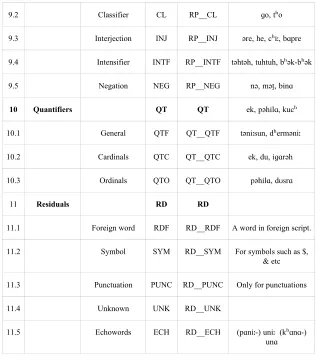
For the annotation of Magahi data, we have used a modified version of BIS standard tagset for Indian Languages. The complete tagset, which consists of 33 tags, is given in Table 1 (the corpus tagged with this tagset is same as described in Kumar, et al. (2011) but the tagset is slightly modified).
Sl. No
Category Label Annotation
Convention Examples (in IPA)
Top level Subtype (level 1)
1 Noun N N cʰɔːɽɑ (boy)
1.1 Common NN N__NN cəcəriː (a small
bridge-like st.) ləŋɡte (naked)
1.2 Proper NNP N__NNP pʰuləva
1.3 Nloc NST N__NST əɡaɽiː, picʰaɽiː
2 Pronoun PR PR
2.1 Personal PRP PR__PRP həm, həməniː
2.2 Reflexive PRF PR__PRF əpəne
2.3 Relative PRL PR__PRL ɟe, ɟekər
2.4 Reciprocal PRC PR__PRC əpəne
2.5 Wh-word PRQ PR__PRQ kɑ, ke
3 Demonstrative DM DM
3.1 Deictic DMD DM__DMD IIhaI, ʊIhaI
3.2 Relative DMR DM__DMR ɟe, ɟəun
3.3 Wh-word DMQ DM__DMQ kekrɑ, kəun
3.4 Indefinite DMI DM__DMI i, ʊ
4 Verb V V ləuknɑ (to see)
4.1 Main VM V__VM pʰiIcnɑ (to wash clothes)
əɟʰurɑnɑ (to get entangled)
4.2 Auxiliary VAUX V__VAUX həi, həliː, hətt̪ʰiː
5 Adjective JJ JJ cəkəitʰ (short and
well-built) bətt̪pʰəros (uselessly talkative)
6 Adverb RB RB cəbʰɑk (with splash)
cəbʰər-cəbʰr (a manner of eating)
7 Postposition PSP PSP ke, me, pər, ɟore
8 Conjunction CC CC
8.1 Co-ordinator CCD CC__CCD ɑʊ, bɑkiː, bəluk
8.2 Subordinator CCS CC__CCS kɑheki, tt̪ə, ki
9 Particles RP RP
9.2 Classifier CL RP__CL ɡo, tʰo
9.3 Interjection INJ RP__INJ əre, he, cʰiː, bɑpre
9.4 Intensifier INTF RP__INTF təhtəh, tuhtuh, bʰək-bʰək
9.5 Negation NEG RP__NEG nə, mətt̪, binɑ
10 Quantifiers QT QT ek, pəhilɑ, kucʰ
10.1 General QTF QT__QTF təniːsun, dʰerməniː
10.2 Cardinals QTC QT__QTC ek, du, iɡɑrəh
10.3 Ordinals QTO QT__QTO pəhilɑ, dʊsrɑ
11 Residuals RD RD
11.1 Foreign word RDF RD__RDF A word in foreign script.
11.2 Symbol SYM RD__SYM For symbols such as $,
& etc
11.3 Punctuation PUNC RD__PUNC Only for punctuations
11.4 Unknown UNK RD__UNK
11.5 Echowords ECH RD__ECH (pɑniː-) uniː (kʰɑnɑ-)
[image:6.420.45.363.69.429.2]unɑ
TABLE 1: Magahi Tagset
2.3 Tagger Tools
We have used the following tools to train different taggers on Magahi data
-• MxPost for Maximum-entropy tagger (Ratnaparkhi, 1996). It uses the contextual features like preceeding words and tags as well as morphological feature of the words like the suffixes and prefixes for tagging any given word.
contextual features and the other is used exclusively for unknown words which also uses lexical information alongwith the contextual features. These features are customisable as per the need of the users
• TnT for HMM-based tagger (Brants, 1994). As the name of the tagger itself suggest (Trigrams 'n' Tags), it uses trigram and the tags of the preceding words as features for training
• SVMTool for SVM-based tagger (Gimenez and Marquez, 2004). This tool provides an interface for using SVM-Light (Joachims, 1999). The features that could be used with this tool is similar to the other tools, viz., morphological features of the word and that of the context as well as the tags of the preceding words.
In general we have used these tools with the default/recommended settings for carrying out the experiments. Each of these tools were trained on exactly the same corpus consisting of around 50,000 tokens.
3 Results and Analysis
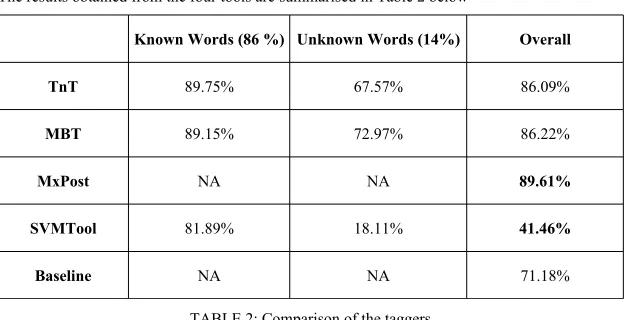
The results obtained from the four tools are summarised in Table 2 below
Known Words (86 %) Unknown Words (14%) Overall
TnT 89.75% 67.57% 86.09%
MBT 89.15% 72.97% 86.22%
MxPost NA NA 89.61%
SVMTool 81.89% 18.11% 41.46%
[image:7.420.62.374.232.392.2]Baseline NA NA 71.18%
TABLE 2: Comparison of the taggers
As mentioned above each tagger was also tested on exactly the same dataset which consisted of around 13,000 tokens. Out of these 13,000 tokens around 86% were known tokens (i.e. they were present in the training set also) while 14% were unknown token (they were encountered by the tagger for the first time in the test set itself). As it is shown in the table, MxPost gives the best overall performance; however since the evaluation results are not calculated separately for known and unknown words the break-up is not known. MBT and TnT gives comparable overall results but MBT is significantly more accurate with unknown words. The most dismal performance is given by SVMTool which could be explained only by an extremely small dataset and presence of a large number of classes which needs to be classified.
is a conjunct verb) proved to be very problematic. Another source of error was a complete absence of examples of certain closed-class categories in the training set viz., interjections. Besides these two, as expected, lexical ambiguity was also one of the minor sources of annotation error.
Conclusion and Way Ahead
In this paper we have presented a comparison of the four state-of-the-art POS taggers with respect to their performance on the Magahi data. The best overall accuracy as well as accuracy on the known and unknown words individually is given by the maximum-entropy based MxPost tagger. However the accuracy (just below 90%) is much below the general expected accuracy of POS taggers. As the error analysis shows all the taggers perform poorly on very similar kinds of words. So combining different taggers could not solve the problem. The two steps which could be taken to increase the accuracy of the tagger include
• A list of closed-class words will be prepared which would be able to handle the cases where the absence of the word in training set has led to the error by the tagger.
• Some explicit disambiguation rules will also be used in certain cases where sufficiently large number of examples is not present in the training corpus so as to discriminate in between the contexts of occurrence of a particular tag of the word.
A third possible step could be to increase the training set size (which is in any case pretty small by the general standards). However this is very resource-intensive because of the lack of easily available data in the language. Moreover as per our current analysis a hybrid system like this is expected to give a performance at par with most of the other state-of-the-art POS taggers for Indian languages.
Acknowledgments
We would like to thank our supervisors for their constant support and guidance. References
Alok, D. (2010). Magahi Noun Particles. Paper presented in 4th International Students' Conference of Linguistics in India (SCONLI-4), Mumbai, India, February 20-22, 2010.
Alok, D. (2012). A language without Articles: The Case of Magahi. Unpublished M.Phil. Dissertation, Jawaharlal Nehru University, New Delhi
Brants , T.. (2000). TnT — A Statistical Part-of-Speech Tagger. In Proceedings of the 6th Applied NLP Conference(ANLP-2000), pages 224–231.
Brill, E. (1994). Some Advances in Transformation-Based Part of Speech Tagging.
Proceedings of AAAI, Vol. 1, pages 722–727.
Brill, E. (1995). Transformation-Based Error-Driven Learning and Natural Language Processing: A Case Study in Part-of-Speech Tagging. Computational Linguistics, 21(4): 543–565.
Cortes , C. and Vapnik, V. (1995). Support Vector Networks. Machine Learning, 20: 273–297.
Jesus Gimenez and Lluis Marquez. (2004). SVMTool: A general POS tagger generator based on support vector machines. In 4th International Conference on Language Resources and Evaluation, pages 168–176, Lisbon, Portugal.
Joachims, T. (1999). Making Large-scale SVM Learning Practical. In Schölkopf, B., Burges, C., Smola, A., eds.: Advances in Kernel Methods – Support Vector Learning, pages 41–56. MIT Press, Boston, MA, USA .
Kumar, R., Lahiri, B. and Alok, D. (2011). Challenges in Developing LRs for Non-Scheduled Languages: A Case of Magahi. In Proceedings of the 5th Language and Technology Conference Human Language Technologies as a Challenge for Computer Science and Linguistics (LTC '11), Adam Mickiewicz University, pages 60-64.