D
AGGER: A Toolkit for Automata on Directed Acyclic Graphs
Daniel Quernheim
Institute for Natural Language Processing Universit¨at Stuttgart, Germany Pfaffenwaldring 5b, 70569 Stuttgart
Kevin Knight
University of Southern California Information Sciences Institute Marina del Rey, California 90292
Abstract
This paper presents DAGGER, a toolkit for
finite-state automata that operate ondirected acyclic graphs(dags). The work is based on a model introduced by (Kamimura and Slutzki, 1981; Kamimura and Slutzki, 1982), with a few changes to make the automata more ap-plicable to natural language processing. Avail-able algorithms include membership checking in bottom-up dag acceptors, transduction of dags to trees (bottom-up dag-to-tree transduc-ers), k-best generation and basic operations
such as union and intersection.
1 Introduction
Finite string automata and finite tree automata have proved to be useful tools in various areas of natural language processing (Knight and May, 2009). How-ever, some applications, especially in semantics, re-quire graph structures, in particulardirected acyclic graphs(dags), to model reentrancies. For instance, the dags in Fig. 1 represents the semantics of the sen-tences “The boy wants to believe the girl” and “The boy wants the girl to believe him.” The double role of “the boy” is made clear by the two parent edges of theBOYnode, making this structure non-tree-like.
Powerful graph rewriting systems have been used for NLP (Bohnet and Wanner, 2010), yet we con-sider a rather simple model: finite dag automata that have been introduced by (Kamimura and Slutzki, 1981; Kamimura and Slutzki, 1982) as a straight-forward extension of tree automata. We present the toolkit DAGGER (written in PYTHON) that can be used to visualize dags and to build dag acceptors
(a)
WANT
BELIEVE
BOY GIRL (b) WANT
BELIEVE
BOY GIRL
Figure 1: (a) “The boy wants to believe the girl.” and (b) “The boy wants the girl to believe him.” First edge represents:agentrole, second edge represents:patient role.
and dag-to-tree transducers similar to their model. Compared to those devices, in order to use them for actual NLP tasks, our machines differ in certain as-pects:
• We do not require our dags to be planar, and we do not only consider derivation dags.
• We add weights from any commutative semir-ing, e.g. real numbers.
The toolkit is available under an open source li-cence.1
2 Dags and dag acceptors
DAGGERcomes with a variety of example dags and automata. Let us briefly illustrate some of them. The dag of Fig. 1(a) can be defined in a human-readable format called PENMAN(Bateman, 1990):
(1 / WANT
:agent (2 / BOY) :patient (3 / BELIEVE
:agent 2
:patient (4 / GIRL)))
1http://www.ims.uni-stuttgart.de/
˜daniel/dagger/
[image:1.612.336.520.235.303.2]s
s -> (WANT :agent i :patient s) s -> (BELIEVE :agent i :patient s) i -> (0)
[image:2.612.74.233.55.194.2]s -> (0) i -> (GIRL) i -> (BOY) s -> (GIRL) s -> (BOY) i i -> (GIRL) i i -> (BOY) i s -> (GIRL) i s -> (BOY) s s -> (GIRL) s s -> (BOY)
Figure 2: Example dag acceptorexample.bda.
In this format, every node has a unique identifier, and edge labels start with a colon. The tail node of an edge is specified as a whole subdag, or, in the case of a reentrancy, is referred to with its identifier. Fig. 2 shows a dag acceptor. The first line con-tains the final state, and the remaining lines contain rules. Mind that the rules are written in a top-down fashion, but are evaluated bottom-up for now. Let us consider a single rule:
s -> (WANT :agent i :patient s)
The right-hand side is a symbol (WANT :agent :patient) whose tail edges are labeled with states (i ands), and after applying the rule, its head edges are labeled with new states (s). All rules are height one, but in the future we will allow for larger subgraphs.
In order to deal with symbols of arbitrary head rank (i.e. symbols that can play multiple roles), we can use rules using special symbols such as2=1and 3=1that split one edge into more than one:
i s -> (2=1 :arg e)
Using these state-changing rules, the ruleset can be simplified (see Fig. 3), however the dags look a bit different now:
(1 / WANT
:agent (2 / 2=1
:arg (3 / BOY)) :patient (4 / BELIEVE
:agent 2
:patient (5 / GIRL)))
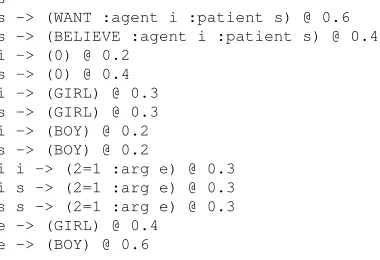
Note that we also added weights to the ruleset now. Weights are separated from the rest of a rule by the@ sign. The weight semantics is the usual one, where weights are multiplied along derivation steps, while the weights of alternative derivations are added.
s
s -> (WANT :agent i :patient s) @ 0.6 s -> (BELIEVE :agent i :patient s) @ 0.4 i -> (0) @ 0.2
s -> (0) @ 0.4 i -> (GIRL) @ 0.3 s -> (GIRL) @ 0.3 i -> (BOY) @ 0.2 s -> (BOY) @ 0.2
i i -> (2=1 :arg e) @ 0.3 i s -> (2=1 :arg e) @ 0.3 s s -> (2=1 :arg e) @ 0.3 e -> (GIRL) @ 0.4
[image:2.612.315.505.57.187.2]e -> (BOY) @ 0.6
Figure 3: Simplified dag acceptorsimple.bda.
2.1 Membership checking and derivation forests
DAGGER is able to perform various operations on dags. The instructions can be given in a simple ex-pression language. The general format of an expres-sion is:
(command f1 .. fm p1 .. pn)
Every command has a number of (optional) features fi and a fixed number of argumentspi. Most
com-mands have a short and a long name; we will use the short names here to save space. In order to evaluate a expression, you can either
• supply it on the command-line: ./dagger.py -e EXPRESSION
• or read from a file: ./dagger.py -f FILE
We will now show a couple of example expres-sions that are composed of smaller expresexpres-sions. Assume that the dag acceptor of Fig. 2 is saved in the file example.bda, and the file boywants.dag contains the example dag in PENMAN format. We can load the dag with the expression (g (f boywants.dag)), and the acceptor with the expres-sion(a w (f example.bda))wherewmeans that the acceptor is weighted. We could also specify the dag directly in PENMANformat usingpinstead off. We can use the commandr:
(r (a w (f example.bda)) (g (f boywants.dag)))
q
WANT
BELIEVE
BOY GIRL =⇒
S
qnomb wants qinf b
BELIEVE
BOY GIRL =⇒
S
qnomb wants INF
qaccg to believe qaccb
BOY GIRL
=⇒
S
INF
NP NP NP
[image:3.612.82.529.53.151.2]the boy wants the girl to believe him
Figure 4: Derivation from graph to tree “the boy wants the girl to believe him”.
q
q.S(x1 wants x2)) -> (WANT :agent nomb.x1 :patient inf.x2)
inf.INF(x1 to believe x2) -> (BELIEVE :agent accg.x1 :patient accb.x2) accg.NP(the girl) -> (GIRL)
nomb.NP(the boy) accb.(him) -> (BOY)
Figure 5: Example dag-to-tree-transducerexample.bdt.
for each successful derivation (and, if the acceptor is weighted, their weights), in this case: (’s’, ’0.1’, 0, ’0’), which means that the acceptor can reach state s with a derivation weighted 0.1. The rest of the output concerns dag-to-tree transducers and will be explained later.
Note that in general, there might be multiple derivations due to ambiguity (non-determinism). Fortunately, the whole set of derivations can be effi-ciently represented as another dag acceptor with the dcommand. Thisderivation forest acceptorhas the set of rules as its symbol and the set of configura-tions (state-labelings of the input dag) as its state set.
(d (a w (f example.bda)) (g f boywants.dag)))
will write the derivation forest acceptor to the stan-dard output.
2.2 k-best generation
To obtain the highest-weighted 7 dags generated by the example dag acceptor, run:
(k 7 (a w (f example.bda)))
(1 / BOY) (1 / GIRL)
(1 / BELIEVE :agent (2 / GIRL) :patient 2) (1 / WANT :agent (2 / GIRL) :patient 2) (1 / 0)
(1 / BELIEVE :agent (2 / BOY) :patient 2) (1 / WANT :agent (2 / BOY) :patient 2)
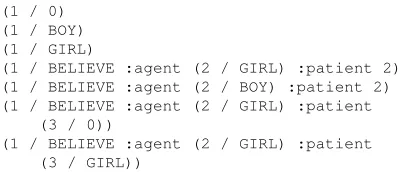
If the acceptor is unweighted, the smallest dags (in terms of derivation steps) are returned.
(1 / 0) (1 / BOY) (1 / GIRL)
(1 / BELIEVE :agent (2 / GIRL) :patient 2) (1 / BELIEVE :agent (2 / BOY) :patient 2) (1 / BELIEVE :agent (2 / GIRL) :patient
(3 / 0))
(1 / BELIEVE :agent (2 / GIRL) :patient (3 / GIRL))
2.3 Visualization of dags
Both dags and dag acceptors can be visualized using GRAPHVIZ2. For this purpose, we use theq(query) command and thevfeature:
(v (g (f boywants.dag)) boywants.pdf) (v (a (f example.bda)) example.pdf)
Dag acceptors are represented as hypergraphs, where the nodes are the states and each hyperedge represents a rule labeled with a symbol.
2.4 Union and intersection
In order to construct complex acceptors from sim-pler building blocks, it is helpful to make use of union (u) and intersection (i). The following code will intersect two acceptors and return the 5 best dags of the intersection acceptor.
(k 5 (i (a (f example.bda)) (a (f someother.bda))))
Weighted union, as usual, corresponds to sum, weighted intersection to product.
2available under the Eclipse Public Licence fromhttp://
[image:3.612.335.534.280.366.2]string automata tree automata dag automata compute . . . strings (sentences) . . . (syntax) trees . . . semantic representations
k-best . . . paths through a WFSA (Viterbi,
1967; Eppstein, 1998) . . . derivations in a weighted forest(Jim´enez and Marzal, 2000; Huang and Chiang, 2005)
3
EM training Forward-backward EM (Baum et al.,
1970; Eisner, 2003) Tree transducer EM training (Graehl etal., 2008) ? Determinization . . . of weighted string acceptors (Mohri,
1997) . . . of weighted tree acceptors (Bor-chardt and Vogler, 2003; May and Knight, 2006a)
?
Transducer
composi-tion WFST composition (Pereira and Riley,1997) Many transducers not closed under com-position (Maletti et al., 2009) ? General tools AT&T FSM (Mohri et al., 2000),
Carmel (Graehl, 1997), OpenFST (Riley et al., 2009)
Tiburon (May and Knight, 2006b), ForestFIRE (Cleophas, 2008; Strolen-berg, 2007)
[image:4.612.75.538.53.204.2]DAGGER
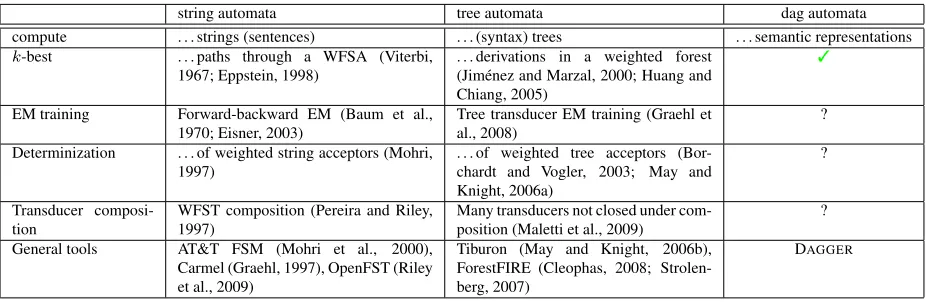
Table 1: General-purpose algorithms for strings, trees and feature structures.
3 Dag-to-tree transducers
Dag-to-tree transducers are dag acceptors with tree output. In every rule, the states on the right-hand sides have tree variables attached that are used to build one tree for each state on the left-hand side. A fragment of an example dag-to-tree transducer can be seen in Fig. 5.
Let us see what happens if we apply this trans-ducer to our example dag:
(r (a t (f example.bdt)) (g (f boywants.dag)))
All derivations including output trees will be listed:
(’q’, ’1.0’,
S(NP(the boy) wants INF(NP(the girl) to believe NP(him))),
’the boy wants the girl to believe him’)
A graphical representation of this derivation (top-down instead of bottom-up for illustrative purposes) can be seen in Fig. 4.
3.1 Backward application and force decoding
Sometimes, we might want to see which dags map to a certain input tree in a dag-to-tree transducer. This is calledbackward applicationsince we use the transducer in the reverse direction: We are currently implementing this by “generation and checking”, i.e. a process that generates dags and trees at the same time. Whenever a partial tree does not match the input tree, it is discarded, until we find a derivation and a dag for the input tree. If we also restrict the dag part, we haveforce decoding.
4 Future work
This work describes the basics of a dag automata toolkit. To the authors’ knowledge, no such im-plementation already exists. Of course, many algo-rithms are missing, and there is a lot of room for im-provement, both from the theoretical and the practi-cal viewpoint. This is a brief list of items for future research (Quernheim and Knight, 2012):
• Complexity analysis of the algorithms.
• Closure properties of dag acceptors and dag-to-tree transducers as well as composition with tree transducers.
• Extended left-hand sides to condition on a larger semantic context, just like extended top-down tree transducers (Maletti et al., 2009). • Handling flat, unordered, sparse sets of
rela-tions that are typical of feature structures. Cur-rently, rules are specific to the rank of the nodes. A first step in this direction could be gone by getting rid of the explicitn=msymbols.
• Hand-annotated resources such as (dag, tree) pairs, similar to treebanks for syntactic repre-sentations as well as a reasonable probabilistic model and training procedures.
• Useful algorithms for NLP applications that exist for string and tree automata (cf. Ta-ble 1). The long-term goal could be to build a semantics-based machine translation pipeline.
Acknowledgements
References
John A. Bateman. 1990. Upper modeling: organizing knowledge for natural language processing. InProc. Natural Language Generation Workshop, pages 54– 60.
L. E. Baum, T. Petrie, G. Soules, and N. Weiss. 1970. A maximization technique occurring in the statistical analysis of probabilistic functions of Markov chains. Ann. Math. Statist., 41(1):164171.
Bernd Bohnet and Leo Wanner. 2010. Open source graph transducer interpreter and grammar develop-ment environdevelop-ment. InProc. LREC.
Bj¨orn Borchardt and Heiko Vogler. 2003. Determiniza-tion of finite state weighted tree automata. J. Autom. Lang. Comb., 8(3):417–463.
Loek G. W. A. Cleophas. 2008. Tree Algorithms: Two Taxonomies and a Toolkit. Ph.D. thesis, Department of Mathematics and Computer Science, Eindhoven Uni-versity of Technology.
Jason Eisner. 2003. Learning non-isomorphic tree map-pings for machine translation. In Proc. ACL, pages 205–208.
David Eppstein. 1998. Finding the k shortest paths. SIAM J. Comput., 28(2):652–673.
Jonathan Graehl, Kevin Knight, and Jonathan May. 2008. Training tree transducers. Comput. Linguist., 34(3):391–427.
Jonathan Graehl. 1997. Carmel finite-state toolkit.
http://www.isi.edu/licensed-sw/ carmel.
Liang Huang and David Chiang. 2005. Better k-best parsing. InProc. IWPT.
V´ıctor M. Jim´enez and Andr´es Marzal. 2000. Computa-tion of the n best parse trees for weighted and stochas-tic context-free grammars. InProc. SSPR/SPR, pages 183–192.
Tsutomu Kamimura and Giora Slutzki. 1981. Paral-lel and two-way automata on directed ordered acyclic graphs.Inf. Control, 49(1):10–51.
Tsutomu Kamimura and Giora Slutzki. 1982. Transduc-tions of dags and trees. Math. Syst. Theory, 15(3):225– 249.
Kevin Knight and Jonathan May. 2009. Applications of weighted automata in natural language processing. In Manfred Droste, Werner Kuich, and Heiko Vogler, editors,Handbook of Weighted Automata. Springer. Andreas Maletti, Jonathan Graehl, Mark Hopkins, and
Kevin Knight. 2009. The power of extended top-down tree transducers. SIAM J. Comput., 39(2):410–430. Jonathan May and Kevin Knight. 2006a. A better n-best
list: Practical determinization of weighted finite tree automata. InProc. HLT-NAACL.
Jonathan May and Kevin Knight. 2006b. Tiburon: A weighted tree automata toolkit. In Oscar H. Ibarra and Hsu-Chun Yen, editors,Proc. CIAA, volume 4094 of LNCS, pages 102–113. Springer.
Mehryar Mohri, Fernando C. N. Pereira, and Michael Riley. 2000. The design principles of a weighted finite-state transducer library. Theor. Comput. Sci., 231(1):17–32.
Mehryar Mohri. 1997. Finite-state transducers in lan-guage and speech processing.Computational Linguis-tics, 23(2):269–311.
Fernando Pereira and Michael Riley. 1997. Speech recognition by composition of weighted finite au-tomata. In Finite-State Language Processing, pages 431–453. MIT Press.
Daniel Quernheim and Kevin Knight. 2012. To-wards probabilistic acceptors and transducers for fea-ture strucfea-tures. InProc. SSST. (to appear).
Michael Riley, Cyril Allauzen, and Martin Jansche. 2009. OpenFST: An open-source, weighted finite-state transducer library and its applications to speech and language. In Proc. HLT-NAACL (Tutorial Ab-stracts), pages 9–10.
Roger Strolenberg. 2007. ForestFIRE and FIREWood. a toolkit & GUI for tree algorithms. Master’s thesis, Department of Mathematics and Computer Science, Eindhoven University of Technology.