
THE ROLE FOR CLUSTERS
IN IRISH ECONOmIC
DEVELOPmENT POLICY
ELEANOR DOYLE AND CONNELL FANNINg
AbstRAct
16.1 Introduction
This chapter focuses on the concept of ‘clusters’ as a tool for economic analysis and guiding development policy. It has been widely used in many policy reports, for example in the Culliton Report, and referred to in many Irish business support programmes as desirable or necessary to improve productivity. This line of thought has been heavily influenced by Michael Porter, especially by his Competitive Advantage of Nations (990). Yet the notion of the cluster is often used with different connotations to that meant when the term was used and defined by Michael Porter. Indeed from the nine inclusions of ‘cluster’ in the Enterprise Strategy Group Report (00) it is not at all obvious that either the meaning or implications of the cluster concept, in Porter’s terms, were intended. In research circles, the concept has also proved problematic and generated a substantial literature debating its merits and shortcomings.
The context in which the cluster is founded and from which it takes its meaning must be understood to appreciate its purpose and its usefulness as a tool of analysis. We explain the concept as grounded in the work of Michael Porter, from its introduction in 990 through to its current and ongoing progression. The setting of the cluster within a theory for economic development that is being developed by Porter is also provided.
International and Irish evidence from the array of research generated by cluster-based analyses is summarised. The mainly negative findings on clusters evident in Irish studies is re-examined in the light of our discussion of the relevance and purpose of using clusters as a lens through which to view economic and business development. Some implications for development in policymaking in Ireland are outlined.
16.2 Porter’s Clusters – Definition and
Foundations
Irish policymakers interest in the cluster concept dates back to 99 with the publication of the Culliton Report, which recommended the promotion of industrial clusters focused on niches of national competitive advantage. Culliton’s views were based on Michael Porter’s 990 book, The Competitive Advantage of Nations, where the cluster was introduced in the context of national competitiveness.
Porter’s focus was on why a nation becomes “the home base for successful international competitors in an industry?” (990: ). In answering the question, Porter observed that:
For the purposes of this chapter, the definition of clusters used follows Porter, as cited above and in later work, where he outlines two specific elements constituting a cluster:
Critical masses - in one place - of unusual competitive success in particular fields…Clusters are geographic concentrations of interconnected companies and institutions in a particular field. Clusters encompass an array of linked industries and other entities important to competition (998: 78).
Porter observed that competitive success of companies in particular ‘fields’ coincided with strong clusters. Porter is unequivocal in defining success in terms of productivity and productivity growth relative to rivals. The above definitions correspond to the question Porter wished to answer regarding the location of successful international competitors. Although Porter set out to identify the causes of national competitive advantage, it is not the only context in which the cluster has relevance. Clustering is appropriate for considering related but distinct issues of industry and regional development that include business and/or industry origins, evolution and decline.
The nature of interconnection can vary across cluster members, which makes a simple definition challenging, but the impact of interaction is seen in the contribution made to cluster members’ individual and overall competitiveness. A cluster may include producers of goods or services, their specialised suppliers, service providers and any associated institutions, from industry or trade associations to universities and standard-setting agencies, normally within the boundaries of a country or across a region. Cluster members may compete with other members in their field or support the competitiveness of other cluster members by resource-sharing. A key feature of Porter’s cluster concept is that co-operation as well as competition underlies cluster activities allowing member firms to have higher productivity than would otherwise be possible.
The essence of the cluster concept has its roots in work on what Marshall, as far back as 890, called ‘externalities of specialised industrial locations’ (Marshall, 90). Somewhat paradoxically in the current context of increasingly globalised markets, firm location and interdependence are significant explanations of their competitive performance according to cluster theory. Location is one of the few sources of differentiation that competitors outside a cluster are unable to imitate. Porter’s cluster concept includes elements of location, competition, co-operation and strong relative performance in a manner that was not otherwise conceptualised, but recognising that: “most past theories address particular aspects of clusters or clusters of a particular type” (998: 08).
Furthermore, by grounding the concept in productivity, a link appears across Porter’s separate research streams at the level of firms, industries and locations in a comprehensive
16.3 Identifying Clusters
The cluster can be considered from the business-based perspective on social structure offered by Herbert Simon.5
A mythical visitor from Mars approaches the Earth from space, equipped with a telescope that reveals social structures. The firms reveal themselves, say, as solid green areas with faint interior contours marking out divisions and departments. Market transactions show as red lines connecting firms, forming a network in the spaces between them. Within firms (and perhaps even between them) the approaching visitor also sees pale blue lines, the lines of authority connecting bosses with various levels of workers…No matter whether our visitor approached the United States or the Soviet Union, urban China, or the European Community, the greater part of the space below it would be within the green areas, for almost all of the inhabitants would be employees, hence inside the firm boundaries. Organizations would be dominant feature of the landscape. A message sent back home, describing the scene, would speak of ‘large green areas interconnected by red lines’.
Extending this thought experiment, ‘the large green areas’ delineating firms would be further connected by market, technology or resource relationships - not necessarily market transactions - that not only allow but stimulate and facilitate firms to improve productivity, innovation and enhance the business environment.
Artefacts of clusters may be found in countries, states, regions, counties, or cities. Clusters may occur in small local industries or large international industries. They characterise small or large economies and tend to be most developed in advanced economies. In practice, precisely how and how well clusters function varies across regions as well as across industries within regions.
Since such standard classifications do not identify the value-adding cross-industry transactions or linkages that characterise the activities of many firms, moving from the cluster concept to its measurement is difficult. This is reflected in how Porter’s methods for cluster identification and measurement have developed and progressed over time (consider Porter, 990 and Porter, 00). Researchers grappling with using the cluster concept are invariably faced with the challenge of dealing with the information and data available to them, usually provided in the format of ‘standard’ industry classifications, and attempt to interpret it or reorganise it in a manner appropriate to the cluster concept and identifying a cluster in particular locations.
16.4 Cluster Origins in the Economic
Environment
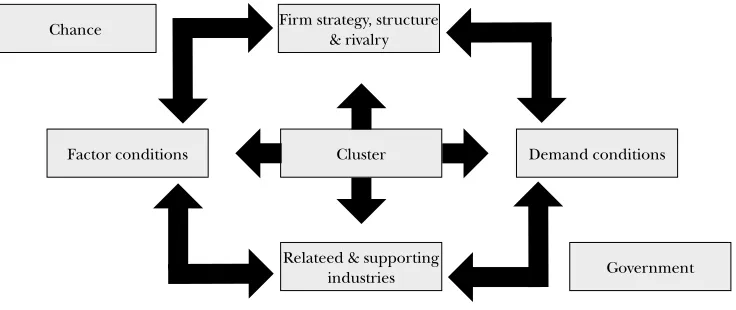
The identification of locations with a distinctive business environment that influences how individual businesses choose to compete is a novel feature in Porter’s work. The cluster emerges from Porter’s analysis of the quality of the economic environment of a location for business and an appreciation of the concept requires that it be placed in this broader context. The factors that Porter included in his ‘Diamond’ framework for competitive advantage (the microeconomic business environment of firms and clusters) presented in Figure ., facilitate or hinder the development of successful firms and clusters.
Figure 16.1: Porter’s ‘Diamond’ Framework: Microeconomic Business Environment
Source: Adapted from Figure .: The Determinants of National Advantage, Porter, (990: 7).
Porter (998: ) states that his “core set of ideas about competition … contains a consistent perspective”. This is echoed in the emphasis of his contributions to the Global Competitiveness Programme of the World Economic Forum on location where he views the sophistication of companies operations and strategies and ‘Diamond’ conditions as the core features or determinants of competitiveness (Porter, 00). So while average industry profitability is determined by the international structure of an industry (as in a ‘Five-Forces’ type analysis), local business conditions and operational and strategic decisions determine the relative productivity/profitability of resident businesses vis-à-vis competitors. Clusters fit into this perspective as their main benefits generate higher productivity for constituent firms, a better environment for innovation and productivity growth and stimulation of new business formation that serve to embed successful firms in their locations.
Those interested in local and regional economic development are aware of the abundance of cluster studies in which the word ‘cluster’ often has a meaning or definition other than that employed by Porter. Spatial definitions (agglomeration, urbanisation and localisation) lack the integration of competition, cooperative and strategic elements that are encompassed in the ‘Diamond’ perspective. Such studies emphasise our central point - a localised concentration of economic activity or employment in one or more classification codes (e.g. NACE : Manufacture of corrugated paper and paperboard and corrugated board containers) is not the same as an industry cluster.
Porter argues that where strong clusters exist, they enhance productivity. Yet not every firm operates, or is presumed to operate, within what may be classified as a strong or active cluster. For a group of interrelated firms to qualify as a cluster four conditions must be met:7
1. Proximity: Firms must be close enough geographically to allow for positive spillovers to be enjoyed and/or for resources to be shared;
2. Market Relationship: Firms must have a common goal (e.g. meeting the needs of the same market), or requiring highly skilled specialised labour in a specific field to benefit from interaction;
Firm strategy, structure & rivalry
Cluster
Relateed & supporting industries
Demand conditions Factor conditions
Chance
3. Active Interaction: Active relationships must be developed for positive cluster effects to emerge; and
4. Critical Mass: A sufficient number of participants must engage in active interactions before any meaningful or significant impact on company performance results. The number depends on the particular cluster, its location, its target market etc.
16.5 Refinement in Cluster Analysis
Porter (00) extended his approach to analysing regional performance, according to the cluster concept, using a specially assembled US dataset. He does not attempt to test any particular hypotheses in this work but to examine the facts and relationships that have been contained in many theories such as how employment growth, industry composition, cluster activity and patenting rates across regions are related to levels and variations in performance, as measured by wages.
Regions were differentiated according to their structure of local, resource-dependent and traded industries. Local industries are defined as those that have similar shares of employment across most regions and represent over two thirds of US private sector employment. Resource-dependent industries tend to be located where resources are accessible and compete with other domestic or international locations but represent less than one per cent of employment. Traded industries’ locations (approximately one third of US employment) are not dependent on resources but are based on “broader competitive considerations, and employment concentration varies markedly by region” (Porter 00: 559).
Porter found traded industries to be more geographically concentrated than local industries. Acknowledging that knowledge spillovers and other positive externalities that characterise clusters are difficult if not impossible to measure directly, Porter used the locational correlation of employment to identify pairs/groups of tightly linked industries, using judgement to identify clusters across industries and to avoid spurious relationships. Overall traded clusters were identified averaging 9 industries in each, each with its own geographic employment configuration.
16.6 International Evidence on Cluster Initiatives
Internationally and across states and cities, practitioners and policymakers have embraced the cluster concept with a range of efforts aimed at improving regional growth and competitiveness. One evaluation of such projects is provided in The Cluster Initiative Greenbook based on a 00 survey reporting on 50 cluster initiatives.9 The survey addressed issues such as the settings in
which cluster initiatives evolved, the objective(s) pursued, the process as it unfolded, and the drivers of good performance. The majority of initiatives were quite recent. Of the initiatives active in 00, almost three quarters were initiated in 999 or later.0
Initiatives were largely focused on technology-intensive sectors including IT, medical devices, production technology, communications equipment, biopharmaceuticals and automotive. The link with technology-intensive sectors/firms is reasonably logical since innovation processes can be well understood from a cluster perspective. Modern innovation is characterised as non-sequential interactions between combinations of companies, research institutions and universities. This is at variance with the ‘traditional’ approach where innovation was carried out by corporate research and development departments that turned basic research of universities into new applied products and processes. Vitally, however, clustering is not limited to such industries or sectors as it is the type of interactions between members and their effects that define the cluster, and not the end productive economic activity defined in terms of goods or services provision.
Table 16.1: Goals of Cluster Initiatives ( indicates the goal of greatest importance)
. To foster networks among people . To provide technical training . To promote expansion of existing firms . To provide management training 5. To establish networks among firms . To diffuse technology within the cluster 7. To facilitate higher innovativeness 8. To enhance production processes 9. To promote innovation and new technologies 0. To lobby government for infrastructure . To attract new firms and talent to the region . To improve FDI incentives
. To create a brand for the region . To improve regulatory policy 5. To promote cluster exports . To provide incubator services 7. To provide business assistance 8. To lobby for subsidies 9. To assemble market intelligence 0. To co-ordinate purchasing
. To analyse technical trends . To conduct private infrastructure projects . To improve firms’ cluster awareness . To establish technical standards
5. To promote formation of spin-offs . To reduce competition in the cluster
Source: Figure in Solvell et al. (00).
Having engaged in cluster initiatives, 85 per cent of respondents agreed that the competitiveness of the cluster was enhanced and 89 per cent agreed that they helped the cluster to grow. In the case of 8 per cent of initiatives, the goals set at their outset were met. In four per cent of instances respondents were disappointed with reports of insignificant change.
Although cluster initiatives appear to offer potential for economic improvement, three key challenges were identified;
. Setting objectives and monitoring performance; . Organising the clusters initiative process over time; and
. Integrating the cluster initiative in a broader microeconomic policy agenda.
The tendency for cluster initiatives to achieve their stated goals is related to the extent to which these three issues are addressed.
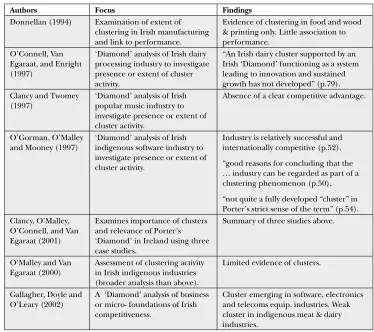
[image:9.482.56.428.75.290.2]Two issues are raised by the cluster research conducted to date. First, two of the three cases addressed in Irish research (popular music and Irish dairy processing) cannot be regarded as competitive, as acknowledged by the authors. The failure to meet one potential requirement
[image:10.482.53.427.240.572.2]in applying a cluster approach, the ‘market test’ of competitive success, is a potential difficulty in studies that set out to apply a Porterian analysis to Irish clusters. The selection of non-competitive sectors in several studies implies the odds were stacked against finding clusters from the outset. It is also worth noting that the most unambiguously competitive industry (Software) was also found to be the most clustered. Second, in using data provided in standard classification formats, efforts to apply the cluster concept were absent from the studies. Properly grounded cluster analysis goes beyond the identification of backward or forward linkages or identifying where geographical concentrations of activities exist.
Table 16.2: Irish Cluster Studies and Findings
Authors Focus Findings
Donnellan (99) Examination of extent of clustering in Irish manufacturing and link to performance.
Evidence of clustering in food and wood & printing only. Little association to performance.
O’Connell, Van Egaraat, and Enright (997)
‘Diamond’ analysis of Irish dairy processing industry to investigate presence or extent of cluster activity.
“An Irish dairy cluster supported by an Irish ‘Diamond’ functioning as a system leading to innovation and sustained growth has not developed” (p.79). Clancy and Twomey
(997)
‘Diamond’ analysis of Irish popular music industry to investigate presence or extent of cluster activity.
Absence of a clear competitive advantage.
O’Gorman, O’Malley and Mooney (997)
‘Diamond’ analysis of Irish indigenous software industry to investigate presence or extent of cluster activity.
Industry is relatively successful and internationally competitive (p.5). “good reasons for concluding that the … industry can be regarded as part of a clustering phenomenon (p.50). “not quite a fully developed “cluster” in Porter’s strict sense of the term” (p.5). Clancy, O’Malley,
O’Connell, and Van Egaraat (00)
Examines importance of clusters and relevance of Porter’s ‘Diamond’ in Ireland using three case studies.
Summary of three studies above.
O’Malley and Van Egaraat (000)
Assessment of clustering activity in Irish indigenous industries (broader analysis than above).
Limited evidence of clusters.
Gallagher, Doyle and O’Leary (00)
A ‘Diamond’ analysis of business or micro- foundations of Irish competitiveness.
Cluster emerging in software, electronics and telecoms equip. industries. Weak cluster in indigenous meat & dairy industries.
A conclusion common to many studies is that Irish industrial policy should not be focused on the development of clusters and that the search for an alternative model for Irish industrial development should proceed, as relative success has been experienced by the Irish economy without the presence of established clusters.5 However, in the context of research to date,
conducted for Ireland. Without such analyses, it must be premature to conclude that a cluster-based approach to development is not relevant for policymaking purposes.
The scale of multinational contribution to Irish economic activity has been identified as problematic in applying the cluster concept since Porter largely excluded such plants and sectors in identifying clusters, although observing their potential to contribute to determining the competitive advantage(s) of a location. In his more recent work he emphasises that: “Productivity is the goal, not whether firms operating in the country are domestic or foreign-owned” (Porter, Ketels and Delgado, 00: 5).
However, it is a matter for debate whether relevant commentary on related issues from 990 may still have relevance.
A development strategy based solely on foreign multinationals may doom a nation to remaining a factor-driven economy. If reliance on foreign multinationals is too complete, the nation will not be the home base for any industry…The result of not developing more advanced forms of competitive advantage is a cap on economic development: rapid progress can be made, but it only goes so far…In Singapore and Ireland, my view is that the shift has been too little and too late. Neither nation has truly committed to the slow process of developing a broader base of indigenous firms (Porter, 990: 79).
A further obstacle to applying Porter’s theory has been identified as the potential requirement to include relevant other countries – including, for example, the sources of productive factors, market destinations, home-base countries of multinational subsidiaries located in Ireland - in a super ‘Diamond’ given Ireland’s small open economy nature. Notwithstanding the
profuse academic literature generated by such views, a review of Porter (990) reveals that Denmark and Singapore, both small economies and the latter one of the most open in the world, were included in his analyses and subjected to analyses based on ‘Diamond’ and cluster approaches.
16.8 The Value and Challenges of Cluster-Based
Analysis
The analysis of economies as systems of clusters, based on ‘Diamond’ conditions, affords policymakers an explicit framework on which to organise focussed policies and launch initiatives across main cluster players, from companies, to state agencies, universities, labour unions or industry associations, based squarely on how businesses conduct their competitive and co-operative activities. Cluster analysis focuses on important inter-firm linkages, complementarities, and spillovers in terms of technology, skills, information, marketing (among others) that describe the ongoing dynamic process of how firms compete.7 Such linkages and
the actual and potential external benefits clusters can generate point to a scope for joint actions by companies, industry groups and/or government to support cluster development.
Despite the research conducted to date, it is our view that a comprehensive cluster analysis, following Porter, of the Irish economy has yet to be carried out. The limited information and evidence available indicates that Porterian clustering is not a widely experienced phenomenon in Ireland. Indeed, we could go so far as to say that a relatively small number of indigenous Irish firms are successful in the international economy. At the same time, it is clear that a considerable share of economic activity based in Ireland leverages competitive advantages effectively on national and international markets but the extent to which these advantages are grounded in elements of location, competition and co-operation remains to be examined.
This might lead to support for the conclusion that clustering is not a relevant policy direction for Ireland. Alternatively, it may be the case that temporary favourable factors, other than strong clustering, more than made up for its absence in the Irish experience. Improvements in economic management and rapid expansion in labour supply for which demand developed, largely due to production by multinational enterprises, are once-off sources of growth associated with the Celtic Tiger. It should be remembered, however, that despite these important recent contributions to growth, Irish productivity per worker averaged .5 per cent per annum between 995 and 00, similar to the figure over the period from 97 to 000.8 To explore how such
rates can be at least maintained, in tandem with full employment, in an economy that has exhausted its catch-up potential, clustering may well prove to be a fruitful strategy.
16.9 Conclusions
A cluster-centred view of economic development poses particular challenges for policymakers. It makes redundant the notion that any specific industry or sector should be targeted by industrial policy since all clusters have the potential to contribute to prosperity and emphasises that business support programmes should best be structured to enhance the competitiveness of groups of related firms rather than individual businesses. Cluster-based thinking accords contributory roles to domestic and foreign companies which are both important in securing productivity improvements. The role of the policymaker in cluster-based economic development is to relax any identified impediments or constraints to productivity and to emphasise and enhance the cross-company linkages and complementarities that facilitate and generate business competitive advantage. This almost certainly implies a role for more cluster initiatives at sub-national and local levels and the development of trust not only by leaders and members of such initiatives in the policy sphere but also in the businesses that populate clusters since they are conduits for information and inputs on the barriers they face to developing their cluster.
success, then facilitation could be provided through state and business representative agencies with requisite responsibilities for supporting business development.
To examine the potential of cluster-based economic development, there is a need to identify existing, emerging and potential clusters, which cannot be done using available data and probably not through desk-research alone, pointing to the need for researchers to engage hands on with businesses and with policymakers in the cluster debate.
Notes
For example see Martin and Sunley (00). See Porter (985).
See Porter (980). See Porter (990). 5 See Simon (99: 7).
See Porter, Ketels and Delgado (00: 5). 7 Ketels (00).
8 For examples see the Cluster Mapping Project for the US developed by Michael Porter at the Harvard Business School and the Cluster Mapping Report for Sweden commissioned by the Swedish Programme for the Development of Innovation Systems and Clusters. The Cluster study of the UK commissioned by the Department for Trade and Industry (00) is based on the methods outlined in Porter (990).
9 Solvell et al.(00).
0 One (anonymous) Irish cluster initiative is included in the survey. For more details on the survey see Solvell et al. (00: -).
From the annual Executive Opinion Survey for the Global Competitiveness Report of the World Economic Forum.
It is also considerably lower than the Irish ranking of 9th on the Business Competitiveness Index, which is constructed to reflect the sustainability of current productivity levels. For example see (Clancy, 000: ).
Only studies considering Porter-type clusters are included.
5 O’Connell, Van Egaraat and Enright, 997; Clancy and Twomey, 997; O’Gorman, O’Malley and Mooney, 997; Clancy, O’Malley, O’Connell and Van Egaraat, 00.
As in Rugman and D’Cruz (99).
7 For examples of the range of cluster-based studies see Van der Linde (00). 8 Kennedy (00) Table presents historical data.
Claros, A., Porter, M. E. and Schwab, K. (00), The Global Competitiveness Report 2006-7, Palgrave Macmillan, -77.
Culliton, J. (99), A Time for Change: Industrial Policy for the 1990s; Report of the Industrial Policy Review Group, Stationery Office; Dublin.
Donnellan, N. (99), The Presence of Porter’s Sectoral Clustering in Irish Manufacturing,
Economic and Social Review, Vol. 5, No. , -.
ESG (00), Ahead of the Curve, Ireland’s Place in the Global Economy, Report of the Enterprise Strategy Group, Forfás.
Gallagher, L., Doyle, E. and O’Leary, E. (00), “Creating the Celtic Tiger and Sustaining Economic Growth: A Business Perspective”, Quarterly Economic Commentary, Economic and Social Research Institute, Spring, -8.
Kennedy, K. (000/), “Reflections on the Process of Irish Economic Growth”, Journal of the Statistical and Social Inquiry Society of Ireland, XXX, -9.
Ketels, C. (00), “European Clusters, Structural Change in Europe – Innovative City and Business Regions”, Hagbarth Publications, -.
Marshall, A. (90), Principles of Economics, Eighth edition, Macmillan and Co. Ltd., London. Original published 890.
Martin, R. and Sunley, P. (00), “Deconstructing Clusters: Chaotic Concept or Policy Panacea?”
Journal of Economic Geography, , 5-5.
Nijhowne, S. (997), “Alternative Aggregations and the Standard Industrial Classification: A note.” paper presented at the th meeting of the Voorburg Group on Services Statistics, Copenhagen, September.
O’Connell, L., Van Egaraat, C. and Enright, P. (997), “The Irish Dairy Processing Industry: An Application of Porter’s Cluster Analysis”, National Economic and Social Council, Research Series Paper No. , November.
O’Gorman, C., O’Malley, E. and Mooney, J. (997), “Clusters in Ireland: The Irish Indigenous Software Industry: An Application of Porter’s Cluster Analysis”, National Economic and Social Council, Research Series Paper No. , November.
O’Malley, E. and Van Egeraat, C. (000), “Industry Clusters and Irish Indigenous Manufacturing: Limits of the Porter View”. Economic and Social Review, (), 55-79.
Porter, M.E. (00), “Building the Microeconomic Foundations of Prosperity: Findings from the Business Competitiveness Index”, chapter . in Porter, M.E., Schwab, K.,
Sala-i-Martin, X. and Lopez-Claros, A. (00), The Global Competitiveness Report 2003-2004, Oxford University Press, 9-5.
Porter, M. E. (00), “The Economic Performance of Regions”, Regional Studies, 7, &7, 9-78.
Porter, M. E. (998), “Clusters and the New Economics of Competition”, Harvard Business Review, Nov.-Dec, 77- 90.
Porter, M. E. (990), The Competitive Advantage of Nations. Free Press, New York. Republished with New Introduction, 998 (990).
Porter, M. E. (985), Competitive Advantage: Creating and Sustaining Superior Performance. Free Press, New York. Republished with New Introduction, 998.
Porter, M. E. (980), Competitive Strategy: Techniques for Analyzing Industries and Competitors. Free Press, New York. Republished with New Introduction, 998.
Rugman, A.M. and D’Cruz, J.R. (99), “The ‘Double Diamond’ Model of International Competitiveness: The Canadian Experience”, Management International Review, Vol. , No. SPI/, 7-9.
Simon, H.A. (99), “Organizations and Markets”, The Journal of Economic Perspectives, 5, , Spring, 5-.
Solvell, O., Ketels, C.H. and Lindqvist, G. (00), The Cluster Initiative Greenbook, The Competitiveness Institute/Vinnova: Gothenburg.

![Methyl (E) 2 [(3 chloro 4 cyanophenyl)imino] 4 (4 chlorophenyl) 6 methyl 1,2,3,4 tetrahydropyrimidine 5 carboxylate](data:image/gif;base64,R0lGODlhAQABAIAAAP///wAAACH5BAEAAAAALAAAAAABAAEAAAICRAEAOw==)