A Semi-supervised Word Alignment Algorithm
with Partial Manual Alignments
Qin Gao, Nguyen Bach and Stephan Vogel
Language Technologies Institute Carnegie Mellon University
5000 Forbes Avenue, Pittsburgh PA, 15213
{qing, nbach, stephan.vogel}@cs.cmu.edu
Abstract
We present a word alignment framework that can incorporate partial manual align-ments. The core of the approach is a novel semi-supervised algorithm extend-ing the widely used IBM Models with a constrained EM algorithm. The par-tial manual alignments can be obtained by human labelling or automatically by high-precision-low-recall heuristics. We demonstrate the usages of both methods by selecting alignment links from manu-ally aligned corpus and apply links gen-erated from bilingual dictionary on unla-belled data. For the first method, we con-duct controlled experiments on Chinese-English and Arabic-Chinese-English translation tasks to compare the quality of word align-ment, and to measure effects of two differ-ent methods in selecting alignmdiffer-ent links from manually aligned corpus. For the second method, we experimented with moderate-scale Chinese-English transla-tion task. The experiment results show an average improvement of 0.33 BLEU point across 8 test sets.
1 Introduction
Word alignment is used in various natural lan-guage processing applications, and most statistical machine translation systems rely on word align-ment as a preprocessing step. Traditionally the word alignment model is trained in an unsuper-vised manner, e.g. the most widely used tool GIZA++ (Och and Ney, 2003), which implements the IBM Models (Brown et. al., 1993) and the HMM model (Vogel et al., 1996). However, for language pairs such as Chinese-English, the word alignment quality is often unsatisfactory (Guzman et al., 2009). There has been increasing interest on using manual alignments in word alignment tasks.
Ittycheriah and Roukos (2005) proposed to use only manual alignment links in a maximum en-tropy model. A number of semi-supervised word aligners are proposed (Blunsom and Cohn, 2006; Niehues and Vogel, 2008; Taskar et al., 2005; Liu et al., 2005; Moore, 2005). These approaches use held-out manual alignments to tune the weights for discriminative models, with the model param-eters, model scores or alignment links from un-supervised word aligners as features. Also, sev-eral models are proposed to address the prob-lem of improving generative models with small amount of manual data, including Model 6 (Och and Ney, 2003) and the model proposed by Fraser and Marcu (2006) and its extension called LEAF aligner (Fraser and Marcu, 2007). The approaches use labelled data to tune parameters to combine different components of the IBM Models.
2005ᒤ Ⲵ ༿ཙ 2005nian de xiatian
[image:1.595.368.466.463.514.2]The summer of 2005
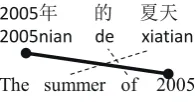
Figure 1: Partial and full alignments
An interesting question is, if we only have par-tial alignments of sentences, can we make use of them? Figure 1 shows the comparison of par-tial alignments (the bold link) and full alignments (both of the dashed and the bold links). A partial alignment of a sentence only provides a portion of links of the full alignment. Although it seems to be trivial, they actually convey different information. In the example, if the full alignment is given, we can assert2005is only aligned to2005nian, not to de orxiatian, but if only the partial alignment is given we cannot make such assertion.
Partial alignments can be obtained from vari-ous sources, for example, we can fetch them by manually correcting unsupervised alignments, by simple heuristics such as dictionaries of technical
terms, by rule-based alignment systems that have high accuracy but low recall rate. The function-ality is considered useful in many scenarios. For example, the researchers can analyse the align-ments generated by GIZA++ and fix common error patterns, and perform training again. On another way, an application can combine active learning (Arora et al., 2009) and crowdsourcing, asking non-expertise such as workers of Amazon Mechanical Turk to label crucial alignment links that can improve the system with low cost, which is now a promising methodology in NLP areas (Callison-Burch, 2009).
In this paper, we propose a semi-supervised ex-tension of the IBM Models that can utilize partial alignment links. More specifically, we are seeking answers for the following questions:
• Given the partial alignment of a sentence, how to find the most probable alignment that is consistent with the partial alignment. • Given a set of partially aligned sentences,
how to get the parameters that maximize the likelihood of the sentence pairs with align-ments consistent with the partial alignalign-ments • Given a set of partially aligned sentences,
with conflicting partial alignments, how to answer the two questions above.
In the proposed approach, the manual partial alignment links are treated as ground truth, there-fore, they will be fixed. However, for all other links we make no additional assumption. When using manual alignments, there can be links con-flicting with each other. These conflicting evi-dences are treated as options and the generative model will choose the most probable alignment from them. An efficient training algorithm for fertility-based models is proposed. The algorithm manipulates the Moving and Swapping matrices used in the hill-climbing algorithm (Och and Ney, 2003) to rule out inconsistent alignments in both E-step and M-step of the training.
A similar attempt has been made by Callison-Burch et al. (2004), where the authors interpo-late the parameters estimated by sentence-aligned and word-aligned corpus. Our approach is differ-ent from their method that we do not require fully aligned data and we do not need to interpolate two parameter sets. All the training is done within a unified framework. Our approach is also different from LEAF (Fraser and Marcu, 2007) and Model 6 (Och and Ney, 2003) that we do not use these
additional links to tune additional parameters to combine model components, as a result, it is not limited to fully aligned corpus.
A question may raise why the proposed method is superior over using the partial alignment links as features in discriminative aligners? There are three possible explanations. First, the method pre-serves the power of the generative model in which the algorithm utilizes large amount of unlabeled data. More importantly, the additional information can propagate over the whole corpus through bet-ter estimation of model paramebet-ters. In contrast, if we use the alignment links in discriminative align-ers as a feature, one link can only affect the par-ticular word, or at most the sentence. Second, al-though the discriminative word alignment meth-ods provide flexibility to utilize labeled data, most of them still rely on generative aligners. Some rely on the model parameters of the IBM Mod-els (Liu et al., 2005; Blunsom and Cohn, 2006), others rely on the alignment links from GIZA++ as features or as training data (Taskar et al., 2005), or use both the model parameters and the align-ment links (Niehues and Vogel, 2008). Therefore, improving the generative aligner is still important even when using discriminative aligners. Third, these methods require full alignment of sentences to provide positive (aligned) and negative (non-aligned) information, which limits the availability of data (Niehues and Vogel, 2008).
The proposed method has been successfully ap-plied on various tasks, such as utilizing manual alignments harvested from Amazon Mechanical Turk (Gao and Vogel, 2010), and active learning methods for improving word alignment (Ambati et al., 2010). This paper provides the detailed al-gorithm of the method and controlled experiments to demonstrate its behavior.
The paper is organized as follows, in section 2 we describe the proposed model as well as the modified training algorithm. Section 3 presents two approaches of obtaining manual alignment links, The experimental results will be shown in section 4. We conclude the paper in section 5.
2 Semi-supervised word alignment
2.1 Problem Setup
HMM model (Vogel et al., 1996). Given two strings from target and source languages f1J = f1,· · · , fj,· · ·fJ ande1I = e1,· · ·, ei,· · ·eI, an
alignment of the sentence pair is defined asaJ1 = [a1, a2,· · ·, aJ], aj ∈ [0, I]. The IBM Models
assume all the target words must be covered ex-actly once (Brown et. al., 1993). We try to model
P(f1J|eI1), which is the probability of observing source sentence given target sentence eI1. In sta-tistical models a hidden alignment variable is in-troduced, so that we can write the probability as
P(f1J|eI1) = P
aJ
1 P r(f J
1, aJ1|eJ1, θ), whereP r(·)
is the estimated probability given the parameter set
θ. The IBM Models define several different set of parameters, from Model 1 to Model 5. Starting from Model 3, the fertility model is introduced.
EM algorithm is employed to estimate the model parameters of the IBM Models. In E-step, it is possible to obtain sufficient statistics from all possible alignments with simplified formulas for simple models such as Model 1 and Model 2. Meanwhile for fertility-based models, enumerat-ing all possibilities is NP-complete and hence it cannot be carried out for long sentences. A solu-tion is to explore only the “neighbors” of Viterbi alignments. However, obtaining Viterbi align-ments itself is NP-complete for these models. In practice, a greedy algorithm is employed to find a local optimal alignments based on Viterbi align-ments generated by simpler models.
First, we define the neighbor alignments ofaas the set of alignments that differ by one of the two operators from the original “center alignment”.
• Move operatorm[i,j], that changes aj := i,
i.e. arbitrarily set wordfj in source sentence
to align to wordfiin target sentence.
• Swap operators[j1,j2]that exchangesaj1 and aj2.
We denote the neighbor alignments set of current center alignment a as nb(a). In each step of hill-climbing algorithm, we find the alignment b(a) in nb(a), s.t. b(a) = arg maxa0∈nb(a)p(a0|e, f), and update the current center alignment. The algorithm iterates until there is no update could be made. The statistics of the neighbor alignments of the final center align-ment will be collected for normalization step (M-step). The algorithm is greedy, so a reasonable start point is important. In practice GIZA++ uses Model 2 or HMM to generate theseed alignment.
To improve the speed of hill climbing, GIZA++ caches the cost of all possible move and swap op-erations in two matrices. In the so called Moving MatrixM, the elementMij stores the likelihood
difference of a move operatoraj =i:
Mij =
P r(m[i,j](a)|e, f)
P r(a|e, f) ·(1−δ(aj, i)) (1)
and in the Swapping Matrix S, the element Sjj0 stores the likelihood difference of a swap operator betweenaj andaj0:
Sjj0=
( P r(S
[j,j0](a)|e,f)
P r(a|e,f) ·(1−δ(aj, aj0)) ifj < j0
0 otherwise
(2) The matrices will be updated whenever an oper-ator is made, but the update is limited to the rows and columns involved in the operator.
We define a partial alignment of a sentence pair (f1J, eI1) as αIJ = {(i, j),0 ≤ i < I,0 ≤
j < J}, note that the partial alignment does not assume 1-to-N restriction on either side, and the word from neither source nor target side need to be covered with links. If an index is missing, it does not mean the word is aligned to the empty word. Instead it just means no information is provided. We use a link(0, j)or(i,0)to explicitly represent the information that wordfjoreiis aligned to the
empty word.
In order to find the most probable align-ment that is consistent the partial alignalign-ments, we treat the partial alignment as constraints, i.e. for an alignment aJ1 = [a1, a2,· · · , aj] on the
sentence pair f1J, eI1, the translation probability
P r(f1J, aJ1|eI1, αJI)will be zero if the alignment is inconsistent with the partial alignments.
P r(f1J|e
I
1, a
J
1, α
J I) =
0, aJ1is inconsistent withαJI
P r(fJ
1|eI1, aJ1, θ),otherwise (3)
Under the constraints of the IBM Models, there are two situations thataJ1 is inconsistent withαJI:
1. Target word misalignment: The IBM Models assume one target word can only be aligned to one source word. Therefore, if the target wordfj aligns to a source wordei, while the
constraintαJ
I suggests fj should be aligned
2005ᒤ
Ⲵ
༿ཙ
the
summer
of
2005
Manual Alignment Link
(a)
2005ᒤ
Ⲵ
༿ཙ
the
summer
Of
2005
Seed Alignment Consistent Alignment Center Alignment
(b) (c) 2005ᒤ
Ⲵ
༿ཙ
the
summer
of
[image:4.595.308.522.73.318.2]2005
Figure 2: Illustration of Algorithm 1
2. Source word to empty word misalignment: Since one source word can be aligned to mul-tiple target words, it is hard to constrain the alignments of source words. However, if a source word is aligned to the empty word, it cannot be aligned to any concrete target word.
However, we are facing the problem of con-flicting evidences. The problem is not necessar-ily caused by errors in manual alignments, but the assumption of the IBM Models that one tar-get word can only be aligned to one source word. This assumption causes multiple alignment links from one target word conflict with each other. In this case, we relax the constraints of situation 1 that if the alignment linkaj∗is consistent with any target-to-source links(i, j)thatj =j∗, it will be considered consistent. Also, we arbitrarily assign the source word to empty word constraints higher priorities than other constraints.
In EM algorithm, to ensure the final model be marginalized on the fixed alignment links, and the final Viterbi alignment is consistent with the fixed alignment links, we need to guarantee that no statistics from inconsistent alignments be col-lected into the sufficient statistics. On fertility-based models, we have to make sure:
1. The hill-climbing algorithm outputs ment links consistent with the fixed align-ment links.
2. The count collection algorithm rules out all the inconsistent statistics.
With the constrained hill-climbing algorithm and count collection algorithm which will be de-scribed below, the above two criteria are satisfied.
2.2 Constrained hill-climbing algorithm
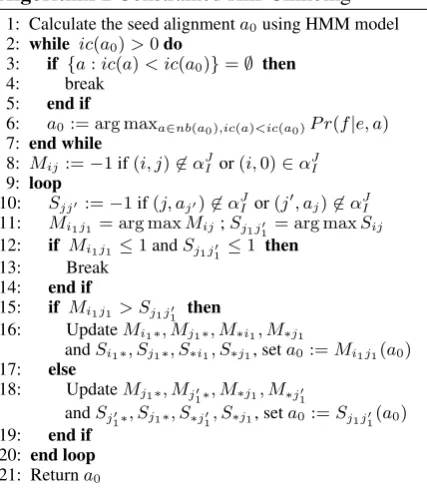
Algorithm 1 shows the algorithm outline of con-strained hill-climbing. First, similar to the original hill-climbing algorithm described above, HMM (or Model 2) is used to obtain a seed alignment. To ensure the resulting center alignment be con-sistent with manual alignment, we need to split the
Algorithm 1Constrained Hill-Climbing
1: Calculate the seed alignmenta0using HMM model 2: while ic(a0)>0do
3: if {a:ic(a)< ic(a0)}=∅ then 4: break
5: end if
6: a0:= arg maxa∈nb(a0),ic(a)<ic(a0)P r(f|e, a)
7: end while
8: Mij:=−1if(i, j)6∈αJI or(i,0)∈α J I
9: loop
10: Sjj0 :=−1if(j, aj0)6∈αJI or(j0, aj)6∈αJI
11: Mi1j1= arg maxMij;Sj1j01= arg maxSij
12: if Mi1j1≤1andSj1j01≤1 then
13: Break 14: end if
15: if Mi1j1> Sj1j10 then
16: UpdateMi1∗, Mj1∗, M∗i1, M∗j1
andSi1∗, Sj1∗, S∗i1, S∗j1, seta0:=Mi1j1(a0) 17: else
18: UpdateMj1∗, Mj10∗, M∗j1, M∗j01
andSj0
1∗, Sj1∗, S∗j10, S∗j1, seta0:=Sj1j01(a0)
19: end if
20: end loop
21: Returna0
hill-climbing algorithm into two stages, i.e. mize towards the constraints and towards the opti-mal alignment under the constraints.
From a seed alignment, we first try to move the alignment towards the constraints by choosing a move or swap operator that:
1. has highest likelihood among alignments generated by other operators, excluding the original alignment,
2. eliminates at least one inconsistent link.
The first step reflects in line 2 through 7 in the algorithm, where we useic(·) to denote the total number of inconsistent links in the alignment, and
nb(·)to denote the neighbor alignments.
We iteratively update the alignment until no ad-ditional inconsistent link can be removed. The al-gorithm implies that we force the seed alignment to become closer to the constraints while trying to find the best consistent alignment. Figure 2 demonstrates the idea, given the manual alignment link shown in (a), and the seed alignment shown as solid links in (b), we move the inconsistent link to the dashed link by a move operation.
it-eration, Since once the alignment is updated, the possible violations will also change. This is done in line 10.
If source words ik are aligned to the empty
word, we setMik,j = −1,∀j, as shown in line 8.
The swapping matrix does not need to be modified in this case because the swapping operator will not introduce new links. Again, Figure 2 demonstrates the optimization step in (c), two move operators or one swap operator can move the link marked with cross to the dashed line, which can be a bet-ter alignment.
Because the cells that can lead to violations are set to negative, the operators will never be picked in line 11, therefore we effectively ensure the con-sistency of the final center alignment.
The algorithm will end when no better update can be made (line 12 through 14), otherwise, we pick the new update with highest likelihood as new center alignment and update the cells in the Mov-ing and SwappMov-ing matrices that will be affected by the update. Line 15 through line 19 perform the operation.
2.3 Count Collection
After finding the center alignment, we collect counts from the neighbor alignments so that the M-step can normalize the counts to produce the model parameters for the next step. All statis-tics from inconsistent alignments are ruled out to ensure the final sufficient statistics marginalized on the fixed alignment links. Similar to the con-strained hill climbing algorithm, we can manipu-late the Moving/Swapping matrices to effectively exclude inconsistent alignments. We just need to bypass all the cells whose values are negative, i.e. represent inconsistent alignments.
By combining the constrained EM algorithm and the count collection, the Viterbi alignment is guaranteed to be consistent with the fixed align-ment links, and the sufficient statistics is guar-anteed to contain no statistics from inconsistent alignments.
2.4 Training scheme
We extend the multi-thread GIZA++ (Gao and Vogel, 2008) to load the alignments from a mod-ified corpus file. The links are appended to the end of each sentence in the corpus file in the form of indices pairs, which will be read by the aligner during training. In practice, we first training un-constrained models up to Model 4, and then switch
to constrained Model 4 and continue training for several iterations, the actual number of training order is: 5 iterations of Model 1, 5 iterations of HMM, 3 iterations of Model 3, 3 iterations of unconstrained Model 4 and 3 iterations of con-strained Model 4. Because here we actually have more Model 4 iterations, to make the comparison fair, in all the experiments below we perform6 it-erations of Model 4 in the baseline systems.
3 Obtaining alignment links
Given the algorithm described in the Section 2, we still face the problem of obtaining alignment links to constrain the system. In this section, we describe two approaches to obtain the links, the first is to resort to human labels, while the second applies high-precision-low-recall heuristic-based aligner on large unsupervised corpus.
3.1 Using manual alignment links
Using manual alignment links is simple and straight-forward, however the problem is how to select links for human to label given that labelling the whole corpus is impossible. We propose two link selectors, the first is the random selector in which every links in the manual alignment has equal probability of being selected. Obviously, the random selecting method is far from optimal because it pays no attention on the quality of ex-isting links. In order to demonstrate that by select-ing links carefully we can achieve better alignment quality with less manual alignment links, we pro-pose the second selector based on disagreements of alignments from two directions. We first clas-sify the source and target words fj and ei into
three categories. Use fj as an example, the
cat-egories are:
• C1: fj aligns toei, i > 0ine → f,1 but in
reversed directioneidoes not align tofj but
to another word.
• C2: fj aligns toei, i > 0, inf → e, but in
reversed direction (e → f), fj aligns to the
empty word.
• C3: no word aligns tofj, inf → e, but in
reversed directionfjaligns toei, i >0.2
The criteria ofeiare the same asfj after
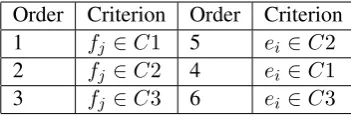
swap-ping the definitions of “source” and “target”. We prioritize the linksαJI = (i, j)by looking at the classes of the source/target words. The order of
1
Recall thatfjcan align to only one word.
2This class is different fromC1that whethere
ialigns to
Order Criterion Order Criterion 1 fj ∈C1 5 ei ∈C2
2 fj ∈C2 4 ei ∈C1
[image:6.595.92.268.62.120.2]3 fj ∈C3 6 ei ∈C3
Table 1: The priorities of alignment links
priorities is shown in Table 1. All the links not in the six classes will have the lowest priorities. The links with higher priorities will be selected first, but the order of two links in a same priority class is not defined and they will be selected randomly.
3.2 Using heuristics on unlabelled data
Another possible way of getting alignment links is to make use of heuristics to generate high-precision-low-recall links and feed them into the aligner. The heuristics can be number map-ping, person name translator or more sophisticated methods such as alignment confidence measure (Huang, 2009). In this paper we propose to use manual dictionaries to generate alignment links.
First we filter out from the dictionary the en-tries with high frequency in the source side, and then build an aligner based on it. The aligner out-put links between words if them match an entry in the dictionary. The method can be applied on large unlabelled corpus and generate large num-ber of links, after that we use the links as manual alignment links in proposed method.
The readers may notice that GIZA++ supports utilizing manual dictionary as well, however it is different from our method. The dictionary is used in GIZA++ only in the initialization step of Model 1, where only the statistics of the word pairs ap-peared in the dictionary will be collected and nor-malized. Given the fact that Model 1 converges to global optimal, the effect will fade out after sev-eral iterations. In contrast, our method impose a hard constraint on the alignments. Also, our method can be used side-by-side with the method in GIZA++.
4 Experiments
4.1 Experiments on manual link selectors
We designed a set of controlled experiments to show that the algorithm acts as desired. Particu-larly, with a number of manual alignment links fed into the aligner, we should be able to correct more misaligned alignment links than the manual align-ment links through better alignalign-ment models. Also, carefully selected alignment links should
outper-form randomly selected alignment links.
We used Chinese-English and Arabic-English manually aligned corpus in the experiments. Ta-ble 2 shows the statistics of the corpora:
Number of Num. of Words Alignment Sentences Source Target Links Ch-En 21,863 424,683 524,882 687,247 Ar-En 29,876 630,101 821,938 830,349
Table 2: Corpus statistics of the corpora
First the corpora is trained as unlabelled data to serve as baselines, and then we feed a portion of alignment links into the proposed aligner. We experimented with different methods of choosing alignment links and adjust the number of links vis-ible to the aligner. Because of the limitations of the IBM Models, such as no N-to-1 alignments, the manual alignment is not reachable from ei-ther direction. We then define the best align-ment that the IBM Models can express “oracle alignment”, which can be obtained by dropping all N-to-1 links from manual alignment. Also, to show the upper-bound performance, we feed all the manual alignment links to our aligner, and call the alignment “force alignment”. Table 3 shows the alignment qualities of oracle alignments and force alignments of both systems. For force align-ments, we show the scores with and without im-plicit empty links derived from the manual align-ment.3The oracle alignments are the performance upper-bounds of all aligners under IBM Model’s 1-to-N assumption. The result from Table 3 shows that, if we include the derived empty links, the force alignments are close to the oracle results. Then the question is how fast we can approach the upper-bound.
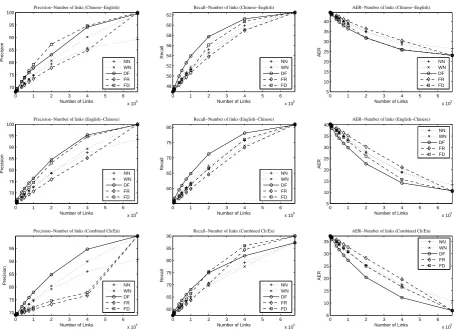
To answer the question, we gradually increase the number of links being fed into the aligner. In these experiments the seeds for random number generator are fixed so that the links selected in later experiments are always superset of that of earlier experiments. The comparison of the align-ment quality is shown in Figure 3 and 4. To show the actual improvement brought in by the algo-rithm instead of the manual alignment links them-selves, we compare the alignment results of the proposed method with directly fixing the align-ments from original GIZA++ training. By fix-ing alignments we mean that first the conventional
0 1 2 3 4 5 6 x 10⁵ 70 75 80 85 90 95 100
Number of Links
Precision
Precision−Number of links (Chinese−English)
NN WN DF FR FD
0 1 2 3 4 5 6
x 105 48 50 52 54 56 58 60 62
Number of Links
Recall
Recall−Number of links (Chinese−English)
NN WN DF FR FD
0 1 2 3 4 5 6
x 105 5 10 15 20 25 30 35 40
Number of Links
AER
AER−Number of links (Chinese−English)
NN WN DF FR FD
0 1 2 3 4 5 6
x 105
70 75 80 85 90 95 100
Number of Links
Precision
Precision−Number of links (English−Chinese)
NN WN DF FR FD
0 1 2 3 4 5 6
x 105
60 65 70 75 80
Number of Links
Recall
Recall−Number of links (English−Chinese)
NN WN DF FR FD
0 1 2 3 4 5 6
x 105
5 10 15 20 25 30 35 40
Number of Links
AER
AER−Number of links (English−Chinese)
NN WN DF FR FD
0 1 2 3 4 5 6
x 105 70 75 80 85 90 95
Number of Links
Precision
Precision−Number of links (Combined Ch/En)
NN WN DF FR FD
0 1 2 3 4 5 6
x 105 60 65 70 75 80 85 90
Number of Links
Recall
Recall−Number of links (Combined Ch/En)
NN WN DF FR FD
0 1 2 3 4 5 6
x 105 5 10 15 20 25 30 35
Number of Links
AER
AER−Number of links (Combined Ch/En)
[image:7.595.77.534.68.398.2]NN WN DF FR FD
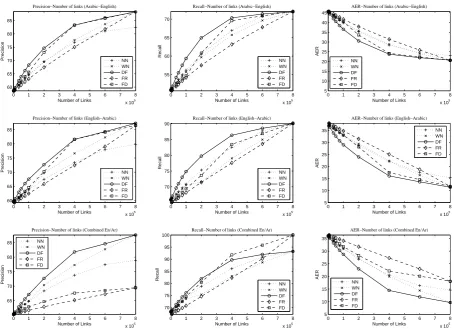
Figure 3: Alignment qualities of Chinese-English word alignment, NN: Random selector without empty links, WN: Random seletor with empty links, DF: Disagreement selector, FR: Directly fixing the align-ments with random selector, FD: Directly fixing the alignalign-ments with disagreement selector. Each row shows the precision, recall and AER when applying different number of manual alignment links. The three rows are for Chinese-English, English-Chinese and heuristically symmetrized alignments (grow-diag-final-and) accordingly.
GIZA++ training is performed and then we add the manual alignment links to the resulting alignment. In case that the 1-to-N restriction of the IBM Mod-els is violated, we keep the manual alignment links and remove the links from GIZA++.
We show the results as FR (dashed curves with diamond markers) and FD (dashed curves with square markers) in the plots, corresponding to alignments selected from the random link selector and the disagreement-based link selector. These two curves serve as baseline, and the gaps between the FR curves and the WN curves (dotted curves with cross markers) and the gaps between the FD curves and the DF curves (solid curves) show the amount of improvement we achieved using the method in addition to the manual alignment links. Therefore, they represent the effectiveness of the proposed alignment approach. Also the gaps
be-tween DF and WN curves indicate the differences in the performance of two link selectors.
0 1 2 3 4 5 6 7 8 x 10⁵ 60 65 70 75 80 85
Number of Links
Precision
Precision−Number of links (Arabic−English)
NN WN DF FR FD
0 1 2 3 4 5 6 7 8
x 105 55
60 65 70
Number of Links
Recall
Recall−Number of links (Arabic−English)
NN WN DF FR FD
0 1 2 3 4 5 6 7 8
x 105 5 10 15 20 25 30 35 40 45
Number of Links
AER
AER−Number of links (Arabic−English)
NN WN DF FR FD
0 1 2 3 4 5 6 7 8
x 105
60 65 70 75 80 85
Number of Links
Precision
Precision−Number of links (English−Arabic)
NN WN DF FR FD
0 1 2 3 4 5 6 7 8
x 105
70 75 80 85 90
Number of Links
Recall
Recall−Number of links (English−Arabic)
NN WN DF FR FD
0 1 2 3 4 5 6 7 8
x 105
5 10 15 20 25 30 35
Number of Links
AER
AER−Number of links (English−Arabic)
NN WN DF FR FD
0 1 2 3 4 5 6 7 8
x 105 65
70 75 80 85
Number of Links
Precision
Precision−Number of links (Combined En/Ar)
NN WN DF FR FD
0 1 2 3 4 5 6 7 8
x 105 70 75 80 85 90 95 100
Number of Links
Recall
Recall−Number of links (Combined En/Ar)
NN WN DF FR FD
0 1 2 3 4 5 6 7 8
x 105 5 10 15 20 25 30 35
Number of Links
AER
AER−Number of links (Combined En/Ar)
[image:8.595.79.534.69.398.2]NN WN DF FR FD
Figure 4: Alignment qualities of Arabic-English word alignment, NN: Random selector without empty links, WN: Random selector with empty links, DF: Disagreement selector, FR: Directly fixing the align-ments with random selector, FD: Directly fixing the alignalign-ments with disagreement selector. Each row shows the precision, recall and AER when applying different number of manual alignment links. The three rows are for Arabic-English, English-Arabic and heuristically symmetrized alignments (grow-diag-final-and) accordingly.
of the curves, with a small number of manual alignment links, we can already improve the align-ment quality by a large gap. This observation can benefit low-resource word alignment tasks.
4.2 Experiment on using heuristics
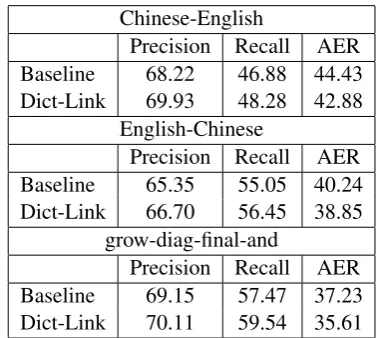
The previous experiment shows the potential of using the method on manual aligned corpus, here we demonstrate another possible usage of the pro-posed method that uses heuristics to generate high-precision-low-recall links. We use LDC Chinese-English dictionary as an example. The entries with single Chinese character and more than six En-glish words are filtered out. The heuristic-based aligner yields alignment that has 79.48% preci-sion and 17.36% recall rate on the test set we used in 4.1. By applying the links as manual links, we run proposed method on the same Chinese-English test data presented in 4.1, and the results
of alignment qualities are shown in 5. As we can see, the AER reduced by 1.64 from 37.23 to 35.61 on symmetrized alignment.
We also experimented with translation tasks with moderate-size corpus. We used the corpus LDC2006G05 with 25 million words. The train-ing scheme is the same as previous experiments, where the filtered LDC dictionary is used. After word alignment, standard Moses phrase extraction tool (Och and Ney, 2004) is used to build the trans-lation models and finally Moses (Koehn et. al., 2007) is used to tune and decode.
We tune the system on the NIST MT06 test set (1664 sentences), and test on the MT08 (1357 sentences) and the DEV075(1211 sentences) test sets, which are further divided into two sources (newswire and web data). A trigram language
MT02 MT03 MT04 MT05 MT08-NW MT08-WB Dev07NW Dev07WB
Baseline 28.87 27.82 30.08 26.77 25.09 17.72 24.88 21.76
[image:9.595.73.527.62.106.2]Dict-Link 29.59 27.67 31.01 27.13 25.14 17.96 25.51 21.88
Table 4: Comparison of the performance of baseline and the alignment generated by new aligner with dictionary links in BLEU scores
[image:9.595.319.508.159.328.2]Precision Recall AER ORL 100.00 62.61 23.00 Ch-En F/NE 89.25 62.47 26.50 F/WE 99.59 62.47 23.22 ORL 100.00 80.98 10.51 En-Ch F/NE 93.49 80.79 13.32 F/WE 99.82 80.79 10.70 F/NE 90.79 87.49 10.89 Comb F/WE 99.78 87.23 6.92 ORL 100.00 72.07 16.23 Ar-En F/NE 82.46 72.00 23.13 F/WE 94.25 72.00 18.36 ORL 100.00 90.14 5.18 En-Ar F/NE 79.81 90.06 15.37 F/WE 93.27 90.10 8.34 F/NE 78.91 93.07 14.59 Comb F/WE 94.64 93.21 6.08
Table 3: Alignment quality of oracle alignment and force alignment, the rows with “ORL” in the second column are oracle alignments, “F/NE” and “F/WE” represent force alignments with empty links and without empty links correspondingly. For “F/NE” and “F/WE” we also listed the scores of heuristically symmetrized alignment4. (“Comb”)
model trained from GigaWord V1 and V2 cor-pora is used. Table 4 shows the comparison of the performances on BLEU metric (Papineni et al., 2002). As we can observe from the results, the proposed method outperforms the baseline on all test sets except MT03, and has significant6 improvement on MT02 (+0.72), MT04 (+0.93), and Dev07NW(+0.63). The average improvement across all test sets is 0.35 BLEU points.
As a summary, the purpose of the this experi-ment is to demonstrate an important characteris-tic of the proposed method. Even with imperfect manual alignment links, we can get better align-ment by applying our method. This characteristic opens a possibility to integrate other more sophis-ticated aligners.
5 Conclusion
In this study, our major contribution is a novel generative model extended from IBM Model 4 to
6We used the confidence measurement described in (Zhang and Vogel, 2004)
Chinese-English
Precision Recall AER Baseline 68.22 46.88 44.43 Dict-Link 69.93 48.28 42.88
English-Chinese
Precision Recall AER Baseline 65.35 55.05 40.24 Dict-Link 66.70 56.45 38.85
grow-diag-final-and
Precision Recall AER Baseline 69.15 57.47 37.23 Dict-Link 70.11 59.54 35.61
Table 5: Comparison on alignment error rate by using alignment links generated by dictionaries
utilize partial manual alignments. The proposed method enables us to efficiently enforce subtle alignment constraints into the EM training. We performed experiments on manually aligned cor-pora to prove the validity. We also demonstrated using the method with simple heuristics to boost the translation quality on moderate size unlabelled corpus. The results show that our method is ef-fective in promoting the word alignment quali-ties with small amounts of partial alignments and with high-precision-low-recall heuristics. Also the method of using dictionary to generate manual alignment links showed an average improvement of 0.35 BLEU points across 8 test sets.
The algorithm has small impact on the speed of GIZA++, and can easily be added to current multi-thread implementation of GIZA++. Therefore it is suitable for large scale training.
Future work includes applying the proposed ap-proach on low resource language pairs and in-tegrating the algorithm with other rule-based or discriminative aligners that can generate high-precision-low-recall partial alignments.
Acknowledgement
[image:9.595.88.274.160.335.2]References
V. Ambati, S. Vogel, and J. Carbonell. 2010. Ac-tive semi-supervised learning for improving word alignment. InProceedings of the NAACL HLT 2010 Workshop on Active Learning for Natural Language Processing.
S. Arora, E. Nyberg, and C. P. Ros´e. 2009. Estimat-ing annotation cost for active learnEstimat-ing in a multi-annotator environment. InHLT ’09: Proceedings of the NAACL HLT 2009 Workshop on Active Learning for Natural Language Processing, pages 18–26.
P. Blunsom and T. Cohn. 2006. Discriminative word alignment with conditional random fields. In
Proceedings of the 21st International Conference on Computational Linguistics and the 44th annual meeting of the Association for Computational Lin-guistics, pages 65–72.
P. F. Brown et. al. 1993. The mathematics of sta-tistical machine translation: Parameter estimation. In Computational Linguistics, volume 19(2), pages 263–331.
C. Callison-Burch, D. Talbot, and M. Osborne. 2004. Statistical machine translation with word-and sentence-aligned parallel corpora. InProceedings of the 42nd Annual Meeting on Association for Compu-tational Linguistics, pages 175–183.
C. Callison-Burch. 2009. Fast, cheap, and creative: Evaluating translation quality using amazons me-chanical turk. In Proceedings of the 2009 Confer-ence on Empirical Methods in Natural Language Processing, pages 286–295.
A. Fraser and D. Marcu. 2006. Semi-supervised training for statistical word alignment. In ACL-44: Proceedings of the 21st International Conference on Computational Linguistics and the 44th annual meeting of the Association for Computational Lin-guistics, pages 769–776.
A. Fraser and D. Marcu. 2007. Getting the struc-ture right for word alignment: LEAF. In Pro-ceedings of the 2007 Joint Conference on Empirical Methods in Natural Language Processing and Com-putational Natural Language Learning (EMNLP-CoNLL), pages 51–60.
Q. Gao and S. Vogel. 2008. Parallel implementations of word alignment tool. InProceedings of the ACL 2008 Software Engineering, Testing, and Quality As-surance Workshop, pages 49–57.
Q. Gao and S. Vogel. 2010. Consensus versus exper-tise : A case study of word alignment with mechan-ical turk. In NAACL 2010 Workshop on Creating Speech and Language Data With Mechanical Turk, pages 30–34.
F. Guzman, Q. Gao, and S. Vogel. 2009. Reassessment of the role of phrase extraction in pbsmt. In The twelfth Machine Translation Summit.
F. Huang. 2009. Confidence measure for word align-ment. InProceedings of the Joint Conference of the 47th Annual Meeting of the ACL and the 4th Interna-tional Joint Conference on Natural Language Pro-cessing of the AFNLP, pages 932–940. Association for Computational Linguistics.
A. Ittycheriah and S. Roukos. 2005. A maximum en-tropy word aligner for arabic-english machine trans-lation. InProceedings of Human Language Technol-ogy Conference and Conference on Empirical Meth-ods in Natural Language Processing, pages 89–96.
P. Koehn et. al. 2007. Moses: Open source toolkit for statistical machine translation. InProceedings of the 45th Annual Meeting of the Association for Com-putational Linguistics Companion Volume Proceed-ings of the Demo and Poster Sessions, pages 177– 180.
Y. Liu, Q. Liu, and S. Lin. 2005. Log-linear models for word alignment. InACL ’05: Proceedings of the 43rd Annual Meeting on Association for Computa-tional Linguistics, pages 459–466.
R. C Moore. 2005. A discriminative framework for bilingual word alignment. In Proceedings of the conference on Human Language Technology and Empirical Methods in Natural Language Process-ing, pages 81–88.
J. Niehues and S. Vogel. 2008. Discriminative word alignment via alignment matrix modeling. In Pro-ceedings of the Third Workshop on Statistical Ma-chine Translation, pages 18–25.
F. J. Och and H. Ney. 2003. A systematic comparison of various statistical alignment models. In Compu-tational Linguistics, volume 1:29, pages 19–51.
F. J. Och and H. Ney. 2004. The alignment template approach to statistical machine translation. In Com-putational Linguistics, volume 30, pages 417–449.
K. Papineni, S. Roukos, T. Ward, and W. Zhu. 2002. BLEU: A method for automatic evaluation of ma-chine translation. InProceedings of ACL’02, pages 311–318, Philadelphia, PA, July.
B. Taskar, S. Lacoste-Julien, and Klein D. 2005. A dis-criminative matching approach to word alignment. In Proceedings of the conference on Human Lan-guage Technology and Empirical Methods in Nat-ural Language Processing, pages 73–80.
S. Vogel, H. Ney, and C. Tillmann. 1996. HMM based word alignment in statistical machine trans-lation. InProceedings of 16th International Confer-ence on Computational Linguistics), pages 836–841.