Resolving Entity Coreference in Croatian
with a Constrained Mention-Pair Model
Goran Glavaˇs and Jan ˇSnajder Text Analysis and Knowledge Engineering Lab
Faculty of Electrical Engineering and Computing, University of Zagreb Unska 3, 10000 Zagreb, Croatia
{goran.glavas,jan.snajder}@fer.hr
Abstract
Being able to identify that different men-tions refer to the same entity is beneficial for applications such as question answering and text summarization. In this paper, we propose the first model for entity corefer-ence resolution for Croatian. We enforce transitivity constraints with integer linear programming on top of pairwise decisions produced by the supervised mention-pair model. Experimental results show that the proposed model significantly outperforms two different rule-based baselines, reach-ing performance of 74.4% MUC score and 77.6%B3score.
1 Introduction
Entity coreference resolution, the task of recog-nizing mentions in text that refer to the same real-world entity, has been one of the central tasks of nat-ural language processing (NLP) for decades (Grosz et al., 1983; Connolly et al., 1997; Ponzetto and Strube, 2006). Coreference resolution owes this at-tention to numerous applications that could greatly benefit from the ability to identify different men-tions of the same entity, such as relation extraction (Shinyama and Sekine, 2006), question answering (Vicedo and Ferr´andez, 2000; Zheng, 2002), and text summarization (Bergler et al., 2003; Stein-berger et al., 2007).
Despite being easy to define, coreference resolu-tion is considered to be a rather difficult task, pri-marily because it heavily relies on external knowl-edge (e.g., for resolving “U.S. President” and
“Barack Obama”, one needs to know that Obama is the president of the USA) (Markert et al., 2003; Durrett and Klein, 2014).
Although machine learning-based approaches to anaphora and coreference resolution for English appeared almost two decades ago (Connolly et al.,
1997), for many languages, including the major-ity of Slavic languages, no coreference resolution systems exist, mainly due to the lack of annotated corpora required for developing such systems.
In this paper, we present a coreference resolu-tion model for Croatian. Our model enforces tran-sitivity of coreference relations via integer linear programming (ILP) optimization over a set of bi-nary coreference decisions made by the supervised mention-pair model (McCarthy and Lehnert, 1995). To the best of our knowledge, this is the first work on coreference resolution for Croatian, and one of the first efforts in coreference resolution for Slavic languages in general.
2 Related Work
Early computational approaches to coreference resolution for English were rule-based and heav-ily influenced by computational theories of dis-course such as focusing and centering (Sidner, 1979; Grosz et al., 1983). As annotated corefer-ence corpora became available, primarily within the Message Understanding Conferences (MUC-6 and MUC-7), research focus shifted towards super-vised machine learning models. The first learning-based coreference resolution approach dates back to Connolly et al. (1997).
The mention-pair model is essentially a binary coreference classifier for pairs of entity mentions, introduced by Aone and Bennett (1995) and Mc-Carthy and Lehnert (1995). It is still at the core of most coreference resolution systems, despite its ob-vious inability to enforce the transitivity inherent to the coreference relation and the fact that it requires an additional clustering algorithm to build the coref-erence clusters. Interestingly enough, more com-plex models such as entity-mention model (Mc-Callum and Wellner, 2003; Daum´e III and Marcu, 2005; Yang et al., 2008a) and ranking models (Iida et al., 2003; Yang et al., 2008b), designed to remedy for the shortcomings of the mention-pair model,
failed to demonstrate a significant performance im-provements over the simple mention-pair model.
Besides for English, there is a significant body of work on coreference resolution for other major languages, including Spanish (Palomar et al., 2001; Sapena et al., 2010), Italian (Kobdani and Sch¨utze, 2010; Poesio et al., 2010), German (Versley, 2006; Wunsch, 2010), Chinese (Converse, 2006; Kong and Zhou, 2010), Japanese (Iida et al., 2003; Iida, 2007), and Arabic (Zitouni et al., 2005; Luo and Zitouni, 2005).
On the other hand, research on coreference reso-lution for Slavic languages has been quite limited, mainly due to the non-existence of manually anno-tated corpora. The exceptions are the work done for Polish, (Marciniak, 2002; Matysiak, 2007; Kopec and Ogrodniczuk, 2012), Czech (Linh et al., 2009), and Bulgarian (Zhikov et al., 2013). In particular, Kopec and Ogrodniczuk (2012) demonstrate that a rule-based coreference resolution system for Polish significantly outperforms state-of-the-art machine learning models for English, suggesting that the coreference resolution model benefits from mor-phological complexity of Polish.
In this work, we present a mention-pair coref-erence resolution model for Croatian. Our model accounts for transitivity of coreference relations by encoding transitivity constraints as an ILP op-timization problem. Our constrained mention-pair model reaches a performance of 77.6%B3score, which is significantly above the state-of-the-art per-formance for English. This supports the claim that rich morphological information facilitates corefer-ence resolution.
3 Dataset Annotation
Supervised coreference models require a manually annotated dataset. We next describe how we com-piled a coreference resolution dataset for Croatian.
3.1 Annotation Guidelines
Although coreference in most cases relates to both mentions referring to exactly the same real-world entity (i.e., identity relation), coreference may also relate to several near-identity relations between two mentions (Recasens et al., 2010); e.g., one mention may be referring to part of the entity to which the other mention refers. Arguably the most important step prior to annotating the coreference resolution dataset is to determine the identity and near-identity relations that hold between different mentions of
the same real-world entity. Considering that Croat-ian is a highly inflectional language, we adopt the coreference relation type scheme for inflectional languages proposed by Ogrodniczuk et al. (2013). This scheme includes the following coreference re-lation types (an instantiation of each of the rere-lation types is given in Table 1):
• IDENTITYrelation covers the most common case of coreference where both mentions refer to exactly the same real-world entity;
• HYPER-HYPONYM relation refers to cases where one mention is a hypernym of the other mention (but both mentions still refer to the same entity);
• MERONYMY relation is present where one mention refers to the part of the entity to which the other mention refers;
• METONYMY is a relation in which one of the mentions, although referring to the same entity as the other mention, is expressed via a phrase that typically denotes a different entity;
• ZERO ANAPHORAis a relation where one of the mentions is expressed implicitly in the form of a hidden subject.
Annotators were instructed to annotate instances of all of the aforementioned coreference relation types. They were instructed to link each mention to its closest previous coreferent mention in the text. Entity mentions that are not being part of at least one coreference relation were ignored.
3.2 Annotation Workflow
Six annotators participated in the annotation task. The corpus used for annotation comprised of arti-cles from the Croatian news collection “Vjesnik”. Annotators used an in-house developed annotation tool and were provided detailed annotation guide-lines. We first asked the annotators to annotate a calibration set consisting of 15 news articles. We then discussed the disagreements and resolved them by consensus.
fol-Coreference type Example
IDENTITY Premijerje izjavio daonnije odobrio taj zahtjev.(The Prime Ministersaidhedidn’t grant that request.)
HYPER-HYPONYM Ivan je kupio noviautomobil. Taj Mercedesje ˇcudo od auta.(Ivan bought a newcar. That
Mercedesis an amazing car.)
MERONYMY Odjedanaestorice rukometaˇsadanas je igralo samo njihosam. (Onlyeightout ofeleven
handball playersplayed today.)
METONYMY Dinamo Zagrebje juˇcer pobijedio Cibaliju. Zagrepˇcanisu postigli tri pogotka. (Dinamo
Zagrebdefeated Cibalia yesterday.Zagreb boysscored three goals.)
[image:3.595.68.530.67.196.2]ZEROANAPHORA Markoje iˇsao u trgovinu.Kupioje banane.(Markowent to the store. [He]boughtbananas.)
Table 1: Coreference relation types.
lowing were the main causes of disagreement: (1) different pairing of mentions (80%), (2) disagree-ment in disagree-mention extent (16.7%), and (3) different coreference type assigned (3.3%).
The entire annotation procedure yielded a dataset consisting of 270 news articles (a total of 147,000 tokens), annotated with almost 13,000 coreference relations.1 Expectedly, the IDENTITYrelation is by far the most frequent one in the dataset, accounting for 87% of all coreference annotations, followed by MERONYMY(7%) and ZERO ANAPHORA(4%). Given the prevalence of the IDENTITYrelation in our dataset, in this work we focus on extracting only coreference relations of that particular type.
4 Constrained Mention-Pair Model
At the core of our approach is a mention-pair model, i.e., a binary classifier that, given two entity men-tions, predicts whether they corefer. To produce clusters of coreferent mentions, a mention-pair model needs to be coupled with two additional components: (1) a heuristic for the generation of mention-pair instances (as forming all possi-ble pairs of mentions would result in a dataset that would be heavily skewed towards the negative class) and (2) a method for ensuring the transitivity of the coreference relation and the clustering of coreferent mentions (as the set of individual binary decisions may conflict the transitivity property of the coreference relation).
4.1 Creating Training Instances
In this work, we generate training instances using the heuristic proposed by Ng and Cardie (2002), which is, in turn, the extension of the approach by Soon et al. (2001). We thus create a positive
1A part of this dataset is freely available; cf. Section 5.
instance between a mentionmj and its closest pre-ceding mentionmi, and negative instances between mj and all the mentions in between mi andmj (mi+1, . . . , mj−1). However, if the mention mj is non-pronominal andmi is pronominal, then we create the positive instance by pairingmjwith its closest preceding non-pronominal mention, instead of withmi.
4.2 Mention-Pair Model
Our mention pair model is a supervised classifier that predicts whether an IDENTITYcoreference re-lation holds for a given pair of mentions. The clas-sifier is based on a set of binary and numeric fea-tures, each comparing two entity mentions. Most of these features or their variants have been proposed in previous work for English and other languages. The features can be roughly grouped into four cate-gories: string-matching features, overlap features, grammatical features, and distance-based features. String-matching features compare the two entity mentions on the superficial string level (without any linguistic preprocessing of the mentions):
• Indication whether the two mention strings fully match (f1);
• Indication whether one mention string con-tains the other (f2);
• Length of the longest common subsequence between the mentions (f3);
• Edit distance (i.e., Levenshtein distance) be-tween the mentions (f4).
Overlap features quantify the overlap between the mentions in terms of tokens these mentions share:
• Indications whether there is at least one match-ing word, lemma, and stem between the to-kens of the two mentions (f4,f5, andf6);
mea-sured as the number of content lemmas (nouns, adjectives, verbs, and adverbs) found in both mentions, normalized by the token length of both mentions (f7).
Grammatical features encode some grammatical properties and aim to indicate grammatical compat-ibility of the two mentions:
• Indication whether the first and second men-tions are pronominal menmen-tions, respectively (f8andf9);
• Indication whether the mentions match in gender (f10). Morphosyntactic descriptors for Croatian content words, including the information on gender and number, are ob-tained with the lemmatization tool for Croat-ian (ˇSnajder et al., 2008);
• Indication whether the mentions match in number (f11).
Distance-based features indicate how far apart the two mentions are in the text (the pronominal refer-ences cannot be too far from the closest coreferent noun-phrase mention):
• Distance between the mentions in the number of tokens (f12);
• Distance between the mentions in the number of sentences (f13);
• Indication whether the two mentions are in the same sentence (f14);
• Indication whether the two mentions are ad-jacent, i.e., whether there are any other entity mentions in between them (f15);
• Number of other mentions in between the mentions at hand (f16).
Given that our original feature space is relatively small (i.e., several orders of magnitude smaller than the number of instances in the training set), we chose as the learning algorithm the support vec-tor machines (SVM) with the radial-basis function (RBF) kernel that maps the training instances into a high-dimensional feature space.
4.3 Enforcing Transitivity
The IDENTITYcoreference relation is inherently transitive. However, by making only the local pair-wise decisions, the mention-pair model does not guarantee global (i.e., document-level) coherence of its decisions with respect to the transitivity of the IDENTITYcoreference relation. Thus, we need a separate mechanism to ensure that the transitivity between individual pairwise decisions holds. In
this work, we enforce transitivity as a set of lin-ear constraints in the integer linlin-ear programming (ILP) optimization setting. We aim to maximize the objective function, which is a linear combination of mention-pair classifier confidences for individ-ual pairwise decisions, by taking into account the linear transitivity constraints at the same time.
Objective function. Let M = {m1, . . . , mn}
be the set of all entity mentions in a single news article, letP be the set of all mention pairs consid-ered by the pairwise classifier,P = {(mi, mj) |
mi, mj ∈ M, i < j}, let r(mi, mj) be the mention-pair classifier’s decision for mentions mi and mj, so that r(mi, mj) ∈ {−1,1}), and let C(mi, mj) be the confidence of the binary mention-pair classifier (0.5 ≤ C(mi, mj) ≤ 1). The objective function is then defined as follows:
X
(mi,mj)∈P
xij ·r(mi, mj)·C(mi, mj)
where xij is the binary label variable indicating whether the mentionsmiandmj corefer.
Transitivity constraints. For all triplets of entity mentions (mi, mj, mk) for which all three pairs
(mi, mj), (mj, mk), and (mi, mk) exist, we en-force the following linear transitivity constraints:
xij+xjk−xik≤1, xij+xik−xjk ≤1, xjk+xik−xij ≤1,
∀{(mi, mj),(mj, mk),(mi, mk)} ⊆P
Clustering. After the ILP optimization, we ob-tain transitively coherent coreference relations, which allows us to derive the clusters of corefer-ent mcorefer-entions simply by computing the transitive closure upon those relations.
5 Evaluation
We split the manually annotated dataset consist-ing of 270 documents into a train set containconsist-ing 220 documents and a test set with 50 documents.2 We optimized the hyperparameters of our SVM mention-pair model (C and γ) by means of 10-folded cross validation. We then trained the model with the optimal hyperparameters on the entire train set and evaluated that model on the test set.
2The test set is available from
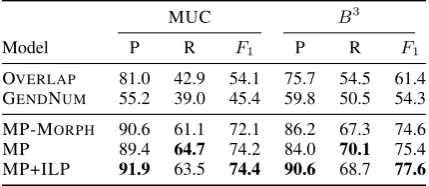
MUC B3
Model P R F1 P R F1
OVERLAP 81.0 42.9 54.1 75.7 54.5 61.4
[image:5.595.71.286.63.156.2]GENDNUM 55.2 39.0 45.4 59.8 50.5 54.3 MP-MORPH 90.6 61.1 72.1 86.2 67.3 74.6 MP 89.4 64.7 74.2 84.0 70.1 75.4 MP+ILP 91.9 63.5 74.4 90.6 68.7 77.6 Table 2: Coreference resolution performance.
Baselines. We compare the performance of our transitively coherent mention-pair model against two different baseline models. The OVERLAP base-line classifies two mentions as coreferent if they share at least one content word. The GENDNUM baseline links each mention to the closest preced-ing mention with which it matches in gender and number. Standard closest-first clustering (Soon et al., 2001) is applied for both baselines.
Results. We show the performance of our mention-pair model, both without (MP) and with (MP+ILP) enforcing transitivity, along with the performance of both baselines in Table 2. We eval-uate all models in terms of two standard evalua-tion measures for coreference resoluevalua-tion – MUC score andB3score. In order to evaluate the contri-bution of morphological features, we additionally evaluate the mention-pair model but excluding all features relying on morphological preprocessing (MP-MORPH).
Results show that the supervised mention-pair model significantly outperforms both reasonable rule-based baselines. When morphological features are not used, the model exhibits a slightly lower performance, although the difference is not sub-stantial. Enforcing transitivity in an ILP setting marginally improves the overall MUC score, but yields notable 2-point improvement inB3 score. Precision is consistently higher than recall for all models and both evaluation metrics, which is con-sistent with the coreference resolution results for other languages (Lee et al., 2011; Kobdani and Sch¨utze, 2011).
Overall, our results are over 10 points higher than the state-of-the-art performance for English (Lee et al., 2011) and comparable (higher MUC and lowerB3score) to the best results obtained for Polish (Kopec and Ogrodniczuk, 2012), suggesting that coreference resolution may be easier task for morphologically complex languages.
Error analysis. In an attempt to identify the most common types of errors, we manually an-alyzed the errors made by the supervised mention-pair model. The vast majority of false nega-tives originate from mention pairs where external knowledge is necessary for inferring coreference, e.g., ˇzeljezni kancelar(iron chancellor) and Bis-marck). Other common causes of false negatives include abbreviations, e.g.,DS andDemokratski savez(Democratic Alliance), and distant pronomi-nal anaphora (i.e., when an anaphoric pronoun is far away from its preceding coreferent mention). Most false positives stem from non-coreferent mentions with substantial lexical overlap, e.g.,
Druˇstvo hrvatskih knjiˇzevnika (Croatian Writers’ Association) andsveˇcanosti u Druˇstvu hrvatskih knjiˇzevnika(ceremonies at the Croatian Writers’ Association). A significant number of false posi-tives are due to a pronominal mention being close to some non-coreferent noun-phrase mention.
6 Conclusion
We presented the first coreference resolution model for Croatian. We built a supervised mention-pair model for recognizing identity coreference rela-tions between entity menrela-tions and augmented it with transitivity constraints enforced via ILP opti-mization. We demonstrated the effectiveness of the model by showing that it substantially outperforms two rule-based baselines. Enforcing transitivity improves theB3score.
Manual error analysis revealed that most errors are due to the lack of external knowledge necessary for inferring coreference. Thus, we plan to extend the model with knowledge-based features obtained from external knowledge sources like Wikipedia. Furthermore, as we currently use no syntactic in-formation, we intend to incorporate dependency relations as features.
In this work we focused on resolving identity coreference between gold event mentions. With the goal of building an end-to-end coreference res-olution system for Croatian, our future efforts will focus on the development of a mention detection model. We will also consider near-identity rela-tions like meronymy and zero anaphora.
Acknowledgments
References
Chinatsu Aone and Scott William Bennett. 1995. Evaluating automated and manual acquisition of anaphora resolution strategies. In Proceedings of the 33rd Annual Meeting on Association for Com-putational Linguistics, pages 122–129.
Sabine Bergler, Ren´e Witte, Michelle Khalife, Zhuoyan Li, and Frank Rudzicz. 2003. Using knowledge-poor coreference resolution for text sum-marization. InProceedings of the Document Under-standing Conference, pages 85–92.
Dennis Connolly, John D Burger, and David S Day. 1997. A machine learning approach to anaphoric reference. InNew Methods in Language Processing, pages 133–144.
Susan Converse. 2006. Pronominal Anaphora Resolu-tion in Chinese. Ph.D. thesis.
Hal Daum´e III and Daniel Marcu. 2005. A large-scale exploration of effective global features for a joint en-tity detection and tracking model. InProceedings of the conference on Human Language Technology and Empirical Methods in Natural Language Processing, pages 97–104.
Greg Durrett and Dan Klein. 2014. A joint model for entity analysis: Coreference, typing, and linking.
Transactions of the Association for Computational Linguistics, 2:477–490.
Barbara J Grosz, Aravind K Joshi, and Scott Weinstein. 1983. Providing a unified account of definite noun phrases in discourse. InProceedings of the 21st An-nual Meeting on Association for Computational Lin-guistics, pages 44–50.
Ryu Iida, Kentaro Inui, Hiroya Takamura, and Yuji Matsumoto. 2003. Incorporating contextual cues in trainable models for coreference resolution. In Pro-ceedings of the Conference of the European Chap-ter of the Association for Computational Linguistics (EACL ’03) Workshop on The Computational Treat-ment of Anaphora, pages 23–30.
Ryu Iida. 2007.Combining Linguistic Knowledge and Machine Learning for Anaphora Resolution. Ph.D. thesis.
Hamidreza Kobdani and Hinrich Sch¨utze. 2010. SU-CRE: A modular system for coreference resolution. InProceedings of the 5th International Workshop on Semantic Evaluation, pages 92–95.
Hamidreza Kobdani and Hinrich Sch¨utze. 2011. Su-pervised coreference resolution with SUCRE. In
Proceedings of the Fifteenth Conference on Compu-tational Natural Language Learning: Shared Task, pages 71–75.
Fang Kong and Guodong Zhou. 2010. A tree kernel-based unified framework for Chinese zero anaphora resolution. In Proceedings of the Conference on
Empirical Methods in Natural Language Processing, pages 882–891.
Mateusz Kopec and Maciej Ogrodniczuk. 2012. Cre-ating a coreference resolution system for Polish. In
LREC, pages 192–195.
Heeyoung Lee, Yves Peirsman, Angel Chang, Nathanael Chambers, Mihai Surdeanu, and Dan Jurafsky. 2011. Stanford’s multi-pass sieve corefer-ence resolution system at the CoNLL-2011 shared task. InProceedings of the Fifteenth Conference on Computational Natural Language Learning: Shared Task, pages 28–34.
Nguy Giang Linh, V´aclav Nov´ak, et al. 2009. Com-parison of classification and ranking approaches to pronominal anaphora resolution in Czech. In Pro-ceedings of the 10th Annual Meeting of the Special Interest Group on Discourse and Dialogue, pages 276–285.
Xiaoqiang Luo and Imed Zitouni. 2005. Multilingual coreference resolution with syntactic features. In
Proceedings of the Conference on Human Language Technology and Empirical Methods in Natural Lan-guage Processing, pages 660–667.
Malgorzata Marciniak. 2002. Anaphor binding for Pol-ish. InProceedings of the 4th Discourse Anaphora and Anaphor Resolution Colloquium.
Katja Markert, Malvina Nissim, and Natalia Modjeska. 2003. Using the web for anaphora resolution. In
Proceedings of the 10th Conference of the European Chapter of the Association for Computational Lin-guistics (EACL ’03) Workshop on the Computational Treatment of Anaphora, pages 39–46.
Ireneusz Matysiak. 2007. Information extraction systems and nominal anaphora analysis needs. In
Proceedings of the International Multiconference on Computer Science and Information Technology, pages 183–192.
Andrew McCallum and Ben Wellner. 2003. Toward conditional models of identity uncertainty with ap-plication to proper noun coreference.
Joseph F McCarthy and Wendy G Lehnert. 1995. Us-ing decision trees for coreference resolution. In Pro-ceedings of the 14th International Joint Conference on Artificial Intelligence, pages 1050–1055.
Vincent Ng and Claire Cardie. 2002. Improving ma-chine learning approaches to coreference resolution. In Proceedings of the 40th Annual Meeting on As-sociation for Computational Linguistics, pages 104– 111.
Manuel Palomar, Antonio Ferr´andez, Lidia Moreno, Patricio Mart´ınez-Barco, Jes´us Peral, Maximiliano Saiz-Noeda, and Rafael Mu˜noz. 2001. An algo-rithm for anaphora resolution in Spanish texts. Com-putational Linguistics, 27(4):545–567.
Massimo Poesio, Olga Uryupina, and Yannick Versley. 2010. Creating a coreference resolution system for Italian. InLREC, pages 713–716.
Simone Paolo Ponzetto and Michael Strube. 2006. Exploiting semantic role labeling, wordnet and wikipedia for coreference resolution. In Proceed-ings of the Human Language Technology Confer-ence of the North American Chapter of the Associ-ation of ComputAssoci-ational Linguistics, pages 192–199.
Marta Recasens, Eduard H Hovy, and Maria Ant`onia Mart´ı. 2010. A typology of near-identity relations for coreference (NIDENT). In LREC, pages 149– 156.
Emili Sapena, Llu´ıs Padr´o, and Jordi Turmo. 2010. RelaxCor: A global relaxation labeling approach to coreference resolution. In Proceedings of the 5th International Workshop on Semantic Evaluation, pages 88–91.
Yusuke Shinyama and Satoshi Sekine. 2006. Preemp-tive information extraction using unrestricted rela-tion discovery. In Proceedings of the Human Lan-guage Technology Conference of the North Amer-ican Chapter of the Association of Computational Linguistics, pages 304–311.
Candace Lee Sidner. 1979. Towards a Computational Theory of Definite Anaphora Comprehension in En-glish Discourse. Ph.D. thesis.
Jan ˇSnajder, Bojana Dalbelo Baˇsi´c, and Marko Tadi´c. 2008. Automatic acquisition of inflectional lexica for morphological normalisation. Information Pro-cessing & Management, 44(5):1720–1731.
Wee Meng Soon, Hwee Tou Ng, and Daniel Chung Yong Lim. 2001. A machine learning ap-proach to coreference resolution of noun phrases.
Computational linguistics, 27(4):521–544.
Josef Steinberger, Massimo Poesio, Mijail Kabadjov, and Karel Jeˇzek. 2007. Two uses of anaphora reso-lution in summarization. Information Processing & Management, 43(6):1663–1680.
Yannick Versley. 2006. A constraint-based approach to noun phrase coreference resolution in German newspaper text. InIn Proceedings of Konferenz zur Verarbeitung Naturlicher Sprache, pages 143–150.
Jos´e Vicedo and Antonio Ferr´andez. 2000. Importance of pronominal anaphora resolution in question an-swering systems. InProceedings of the 38th Annual Meeting on Association for Computational Linguis-tics, pages 555–562.
Holger Wunsch. 2010. Rule-Based and Memory-Based Pronoun Resolution for German: A Compar-ison and Assessment of Data Sources. Ph.D. thesis, Universit¨at T¨ubingen.
Xiaofeng Yang, Jian Su, Jun Lang, Chew Lim Tan, Ting Liu, and Sheng Li. 2008a. An entity-mention model for coreference resolution with in-ductive logic programming. In ACL, pages 843– 851.
Xiaofeng Yang, Jian Su, and Chew Lim Tan. 2008b. A twin-candidate model for learning-based anaphora resolution. Computational Linguistics, 34(3):327– 356.
Zhiping Zheng. 2002. Answerbus question answer-ing system. InProceedings of the Second Interna-tional Conference on Human Language Technology Research, pages 399–404.
Valentin Zhikov, Georgi Georgiev, Kiril Simov, and Petya Osenova. 2013. Combining POS tagging, dependency parsing and coreferential resolution for Bulgarian. InRANLP, pages 755–762.