Submitted14 February 2018
Accepted 15 June 2018
Published11 July 2018
Corresponding author
Tri Arfianti, [email protected], [email protected], [email protected]
Academic editor
James Reimer
Additional Information and Declarations can be found on page 12
DOI10.7717/peerj.5187 Copyright
2018 Arfianti et al.
Distributed under
Creative Commons CC-BY 4.0 OPEN ACCESS
Progress in the discovery of amphipod
crustaceans
Tri Arfianti1,2, Simon Wilson3and Mark John Costello1
1Institute of Marine Science, University of Auckland, Auckland, New Zealand
2Research Center for Oceanography, Indonesian Institute of Sciences, Jakarta Utara, Indonesia 3Discipline of Statistics, Trinity College Dublin, Dublin, Ireland
ABSTRACT
At present, amphipod crustaceans comprise 9,980 species, 1,664 genera, 444 subfami-lies, and 221 families. Of these, 1,940 species (almost 20%) have been discovered within the last decade, including 18 fossil records for amphipods, which mostly occurred in Miocene amber and are probably all freshwater species. There have been more authors describing species since the 1950s and fewer species described per author since the 1860s, implying greater taxonomic effort and that it might be harder to find new amphipod species, respectively. There was no evidence of any change in papers per author or publication life-times of taxonomists over time that might have biased apparent effort. Using a nonhomogeneous renewal process model, we predicted that by the year 2100, 5,600 to 6,600 new amphipod species will be discovered. This indicates that about two-thirds of amphipods remain to be discovered which is twice the proportion than for species overall. Amphipods thus rank amongst the least well described taxa. To increase the prospect of discovering new amphipod species, studying undersampled areas and benthic microhabitats are recommended.
SubjectsBiodiversity, Taxonomy, Zoology
Keywords Amphipoda, Crustacea, Taxonomy, Biodiversity
INTRODUCTION
Research into the progress of species discovery is of great interest to determine how many species exist on Earth (Costello, 2016). Recent studies on species discovery indicate that about two-thirds of species on Earth have already been described, and show that increasing numbers of people have been describing species new to science (e.g.,Appeltans et al., 2012; Costello, May & Stork, 2013;Costello & Chaudhary, 2017). Thus, the present rate of species discovery is being sustained by an increasing number of taxonomists (both professional and amateur), and the relative number of species described per author has been decreasing for decades (e.g.,Appeltans et al., 2012;Costello, May & Stork, 2013). These findings indicate that species discovery is flourishing and contradict the view that species discovery and description is facing a crisis (Wheeler, 2004;Wilson, 2004). Regardless of debates about how many species remain to be discovered, there is consensus that the new extinction crisis makes species description urgent to understand life on Earth and use resources sustainably (Costello, May & Stork, 2013;Wheeler et al., 2012).
the age distribution of taxonomists, annual rates of new taxa during the careers of four taxonomists, and the most productive taxonomists with working status (having permanent positions or temporary contracts) were also presented. However, trends in subgroups across environments and lifestyles were not studied and these may indicate where new species are most likely to be discovered. In this work, we reviewed trends in species description across all, benthic, pelagic, marine, freshwater, and subterranean amphipods. We used a statistical model to predict the number of amphipod species remaining to be described and analyzed taxonomic effort indicators such as the proportion of ‘‘oncer’’ authors (only ever described one species), the number of single and multiple authorship species, and authors’ publication lifetime and productivity. Although taxonomic effort has been increasing, the proportion of species remaining to be discovered is double that for all species on Earth. Amphipods are thus amongst the least well-known taxa globally.
METHODS
Data source
Our analysis was based on the world list of amphipod crustaceans in the World Register of Marine Species (WoRMS) (Horton et al., 2016) as recorded on 3rd November 2016. We presented the results of the analysis for all species as well as for marine, freshwater, subterranean, benthic and pelagic species. We classified species as benthic and pelagic based on literature (Barnard, 1969;Bousfield, 1987;Brusca, 1967;Brusca, 1973;Lowry & Myers, 2009;Pillai, 1957;Streets, 1878;Vinogradov, 1988;Vinogradov, 1990). Only species names with accepted status and those that had been checked by the taxonomic editor were analyzed to avoid the over-estimation of the actual number of known species. Species described byChevreux (1919–1920)were counted as species described in 1919.
Taxonomic effort
The number of authors is an indicator of taxonomic effort which may influence the rate of description. However, it could be biased by changing authorship practices whereby species are increasingly described by two or more authors. Thus, only the surname of the first author was considered to minimize estimates of effort. Dissimilar names or spelling variants (e.g., Kröyer and Krøyer) for the same author were corrected and counted as the same author. It was assumed that the number of authors with the same surnames at the same time were negligible and random over time (Costello, Wilson & Houlding, 2012). As the changes in description effort reflect the changes in taxonomic citation practices, we also analysed trends in the number of multiple and single authorships.
amphipods species described, and the first year of an author’s publication. Non-amphipod species description data were gained through the advanced search feature on WoRMS and only non-amphipod species with accepted status were included. As WoRMS is primarily marine species it is possible that authors also described some non-marine species we have not accounted for.
An author’s publication lifetime was calculated as the number of years between their first and most recent species described. If authors’ publication lifetimes have been decreasing over time this may suggest a decrease in the number of amphipod specialists. Accordingly, we provided the linear regression on the publication lifetime against species per year for all authors either including or excluding Dybowsky (who described 97 species in one year).
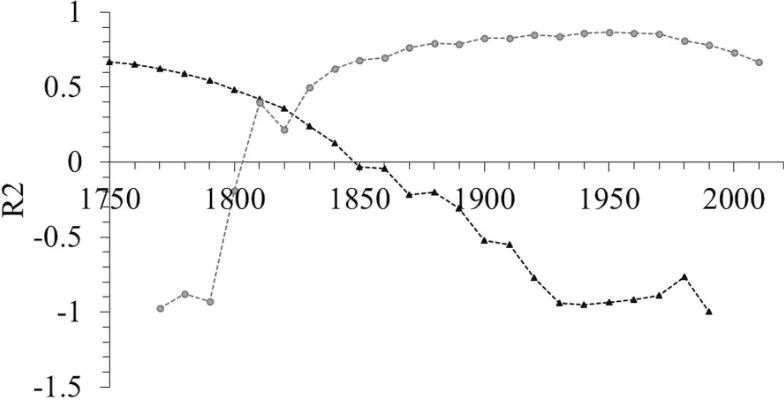
We counted the number of species described per number of authors in a year. In the early years of discovery, it is easy for authors to find and name new species. After this period, it becomes more difficult and the proportion of species described per number of authors decline. FollowingCostello, Wilson & Houlding (2012); andCostello, May & Stork (2013), we used Muggeo’s (2003,2008) method to determine the breakpoint between the increasing and decreasing number of species described per author in the time series.
We analysed whether families and genera which were described first had more species than those newly described by running a simple linear regression analysis between the ages of family against number of species in each family and the age of genus against number of species in each genus. The ratio of species to genera depend strongly on the number of species available and is expected to increase with discoveries overtime. Therefore, we depicted the trend in the number of genera described and the number of species per genus described. The Non-Homogenous Renewal Process (NHRP) was fitted to the description data to make predictions of numbers of amphipod species to be described by 2050 and 2100 by the following equation:
Number discovered by yeart= N
1+exp(−Nβ(t−α)).
The parameters of the function were:N, the total number of species to be discovered;α, the year of the maximum rate of discovery; andβwhich describes the overall rate of discovery, with a largerβimplying a faster rate (Costello & Wilson, 2011;Wilson & Costello, 2005).
RESULTS
In total, 9,980 accepted names of marine, brackish, freshwater and terrestrial amphipods species were described from 1758 to 2016. There were 221 families, 86 subfamilies, and 1,674 genera. The number of non-accepted species names was 3,332 or 25% of all 13,312 names (Table 1). There were 18 fossil amphipod species discovered up to the year 2016, all of them attributed either to the family Gammaridae or Pontogammaridae, and at least 14 were from the freshwater environment (Table 2). The top-five species-rich genera were
Table 1 Currently valid and non-valid amphipod families, genera, infraorders, species and subfami-lies.
Taxonomy status Infraorder Family Subfamily Genus Species
Accepted 8 221 86 1,674 9,980
Non-accepted:
-Alternate representation 0 0 2 3 58
-Interim unpublished 0 0 0 0 2
-Nomen dubium 0 0 0 1 83
-Nomen nudum 0 0 0 1 25
-Taxon inquirendum 0 0 0 0 6
-Temporary name 0 1 0 5 25
-Unaccepted 3 20 8 210 3,133
Total non-accepted 3 21 10 220 3,332
Total data 11 242 96 1,894 13,312
Table 2 Documented fossil occurrences of 18 amphipod species.
Scientific name Authority Year of
description
Environment Occurrence
Palaeogammarus sambiensis Zaddach 1864 Freshwater Eocene-Oligocene Baltic amber
Gammarus oeningensis Heer 1865 Freshwater Miocene amber
Hellenis saltatorius Petunnikov 1914 Freshwater Miocene amber
Gammarus alsaticus Van Straelen 1924 Freshwater Miocene amber
Praegmelina archangelskii Derzhavin 1927 Freshwater Miocene amber
Andrussovia bogacevi Derzhavin 1927 Freshwater Miocene amber
Andrussovia sokolovi Derzhavin 1927 Freshwater Miocene amber
Praegmelina andrussovi Derzhavin 1927 Freshwater Miocene amber
Palaeogammarus balticus Lucks 1928 Freshwater Eocene-Oligocene Baltic amber
Andrussovia vassolevitschi Derzhavin 1941 Freshwater Miocene amber
Gammarus praecyrius Derzhavin 1941 Probably freshwater Miocene amber
Gammarus retzi Maikovsky 1941 Probably freshwater Miocene amber
Palaeogammarus danicus Just 1974 Freshwater Eocene-Oligocene Baltic amber
Tethorchestia palaeorchestes Bousfield & Poinar Jr. 1995 Terrestrial
Niphargus groehni Coleman & Myers 2001 Freshwater Eocene-Oligocene Baltic amber
Palaeogammarus polonicus Jażdżewski & Kulicka 2002 Freshwater Eocene-Oligocene Baltic amber
Palaeogammarus debroyeri Jażdżewski, Grabowski & Kupryjanowicz 2014 Freshwater Eocene-Oligocene Baltic amber
Synurella aliciae Jażdżewski, Grabowski & Kupryjanowicz 2014 Freshwater Eocene-Oligocene Baltic amber
Progress in species descriptions
[image:4.612.38.578.319.592.2]Table 3 The 35 families with the most species, their number of genera and the year of description of the first and last species as perHorton et al. (2016).
Rank Family Number of
species Number of genera First species described (Year) Last species described (Year)
1 Lysianassidae 536 82 1830 2015
2 Caprellidae 425 90 1767 2016
3 Gammaridae 414 34 1758 2016
4 Niphargidae 377 10 1836 2016
5 Phoxocephalidae 369 79 1842 2015
6 Maeridae 367 47 1808 2016
7 Talitridae 316 72 1766 2016
8 Ampeliscidae 302 4 1840 2013
9 Stenothoidae 279 45 1815 2015
10 Ischyroceridae 264 43 1808 2014
12 Aoridae 250 25 1843 2016
11 Oedicerotidae 250 46 1842 2014
13 Crangonyctidae 226 7 1840 2016
14 Photidae 225 17 1828 2016
15 Ampithoidae 216 16 1816 2016
16 Leucothoidae 179 5 1789 2015
17 Melitidae 175 26 1804 2016
18 Uristidae 171 24 1774 2014
19 Pontogeneiidae 168 32 1838 2014
21 Corophiidae 158 26 1761 2016
20 Hyalidae 158 12 1830 2016
22 Pleustidae 141 33 1838 2009
23 Dexaminidae 125 12 1813 2016
24 Acanthogammaridae 122 34 1858 2002
25 Liljeborgiidae 119 2 1853 2012
26 Eusiridae 116 10 1780 2015
27 Bogidiellidae 113 37 1933 2016
28 Eulimnogammaridae 112 16 1858 2014
29 Stegocephalidae 109 27 1774 2012
30 Synopiidae 108 17 1853 2013
31 Iphimediidae 105 15 1843 2014
32 Calliopiidae 104 27 1830 2014
33 Hadziidae 91 27 1907 2016
34 Amphilochidae 90 15 1862 2016
35 Podoceridae 89 8 1814 2016
description of subterranean species was later than for marine and freshwater environments, with most species described since the late 18th century (Fig. 1D).
Table 4 The age of families consisting of one species (monotypic families).
Family Age (Year) Species
Argissidae 147 Argissa hamatipes(Norman, 1869) Baikalogammaridae 142 Baikalogammarus pullus(Dybowsky, 1874) Dairellidae 131 Dairella californica(Bovallius, 1885) Giniphargidae 117 Giniphargus pulchellus(Sayce, 1899) Prolanceolidae 109 Prolanceola vibiliformisWoltereck, 1907 Tryphanidae 145 Tryphana malmiiBoeck, 1871
Figure 1 Accumulation curves of amphipod species described per year.(A) all accepted, (B) benthic (gray circles) and pelagic (black triangles), (C) marine (gray circles) and freshwater (black triangles), and (D) subterranean up to the year 2016. Note scales vary.
Full-size DOI: 10.7717/peerj.5187/fig-1
described had been declining since the 1890s (Fig. 2B). Overall, the average number of species described per year was 48 (95% confidence interval 41–54).
Using the nonhomogeneous renewal process model, with 95% probability, we predicted that by 2050 and 2100, there would be 2,900–3,300 and 5,600–6,600 more amphipod species to be described with the median prediction of 3,100 and 6,100, respectively (Fig. 3).
Figure 2 The number of amphipod species described per year.(A) all species, (B) benthic (dotted line) and pelagic (solid line), (C) marine (dotted line) and freshwater (solid line), and (D) subterranean up to the year 2016. Solid triangles indicate top three years for species described. The lines are 10-year moving averages.
Full-size DOI: 10.7717/peerj.5187/fig-2
Authors as an indicator of taxonomic effort
The trend in amphipod discovery above might be due to the increasing number of ‘‘oncers,’’ people who only describe one species. However, we found no trend in the proportion of oncers for more than one century and in the recent decade the highest proportion of ‘‘oncers’’ was only 35% (Fig. 6). Also, the skewness values were positive and were around 1.0 with an exception in the 1990s, which had high skewness (Fig. S1). Furthermore, it appears that ‘‘non-oncers’’ authors were responsible for almost all the new species descriptions (98%) since the 1850s, whereas ‘‘oncers’’ authors described only 2% of species.
At the beginning of amphipod species descriptions in the 1750s, single authorship was the norm. Multiple authorship emerged more than 100 years later in the 1860s. Since the 1950’s the number of multiple authorships has been increasing (Fig. 7).
Among the 638 people involved in describing amphipod species from 1758 to 2016, 26 people described more than 90 species which we considered to be the most prolific authors (Table S1). We found that the average publication lifetime of all authors was nine years. However, there was no significant trend (R2<0.1,P>0.05) in authors’ publication lifetimes over years for all authors, whether Dybowsky (who described 97 species in one year) was included or not (Fig. S2). Thus, there is no evidence of any change in author productivity since the 1850’s.
Figure 3 The cumulative number of amphipod species described over time (red line), with the pre-dicted number of species based on the number of species described by 2050 and 2100.
Full-size DOI: 10.7717/peerj.5187/fig-3
There was no significant relationship (R2=0.0003,P>0.05) between the number of
amphipod and non-amphipod species described by the most prolific authors (Fig. S5A). However, there was a weak but significant relationship (R2=0.16,P<0.05) in the number
of non-amphipod species described with the first year of an author’s publication (Fig. S5B) indicating that recent authors are describing fewer non-amphipods.
DISCUSSION
Species description rates
Figure 4 The number of first authors (solid line) and species/author (dotted line) of amphipod species described.(A) all species, (B) benthic, (C) pelagic, (D) marine, (E) freshwater, and (F) subterranean per year up to the year 2016. The lines are three-year moving averages.
Full-size DOI: 10.7717/peerj.5187/fig-4
the past century is likely because pelagic species are more geographically widespread than benthic and thus are described earlier (Costello et al., 2015). The peak in the number of pelagic species described in 1879 was due to the contribution of a single author, Claus, who published three new genera and 29 new hyperiid amphipod species (Claus, 1879).
The nonhomogeneous renewal process model predicted that about one third of the described species would be described by 2050, and two-thirds more by 2100. These findings contrast with findings for all species on Earth and all marine species using the same model (Appeltans et al., 2012;Costello, Wilson & Houlding, 2012), and other assessments using proportions of undescribed species (Appeltans et al., 2012) and expert assessments (reviewed byCostello & Chaudhary, 2017). In these other cases, at least half and sometimes 80% of species are considered to have been described, and about two-thirds overall. Thus, amphipods appear to be only half as well described as other taxa.
Figure 5 Change in the correlation coefficient of the number of all amphipod species described per au-thor over 25 decades indicating the breakpoint was around 1820.The grey dots indicate the correlation coefficients between the most recent decade and each previous decade. In contrast, the black triangles are the correlation coefficients between the first and each subsequent decade.
Full-size DOI: 10.7717/peerj.5187/fig-5
Figure 6 The proportion of authors who described only one species (‘‘oncers’’) per decade, up to the year 2016.The lines are three-year moving averages.
Full-size DOI: 10.7717/peerj.5187/fig-6
Stoddart & Lowry, 2012). Twenty-four new species of leucothoids from Japan (White & Reimer, 2012a;White & Reimer, 2012b; White & Reimer, 2012c) and six new species of
[image:10.612.185.535.372.578.2]Figure 7 The number of amphipod species described with one (triangle) and multiple (circle) authors. Full-size DOI: 10.7717/peerj.5187/fig-7
described later indicates that the major evolutionary lineages of amphipods have already been described. Thus, new species tend to be from already known families and genera.
Taxonomic effort
The increased number of people involved in describing species indicated increased taxonomic effort. Other studies have similarly reported the increasing trend in taxonomic effort (e.g., Costello, Wilson & Houlding, 2012; Costello, May & Stork, 2013; Costello, Houlding & Wilson, 2014; Costello et al., 2015; Essl et al., 2013;Irfanullah, 2013) which must have contributed to the sustained high number of species described (Appeltans et al., 2012). We found no change in skewness (of papers per author per year) over the past century, and that the percentage of ‘‘oncers’’ had not shown any trend in the past century and the largest proportion of ‘‘oncers’’ was only 35%. This ratio was lower than reported in previous research (42%–44%,Appeltans et al., 2012). Neither was there any significant trend in authors’ publication lifetimes or productivity of the 26 most prolific authors over time. By only using first authors we avoided any bias due to increasing multiple-authorships of species in recent decades. However, such co-authors are often first authors on other species, so our results will underestimate rather than overestimate the number of active authors of new species. Thus, there was no evidence of any change in author productivity that may affect description rates. The same results have also been reported for other taxa (Costello, Wilson & Houlding, 2012;Eschmeyer et al., 2010;Joppa, Roberts & Pimm, 2011;Pimm et al., 2010). Another measure of taxonomic productivity is the number of publications, and this is highly correlated with the number of authors per species (Edie, Smits & Jablonski, 2017).
Luksenburg, 2015). However, these factors are likely compensated by the efficiency of the latest technology (Eschmeyer et al., 2010), the availability of reputable online database such as WoRMS to check the status of a species, the online availability of original descriptions from the Biodiversity Heritage Library, and greater ease of communication, transportation and improvement in sampling methods (Costello, Wilson & Houlding, 2012;Costello, May & Stork, 2013). For amphipods particularly, there is an extensive taxonomic character database (DELTA) and new techniques on amphipod descriptions initiated byColeman (2003),Coleman (2006),Coleman (2009)andColeman, Lowry & Macfarlane (2010), that provide more efficient ways of digital drawing for publication. We found that working on other taxa did not affect the number of amphipod species described. Also, we found that recent authors are having fewer non-amphipods described; thus there is no evidence of authors being distracted from working on amphipods.
CONCLUSIONS
Our results support previous studies on species description rates in finding increasing numbers of authors, a decreasing rate of species being described per authors, no changes in the relative productivity of authors over the past century, and that pelagic species are relatively better named than benthic. Most future new species are likely to be benthic and endemic, and from already known families and genera. However, we also find that two-thirds of amphipod species remain to be described, double the proportion of most other taxa, whether marine or terrestrial.
ACKNOWLEDGEMENTS
We thank Joko Pamungkas, Junita Duwi Purwandari, Danny McDougall, Chhaya Chaudhary, Irawan Asaad, Han-Yang Lin, Dinusha Jayathilake and Qianshuo Zhao for helpful discussion and tips regarding analyses.
ADDITIONAL INFORMATION AND DECLARATIONS
Funding
This work was supported by the New Zealand ASEAN Scholarships (NZAS) for the scholarship awarded to Tri Arfianti to study for a Ph.D. at the University of Auckland. The funders had no role in study design, data collection and analysis, decision to publish, or preparation of the manuscript.
Grant Disclosures
The following grant information was disclosed by the authors: New Zealand ASEAN Scholarships (NZAS).
Competing Interests
Author Contributions
• Tri Arfianti and Simon Wilson conceived and designed the experiments, performed the
experiments, analyzed the data, contributed reagents/materials/analysis tools, prepared figures and/or tables, authored or reviewed drafts of the paper, approved the final draft.
• Mark John Costello conceived and designed the experiments, performed the experiments,
analyzed the data, contributed reagents/materials/analysis tools, authored or reviewed drafts of the paper, approved the final draft.
Data Availability
The following information was supplied regarding data availability:
Arfianti, Tri; Wilson, Simon; Costello, Mark (2018): WoRMS_Amphipoda_RawData.xlsx. figshare. Dataset.https://doi.org/10.17608/k6.auckland.6213965.v1.
Supplemental Information
Supplemental information for this article can be found online athttp://dx.doi.org/10.7717/ peerj.5187#supplemental-information.
REFERENCES
Appeltans W, Ahyong ST, Anderson G, Angel MV, Artois T, Bailly N,
Błażewicz-Paszkowycz M. 2012.The magnitude of global marine species diversity.Current
Biology2223:2189–2202DOI 10.1016/j.cub.2012.09.036.
Barnard JL. 1969.The families and genera of marine gammaridean Amphipoda.
Washing-ton D.C.: Smithsonian Institution Press.
Bousfield EL. 1987.Amphipod parasites of fishes of Canada.Canadian Bulletin of
Fisheries and Aquatic Sciences217:1–37.
Brusca GJ. 1967.The ecology of pelagic Amphipoda I species accounts vertical zonation
and migration of Amphipoda from the waters off southern California.Pacific Science
21:382–393.
Brusca GJ. 1973.Pelagic Amphipoda from the waters near Oahu Hawaii excluding the
family Scinidae.Pacific Science27:8–27.
Chevreux E. 1919–1920.Note préliminaire sur les amphipodes recueillis par les
ex-péditions du Travailleur et du Talisman 1880–1883.Bulletin du Muséum national d’Histoire naturelle Paris257:574–580.
Claus C. 1879.Die Gattungen und Arten der Platysceliden in Systematischer Übersicht.
Arbeiten aus dem Zoologischen Institut der Universität zu Wien2:147–198.
Coleman CO. 2003.‘‘Digital inking’’: how to make perfect line drawings on computers.
Organisms Diversity & Evolution34:303–304DOI 10.1078/1439-6092-00081.
Coleman CO. 2006.Substituting time-consuming pencil drawings in arthropod
taxon-omy using stacks of digital photographs.Zootaxa13601:61–68.
Coleman CO. 2009.Drawing setae the digital way.Mitteilungen aus dem Museum für
Coleman CO. 2015.Taxonomy in times of the taxonomic impediment—examples from the community of experts on amphipod crustaceans.Journal of Crustacean Biology
356:729–740DOI 10.1163/1937240X-00002381.
Coleman CO, Lowry JK, Macfarlane T. 2010.DELTA for beginners. An introduction
into the taxonomy software package DELTA.ZooKeys45:1–75
DOI 10.3897/zookeys.45.263.
Costello MJ. 2016.Parasite rates of discovery, global species richness and host specificity.
Integrative and Comparative Biology56(4):588–599DOI 10.1093/icb/icw084.
Costello MJ, Chaudhary C. 2017.Marine biodiversity biogeography deep-sea gradients
and conservation.Current Biology2711:R511–R527DOI 10.1016/j.cub.2017.04.060.
Costello MJ, Houlding B, Wilson S. 2014.As in other taxa relatively fewer beetles are
being described by an increasing number of authors: response to Löbl and Leschen.
Systematic Entomology393:395–399DOI 10.1111/syen.12068.
Costello MJ, Lane M, Wilson S, Houlding B. 2015.Factors influencing when species are
first named and estimating global species richness.Global Ecology and Conservation
4:243–254DOI 10.1016/j.gecco.2015.07.001.
Costello MJ, May RM, Stork NE. 2013.Can we name earth’s species before they go
extinct?Science339:413–416 DOI 10.1126/science.1230318.
Costello MJ, Wilson SP. 2011.Predicting the number of known and unknown species
in European seas using rates of description.Global Ecology and Biogeography
202:319–330DOI 10.1111/j.1466-8238.2010.00603.x.
Costello MJ, Wilson S, Houlding B. 2012.Predicting total global species richness using
rates of species description and estimates of taxonomic effort.Systematic Biology
615:871–883DOI 10.1093/sysbio/syr080.
Edie SM, Smits PD, Jablonski D. 2017.Probabilistic models of species discovery and
biodiversity comparisons.Proceedings of the National Academy of Sciences of the United States of America11414:3666–3671DOI 10.1073/pnas.1616355114.
Eschmeyer WN, Fricke R, Fong JD, Polack DA. 2010.Marine fish diversity: history of
knowledge and discovery Pisces.Zootaxa25251:19–50.
Essl F, Rabitsch W, Dullinger S, Moser D, Milasowszky N. 2013.How well do we
know species richness in a well-known continent? Temporal patterns of endemic and widespread species descriptions in the European fauna.Global Ecology and Biogeography 221:29–39DOI 10.1111/j.1466-8238.2012.00787.x.
Frank JH, Curtis GA. 1979.Trend lines and the number of species of Staphylinidae.The
Coleopterists’ Bulletin33:133–149.
Horton T, Lowry J, De Broyer C, Bellan-Santini D, Coleman CO, Corbari L, Daneliya M, Dauvin JC, Fišer C, Gasca R, Grabowski M, Guerra-García JM, Hendrycks E, Hughes L, Jaume D, Jazdzewski K, Kim YH, King R, Krapp-Schickel T, LeCroy S, Lörz AN, Mamos T, Senna AR, Serejo C, Sket B, Souza-Filho JF, Tandberg AH, Thomas J, Thurston M, Vader W, Väinölä R, Vonk R, White K, Zeidler W. 2016.
World Amphipoda database. Amphipoda.Available athttp:// www.marinespecies.org/
Irfanullah HM. 2013.Plant taxonomic research in Bangladesh 1972–2012: a critical re-view.Bangladesh Journal of Plant Taxonomy20(2):267–279
DOI 10.3329/bjpt.v20i2.17404.
Joppa LN, Roberts DL, Pimm SL. 2011.How many species of flowering plants are there?
Proceedings of the Royal Society of London B: Biological Sciences278(1705):554–559
DOI 10.1098/rspb.2010.1004.
Just J. 2012.SiphonoecetiniJust 1983 Crustacea Amphipoda Ischyroceridae 10:
Belkginoe-cetesgen novTropicoecetesgen nov andRhinoecetesJust 1983 from north-eastern and northern Australian shallow water with eight new species.Zootaxa35281:1–28.
Lowry JK, Myers AA. 2009.Benthic Amphipoda crustacea: peracarida of the great barrier
reef.Zootaxa2260(16):1–930.
Lowry JK, Stoddart HE. 2012.Australian and South African conicostomatine amphipods
Amphipoda: Lysianassoidea: Lysianassidae: Conicostomatinae subfam nov.Zootaxa
32481:43–65.
Muggeo VM. 2003.Estimating regression models with unknown break-points.Statistics
in Medicine2219:3055–3071DOI 10.1002/sim.1545.
Muggeo VM. 2008.Segmented: an R package to fit regression models with broken-line
relationships.R News81:20–25.
O’Dor R, Boustany AM, Chittenden CM, Costello MJ, Moustahfid H, Payne J, Steinke
D, Stokesbury MJW, Vanden Berghe E. 2012.A census of fishes and everything they
eat: how the census of marine life advanced fisheries science.Fisheries379:398–409.
Pillai NK. 1957.Pelagic crustacea of Travancore: 3 Amphipoda.Bulletin of the Central
Research Institute Uni Travancore5:29–68.
Pimm SL, Jenkins CN, Joppa LN, Roberts DL, Russell GJ. 2010.How many endangered
species remain to be discovered in Brazil.Natureza & Conserva¸cão81:71–77
DOI 10.4322/natcon.00801011.
Poulin R, Presswell B. 2016.Taxonomic quality of species descriptions varies over time
and with the number of authors but unevenly among parasitic taxa.Systematic Biology656:1107–1116DOI 10.1093/sysbio/syw053.
Ren XQ. 2012.Fauna Sinica. Invertebrata vol. 43, Crustacea Amphipoda Gammaridea (2).
Beijing: Science Press.
Rodman JE, Cody JH. 2003.The taxonomic impediment overcome: NSF’s
partner-ships for enhancing expertise in taxonomy PEET as a model.Systematic Biology
523:428–435DOI 10.1080/10635150390197055.
Sangster G, Luksenburg JA. 2015.Declining rates of species described per taxonomist:
slowdown of progress or a side-effect of improved quality in taxonomy?Systematic Biology641:144–151DOI 10.1093/sysbio/syu069.
Stoddart HE, Lowry JK. 2012.Revision of the lysianassoid genera Acidostoma and
Shackletonia Crustacea: Amphipoda: Acidostomatidae fam nov.Zootaxa33071:1–34.
Streets TH. 1878.Pelagic Amphipoda.Proceedings of the Academy of Natural Sciences of
Philadelphia30:276–290.
Vinogradov GM. 1988.Life forms of pelagic amphipods.Zoologichesky Zhurnal
Vinogradov GM. 1990.Pelagic amphipods Amphipoda Crustacea from the south-eastern Pacific.Akademija Nauk SSSR Trudy Instituta Okeanologii124:27–104.
Wheeler QD. 2004.Taxonomic triage and the poverty of phylogeny.Philosophical
Transactions of the Royal Society of London B: Biological Sciences359:571–583
DOI 10.1098/rstb.2003.1452.
Wheeler QD, Knapp S, Stevenson DW, Stevenson J, Blum SD, Boom BM, Donoghue
MJ. 2012.Mapping the biosphere: exploring species to understand the origin
organization and sustainability of biodiversity.Systematics and Biodiversity101:1–20
DOI 10.1080/14772000.2012.665095.
White KN, Reimer JD. 2012a.Commensal Leucothoidae Crustacea Amphipoda of
the Ryukyu Archipelago Japan Part I: ascidian-dwellers.ZooKeys163:13–55
DOI 10.3897/zookeys.163.2003.
White KN, Reimer JD. 2012b.Commensal Leucothoidae Crustacea Amphipoda
of the Ryukyu Archipelago Japan Part II: sponge-dwellers.ZooKeys166:1–58
DOI 10.3897/zookeys.166.2313.
White KN, Reimer JD. 2012c.Commensal Leucothoidae Crustacea Amphipoda of
the Ryukyu Archipelago Japan Part III: coral rubble-dwellers.ZooKeys173:11–50
DOI 10.3897/zookeys.173.2498.
Wilson EO. 2004.Taxonomy as a fundamental discipline.Philosophical
Transac-tions of the Royal Society of London B: Biological Sciences359(1444):739–739
DOI 10.1098/rstb.2003.1440.
Wilson SP, Costello MJ. 2005.Predicting future discoveries of European marine species