D S Sharma, R Sangal and E Sherly. Proc. of the 12th Intl. Conference on Natural Language Processing, pages 65–70, Trivandrum, India. December 2015. c2015 NLP Association of India (NLPAI)
Compositionality in Bangla Compound Verbs and their Processing in
the Mental Lexicon
Tirthankar Dasgupta
1TCS Innovation Lab,
New Delhi
[email protected]
Manjira Sinha
1Xerox Research Center
In-dia, Bangalore
[email protected]
Anupam Basu
Department of Computer
Science and Engineering,
IIT Kharagpur
[email protected]
Abstract
We conduct a cross-modal priming exper-iment to determine the mental representa-tion and access strategies for compound verbs (CV) in Bangla. Analysis of reac-tion time indicates that composireac-tionality among CVs triggers priming effects for both the constituent verbs. On the other hand non-compositional CVs exhibit priming only for the polar verb. Thus, compositional CVs are decomposed into their constituent verbs during processing. On the other hand, non-compositional verb phrases are represented and accessed as a whole in the minds of a Bangla speaker. The reaction time data thus col-lected are used to evaluate our vector space model for compositionality judg-ment.
1
Introduction
The term compositionality refers to the idea that the meaning of a complex expression is derived from (i) its structure and (ii) the meanings of its constituents (refer to (Fodor and Pylyshyn, 1988) for details). Compound verbs (henceforth CV) in Bangla are known to exhibit continuum of com-positionality. Thus, some of them are composi-tional (khete bashA “sit to eat”), some are non-compositional (jAliye mArA “to irritate”) and some in between (ghure berAno “loitering”).
There is a considerable linguistic debate on whether CVs are considered as two distinct words connected by some syntagmatic rule or whether
1 Work done during the tenure at IIT Kharagpur.
they form a single lexical unit (Paul, 2010; Chakrabarti et al., 2008; Butt, 1995) and whether semantic compositionality plays any role decid-ing the above. These ldecid-inguistically and computa-tionally challenging issues play an important role in developing lexical resources like WordNet (Fellbaum, 2010).
Since, none of the linguistic arguments and computational approaches has so far led to any consensus, we here for the first time performed a series of psycholinguistic experiments on Bangla compound verbs to study and model how the men-tal lexicon(ML), organize and process such com-plex expressions. The term mental lexicon refers to the storage of words in the human mind (Aitchison, 2005). A clear understanding of the structure and processing mechanism of CVs in the ML may provide us insight about how to repre-sent and process CVs in computational lexicons. Further, the reaction time of the subjects for rec-ognizing various lexical items under appropriate conditioning may lead us to develop more robust computational models of automatic identification of CVs.
A plethora of works have been done to explore the representation and processing of words in the mental lexicon (refer to Seidenberg, 2012 to get a detail account of it). Attempts have also been made to study the processing of Bangla deriva-tionally suffixed morphologically complex words (Dasgupta et al., 2010; Dasgupta et al., 2012, 2014) and Bangla compound words (Dasgupta et al., 2015). However, to the best of our knowledge
no such prior attempts have been made to psycho-linguistically analyze the representation and pro-cessing of the Bangla compound verbs.
Based on the above discussion, the objective of this paper is to explore the semantic composition-ality in Bangla CVs and its role in the possible organization and processing of CVs in the ML. Accordingly, we first use empirical techniques to collect user judgment of compositionality for Bangla CVs. Next, we perform the cross modal priming experiment to understand the processing of CVs ML. We found that Bangla CV exhibit continuum of compositionality. Highly composi-tional verb phrases V1V2 trigger significant prim-ing effect for both its constituent verbs V1 and V2. On the other hand, non-compositional verb se-quences exhibit priming effect only for V1. These observations together imply that the mental lexi-con decomposes compositional verb sequences into their constituent verbs and recognize sepa-rately during processing. On the other hand non-compositional verb sequences are organized and accessed as a whole. Based on the dataset col-lected from the above experiments, we further de-velop a vector space model to compute semantic compositionality in a verb sequence. The pre-dicted values are compared with the human judg-ment scores and the priming experijudg-ment results where a significant correlation is found.
2
Compositionality Judgments
We could not find any Bangla CV dataset publicly available and annotated in terms of composition-ality. Thus, we choose 300 verb sequences and presented them to 36 native Bangla speakers. Similar to the work discussed in (Reddy et al., 2011), we request each subject to give composi-tionality score of the verb sequences by asking a) how literal the verb phrase is in a given context and b) how literal the constituent verbs are. Sub-jects were asked to rate the compositionality un-der 1-10 point scale, 10 being highly composi-tional and 1 for non-composicomposi-tional. In order to validate the user annotated data, we compute the inter-annotator agreement using the Fleiss Kappa measure (Fleiss et al., 1981). We found an agree-ment of 𝜅= 0.68.
3
The Priming Experiment
Priming effects are observed because of the way our brain is supposed to function. Presentation of a stimulus (say a word P) activates a group of neu-rons (often called a functional web) in the brain.
When another stimulus (say word T) is then pre-sented to the individual within a short duration, the recognition of T is faster if the functional web of T shares a lot of neurons with that of P. This fast reaction time to recognize a stimulus due to the prior exposure to a functionally related stimu-lus is known as priming (Tulving et al., 1982). Thus, through priming experiments, we can iden-tify word pairs whose functional webs have a stronger overlap, which in turn reveals how brain organizes the words in the mental lexicon (See (Pulvermüller, 2003; Spivey et al., 2012) for a de-tailed account of such phenomena and different types of priming techniques).
Experiment design: We conduct the cross-modal repetition priming experiments as de-scribed in (Marslen-Wilson et al., 1994). Here, a subject gets an audio stimulus (called prime (P)) of a verb sequence V1V2 and immediately at the offset of the spoken prime, gets a visual represen-tation of the target (T) word V1. The same audio stimulus is presented to the subject after a random number of trials with the target V2. Based on the auditory prime and the visual target probe, the subjects are asked to decide whether the visually presented target V1 or V2 is a valid word in the language. The above experiment is also repeated with the same target words but with different au-ditory inputs called the controls(C). The control verb sequences do not have any relatedness with the targets. For example, “kheye felo” (complete eating) and “khAOyA” (to eat) or “kheye felo” and “felo” (to drop) are P-T pairs, for which the corresponding C-T pair could be “niye jAO” (take away) and “khAOyA” (to eat). The time taken by a subject to complete the lexical decision task af-ter the visual presentation of the target is defined as the response time (RT). For both the experi-ments, RTs of all the targets were recorded and analyzed to observe priming effects.
Materials: The 300 verb pairs as discussed in section 2, are grouped into two classes highly compositional (C1) and non-compositional (C2). We randomly choose 30 V1V2 pairs from each class as primes. For each prime, we have two tar-gets V1 and V2, which makes 120 P-T pairs. Con-sequently, 120 C-T and 240 fillers (or non-words) have been chosen to restrict the subjects to apply any strategic guess during the experiment. Over-all, we have collected RTs for 480 word pairs in one experiment. A set of 10 P-T and C-T pairs were also collected for a practice session before the true experiments. However, the RTs of these practice pairs are not included in any analysis.
The experiment was conducted using the DMDX software tool that plays the auditory stimulus and then showed the visual probe for 200ms. Corre-sponding to each visual probe, subjects had 3000ms to perform the lexical decision after which the system presents the next audio stimu-lus. The subject performs the decision task by pressing either the “K”' key for a VALID word and “S”' for INVALID word. The system auto-matically records the RT, which in this case is the time between the onset of the visual probe and clicking of one of the buttons by the subject. The experiments were conducted on 36 native Bangla speakers; 29 of them have a graduate degree and 7 hold a post graduate degree. The age of the sub-jects varies between 25 to 35 years.
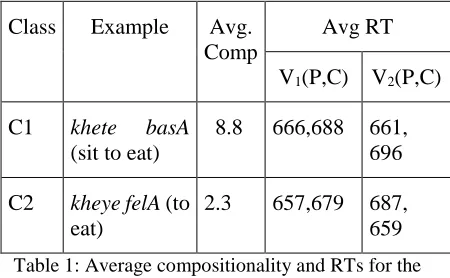
Results: The RTs with extreme values (>2000ms) and those for incorrect lexical deci-sions (about 3.2%) were excluded from the data. The raw RTs for all correct responses were in-versely transformed (Ratcliff, 1993) and entered into a mixed-design analysis of variance with two factors: priming (primed and unprimed), and con-dition (C1, C2). In the subject’s analysis (F1), condition and priming were treated as repeated measures. In the items analysis (F2), priming is treated as repeated factor and condition as inde-pendent factor. Table 1 summarizes the mean RTs for the prime (P) and control (C) sets of the V1 and V2 for the two classes.
Class Example Avg. Comp
Avg RT
V1(P,C) V2(P,C)
C1 khete basA (sit to eat)
8.8 666,688 661, 696
C2 kheye felA (to eat)
[image:3.612.79.304.437.576.2]2.3 657,679 687, 659
Table 1: Average compositionality and RTs for the different word classes
There was a strong main effect of priming with faster RTs to primed (667ms for V1 and 687ms for V2) than unprimed (679ms and 659ms) targets, F1(1, 36)= 47.60, p<.01; F2(1, 60)=26.00, p<0.01. There was a main effect of condition F1(1, 30)=11.69, p<0.01, F2(1,60) =3.51, p<0.01, and a significant condition by priming interaction, indi-cating that priming effects varied across condi-tions. Thus, we have observed that when V1 is presented as target, significant priming occurred for words belonging to both C1 and C2. These re-sults are statistically significant according to the
2-way ANOVA test. On the other hand, when V2 is presented as target with the same prime stimu-lus V1V2, priming is observed only in C2. This re-sult indicates that, compositional verb sequences exhibits priming for both the constituent verbs V1 and V2 whereas, non-compositional verb se-quences (C1) exhibit priming only with V1. This may be accounted for by the fact that non-compo-sitional verb sequences derive their meaning mainly from the meaning of its first constituent verb V1, thus, priming occurs only with V1. On the other hand, as semantic compositionality be-tween verb sequences increases, both the constit-uent verbs (V1 and V2) plays role in determining the meaning of the whole expression. Thus, both the constituent verbs exhibit priming behavior when preceded by the prime V1+V2. The above observations together imply that:
Compositional verb sequences are in general represented in terms of their constituent verbs in the mental lexicon; lexical access and comprehension is facilitated through de-composition of the surface forms into the cor-responding constituent verbs. On the other hand non compositional verb sequences are
represented and accessed as a whole.
4
Computational Model
Based on the collected data, we now try to de-velop a vector space model of semantic composi-tionality to predict the organization and pro-cessing of verb phrases in the mental lexicon. We evaluate our model with the data collected from our human judgment compositionality score and the cross-modal priming experiments.
In our vector space model we represent a word's meaning in an n-dimensional space. Here, meaning of individual words is represented in terms of its co-occurrences observed in a large corpus. These co-occurrences are stored in a vec-tor format acquired from a corpus following the different procedures as suggested in the literature (refer to (Mitchell and Lapata, 2008) for a de-tailed overview).
We have considered the lemmatized context words around the target word in a window of size 200 as the co-occurrences. For the purpose of lemmatization, we have used a Bangla morpho-logical analyzer having an accuracy of around
95%. A Bangla corpus of 33 million words is al-ready available2. The corpus contains document from different domain like literature, tourism, news and personal blogs. The top 10000 frequent content words from the corpus are used for the feature co-occurrences. To measure similarity be-tween two vectors, cosine similarity (sim) is used. We have used the raw co-occurrence frequency as the values of the constructed vector.
Given a CV W3 with the constituents W1 and W2, the compositionality score S3 of W3 is com-puted as 𝑆3= 𝑓(𝑆1, 𝑆2). Where, S1 and S2 are the literality scores of W1 and W2 respectively and f is the semantic compositionality function defined in Column 1 of Table 1. S1 and S2 are computed as
𝑆1= 𝑠𝑖𝑚(𝑣1, 𝑣3) and
𝑆2= 𝑠𝑖𝑚(𝑣2, 𝑣3).
Where, v1, v2 and v3 be the co-occurrence vectors of W1, W2 and W3 respectively and 𝑠𝑖𝑚 is the co-sine similarity between two vectors computed as:
𝑠𝑖𝑚(𝑣1, 𝑣2) =
𝑣1. 𝑣2
|𝑣1||𝑣2|
The primary idea behind the constituent based compositionality model is the fact that if a con-stituent word is used literally in a given verb se-quence it is possible that the verb sese-quence and its constituent share common co-occurrences.
We compare the compositionality score S3 of all the five composition functions namely, f1, f2, f3, f4, and f5 with the human annotated composition-ality score. The constant parameters (𝛼, 𝛽, 𝛾) for all the five models have been computed using list square linear regression technique. We perform a 6 folded cross validation over the test data. The performance of the individual models is reported in Table 2 below. We can observe that the com-position functions f1and f5 are better predictor of phrase based compositionality than the other models.
# F 𝜌, R2 (𝛼, 𝛽, 𝛾)
1 𝛼 𝑣
1+ 𝛽𝑣2= 𝑣3 0.73, 0.80 0.02, 0.40
2 𝛾𝑣
1𝑣2= 𝑣3 0.40, 0.71 0.32
3 𝛼𝑣1+ 𝛽𝑣2 + 𝛾(𝑣1. 𝑣2) = 𝑣3
0.43, 0.77 0.01, 0.41,
0.33
4 𝛼𝑣
1= 𝑣3 0.30, 0.55 0.12
2 www.cel.iitkgp.ernet.in
[image:4.612.312.531.109.293.2]5 𝛽𝑣2= 𝑣3 0.75, 0.89 0.73
[image:4.612.315.535.335.535.2]Table 2: Correlation between the human judgment compositionality and the predicted S3 by each of the composition function along with the goodness of fit.
Figure 1: Change in degree of priming of V1 with re-spect to the semantic distance of V1 and V1+V2
Figure 2: Change in degree of priming of V2 with re-spect to the semantic distance of V2 and V1+V2
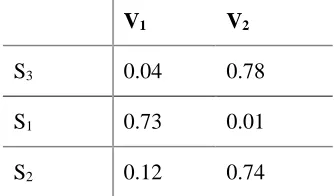
In the final phase of our work, we have compared the phrase level compositionality score S3 and the literality scores S1 and S2 with the priming behav-ior of targets V1 and V2. The correlation results are reported in Table 3. We observe S3 has got a high correlation with the priming behavior of the second constituent verb V2. On the other hand, weak correlation exists between S3 and V1. The observations are quite expected, as priming be-havior in V1 is observed irrespective of the se-mantic compositionality of the phrase V1V2,
0 5 10 15 20 25 30 35 40 45
0 2 4 6
Semantic Distance of V1 with V1+V2
0 5 10 15 20 25 30 35 40
0 2 4 6
D
eg
re
e o
f
P
ri
m
ing
f
o
r
V2
(R
T(
C
)-R
T(
P
)
Semantic Distance of V2 with V1+V2
[image:4.612.82.297.599.734.2]whereas, priming behavior in V2 changes as com-positionality in V1V2 changes. This is also re-flected in Figure 1 and Figure 2 respectively.
Similar observations are found for S1 and S2. Overall, the results in Table 3 are in agreement with that of Table 1: compositional verb phrases exhibit priming for both its constituents whereas non-compositional verb phrases shows priming only to its first constituent verb (V1).
V1 V2
S3 0.04 0.78
S1 0.73 0.01
[image:5.612.104.271.174.272.2]S2 0.12 0.74
Table 3: Correlation between priming in V1 and V2 and the computed cosine similarity scores (S1, S2).
5
General Discussion and Conclusion
In this paper we have presented some preliminary psycholinguistic experiments to identify the role of compositionality in the representation and pro-cessing of Bangla compound verbs in the mental lexicon. In order to do so, we first computed the user judgment of compositionality score. We found that there is a continuum of compositional-ity between Bangla compound verbs. Next, we employ the cross-modal repetition priming exper-iment over a set of Bangla compound verbs. Our initial results show that non-compositional verb sequences exhibit priming only with V2. On the other hand compositional verb sequences exhibit priming with both the constituent verbs V1 and V2. These observations together lead us to believe that mental representation and access of com-pound verbs in Bangla typically depends on the compositionality of the constituent verbs. Com-positional verb phrases are accessed via decom-position of the phrase into its constituent verbs whereas non-compositional phrases are accessed as a whole.
In the next phase of our work, we try to develop a vector space model of semantic compositional-ity to predict the organization and processing of verb phrases in the mental lexicon. We evaluate our model with the data collected from our human judgment compositionality score and the cross-modal priming experiments. Comparing the mod-els output with that of the empirically collected data, we claim that the proposed vector space
model correctly predicts the semantic composi-tionality of Bangla verb sequences and their pos-sible organization and processing in the mental lexicon. However, it would be premature to con-clude anything concrete based only on the current experimental results. We also observe that several other factors including usage frequency and verb ordering affect the overall word recognition time and access mechanisms. Each of these factor calls for rigorous experimentation for understanding the exact nature of their interdependencies that we intend to perform in future.
Acknowledgement
We are thankful to all the participants who ac-tively helped us to conduct the psycholinguistic experiments. We are also thankful to TCS Inno-vation Lab, Delhi for funding us to travel and at-tend the conference.
Reference
Aitchison, J. (2005). Words in the mind: An introduc-tion to the mental lexicon. Taylor & Francis.
Butt, M. (1995). The structure of complex predicates in Urdu. Center for the Study of Language and Inf.
Chakrabarti, D., Mandalia, H., Priya, R., Sarma, V., and Bhattacharyya, P. (2008). Hindi compound verbs and their automatic extraction. In Interna-tional Conference on ComputaInterna-tional Linguistics, pages 27–30.
Fellbaum, C. (2010). Wordnet. Theory and Applica-tions of Ontology: Computer ApplicaApplica-tions, pages 231–243.
Fleiss, J. L., Levin, B., and Paik, M. C. (1981). The measurement of interrater agreement. Statistical methods for rates and proportions, 2:212–236.
Fodor, J. A. and Pylyshyn, Z. W. (1988). Connection-ism and cognitive architecture: A critical analysis. Cognition, 28(1):3–71.
Marslen-Wilson, W., Tyler, L., Waksler, R., and Older, L. (1994). Morphology and meaning in the english mental lexicon. Psychological Review, 101(1):3.
Mitchell, J. and Lapata, M. (2008). Vector-based mod-els of semantic composition. proceedings of ACL-08: HLT, pages 236–244.
Paul, S. (2010). Representing compound verbs in indo wordnet. In Golbal Wordnet Conference, pages 84– 91.
Pulvermüller, F. (2003). The neuroscience of lan-guage: on brain circuits of words and serial order. Cambridge University Press.
Ratcliff, R. (1993). Methods for dealing with reaction time outliers. Psychological bulletin, 114(3):510.
Reddy, S., McCarthy, D., and Manandhar, S. (2011). An empirical study on compositionality in com-pound nouns. In Proceedings of IJCNLP.
Spivey, M. J., Joanisse, M., and McRae, K. (2012). The cambridge handbook of psycholinguistics. Cambridge University Press.
Tulving, E., Schacter, D. L., and Stark, H. A. (1982). Priming effects in word-fragment completion are independent of recognition memory. Journal of ex-perimental psychology: learning, memory, and cog-nition, 8(4):336–342.
Seidenberg, M. S. (2012). Computational models of reading. The Cambridge handbook of psycholin-guistics, page 186.
Dasgupta, T., Choudhury, M., Bali, K. and Basu, A. (2010). Mental representation and access of poly-morphemic words in bangla: Evidence from cross-modal priming experiments. International confer-ence on natural language processing (ICON). pp. 58-67.
Dasgupta T., Sinha M., Basu A. (2012). “ Computa-tional Models to understand the Access and Repre-sentation of Bangla Polymorphemic Words in the Mental Lexicon”. International Conference on Computational Linguistics (COLING), 2012, pp-235-244.
Dasgupta T., Sinha M., Basu A. (2014), “ Computa-tional Modeling of Morphological Effects in Bangla Visual Word Recognition”, Journal of Psycholin-guistic Research (JOPR), Springer, 2015.
Dasgupta T., Sinha M., Basu A. (2015). Computa-tional Models of the Lexical Representation of Bangla Compound Words in the Mental Lexicon", Journal of Psycholinguistic Research (JOPR), Springer, 2015