Interactive Second Language Learning from News Websites
Tao Chen1 Naijia Zheng1 Yue Zhao1
Muthu Kumar Chandrasekaran1 Min-Yen Kan1,2∗ 1School of Computing, National University of Singapore
2NUS Interactive and Digital Media Institute, Singapore
{taochen,muthu.chandra,kanmy}@comp.nus.edu.sg
{znj472982642,immortalzhaoyue}@gmail.com
Abstract
We propose WordNews, a web browser extension that allows readers to learn a second language vocabulary while reading news online. Injected tooltips allow read-ers to look up selected vocabulary and take simple interactive tests.
We discover that two key system com-ponents needed improvement, both which stem from the need to model context. These two issues are real-world word sense disambiguation (WSD) to aid trans-lation quality and constructing interactive tests. For the first, we start with Mi-crosoft’s Bing translation API but employ additional dictionary-based heuristics that significantly improve translation in both coverage and accuracy. For the second, we propose techniques for generating ap-propriate distractors for multiple-choice word mastery tests. Our preliminary user survey confirms the need and viability of such a language learning platform.
1 Introduction
Learning a new language from language learn-ing websites is time consumlearn-ing. Research shows that regular practice, guessing, memorization (Ru-bin, 1975) as well as immersion into real scenar-ios (Naiman, 1978) hastens the language learning process. To make second language learning attrac-tive and efficient, we interleave language learning with the daily activity of online news reading.
Most existing language learning software are either instruction-driven or user-driven. ∗This research is supported by the Singapore National Research Foundation under its International Research Centre @ Singapore Funding Initiative and administered by the IDM Programme Office.
Duolingo1 is a popular instruction-driven
sys-tem that teaches through structured lessons. Instruction driven systems demand dedicated learner time on a daily basis and are limited by learning materials as lesson curation is often labor-intensive.
In contrast, many people informally use Google Translate2 or Amazon Kindle’s
Vo-cabulary Builder3 to learn vocabulary, making
these prominent examples of user-driven systems. These systems, however, lack the rigor of a learn-ing platform as they omit tests to allow learners to demonstrate mastery. In our work, we merge learning and assessment within the single activity of news reading. Our system also adapts to the learner’s skill during assessment.
We propose a system to enable online news readers to efficiently learn a new language’s vo-cabulary. Our prototype targets Chinese lan-guage learning while reading English lanlan-guage news. Learners are provided translations of open-domain words for learning from an English news page. In the same environment – for words that the system deems mastered by the learner – learn-ers are assessed by replacing the original English text in the article with their Chinese translations and asked to translate them back given a choice of possible translations. The system,WordNews, deployed as a Chrome web browser extension, is triggered when readers visit a preconfigured list of news websites (e.g., CNN, BBC).
A key design property of our WordNews web browser extension is that it is only active on cer-tain news websites. This is important as news arti-cles typically are classified with respect to a news
category, such asfinance,world news, andsports. If we know which category of news the learner is viewing, we can leverage this contextual knowl-edge to improve the learning experience.
In the development of the system, we discov-ered two key components that can be affected by this context modeling. We report on these devel-opments here. In specific, we propose improved algorithms for two components:(i)for translating English words to Chinese from news articles,(ii) for generating distractors for learner assessment.
2 The WordNews Chrome Extension
Our method to directly enhance the web browser is inspired by earlier work in the computer-aided language learning community that also uses the web browser as the delivery vehicle for language learning. WERTi (Metcalf and Meurers, 2006; Meurers et al., 2010) was a monolingual, user-driven system that modified web pages in the tar-get language to highlight or remove certain words from specific syntactic patterns to teach difficult-to-learn English grammar.
Our focus is to help build Chinese vocabulary for second language learners fluent in English. We give a running scenario to illustrate the use of WordNews. When a learner browses to an En-glish webpage on a news website, our extension either selectively replaces certain original English words with their Chinese translation or underlines the English words, based on user configuration (Figure 1, middle). While the meaning of the Chinese word is often apparent in context, the learner can choose to learn more about the replaced/underlined word, by mousing over the word to reveal a definition tooltip (Figure 1, left) to aid mastery of the Chinese word. Once the learner has encountered the target word a few times, WordNews assesses learner’s mastery by generating a multiple choice translation test on the target word (Figure 1, right). Our learning platform thus can be viewed as three logical use cases:translating,learningandtesting.
Translating. We pass the main content of the webpage from the extension client to our server for candidate selection and translation. As cer-tain words are polysemous, the server must select the most appropriate translation among all
pos-sible meanings. Our initial selection method re-places any instance of words stored in our dictio-nary. For translation, we check the word’s stored meanings against the machine translation of each sentence obtained from the Microsoft Bing Trans-lation API4 (hereafter, “Bing”). Matches are
deemed as correct translations and are pushed back to the Chrome client for rendering.
Learning. Hovering the mouse over the re-placement Chinese word causes a tooltip to ap-pear, which gives the translation, pronunciation, and simplified written form, and aMorelink that loads additional contextual example sentences (that were previously translated by the backend) for the learner to study. The Morelink must be clicked for activation, as we find this two-click ar-chitecture helps to minimize latency and the load-ing of unnecessary data. The server keeps record of the learning tooltip activations, logging the en-closing webpage URL, the target word and the user identity.
Testing. After the learner encounters the same word a pre-defined number t = 3 times, Word-News generates a multiple choice question (MCQ) test to assess mastery. When the learner hovers over the replaced word, the test is shown for the learner to select the correct answer. When an op-tion is clicked, the server logs the selecop-tion and updates the user’s test history, and the client re-veals the correct answer.
2.1 News Categories
As our learning platform is active only on certain news websites, we can model the news category (for individual words and whole webpages) as ad-ditional evidence to help with tasks. Of particu-lar importance to WordNews is the association of words to a news category, which is used down-stream in both word sense disambiguation (Sec-tion 3) and the genera(Sec-tion of distractors in the in-teractive tests (Section 4). Here, our goal is to au-tomatically find highly relevant words to a particu-lar news category –e.g., “what are typicalfinance words?”
We first obtain a large sample of catego-rized English news webpages, by creating custom crawlers for specific news websites (e.g. CNN). We use a seed list of words that are matched
Figure 1: Merged screenshots of our Chrome extension on the CNN English articleSpotify wants to be the soundtrack of your life. Underlined components are clickable to yield tooltips of two different forms: (left) a definition for learning, (right) a multiple-choice interactive test.
Table 1: News category alignment between En-glish and Chinese.
English
Category ChineseCategory ExampleWords 1.
Entertain-ment Entertainment “superstar”,“明星” 2. World Military,
International, Social
“attacks”, “军事”
3. Finance Finance “investment”, “财富” 4. Sports Sports “score”, “比
赛” 5. Fashion Beauty &
Health “jewelry”,“时髦”
6. Technology Technology “cyber”, “互联网”
7. Travel “natural”
against a target webpage’s URL. If any match, the webpage is deemed to be of that category. For example, a webpage that has the seed word “foot-ball” in its URL is deemed of category “Sports”. Since the news category is also required for Chi-nese words for word sense disambiguation, we must perform a similar procedure to crawl Chi-nese news (e.g., BaiduNews5) However,
Chi-nese news sites follow a different categorization scheme, so we first manually align the categories based on observation (see Table 1), creating seven bilingual categories: namely, “World”, “Tech-nology”, “Sports”, “Entertainment”, “Finance”, “Fashion” and “Travel”.
We tokenize and part-of-speech tag the main body text of the categorized articles, discarding
5http://news.baidu.com
punctuation and stopwords. For Chinese, we ment words using the Stanford Chinese word seg-menter (Chang et al., 2008). The remaining words are classified to a news category based on docu-ment frequency. A wordwis classified to a cate-gorycif it appears more often (a tunable threshold δ6) than its average category document frequency.
Note that a word can be categorized to multiple categories under this scheme.
3 Word Sense Disambiguation (WSD) Component
Our extension needs to show the most appropri-ate translation sense based on the context. Such a translation selection task – cross-lingual word sense disambiguation – is a common problem in machine translation. In this section, we describe how we improved WordNews’ WSD capabilities through a series of six approaches.
The context evidence that we leverage for WSD comes in two forms: the news category of the tar-get word and its enclosing sentence.
3.1 Bilingual Dictionary and Baseline
WordNews’s server component includes a bilin-gual lexicon of English words with possible Chi-nese senses. The English words in our dictionary is based on the publicly-available College English Test (CET 4) list, which has a breadth of about 4,000 words. We augment the list to include the relative frequency among Chinese senses, with their part-of-speech, per English word.
Our baseline translation uses the most frequent sense: for an English word to be translated, it chooses the most frequent relative Chinese trans-lation sense c from the possible set of sensesC.
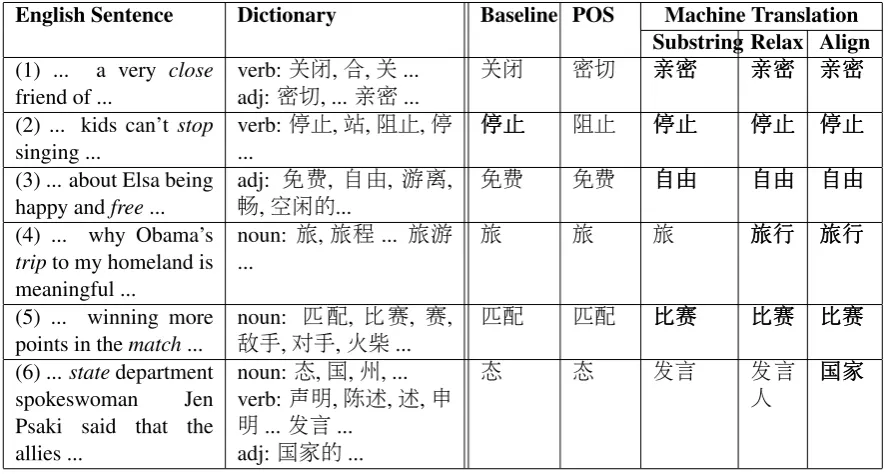
[image:3.595.74.292.258.482.2]Table 2: Example translations from our approaches to WSD. Target words are italicized and correct translations are bolded.
English Sentence Dictionary Baseline POS Machine Translation Substring Relax Align (1) ... a very close
friend of ... verb:
关闭,合,关... adj:密切, ...亲密...
关闭 密切 亲亲亲密密密 亲亲亲密密密 亲亲亲密密密
(2) ... kids can’t stop
singing ... verb: 停
止,站,阻止,停
... 停停停
止 止
止 阻止 停停停止止止 停停停止止止 停停停止止止
(3) ... about Elsa being happy andfree... adj:
免费, 自由, 游离, 畅,空闲的...
免费 免费 自自自由由由 自自自由由由 自自自由由由
(4) ... why Obama’s tripto my homeland is meaningful ...
noun: 旅,旅程... 旅游
... 旅 旅 旅 旅旅旅行行行 旅旅旅行行行
(5) ... winning more
points in thematch... noun: 匹
配, 比赛, 赛,
敌手,对手,火柴... 匹
配 匹配 比比比赛赛赛 比比比赛赛赛 比比比赛赛赛
(6) ... statedepartment spokeswoman Jen Psaki said that the allies ...
noun: 态,国,州, ... verb: 声明,陈述,述,申 明...发言...
adj:国家的...
态 态 发言 发言
人 国国国家家家
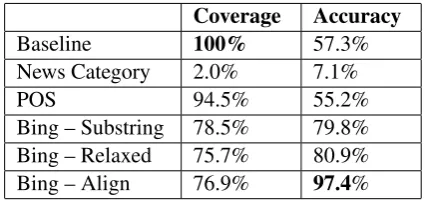
This method has complete coverage over the CET 4 list (as the word frequency rule always yields a prospective translation), but as it lacks any context model, it is the least accurate.
3.2 Approach 1: News Category
Topic information has been shown to be useful in WSD (Boyd-Graber et al., 2007). For exam-ple, consider the English word interest. In fi-nance related articles, “interest” is more likely to carry the sense of “a share, right, or title in the ownership of property” (“利息” in Chinese), over other senses. Therefore, analysing the topic of the original article and selecting the translation with the same topic label might help disambiguate the word sense. For a target English worde, for each prospective Chinese sensec∈ C, choose the first (in terms of relative frequency) sense that has the same news category as the containing webpage.
3.3 Approach 2: Part-of-Speech
Part-of-Speech (POS) tags are also useful for word sense disambiguation (Wilks and Steven-son, 1998) and machine translation (Toutanova et al., 2002; Ueffing and Ney, 2003). For exam-ple, the English word “book” can function as a verb or a noun, which gives rise to two
differ-ent dominant senses: “reserve” (“预定” in Chi-nese) and “printed work” (“书”), respectively. As senses often correspond cross-lingually, knowl-edge of the English word’s POS can assist dis-ambiguation. We employ the Standford log-linear Part-of-Speech tagger (Toutanova et al., 2003) to obtain the POS tag for the English word, whereas the POS tag for target Chinese senses are provided in our dictionary. In cases where multiple candi-date Chinese translations fit the same sense, we again break ties using relative frequency of the prospective candidates.
Approach 3 – Substring Match. As potential Chinese translations are available in our dictio-nary, a straightforward use of substring matching recovers a Chinese translation;i.e., check whether the candidate Bing translation is a substring of the Chinese translation. If more than one candidate matches, we use the longest string match heuristic and pick the one with the longest match as the fi-nal output. If none matches, the system does not output a translation for the word.
Approach 4 – Relaxed Match. The final rule in the substring match method unfortunately fires often, as the coverage of WordNews’s lexicon is limited. As we wish to offer correct translations that are not limited by our lexicon, we relax our substring condition, allowing the Bing translation to be a superset of a candidate translation in our dictionary (see Example 4 in Table 2, where the Bing translation “旅行” is allowed to be relaxed to match the dictionary “旅”). To this end, we must know the extent of the words in the tion. We first segment the obtained Bing transla-tion with the Stanford Chinese Word Segmenter, and then use string matching to find a Chinese translationc. If more than one candidate matches, we heuristically use the last matched candidate. This technique significantly augments the transla-tion range of our extension beyond the reach of our lexicon.
Approach 5 – Word Alignment. The relaxed method runs into difficulties when the target En-glish e’s Chinese prospective translations which come from our lexicon generate several possible matches. Consider Example 6 in Table 2. The tar-get English word “state” has corresponding Chi-nese entries “发言” and “国家的” in our dictio-nary. For this reason, both “国家” (“country”, cor-rect) and “发言人” (“spokeswoman”, incorrect) are relaxed matches. As relaxed approach always picks up the last candidate, “发言人” is the final output, which is incorrect.
To address this, we use the Bing Word Align-ment API7to provide a possibly different
prospec-tive Chinese sense c. In this example, “state” matches “国家” (“country”, correct) from word alignment, and the final algorithm chooses “国家” as the output.
[image:5.595.308.521.94.196.2]7 https://msdn.microsoft.com/en-us/library/dn198370.aspx
Table 3: WSD performance over our test set.
Coverage Accuracy
Baseline 100% 57.3%
News Category 2.0% 7.1%
POS 94.5% 55.2%
Bing – Substring 78.5% 79.8% Bing – Relaxed 75.7% 80.9% Bing – Align 76.9% 97.4%
3.5 Evaluation
To evaluate the effectiveness of our proposed methods, we randomly sampled 707 words and their sentences from recent CNN8 news articles,
manually annotating the ground truth translation for each target English word. We report both the coverage(i.e., the ability of the system to return a translation) andaccuracy(i.e., whether the trans-lation is contextually accurate).
Table 3 shows the experimental results for the six approaches. As expected, frequency-based baseline achieves 100% coverage, but a low accu-racy (57.3%); POS also performs similarly . The category-based approach performs the worst, due to low coverage. This is because news category only provides a high-level context and many of the Chinese word senses do not have a strong topic tendency.
Of most promise is our use of web based trans-lation related APIs. The three Bing methods iter-atively improve the accuracy and have reasonable coverage. Among all the methods, the additional step of word alignment is the best in terms of ac-curacy (97.4%), significantly bettering the others. This validates previous work that sentence-level context is helpful in WSD.
4 Distractor Generation Component
Assesing mastery over vocabulary is the other key functionality of our prototype learning platform. The generation of the multiple choice selection test requires the selection of alternative choices aside from the correct answer of the target word. In this section, we investigate a way to automati-cally generate such choices (calleddistractorsin the literature) in English, given a target word.
4.1 Related Work
Multiple choice question (MCQ) is widely used in vocabulary learning. Semantic and syntactic properties of the target word need to be consid-ered while generating their distractors. In partic-ular, (Pho et al., 2014) did an analysis on real-life MCQ corpus, and validated there are syntactic and semantic homogeneity among distractors. Based on this, automatic distractor generation algorithms have been proposed.
For instance, (Lee and Seneff, 2007) gener-ate distractors for English prepositions based on collocations, and idiosyncratic incorrect usage learned from non-native English corpora. L¨arka (Volodina et al., 2014) – a Swedish language learning system – generates vocabulary assess-ment exercises using a corpus. They also have dif-ferent modes of exercise generation to allow learn-ing and testlearn-ing via the same interface. (Susanti et al., 2015) generate distractors for TOEFL vo-cabulary test using WordNet and word sense dis-ambiguation given a target word. While these ap-proaches serve in testing mastery, they do not pro-vide the capability for learning new vocabulary in context. The most related prior work is WordGap system (Knoop and Wilske, 2013), a mobile appli-cation that generates MCQ tests based on the text selected by users. WordGap customizes the read-ing context, however, the generation of distractors – based on syntactic and semantic homogeneity – is not contextualized.
4.2 Approach
WordNews postulates “a set of suitable distrac-tors” as: 1) having the same form as the target word, 2) fitting the sentence’s context, and 3) hav-ing proper difficulty level accordhav-ing to user’s level of mastery. As input to the distractor generation algorithm, we provide the target word, its part-of-speech (obtained by tagging the input sentence first) and the enclosing webpage’s news category. We restrict the algorithm to produce distractors matching the input POS, and which match the news category of the page.
We can design the test to be more difficult by choosing distractors that are more similar to the target word. By varying the semantic distance, we can generate tests at varying difficulty levels. We quantify similarity by using the Lin distance (Lin,
1998) between two input candidate concepts in WordNet (Miller, 1995):
sim(c1, c2) = logP2∗logP(c1) +(lso(c1, c2))logP(c2) (1)
whereP(c)denotes the probability of encounter-ing concept c, and lso(c1, c2) denotes the low-est common subsumer synset, which is the lowlow-est node in the WordNet hierarchy that is a hypernym of both c1 and c2. This returns a score from 0 (completely dissimilar) to 1 (semantically equiva-lent).
If we use a target wordeas the starting point, we can use WordNet to retrieve related words using WordNet relations (hypernyms/hyponyms, synonyms/antonyms) and determine their similar-ity using Lin distance.
We empirically set0.1as the similarity thresh-old – words that are deemed more similar than0.1 are returned as possible distractors for our algo-rithm. We note that Lin distance often returns a score of 0 for many pairs and the threshold of 0.1allows us to have a large set of distractors to choose from, while remaining fairly efficient in run-time distractor generation.
We discretize a learner’s knowledge of the word based on their prior exposure to it. We then adopt a strategy to generate distractors for the input word based learners’ knowledge level:
Easy: The learner has been exposed to the word at least t = 3 times. Two distractors are randomly selected from words that share the same news category as the target word e. The third distractor is generated using our algorithm.
Hard: The learner has passed the Easy level testx =6 times. All three distractors are gener-ated from the same news category, using our algo-rithm.
4.3 Evaluation
select the most frequently used word, w1, from the target word’s synonym set, and then select the synonyms ofw1, calleds1. Finally, WordGap se-lects the three most frequently-used words from s1as distractors.
We conducted a human subject evaluation of distractor generation to assess its fitness for use. The subjects were asked to rank the feasibility of a distractor (inclusive of the actual answer) from a given sentential context. The contexts were sen-tences retrieved from actual news webpages, iden-tical to WordNews’s use case.
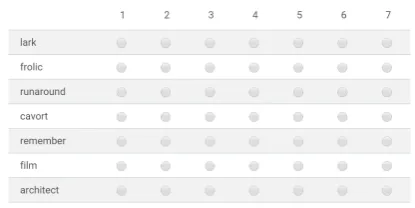
We randomly selected 50 sentences from recent news articles, choosing a noun or adjective from the sentence as the target word. We show the orig-inal sentence (leaving the target word as blank) as the context, and display distractors as choices (see Figure 2). Subjects were required to read the sentence and rank the distractors by plausibility: 1 (the original answer), 2 (most plausible alterna-tive) to 7 (least plausible alternaalterna-tive). We recruited 15 subjects from within our institution for the sur-vey. All of them are fluent English speakers, and half are native speakers.
We evaluated two scenarios, for two different purposes. In both evaluations, we generate three distractors using each of the two systems, and add the original target word for validation (7 options in total, conforming to our ranking options of 1–7).
Since we have news category information, we wanted to check whether that information alone could improve distractor generation. Evaluation 1 tests the WordGap baseline system versus a Ran-dom Newssystem that uses random word selec-tion. It just uses the constraint that chosen distrac-tors must conform to the news category (be clas-sified to the news category of the target word).
In our Evaluation 2, we tested ourHardsetup where our algorithm is used to generate all dis-tractors against WordGap. This evaluation aims to assess the efficacy of our algorithm over the base-line.
4.3.1 Results and Analysis
[image:7.595.309.517.86.190.2]Each question was answered by five different users. We compute the average ranking for each choice. A lower rating means a more plausible (harder) distractor. The rating for all the target words is low (1.1on average) validating their truth
Figure 2: Sample distractor ranking question.
and implying that the subjects answered the sur-vey seriously, assuring the validity of the evalua-tion.
For each question, we deem an algorithm to be the winner if its three distractors as a whole (the sum of three average ratings) are assessed to be more plausible than the distractors by its competi-tor. We calculate the number of wins for each al-gorithm over the 50 questions in each evaluation.
Table 4: WordGap vs. Random News. Lower scores are better.
# of wins Avg. score
WordGap 27 3.84
Random News 23 4.10
Table 5: WordGap vs. WordNews Hard. Lower scores are better.
# of wins Avg. score
WordGap 21 4.16
WordNews Hard 29 3.49
We display the results of both evaluations in Table 4 and Table 5. We see that the WordGap baseline outperforms the random selection, con-strained solely by news category, by 4 wins and a 0.26 lower average score. This shows that word news category alone is insufficient for generating good distractors. When a target word does not have a strong category tendency,e.g., “venue” and “week”, the random news method cannot select highly plausible distractors.
Table 6: Distractors generated by WordGap and WordNews Hard for example question in Figure 2. The identified news category for the enclosing webpage was Entertainment.
System Distractor Lin Dist. Avg. Rate
Target Word lark 1.33
WordGap frolicrunaround 3.335.67
cavort 4.17
WordNews art 0.154 1.67
Hard film 0.147 3.33
actress 0.217 4.83
wins (8 more) and average score (0.67 lower). This further confirms that context and semantic in-formation are complementary for distractor gener-ation. As we mentioned before, a good distractor should fit the reading context and have a certain level of difficulty. Finally, in Table 6 we show the distractors generated for the target word “lark” in the example survey question (Figure 2).
5 Platform Viability and Usability Survey
We have thus far described and evaluated two crit-ical components that can benefit from capturing the learner’s news article context. In the larger context, we also need to check the viability of second language learning intertwined with news reading. In a requirements survey prior to the pro-totype development, two-thirds of the respondents indicated that although they have interest in learn-ing a second language, they only have only used language learning software infrequently (less than once per week) yet frequently read news, giving us motivation for our development.
Post-prototype, we conducted a summative sur-vey to assess whether our prototype product satis-fied the target niche, in terms of interest, usability and possible interference with normal reading ac-tivities. We gathered 16 respondents, 15 of which were between the ages of 18–24. 11 (the majority) also claimed native Chinese language proficiency. The respondents felt that the extension platform was a viable language learning platform (3.4 of 5; on a scale of 1 “disagreement” to 5 “agreement”) and that they would like to try it when available for their language pair (3 of 5).
In our original prototype, we replaced the
orig-inal English word with the Chinese translation. While most felt that replacing the original En-glish with the Chinese translation would not ham-per their reading, they still felt a bit uncomfortable (3.7 of 5). This finding prompted us to change the default learning tooltip behavior to underlining to hint at the tooltip presence.
6 Conclusion
We described WordNews, a client extension and server backend that transforms the web browser into a second language learning platform. Lever-aging web-based machine translation APIs and a static dictionary, it offers a viable user-driven language learning experience by pairing an im-proved, context-sensitive tooltip definition service with the generation of context-sensitive multiple choice questions.
WordNews is potentially not confined to use in news websites; one respondent noted that they would like to use it on arbitrary websites, but cur-rently we feel usable word sense disambiguation is difficult enough even in the restricted news do-main. We also note that respondents are more willing to use a mobile client for news reading, such that our future development work may be geared towards an independent mobile applica-tion, rather than a browser extension. We also plan to conduct a longitudinal study with a cohort of second language learners to better evaluate Word-News’ real-world effectiveness.
References
Jordan Boyd-Graber, David Blei, and Xiaojin Zhu. 2007. A Topic Model for Word Sense Disambigua-tion. In Proceedings of the 2007 Joint Confer-ence on Empirical Methods in Natural Language Processing and Computational Natural Language Learning, EMNLP-CoNLL’07, pages 1024–1033.
Pi-Chuan Chang, Michel Galley, and Christopher D. Manning. 2008. Optimizing Chinese Word Seg-mentation for Machine Translation Performance. In
Proceedings of the Third Workshop on Statistical Machine Translation, StatMT’08, pages 224–232.
John Lee and Stephanie Seneff. 2007. Automatic gen-eration of cloze items for prepositions. In INTER-SPEECH, pages 2173–2176.
Dekang Lin. 1998. An information-theoretic defini-tion of similarity.
Vanessa Metcalf and Detmar Meurers. 2006. Gener-ating web-based english preposition exercises from real-world texts. Presentation at EUROCALL, September. http://purl.org/dm/handouts/eurocall06-metcalf-meurers.pdf.
Detmar Meurers, Ramon Ziai, Luiz Amaral, Adriane Boyd, Aleksandar Dimitrov, Vanessa Metcalf, and Niels Ott. 2010. Enhancing authentic web pages for language learners. InProceedings of the NAACL HLT 2010 Fifth Workshop on Innovative Use of NLP for Building Educational Applications, pages 10– 18. Association for Computational Linguistics. George A. Miller. 1995. WordNet: A Lexical
Database for English. Communications of the ACM, 38(11):39–41.
Neil Naiman. 1978. The Good Language Learner, volume 4. Multilingual Matters.
Van-Minh Pho, Thibault Andr´e, Anne-Laure Ligozat, B Grau, G Illouz, Thomas Franc¸ois, et al. 2014. Multiple choice question corpus analysis for distrac-tor characterization. In 9th International Confer-ence on Language Resources and Evaluation (LREC 2014).
Joan Rubin. 1975. What the ”good language learner” can teach us. TESOL quarterly, pages 41–51. Yuni Susanti, Ryu Iida, and Takenobu Tokunaga.
2015. Automatic generation of english vocabulary tests. InProceedings of the 7th International Con-ference on Computer Supported Education (CSEDU 2015), pages 77–78.
Kristina Toutanova, H Tolga Ilhan, and Christopher D Manning. 2002. Extensions to HMM-based Sta-tistical Word Alignment Models. InProceedings of the 2002 Conference on Empirical Methods in Nat-ural Language Processing, EMNLP EMNLP’02, pages 87–94.
Kristina Toutanova, Dan Klein, Christopher D. Man-ning, and Yoram Singer. 2003. Feature-rich Part-of-speech Tagging with a Cyclic Dependency Network. InProceedings of the 2003 Conference of the North American Chapter of the Association for Computa-tional Linguistics on Human Language Technology, NAACL ’03, pages 173–180.
Nicola Ueffing and Hermann Ney. 2003. Using POS Information for Statistical Machine Translation into Morphologically Rich Languages. In Proceed-ings of the 10th Conference on European Chapter
of the Association for Computational Linguistics, EACL’03, pages 347–354.
Elena Volodina, Ildik´o Pil´an, Lars Borin, and Therese Lindstr¨om Tiedemann. 2014. A flexible language learning platform based on language re-sources and web services. Proceedings of LREC 2014.