Identifying Appropriate Support for Propositions in Online User
Comments
Joonsuk Park
Department of Computer Science Cornell University
Ithaca, NY, USA
Claire Cardie
Department of Computer Science Cornell University
Ithaca, NY, USA
Abstract
The ability to analyze the adequacy of sup-porting information is necessary for deter-mining the strength of an argument.1 This is especially the case for online user com-ments, which often consist of arguments lacking proper substantiation and reason-ing. Thus, we develop a framework for automatically classifying each proposition as UNVERIFIABLE, VERIFIABLE NON
-EXPERIENTIAL, or VERIFIABLE EXPE -RIENTIAL2, where the appropriate type of
support isreason, evidence, andoptional evidence, respectively3. Once the exist-ing support for propositions are identi-fied, this classification can provide an es-timate of how adequately the arguments have been supported. We build a gold-standard dataset of 9,476 sentences and clauses from 1,047 comments submitted to an eRulemaking platform and find that Support Vector Machine (SVM) classifiers trained with n-grams and additional fea-tures capturing the verifiability and expe-rientiality exhibit statistically significant improvement over the unigram baseline, achieving a macro-averaged F1of 68.99%.
1 Introduction
Argumentation mining is a relatively new field focusing on identifying and extracting argumen-tative structures in documents. An argument is typically defined as a conclusion with supporting
1In this work, even unsupported propositions are consider
part of an argument. Not disregarding such implicit argu-ments allows us to discuss the types of support that can fur-ther be provided to strengthen the argument, as a form of as-sessment.
2Verifiable Experiential propositions are verifiable
propo-sitions about personal state or experience. See Table 1 for examples.
3We are assuming that there is no background knowledge
that eliminates the need of support.
premises, which can be conclusions of other argu-ments themselves (Toulmin, 1958; Toulmin et al., 1979; Pollock, 1987). To date, much of the argu-mentation mining research has been conducted on domains like news articles, parliamentary records and legal documents, where the documents con-tain well-formed explicit arguments, i.e. proposi-tions with supporting reasons and evidence present in the text (Moens et al., 2007; Palau and Moens, 2009; Wyner et al., 2010; Feng and Hirst, 2011; Ashley and Walker, 2013).
Unlike documents written by professionals, on-line user comments often contain arguments with inappropriate or missing justification. One way to deal with such implicit arguments is to sim-ply disregard them and focus on extracting ar-guments containing proper support (Villalba and Saint-Dizier, 2012; Cabrio and Villata, 2012). However, recognizing such propositions as part of an argument,4 and determining the appropriate types of support can be useful for assessing the ad-equacy of the supporting information, and in turn, the strength of the whole argument. Consider the following examples:
How much does a small carton of milk cost?1 More children should drink
milk2, because children who drink milk
everyday are taller than those who don’t3. Children would want to drink
milk, anyway4.
Firstly, Sentence 1does not need any support, nor is it part of an argument. Next,Proposition 2
is anunverifiableproposition because it cannot be proved with objective evidence, due to the value judgement. Instead, it can be supported by a son explaining why it may be true. If the rea-son, Proposition 3, were not true, the whole
ar-4Not all sentences in user comments are part of an
argu-ment, e.g. questions and greetings. We address this in Sec-tion 4.1
gument would fall apart, giving little weight to
Proposition 2. Thus, an objective evidence sup-portingProposition 3, which is averifiable propo-sition, could be provided to strengthen the argu-ment. Lastly, asProposition 4isunverifiable, we cannot expect an objective evidence that proves it, but a reason as its support. Note that providing a reason why Proposition 3might be true is not as effective as substantiating it with a proof, but is still better than having no support. This shows that not only the presence, but also the type of sup-porting information affects the strength of the ar-gument.
Examining each proposition in this way, i.e. with respect to its verifiability, provides a means to determine the desirable types of support, if any, and enables the analysis of the arguments in terms of the adequacy of their support. Thus, we propose the task of classifying each proposi-tion (the elementary unit of argumentaproposi-tion in this work) in an argument as UNVERIFIABLE, VERI -FIABLEPUBLIC, or VERIFIABLEPRIVATE, where
the appropriate type of support isreason,evidence, and optional evidence, respectively. To perform the experiments, we annotate 9,476 sentences and clauses from 1,047 comments extracted from an eRulemaking platform.
In the remainder of the paper, we describe the annotation scheme and a newly created dataset (Section 2), propose a supervised learning proach to the task (Section 3), evaluate the ap-proach (Section 4), and survey related work (Sec-tion 5). We find that Support Vector Machines (SVM) classifiers trained with n-grams and other features to capture the verifiability and experien-tiality exhibit statistically significant improvement over the unigram baseline, achieving a macro-averaged F1score of 68.99%.
2 Data
We have collected and manually annotated sen-tences and (independent) clauses from user com-ments extracted from an eRulemaking website,
Regulation Room5. Rulemaking is the process by which U.S. government agencies make new reg-ulations and enact public policy; its digital coun-terpart — eRulemaking — moves the process to online platforms (see, e.g. (Park et al., 2012)). By providing platforms in which the public can discuss regulations that interest them, government
5http://www.regulationroom.org
agencies hope to enlist the expertise and experi-ence of participants to create better regulations. In many rulemaking scenarios, agencies are, in fact, required to obtain feedback from the pub-lic on the proposed regulation as well as to ad-dress all substantive questions, criticisms or sug-gestions that are raised (Lubbers, 2006). In this way, public comments can produce changes in the final rule (Hochschild and Danielson, 1998) that, in turn, can affect millions of lives. It is crucial, therefore, for rule makers to be able to identify credible comments from those submitted.
Regulation Room is an experimental web-site operated by Cornell eRulemaking Initiative (CeRI)6 to promote public participation in the rulemaking process, help users write more infor-mative comments and build collective knowledge via active discussions guided by human moder-ators. Regulation Room hosts actual regulations from government agencies, such as the U.S. De-partment of Transportation.
For our research, we collected and manually an-notated 9,476 propositions from 1,047 user com-ments from two recent rules: Airline Passenger Rights (serving peanuts on the plane, tarmac de-lay contingency plan, oversales of tickets, baggage fees and other airline traveller rights) and Home Mortgage Consumer Protection (loss mitigation, accounting error resolution, etc.).
2.1 Annotation Scheme
To start, we collected 1,147 comments and ran-domly selected 100 of them to devise an annota-tion scheme for identifying appropriate types of support for propositions and to train annotators. Initially, we allowed the annotators to define the span for a propositions, leading to various compli-cations and a low inter-annotator reliability. Thus, we introduced an additional step in which com-ments were manually sliced into propositions (or non-propositional sentences) before being given to the annotators. A proposition or sentence found this way was split further if it consisted of two or more independent clauses. The sliced comments were then coded by two annotators into the fol-lowing four disjoint classes (See Figure 1 for an overview):
Verifiable Proposition[Experiential(VERIFEXP)
and Non-experiential(VERIFNON)]. A proposi-tion is verifiable if it contains an objective
Figure 1: Flow chart for annotation (Itrefers to the sentence (or clause) being annotated)
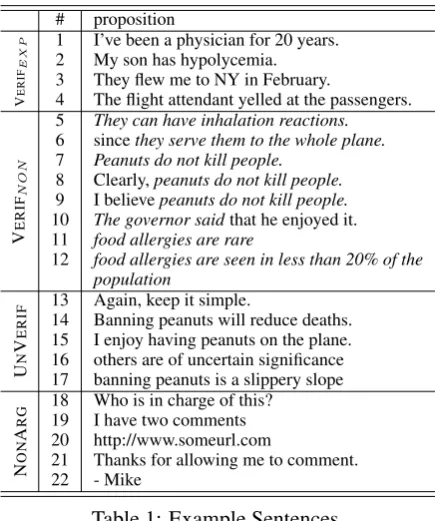
# proposition
V
E
R
IFE
X
P 1 I’ve been a physician for 20 years.
2 My son has hypolycemia. 3 They flew me to NY in February.
4 The flight attendant yelled at the passengers.
V
E
R
IFN
O
N
5 They can have inhalation reactions. 6 sincethey serve them to the whole plane. 7 Peanuts do not kill people.
8 Clearly,peanuts do not kill people. 9 I believepeanuts do not kill people. 10 The governor saidthat he enjoyed it. 11 food allergies are rare
12 food allergies are seen in less than 20% of the population
U
N
V
E
R
IF 1314 Again, keep it simple.Banning peanuts will reduce deaths.
15 I enjoy having peanuts on the plane. 16 others are of uncertain significance 17 banning peanuts is a slippery slope
N
O
N
A
R
G 1819 Who is in charge of this?I have two comments
20 http://www.someurl.com
21 Thanks for allowing me to comment. 22 - Mike
Table 1: Example Sentences.
* Italics is used to illustratecore clause(Section 3.2).
tion, where objective means “expressing or deal-ing with facts or conditions as perceived without distortion by personal feelings, prejudices, or in-terpretations.”7 Such assertions have truth values that can be proved or disproved with objective ev-idence8:
Consider the examples from Table 1. propo-sitions 1 through 7 are clearly verifiable because they only contain objective assertions. proposi-tions 8 and 9 show that adding subjective expres-sions such as “Clearly” (e.g. sentence 8) or “I be-lieve that” (e.g. sentence 9) to an objectively veri-fiable proposition (e.g. sentence 7) does not affect the verifiability of the proposition. Sentence 10 is considered verifiable because whether or not the
7http://www.merriam-webster.com/
8The correctness of the assertion or the availability of the
objective evidence does not matter.
governorsaid“he enjoyed the peanuts” can be ver-ified with objective evidence, even though whether he really does or not cannot be verified.
For the purpose of identifying an appropriate type of support, we employ a rather lenient no-tion of objectivity: an asserno-tion is objectively veri-fiable if thedomain of comparisonis free of inter-pretation. For instance, sentence 11 is regarded as objectively verifiable, because it is clear, i.e. it is not open for interpretation, thatpercentage of the population is the metric under comparison even though the threshold is purely subjective9. The rationale is that this type of proposition can be sufficiently substantiated with objective evidence (e.g. published statistics showing the percentage of people suffering from food allergies). Another way to think about it is that sentence 11 is a loose way of saying a (more obviously) verifiable sen-tence 12, where the commenter neglected to men-tion the threshold. This is fundamentally different from propositions 13 through 16 for which objec-tive evidence cannot exist10.
A verifiable proposition can further be dis-tinguished as experiential or not, depending on whether the proposition is about the writer’s per-sonal state or experience (VERIFEXP) or
some-thing non-experiential (VERIFNON). This
dif-ference determines whether objective evidence is mandatory or optional with respect to the credibil-ity of the comment. Evidence is optional when the evidence contains private information or is prac-tically impossible to be provided: While proposi-tions 1 through 3 can be proved with pictures of official documents, for instance, the commenters may not want to provide them for privacy rea-sons. Also, the website interface may not
al-9One may think anything less frequent than the average is
rare and another may have more stricter notion.
10Objective evidence may exist for propositions that
[image:3.595.72.292.226.487.2]Regulation VERIFNON VERIFEXP UNVERIF Subtotal NONARG Total # of Comments
APR 1106 851 4413 6370 522 6892 820
HMCP 251 416 1733 2400 186 2586 227
Total 1357 1267 6146 8770 708 9476 1047
Table 2: Class Distribution Over Sentences and Clauses
low pictures to be uploaded in comment section, which is the case with most websites. sentence 4 is practically impossible to prove unless the com-menter happened to have recorded the conversa-tion, and the website interface allows multimedia files to be uploaded. This is different from propo-sitions 5 through 12, which should be (if valid, that is) based on non-experiential knowledge the com-menter acquired through objective evidence avail-able to the public.
In certain domains, VERIFEXP propositions—
sometimes referred to as anectotal evidence— provide the novel knowledge that readers are seek-ing. In eRulemaking, for instance, agencies ac-cept a wide variety of comments from the pub-lic, including accounts of personal experience with the problems or conditions the new regulation pro-poses to address. If these accounts are relevant and plausible, the agencies may use them, even if they include no independent substantiation. Taking it to an extreme, even if the “experience” is fake, the “experience” and opinions based on them are valu-able to the agencies as long as the “experience” is realistic.
Unverifiable Proposition(UNVERIF). A
propo-sition is unverifiable if it cannot be proved with ob-jective evidence. UNVERIFpropositions are
typi-cally opinions, suggestions, judgements, or asser-tions about what will happen in the future. (See propositions 13 through 17.) Assertions about the future are typically unverifiable, because there is no direct evidence that something will happen. A very prominent exception is a prediction based on a policy of organizations, i.e. “The store will be open this Sunday.” where the policy serves as a di-rect evidence.
Non-Argumentative (NONARG). A sentence or
clause is in this category if it is not a proposition, i.e. it cannot be verified with objective evidence and no supporting reason is required for the pur-pose of improving the comment quality. Exam-ples include question, greeting, citation, and URL. (See sentences 18 through 21.)
2.2 Annotation Results
The resulting distribution of classes is shown in Table 2. Note that even though we employed a rather lenient definition of objective proposi-tions, the distribution is highly skewed towards UNVERIFpropositions. This is expected because
the comments are written by people who want to express their opinions about a regulation. Also, NONARG sentences comprise about 7% of the
data, suggesting that most comment propositions need to be supported with a reason or evidence for maximal credibility.
The inter-coder reliability checked on 30% of the data is moderate, yielding anUnweighted Co-hen’s κ of 0.73. Most of the disagreement oc-curred in propositions like “Airlines have to pro-vide compensation for both fees and lost bags” in which it is not clear from the context whether it is an opinion (UNVERIF) or a law (VERIFNON).
Also, opinions that may be verifiable (e.g. “The problems with passenger experience are not de-pendant on aircraft size!”) seem to cause disagree-ment among annotators.
3 Proposition Type Classification
3.1 Learning Algorithm
To classify each proposition in an argument as VERIFNON, VERIFEXP, or UNVERIF, we train
multiclass Support Vector Machines (SVM) as for-mulated by Crammer and Singer (2002), and later extended by Keerthi et al.(2008). We use the Lib-Linear (Fan et al., 2008) implementation. We ex-perimented with other multiclass SVM approaches such as 1-vs-all and 1-vs-1 (all-vs-all), but the dif-ferences were statistically insignificant, consistent with Hsu and Lin’s (2002) empirical comparison of these methods. Thus, we only report the per-formance of the Crammer and Singer version of Multiclass SVM.
3.2 Features
are numeric counts of the occurrence of each fea-ture is converted to a set of three binary feafea-tures each denoting 0, 1 and 2 or more occurrences. We first tried a binning method with each digit as its own interval, resulting in binary features of the formfeatCntn, but the three-interval approach proved to be better empirically, and is consistent with the approach by Riloff and Shoen (1995).
The features can be grouped into three cate-gories by purpose: Verifiability-specific (VER), Experientiality-specific (EXP) and Basic Features, each designed to capture the given proposition’s verifiability, experientiality, and both, respec-tively. Now we discuss the features in more detail.
3.2.1 Basic Features
N-gram Presence A set of binary features de-note whether a given unigram or bigram occurs in the proposition. The intuition is that by ex-amining the occurrence of words or phrases in VERIFNON, VERIFEXP, and UNVERIF
propo-sitions, the classes that have close ties to certain words and phrases can be identified. For instance, when a proposition contains the word happy, the proposition tends to be UNVERIF. From this
ob-servation, we can speculate that happy is highly associated with UNVERIF, andwent, VERIFEXP.
n-gram presence, rather than the raw or normal-ized frequency is chosen for its superior perfor-mance (O’Keefe and Koprinska, 2009).
Core Clause Tag (CCT) To correctly classify
propositions with main or subordinate clauses that do not affect the verifiability of the proposition (e.g. propositions 8 through 10 in Table 1, respec-tively), it is necessary to distinguish features that appear in the main clause from those that appear in the subordinate clause. Thus, we employ an auxil-iary feature that adds clausal information to other features by tagging them as eithercore or acces-soryclause.
Let’s consider propositions 7, 9 and 10 in Ta-ble 1: In all three examples, thecore clauseis ital-icized. In single clause cases like proposition 7, the entire proposition is the core clause. However, for proposition 9, the core clause is the subordi-nate clause introduced by the main clause, i.e. “I believe” should be ignored, since the verifiability of “peanuts do not kill people” is not dependent on it. It is the opposite for proposition 10: the main clause “The governor said” is the core clause, and the rest need not be considered. The reason is that “said” is a speech event, and it is possible to
objec-tively verify whether or not the governor verbally expressed his appreciation of peanuts.
To realize this intuition, we use syntactic parse trees generated by the Stanford Parser (De Marn-effe et al., 2006). In particular, Penn Treebank 2 Tags contain a clause-level tagSBAR denoting a “clause introduced by a subordinating conjunc-tion” (Marcus et al., 1993). The “that” clause in proposition 10 spans a subtree rooted by SBAR, whose left-most child has a lexical value “that.” Similarly, the subordinate (non-italicized) clause in proposition 9 falls in a subtree rooted bySBAR, whose only child isS. Once the main clause of a given proposition is identified, all features set off by the clause are tagged as “core” and the rest are tagged as ”accessory.” If a speech event is present, the tags are flipped.
3.2.2 Verifiability-specific Features (VER)
Parts-of-Speech (POS) Count Rayson et
al. (2001) have shown that the POS distribution is distinct in imaginative vs. informative writing. We expect this feature to distinguish UNVERIF
propositions from the rest.
Sentiment Clue CountWilson et al. (2005) pro-vides a subjectivity clue lexicon, which is a list of words with sentiment strength tags, either strong or weak, along with additional information, such as the sentiment polarity, Part-of-Speech Count
(POS), etc. We suspect that propositions contain-ing more sentiment words is more likely to be UN
-VERIF.
Speech Event CountWe use the 50 most frequent
Objective-speech-eventtext anchors crawled from theMPQA 2.0 corpus (Wilson and Wiebe, 2005) as a speech event lexicon. The speech event text anchors refer to words like “stated” and “wrote” that introduce written or spoken propositions at-tributed to a source. propositions containing speech events such as proposition 10 in Table 1 are generally VERIFNON or VERIFEXP, since
whether the attributed source has indeed made the proposition he allegedly made is objectively veri-fiable regardless of the subjectivity of the proposi-tion itself.
Imperative Expression Count Imperatives, i.e. commands, are generally UNVERIF(e.g. “Do the
context makes it clear that the writer is claiming that the library lends out books.) This feature de-notes whether the proposition begins with a verb or contains the following: must, should, need to, have to, ought to.
Emotion Expression Count These features
tar-get specific tokens “!”, and “...” as well as fully capitalized word tokens to capture the emotion in text. The rationale is that expression of emotion is likely to be more prevalent in UNVERIF
proposi-tions.
3.2.3 Experientiality-specific Features (EXP) Tense Count propositions written in past tense are rarely VERIFNON, because even in the case that the statment is verifiable, they are likely to be the commenter’s past experience, i.e. VERIFEXP. Future tense are typically UNVERIF because
propositions about what will happen in the fu-ture are often unverifiable with objective evidence, with exception being propositions like predictions based on policy of organizations, i.e. “Fedex will deliver on Sunday.” To take advantage of these ob-servations, three binary features capture each of three tenses:past, present,andfuture.
Person CountFirst person narratives can suggest that the proposition is UNVERIF or VERIFEXP,
except for rare cases like “We, the passengers,...” in which the first person pronoun refers to a large body of individuals. This intuition is captured by having binary features for: 1st, 2nd and3rd per-son.
4 Experiments
4.1 Methodology
A Note on Argument Detection A natural first
step in argumentation mining is to determine which portions of the given document comprise an argument. It can also be framed as a binary classification task in which each proposition in the document needs to be classified as either argumen-tative or not. Some authors choose to skip this step (Feng and Hirst, 2011), while others make use of various classifiers to achieve high level of accuracy, as Palau and Moens achieved over 70% accuracy on Araucaria and ECHR corpus (Reed and Moens, 2008; Palau and Moens, 2009).
As we have discussed in Section 1, our setup is a bit unique in that we also consider implicit arguments, where propositions are not supported with explicit reason or evidence, as argumentative. As a result, only about 7%(NONARG
TOTAL in Table 2) of
our entire dataset is marked as non-argumentative, most of which consists of questions and greetings. By simply searching for specific unigrams, such as “?” and “thank”, we achieve over 99% F1score
in determining which propositions are part of an argument.
The remaining experiments were done without non-argumentative propositions, i.e. NONARG in
Table 2.
Experimental Setup We first randomly selected 292 comments as held-out test set, resulting in the distribution shown in Table 4. Then, VERIFNON and VERIFEXP in the training set were oversam-pled so that the classes are equally distributed. During training, five fold cross-validation was done on the training set to tune the C parameter to32. Because the micro-averaged F1 score can
be easily boosted on datasets with highly skewed class distribution, we optimize for the macro-averaged F1score.
Preprocessing was kept at a minimal level: cap-ital letters were lowercased after counting fully capitalized words, and numbers were converted to aNUMtoken.
VERIFNON VERIFEXP UNVERIF Total
Train 987 900 4459 6346
Test 370 367 1687 2424
Total 1357 1267 6146 8770
Table 4: # of propositions in Train and Test Set
4.2 Results & Analysis
Table 3 shows a summary of the classification re-sults. The best overall performance is achieved by combining all features (UNI+BI+VER+EXP), yielding 68.99% macro-averaged F1, where the
gain over the baseline is statistically significant according to the bootstrap method with 10,000 samples (Efron and Tibshirani, 1994; Berg-Kirkpatrick et al., 2012).
Core Clause Tag (CCT) We do not report the
performance of employing feature sets withCore Clause Tag (CCT)in Table 3, because the effect ofCCT on each of the six sets of features is sta-tistically insignificant. This is surprising at first, given the strong motivation for distinguishing the core clause from auxiliary clause, as addressed in the previous section: Subordinate clauses like “I believe” should not cause the entire proposition to be classified as UNVERIF, and clauses like “He
Feature Set UNVERIFvs All VERIFNONvs All VERIFEXP vs All Average F1
Pre. Rec. F1 Pre. Rec. F1 Pre. Rec. F1 Macro Micro
UNI(base) 85.24 79.43 82.23 42.57 51.89 46.77 61.10 66.76 63.80 64.27 73.31 UNI+BI 82.14 89.69* 85.75* 51.67* 37.57 43.51 73.48* 62.67 67.65* 65.63 77.64*
VER 88.52* 52.10 65.60 28.41 61.35* 38.84 42.41 73.02* 53.65 52.70 56.68 EXP 82.42 4.45 8.44 20.92 76.49* 32.85 31.02 82.83* 45.14 28.81 27.31 VER+EXP 89.40* 49.50 63.72 29.25 71.62* 41.54 50.00 79.56* 61.41 55.55 57.43
UNI+BI+
[image:7.595.74.529.63.160.2]VER+EXP 86.86* 83.05* 84.91* 49.88* 55.14 52.37* 66.67* 73.02* 69.70* 68.99* 77.27* Table 3: Three class classification results in % (Crammer & Singer’s Multiclass SVMs)
Precision, recall, and F1scores are computed with respect to each one-vs-all classification problem for evaluation purposes,
though a single machine is built for the multi-class classification problem, instead of 3 one-vs-all classifiers. The star (*) indicates that the given result is statistically significantly better than the unigram baseline.
Fts UNI UNICCT
U
N
V
E
R
IF
+ should, whatever,
respon-sibility shouldunderstandC, C shouldA,
- previous, solve, florida, exposed, reacted, reply, kinds
exposedC, solveC,
NUMC, floridaC,
reactedC, poolC, owedC
V
E
R
IFN
O
N + impacted, NUM, solve,
cars, pull, kinds, congress impactedcarsC, NUMC, C, poolsolveCC,,
writingC, deathC, linkC
- should, seems, comments shouldC, commentsC
V
E
R
IFE
X
P + owed, consumed, saw, ex-pert, interesting, him,
re-acted, refinance
owedC, consumedC,
expertC, reactedC,
happenedC, interestingC
- impacted, wo impactedC, woC,
[image:7.595.72.288.233.392.2]concernC, diedC
Table 5:Most Informative Features forUNIandUNICCT
10 Unigrams with the largest weight (magnitude) with respect to each class ( + : positive weight / - : negative weight).
it. Our conjecture turned out to be wrong, mainly because such distinction can be made for only a small subset of the data: For instance, over 83% of the unigrams are tagged ascorein theUNI fea-ture set. Thus, most of the important feafea-tures for feature sets withCCT end up being features with
coretag, and the important features for feature sets with and withoutCCTare practically the same, as shown in Table 5, resulting in statistically insignif-icant performance differences.
Informative FeaturesThe most informative
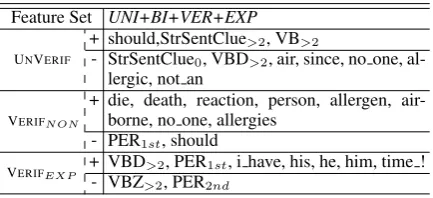
fea-Feature Set UNI+BI+VER+EXP
UNVERIF
+ should,StrSentClue>2, VB>2
- StrSentClue0, VBD>2, air, since, no one,
al-lergic, not an
VERIFNON
+ die, death, reaction, person, allergen, air-borne, no one, allergies
- PER1st, should
VERIFEXP + VBD- VBZ>2, PER1st, i have, his, he, him, time !
>2, PER2nd
Table 6:Most Informative Features forUNI+BI+VER+EXP 10 Features with the largest weight (magnitude) with re-spect to each class ( + : positive weight / - : negative weight).
tures reported in Table 6 exhibit interesting differ-ences among the three classes: Sentiment bearing words, i.e. “should” and strong sentiment clues, are good indicators of UNVERIF, whereas person
and tense information is crucial for VERIFEXP. As expected, the strong indicators of UNVERIF
and VERIFEXP, namely “should” and PER1stare
negatively associated with VERIFNON. It is in-triguing to see that the heavily weighted features of VERIFNON are non-verb content words, unlike
those of the other classes. One explanation for this is that VERIFNON are rarely indicated by specific
cues; instead, a good sign of VERIFNON is the
absences of cues for the other classes, which are often function words and verbs. What is remain-ing, then, are non-verb content words. Also, cer-tain content words seem to be more likely to bring about factual discussions. For instance, technical terms like“allergen” and “airborne,” appear in ver-ifiable non-experiential propositions as “The FDA requires labeling for the following 8 allergens.”
Non-n-gram FeaturesTable 3 clearly shows that the three non-n-gram features, VER, EXP, and
VER+EXP, do not perform as well as the n-gram features. But still, the performance is impressive, given the drastic difference in the dimensionality of the features: Even the combined feature set,
VER+EXP, consists of only about 100 features, when there are over 8,000 unigrams and close to 70,000 bigrams. In other words, the non-n-gram features are effectively capturing characteristics of each class. This is very promising, since this shows that a better understanding of the types of proposition can potentially lead to a more concise set of features with equal, or even better, perfor-mance.
[image:7.595.72.289.610.709.2]in-triguing, becauseVERare mostly from subjectiv-ity detection domain, intended to capture the sub-jectivity of words in the propositions leveraging on pre-built lexia. Simply considering subjectivity of words should provide no means of distinguish-ing VERIFNON from VERIFEXP. One of the rea-sons forVER’s superior performance overEXPis that EXP by itself is inadequate for the classifi-cation task: EXP consists of only 6 (or 12 with CCT) features denoting the person and tense infor-mation. Another reason is thatVER, in a limited fashion, does encode experientiality: For instance, past tense propositions can be identified with the existence ofVBD(verb, past tense) andVBN(verb, past participle).
5 Related Work
Argumentation Mining The primary goal of
ar-gumentation mining has been to identify and ex-tract argumentative structures present in docu-ments, which are often written by profession-als (Moens et al., 2007; Wyner et al., 2010; Feng and Hirst, 2011; Ashley and Walker, 2013). In cer-tain cases, the specific document structure allows additional means of identify arguments (Mochales and Moens, 2008). Even the work on online text data, which are less rigid in structure and often contain insufficiently supported propositions, fo-cus on the extraction of arguments (Villalba and Saint-Dizier, 2012; Cabrio and Villata, 2012). We, however, are interested in the assessment of the argumentative structure, potentially providing rec-ommendations to readers and feedback to the writ-ers. Thus it is crucial that we also process unsub-stantiated propositions, which we consider as im-plicit arguments. Our approach should be valu-able for processing documents like online user comment where arguments may not have adequate support and an automatic means of analysis can be useful.
Subjectivity DetectionWork to distinguish sub-jective from obsub-jective propositions (e.g.(Wiebe and Riloff, 2005)), often a subtask for sentiment analysis (Pang and Lee, 2008), is relevant to our work since we are concerned with the objective verifiability of propositions. In particular, previ-ous work attempts to detect certain types of sub-jective proposition: Conrad et al. (2012) iden-tifyarguing subjectivitypropositions and tag them with argument labels in order to cluster argument paraphrases. Others incorporate this task as a com-ponent for solving related problems, such as
an-swering opinion-based questions and determining the writer’s political stance (Somasundaran et al., 2007; Somasundaran and Wiebe, 2010). Similarly, Rosenthal and McKeown (2012) identify opinion-ated propositions expressing beliefs, leveraging from previous work in sentiment analysis and be-lief tagging. While the class ofsubjective propo-sitions in subjectivity detection strictly contains UNVERIF propositions, it also partially overlaps
with the VERIFEXP and VERIFNON classes of
our work: We want to identify verifiable assertions within propositions, rather than determine the sub-jectivity of the proposition as a whole (e.g. propo-sition 8 in Table 1 is classified as a VERIFNON,
though “Clearly” is subjective.). We also distin-guish two types of verifiable propositions, which is necessary for the purpose of identifying appro-priate types of support.
6 Conclusions and Future Work
We have proposed a novel task of automatically classifying each proposition as UNVERIFIABLE,
VERIFIABLE NONEXPERIENTIAL, or VERIFI -ABLEEXPERIENTIAL, where the appropriate type
of support is reason, evidence, and optional evi-dence, respectively. This classification, once the existing support relations among propositions are identified, can provide an estimate of how well the arguments are supported. We find that Support Vector Machines (SVM) classifiers trained with n-grams and other features to capture the verifi-ability and experientiality exhibit statistically sig-nificant improvement over the unigram baseline, achieving a macro-averaged F1 score of 68.99%.
In the process, we have built a gold-standard dataset of 9,476 propositions from 1,047 com-ments submitted to an eRulemaking platform.
One immediate avenue for future work is to in-corporate the identification of relations among the propositions in an argument to the system to ana-lyze the adequacy of the supporting information in the argument. This, in turn, can be used to recom-mend comments to readers and provide feedback to writers so that they can construct better argu-ments.
Acknowledgments
References
Kevin D. Ashley and Vern R. Walker. 2013. From in-formation retrieval (ir) to argument retrieval (ar) for legal cases: Report on a baseline study. InJURIX, pages 29–38.
Taylor Berg-Kirkpatrick, David Burkett, and Dan Klein. 2012. An empirical investigation of statis-tical significance in nlp. InProceedings of the 2012 Joint Conference on Empirical Methods in ral Language Processing and Computational Natu-ral Language Learning, EMNLP-CoNLL ’12, pages 995–1005, Stroudsburg, PA, USA. Association for Computational Linguistics.
Elena Cabrio and Serena Villata. 2012. Combin-ing textual entailment and argumentation theory for supporting online debates interactions. In Proceed-ings of the 50th Annual Meeting of the Association for Computational Linguistics (Volume 2: Short Pa-pers), pages 208–212, Jeju Island, Korea, July. As-sociation for Computational Linguistics.
Alexander Conrad, Janyce Wiebe, Hwa, and Rebecca. 2012. Recognizing arguing subjectivity and argu-ment tags. In Proceedings of the Workshop on Extra-Propositional Aspects of Meaning in Com-putational Linguistics, ExProM ’12, pages 80–88, Stroudsburg, PA, USA. Association for Computa-tional Linguistics.
Koby Crammer and Yoram Singer. 2002. On the algo-rithmic implementation of multiclass kernel-based vector machines. J. Mach. Learn. Res., 2:265–292, March.
Marie-Catherine De Marneffe, Bill Maccartney, and Christopher D. Manning. 2006. Generating typed dependency parses from phrase structure parses. In
In Proc. Intl Conf. on Language Resources and Eval-uation (LREC, pages 449–454.
B. Efron and R.J. Tibshirani. 1994.An Introduction to the Bootstrap. Chapman & Hall/CRC Monographs on Statistics & Applied Probability. Taylor & Fran-cis.
Rong-En Fan, Kai-Wei Chang, Cho-Jui Hsieh, Xiang-Rui Wang, and Chih-Jen Lin. 2008. Liblinear: A li-brary for large linear classification. J. Mach. Learn. Res., 9:1871–1874, June.
Vanessa Wei Feng and Graeme Hirst. 2011. Classi-fying arguments by scheme. InProceedings of the 49th Annual Meeting of the Association for Com-putational Linguistics: Human Language Technolo-gies - Volume 1, HLT ’11, pages 987–996, Strouds-burg, PA, USA. Association for Computational Lin-guistics.
Jennifer L. Hochschild and Michael Danielson, 1998.
Can We Desegregate Public Schools and Subsi-dized Housing? Lessons from the Sorry History of Yonkers, New York, chapter 2, pages 23–44. Uni-versity Press of Kansas, Lawrence KS, edited by clarence stone edition.
Chih-Wei Hsu and Chih-Jen Lin. 2002. A comparison of methods for multiclass support vector machines.
Trans. Neur. Netw., 13(2):415–425, March.
S. Sathiya Keerthi, S. Sundararajan, Kai-Wei Chang, Cho-Jui Hsieh, and Chih-Jen Lin. 2008. A sequen-tial dual method for large scale multi-class linear svms. InProceedings of the 14th ACM SIGKDD in-ternational conference on Knowledge discovery and data mining, KDD ’08, pages 408–416, New York, NY, USA. ACM.
Jeffrey S. Lubbers. 2006. A Guide to Federal Agency Rulemaking. American Bar Association Chicago, 4th ed. edition.
Mitchell P. Marcus, Beatrice Santorini, and Mary Ann Marcinkiewicz. 1993. Building a large annotated corpus of english: The penn treebank. COMPUTA-TIONAL LINGUISTICS, 19(2):313–330.
Raquel Mochales and Marie-Francine Moens. 2008. Study on the structure of argumentation in case law. In Proceedings of the 2008 Conference on Legal Knowledge and Information Systems: JURIX 2008: The Twenty-First Annual Conference, pages 11–20, Amsterdam, The Netherlands, The Netherlands. IOS Press.
Marie-Francine Moens, Erik Boiy, Raquel Mochales Palau, and Chris Reed. 2007. Automatic detection of arguments in legal texts. In Proceedings of the 11th International Conference on Artificial Intelli-gence and Law, ICAIL ’07, pages 225–230, New York, NY, USA. ACM.
Tim O’Keefe and Irena Koprinska. 2009. Feature se-lection and weighting methods in sentiment analy-sis. InProceedings of the 14th Australasian Docu-ment Computing Symposium.
Raquel Mochales Palau and Marie-Francine Moens. 2009. Argumentation mining: The detection, classi-fication and structure of arguments in text. In Pro-ceedings of the 12th International Conference on Ar-tificial Intelligence and Law, ICAIL ’09, pages 98– 107, New York, NY, USA. ACM.
Bo Pang and Lillian Lee. 2008. Opinion mining and sentiment analysis. Found. Trends Inf. Retr., 2(1-2):1–135, January.
Joonsuk Park, Sally Klingel, Claire Cardie, Mary Newhart, Cynthia Farina, and Joan-Josep Vallb´e. 2012. Facilitative moderation for online participa-tion in erulemaking. InProceedings of the 13th An-nual International Conference on Digital Govern-ment Research, dg.o ’12, pages 173–182, New York, NY, USA. ACM.
John L. Pollock. 1987. Defeasible reasoning. Cogni-tive Science, 11:481–518.
Raquel Mochales Palau Rowe Glenn Reed, Chris and Marie-Francine Moens. 2008. Language resources for studying argument. In Proceedings of the 6th conference on language resources and evaluation -LREC 2008, pages 91–100. ELRA.
Ellen Riloff and Jay Shoen. 1995. Automatically acquiring conceptual patterns without an annotated corpus. InIn Proceedings of the Third Workshop on Very Large Corpora, pages 148–161.
Sara Rosenthal and Kathleen McKeown. 2012. De-tecting opinionated claims in online discussions. In
ICSC, pages 30–37.
Swapna Somasundaran and Janyce Wiebe. 2010. Rec-ognizing stances in ideological on-line debates. In
Proceedings of the NAACL HLT 2010 Workshop on Computational Approaches to Analysis and Gener-ation of Emotion in Text, CAAGET ’10, pages 116– 124, Stroudsburg, PA, USA. Association for Com-putational Linguistics.
Swapna Somasundaran, Josef Ruppenhofer, and Janyce Wiebe. 2007. Detecting arguing and sentiment in meetings. InProceedings of the SIGdial Workshop on Discourse and Dialogue.
Stephen E. Toulmin, Richard Rieke, and Allan Janik. 1979. An Introduction to Reasoning. Macmillan Publishing Company.
S.E. Toulmin. 1958. The Uses of Argument. Cam-bridge University Press.
Maria Paz Garcia Villalba and Patrick Saint-Dizier. 2012. Some facets of argument mining for opinion analysis. InCOMMA, pages 23–34.
Janyce Wiebe and Ellen Riloff. 2005. Creating subjec-tive and objecsubjec-tive sentence classifiers from unanno-tated texts. InIn CICLing2005, pages 486–497. Theresa Wilson and Janyce Wiebe. 2005.
Annotat-ing attributions and private states. InProceedings of ACL Workshop on Frontiers in Corpus Annotation II: Pie in the Sky.
Theresa Wilson. 2005. Recognizing contextual po-larity in phrase-level sentiment analysis. InIn Pro-ceedings of HLT-EMNLP, pages 347–354.