Enhancing FreeLing Rule-Based Dependency Grammars
with Subcategorization Frames
Marina Lloberes
U. de Barcelona Barcelona, Spain
Irene Castell´on
U. de Barcelona Barcelona, Spain
Llu´ıs Padr´o
U. Polit`ecnica de Catalunya Barcelona, Spain
Abstract
Despite the recent advances in parsing, significant efforts are needed to improve the current parsers performance, such as the enhancement of the argument/adjunct recognition. There is evidence that verb subcategorization frames can contribute to parser accuracy, but a number of issues re-main open. The re-main aim of this paper is to show how subcategorization frames ac-quired from a syntactically annotated cor-pus and organized into fine-grained classes can improve the performance of two rule-based dependency grammars.
1 Introduction
Statistical parsers and rule-based parsers have ad-vanced over recent years. However, significant ef-forts are required to increase the performance of current parsers (Klein and Manning, 2003; Nivre et al., 2006; Ballesteros and Nivre, 2012; Marimon et al., 2014).
One of the linguistic phenomena which parsers often fail to handle correctly is the argu-ment/adjunct distinction (Carroll et al., 1998). For this reason, the main goal of this paper is to test empirically the accuracy of rule-based depen-dency grammars working exclusively with syntac-tic rules or adding subcategorization frames to the rules.
A number of studies shows that subcategoriza-tion frames can contribute to improve parser per-formance (Carroll et al., 1998; Zeman, 2002; Mir-roshandel et al., 2013). Particularly, these studies are mainly concerned with the integration of sub-categorization information into statistical parsers.
The list of studies about rule-based parsers in-tegrating subcategorization information is also ex-tensive (Lin, 1998; Alsina et al., 2002; Bick, 2006; Calvo and Gelbukh, 2011). However, they do not
explicitly relate the improvements in parser per-formance to the addition of subcategorization.
This paper analyses in detail how subcatego-rization frames acquired from an annotated cor-pus and distributed among fine-grained classes in-crease accuracy in rule-based dependency gram-mars.
The framework used is that of the FreeLing Dependency Grammars (FDGs) for Spanish and Catalan, using enriched lexical-syntactic informa-tion about the argument structure of the verb. FreeLing (Padr´o and Stanilovsky, 2012) is an open-source library of multilingual Natural Lan-guage Processing (NLP) tools that provide linguis-tic analysis for written texts. The FDGs are the core of the FreeLing dependency parser, the Txala Parser (Atserias et al., 2005).
The remainder of this paper is organized as fol-lows. Section 2 contains an overview of previous work related to this research. Section 3 presents the rule-based dependency parser used and the Spanish and Catalan grammars. Section 4 de-scribes the strategy followed initially to integrate subcategorization into the grammars and how this information has been redesigned. Section 5 fo-cuses on the evaluation and the analysis of sev-eral experiments testing versions of the grammars including or discarding subcategorization frames. Finally, the main conclusions and the further re-search goals arisen from the results of the experi-ments are exposed in Section 6.
2 Related Work
There has been an extensive research on parser de-velopment, and most approaches can be classified asstatisticalorrule-based. In the former, a statis-tical model learnt from annotated or unannotated texts is applied to build the syntactic tree (Klein and Manning, 2003; Collins and Koo, 2005; Nivre et al., 2006; Ballesteros and Nivre, 2012), whereas the latter uses hand-built grammars to guide the
parser in the construction of the tree (Sleator and Temperley, 1991; J¨arvinen and Tapanainen, 1998; Lin, 1998).
Concerning the languages this study is based on, some research on Spanish has been performed from the perspective of Constraint Grammar (Bick, 2006), Unification Grammar (Ferr´andez and Moreno, 2000), Head-Driven Phrase Structure Grammar (Marimon et al., 2014), and Dependency Grammar for statistical parsing, both supervised (Carreras et al., 2006) and semi-supervised (Calvo and Gelbukh, 2011). For Catalan, a rule-based parser based on Constraint Grammar (Alsina et al., 2002) and a statistical dependency parser (Car-reras, 2007) are available.
Despite the huge achievements in the area of parsing, argument/adjunct recognition is still a lin-guistic problem in which parsers still show low ac-curacy and in which there is still no generalized consensus in Theoretical Linguistics (Tesni`ere, 1959; Chomsky, 1965). This phenomenon refers to the subcategorization notion, which corre-sponds to the definition of the type and the number of arguments of a syntactic head.
The acquisition of subcategorization frames from corpora is one of the strategies for integrat-ing information about the argument structure into a parser. Depending on the level of language anal-ysis of the annotated corpus, two main strategies are used in automatic acquisition.
If the acquisition is performed over a mor-phosyntactically annotated text, the subcatego-rization frames are inferred by applying statisti-cal techniques on morphosyntactistatisti-cally annotated data (Brent, 1993; Manning, 1993; Korhonen et al., 2003).
Alternatively, acquisition can be performed withsyntactically annotated texts(Sarkar and Ze-man, 2000; O’Donovan et al., 2005; Aparicio et al., 2008). Subcategorization acquisition can be performed straightforwardly because the informa-tion about the argument structure is available in the corpus. Therefore, this approach generally fo-cuses on the methods for subcategorization frames classification.
The final classification in a lexicon of frames is a computational resource for several NLP tools. In the framework which this research focuses on, the integration of the acquired subcategorization is orientated to the contribution towards building the syntactic tree when the parser has incomplete
in-formation to make a decision (Carroll et al., 1998). Depending on the characteristics of the parser, subcategorization assists in this task in a different way. Subcategorization information can be used to assign a probability to every possible syntactic tree and to rank them in parsers that perform the whole set of possible syntactic analysis of a partic-ular sentence (Carroll et al., 1998; Zeman, 2002; Mirroshandel et al., 2013).
In contrast, subcategorization may help to re-strict the application of certain rules. Then, when the parser detects the subcategorization frame in the input sentence, it labels the syntactic tree ac-cording to the frame discarding any other possible analysis (Lin, 1998; Calvo and Gelbukh, 2011).
3 Dependency Parsing in FreeLing
The rule-based dependency grammars presented in this article are the core of the Txala Parser (At-serias et al., 2005), the NLP module in charge of Dependency Parsing in the FreeLing library (Padr´o and Stanilovsky, 2012).1
FreeLing is an open-source project that has been developed for more than ten years. It is a com-plete NLP pipeline built on a chain of modules that provide a general and robust linguistic anal-ysis. Among the available tools, FreeLing offers sentence recognition, tokenization, named entity recognition, tagging, chunking, dependency pars-ing, word sense disambiguation, and coreference resolution.
3.1 Txala Parser
The Txala Parser is one of the dependency pars-ing modules available in FreeLpars-ing. It is a rule-based, non-projective and multilingual depen-dency parser that provides robust syntactic anal-ysis in three steps.
Txala receives the partial syntactic trees pro-duced by the chunker (Civit, 2003) as input. Firstly, the head-child relations are identified us-ing a set of heuristic rules that iteratively decide whether two adjacent trees must be merged, and in which way, until there is only one tree left. Sec-ondly, it is converted into syntactic dependencies according to Mel’ˇcuk (1988). Finally, each depen-dency arch of the tree is labelled with a syntactic function tag.
Rules
Language Total Linking Labelling
English 2961 2239 722
Spanish 4042 3310 732
Catalan 2879 2099 780
Galician 178 87 91
[image:3.595.95.268.62.134.2]Asturian 4438 3842 596
Table 1: Sizes of the FDGs
3.2 FreeLing Dependency Grammars
The current version of FreeLing includes rule-based dependency grammars for English, Span-ish, Catalan, Galician and Asturian (see Table 1 for a brief overview of their sizes). In this pa-per, the Spanish and Catalan dependency gram-mars are described.
The FDGs follow the linguistic basis of syn-tactic dependencies (Tesni`ere, 1959; Mel’ˇcuk, 1988). However, we propose a different analy-sis for prepositional phrases (preposition-headed), subordinate clauses (conjunction-headed) and co-ordinating structures (conjunction-headed).
A FDG is structured as a set of manually de-fined rules which link two adjacent syntactic par-tial trees (linking rules) and assign a syntactic function to every link of the tree (labelling rules), according to certain conditions and priority. They are applied based on this priority: at every step, two adjacent partial trees will be attached or will be labelled with a syntactic function tag if their rule is the highest ranked for which all the condi-tions are met.
Linking rules can contain four kind of con-ditions, regarding morphological (part-of-speech tag), lexical (word form, lemma), syntactic (syn-tactic context, syn(syn-tactic features of lemmas) and semantic features (semantic properties predefined by the user).
For instance, the rule shown in Figure 1 has pri-ority911, and states that a sub-tree marked as a subordinate clause (subord) whose head is a rel-ative pronoun (PR) attached as a child to the noun phrase (sn) to its left (top left) when these two consecutive sub-trees are not located to the right of a verb phrase (!grup-verb $$).
Concerning thelabelling rules, the set of condi-tions that the parent or the child of the dependency must meet may refer to morphological (part-of-speech tag), lexical (word form, lemma), syntac-tic (lower/upper sub-tree nodes, syntacsyntac-tic features of lemmas) and semantic properties (EuroNet Top Concept Ontology -TCO- features,
Word-911 !grup-verb $$ - (sn,subord{ˆPR}) top left RELABEL
-Figure 1: Linking rule for relative clauses
grup-verb dobj
d.label=grup-sp p.class=trans d.side=right d.lemma=a|al d:sn.tonto=Human
d:sn.tonto!=Building|Place
Figure 2: Labelling rule for human direct objects
Net Semantic File, WordNet Synonyms and Hy-pernyms and other semantic features predefined by the user).
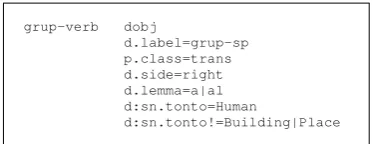
In the rule illustrated in Figure 2, the direct ob-ject label (dobj) is assigned to the link between a verbal head (grup-verb) and a prepositional phrase (grup-sp) child when the head belongs to the transitive verbs class (trans) and the child is post-verbal (right), the preposition isa(or the contractional), and the nominal head inside the prepositional phrase has the TCO featureHuman
but not (!=) the features Building orPlace
(to prevent organizations from being identified as a direct object).
4 CompLex-VS lexicon for Parsing
Following the hypothesis that subcategorization frames improve the parsing performance (Carroll et al., 1998), the first version of FDGs included verbal and nominal frames in order to improve ar-gument/adjunct recognition and prepositional at-tachment (Lloberes et al., 2010). In this paper, only the verbal lexicon is presented because it is the resource used for the argument/adjunct recog-nition task in the grammars.
[image:3.595.323.510.133.205.2]orga-nized according to the linguistic-motivated classi-fication proposed by Alonso et al. (2007).
The final lexicon applied to the FDGs has 11 subcategorization classes containing a total of 1314 Spanish verbal lemmas and 847 Catalan verbal lemmas with a different subcategorization frame.
A first experimental evaluation of the Spanish Grammar with the initial subcategorization lexi-con (Lloberes et al., 2010) showed that incorpo-rating subcategorization information is promising.
4.2 Redesign of the CompLex-VS lexicon According to the evaluation results of the gram-mars with the initial CompLex-VS included, the lexicon has been redesigned, proposing a set of more fine-grained subcategorization frame classes in order to represent verb subcategorization in the dependency rules in a controlled and detailed way. New syntactic-semantic patterns have been ex-tracted automatically from the SenSem Corpus ac-cording to the idea that every verbal lemma with a different subcategorization frame expresses a dif-ferent meaning. Therefore, a new lexicon entry is created every time an annotated verbal lemma with a different frame is detected.
The CompLex-VS contains 3102 syntactic pat-terns in the Spanish lexicon and 2630 patpat-terns in the Catalan lexicon (see Section 4.3 for detailed numbers). They are organized into 15 subcate-gorization frames as well as into 4 subcategoriz-tion classes. The lexicon is distributed in XML format under the Creative Commons Attribution-ShareAlike 3.0 Unported License.2
Certain patterns have been discarded because they are non-prototypical in the corpus (e.g. clitic left dislocations), they alter the sentence order (e.g. relative clauses), or they involve controver-sial argument classes (e.g. prepositional phrases seen as arguments or adjuncts depending on the context).
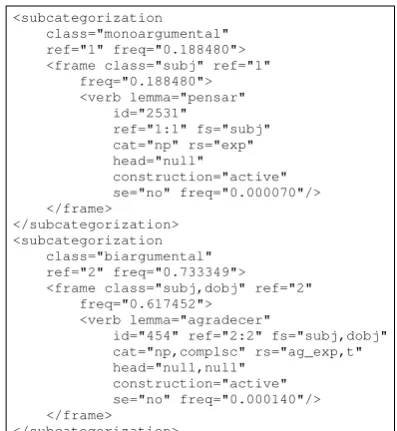
As Figure 3 shows, the extracted patterns (<verb>) have been classified into <frame>
classes according to the whole set of argument structures occurring in the corpus (subj for in-transitive verbs,subj,dobjfor transitive verbs, etc.). Simultaneously, frames have been organized in <subcategorization> classes (monoar-gumental, biar(monoar-gumental, triargumental and quatri-argumental).
2http://grial.uab.es/descarregues.php
<subcategorization
class="monoargumental" ref="1" freq="0.188480"> <frame class="subj" ref="1"
freq="0.188480"> <verb lemma="pensar"
id="2531"
ref="1:1" fs="subj" cat="np" rs="exp" head="null"
construction="active" se="no" freq="0.000070"/> </frame>
</subcategorization> <subcategorization
class="biargumental" ref="2" freq="0.733349"> <frame class="subj,dobj" ref="2"
freq="0.617452"> <verb lemma="agradecer"
id="454" ref="2:2" fs="subj,dobj" cat="np,complsc" rs="ag_exp,t" head="null,null"
construction="active" se="no" freq="0.000140"/> </frame>
[image:4.595.316.515.60.276.2]</subcategorization>
Figure 3: Example of the CompLex-VS
Every lexicon entry contains the syntactic func-tion of every argument (fs), the grammatical cat-egory of the head of the argument (cat) and the thematic role (rs). The type ofconstruction
(e.g. active, passive, impersonal, etc.) has been inferred from the predicate and aspect annotations available in the SenSem Corpus.
Two non-annotated lexical items of the sentence have also been inserted into the subcategorization frame because the information that they provide is crucial for the argument structure configuration (e.g. the particle ‘se’ and the lexical value of the prepositional phrasehead).
In addition, meta-linguistic information has been added to every entry: a unique id and the relative frequency of the pattern in the corpus (freq). A threshold frequency has been estab-lished at7·10−5(Spanish) and at8.5·10−5 (Cata-lan). Patterns below this threshold have been con-sidered marginal in the corpus and they have been discarded.
Every pattern contains a link to the frame and subcategorization class that they belong to (ref). For example, if an entry has the reference1:1, it means that the pattern corresponds to a monoargu-mental verb whose unique argument is a subject.
con-Frames Spanish Catalan
subj 203 386
subj,att 3 7
subj,dobj 440 230
subj,iobj 37 61
subj,pobj 126 93
subj,pred 45 31
subj,attr,iobj 2 1
subj,dobj,iobj 113 72
subj,dobj,pobj 42 34
subj,dobj,pred 21 18
subj,pobj,iobj 2 1
subj,pobj,pobj 14 9
subj,pobj,pred 1 0
subj,pred,iobj 4 5
[image:5.595.97.265.61.223.2]subj,dobj,pobj,iobj 1 0
Table 2: CompLex-SynF lexicon in numbers
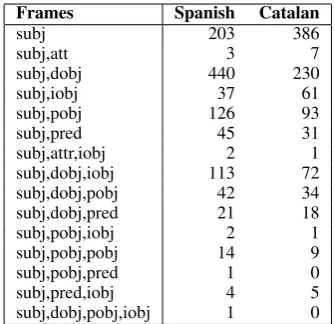
tains the subcategorization patterns generalized by the syntactic function (Table 2). The CompLex-SynF+Cat lexicon collects the syntactic patterns combining syntactic function and grammatical category (adjective/noun/prepositional phrase, in-finitive/interrogative/completive clause).
The addition of grammatical categories makes it possible to restrict the grammar rules. For exam-ple, a class of verbs containing the verbquedarse
(‘to get’) whose argument is a predicative and a prepositional phrase allows the rules to identify that the prepositional phrase of the sentence Se ha quedado de piedra (‘[He/She] got shocked’) is a predicative argument. Furthermore, it allows for discarding the prepositional phrase of the sen-tenceAparece de madrugada(‘[He/She] shows up at late night’) being a predicative argument, al-thoughaparecerbelongs to the class of predicative verbs but conveying a noun phrase as argument.
While in the CompLex-SynF lexicon the infor-mation is more compacted (1054 syntactic pat-terns classified in 15 frames), in the CompLex-SynF+Cat lexicon the classes are more granular (1356 syntactic patterns organized in 77 frames).
Only subcategorization patterns corresponding to lexicon entries referring to the active voice have been integrated in the FDGs, since they in-volve non-marked word order. Both lexicons also exclude information about the thematic role, al-though they take into account the value of the head (if the frame contains a prepositional argument) and the pronominal verbs (lexical entries that ac-cept ‘se’ particle whose value neither is reflexive nor reciprocal).
Two versions of the Spanish dependency gram-mar and two versions of the Catalan dependency
Grammar Spanish Catalan
Bare 450 508
Baseline 732 780
SynF 872 917
SynF+Cat 869 917
Table 3: Labelling rules in the evaluated grammars
grammar have been created. One version contains the CompLex-SynF lexicon and the other one the CompLex-Synf+Cat.
The old CompLex-VS lexicon classes have been replaced with the new ones. Specifically, this information has been inserted in the part of the la-belling rules about the syntactic properties of the parent node (observep.classin Figure 2).
Finally, new rules have been added for frames of CompLex-SynF and CompLex-SynF+Cat that are not present in the old CompLex-VS lexicon. Furthermore, some rules have been disabled for frames of the old CompLex-VS lexicon that do not exist in the SynF and CompLex-SynF+Cat lexicons (see Table 3 for the detailed size of the grammars).
5 Evaluation
An evaluation task has been carried out to test empirically how the FDGs performance changes when subcategorization information is added or subtracted. Several versions of the grammars have been tested using a controlled annotated linguistic data set.
This evaluation specifically focuses on analysing the results of the experiments qualita-tively. This kind of analysis makes it possible to track the decisions that the parser has made, so that it is possible to provide an explanation about the accuracy of the FDGs running with different linguistic information.
5.1 Experiments
Four versions of both Spanish and Catalan gram-mars are tested in order to assess the differences of the performance depending on the linguistic infor-mation added.
• Bare FDG. A version of the FDGs running without subcategorization frames.
• Baseline FDG. A version of the FDGs run-ning with the old CompLex-VS lexicon.
[image:5.595.352.484.62.114.2]Tag SenSem ParTes SenSem ParTes Spanish Spanish Catalan Catalan subj 42.23 34.03 43.03 28.08 dobj 35.77 29.86 34.64 34.25 pobj 16.73 13.89 16.56 17.12
iobj 4.64 6.25 4.70 2.05
pred 0.49 2.08 0.51 0.68
[image:6.595.81.280.60.144.2]attr 0.14 13.89 0.56 17.81
Table 4: Comparison of the labelling tags distribu-tion in SenSem and ParTes (%)
• SynF+Cat FDG. A version of the FDGs run-ning with the CompLex-Synf+Cat lexicon.
Since this research is focused on the implemen-tation of subcategorization information for argu-ment/adjunct recognition, only thelabelling rules
are discussed in this paper (Table 3). However, metrics related tolinking rulesare also mentioned to provide a general description of the FDGs.
5.2 Evaluation data
To perform a qualitative evaluation, the ParTes test suite has been used (Lloberes et al., 2014). This resource is a multilingual hierarchical test suite of a representative and controlled set of syntactic phenomena which has been developed for evalu-ating the parsing performance as regards syntactic structure and word order.
It contains 161 syntactic phenomena in Span-ish (99 referring to structure and 62 to word order) and 147 syntactic phenomena in Catalan (101 cor-responding to structure phenomena and 46 to word order).
The current version of ParTes is distributed with an annotated data set in the CoNLL format. Al-though this data set is not initially developed for evaluating the argument/adjunct recognition, the number of arguments and adjuncts contained in ParTes is proportional to the number of arguments and adjuncts of the SenSem Corpus (Table 4). Therefore, the ParTes data set is a reduced sam-ple of the linguistic phenomena that occur in a larger corpus, which makes ParTes an appropriate resource for this task.
5.3 Evaluation metrics
The metrics have been computed using the CoNLL-X Shared Task 2007 script (Nivre et al., 2007). The output of the FDGs (system output) has been compared to the ParTes annotated data set (gold standard).
[image:6.595.359.472.61.144.2]Tag Description adjt Adjunct attr Attribute dobj Direct Object iobj Indirect Object pobj Prepositional Object pred Predicative subj Subject
Table 5: Tagset of syntactic functions related to the subcategorization
The metrics used to evaluate the performance of the several FDGs versions are the following ones:
Accuracy3
LAS = correct attachments and labellingstotal tokens
UAS = correct attachmentstotal tokens
LAS2 = correct labellingstotal tokens
Precision
P = system correct tokenssystem tokens
Recall
R = system correct tokensgold tokens
Both quantitative and qualitative analysis de-tailed in Section 5.4 pay special attention to the metric LAS2, which informs about the number of heads with the correct syntactic function tag.
Precision and recall metrics of the labelling rules provide information about how the addi-tion of verbal subcategorizaaddi-tion informaaddi-tion con-tributes to the grammar performance. For this rea-son, in the qualitative analysis, only labelling syn-tactic function tags directly related to verbal sub-categorization are considered (Table 5).
5.4 Accuracy results
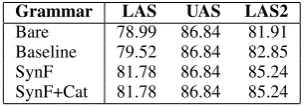
The global results of the FDGs evaluation (LAS) show that the whole set of evaluated grammars score over 80% accuracy in Spanish (Table 6) and around 80% in Catalan (Table 7).
In the four Spanish grammar versions (Table 6), the correct head (UAS) has been identified in 90.01% of the cases. On the other hand, the tendency changes in syntactic function labelling (LAS2). The Baseline establishes that 85.54% of tokens have the correct syntactic function tag.
3LAS: Labeled Attachment Score; UAS: Unlabeled
Grammar LAS UAS LAS2 Bare 81.37 90.01 82.86 Baseline 83.76 90.01 85.54 SynF 84.50 90.01 86.29 SynF+Cat 84.50 90.01 86.29
Table 6: Accuracy scores (%) in Spanish
Grammar LAS UAS LAS2
[image:7.595.307.526.58.279.2]Bare 78.99 86.84 81.91 Baseline 79.52 86.84 82.85 SynF 81.78 86.84 85.24 SynF+Cat 81.78 86.84 85.24
Table 7: Accuracy scores (%) in Catalan
However, Bare drops 2.68 scores and SynF and
SynF+Catimprove 0.75 scores with respect to the baseline.
A parallel behaviour is observed in Catalan, al-though the scores are slightly lower than in Span-ish (Table 7). The four Catalan grammars score 86.84% in attachment (UAS). TheBaselinescores 82.85% in syntactic function assignment (LAS2). Once again FDGs perform worse without subcat-egorization information (0.94 points less inBare
grammar) and better with subcategorization infor-mation (2.39 points more inSynFandSynF+Cat). From a general point of view, accuracy met-rics show a medium-high accuracy performance of all versions of FDGs in both languages. Specif-ically, these first results highlight that subcatego-rization information helps with the syntactic func-tion labelling. However, qualitative results will re-veal how subcategorization influences the gram-mar performance (Sections 5.5 and 5.6).
5.5 Precision results
As observed in the quantitative analysis (Sec-tion 5.4), in both languages most of the syntac-tic function assignments drop in precision when subcategorization classes are blocked in the gram-mar (Tables 8 and 9), whereas syntactic function labelling tends to improve when subcategorization is available.
For example, the precision of the prepositional object (pobj) in both languages drops drastically when subcategorization is disabled (Bare). On the contrary, the precision improves significantly when the rules include subcategorization infor-mation (Baseline). Furthermore, the introduc-tion of more fine-grained frames helps the gram-mars reach a precision of 94.74% in Spanish and 94.12% in Catalan (SynF and SynF+Cat).
Fig-* La herramienta con la que trabajan es gratuita The tool with Ø which work-3P is free
root
spec
subj
adjt
spec comp mod
attr
* La herramienta con la que trabajan es gratuita The tool with Ø which work-3P is free
root
spec
subj
pobj
spec comp mod
[image:7.595.105.258.62.114.2]attr
Figure 4: Example of bare FDGs wrongly la-belling apobjasadjt (above) and ofSynFFDGs correctly labelling it (below)
Tag Bare Baseline SynF SynF+Cat adjt 59.26 70.27 61.54 61.54 attr 84.21 71.43 71.43 71.43 dobj 78.26 85.71 87.80 87.80 iobj 100.00 100.00 100.00 100.00 pobj 42.50 77.27 94.74 94.74
pred 12.50 0.00 33.33 33.33
subj 90.24 90.91 91.11 91.11
Table 8: Labelling precision scores (%) in Spanish
ure 4 shows this dichotomy.
Despite these improvements, some items differ from the general tendency.
In Spanish, the improvement of the copulative verbs (attr) is due to lexical information in the
Bare FDG, while they keep stable in SynF and
SynF+Cat. Precision remains the same in the indi-rect object (iobj) because morphological informa-tion is enough to detect dative clitics in singular.
The performance of predicative (pred) in all the grammars is related to the lack or addition of sub-categorization. TheBaselineFDG subcategoriza-tion classes do not include the same set of verbs as in the evaluation data. For this reason, a generic rule for capturing predicatives (BareFDG) covers the lack of verbs in a few cases. The improve-ment of the coverage with new verbs (SynF and
[image:7.595.105.258.151.204.2]Tag Bare Baseline SynF SynF+Cat adjt 60.71 61.76 62.50 62.50 attr 95.65 82.14 95.83 95.83 dobj 75.00 83.33 84.78 82.98 iobj 100.00 100.00 100.00 100.00 pobj 61.29 66.67 94.12 94.12 pred 50.00 0.00 100.00 100.00 subj 72.50 71.43 73.81 73.81
Table 9: Labelling precision scores (%) in Catalan
FDGs in Catalan show a parallel behaviour to that in Spanish, but they follow the general ten-dency in more cases. SynF and SynF+Cat in-crease the precision in all the cases, except for the direct object (dobj) inSynF+Cat. Once more the prepositional object (pobj) performance raises when subcategorization frames are available.
Although a drop in all the cases in theBareFDG is expected, the attribute (attr) and the predicative (pred) increase the precision because of the same reasons as the Spanish grammars.
The results of SynF andSynF+Cat are almost identical. The analysis of their outputs shows that more fine-grained subcategorization classes including grammatical categories do not have a contribution to the precision improvement.
5.6 Recall results
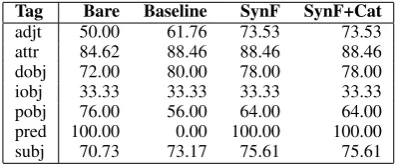
The addition of subcategorization information in the FDGs also contributes to the improvement, al-most in all the cases, in Spanish as well as in Cata-lan (Tables 10 and 11). The use of FDGs without subcategorization involves a decrease in the recall most of times.
In Spanish, theBaselinegrammar contains very generic rules to capture adjuncts and more fine-grained subcategorization classes restrict these rules. For this reason, the recall slightly drops in
SynF and SynF+Cat. As observed in the preci-sion metric (Section 5.5), small populated classes related to predicative arguments make recall drop in the baseline. Consequently, generic rules for predicative labelling in the Bare grammar and better populated predicative classes in SynF and
SynF+Catallows a recovery in recall.
FDGs in Catalan show a similar tendency. In theBaregrammar, prepositional objects and pred-icatives are better captured than in the baseline be-cause the lack of subcategorization information al-lows rules to apply in a more irrestrictive way. On the other hand, the addition of subcategorization information does not seem to help with capturing
[image:8.595.82.281.61.145.2]Tag Bare Baseline SynF SynF+Cat adjt 57.14 92.86 85.71 85.71 attr 80.00 100.00 100.00 100.00 dobj 83.72 83.72 83.72 83.72 iobj 33.33 33.33 44.44 44.44 pobj 85.00 85.00 90.00 90.00 pred 33.33 0.00 33.33 33.33 subj 75.51 81.63 83.67 83.67
Table 10: Labelling recall scores (%) in Spanish
Tag Bare Baseline SynF SynF+Cat adjt 50.00 61.76 73.53 73.53 attr 84.62 88.46 88.46 88.46 dobj 72.00 80.00 78.00 78.00 iobj 33.33 33.33 33.33 33.33 pobj 76.00 56.00 64.00 64.00 pred 100.00 0.00 100.00 100.00 subj 70.73 73.17 75.61 75.61
Table 11: Labelling recall scores (%) in Catalan
more direct objects. Lower results are due to some verbs missing.
Once again there are no significant differences between SynF and SynF+Cat, which reinforces the idea that grammatical categories do not pro-vide new information for capturing new argument and adjuncts.
5.7 Analysis of the results
The whole set of experiments demonstrate that subcategorization improves significantly the per-formance of the rule-based FDGs.
However, some arguments, such as the prepo-sitional object and the predicative, are difficult to capture without subcategorization information. Meanwhile, there are others, such as the attribute, that do not need to be handled with subcategoriza-tion classes.
Proper subcategorization information also con-tributes to capture more arguments and adjuncts. The recall scores are stable among the grammars that use subcategorization information. Secondly, most of these scores are medium-high precision.
[image:8.595.317.515.182.265.2]classes because it can be redundant, such as the combination of syntactic function and grammati-cal category.
The CompLex-VS lexicon still needs the inclu-sion of new verbs, since some arguments for verbs missing in the lexicon are not captured properly.
6 Conclusions
This paper presented two rule-based dependency grammars in Spanish and Catalan for the FreeLing NLP library.
Besides the grammars, a new subcategoriza-tion lexicon, CompLex-VS, has been designed us-ing frames acquired from the SenSem Corpus. The new frames have been integrated in the argu-ment/adjunct recognition rules of the FDGs.
A set of experiments has been carried out to test how the subcategorization information improves the performance of these grammars.
The results show that subcategorization frames ensure a high accuracy performance. In most cases, the old CompLex-VS frames and the new CompLex-VS frames show an improvement.
However, the increment is more evident in some arguments –such as the prepositional object and the predicative– than others, like the complement in attributive verbs. These results indicate that some arguments necessarily need subcategoriza-tion informasubcategoriza-tion to be disambiguated, while others can be disambiguated just with syntactic informa-tion.
Furthermore, the new frames of CompLex-VS provide better results than the initial ones. Therefore, more fine-grained frames (CompLex-SynF) contribute to raise the accuracy. Despite this evidence, fine-grained classes do not neces-sarily mean improvement of the parser perfor-mance. The most fine-grained lexicon (CompLex-SynF+Cat), which combines syntactic function and grammatical category information, neither im-proves nor worsens the results of the FDGs.
These conclusions are built on a small set of test data. Although it is a controlled and representative evaluation data set, these results need to be con-trasted with a larger evaluation data set.
It would be interesting to evaluate how the pars-ing performance improves while subcategoriza-tion informasubcategoriza-tion is added incrementally.
Acknowledgments
This research arises from the research project SKATeR (Spanish Ministry of Economy and Competitiveness, TIN2012-38584-C06-06 and TIN2012-38584-C06-01).
References
L. Alonso, I. Castell´on, and N. Tincheva. 2007. Ob-taining coarse-grained classes of subcategorization patterns for Spanish. InProceedings of the Interna-tional Conference Recent Advances in Natural Lan-guage Processing.
`A. Alsina, T. Badia, G. Boleda, S. Bott, `A. Gil, M. Quixal, and O. Valentn. 2002. CATCG: Un sistema de an´alisis morfosint´actico para el catal´an.
Procesamiento del Lenguaje Natural, 29.
J. Aparicio, M. Taul´e, and M.A. Mart´ı. 2008. AnCora-Verb: A Lexical Resource for the Semantic Anno-tation of Corpora. In Proceedings of the Sixth In-ternational Conference on Language Resources and Evaluation.
J. Atserias, E. Comelles, and A. Mayor. 2005. TXALA un analizador libre de dependencias para el castel-lano. Procesamiento del Lenguaje Natural, 35. M. Ballesteros and J. Nivre. 2012. MaltOptimizer: A
System for MaltParser Optimization. In Proceed-ings of the Eight International Conference on Lan-guage Resources and Evaluation.
E. Bick. 2006. A Constraint Grammar-Based Parser for Spanish. InProceedings of TIL 2006 - 4th Work-shop on Information and Human Language Technol-ogy.
M.R. Brent. 1993. From Grammar to Lexicon: Un-supervised Learning of Lexical Syntax. Computa-tional Linguistics, 19(2).
H. Calvo and A. Gelbukh. 2011. DILUCT: An´alisis Sint´actico Semisupervisado Para El Espa˜nol. Edi-torial Academica Espanola.
X. Carreras, M. Surdeanu, and L. M`arquez. 2006. Projective Dependency Parsing with Perceptron. In
Proceedings of the Tenth Conference on Computa-tional Natural Language Learning.
X. Carreras. 2007. Experiments with a Higher-Order Projective Dependency Parser. In Proceedings of the CoNLL Shared Task Session of EMNLP-CoNLL 2007.
J. Carroll, G. Minnen, and T. Briscoe. 1998. Can Subcategorisation Probabilities Help a Statistical Parser? In Proceedings of the 6th ACL/SIGDAT Workshop on Very Large Corpora.
M. Civit. 2003. Criterios de etiquetaci´on y desam-biguaci´on morfosint´actica de corpus en espa˜nol. In
Colecci´on de Monograf´ıas de la Sociedad Espa˜nola para el Procesamiento del Lenguaje Natural: 8. So-ciedad Espa˜nola para el Procesamiento del Lenguaje Natural.
M. Collins and T. Koo. 2005. Discriminative Rerank-ing for Natural Language ParsRerank-ing. Computational Linguistics, 31(1).
A. Fern´andez and G. V`azquez. 2014. The SenSem Corpus: an annotated corpus for Spanish and Cata-lan with information about aspectuality, modality, polarity and factuality. Corpus Linguistics and Lin-guistic Theory, 10(2).
A. Fern´andez, G. Vazquez, P. Saint-Dizier, F. Bena-mara, and M. Kamel. 2002. The VOLEM Project: A Framework for the Construction of Advanced Multilingual Lexicons. In Proceedings of the Lan-guage Engineering Conference.
A. Ferr´andez and L. Moreno. 2000. Slot Unification Grammar and Anaphora Resolution. In N. Nicolov and R. Mitkov, editors, Recent Advances in Natu-ral Language Processing II. Selected papers from RANLP 1997. John Benjamins Publishing Co. T. J¨arvinen and P. Tapanainen. 1998. Towards an
im-plementable dependency grammar. InProceedings of Workshop on Processing of Dependence-Based Grammars, CoLing-ACL’98.
D. Klein and C.D. Manning. 2003. Accurate Unlexi-calized Parsing. InProceedings of the 41st Annual Meeting on Association for Computational Linguis-tics - Volume 1.
A. Korhonen, Y. Krymolowski, and Z. Marx. 2003. Clustering Polysemic Subcategorization Frame Dis-tributions Semantically. InProceedings of the 41st Annual Meeting of the Association for Computa-tional Linguistics.
D. Lin. 1998. Dependency-Based Evaluation of MINI-PAR. InWorkshop on the Evaluation of Parsing Sys-tems, First International Conference on Language Resources and Evaluation.
M. Lloberes, I. Castell´on, and L. Padr´o. 2010. Spanish FreeLing Dependency Grammar. InProceedings of the Seventh Conference on International Language Resources and Evaluation.
M. Lloberes, I. Castell´on, L. Padr´o, and E. Gonz`alez. 2014. ParTes. Test Suite for Parsing Evaluation.
Procesamiento del Lenguaje Natural, 53.
C.D. Manning. 1993. Automatic Acquisition of a Large Subcategorization Dictionary from Corpora. In Proceedings of the 31st Annual Meeting of the Association for Computational Linguistics.
M. Marimon, N. Bel, and L. Padr´o. 2014. Automatic Selection of HPSG-parsed Sentences for Treebank Construction. Computational Linguistics, 40(3).
I.A. Mel’ˇcuk. 1988. Dependency Syntax: Theory and Practice. State U. Press of NY.
S.A. Mirroshandel, A. Nasr, and B. Sagot. 2013. En-forcing Subcategorization Constraints in a Parser Using Sub-parses Recombining. InNAACL 2013 -Conference of the North American Chapter of the Association for Computational Linguistics.
J. Nivre, J. Hall, J. Nilsson, G. Eryiˇgit, and S. Marinov. 2006. Labeled Pseudo-projective Dependency Pars-ing with Support Vector Machines. InProceedings of the Tenth Conference on Computational Natural Language Learning.
J. Nivre, J. Hall, S. K¨ubler, R. McDonald, J. Nilsson, S. Riedel, and D. Yuret. 2007. The CoNLL 2007 Shared Task on Dependency Parsing. In Proceed-ings of the CoNLL Shared Task Session of EMNLP-CoNLL 2007.
R. O’Donovan, M. Burke, A. Cahill, J. Van Genabith, and A. Way. 2005. Large-Scale Induction and Evaluation of Lexical Resources from the Penn-II and Penn-III Treebanks. Computational Linguistics, 31(3).
L. Padr´o and E. Stanilovsky. 2012. Freeling 3.0: Towards wider multilinguality. In Proceedings of the Eight International Conference on Language Re-sources and Evaluation.
A. Sarkar and D. Zeman. 2000. Automatic Extraction of Subcategorization Frames for Czech. In Proceed-ings of the 18th Conference on Computational Lin-guistics - Volume 2.
D. Sleator and D. Temperley. 1991. Parsing English with a Link Grammar. InThird International Work-shop on Parsing Technologies.
L. Tesni`ere. 1959. El´ements de syntaxe structurale. Klincksieck.