Proceedings of the Workshop on Open Infrastructures and Analysis Frameworks for HLT, pages 60–65, Dublin, Ireland, August 23rd 2014.
Command-line utilities for managing and exploring annotated corpora
Joel Nothman and Tim Dawborn and James R. Curran e -lab, School of Information Technologies
University of Sydney NSW 2006, Australia
{joel.nothman,tim.dawborn,james.r.curran}@sydney.edu.au
Abstract
Users of annotated corpora frequently perform basic operations such as inspecting the available annotations, filtering documents, formatting data, and aggregating basic statistics over a corpus. While these may be easily performed over flat text files with stream-processing UNIX tools,
similar tools for structured annotation require custom design. Dawborn and Curran (2014) have developed a declarative description and storage for structured annotation, on top of which we have built generic command-line utilities. We describe the most useful utilities – some for quick data exploration, others for high-level corpus management – with reference to comparableUNIX
utilities. We suggest that such tools are universally valuable for working with structured corpora; in turn, their utility promotes common storage and distribution formats for annotated text. 1 Introduction
Annotated corpora are a mainstay of language technology, but are often stored or transmitted in a variety of representations. This lack of standardisation means that data is often manipulated in anad hocmanner, and custom software may be needed for even basic exploration of the data, which creates a bottleneck in the engineer or researcher’s workflow. Using a consistent storage representation avoids this problem, since generic utilities for rapid, high-level data manipulation can be developed and reused.
Annotated text processing frameworks such as GATE (Cunningham et al., 2002) and UIMA (Lally
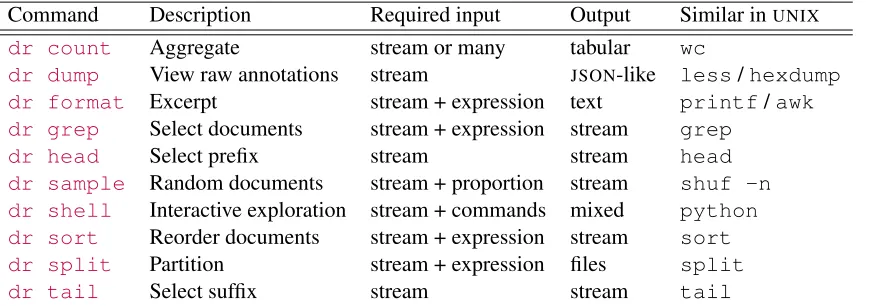
et al., 2009) provide a means of implementing and combining processors over collections of annotated documents, for which each framework defines a serialisation format. Developers using these frameworks are aided by utilities for basic tasks such as searching among annotated documents, profiling processing costs, and generic processing like splitting each document into many. Such utilities provide a means of quality assurance and corpus management, as well as enabling rapid prototyping of complex processors. The present work describes a suite of command-line utilities – summarised in Table 1 – designed for similar ends in a recently released document representation and processing framework,DOCREP
(Daw-born and Curran, 2014). DOCREPrepresents annotation layers in a binary, streaming format, such that
process pipelining can be achieved throughUNIX pipes. The utilities have been developed organically
as needed over the past two years, and are akin toUNIXutilities (grep,head,wc, etc.) which instead
operate over flat file formats. The framework and utilities are free and open source (MITLicence) and
are available athttps://github.com/schwa-lab/libschwa.
Some of our tools are comparable to utilities inUIMAandGATE, while others are novel. A number of
our tools exploit the evaluation of user-supplied Python functions over each document, providing great expressiveness while avoiding engineering overhead when exploring data or prototyping.
Our utilities makeDOCREPa good choice forUNIX-style developers who would prefer a quick
script-ing language over anIDE, but such modalities should also be on offer in other frameworks. We believe
that a number of these utilities are applicable across frameworks and would be valuable to researchers and engineers working with manually and automatically annotated corpora. Moreover, we argue, the availability of tools for rapid corpus management and exploration is an important factor in encouraging users to adopt common document representation and processing frameworks.
2 Utilities for managing structured data
Data-oriented computing tends to couple data primitives with a declarative language or generic tools that operate over those primitives. UNIXprovides tools for operating over paths, processes, streams and
textual data. Among them arewcto count lines and words, andgrepto extract passages matched by a regular expression; piped together, such utilities accomplish diverse tasks with minimal development cost. Windows PowerShell extends these notions to structured .NET objects (Oakley, 2006); Yahoo!
Pipes (Yahoo!, 2007) provides equivalent operations overRSSfeeds;SQLtransforms relational data; and XSLT(Clark, 1999) orXQuery (Chamberlin, 2002) makeXMLmore than mere markup.
Textual data with multiple layers of structured annotation, and processors over these, are primitives of natural language processing. Such nested and networked structures are not well represented as flat text files, limiting the utility of familiarUNIX utilities. By standardising formats for these primitives,
and providing means to operate over them, frameworks such as GATE and UIMA promise savings in
development and data management costs. These frameworks store annotated corpora withXML, so users
may exploit standard infrastructure (e.g.XQuery) for basic transformation and aggregation over the data.
Generic XML tools are limited in their ability to exploit the semantics of a particular XML language,
such that expressing queries over annotations (which include pointers, spatial relations, etc.) can be cumbersome. LT-XML(Thompson et al., 1997) implements annotators using standardXMLtools, while
Rehm et al. (2008) present extensions to anXQuery implementation specialised to annotated text.
Beyond generic XML transformation, UIMA and GATE and their users provide utilities with broad
application for data inspection and management, ultimately leading to quality assurance and rapid de-velopment within those frameworks. Both GATE and UIMA provide sophisticated graphical tools for
viewing and modifying annotations; for comparing parallel annotations; and for displaying a concor-dance of contexts for a term across a document collection (Cunningham et al., 2002; Lally et al., 2009). Both also provide means of profiling the efficiency of processing pipelines. The EclipseIDE serves as
a platform for tool delivery and is comparable to theUNIXcommand-line, albeit more graphical, while
providing further opportunities for integration. For example,UIMAemploys Java Logical Structures to
yield corpus inspection within the Eclipse debugger (Lally et al., 2009).
Generic processors in these frameworks include those for combining or splitting documents, or copy-ing annotations from one document to another. The community has further built tools to export corpora to familiar query environments, such as a relational database or Lucene search engine (Hahn et al., 2008). The uimaFITlibrary (Ogren and Bethard, 2009) simplifies the creation and deployment ofUIMA
proces-sors, but to produce and execute a processor for mere data exploration still has some overhead.
Other related work includes utilities for querying or editing treebanks (e.g. Kloosterman, 2009), among specialised annotation formats; and for working with binary-encoded structured data such as Protocol Buffers (e.g. protostuff1). Like these tools and those within UIMA andGATE, the utilities presented in
this work reduce development effort, with an orientation towards data management and evaluation of arbitrary functions from the command-line.
3 Common utility structure
For users familiar withUNIX tools to process textual streams, implementing similar tools for working
with structuredDOCREPfiles seemed natural. Core utilities are developed in C++, while others are able
to exploit the expressiveness of interpreted evaluation of Python. We describe a number of the tools according to their application in the next section; here we first outline common features of their design.
Invocation andAPI Command-line invocation of utilities is managed by a dispatcher program, dr, whose operation may be familiar from thegitversioning tool: an invocation ofdr cmddelegates to a command nameddr-cmd where found on the user’sPATH. Together with utility developmentAPIs in
both C++ and Python, this makes it easy to extend the base set of commands.2 1https://code.google.com/p/protostuff/
Command Description Required input Output Similar inUNIX dr count Aggregate stream or many tabular wc
dr dump View raw annotations stream JSON-like less/hexdump dr format Excerpt stream + expression text printf/awk dr grep Select documents stream + expression stream grep
dr head Select prefix stream stream head
dr sample Random documents stream + proportion stream shuf -n dr shell Interactive exploration stream + commands mixed python dr sort Reorder documents stream + expression stream sort dr split Partition stream + expression files split
[image:3.612.95.530.37.190.2]dr tail Select suffix stream stream tail
Table 1: Some useful commands and comparableUNIXtools, including required input and output types.
Streaming I/O As shown in Table 1, most of ourDOCREP utility commands take a single stream of
documents as input (defaulting tostdin), and will generally output either plain text or anotherDOCREP
stream (tostdoutby default). This parallels the UNIXworkflow, and intends to exploit its constructs
such as pipes, together with their familiarity to aUNIX user. This paradigm harnesses a fundamental
design decision in DOCREP: the utilisation of a documentstream, rather than storing a corpus across
multiple files.
Self-description for inspection Generic command-line tools require access to theschemaas well as the data of an annotated corpus. DOCREPincludes a description of the data schema along with the data
itself, making such tools possible with minimal user input. Thus by reading from a stream, fields and annotation layers can be referenced by name, and pointers across annotation layers can be dereferenced.3
Extensions to this basic schema may also be useful. For many tools, a Python class (on file) can be referenced that providesdecorations over the document: in-memory fields that are not transmitted on the stream, but are derived at runtime. For example, a document with pointers from dependent to gover-nor may be decorated with a list of dependents on each govergover-nor. Arbitrary Python accessor functions (descriptors) may similarly be added. Still, for many purposes, the self-description is sufficient.
Custom expression evaluation A few of our utilities rely on the ability to evaluate a function given a document. The suite currently supports evaluating such functions in Python, providing great flexibility and power.4 Their input is an object representing the document, and its offset (0 for the first document
in a stream, 1 for the second, etc.). Its output depends on the purpose of the expression, which may be for displaying, filtering, splitting or sorting a corpus, depending on the utility in use, of which examples appear below. Often it is convenient to specify an anonymous function on the command-line, a simple Python expression such aslen(doc.tokens) > 1000, into which local variablesdoc(document object) andind(offset index) are injected as well as built-in names likelen. (Python code is typeset in blue.) In some cases, the user may want to predefine a library of such functions in a Python module, and may then specify the path to that function on the command-line instead of an expression.
4 Working withDOCREPon the command-line
Having described their shared structure, this section presents examples of the utilities available for work-ing with DOCREP streams. We consider three broad application areas: quality assurance, managing
corpora, and more specialised operations.
3This should be compared toUIMA’s Type System Descriptions, and uimaFIT’s automatic detection thereof.
4.1 Debugging and quality assurance
Validating the input and output of a process is an essential part of pipeline development in terms of quality assurance and as part of a debugging methodology. Basic quality assurance may require viewing the raw content contained on a stream: schema, data, or both. This could ensure, for instance, that a user has received the correct version of a corpus from a correspondent, or that a particular field was used as expected. SinceDOCREPcentres on a binary wire format,dr dump(cf.UNIX’shexdump) provides a
decoded textual view of the raw content on a stream. Optionally, it can provide minimal interpretation of schema semantics to improve readability (e.g. labelling fields by name rather than number), or can show schema details to the exclusion of data.
For an aggregate summary of the contents of a stream,dr countis a versatile tool. It mirrorsUNIX’s wcin providing the basic statistics over a stream (or multiple files) at different granularities. Without any arguments,dr countoutputs the total number of documents on standard input, but the number of annotations in each store (total number of tokens, sentences, named entities, etc.) can be printed with flag
-a, or specific stores with-s. The same tool can produce per-document (as distinct from per-stream) statistics with-e, allowing for quick detection of anomalies, such as an empty store where annotations were expected.dr countalso doubles as a progress meter, where its input is the output of a concurrent corpus processor, as in the following example:
my-proc < /path/to/input | tee /path/to/output | dr count -tacv 1000
Here, the options-acvnoutput cumulative totals over all stores everyndocuments, while-tprefixes each row of output with a timestamp.
Problems can often be identified from only a small sample of documents. dr head (cf. UNIX’s head) extracts a specified number of documents from the beginning of a stream, defaulting to 1.
dr sampleprovides a stochastic alternative, employing reservoir sampling (Vitter, 1985) to efficiently draw a specified fraction of the entire stream. Its output can be piped to processing software for smoke testing, for instance. Such tools are obviously useful for a binary format; yet it is not trivial to split on document boundaries even for simple text representations like theCONLLshared task format.
4.2 Corpus management
Corpora often need to be restructured: they may be heterogeneous, or need to be divided or sampled from, such as when apportioning documents to manual annotators. In other cases, corpora or annotations from many sources should be combined.
As with theUNIXutility of the same name,dr grephas many uses. Here it might be used to extract
a particular document, or to remove problematic documents. The user provides a function that evaluates to a Boolean value; where true, an input document is reproduced on the output stream. Thus it might extract a particular document by its identifier, all documents with a minimum number of words, or those referring to a particular entity. Note, however, that like its namesake, it performs a linear search, while a non-streaming data structure could provide fast indexed access; each traversed document is (at least partially) deserialised, adding to the computational overhead.5dr grepis often piped intodr count,
to print the number of documents (or sub-document annotations) in a subcorpus.
dr splitmoves beyond such binary filtering. LikeUNIX’ssplit, it partitions a file into multiple,
using a templated filename. Indr split, an arbitrary function may determine the particular output paths, such as to split a corpus whose documents have one or more category label into a separate file for each category label. Thusdr split -t /path/to/{key}.dr py 'doc.categories'
evaluates each document’scategoriesfield via a Python expression, and for each key in the returned list will write to a path built from that key. In a more common usage,dr split k 10will assign documents by round robin to files named fold000.dr through fold009.dr, which is useful to derive ak-fold cross-validation strategy for machine learning. In order to stratify a particular field across
5Two commands that are not featured in this paper may allow for faster access: dr subsetextends upondr headto extract any number of documents with minimal deserialisation overhead, given their offset indices in a stream.dr offsets
the partitions for cross-validation, it is sufficient to first sort the corpus by that field usingdr split k. This is one motivation fordr sort, which may similarly accept a Python expression as the sort key, e.g.
dr sort py doc.label. As a special case,dr sort randomwill shuffle the input documents, which may be useful before manual annotation or order-sensitive machine learning algorithms.
The inverse of the partitioning performed bydr splitis to concatenate multiple streams. Given
DOCREP’s streaming design, UNIX’scat suffices; for other corpus representations, a specialised tool
may be necessary to merge corpora.
While the above management tools partition over documents, one may also operate on portions of the annotation on each document. Deleting annotation layers, merging annotations from different streams (cf.UNIX’scutandpaste), or renaming fields would thus be useful operations, but are not currently
available as aDOCREPcommand-line utility. Related tasks may be more diagnostic, such as identifying
annotation layers that consume undue space on disk;dr count --bytesshows the number of bytes consumed by each store (cf.UNIX’sdu), rather than its cardinality.
4.3 Exploration and transformation
Other tools allow for more arbitrary querying of a corpus, such as summarising each document.
dr formatfacilitates this by printing a string evaluated for each document. The tool could be used to extract a concordance, or enumerate features for machine learning. The following would print each document’sidfield and its first thirty tokens, given a stream on standard input:
dr format py '"{}\t{}".format(doc.id, " ".join(tok.norm for tok in doc.tokens[:30]))'
We have also experimented with specialised tools for more particular, but common, formats, such as the tabular format employed in CoNLL shared tasks. dr conllmakes assumptions about the schema to print one token per line with sentences separated by a blank line, and documents by a specified delim-iter. Additional fields of each token (e.g. part of speech), or fields derived from annotations over tokens (e.g.IOB-encoded named entity recognition tags) can be added as additional columns using
command-line flags. However, the specification of such details on the command-command-line becomes verbose and may not easily express all required fields, such that developing anad hocscript to undertake this transformation may often prove a more maintainable solution.
Our most versatile utility makes it easy to explore or modify a corpus in an interactive Python shell. This functionality is inspired by server development frameworks (such as Django) that provide a shell specially populated with data accessors and other application-specific objects. dr shellreads docu-ments from an input stream and provides a Python iterator over them nameddocs. If an output path is specified on the command-line, a functionwrite_docis also provided, which serialises its argument to disk. The user would otherwise have the overhead of opening input and output streams and initialising the de/serialisation process; the time saved is small but very useful in practice, since it makes interactive corpus exploration cheap. This in turn lowers costs when developing complex processors, as interactive exploration may validate a particular technique. The following shows an interactive session in which the user prints the 100 lemmas with highest document frequency.
$ dr shell /path/to/input.dr
>>> from collections import Counter >>> df = Counter()
>>> for doc in docs:
... doc_lemmas = {tok.lemma for tok in doc.tokens} ... df.update(doc_lemmas)
...
>>> for lemma, count in df.most_common(100): ... print("{:5d}\t{}".format(count, lemma))
5 Discussion
DOCREP’s streaming model allows the reuse of existingUNIXcomponents such ascat,teeand pipes.
This is similar to the way in which choosing anXMLdata representation means users can exploit standard XMLtools. The specialised tools described above are designed to mirror the functionality if not names
of familiarUNIXcounterparts, making it simple forUNIXusers to adopt the tool suite.
No doubt, many users of Java/XML/Eclipse find command-line tools unappealing, just as a “UNIX
hacker” might be put off by monolithic graphical interfaces and unfamiliarXMLprocessing tools. Ideally
a framework should appeal to a broad user base; providing tools in many modalities may increase user adoption of a document processing framework, without which it may seem cumbersome and confining.
In this vein, a substantial area for future work withinDOCREPis to provide more graphical tools, and
utilities such as concordancing or database export that are popular within other frameworks. Further utilities might remove existing fields or layers from annotations; select sub-documents; set attributes on the basis of evaluated expressions; merge annotations; or compare annotations.
We have described utilities developed in response to a new document representation and processing framework, DOCREP. Similar suites deserve attention as an essential adjunct to representation
frame-works, and should encompass expressive tools and various paradigms of user interaction. When per-forming basic corpus manipulation, these utilities save substantial user effort, particularly by adopting a familiar interface. Such boons highlight the benefit of using a consistent annotated corpus representation. References
Donald D. Chamberlin. 2002. XQuery: An XML query language.IBM Systems Journal, 41(4):597–615. James Clark. 1999. XSL transformations (XSLT). W3C Recommendation, 16 November.
Hamish Cunningham, Diana Maynard, Kalina Bontcheva, and Valentin Tablan. 2002. GATE: A frame-work and graphical development environment for robust NLP tools and applications. InProceedings of the 40th Annual Meeting of the Association for Computational Linguistics (ACL), pages 168–175. Tim Dawborn and James R. Curran. 2014. docrep: A lightweight and efficient document representation
framework. InProceedings of the 25th International Conference on Computational Linguistics. Udo Hahn, Ekaterina Buyko, Rico Landefeld, Matthias Mühlhausen, Michael Poprat, Katrin Tomanek,
and Joachim Wermter. 2008. An overview of JCoRe, the JULIE lab UIMA component repository. InProceedings of LREC’08 Workshop ‘Towards Enhanced Interoperability for Large HLT Systems: UIMA for NLP’, pages 1–7.
Geert Kloosterman. 2009.An overview of the Alpino Treebank tools. http://odur.let.rug.nl/ vannoord/alp/Alpino/TreebankTools.html. Last updated 19 December.
Adam Lally, Karin Verspoor, and Eoric Nyberg. 2009.Unstructured Information Management Architec-ture (UIMA) Version 1.0. OASIS Standard, 2 March.
Andy Oakley. 2006. Monad (AKA PowerShell): Introducing the MSH Command Shell and Language. O’Reilly Media.
Philip Ogren and Steven Bethard. 2009. Building test suites for UIMA components. InProceedings of the Workshop on Software Engineering, Testing, and Quality Assurance for Natural Language Processing (SETQA-NLP 2009), pages 1–4.
Georg Rehm, Richard Eckart, Christian Chiarcos, and Johannes Dellert. 2008. Ontology-based XQuery’ing of XML-encoded language resources on multiple annotation layers. In Proceedings of the Sixth International Conference on Language Resources and Evaluation (LREC’08).
Henry S. Thompson, Richard Tobin, David McKelvie, and Chris Brew. 1997. LT XML: Software API and toolkit for XML processing. http://www.ltg.ed.ac.uk/software/.
Jeffrey S. Vitter. 1985. Random sampling with a reservoir.ACM Transactions on Mathematical Software (TOMS), 11(1):37–57.