Thesis by Jay- Chung Chen
In Partial Fulfillment of the Requirements For the Degree of
Doctor of Philosophy
California Institute of Technology Pasadena, California
1972
ACKNOWLEDGMENT
The author is sincerely grateful to Dr. C. D. Babcock for the patient guidance and endless discussions provided by him during the course of this investigation. Throughout his graduate study, the author has benefited from the advice and counsel of Dr. E. E. Sechler; his continuous support is sincerely appreciated. The author is also indebted to Dr. D. A. Evensen of TRW, who made many helpful comments and suggestions. Thanks are also due Messrs. C. B. Hemphill and M. E. Jessey for their support in the experimental study, Mrs. Elizabeth Fox for typing the manuscript and Mrs. Betty Wood for the graphs and figures.
The author is employed by the Structur es, Dynamics and Materials Section (formerly Applied Mechanics Section) of the Jet Propulsion Laboratory. Their permission to undertake this study, financial support and understanding are gratefully acknowledged.
The large amplitude vibrations of a thin-walled cylindrical shell are analyzed using the Donnell's shallow-shell equations. A perturbation method is applied to reduce the nonlinear partial differential equations into a system of linear partial differential equations. The simply-supported boundary condition and the cir-cumferential periodicity condition are satisfied. The resulting solution indicates that in addition to the fundamental modes, the response contains asymmetric modes as well as axisymmetric modes with the frequency twice that of the fundamental modes. In the previous investigations in which the Galerkins procedure was applied, only the additional axisymmetric modes were assumed.
Vibrations involving a single driven mode response are investigated. The results indicate that the nonlinearity is either softening or hardening depending on the mode. The vibrations involving both a driven mode and a companion mode are also in-vestigated. The region where the companion mode participates in the vibration is obtained and the effects due to the participation of the companion mode are studied.
An experimental investigation is also conducted. The
results are generally in agreement with the theory. IINon-stationary' response is detected at some frequencies for large amplitude
TABLE OF CCNTENTS
PART TITLE PAGE
I Introduction 1
II Discussions of Equations of Motion 6
III Summ.ary of the Previous Investigations 14 22 IV Perturbation Method
4. 1 Nondimensionalization and Systems of Linear 23 Equations
4. 2 Solutions of Zero Order Equations 28 4.3 Solutions of First Order Equations 31 4.4 Response-Frequency Relationship from the
Second Order Equations 43
4. 5 Discussion of Results and Comparison with
Previous Investigations 53
V Experimental Analysis
59
5. 1 Test Specimen 60
5. 1. 1 Description of Test Shell 60 5. 1. 2 Determination of Shell Wall Thicknes s 61 5.1.3 Support Plate for Shell-Ring System 62 5. 1. 4 Comparison between the Shell- Ring
System and the Simply-Supported
Shell 62
5.2 Description of Test Set- Up 63
5. 3 Driven Mode Response 66
5.4 Response with Companion Mode Participation 67
5.5 Other Results of Interest 71
[image:4.573.89.500.27.741.2]PART
VI
TITLE PAGE
5.5. 3 Rotating of the Shell at Large Amplitude 72 Concluding Remarks
References Appendix A Appendix B Appendix C Appendix D Appendix E Appendix F Appendix G Appendix H Appendix I ' Table
Figures
' ,
74
75 78 85 88
95
97
98
101 106
111
LIST OF FIGURES
FIGURE TITLE PAGE
I Shell geometry and coordinate system 116
2 Element of cylindrical shell 117
3 Driven mode and companion mode 118
4 Response-frequency relationship for driven
mode only 119
5 Response-frequency relationship of driven
mode m
=
1, n=
6 1206 Response-frequency relationship of driven
mode m
=
1, n=
1 0 1217 Response-frequency relationship of driven
mode m
=
1, n=
12 1228 Backbone curves for various driven modes 123
9 Nonlinearity parameter 124
10 Nonlinearity parameter 125
11 Locus of vertical tangent of driven mode
response 126
12 ~ Response-frequency relationship of driven
mode m
=
1, n=
6 12713 Response-frequency relationship of driven
mode m
=
1, n=
6 12814 Response-frequency relationship of companion
mode m
=
1, n=
6 129FIGURE TITLE 16 Axisymmetric mode g2(s)
17 Axisymmetric mode for
~
=
2,~
=
O. 0025 18 Comparison of nonlinearity parameter 19 Comparison of nonlinearity parameter and20 21 22 23 24 25 26
percentage difference
Comparison of nonlinearity
Standing and traveling wave response Properties of shell-ring system Shell specimen and supporting plate
Frequency spectrum of shell specimen
Calculated axial mode shapes of shell specimen Calibration of reluctance pickup
27 Arrangement of acoustic driver and reluctance pickup
28 Schematic diagram of instrumentation arrangement
29 .. Instrumentation set-up
30 Response-frequency relationship of driven mode m = 1, n = 6
31 Response-frequency relationship of driven mode m = 1, n = 12
32 Response-frequency relationship of driven mode m
=
1, n=
1033 Mode shapes for m
=
1, n=
6FIGURE
LIST OF FIGURES (Cont'd) TITLE
34 Response-frequency relationship of driven mode m
=
1, n=
635 36 37
Mode shapes for m
=
1, n=
6Lissajous figure at antinode of cos(ne) Lissajous figure at node of sin(ne)
38 Response-frequency relationship of companion mode m
=
1, n=
639 Response-frequency relationship of driven mode with additional constraint
40 Response-frequency relationship of driven mode m
=
1, n=
641 Response-frequency relationship of driven mode m = 1, n = 6
42 Drifting phenomenon of response 43 Traveling wave phenomenon 44 Region of jump phenomena
45 Region of companion mode participation
PAGE
149
150
151
151
152
153
154
SYMBOLS
a
A(T)
b
B(T)
C
E
f
F
G
I---G4
GI---G4 gO----g6 gO----g6 h
k
L
DEFINITION Amplitude of the driven mode Driven mode
Amplitude of the companion mode Companion mode
Coefficient of viscous damping Critical damping
Constant coefficients of first order particular solution Plate bending rigidity
Young's modulus
Amplitude of external forcing function Stress function
Constants in the second order equations
First order complementary solution
Shell thickness
Length to radius ratio Length of the shell M
x' M ,M y xy Bending moment
m Half axial wave number
n Circumferential wave number Nx ' Ny' Nxy Stress resultant
q(x, y, t) External forcing function
r Nondimens ional bending rigidity
=
hSYMBOL
R
S
t
T u
U
v
v
w
w
m
x
y
z
X,Y
a.
",a,,,
y
p
NOMENCLATURE (Cont'd) DEFINITION
Shell radius
Nondimensional axial coordinate Time
Period of vibration Axial displacement
Nondimensional axial displacement Circumferential displacement
Nondimensional circumferential displacement Radial displacement
Maximum radial displacement
Nondimens ional radial displacement First order particular solution First order complementary solution Longitudinal coordinate
Cir cumfer ential coor dinate Radial coordinate
Constants
Nonlinear parameter
Constants in the second order equations First order particular solution
Percentage of critical damping Nondimensional stress function Density
SYMBOL
w
ax'
a
y ' axy£x' £y' £xy
v
V4
T
DEFINITION
Nondimensional frequency parameter Circumferential wave length
Perturbation values of nondimensional frequency parameter
Frequency
Normalized frequency Aspect rat io
Small perturbation parameter Stresses
Strains
Poisson's ratio
Biharmonic operator
Phase angle of the driven mode Phas e angle of the companion mode Constant
Nondimensional time
Nondimensional circumferential coordinate
I. INTRODUCTION
Thin walled cylindrical shells have a wide application in
modern aerospace vehicle structural design. With increasing vehicle speed and more powerful propulsion systems, the dynamic environment imposed on the vehicle structure becomes severe. Hence there is a growing appreciation of the importance of nonlinear effects in deter-mining the stability and response of thin walled shells under dynamic loading. The nonlinearities considered here are of geometric nature, namely the large amplitude in the shell wall deformation makes the nonlinear relations between the strain and displacement necessary. However, the amplitude is small enough such that the strain itself is considered infinitesimal. Since the amplitude is of the order of shell thickness the nonlinear terms are small in the governing equation. But the effects due to this small nonlinearity can be quite pronounced as has been demonstrated in the buckling problem of cylindrical shells under axial compression.
The nonlinear effects of large amplitude vibration of cylindrical shells are demonstrated by two phenomena; namely, the response-frequency relationship in the vicinity of a resonant response-frequency and the occurrence of traveling wave response. Contrasted to the linear vibration in which the resonant frequency is independent of its amp-litude of vibration, the resonant frequency in nonlinear vibration is
acteristic in the spring (Ref. 1).
In the linear vibration of cylindrical shells, the response to a stationary periodic excitation is in the form of a standing wave. This standing wave will be in conformity with the distribution of the external excitation. In case of the external force applied on a dis-crete point, the standing wave will be symmetrical with respect to the point of application. In other words, the response will be a cosine function in both circumferential and axial direction with the origin at point of application. In the present investigation this standing wave will be referred to as a "driven mode. II
A striking feature of the results of experimental observation of supersonic cylindrical shell flutter (Ref. 2) is the fact that" almost all the flutter modes observed in these experiments were of the cir-cumferentia1ly traveling-wave type." Such traveling waves are not predicted by linear theory and it was suggested in Ref. 2 that nonline-arities in the shell were responsible for the phenomenon. A circum-ferentially traveling wave in cylindrical shell response can be
decomposed into a driven mode standing wave and another standing wave which is circumferentially 90 degrees out of phase with the
driven mode (which will be referred to as a II companion mode ", in this
investigation). Therefore, the occurrence of the circumferentially traveling wave is a result of the companion mode being excited due
to the nonlinearities in the shell response. Related studies on nonlinear vibrations of circular rings (Ref. 3) and circular plates (Ref. 4) have
nonlinear forced vibrations of axisymmetric structures. In addi-t ion addi-t o addi-t h e sup e r son i c c Y 1 i n d ric a 1 she 11 f 1 u t t e r, the traveling wave responses have been observed in the sloshing-vibration of thin cylindrical shells (Ref. 5).
The problem of large amplitude vibration of cylindrical shells has given rise to a number of theoretical studies (Refs. 7 to 17). The basic approach used in these studies (except Ref. 17) is to assume the shape of the deflection in space, that is, the shape of the vibration mode, sometimes referred to as generalized coordinates, and then to derive a set of nonlinear ordinary differential equations by using Galerkin's approximation procedure. Subsequently, the nonlinear ordinary differential. equations are solved to obtain the response-frequency relationship.
The Galerkin's method is a very powerful approximation method that reduces a system of nonlinear partial differential equa-tions. into a system of nonlinear ordinary differential equations which become manageable. Also the Galerkiil' 8 method provides insight
to the nonlinear coupling of various vibration modes during the solu-tion procedure. However, its results are highly dependent on the assumed deflection shape. Completely different results could be obtained by a small difference in the assumed deflection shape as
can be seen from the previous investigations on this subject. Even-sen (Ref. 18) and Dowell (Ref. 13) have pointed out that the axisym-metric modes in the assumed deflection shape play an important role in the outcome of the results. Yet there is no standard for selecting
bration equations of cylindrical shells, namely the midplane circum-ferential displacement must satisfy the periodicity condition in the circumferential direction. This periodicity condition assures that the circumferential displacement will be continuous and single-valued whenever the circumferential coordinate moves by 2",. This constraint is identically satisfied in the linear cylindrical shell
theory once the periodicity condition is satisfied by the radial (lateral) displacement due to the linear relation between the circumferential displacement and radial displacement. However, in the nonlinear theory of cylindrical shells, the circumferential and radial displace-ments are nonlinearly related and circumferentially periodicity of radial displacement does not necessarily enforce the same condition on the circumferential displacement. In general, for nonlinear vi-brations of cylindrical shells the radial displacement is solved
The present investigation will apply a perturbation technique using the ratio of maximwn radial displacement to the radius of the shell as a small parameter to reduce the nonlinear partial differen-tial equations into a system of linear pardifferen-tial differendifferen-tial equations. Then the solutions may be obtained without the handicap of selecting a particular set of deflections in the analysis. The usual response-frequency relationship will be calculated and the occurrence of traveling wave response will also be investigated. The resulting deflection shape will be discussed and compared with the previous studies to establish the important axisymmetric modes participating in the nonlinear vibration. This may provide a reasonable method for selecting the assumed deflection shape in future analyses using Galerkin's method which by far is the simplest method used by previous investigations in nonlinear vibration of shells.
In the following, a brief summary of previous investigations will be given and then the present investigation will be described. For the convenience of summary, the equations of motion will be discussed first. Finally an experimental investigation will be
In m.ost of the analyses of nonlinear vibration of cylindrical shells, the well-known Donnell's shallow-shell equations have been us ed be caus e of their s im.plicity. However, the Donnell's equations are of an approximate nature, a sim.plification of the full nonlinear shell equations in which the following quantities are neglected:
1. Inplane displacem.ents in the curvature relations
2. Transver s e shear for ce in the inplane equilibrium. equations 2
3. Order
(~)
in the inplane shear force(i.
e.,
N=
N )xy yx 4. Tangential inertia 5. Rotary inertia
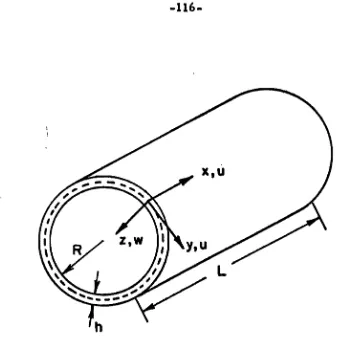
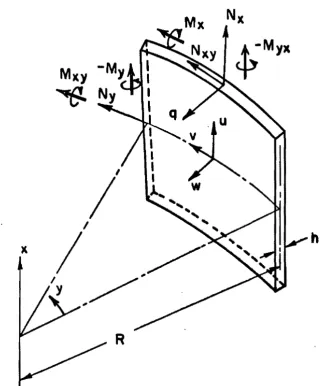
The Donnell's shallow-shell equations are often derived (Refs. 7 and 8) and are sim.ply sum.m.arized here: The coordinate system., displacem.ents and the resultant forces, m.om.ents are shown in Fig. 1 and Fig. 2 respectively. The equilibrium. equations are:
aN aN
~
ax
+
----E..ay
=
0 (2.1)(2.2)
(2. 3)
h/z
h/z
N
=
J
0 dz, N=
J
0 dz, x-h/z
xx
xy-h/z
xyh/z
N
=
J
0 dzY
-h/z
YY(Z.4)
h/z
M
=
J
0 zdz,x
xx
h/z
h/z
M
=
J
0 zdz. M=
J
0 zdzxy
-h/z
xy . Y-h/z
YY-h/z
The applied external load q(x. y. t) acts in the radial direction. The constitutive law for the cylindrical shell of isotropic linear elastic material is as follows:
o =
~
(E' + V E' )xx I-v xx YY
E
o
=-Z(E' +VE' )YY I-v YY xx (Z.5)
E E'
Z(I+V) xy
where E is Young's modulus and v is Poisson's ratio. The strain-displacement relations are approximated by
au
1 8wz
flw
E' = - + - ( - ) -z----:or
xx
ax
z ax
ax'
8v w 1 8w Z 8Zw
E' =
a -
R+
'Z (
~,J -z:-z
YY Y V7 8y
(Z.6)
ment relation (eqs. 2.6), the resultant forces and moments (eqs. 2.4) can be written in terms of displacements:
Eh au av w I
aw
2aw
2 N= -
{ -
+
v [ - - - ]+ - [(-)
+v (-) ]}x l_v2
ax
ay R 2ax
ay2
aw
2N -
---:--2
Eh {ftva
-R !!.+Vax
au+.!.[(aw) 2 ~,. +v(ax)]} (2.7)Y I-v Y V7
Eh ftv au
aw aw
Nxy
=
2(1+v)(ax
+ay
+ax
ay)where the shell bending rigidity D
=
2
12(1-v )
(2.8)
Using eqs. (2. 1), (2.2) and (2. 8), eq. (2. 3) can be rewritten as
(2.9)
4 a4 a4 a4 where V4 is a biharmonic operator V
=
ax4+
22
2 +"'4
Now by assuming a stress function F(:x:, y, t)
N :x:y
=-(2. 10)
The equilibrium equations (2. 1) and (2.2) are identically satisfied and eq. (2. 9) becomes
(2. 11)
On the other hand, from eqs. (2. 7) the compatibility equation can be obtained by eliminating the inplane displacements u, v as follows
(2. 12)
Equations (2. 11) and (2. 12) are generally referred to as Donnell's shallow-shell equations which have been used in the pre-vious investigation of nonlinear vibrations (except Refs. 11, 17).
The boundary conditions in this investigation are assUIned to be the "classical simply-supported" conditions, sometimes referred to as SSI/SSI conditions. Mathematically, they can be expressed as:
w
=
M :x:=
N :x:=
v=
0 at :x:=
0, L (2. 13)stresses must all satisfy the periodicity condition in the circumfer-ential dir ection. The dependent variables wand F in equations (Z.ll) and (Z.lZ) can be enforced to satisfy this periodicity condi-tion during the solucondi-tion procedure. However the periodicity of w and F is not sufficient for the other physical quantities to satisfy the periodicity condition as can be shown from eqs. (Z. 7) and (Z. 8). Therefore it is necessary that in addition to wand F, the circum-ferential displacement v must also be enforced to satisfy the cir-cumferential periodicity condition. (Note from eq. (Z. 7) that axial displacement u satisfies the circumferential periodicity condition whenever the circumferential displacement satisfies the same
condition. ) Hence
w(x, y, t)
=
w(x, y + Z".R, t) F(x, y, t)=
F(x, y+Z".R, t) vex, y, t) = vex, y+Z".R, t)(Z. l4a) (Z.14b) are the additional constraints that the solutions of differential equa-tions (Z. 11) and (Z. lZ) must satisfy. This circumferential periodicity condition is sometimes referred to as the continuity condition (Refs. 13, 14).
- .!!I. m1l'X
q(x, y, t) = f coswtcos R sin-,:;- (2.15)
since a "steady state" solution (note that It steady state" means
periodic in time) is sought, no initial conditions are neces sary.
In Donnell's shallow- shell equations the neglecting of inplane displacements in the curvature relations and transverse shear force in the inplane equilibrium equations is the result of shallow- shell approximation in which the circumferential wave length 2".R (n is
n
the circumferential wave number) of the deformation pattern is always small compared with the radius R. Essentially. it is saying that the curvature and inplane equilibrium of the cylindrical shell
2 2
th
n
t 1 t T t · I * t*a
ua
vare e same as a a p a e. angen la mer las
-Z
t-::z
areat
at
neglected because of the assumption that the flexural motion is
predominant in the present investigation. Rotary inertia is neglected because the wave lengths 2".R and 2L (m is the half axial wave
n m
number) are large compared to the shell thickness h.
EI Raheb (Ref. 19) has made a detailed comparison for linear vibration between the results of Donnell's equations and the "exact" equations of motion derived by KoUer (Ref. 20) based on
the Love-Kirchhoff hypothesis for shell theory in which all the quantities neglected in the Donnell's equations have been retained. He defined that the errors in frequency obtained by approximation as
e
=
w approx.
w
exact and concluded that:
- 1 (2. 16)
where r
=
hs
= m1l'R L m is half axial wave number.2. Maximum error due to neglecting tangential inertia is
for
n»
3 (2. 18)This error is more pronounced for small n which is the circumferen-tial wave number.
3. Error due to neglecting rotary inertia is
(Z. 19)
With these estimations in errors due to the approximations in Donnell's shallow-shell equations, the present investigation will be limited to shells with the following configuration:
L
R ~ 10 (Z. ZO)
Also the deformation pattern will be limited to
4 ~ n ~ 30 , 1 ~ m ~ 6 (2. ZI)
so as to keep the errors within the acceptable range.
For example, the typical error for a shell having
~
=
4~0
•L
R
=
Z, m=
I, n=
5, will bee
T
=
e l+
e Z+
E!3=
0.009979+
0.02+
0.000007Z:::::= 30/0
As can be seen, the largest error is caused by neglecting the tangential inertia. However, this error will be rapidly reduced for larger circumferential wave number n.
Although E1 Raheb ' s error estimation for Donnell' s shallow-shell equation has been made for the linear vibration, it is assumed that it will also be applicable to nonlinear vibrations. This will be true as long as the nonlinearity is small, as will be demonstrated later for the present investigation. Therefore the Donnell's
shallow-shell equations will be used for the analysis of nonlinear vibration of cylindrical shells within the limits specified by (2.20) and (2.21).
In a pioneering work, Reissner (Ref. 7) analyzed the problem of nonlinear vibration of cylindrical shell using Donnell's
shallow-shell equations (2. 11) and (2. 12) by as suming the deflection shape of the linear vibration. His results indicated that the nonlinearity could be either of the hardening or softening type, depending upon the geometry of the single half-wave or lobe chosen to be analyzed. Chu (Ref. 8) employed the same assumed mode shape as that of Reissner' s but analyzed somewhat differently. His results indicated that the non-linearity was always of the hardening type and could be strong in some cases. Cummings (Ref. 9) employed a Galerkin p'rocedure and found that the results varied with the region of integration. The results over a single half-wave or lobe were the same as those of Reissner. The results for a complete shell were similar to those of Chu. Thus, it appeared that Reissner's results were character-istic of curved panels whereas Chu's calculations were apparently applicable to complete cylindrical shells. These three analyses did not investigate the traveling wave solution and the boundary conditions were partially satisfied; also the circumferential periodicity condi-tion was violated by Chu (Ref. 8).
Nowinski (Ref. 10) applied Galerkin's procedure with an
Evensen solved a ring problem in considerable detail (Ref. 3) and subsequently investigated a cylindrical shell (Ref. 12). The mode shape Evensen assumed in his Galerkin procedure satisfied the cir-cumferential periodicity condition but the boundary conditions were partially satisfied as long as a simply supported condition was consid-ered. His results for the shell included the traveling wave response and a stability analysis which indicated the stability region of stand-ing wave response and travelstand-ing wave response.
Dowell (Ref. 13) made a similar analysis to that of Evensen wilha slightly different axisymmetric mode term in the assumed de-flection shape. In his analysis all the simply supported boundary conditions and circumierentially periodicity conditions were satis-fied "on the average. n Although no numerical results were given.
the modal equations obtained in the limiting case of L/R - 00 agreed
with that of ring equations and L/R - 0 agreed with that of plate equation.
Matsuzaki and Kobayashi (Refs. 15 and 16) carried out an analysis on a cylindrical shell with clamped ends. The method was similar to that of Evensen (Ref. 12). The results showed the non-linearity being of the softening type.
long cylindrical shell (periodic in axial direction). Their approach was to express three displacements in complete sets of normal mode
series and then the energy expression was obtained in terms of these series. Lagrange equations were used to establish the equilibrium conditions and a perturbation method was employed to determine the truncation of the infinite series. Response-frequency relationship traveling wave response and stability analysis were included in the results. Tangential inertia and transverse shear deformation were included in the energy expression.
It is of interest to contrast and compare the analyses of Refs. 8, 10, 12 and 13, since these studies used the same Donnell's shallow shell equations (eqs. 2. 11 and 2. 12) and considered the simply
supported end conditions (eq. 2. 13). Also these four studies rep-resent the major effort in the previous investigation on the problem of nonlinear vibration of cylindrical shells. In the following, their approach, satisfaction of boundary conditions and circumferential periodicity condition, and results will be summarized.
1. Chu (Ref. 8)
a) Assumed deflection shape:
w(x, y, t) ::: All (t)Sin
<r)COS(1t)
(3. 1)This is the mode shape of linear vibration. b) Approach:
deflection wand the solution of stress function Fare substituted into eq. (Z. 11) and the collection of the first harmonic terms gives a nonlinear ordinary differential equation which is subsequently solved by using elliptic integrals to obtain the response-frequency relationship. c) Boundary conditions: (at x
=
0 and L)Out of plane boundary conditions,
w
=
0, M =0x
Inplane bOuridary conditions
d) Circumferential periodicity condition: not satisfied. e) Results: hardening type of nonlinearity is found. Z. Nowinski (Ref. 10)
a) ;Assumed deflection shape:
w(x, y, t) = f(t)sin
~
sin!ft+
fo(t) (3. Z)An axisymmetric term is added to the assumed deflection shape. Stress function is obtained in a similar fashion as that of Chu.
b) Approach:
Eq. (3. Z) and stress function F are substituted into eq. (Z. 11) and then a Galerkin procedure is applied to reduce eq. (Z. 11) into an ordinary equation. The weighting func-tion chosen for the Galerkin procedure is sin m~ sin
1t
which effectively eliminates the coupling effect of £ (t)o
Out of plane bOWldary conditions
w =f. 0, M =0 x
Inp1ane bOWldary oonditions N x =f. 0, v:/: 0
d) Circumferential periodicity condition:
This condition is satisfied by determining f (t) in terms
o
of f(t).
e) Results: hardening type of nonlinearity is fOWld. 3. Evensen (Ref. 12):
a) Assumed deflection shape:
w(x, y, t)
=
[A(t)cosW+
B(t)sinW]
sin m.;x 2+
:R
[A 2(t)+
B2(t)] sin2rr;:"
(3.3)
The companion mode as well as the driven mode are considered. Also there are two terms in the
axisytn-. d ' .2m1l'X 1(1 2m1l'X) metrlC mo e smce sm -,:;-
=
2 -cos L b) Approach:Stress fWlctionF is obtained as a particular solution to eq. (2. 12) which is substituted into eq. (2.11) together with eq. (3. 3). Ga1erkin procedure is employed to re-duce eq. (2. 11) into two nonlinear ordinary equations.
This provides the coupling effect of the axisynunetric modes to the fundamental modes.
c) Boundary conditions: (at x
=
0 and L) Out of plane boundary conditions:w
=
0, M =f.: 0 xlnplane boundar y conditions: N =f.: 0, v =f.: 0
x
d) Circumferential periodicity conditions: satisfied. e) Results:
Type of nonlinearity is found depending on the" Aspect Ratio" (ratio of circumferential wave length to axial wave length). For small aspect ratio, the nonlinearity is of the softening type, for large aspect ratio the nonlinearity is of the hardening type. The traveling wave response and the stability problem are also studied.
4. Dowell (Ref. 13):
a) Assumed deflection shape:
w(x, y, t)
=
[A(t)cosIt
+B(t)sinltl
sin m~(3.4)
+A (t)sin~
o L
Here the coefficient of the axisymmetric mode is consid-ered as independent of the driven mode A(t) and companion mode B(t).
b) Approach:
(3. 5) This satisfies the equation V4F
=
O. N , Nand Nx y xy
are functions of tilne t only and are to be determined by considering the inplane boundary condition and circum-ferential periodicity conditions. Three nonlinear ordi-nary differential equations are obtained after employing the Galerkin procedure. The choice of the weighting functions is the same as that of Evens en.
c) Boundary conditions:
Out of plane boundary conditions:
w
=
0, M =0x
Inplane boundary conditions are satisfied "on the average;" 271"R L au
1 1
ax
dxdy=
0,o
0271"R
I
N dxdy=
0o
xyd) Circumferential periodicity condition is satisfied "on the average;"
L 271"R
av
Lf
J
-a
dydx=
I
[v(x, 271"Brv(x, 0)] dx=
0o
0y
0e) Results;
Numerical results are not given. But, in the limiting cases, the resulting differential equations converge to the equation of a plate for
i -
0 and the equation of a. f L
rmg or R
-00.
However, for R -L 00 and m even,between A(t), B(t) and A (t) and leads to a hardening o type nonlinearity. This is in contrast to the findings by Evensen (Ref. 3).
The conclusion emerging from these four previous studies clearly indicates the following:
1) The assumed deflection shape plays an important role in the analysis and the results are somewhat dictated by the as sumed deflection shape.
2) Specified boundary conditions are not enforced strictly in the previous studies. Evensen (Ref. 21) has shown that added inplane restraints may alter the response-frequency relationship.
3) Circumferential periodicity condition must be satisfied. One of the purposes of the present investigation is to avoid the necessity of assuming the deflection shape, instead the deflection shape will be obtained as a result of the perturbation technique. Boundary con-ditions and circumferential periodicity concon-ditions will be satisfied asymptotically with respect to a
One of the important methods for solving nonlinear differen-tial equations is the perturbation method. The use of this method was, in the early days, limited to astronomical calculations. But the important contributions of Poincar~ and later mathematicians have broadened the capability of the method to include a more general field of nonlinear mechanics.
This method is applicable to equations in which a small parameter is as sociated with nonlinear terms. In application, it consists of developing the desired quantities in powers of the small parameter multiplied by coefficients which are functions of the inde-pendent variable and determining the coefficients of the developments one by one, usually by solving a sequence of linear equations.
In nonlinear vibration of cylindrical shells, it would be natural to regard the amplitude of response as a quantity to be determined by the power series expansion of the small parameter. However by proceeding in this way a serious difficulty may be en-countered in the form of the so-called "secular terms," i. e •• terms which grow up indefinitely as t - 00. The appearance of the
a small parameter in the perturbation method. Then, elimination of secular terms in the solution will provide the frequency-response relationship.
First the small nondimensional parameter used in the power series expansion must be determined. In the vibration of cylindrical shells the maximum amplitude of response is of the order of shell thickness h. Since thin-walled shells
(~«
1) are considered, it seems natural that the small parameter E be chosen asw is the maximum radial displacement of the shell. m
w
m where R
4. 1 Nondimensionalization and Systems of Linear Equations
Before proceeding in applying the perturbation method, the differential equations must be rewritten in the nondimensional form. Also the effect of damping will·be included in the analysis by induc-ing a vis cous dampinduc-ing term in the equilibrium equation:
4
a
2aw
1a
2FDV w
+
pha~
+
~h
at
=
q(x,y,
t)+ R
ax
2(4. 1)
(4.2)
where C is the coefficient of linear viscous damping.
Next, let the nondimensional independent variables be de-fined as follows:
x
s
=
L'e-Y.
- R T=
wtwhere w is the frequency of the system.
are defined as follows:
W( s,
a,
T )=
w(x,y, t)
wm U(s,a,
T)V(s,
a,
T)=
u(x,y, t)
w
m,
=
vex,y,
t) wm
(4.4)
2
1-
v
q,(s,
a,
T)=
Ehw R F(x,y, t)
(4.5)m
where w is the maximum radial displacement. Also the following m
nondim.ensional quantities are defined:
'V =
£
,
c '
c
1 h
r = -
R\In
( 1 2)R2
Q(s,
a,
T)= -
v
2 q (x,y,
t) Ehc
= pwc o ' .-q(s, a,T)
=
w
h Q (s,a,
T)m
(4.6)
where w is the frequency of linear vibration of a cylindrical shell to o
be defined later.
(4.8) The boundary condition can be obtained as:
1 aZw aZw
.DE
w
=
(:-z
- Z+
II --::::-2) = Z=
V=
0 at s=
0, 1k as a9 a9
(4.9) The circumferential periodicity condition,
Z'II' Z'II'
f
as
avf
{I [1
~
aZcb] [
1 aw2n
-d9
=
:--z:-z
Z - II ~ + W -"2 E (a9) lJd9=
0,o
0 1-II k as a9(4. 10) eq. (4.10), is obtained from the first two equations of (2.7) by
I ' ' t ' au
e lmma mg
ax.
From equation (Z. 15), it is obvious that
q(s, 9, 'T) = f cos 'T cosn9 sinmll's (4.11)
Z Z
where f - (1-1I)R
£=
~ G- EhZ wm (4. lZ)
It is clear now that the nonlinear terms in eqs. (4.7), (4.8) and (4. 10) are multiplied by a small parameter E. The dependent variable and nondimensional frequency parameter X will be expanded into a power series of E as follows:
Z
W(s, 9, 'T,E )
=
w o(s, 9, 'T)+E WI (s, 9, 'T)+ E W Z(s, 9, 'T) +---(4. 13)
Z
---(4. 13)
Cont'd
Substituting eq. (4.13) into eqs. (4.7), (4.8) and (4.10) and equating the terms with equal powersof £, a system of linear equations
may be obtained. However two assumptions will be made before th~
linearization, namely,
1) the amplitude of the periodical external forcing function q is small such that f
=
£2f ,2) the damping of the shell is also small such that
2-y
=
£ Yboundary condition:
a
2w
oa
2w
a
2q,
0 0
-a-s-.;"2-
+ "
ae
2
=a;z
=
V 0 = 01
W
=~o k'" at
8
=
0,1circumferential periodicity condition
211'
av
211'a
2q,
f
ao
o dO=
f
{~[~
ZO
o
0 1-" k asa
2q,
1..
- " ae
2 ]
+ W oJde=
0(4.14) (4. 15)
(4.16)
Order of E:
boundary conditions:
2 2 2
1
a
WIa
WIa
CPIWI =:-z
-:-z-
+
v-::z
=-2-= VI = 0 at s = 0,1k
as
Be Becircumferential periodicity condition,
2 order of E:
(4.18)
(4. 19)
(4.20)
[8
q)+
1 0 1+
1 0 0 1kZ
ae
l
as
l
ae
l
as
l
- 2aeas aeas
a
2cpla
2w
a
2cpa
2w
a
2cp82wo]
0
+
0 1+
1-2
aeas aeas
as
l
ae
l
as
2ae
l
boundary conditions
a
2cp2=
ae
2=
V 2=
0 at s=
0 f 1circumferential periodicity condition
2Wa~'.
2#1
[
;~
f
2f
1 · 1 "'2ae de
=
----z
2
2
o
0 I-v kas
+
[W2 -
&:0 8:1
lIdS
=0
I
2
a
CP2 ] ;
- v
l
+
ae
(4.22) Cont'd
(4.23
(4.24)
(4.25 )
Similarly, the linearized equations for the order of £3 and higher can be written. In the following sections the equations for zero .
order, first order and second order of £ will be solved.
4. 2 Solutions of Zero Order Equations
00 00
W 0 =
~ ~
[AmnC T)COSO:tO)+
BmnCT)S~O)]
Sintnll'S) C 4.26) m=ln=lAs indicated by the results of linear vibration (Appendix A), with an external forcing function of the form fCosTcosnOsinmll's, the response at the vicinity of a resonance can be expressed as
W = acosTcos(nEJsintnll'!iO o . (4. 26a) In nonlinear vibration of cylindrical shells, the circumferen-tially traveling wave response must be included. The traveling wave response may be expressed as:
W = ccos( T-nO)sintn1TS)
o (traveling wave)
(4.27)
Combining the standing wave response, eq. (4.26) and travel-ing wave response, eq. (4.27), the zero order solution will be
where
W (s, 0, T) = [A(T)COsO.tEtt-B( T)sinPttl Sintn1TS) o
A(T) = acos( 740 ) and
a
I
(4.28)
(4.29)
where 0a and 0b are the phase angles which are included in the re-sponse due to the damping and nonlinear effects.
Here A(T)coS(P~sin4n1Ts)will be referred to as the driven mode since it is spatially similar to the external forcing function.
B(T)sinf!e)si.:Jltnn's) will be referred to as the companion mode since it is excited indirectly.
Substituting eq. (4. 28) into eq. (4.15), the zero. order stress function can be obtained as:
where
"
m1T
t
=
nk(4.30)
( 4. 31)
With eq. (4.28) and eq. (4.30), it can be shown that the bound-ary conditions, eq. (4. 16) and the circumferential periodicity
condi-t
tion are satisfied.
Substituting eqs. (14.28) and (4.30) into eq. (4.14), the zero
order frequency parameter X may be obtained as,
o
4
2 m".
2 m 1T 2 2 2 (1-V )(T)
X
=
r [~k)
+n] +2 2
2
o R ~". ) +n ]
( 4. 32)
This zero order nondimensional frequency parameter is
identical to the resonance frequency of linear vibration.
The amplitudes and phase angles of the driven mode and
com-panion mode are not determined by this zero order solution.
4. 3 Solutions of First Order Equations
With the results of the zero order solution, the first order equations (4. 18) and (4. 19) can be written as
4 4 4___ l
. l [ I a WI l aWl a -WI] a WI
r
~
B;4
+~
asZae Z +-;r
+ >"o-;:;rl I a till
-
~87
=
-AI [A
cos(ne)+
B
s~e}]ampul's)
(4.33)l
Dln1r [ l l l l .
+
(-k-)r
(A +B )coslm1rs+(A -B )coslnO+lABsmlnO](4. 34) l
mn1r
[1
l l1
l l .= (-k-) y(A +B )coslm1rs - y(A -B )coslnO-ABsmlnO]
The right hand side of eqs. (4.33) and (4.34) are the results of the right hand side of eqs. (4. 18) and (4. 19) by substituting the
zero order solutions and using trigonometric relations. The •• _ alA dot means differentiation with respect to time T, hence A
-- aT
l ·Since eqs. (4.33) and (4.34) are inhomogeneous, the solutions of these equations are decomposed into two parts, the particular
solution
wt '
tilt
and the homogeneous solutions WI c, till c. There-fore the complete solution can be written as:WI =W IP +W lc
till =
tIl
lP + till cI
(4.35)
(4. 36)
(4. 31)
and the com.plete solution (4.35) m.ust satisfy the boundary condition (4.20) and the circumferential periodicity condition(4. 21).
Let the particular solutions WI P and
CPl
P be as follows:( 4. 38)
4 2
16n -Q _ !.(nm11') (A2 B2)
:--z
2 - - 2l t
-I-v
4 2
16n - _ (nm11') AB
-:--z
Q3 - - k-1-
v
The solutions of eqs. (4.39), (4.40) and (4.41) m.ay be readily obtained as
(4.39 )
(4.40)
(4.41 )
(4.42)
where
)
Z Z Z Z
o.z
= c 3(a -b )+C4 [ a cosZ(rt6a)+b cosZ(rt6b )] }- - Z Z - [ Z Z
··o.z
=
c3(a -b )+c4 a cosZ( rt 6a)+b cosZ( rt6b)
1
0.
3
=
ca
absin(6b - 6a )+c7absin(Z,.'+6b +6a )I
0:
3
=
c
a
absin(6b -6a)+c7absin(ZT'+6b +6a)Z
Z
(4.44)
(4.45)
(4.46)
(1-11) 1 n
C
z
=
4--z:z
(17)+
cZ)n
t
- , 1 Z Z
c
3= -
'"()4 (1-II )t
- 1 Z .2
c
a
= -
3Z (1-11 ) ~where rand
t
2 are defined in eq. (4.31).The solutions of equations (4. 42) and (4. 43) need special attention. By eliminating Al (r), eq. (4. 43) can be reduced to as the following equation
(4.48)
The solution of the above equation is
(4.49)
A
l(r) is the so-called "secular term" which grows
indefi-nite1yas
r -
00. Since only the periodic solutions are sought,Al (r) can not be part of the solution •. Therefore it is necessary to assign:
which in turn makes:
(4.50)
(4.51 )
Now the particular solution has been obtained and the first order frequency parameter has also been determined to be zero. This particular solution satisfies neither the boundary condition (4.20) nor the periodicity condition (4.21). Therefore the comple-mentary solution is necessary to enforce these conditions.
(4.52)
and
(4.53)
Substituting eqs. (4.52) and (4.53) into the homogeneous equations (4. 36) and (4.37) and equating the coefficients of likely terms, a set of ordinary differential equations for the unknown func-tions may be obtained. The circumferential periodicity condition (4.21) must be satisfied by the complete solution (4.35) which is the sum of a particular solution and complementary solution. This provides an additional equation for the function g (r-) and
i
(T).o 0
a
fa
boundary conditions will be summarized. [Note (. )
=
8r' ( )
=
as]}
(4.54)The solutions are as follows:
(4. 54a)
where
' 2 2 ,I: 2 I
n I-v n
c
=
T'7" , C6=
Z
T'7"5 , 10 1 (I .. JI l..4)":) 10:
2 2 2 0
, ( 1-
v
)n i k ~o : , ' I, Il , 11
(4. 54b) c
6
= -2
8(I-v -4)..0)
(4.55) 1 1
g""
+
~
g"l=
0~k4
1k~
The boundary conditions at s
=
0,1 are~
1 (0) =:!
0:"1 (2.-1jo!nbtil
(20-1j+K~
coo"l
(20 -1)coBhf'1 (20 -I ) ]81(S)=:-2'81(s) (4. 55b)
k
1 1
where .... 1' KI and K2 are constants. The detailed solution procedure and these constants may be found in Appendix D.
2 r 8 'III
k4
2~
1il"
+
1 8"=
0I-I!
k4
kZ
2The boundary conditions at s
=
0, I
are:2 82(s=0, I) = (2m'IT) c2 ThesolutioDs are:
I
(4.56)
(4. 56a)
82(8
)=K~Sin""2(2S-1
)sinh .... 2(2a-1)+K~cos""2(2s-l)c08h.,..2(2S-I)
(4. 56b)Z I lilt ln Z 4 1
-r [ , g3 -Z(lt) g;+(ln) g3]
-:z
g;=
0k k
(4.57) Z
~
[~
g;"-Z(~)
g; +(Zn)"'i31
+~
8;=0I-v k k
The boundary conditions at s :: 0,1 are:
g;(s=O, I) = 0
(4. 57a)
g;(s=O, I) = 0
The solutions are:
+K~COSA4(ZS-1) cos~(Zs-1
)+K;sinA4(ZS-1)s~(Zs-l)
i
3(s) =Z ....~rZ[K~coS~(Zs-l)Coshl\ (ZS-I)-K:S~(ZS-I)S~
(Zs-I)+K!cOSA4(ZS-1 )cosllAz(Zs-1
)-K~SinA4(2S-1 )s~(2s-1)
(4. 57b)
3 3 3 3
where K I , KZ' K 3, K4 , -'\, AZ' ~, A4 and .... 3 are constant. The
deta.iled 801utioa procedure and these COIUItaa.ta may be fo1Dld iD
r2
[~
g'4 -2(1?) g4 + (2n)4g41-4~og4- ~g4
= 0~
[~
gil" _2(2n)2 sr!'+(2n)"i ] +..;. g4" = 0 )1-1/ k 4 k ""4 4 k'
(4.58)
The boundary conditions at s = 0,1 are
g4(s=O, I) = 0
(4. 58a)
g4(s=O, 1) = 0
The solutions are:
g4( s) =
KiCOS~(2s
.. 1 )cosli1\(2~1
)+KiSmA3(2s-1 )sinhl\ (2s-l)+K~cOSA4(2s-1
)cosb1i:2(2s-1)+K:s~4(2S-I)S~2(2S-I)
(4. 58b) The detailed solution procedure and the constants in the
solu-r
(4.59)
,
~
[~
gs"
-2(¥) 2 Is
+(2n)415]
+~
15
=
0'I-v k k
The boundary conditions at s
=
0, 1 are:g5(s=0, 1)
=
0(4. 59a}
is
(s =0, 1) = 0The solutions are:
(4. 59b)
The detailed solution procedure and the constants in the solu-tions may be found in Appendix G.
g6(s=0, 1)
=
0The solutions are:
g6
(8)=K~ cos~(2s-1
)coshL'\ (2s-1)+K~Sin~(2s-1
)sinh:J\ (2s-1)+K~COSA4(2S-1 )cosh~(2s-1
)+K!SinA4(2s-1 )sinbAz(2s-1)(4.60a)
g6(s)=21J.~r2 [K~cosA3(2s-l)coSh.L\
(2s-1):-K~S~(2S-I)Si.rllu\
(2s-1)+K!coSA4(2s-1 )cosh:Az(2s-1
)-K~sinA4(2s-1
)sinbAz(2s-1)](4.60b) The detailed solution procedure and the constants in the solu-tion may be found in Appendix F.
Now the solutions for the first order(e) perturbation equa-tions have been solved. The specified circumferential periodicity condition and boundary conditions are all satisfied. Combining the zero order solutions and the first order solutions the response of the large amplitude vibration of a cylindrical shell can be obtained
w
to the accuracy of the order of E
= :;.
If the maximum radialthe shell theory used in which
~
«
1 is applied, the solution up to the order of E should be considered adequate in consistency withthe shell theory. However the response-frequency relationship has yet to be determined. The second order perturbation equation will be us ed to obtain this relationship.
4.4 Response-Frequency Relationship from Second Order Equations The second order perturbation equations, (4. ZZ) and (4. Z3), are of inhomogerteous type as are' the firs t order equations. The right.;.hand side of equations (4. ZZ) and (4. Z3) are functions of zero order solution and first order solution. Since only the
response-:trequen~y r'elati~nship is sought from the second order
equation, the so-called If secular terms" are of particular interest;
in other words,'the terms with the spatial dependents cosnesinmrrs and sinnesinm,rs;Ho\Vever, as' the complementary solution of the first order' equation is not 'expressed in tlle form of a trigonometric function in
s,
it is nece'ssary to expand these solutions in terms of trigonometric functions. A careful examination of the comple-mentary solution of the first order equation indicates that it is finite and integrable in the interval s=
0 to s=
1 and has a finite number of maxima and minima. Therefore a convergent Fourier series exists for the complementary solution, such as8i(s)
=
-k (I-II)[6
0+
2:; ~. co.Zjll's]j=1 J
3 00 3 .
. 83{s) = 6
+
2:; 6. cos2J1I's;\o j=1 J
' - ' 3 00 3'" !
83(s) =
t
+
2:; ~. coslj1l's. ' 0, j=l J , !
. .' 4 00,' 4 .,
84(s) = 6
+
2:; 6. cosj1l's o:.j=1 J84(s) =
~
+
~ ~
cos lj1l'so . I J:
, J = '
j ' "
5 00 5 J
8S{S) = 6
+
2:; 6. cbsZj1l's . o j=1 J ,- 5 00 5
85(s) = ~
+
2:; ~. cos2j1l'so j=1 J
86(s) = 66
+
~
6?coSlj1l'S o j=1 J86(s) =
~6
+
~ ~?
coslj1l's o j=1 JI, 1
I
l,
(4.63)I '
," ' 1 . 1 , I"~
, , I
I
(4.64)l
(4.65)}
(4.66)The detailed Fourier series expansion and their coefficients ar e dis cus s ed in App endix H.
,', j " '
-45-(4.68)
The right-hand side of eqs. (4.67) and (4.68) are the results of the right-hand side of eqs. (4. ZZ) and (4. Z3). The expressions of G1, GZ' G3, G4, G
1, GZ'
03
and G4 can be found in Appendix. 'L G (s, 9, r) and G (s, 9. r) are functions with the spatial dependentso 0
other than cosij,9)sin(j1Ts)and s~6JBi..r(j1Ts)where i:f:. n, j:f:. m. Now let the solutions of second order equations be:
WZ{B. e. T)
';~AZ{T)cosne+BZ{T).innel
sinm". + WZ{s. e.T)I
CPZ{S, 9, r) =[A
Z( r)cosn9+BZ( r)sinn9] sinm1Ts+ 4}Z{s, 9, r)
(4.69) Substituting eqs. (4.69) into eqs. (4.67) and (4.68) and
equating the coefficients of COsfp.9)siDpl1Ts) and sil::lp(jsU:tn1TE9, the fol-lowing ordinary differential equations may be obtained:
+
J-
{f' sin6 +TlabZsinZ(6b-6 )+"">..~
ya}sin(.,...6 )~ a a 0 a (4.70)
o
•• 1 3 Z
B Z+BZ = >"0 {nb + [j3+O'cosZ(6b-6a )] a b+>"zb}sin(.,...6b )
1
+
i- {
f1&ZbSinZ(6b -6a)-oJ).~Y.b}cOS(r+6b)
(4.71)n, half axial wave number In, Poisson's ratio
v,
length to radius k and nondimensional bending rigidity r. Their expressions can also be found in Appendix I.It should be remembered that,a}is the amplitude of driven mode and}b,is the amplitude of companion mode.
, Equationsi
(4.70) and (4.71) are similar tq eq. (4.48). There-fore
~e
solutionAz
and BZ are~e
secular terms which grow indefi.'I
nitelyj as T - 00. ConsequenUy for a steady state solution the following
t I I I I j
must be true: i,
3 . Z '!
~Za + aa + [J3+ocosA] ab + f' cos 0
=
0..r~
..Jr:"
'Ya + TJ ab Z sinA + f'sino=
0o
3 Z
~Zb + ab T [I*0cosA] a b
=
0where 0
=
0 andA a=
Z(ob-o ) a;
" ,
(4.7Z)
(4.73)
(4. 74)
(4. 75)
(4. 76)
Eqs. (4.7Z), (4. 73), (4. 74) and (4. 75) are four algebraic equations for four unknowns, namely a, b, {) and A. These un-knowns can be solved in terms of Q, J3, 0, TJ, which are functions
response-frequency relationship.'
Single mode (driven mode only) response i l l
b:; 0 is one of the solutions for eqs. (4.72) to (4.75). In this case the companion mode is not participating in the vibration. The response inyolves the single mode, namely the driven mode only. The equations governing the driven mode response can be reduced to as foUow~:
~..r;:- Va
+
fl sin 0=
0 oEliminating 0 from eq. (4.77), one obtains!
2 2 - 2 fl2
(~2
+
aa )+
~ ~ y=--Z
Now defining
Col)
Q = -Col) I
o
. . a
. :2' "
A .
2 42n
=X-=l+E
r-o 0
equation (4. 78) can be reduced to
(4. 77)
(4.78)
(4.79)
, ;
. \ ,
(4.80)
2-
2
Here the relations y
=
E 'Y and f = E £1, which have been defined before, are used.Equation (4.80) can be rewritten as:
(4.80a)
where a and bare nondim.ensionalized amplitudes of the driven mode and the companion mode respectively. Obviously the quantities wma and wmb are the physical amplitude of the driven mode and the com-i
panion mode respectively • . Since the deflection is of the order of
I , ,!
shell thickness for the convenience of comparison, the following non-, • I \ : " 1 ! ! ' ; , , I '. ~ ,
dim.ensionalized quantities will be defined
w a
m
w
=
-.,F--a
h
w b m wb
=
h
Then eq. (4. 80a) can be written as
G2 2 >"owa
(4.80b)
(4.80c)
Throughout this study, the driven mode and the companion mode are plotted in terms of wa and wb respectively_
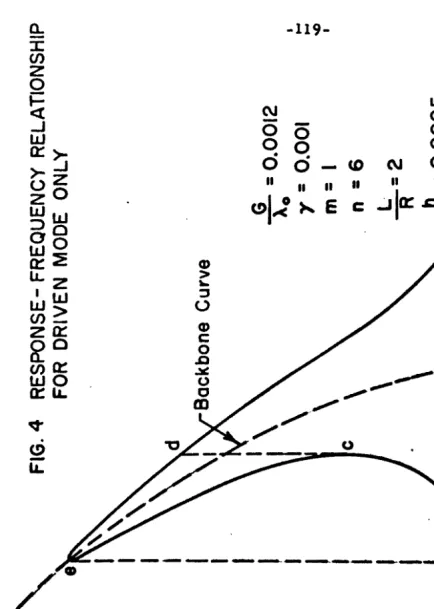
Eq. (4.80) is the so-called response-frequency relationship. Fig. 4 is a typical plot of eq. (4. 80) for m = 1, n
=
6, R=
4", L=
8",h
h
=
0.010" and R=
O. 0025, f=
O. 0012, 'Y=
0.001. As can be seen, the nonlinearity is of the softening type, i. e., the frequencydecreases with increasing response amplitude. This curve is sirni-lar to the response-frequency relationship of a simple spring-mass
[image:59.565.51.523.47.719.2]the curve a .. b-c and then jump to d. Further increasing the fre-quency, the response will follow the curve from d to f. When the frequency is decreasing the response will follow the curve f-d-e and then jump to b. Further decreasing the frequency, the response will follow the curve from b to a. The dis continuous r espons es at
c, d and e, b are called" jump phenomena II which have been observed
in various nonlinear vibration systems. Figs. 5,
6.
and 7 are the similar plots for different wave numbers, damping and amplitude of external forciD.g functions.In the case of free vibration, the response-frequency rela-tionship can be obtained by letting f
=
'Y=
0 in eq. (4.80), namely,2 2
a
2n
=1-E'r a
(4.81 )o
which are plotted by dashed lines in Figs. 4, 5, 6 and 7 and referred to as "backbone curves."
The backbone curves can be used to determine the type of nonlinearities (softening or hardening) and the degree of nonlinearity. If the backbone curve bends toward the left, the nonlinearity is soft-ening, if to the right the nonlinearity is hardening.
Although a softening type n~nlinearity is indicated in Figs. 4 to 7, not all the modes (combination of m and n) are of the softening type. Fig. 8 shows the backbone curves for different modes. It is
clear that the nonlinearity in the vibration of a circular cylindrical shell with finite length is of both the softening and hardening type.
magnitude of
a.
The largera
implies the larger nonlinearity. Figs. 29 and 10 show the quantity
(~)
r
(note>.. is always positive) as ao 0
function of half aXial wave number m and circumferential wave
num-L h
ber n for R =:: 2 and
R:
=
O. 0025. For m=
1 the nonlinearity is of the softening type only. For m ~ 2 the nonlinearity is either of the softening or hardening type depending on the circumferential wave number n.The forced response-frequency relationship is given by the solution of eq. (4.80). At a given frequency the response can be expressed as a function of the eXternal forcing function. Figs. 4 to7 show that the r'esponse at certain frequencies is not single-valued. For instance in Fig. 4 the response is triple-valued for 0.9965<0 < O~ 9984 and double:'valued for 0
=
0.9965 and 0=
0.9984. In the multiple-valued response region, a stability analysis must be performed to deterrhine the stable response. This stability analysis will not be includedul.
this investigation. However. it can beob-served from the resp0l!se-freciuency relationship that the multiple 'response region is confined between the two
f~equencies
where thetangent of eq. (4.80) is vertical, i. e., :
=
O. In other words, the locus of these vertical tangents is the stability boundary (Ref. 1).Fig. 11 shows the locus of vertical tangents for y
=
0.001 andjump phenomenon. Larger damping will make the jump phenomenon occur at a higher amplitude of response.
Companion Mode Participation
In the case of the companion mode participating in the
vibra-~ion, i. e., b'l- 0, eqs" '(4.72) to (4.15) can be reduced as follows by
eliminating 6 and A: •
(4.83)
Eqs. (4.82) and (4.83) are nonlinear algebraic equations for two unknowns, namely a and b. A direct solution for a and b as functions of f, nand 'Y is difficult. There:t'ore a small computer
i I ! i f
program was developed to calculate b and
r
for given a and 0. By, 0 '
cross-plotting the 'results, it is possible to obtain ~urves of a vs. 0
and b vs.
n
for constant~
a.:rldy.
Figs. 12 and 13 show theampli-0 ,
tude of the driven mode 'a with and wi'thout th~ ~companionmode participation for constant
~
and 'Y. Since b == 0 is a solution ofo
eqs. (4.72) to (4.75), both curves in the figure represent the possi-ble response of the shell. The actual response in the multi-valued region has to be determined by a stability analysis. Fig. 14 shows the corresponding amplitude of the companion mode as a function of n for constant
~
and 'Y. As can be observed, the response ofo
mode b to be a real value, it is necessary that the following is true ..
~ I 2' 2
.... 2 °
yTJ
which in turn can be written as
(4.84)
(4.85 )
This indicates that larger damping y will make the companion mode occur at larger amplitude.
After establishing the minimum amplitude for the driven mode, a minimum magnitude of forcing function f can be established by using eq. (4.82). The existence of a minimum forcing function implies that in order to make the companion mode participate, the external forcing function must be greater than a certain minimum value. This explains the fact that the companion mode can be ob-served experimentally only for the large external excitation.
L h '
participating for R =
z,
R
= O. 00Z5, m = 1, n = 6, 'Y = 0.001.4. S Discussion of Results and Comparison with Previous Investigation The radial response of nonlinear vibration of a cylindrical
i i .
shell simply supported at both ends can be written as
W(8, 0, 1') = [acos(T+oa)cosne+bsin(T+~)sinne] sinm"s
+gl (8 )+gZ(S )[aZ cosZ( 'r+0a) .. bZ cosZ(
T+~)]
+g
3(*
)cosZn9+g4(s )cosZn9 [aZ cosZ( 'r+0a)+bZ cosZ(;:..~)]
+gs(s)sinZn9sin(2 ir+oa+o
b)+g6(s)sinZn9sin(
~
-oa)} 'Z+0(£ ) + • ••• • (4.86)
where the amplitude of the driven mode. a, and the companion mode b,are functions of the frequency, external forcing function and damp-ing. The terms multiplied by the small parameter £ are due to the
nonlinearities of the problem. ' These terms represent the difference of the deflection shape and harmonic content between the linear and nonlinear response of the shell. Therefore, it is of interest to dis-cuss these terms. The functions go(T), 1:X
1(T), I:XZ(T) andI:X3(T) involve a constant term and a term with coefficient COSZT or sinZT. The functions gl (s) to g6(s) are of the "boundary layer" type, i. e. , they possess large magnitude neal: both ends (s = 0 and
s = 1) and vanishingly small magnitude elsewhere. A typical plot of
of the boundary is concerned, terms like go(T), al(T)cosZm'll's, aZ(T)cosZn8 and a
3(T)sinZn8 are dominant.
In Section II, previous investigations of nonlinear vibration of cylindrical shells have been discussed. The deflection shape as-sumed in those previous investigations for applying the Galerkin method will now be compared with the present calculated deflection shape. Since the fundamental deflection shapes are all identical to the linear mode shape, only the "added" terms in the deflection shape will be compared; Chu (Ref. 8) has no added terms for the
,
deflection shape. Nowinski (Ref. 10) has a constant as the added term. Evensen (Ref. IZ) has (l-cosZm'll's) as the added terms. Dowell has sinm'll'S as the added term. All the added terms are axisymmetric. In the present analysis, non-axisymmetric terms such as aZ(T)cosZn8 and 0!3(T)sinZn8 are found. A comparis'on of the axisymmetric mode of the present solution and Evensen's assumed deflection is shown in Fig. 17. (Note the axisymmetric modes in the present solution are go(T)+O!l (T)cosZm'll's+gl (s)+gZ(s)[ aZcos(T+6
a
>·
Zb cosZ( T+6
b)]). For small" aspect ratio," favorable agreement is indicated. However increasing the aspect ratio makes the deviation between the two mode shapes larger. For the m
=
3, n=
7 mode the deviation is quite pronounced. One possible explanation of the large deviation at large aspect ratio is that the amplitude of Evensen's