Manuscript received June 20, 2018; revised July 30, 2018. This work was supported by the Vaal University of Technology.
R. Moletsane is in the Department of Software studies at Vaal University of Technology, Vanderbijlpark, South Africa (e-mail: [email protected]).
T. Zuva is in the Department of ICT, Vaal University of Technology, Vanderbijlpark, South Africa (e-mail: [email protected]).
Abstract—The rate of penetration and the volume of
electronic waste (e-waste) generated from mobile phones is becoming a significant challenge, mainly African nations. Mobile phones waste is terrible because it contains harmful heavy metals to the environment and human well-being. This paper reviews the management of waste generated from mobile phones in African countries. The study findings show that most African countries manage e-waste using unsafe and harmful methods. Activities that include open burning, landfilling and informal recycling. The use of hazardous e-waste management methods is mainly caused by, lack of e-waste regulations and enforcement, red tape was also identified as a barrier to acquire formal recycling business, lack of awareness about the harmful impact of e-waste on the ecology and political unwillingness to engage in safe e-waste management activities. The study recommends that governments of African nations should put in place e-waste regulations and enforcement policies. It would also be beneficial if e-waste education could become part of the curriculum in schools.
Index Terms— African countries, electronic waste, heavy
metals, health and environment
I. INTRODUCTION
he fast growth in e-waste and fast product outdated nature has realized the significant issues of e-waste on human wellbeing, animals, and ecology [1]. The measure of cadmium in one cell phone can taint up to 600 cubic meters of water placing human health and livestock at risk [2]. According to Perkins, et al. [3], the problem of concern is the rate at which e-waste develops. Schwarzer, et al. [4] assert that e-waste grows at a rate of 3% to 5% annually, and development rate of e-waste is around three times more than any own waste in the solid waste segment. In the United States over 300,000 mobile phones are improperly disposed of every day [5]. Literature also suggests that the accumulating e-waste is due to the absence of knowledge about its harmful effects on humans and ecology [6]. Market demand of information and communication technology products has lured in new market players like China who manufacture and produce imitation products that eventually has the short lifespan and low quality [7]. The reduced lifespan and quality of these electronic products have placed much burden on e-waste management and
disposal. E-waste problem knows no colour, boundary or gender and it is everywhere.
In Africa, Uganda became the first country with many mobile phones exceeding the number of fixed-line customers in 1999. Ten years later 30 other nations in Africa followed this trend [8]. In Kenya, mobile phones subscriptions increased from a mere 330 000 to 38 million in 2016 in a country with a population estimated at 45 million [9].
In 2012 the e-waste generated worldwide was 45.6 million metric tons [10]. It is irrefutable that less developed nations have a generous offer of e-waste as well. China and the United States of America reported 6.3 million metric tons and 7.2 million metric tons of e-waste accumulated in the year 2016 respectively [11]. According to Rohman and Bohlin [12], mobile phones and computers are the fastest growing information and communication technology equipment around the world. In 2004 over 3 million mobile phones became obsolete in Korea [13]. E-waste from mobile phones in India alone is relied upon to expand 18 fold from 2007 aggregate by the year 2020 [14]. In 2013 the world had about 6 billion mobile phones [15]. Babatunde, et al. [16] are of the opinion that the highest number of mobile phones subscribers resides in the developing nations.
The developing countries have a high level of illiteracy that barred the proper management of e-waste [1]. The perceived limited knowledge about the harmful effects of e-waste generated by mobile phones on human well-being and ecology motivates this study. Literature posits that people lack awareness about the impact of e-waste primarily in developing countries [1, 6, 17]. This paper explores the management of e-waste generated by mobile phones in African countries.
This study is structured as follows: Section II and Section III define e-waste and discuss mobile phones in Africa respectively. Section IV provides problems with the mobile phones. Section V discusses mobile phones disposal and recycle in Africa. The study concludes in Section IV.
II.ELECTRONIC WASTE
Literature has identified more than one definitions of e-waste. There is no inclusive definition of e-waste [18]. The e-waste definitions converge to include characteristics such as discarded or unwanted electronic products regardless of their working state, electronic devices that are close to ending life, old devices that contains toxic and valuable materials, device that is subject to electric current or
Managing Electronic Waste Generated from
Mobile Phones: A Review of African Countries
R. Moletsane, T. Zuva
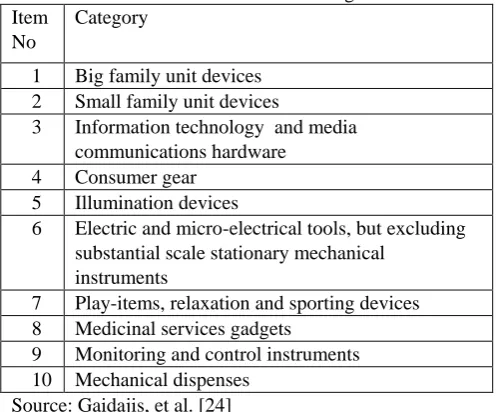
electromagnetic fields to work legitimately [1, 19-21]. In this study e-waste is defined as any unwanted or discarded electronic equipment by the owner regardless of working state or not, also contains both toxic and valuable materials. According to [22] E-waste can be separated into three classifications: family applications —washing machines, information technology and telecommunications—personal computers, laptops, and consumer equipment—television, mp3 players and mobile phones. A broader and encompassing e-waste category is shown in Table 1. This classification is according to the European Union directives on WEEE (Waste Electrical and Electronic Equipment) [23].
Table 1 Ten electronic waste main categories Item
No
Category
1 Big family unit devices 2 Small family unit devices
3 Information technology and media communications hardware
4 Consumer gear 5 Illumination devices
6 Electric and micro-electrical tools, but excluding substantial scale stationary mechanical
instruments
7 Play-items, relaxation and sporting devices 8 Medicinal services gadgets
9 Monitoring and control instruments 10 Mechanical dispenses
Source: Gaidajis, et al. [24]
III. MOBILE PHONES AND AFRICA
United Nations [25] grouped the African continent into five regions namely North Africa, West Africa, East Africa, Southern Africa, and Central or middle Africa. Challenges of these regions cover transportation, power and communication to mention the least. Poor infrastructure is the inhibitor of development and advancement in all African regions [26]. Aker and Mbiti [27] indicated that sub-Saharan Africa has limited infrastructure development across all nations of the world. Mobile technology financial services have played a crucial role in promoting financial inclusion of sub-Sahara Africa. Ivory Coast, Zimbabwe, South Africa, Rwanda and Botswana are some of the continents’ countries with high mobile financial services after Kenya [28]. M-Pesa— a short message service based money transfer arrangement has revolutionized the way Kenyan's send and get money [29]. Registered M-Pesa users are also able to pay taxi fares or utility bills [9].
The challenge of physical meeting of people because of poor roads is no longer a barrier due to mobile phones [30]. The public of Timbuktu in Mali—West African region country— can speak with relatives living in the capital city or other family members in France. Agriculturalists in Tamale, Ghana can learn prices of stock from capital city Accra that is over 400 kilometres away. In Niger, a call can save the US$40 travel to find about job opportunities available in Benin [27]. As mobile phones and data turn out
to be more reasonable in pricing, more ease of access to cell mobiles—which have outpaced different types of communications framework on the continent—is changing the manner by which public administrations are conveyed, business and governmental issues are being led [9]. Zambia, a nation landlocked in Southern Africa utilize mobile phones in the prevention and treatment plans of human immunodeficiency virus by sending update calls and SMS to the patients [31]. In central Africa region country, Rwanda mobile phones have helped expecting mothers. The health worker will record the data of the expecting mother using the mobile phone. If there are questions, complications in connection to the pregnancy, the health worker will send an SMS to the local clinic and receive response within a short space of time [32].
IV. PROBLEMS WITH MOBILE PHONES
Mobile phones rapid rise and their relatively short lifespan are posing disposal management challenges at the height when mobile phones are the fastest growing stream of e-waste [33]. According to Babatunde, et al. [16], most people consider this gadget obsolete in little over a year, even though they are still in right working conditions [34]. When mobile phones are considered e-waste by their owners, they threw them along with municipality solid waste from dustbins. According to Rowley [35] throwing away mobile phones with municipal rubbish should be avoided, this tendency could make e-waste lend into or onto landfill.
Instead of throwing old gadget, these should be deposited in a take-back scheme for recycling or refurbishment. The findings of the study conducted in Nigeria revealed that most people change mobile phones at least twice in a year. They throw old batteries and unwanted mobile phones in rivers or streams, burn them in the open or keep them in their homes [16]. Geyer and Blass [36] indicated that one of the reasons for mobile owners to keep their mobile phones beyond their end of lifespan at their homes is lack of knowledge regarding proper e-waste disposal.
Most mobile phones contain heavy metals which are of significant concern to the environment. The incorrect handling or disposing of these mobile gadgets as e-waste may lead to leak into soil and underground water when the battery casing corrodes [16]. It has been reported that one mobile phone battery is enough to contaminate 600,000 litres of water [37]. Regarding material composition, mobile phones are similar to other electronic products. They do contain both valuable materials and toxic heavy metals [33]. A high-level exposure to lead coating of mobile phones can result in adverse health problem to humans.
in turn results in devastating effects such as drought [40]. Oxford Dictionary [41] define environment as "surroundings, especially as they affect people's lives, the natural world of the land, sea, and air." Therefore environmental dangers of e-waste can be classified under land dangers, air and water dangers [19]. As indicated by Deng [42] operations envolved in the recovery of valuable metals from e-waste can cause extreme pollution of highly toxic heavy metals in water, land, and atmosphere. Soil contamination from aerial deposition or irrigation is likely to induce crops [43]. Findings of the study conducted in China revealed that soil contamination from aerial deposition is the source for toxic metals— such as cadmium lead and mercury— contamination in rice [44]. The polluted farm products with e-waste are probably to take-up and gather these toxic metals from e-waste and afterward apply potential wellbeing dangers to people and animals [19].
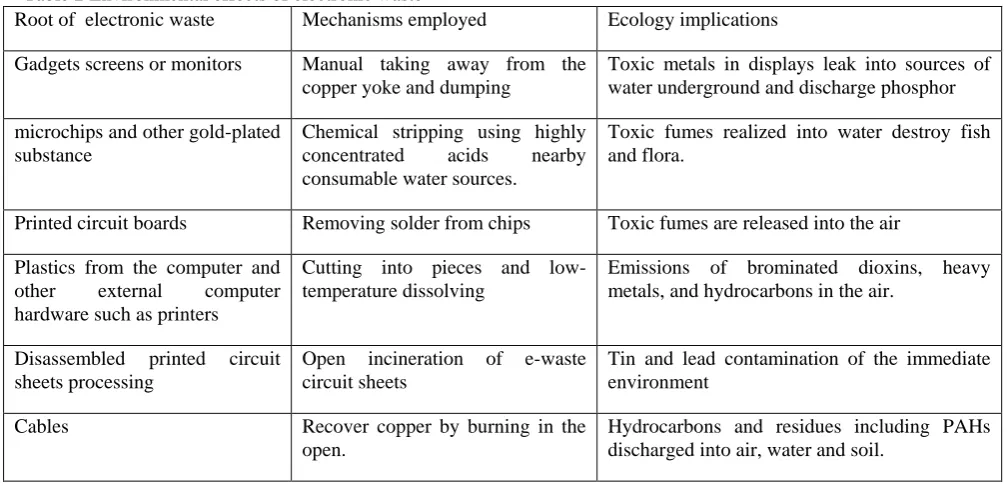
Air pollution: open burning for the recovery of copper from computers wires releases hydrocarbons in the air. Ha, et al. [45], demonstrated that labourers in the recuperation of resources from e-waste materials in Bangalore, India breathe clean stacked air containing cadmium, lead and other dangerous metals. Various e-waste contaminants are spread into the air by dust. The contaminants enter to individuals through ingestion, internal breath and skin retention [46]. Water pollution: toxic metals could leach through the soil into underground water streams of local communities. Luo, et al. [47] found the contaminated land farm with dioxins and dibenzofurans, and the farm was very close to the e-waste site. Gupta [8] found that dumping of acid “leftovers” or sludge into the rivers after informal treatment of e-waste, has led to water scarcity for households due to contamination. He noted that water had to be transported from afar towns to cater for Guiyu population in Hong Kong [8]. E-Waste sludges dropped into the rivers endanger not only people but also wildlife that relies on the water to sustain. Gupta [48] in Table 2 summarises some of the negative environmental impacts presented by electronic devices. Humans cannot live outside the environment. The environment supports any living being with life. It is therefore crucial for all of us to protect our planet.
V.DISPOSING AND RECYCLING MOBILE PHONES IN AFRICA
In most African countries, recycling and disposal are carried out on an informal basis often in unmonitored dumpsites and landfills [49]. The following factors in Table 3 make unregulated recycling thrive:
The informal sector mostly controls e-waste recycling in South Africa. Though unregulated recycling is useful in managing e-waste volume, it is the least preferred option due to harmful effects of e-waste components. In South Africa many efforts to regulate informal sector had been unsuccessful. The inability to formalize e-waste recycling is mostly because of the refusal by e-waste recyclers to work formally. Red-tape also is a factor [54]. Formal recycling activities need a constant injection of e-waste to recycle. The process of registering an official recycling business to liaise with government departments for e-waste supply is daunting. You have to fill sixty pages application form,
excluding a quite number of documents such as proof of residence. Given the fact that South Africa has about fifty governments departments, it takes an average of one month to prepare all the required documents needed for registration. Notwithstanding the printed material, a particular expense is necessary to process the application form. The whole procedure goes up to four months on average [54]. Formal recycling is beneficial not only because it reduces e-waste volume or less toxic relative to an unregulated sector and safe but also it can be used to capture e-waste statistics. South Africa have limited knowledge about e-waste [54].
In Section 4 of this study, landfill, open dumping, and casual recycling were singled out as the least options due to their harmful effects on human well-being and ecology. Landfill option danger is leaching— a biochemical process that takes place when rainwater filters through waste in a landfill [55]. Open dumping releases all harmful emissions into the air that eventually add to carbon footprint and contributes to human chronic diseases [40]. Literature added that developing countries, particularly African nations rely on unsafe and harmful activities to the recovery of valuable metals from e-waste components [18, 19]. Grant, et al. [19] indicated that absence of knowledge about the undesirable effects of e-waste is the source of the problem. Therefore people need to be educated about e-waste [6].
Many countries lack information and communication policy to establish e-waste recycling facilities [1]. Indeed, even a few nations that have the strategy on electronic and communication innovation appear not keen on building the framework essential for recycling; there is nonattendance of political will by African governments to take part in safe administration choices of e-waste[56, 57]. In East Africa, Kenya is the only country that has recycling site while in Southern Africa only South Africa has several recycling sites [49]. Literature suggests that lack of e-waste recycling facilities, lack of political will and safe disposal activities is one of the reasons that encourage improper disposal and recycling [1].
IV. CONCLUSION AND RECOMMENDATIONS
This paper discussed about the management of e-waste generated by mobile phones in the African continent. The discussion also included the repercussions of neglecting the issue of e-waste management in African countries. The results of the study show that most African nations are still reliant on unsafe and dangerous recycling activities. These activities include open burning, landfilling and informal recycling.
The challenge faced with African people to manage e-waste suitably is of their own making. They do not have regulations in place and lack regulation enforcement where the regulation exists, lack of political by governments to prioritize problem of waste, red tape to establish formal e-waste business, limited awareness on e-e-waste hazards, funding incapacity to develop formal recycling operations seen in the developed countries, shortage of skilled recycling workers and illegal e-waste trading.
Table 2 Environmental effects of electronic waste
Root of electronic waste Mechanisms employed Ecology implications Gadgets screens or monitors Manual taking away from the
copper yoke and dumping
Toxic metals in displays leak into sources of water underground and discharge phosphor microchips and other gold-plated
substance
Chemical stripping using highly concentrated acids nearby consumable water sources.
Toxic fumes realized into water destroy fish and flora.
Printed circuit boards Removing solder from chips Toxic fumes are released into the air Plastics from the computer and
other external computer hardware such as printers
Cutting into pieces and low-temperature dissolving
Emissions of brominated dioxins, heavy metals, and hydrocarbons in the air.
Disassembled printed circuit sheets processing
Open incineration of e-waste circuit sheets
Tin and lead contamination of the immediate environment
Cables Recover copper by burning in the
open.
Hydrocarbons and residues including PAHs discharged into air, water and soil.
[image:4.595.54.539.333.585.2]Source: Gupta [48]
Table 3 List of factors that inhibit formal recycling activities in Africa List of things that hinder regulated recycling in African
countries
Paper title and Author(s) Lack of interest by some of the African countries to engage
in same e-waste regulation, the cost associated with formal recycling activities, the absence of e-waste regulation in the continent, Lack of political will.
Title: Electronic Waste Management in Zimbabwe: A Slow Onset Public Health Disaster. Author(s): Mutsau and Billiat [50]
The absence of regulatory enforcement where it exists, financial capacity to build state of the art recycling facilities, limited skilled workers
Thesis Title: Toxic Trade: E-Waste Disposal and Environmental Governance in West Africa. Author: Hector [51]
Low charges to transport e-waste to the African continent, Exploitation of international regulations on e-waste loopholes, informal recycling is a lucrative business with low start-up cost and operational costs, administrative violations and irregularities by the sender of e-waste border authorities.
Title: How e‐Waste Challenges Environmental Governance. Author: Bisschop [52]
The insufficient legislation, poor mindfulness and hesitance concerning the business part to address e-waste issues.
Title: Electronic Waste in Bangladesh: Evaluating the Situation, Legislation and Policy and way Forward with Strategies and Approach. Author: Alam and Bahauddin [53]
regulations. Establishment of rules without enforcement serves no purpose. Programs on e-waste education should be encouraged. Promotions and advertisements activities need to be in place for a start-up. Over time, making e-waste awareness part of the curriculum would be much beneficial.
REFERENCES
[1] J. K. Park, L. Hoerning, S. Watry, T. Burgett, and S. Matthias, "Effects of Electronic Waste on Developing Countries." Advances in Recycling & Waste Management, vol. 2, no 2, pp. 1-6, 2017. [2] Q. Song and J. Li, "A systematic review of the human body burden of
e-waste exposure in China," Environ Int, vol. 68, no pp. 82-93, 2014. [3] D. N. Perkins, M. Drisse, and T. Nxele, "E-Waste: A Global Hazard."
Annals of Global Health, vol 80, no 4, pp. 286-295, 2014.
[4] S. Schwarzer, A. D. Bono, P. Peduzzi, G. Giuliani, and S. Kluser, "E-waste, the hidden side of IT equipment's manufacturing and use
UNEP Early Warning on Emerging Environmental Threats No. 5.," 2005.
[5] M. Anderson, "What an E-Waste," IEEE Spectrum, vol. 47, no 9, p. 72, 2010.
[6] A. W. Kitila, "Electronic Waste Management in Educational Institutions of Ambo Town, Ethiopia,East Africa," International Journal of Sciences: Basic Applied Research, vol. 24, pp. 319-331, 2015.
[7] F. Alias, M. B. Ishak, S. N. Zulkifli, and R. A. Jalil, "E-waste management: An emerging global crisis and the Malaysian scenario."
Journal of Environmental Sciences, vol. 4, no 4, pp. 444-457, 2014. [8] K. M. Gupta, "E-waste Management: Teaching how to Reduce, Reuse
and Recycle For Sustainable Development- Need of Some Educational strategies." Journal of Education and Practice, vol. 2, no 3, pp. 74-86, 2011.
[10] StEP Initiative. (2013, January 14). "StEP Annual Report 2013." Available http://www.step-initiative.org/
[11] F. Richer. (2017, December 14) "These Countries Generate the Most
Electronic Waste." Available
http://www.statista.com/chart/2283/electrronic-waste/
[12] I. K. Rohman and E. Bohlin, "An assessment of Mobile Broadband Access in Indonesia: a Demand or Supply Problem?" Internetworking Indonesia, vol. 3, no 2, pp. 15-22, 2011.
[13] Y. Hyunmyung and J. Yong-Chul, "The practice and challenges of electronic waste recycling in Korea with emphasis on extended producer responsibility (EPR)," in Proceedings of the 2006 IEEE International Symposium on Electronics and the Environment, 2006. [14] M. Schluep, C. Hagelüken, and R. Kuehr, "Sustainable innovation &
technology transfer industrial sector studies: recyclingefrom e-waste to resources United Nations Environment Programme (UNEP) and StEPesolving the e-waste problem," 2009.
[15] E. Gelenbe and Y. Caseau, "The Impact of Information Technology on Energy Consumption and Carbon Emissions." Ubiquity, vol. 2015, no 1, pp. 1-15, 2015.
[16] O. A. Babatunde, C. A. Eguma, B. T. Oyeledun, O. C. Igwilo, O. G. Awosanya, and O. Adegbenro, "Mobile Phone Usage and Battery Disposal in Lagos, Nigeria," International Journal of Applied Psychology, vol. 4, no 4, pp. 147-54, 2014.
[17] S. Devika, "Environmental Impact of Improper Disposal of Electronic Waste.” International Journal of Computer Applications, vol. 127, no 4, pp. 29-31, 2010.
[18] S. Needhidasan, M. Samuel, and R. Chidambaram, "Electronic waste: An emerging threat to the environment of urban India," Journal of Environmental Health Science & Engineering, vol 12, no 1, pp. 12-36, 2014.
[19] K. Grant, F. C. Goldizen, P. D. Sly, M.-N. Brune, M. Neira, M. van den Berg, et al., "Health consequences of exposure to e-waste: a systematic review," Lancet Glob Health vol. 1, no 6, pp. 350-361, 2013.
[20] J. Puckett, L. Byster, and S. Westervelt, "Exporting Harm: The High-Tech Trashing of Asia, The Basel Action Network (BAN) and Silicon Valley Toxics Coalition (SVTC), 2002." 2002. Available http://www.ban.org/E-waste/technotrashfinalcomp.pdf
[21] D. M. Ceballos and Z. Dong, "The formal electronic recycling industry: Challenges and opportunities in occupational and environmental health research," Environment International, vol. 95, no 2016, pp. 157-166, 2016.
[22] D. N. Perkins, M.-N. Brune Drisse, T. Nxele, and P. D. Sly, "E-Waste: A Global Hazard," Annals of Global Health, vol. 80, no 4, pp. 286-295, 2014.
[23] European Union. (2002, January 27). "European Union Directives 2002/96/EC of the European parliament and of the council of 27 January 2003 on waste electrical and electronic equipment (WEEE)- Joint declaration of the European parliament, the council and the commission relating to article 9."
[24] G. Gaidajis, K. Angelakoglou, and D. Aktsoglou, "E-waste: Environmental Problems and Current Management," Journal of Engineering Science and Technology Review, vol. 3, no 1, pp. 193-199, 2010.
[25] United Nations, "Classification of Major Areas and Regions," Geneva
2001 Available
https://esa.un.org/unpd/popdev/AgingProfiles2013/Docs/Classificatio n%20of%20Major%20Areas%20and%20Regions_2013.pdf
[26] Deloitte and A. Pottas, "Addressing Africa’s Infrastructure Challenges” 2013.
[27] J. C. Aker and I. M. Mbiti, "Mobile Phones and Economic Development in Africa." Journal of Economic Perspectives, vol. 24, no 3, pp. 207–232, 2010.
[28] C. Ligami. (2016, February 15) "Africa’s phone users reach 700
million." Available
http://www.bizcommunity.com/Search.aspx?l=196&c=742&s=Christ abel%20Ligami
[29] K. Manson. (2013, March 14). "Africa takes lead in mobile
revolution.” Financial Times Available
https://www.ft.com/content/0846ab76-8c8d-11e2-8ee0-00144feabdc0 [30] J. Poushter and R. Oates, "Cell Phones in Africa: Communication Lifeline Texting Most Common Activity, but Mobile Money Popular in Several Countries " Pew Research Center2015.
[31] F. R. Sawaya. (2016, March 21) "Mobile Phones are solving real problems in Africa." Available https://itp.nyu.edu/classes/newmedia-spring2016/mobile-phones-are-solving-real-problems-in-africa/
[32] L. Desai. (2010, July 28) "Cell phones save lives in Rwandan villages." CNN Inside Africa Available http://edition.cnn.com/2010/WORLD/africa/07/28/Rwanda.phones.pr egnant.women/index.html
[33] J. Speake and L. N. Yangke, ""What do I do with my old mobile phone? I just put them in a drawer": Attitudes and perspectives towards the disposal of mobile phones in Liverpool, UK." Human Geographies- Journal of Studies and Research in Human Geography, vol. 9, no 2, pp. 242-259, 2015.
[34] F. O. Ongondo and I. Williams, "'Greening Academia: Use and disposal of mobile phones among university students'," Waste Management, vol. 31, no 2011, pp. 1617-1634, 2011.
[35] J. Rowley. (2006, October), "Mobile Phone Lifecycles Use, Take-back, Reuse and Recycle," Available https://docplayer.net/3629152-Mobile-phone-lifecycles.html
[36] R. Geyer and V. D. Blass, "The economics of cell phone reuse and recycling." Int J Adv Manuf Technol, vol. 47, no 2010, pp. 515-525, 2010.
[37] G. Lean. (2004, October 23) "Your old mobile is destroying the
planet.” The Independent Available
https://rense.com/general58/destroy.htm
[38] S. Sivaramanan, "E-waste Management, Disposal and Its Impacts on the Environment." Universal Journal of Environmental Research and Technology, vol. 3, no 5, pp. 531-537, 2013.
[39] Z. Khan. (2017, 29 January 2018). How mobile phone addiction is linked to climate change? Available: http://nation.com.pk/28-Oct-2017/how-mobile-phone-addiction-is-linked-to-climate-change [40] P. Bi and A. Hansen, "Carbon emissions and public health: an inverse
association?," The Lancet Planetary Health, vol. 2, pp. e8-e9, 2018. [41] Oxford Dictionary, "Easy to use English." 2012, pp. 1-688.
[42] W. J. Deng, "Atmospheric levels and cytotoxicity of PAHs and heavy metals in TSP and PM at an electronic waste recycling site in southeast China," Atmospheric Environment, vol. 40, pp. 6945-6955, 2006.
[43] Z. Nan, C. Zhao, J. Li, F. Chen, and W. Sun, "Relations between soil properties and elected heavy metal concentrations in spring wheat (Triticum aestivum L.) grown in contaminated soils," Water, Air, Soil Pollut, vol. 133, pp. 205–213, 2002.
[44] J. Fu, Q. Zhou, J. Liu, W. Liu, T. Wang, Q. Zhang, et al., "High levels of heavy metals in rice (Oryza sativa L.) from a typical E-waste recycling area in southeast China and its potential risk to human health," Chemosphere, vol. 71, no 7, pp. 1269–1275, 2008.
[45] N. N. Ha, T. Agusa, K. Ramu, N. P. C. Tu, S. Murata, and K. A. Bulbule, "Contamination by trace elements at e-waste recycling sites in Bangalore: India." Chemosphere, vol. 76, pp. 9-15, 2009. [46] H. W. Mielke and P. Reagan, "Soil is an important pathway of human
lead exposure." Environ Health Perspect, vol. 106, pp. 217–29, 1998. [47] X. J. Luo, X. L. Zhang, J. Liu, J. P. Wu, Y. Luo, and S. J. Chen, "Persistent halogenated compounds in waterbirds from an e-waste recycling region in South China." Environ Sci Technol, vol. 43, no 2, pp. 306–11, 2009.
[48] K. M. Gupta, "Environmental Effects of Growing E Waste," International Journal of Science and Research, vol. 3, no 12, pp. 204-206, 2014.
[49] M. Malakata. (2015, January 3). "West Africa turns into dumping ground for e-waste." IDG News Service: PC World Available https://www.pcworld.com/article/2878492/west-africa-turns-into-dumping-ground-for-ewaste.html
[50] S. Mutsau and E. Billiat, "Electronic Waste Management in Zimbabwe: A Slow Onset Public Health Disaster," Civil and Environmental Research vol. 7, no 12, pp. 84-87, 2015.
[51] M. C. Hector, "Toxic Trade: E-Waste Disposal and Environmental Governance in West Africa," Master of Arts (International Studies), Faculty of Arts and Social Sciences, Stellenbosch, Cape Town, South Africa, 2017.
[52] L. Bisschop, "How e‐Waste Challenges Environmental Governance " International Journal for Crime, Justice and Social Democracy, vol. 3, no 2, pp. 81-95, 2014.
[53] M. Alam and K. Bahauddin, "Electronic Waste in Bangladesh: Evaluating the Situation, Legislation and Policy and way Forward with Strategies and Approach " De Gruyter Open, vol. 9, no 1, pp. 82-101, 2015.
[55] F. Lombardi, G. Costa, and P. Sirini, "Analysis of the role of the sanitary landfill in waste management strategies based upon a review of lab leaching tests and new tools to evaluate leachate production."
Revista Ambiente & Água, vol. 12, no 4, pp. 543-555, 2017.
[56] D. Olowu, "Menace of E-wastes in Developing Countries: An Agenda for Legal and Policy Responses," Law, Environment and Development Journal, vol. 8, no 1, pp. 61-75, 2012.