Abstract— In this work, we first give a general method which can get a large class of balanced Boolean functions with reasonably high nonlinearity, larger than that obtained by Lobanov. Then, we study the secondary construction of Boolean functions without extending their number of variables, introduced recently by Carlet. This gives interesting cryptographic properties in terms of balancedness, nonlinearity and algebraic immunity. We conclude the paper by proving that the algebraic immunity of the constructed functions is better than among of the starting functions.
Index Terms—Algebraic immunity, Boolean function, nonlinearity, resiliency.
I. INTRODUCTION
Boolean functions, when used in stream cipher (combiner model or filter model), are required to have good cryptographic properties. Some of the important properties are balancedness, a high algebraic degree, a high non linearity and in the case of the combiner model, a reasonably high correlation immunity. These properties ensure that the functions are resistant against correlation attacks [1] and linear cryptanalysis [2].
Recently, algebraic attacks [8], [9], [10], [11], [12], [13], [14] have been observed that a Boolean function
f
used as a cryptographic primitive, must have a high algebraic immunity. But not sufficient property for Boolean function used in stream ciphers.It is an important topic to construct Boolean
functions with optimum algebraic immunity. But these
functions must also satisfy the other criteria recalled
above for being likely to be used in stream ciphers.
Non linearity is the most important property among those cryptographic properties on Boolean function used in streamManuscript received May, 2008.
A. Belmeguenaï is with the Laboratory of applied automatic, Department of electronics, Faculty of Science and Engineering August 20- 55 Skikda University LP 26 El-hadeik Avenue, Algeria (e-mail:
N. Doghmane is with the Department of electronics, Faculty of Science and Engineering Badji Mokhtar University - Annaba LP 12, Algeria (e-mail:
K. Mansouri is with the Department of electronics, Faculty of Science and Engineering Badji Mokhtar University - Annaba LP 12, Algeria (e-mail: mansouri.khaled@ voila.fr).
ciphers. In [15], Lobanov proved that
∑
−=
−
≥
( ) 20
1
2
f AI
i
i
n
Nf
for every
n
-variable Boolean functions. Moreover, by constructing a family of Boolean function achieving theequality
∑
−
=
−
=
( ) 20
1
2
f AI
i
i
n
Nf
, he proved that this lowerbound cannot be improved further. The result of [15] and theorem 2 of [16] give a new reason why one should not use functions
f
with low nonlinearity, since in that caseAI
n( f
)
would be low. However, they do not ensure that if
f
has high algebraic immunity (for instance an optimum one
=
2
)
(
f
n
AI
n ) then its nonlinearity will be high. Indeed, the result of [15] implies then thatf
has nonlinearity atleast
∑
−
=
−
2 2
0
1
2
n
i
i
n
, that is,
−
−
−
−
2
1
1
2
1n
n
nif
n
is oddand
−
−
−
−
−
−
2
1
1
2
1
2
1n
n
n
n
nif
n
is even.The object of this work is double. In the first time, it is a question of studying the non linearity and the algebraic immunity of a
n
-variable function. General method which can get a large class of Boolean functions are considered. All these functions have algebraic immunity at leastk
, where
2
n
k
pp
is any integer. We study their Walsh transforms. Furthermore, by choosing suitable parameters, we show that some infinite classes of balanced functions can have nonlinearity significantly larger than
−
−
−
−
−
−
2
1
1
2
1
2
1n
n
n
n
n.
Thus, we use Carlet's construction [17] to construct Boolean functions with better cryptographic properties, which gives the guidance for the design of balanced Boolean functions to resist algebraic attack, and helps to design good cryptographic primitives of cryptosystems.
Construction of Balanced Functions without
Extending Their Number of Variables
The paper is organized as follows. Section 2 gives preliminaries. In section 3, we give a general methode to get a large numerous Boolean functions with algebraic immunity at
2
n
k
pp
and have important nonlinearity. In section 4 we deduce balanced functions with nonlinearity, larger than that obtained by Lobanov. In section 5, we use construction introduced by Carlet [17] to derive construction of balanced functions with reasonably high nonlinearity and we show that, the algebraic immunity of the constructed functions is better than among of the starting functions. Section 6 concludes the study.II. PRELIMINARIES
A Boolean function on
n
-variable may be viewed as a mapping fromF
2nin toF
2. The set of alln
-variable Boolean functions is denoted byB
n. By⊕
we denote sum modulo 2. The Hamming weightwt
( f
)
of a Boolean functionf
onn
F
2 is the size of its support{
x
∈
F
2;
f
(
x
)
=
1
}
n. The Hamming distance
d
(
f
,
g
)
between two Boolean functionsf
andg
is the Hamming weight of their differencef
⊕
g
,)
(
)
,
(
f
g
wt
f
g
d
=
⊕
. Ann
-variable Boolean functionf
has unique algebraic normal form (A.N.F):+
+
=
∑
=
n
i i i
n
a
a
x
x
x
f
0 0 1
,...,
)
(
n n
n j i
j i
ij
x
x
a
x
x
x
a
...
12... 1 2...
1
+
+
∑
≤ ≤p
.
Where the coefficients
a
0,a
i,a
ij,..,a
12...nbelong toF
2. The algebraic degree of Boolean functionf
, denoted byd
°
( f
)
, is defined as the number of variables in the highest order term with nonzero coefficient. If algebraic degree off
is smaller than or equal to one thenf
is called affine function. An affine function with a constant term equal to zero is called a linear function. Many properties of Boolean functions can be described by the Walsh-Hadamard transform. Letf
be Boolean function onF
2n. Then the Walsh-Hadamard transform off
is defined as:
∑
∈
−
−
=
∈
∀
n F x
x u x f n
u
Wf
F
u
2
. ) (
2
,
(
)
(
1
)
(
1
)
. (1) Wherex
.
u
=
x
1.
u
1+
...
+
x
n.
u
n denotes the usual scalarproduct of vectors
u
andx
.The nonlinearity
Nf
of an
-variable functionf
is the minimum distance from the set of alln
-variable affine functions, it equal to:
max
(
)
2
1
2
2 1
u
Wf
Nf
n F u n
∈ −
−
=
. (2)Boolean functions used in cipher system must have high nonlinearity to prevent correlation and linear attacks [18], [19], [20], [1]. A Boolean function
f
onF
2n is balanced ifwt
(
f
)
=
wt
(
f
⊕
1
)
. In other words,f
is balanced if and only if(
)
=
2
n−1f
wt
. Correlation immune functions and resilient functions are two important classes of Boolean functions. Xiao and Massey [21] provided a spectral characterization of correlation immune andt
-th order resilientfunctions. A function
f
ist
-th order correlation immune ifand only if its Walsh transform satisfies:
Wf
(
u
)
=
0
, fort
u
wt
≤
≤
(
)
1
, wherewt
(u
)
denotes the Hamming weight ofu, and
f
ist
-resilient if moreoverWf
(
0
)
=
0
. 2,
n
F
u
∈
∀
t
u
wt
≤
≤
(
)
0
.The algebraic immunity of a Boolean function
f
is the smaller degree of non null functiong
such that0
*
g
=
f
or(
1
⊕
f
)
*
g
=
0
. Otherwise, the minimum value ofd
such thatf
or1
⊕
f
admits an annihilator of degreed
. We denoted byAI
n(
f
)
the algebraic immunity ofa Boolean function
f
. It is shown in [13] and [10] that algebraic immunity of a Boolean functionf
is at most[ ]
2n .Notation:
x
⊕
y
=
(
x
1⊕
y
1,
x
2⊕
y
2,...,
x
n⊕
y
n)
,where
x
=
(
x
1,
x
2,...,
x
n)
,y
=
(
y
1,
y
2,...,
y
n)
nF
2∈
;(
x
x
x
n)
x
=
⊕
⊕
⊕
⊕
1
,
1
,...,
1
1
1 2 is the bitwisecomplement of
x
=
(
x
1,
x
2,...,
x
n)
.It is known that for a fixed every vector
u
∈
F
2n such thatwt
(
u
)
=
m
, we have( )
( )
K
( )
m
n
j
i
m
n
j
m
i i
j j x
u
i x wt F x n
,
1
1
0 )
( / 2
=
−
−
−
=
−
∑
∑
= ⋅
= ∈
. (3) Where
K
i( )
x
,
n
is the Krawtchouk polynomial [22].Proposition 1:
1)
K
0( )
m
,
n
=
1
,K
1( )
m
,
n
=
n
−
2
m
; 2)( ) ( ) (
i
+
1
K
i+1m
,
n
=
n
−
2
m
) ( )
K
im
,
n
−
(
n
−
i
+
1
) ( )
k
i−1m
,
n
;3)
(
n
−
m
) (
K
im
+
1
,
n
) (
=
n
−
2
i
) ( )
K
im
,
n
−
(
m
n
)
mk
i−
1
,
;4)
K
i( ) ( )
m
,
n
=
−
1
iK
n−i(
n
−
m
,
n
)
.The following lemmas will be used to prove the results in the paper.
Lemma 1: [23] For
−
≤
≤
2
1
1
i
n
and1
Lemma 2: For every two integers
n
andm
≥
0
: we have1)
1
0
=
n
;
2)
=
1
n
n
;
3)
=
0
m
n
, for every
m
f
n
;4)
+
−
+
+
+
=
n
n
n
n
n
n
n1
...
1
0
2
;5)
+
+
=
+
+
m
n
m
n
m
n
1
1
1
, for every
n
≥
0
and0
≥
m
.Lemma 3: [17] Let
f
1, f
2 andf
3 be three Boolean functions onF
2n. We denoted byα
1 the Boolean function equal to3 2
1
f
f
f
⊕
⊕
and byα
2 the Boolean function equal tof
1f
2⊕
f
1f
3⊕
f
2f
3 . Then we have2 1 3 2
1
+
f
+
f
=
α
+
2
α
f
. This implies2 1
3 2
1
Wf
Wf
W
α
2
W
α
Wf
+
+
=
+
. (4)Lemma 4: Let
k,
n
be any two positive integers such that
2
n
k
pp
. For1
≤
i
≤
k
−
1
,
K
i( )
1
,
n
≤
K
i( )
0
,
n
. (5)Proof: Note that
( )
=
i
n
n
K
i0
,
,( )
−
−
−
−
=
1
1
1
,
1
i
n
i
n
n
K
i . Fori
=
0
, we have( )
0
,
0(
1
,
)
1
0
n
=
K
n
=
K
. Fori
=
1
,K
1( )
0
,
n
=
n
and( )
1
,
2
1
n
=
n
−
K
.Suppose that
K
i( )
1
,
n
≤
K
i( )
0
,
n
true for1
≤
i
≤
k
−
2
.( )
−
=
−
1
,
0
1
k
n
n
K
k . By lemma 2 (Item 5), we have( )
≥
−
−
+
−
−
=
−
=
−
2
1
1
1
1
,
0
1
k
n
k
n
k
n
n
K
k
−
−
−
−
−
+
−
−
−
−
−
3
1
2
1
2
1
1
1
k
n
k
n
k
n
k
n
−
−
−
−
−
≥
−
−
−
−
−
=
2
1
1
1
3
1
1
1
k
n
k
n
k
n
k
n
( )
n
K
k−11
,
=
.Hence, the inequalities (5) true for
1
≤
i
≤
k
−
1
.III. CONSTRUCTION OF BOOLEAN FUNCTIONS The idea of our construction comes from the following.
Construction 1: Let
k,
n
be any two positive integers such that
2
n
k
pp
. Letg
andf
be two Booleans functions ofn
B
with the following conditions.1)
g
equal zero forwt
(
x
)
p
k
andwt
(
x
)
f
n
−
k
,2)
−
−
≤
≤
=
k
n
x
wt
if
k
n
x
wt
k
if
x
g
k
x
wt
if
x
f
f
p
)
(
1
)
(
)
(
)
(
0
)
(
Then we have the following important result.
Lemma 5: Let
f
∈
B
n be a function as described in Construction 1. ThenAI
n(
f
)
≥
k
.Proof: We first show that the function
1
⊕
f
has not a nonzero annihilator of degree less thank
.Write the possible annihilator
h
of the function1
⊕
f
of degree at mostk
−
1
by means of indeterminate coefficients:+
+
=
∑
=
n
i i i
x
a
a
h
0
0 12... 1 1 2 1
1
...
...
− −≤ ≤
+
+
∑
k kn j i
j i
ij
x
x
a
x
x
x
a
pThe function
h
is the annihilator of1
⊕
f
if only if1
)
(
1
⊕
f
x
=
followsh
(
x
)
=
0
. We obtain the system of homogeneous linear equations on the coefficients of the functionh
:0
)
(
x
=
h
for all vectors
x
of Hamming weight less than or equalsk
−
1
. Sinceh
(
0
,...,
0
)
=
0
, we havea
0=
0
. Since0
)
(
x
=
h
ifwt
(
x
)
=
1
, we havea
i=
a
0=
0
. Applying the induction on the weight of vectors we, obtain that all coefficients ofh
are zeros, hence,h
≡
0
. i.e1
⊕
f
has not a nonzero annihilator of degree less thank
.Now, we prove that
f
has not annihilator of degree less thank
. Supposef
has an annihilatorH
of degree less thank
. That is,f
(
x
)
*
H
(
x
)
=
0
, i.e.,H
(
x
)
=
0
whenf
(
x
)
=
1
. Note that, ifg
(
x
)
=
1
, we haveH
(
x
)
=
0
for every vectorn
F
x
∈
2 such thatwt
(
x
)
≥
k
. Define1
H
asH
1(
x
)
=
H
(
1
⊕
x
)
, i.e.,H
(
x
)
=
H
1(
1
⊕
x
)
. This givesdeg(
H
1)
=
deg(
H
)
p
k
. Hence, weIf
g
(
x
)
=
0
, thenH
(
x
)
=
0
for every vectorx
∈
F
2nsuch thatwt
(
x
)
f
n
−
k
. DefineH
2 asH
2(
x
)
=
H
(
1
⊕
x
)
, i.e.,H
(
x
)
=
H
2(
1
⊕
x
)
. This gives,k
H
H
)
deg(
)
p
deg(
2=
. Hence, wehave
(
1
⊕
f
(
x
)
)
*
H
2(
1
⊕
x
)
=
0
. So,1
⊕
f
has anannihilator of degree less than
k
, which is a contradiction.Lemma 6: Let
f
∈
B
n be a function as described inConstruction 1. Then
∑
∑
− = − =
≤
≤
n ki k i
i
n
f
wt
i
n
0 1 0)
(
. (6)Lemma 7: Let
f
∈
B
n be a function as described in Construction 1. Then the value of the Walsh transform off
at everyu
∈
F
2nequals:
( )
( )
−
+
−
−
=
⋅ ∈ ∈ ⋅∑
∑
)
(
1
2
)
(
)
(
1
2
)
(
)
(
) ( / ) ( / 2 2u
wt
odd
for
u
Wg
u
wt
even
for
u
Wg
u
Wf
x u k x wt F x k x wt F x x u n n p p (7)Proof: For every vector
u
∈
F
2n , we have( )
f x uxF x n
u
Wf
⊕⋅∈
∑
−
=
( ) 21
)
(
( )
∑
( )
∑
( )
∑
− ∈ ⊕ ⋅ ⊕ − ≤ ≤ ∈ ∈ ⋅ ⊕ + − + − − = k n x wt F x x u x u x g k n x wt k F x k x wt F x x u n nn p / ( )f
. 1 ) ( ) ( / ) ( / 0 2 2 2 1 1 1
( )
( )
g x uxF x k x wt F x x u n n ⋅ ⊕ ∈ ∈ ⋅ ⊕
∑
∑
−
+
−
=
( ) ) ( / 0 2 21
1
p( )
( )
( )
uxk n u wt F x x u k n x wt F x k x wt F x x u n n n ⋅ ⊕ − ∈ ⋅ ⊕ − ∈ ∈ ⋅ ⊕
∑
∑
∑
−
−
−
+
−
−
1 ) ( / 0 ) ( / ) ( / 0 2 2 21
1
1
f f p( )
∑
( )
∑
( )
∑
∈ ⋅ ⊕ ⊕ ⋅ ⊕ ∈ ⋅ ⊕ ∈−
+
−
−
−
=
k x wt F x x u u x u u k x wt F x x u x g Fx n n p n/ ( )p
1 ) ( / ) ( 2 2 2
1
1
1
( )
( )
−
+
−
−
=
⋅ ∈ ∈ ⋅∑
∑
)
(
1
2
)
(
)
(
1
2
)
(
) ( / ) ( / 2 2u
wt
odd
for
u
Wg
u
wt
even
for
u
Wg
x u k x wt F x k x wt F x x u n n p p .IV. DEDUCED BALANCED FUNCTIONS
We use the result of Lemma 7 to study the nonlinearity and balancedness for a class of functions based on Construction 1.
Theorem 1: Let
k,n
be any two positive integers such that
2
n
k
pp
. Letf
∈
B
n be a function as defined byConstruction 1. Then, if
∑
− =
=
n k k ii
n
g
Wt
2
1
)
(
, thenf
isbalanced. Moreover
−
−
≥
1
k
n
Ng
Nf
. (8)Proof: Relation (7) and the fact that for every vector
0
=
u
implies relation∑
− =
−
=
1 02
)
0
(
)
0
(
k ii
n
Wg
Wf
∑
− =
−
−
=
1 02
)
(
2
2
k i ni
n
g
wt
)
(
2
wt
g
i
n
k n k i−
=
∑
− =Imply that
Wf
(
0
)
=
0
if onlyif
∑
− =
=
n k k ii
n
g
Wt
2
1
)
(
:f
is balanced.Relation (3), relation (7) and the fact that for every vector
n
F
u
∈
2 implies relation(
wt
u
n
)
K
u
Wg
u
Wf
k F u F u Fu n n n
),
(
max
2
)
(
max
)
(
max
1 2 2 2 − ∈ ∈∈
≤
+
. (9)From lemma 1, one has
(
wt
u
n
)
(
K
( )
n
K
( )
n
n
)
K
k k kF
u n
(
),
max
1
,
,
,
max
1 1 12
− −
−
∈
=
.From proposition 1 (Item 4), we
have
K
( ) ( ) (
m
n
K
in
m
n
)
i
i
,
=
−
1
−
,
, thisgive
K
k−1( ) ( )
n
,
n
=
−
1
k−1K
k−1( )
0
,
n
, we have(
wt
u
n
)
(
K
( )
n
K
( )
n
)
K
k k kF u n
,
0
,
,
1
max
),
(
max
1 1 12
− −
−
∈
=
. (10)By using relations (9) and (10), we have
( )
( )
+ ≤ ∈ ∈ − ∈ −∈F Wf u u F Wg u u F Kk n u F Kk n
u n ( ) maxn ( ) 2max maxn 1, ,maxn 0,
max 1 1
2 2
2 2
and relation (5) implies the relation
−
+
≤
∈∈
(
)
max
(
)
2
1
max
2 2k
n
u
Wg
u
Wf
nn u F
F u
. (11) Using relation (2), we deduce relation (8).
In the following corollary 1, we will show that the nonlinearity of function
f
∈
B
n as described in construction 1 can achieve the best possible nonlinearity, larger than obtained by Lobanov [15].Corollary 1: Let
n
be even integer. Letf
∈
B
n be Boolean function as described in construction 1. Ifg
is bent andif
∑
− =
=
n k k ii
n
g
Wt
2
1
)
(
. Thenf
is balanced function hasnonlinearity at least
−
−
−
− −1
2
2
1 2 1k
n
n nNote that in [15] it was constructed the balanced function
f
of even numbern
of variables with the maximum possible algebraic immunity
=
2
n
k
and nonlinearity
−
−
−
−
−
−
2
1
1
2
1
2
1n
n
n
n
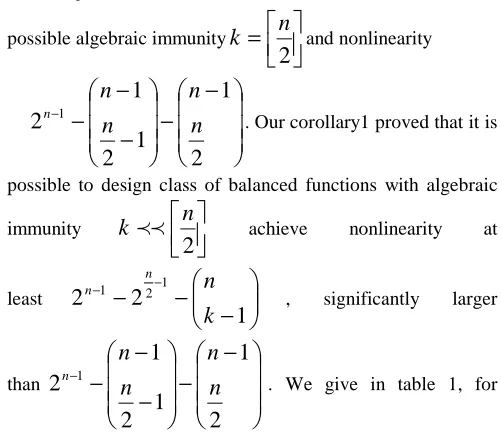
n. Our corollary1 proved that it is
possible to design class of balanced functions with algebraic immunity
2
n
k
pp
achieve nonlinearity atleast
−
−
−
−−
1
2
2
1 2 1k
n
n n, significantly larger
than
−
−
−
−
−
−
2
1
1
2
1
2
1n
n
n
n
n. We give in table 1, for
18
≥
n
and even, the few values onNf
of bound of corollary 1 and in table 2 we give the values of nonlinearityn
n
n
n
n
nn n
π
2
2
2
2
1
1
2
1
2
1 1
1
+ −
−
≈
−
−
−
−
−
−
obtained in [15]. [image:5.595.42.293.109.325.2]The bound of corollary 1 is better than the bound of [15] for every
n
≥
22
even and for every value of2
≤
k
≤
5
(see table 1 and table 2).Remark 1: The family of functions described by construction 1
is very general. It is easy to see that construction 1 makes possible to define a large class of Boolean functions with algebraic immunity at least
2
n
k
pp
and an importantnonlinearity. For example if
=
2
n
k
, we get class of Boolean functionsf
ofn
-variable achieving the nonlinearity∑
−
=
−
=
2 2
0
1
2
n
i
i
n
Nf
giving in [15]. Thus, by choosingsuitable parameters, for even
n
, bent functiong
and∑
−=
=
n k ki
i
n
g
Wt
2
1
)
(
, we show that some infinite classes of balanced functions can have non linearity significantly largerthan
−
−
−
−
−
−
2
1
1
2
1
2
1n
n
n
n
n. For instance, for bent
function
g
,k
=
2
and∑
−=
=
n k ki
i
n
g
Wt
2
1
)
(
. Then, thefunction
f
of even numbern
of variables is balanced hasnonlinearity at least
−
≈
−
−
− − −− 1
2 1 1
2 1
2
2
2
2
n n
n n
n
ο
, bestpossible non linearity.
Lobanov’s bound does not guarantee that having a high resistance to the correlation attacks. Indeed, such resistance needs a high nonlinearity, from table 2, we see Lobanov’s
bound
n
n
n
n
n
nn n
π
2
2
2
2
1
1
2
1
2
1 1
1
+ −
−
≈
−
−
−
−
−
−
is notquite satisfactory. But the bound of corollary 1, show that having a reasonable high algebraic immunity and important nonlinearity. Moreover, for every
n
≥
28
even and for every value ofk
≥
7
, the algebraic immunityk
≥
7
is a strong property, not only with respect to the resistance to algebraic attacks, but also with respect to the resistance to higher order attacks.V. CONSTRUCTION BALANCED FUNCTIONS
WITHEOUT EXTENDING THEIR NUMBER OF VARIABLES
We use now the results of Lemma 3 and lemma 7 and the construction [17] to construct Boolean functions with better cryptographic properties, which gives the guidance for the design of balanced Boolean functions to resist algebraic attack, and helps to design good cryptographic primitives of cryptosystems.
Theorem 2: Let
k,n
be any two positive integers such that
2
n
k
pp
. Letg
1, g
2 andg
3 be three Boolean functions onF
2nequals zero forwt( x)
p
k
andwt(x)
f
n
−
k
. We denoted byσ
1 the Boolean function equal tog
1⊕
g
2⊕
g
3.Let
−
−
≤
≤
=
k
n
x
wt
if
k
n
x
wt
k
if
x
g
k
x
wt
if
x
f
f
p
)
(
1
)
(
)
(
)
(
0
)
(
11 ,
−
−
≤
≤
=
k
n
x
wt
if
k
n
x
wt
k
if
x
g
k
x
wt
if
x
f
f
p
)
(
1
)
(
)
(
)
(
0
)
(
2
−
−
≤
≤
=
k
n
x
wt
if
k
n
x
wt
k
if
x
g
k
x
wt
if
x
f
f
p
)
(
1
)
(
)
(
)
(
0
)
(
33 three balanced
functions. Then the function
α
1=
f
1⊕
f
2⊕
f
3is balanced if only if the functionα
2=
f
1f
2⊕
f
1f
3⊕
f
2f
3is balanced. Moreover 1 3 1 1 22
1
2
2
1
− =−
−
−
+
≥
∑
ni i
k
n
N
Ng
N
α
σ
(12)if the Walsh support of
f
1, f
2 andf
3are pairwise disjoint,then
(
)
−
−
+
≥
≤ ≤1
min
2
1
1 3 1 2k
n
N
Ng
N
i iσ
α
. (13)Proof: Relation (4) and the fact that for every vector
u
=
0
, we haveWf
i(
0
)
=
0
, fori
=
1
,
2
,
3
imply thatW
α
1(
0
)
=
0
if only ifW
α
2=
0
. Relations (4) and the fact that for every vectoru
∈
F
2n implies relation
+
≤
∈ = ∈∈
2
∑
max
(
)
max
(
)
1
)
(
max
1 3 1 2 2 2 2u
W
u
Wf
u
W
n nn u F
i
i F u F
u
α
α
and relation (11) implies
− + + − + ≤ ∈ = ∈
∈ 2
∑
max ( ) 6 1 max ( ) 2 11 ) ( max 1 3 1 2 2 2 2 k n u W k n u Wg u W n n
n uF
i
i F u F
u α σ
, using relation (2), we have
−
+
−
−
×
≤
−
∑
=1
8
2
2
2
4
2
1
2
2
3 1 1 2k
n
N
Ng
N
i i nn
α
σ
or equivalent relation (12).
If at most one value
Wf
i(
u
)
=
0
, fori
=
1
,
2
,
3
is nonzero, thenrelation (4) implies the relation
+
≤
∈ ∈ ≤ ≤∈
2
max
max
(
)
max
(
)
1
)
(
max
1 3 1 2 2 2 2u
W
u
Wf
u
W
n nn i u F i u F
F
u
α
α
, relation (11) implies
− + + − + ≤ ∈ ∈ ≤ ≤
∈ 2 max max ( ) 2 1 max ( ) 2 1
1 ) ( max 1 3 1 2 2 2 2 k n u W k n u Wg u W n n
n i uF i uF
F
u α σ
and relation (2) implies then relation (13).
Now, we study an algebraic immunity of Boolean functions
α
2. We will prove the functionα
2 in theorem 2 can have better algebraic immunity thanf
1,
f
2,
f
3 andα
1 . Givenf
∈
B
n, we denote byAN
n( f
)
the set of non nulln
B
p
∈
with lowest possible degree such thatp
∗
f
=
0
or
p
∗
(
1
⊕
f
)
=
0
.Proposition 2: Let
−
−
≤
≤
=
k
n
x
wt
if
k
n
x
wt
k
if
x
g
k
x
wt
if
x
f
f
p
)
(
1
)
(
)
(
)
(
0
)
(
11 ,
−
−
≤
≤
=
k
n
x
wt
if
k
n
x
wt
k
if
x
g
k
x
wt
if
x
f
f
p
)
(
1
)
(
)
(
)
(
0
)
(
2 2 and
−
−
≤
≤
=
k
n
x
wt
if
k
n
x
wt
k
if
x
g
k
x
wt
if
x
f
f
p
)
(
1
)
(
)
(
)
(
0
)
(
33 be three
Boolean functions on
F
2nhave respectively algebraic degree 21
, r
r
andr
3 . Let)
(
)
(
)
(
)
(
)
(
)
(
)
(
1 2 1 3 2 32
x
=
f
x
f
x
⊕
f
x
f
x
⊕
f
x
f
x
α
beBoolean function. Then
1)
k
≤
AI
n(
α
2)
≤
k
+
min(
r
1,
r
2,
r
3)
2) if
r
1=
r
2=
r
3=
r
then
k
≤
AI
n(
α
2)
≤
k
+
r
Proof: From lemma 5, we have
)
(
)
(
)
(
f
1AI
f
2AI
f
3AI
k
≤
n=
n=
n .Let
σ
2=
g
1g
2⊕
g
1g
3⊕
g
2g
3 . Note that,)
(
)
(
)
(
)
(
)
(
)
(
)
(
1 2 1 3 2 32
x
=
f
x
f
x
⊕
f
x
f
x
⊕
f
x
f
x
α
−
−
≤
≤
=
k
n
x
wt
if
k
n
x
wt
k
if
x
k
x
wt
if
f
p
)
(
1
)
(
)
(
)
(
0
2σ
.From lemma 5, we have
k
≤
AI
n(
α
2)
(14)Let
p
1∈
AN
n(
f
1)
. Iff
1∗
p
1=
0
, then(
f
2⊕
f
3)
α
2∗
p
1=
0
. If(
1
⊕
f
1)
∗
p
1=
0
, then(
f
2⊕
f
3)
(
1
⊕
α
2)
∗
p
1=
0
. This gives inequalities:Let
p
2∈
AN
n(
f
2)
. Iff
2∗
p
2=
0
, then(
f
1⊕
f
3)
α
2∗
p
2=
0
. If(
1
⊕
f
2)
∗
p
2=
0
, then(
f
1⊕
f
3)
(
1
⊕
α
2)
∗
p
2=
0
. This gives inequalities:AI
n(
α
2)
≤
k
+
min(
r
1,
r
3)
(16)Let
p
3∈
A
n(
f
3)
. Iff
3∗
p
3=
0
, then(
f
1⊕
f
2)
α
2∗
p
3=
0
. If(
1
⊕
f
3)
∗
p
3=
0
then
(
f
1⊕
f
2)
(
1
⊕
α
2)
∗
p
3=
0
. This gives inequalities:AI
n(
α
2)
≤
k
+
min(
r
1,
r
2)
(17)Equations (15), (16) and (17) give inequalities on the right. Item 2 is direct consequence of item 1.
VI. CONCLUSIONS
We presented a general method of Boolean functions which can get a large class of Boolean functions with reasonably high nonlinearity. It is possible to specify the parameters
n
andg
, to define class of balanced functions of even numbern
of variables with an algebraic immunity
2
n
k
pp
that achievesnonlinearity at least
−
−
−
−−
1
2
2
1 2 1k
n
n n, significantly larger than that obtained by Lobanov. Then, we study the secondary construction of Boolean functions without extending their number of variables, introduced recently by Carlet. This gives interesting cryptographic properties in terms of balancedness, nonlinearity and algebraic immunity. We prove that, the algebraic immunity of the constructed functions is better than among of the starting functions.
References
[1] T. Siegenthaler, “Decrypting a class of stream ciphers using cipher text only”, IEEE Transactions on Computers, C-34, N°1:81–85, January 1985.
[2] C. Ding, G. Xiao, and W. Shan, “The stability theory of stream ciphers”,
Number 561, Lecture Notes in Computer Science, Springer Verlag,
August 1991.
[3] O. S. Rothaus, “On bent functions”, Journal of Combinatorial Theory, Series A20, pp. 300-305.
[4] T. Siegenthaler, “Correlation-immunity of nonlinear combining functions for cryptographic applications”, IEEE Transactions on Information
Theory, IT-30, N°5:776–780, September 1984.
[5] P. Sarkar and S. Maitra, “Nonlinearity bounds and construction of resilient Boolean functions”, In: Advances in Cryptology - EUROCRYPT
2000, vol. 1880 in Lecture Notes in Computer Science, pages 515–532.
Springer Verlag, 2000
[6] Y. V. Tarannikov, “On resilient Boolean functions with maximum possible nonlinearity”, Proceedings of INDOCRYPT 2000, lecture Notes in Computer Science 1977, pp19-30, 2000.
[7] Y. Zheng and X. M. Zhang, “Improving upper bound on the non linearity of high order correlation immune functions”, Proceedings of Selected
Areas in Cryptography 2000, Lecture Notes in computer Science 2012,
pp262- 274, 2001.
[8] J. Y. Cho and J. Pieprzyk, “Algebraic Attacks on SOBER-t32 and SOBER-128”, In FSE 2004, number 3017 in Lecture Notes in Computer
Science, pages 49–64. Springer Verlag, 2004.
[9] N. Courtois and J. Pieprzyk,” Cryptanalysis of block ciphers with overde-fined systems of equations”, In Advances in Cryptology –
ASIACRYPT 2002, number 2501 in Lecture Notes in Computer Science,
pages 267–287. Springer Verlag, 2002.
[10] N. Courtois and W. Meier, “Algebraic Attacks on Stream Ciphers with Linear Feedback”, Advances in cryptology– EUROCRYPT 2003, Lecture Notes in Computer Science 2656, pp. 345-359, Springer, 2003. [11] N. Courtois, “Fast Algebraic Attacks on Stream Ciphers with Linear
Feedback”, advances in cryptology–CRYPTO 2003, Lecture Notes in Computer Science 2729, pp. 177-194, Springer, 2003.
[12] D. H. Lee et al, “Algebraic Attacks on Summation Generators”, In FSE
2004, number 3017 in Lecture Notes in Computer Science, pages 34–48.
Springer Verlag, 2004.
[13] W. Meier, E. Pasalic and C. Carlet, “Algebraic attacks and decomposition of Boolean functions” In Advances in Cryptology - EUROCRYPT 2004, number 3027 in Lecture Notes in Computer Science, pages 474–491. Springer Verlag, 2004.
[14] F. Armknecht, “Improving Fast algebraic Attacks”, In FSE 2004, number 3017 in lecture Notes in computer Science, pages 65-82. Springer Verlag, 2004.
Table 2: The best lower bounds of balanced function f of [15]
n Nf
18 20 22
81751 339517 1383228
24 5653936
26 23044039 28 93729726 30 380348781 32 1541277961
Table 1: The best lower bounds of balanced function f
for 1 2 1
2 2− − −
= n n
Ng
n m=3 m=4 m=5
[15] M. Lobanov, “Tight bound between nonlinearity and algebraic immunity”, Paper 2005/441 in http://eprint.iacr.org/.
[16] C. Carlet, D. K. Dalai, K. C. Gupta, S. Maitra, “Algebraic immunity for cryptographically Significant Boolean functions: analysis and construction”, IEEE Transaction on information theory, vol XX, N° Y, 2006.
[17] C. Carlet, “Improving the algebraic immunity of resilient and nonlinear functions and constructing bent functions. IACR eprint server, http://eprint.iacr.org, 2004/276. See also the extended abstract entitled Designing bent functions and resilient functions from known ones, without extending their number of variables”, in the proceedings of ISIT 2005.
[18] A. Canteaut and M. Trabbia, “Improved fast correlation attacks using parity-check equations of weight 4 and 5”, Advanced in
Cryptology-EUROCRYPT 2000. Lecture notes in computer science 1807
(2000), pp. 573-588.
[19] T. Johansson and F. Jonsson, “Improved fast correlation attack on stream
ciphers via convolutional codes”, Advances in Cryptology -
EUROCRYPT’99, number 1592 in Lecture Notes in Computer Science
(1999), pp. 347–362.
[20] T. Johansson and F. Jonsson, “Fast correlation attacks based on turbo code techniques” , Advances in Cryptology - CRYPTO’99, number 1666 in Lecture Notes in Computer Science (1999), pp. 181–197.
[21] G. Z. Xiao and Massey J L, “A spectral characterization of correlation-immune combining functions”, IEEE Trans. Inf. Theory, Vol IT 34, n° 3, pp. 569-571, 1988.
[22] F. J. MacWilliams and N. J. Sloane, “The Theory of Error-Correcting Codes”, Amsterdam, The Netherlands:North-Holland, 1977.