See Colour Plates 6, 7, 8, 9.
Further Reading
Andrews AT (1986) Electrophoresis Theory, Techniques and Biochemical and Clinical Applications, 2nd edn Oxford: Oxford University Press.
Camilleri P (1997)Capillary Electrophoresis:Theory and Practice, 2nd edn. Boca Raton, FL: CRC Press. Dunn MJ (1993)Gel Electrophoresis of Proteins. Oxford:
Bios.
Everaerts FM, Beckers JL and Verheggen TP (1976) Iso-tachophoresis: Theory, Instrumentation and Applica-tions. New York: Elsevier.
Landers JP (ed.) (1994) Handbook of Capillary Elec-trophoresis. Boca Raton, FL: CRC Press.
Mosher RA, Saville DA and Thormann W (1992) The Dynamics of Electrophoresis. Weinheim: VCH. Smith I (1968)Chromatography and Electrophoresis, vol.
II.Zone Electrophoresis. London: Heinemann. Vindevogel J and Sandra P (1992)Introduction to Micellar
Electrokinetic Chromatography. Heidelberg: HuKthig. Weinberger R (1993)Practical Capillary Electrophoresis.
New York: Academic Press.
Westermeier R (1997)Electrophoresis in Practice, 2nd edn. Weinheim: VCH.
Zweig G and Whitaker JR (1967)Paper Chromatography and Electrophoresis, vol. 1.Electrophoresis in Stabiliz-ing Media. New York: Academic Press.
EXTRACTION
D. E. Raynie, The Procter & Gamble Company, Cincinnati, OH, USA
Copyright^ 2000 Academic Press
Introduction
Extractions are common in the world around us. Each time we brew a cup of tea or a pot of coffee, and each time we launder our clothes, we’re perform-ing a chemical extraction process. Perhaps because of this familiarity, extraction processes in chemical laboratories are often not fully appreciated, or fully understood. Quite simply, an extraction is the process of moving one on more compounds from one phase to another. Yet behind this simple deRnition lies a great deal of subtlety: separations are contrary to thermodynamic intuition, because entropy is gained through mixing, not separation; extraction methods are developed based on a drive towards equilibrium, yet the kinetics of mass transfer cannot be ignored. Such a list of physical chemical nuances provides the basis for this chapter on the fundamentals of chemical extractions.
Extractions are carried out for a variety of reasons, for example when distillation is either impractical (e.g., distillations are favourable when the relative volatility of the compounds to be separated is greater than about 1.2) or is too expensive, to isolate material for characterization, to purify compounds for sub-sequent processing, etc. Extractions can be classiRed according to a number of schemes:
E analytical versus preparative (depending on the quantity of pure compound to be separated);
E batch versus continuous (depending on the mode of feeding the material to be separated into the extrac-tion apparatus);
E based on the physical principles involved (is the extraction strictly based on partitioning, or are adsorption or other processes involved?);
E based on the types of phases involved (so called liquid}liquid extraction, gas}solid extraction, supercriticalSuid extraction, etc.).
Perhaps the biggest recent advances in the Reld of chemical extractions have taken place in the petro-leum, nuclear, and pharmaceutical industries. The understanding and practise of extraction lies at the crossroads of analytical, inorganic, organic, and physical chemistry, with theoretical and applied chemical engineering. Yet the fundamental physico-chemical principles involved are the same. Because of the author’s background, this chapter presents a de-scription of the fundamental basis for chemical ex-tractions and an overview of extraction techniques with a slant, or emphasis, towards the analytical chemists’ perspective.
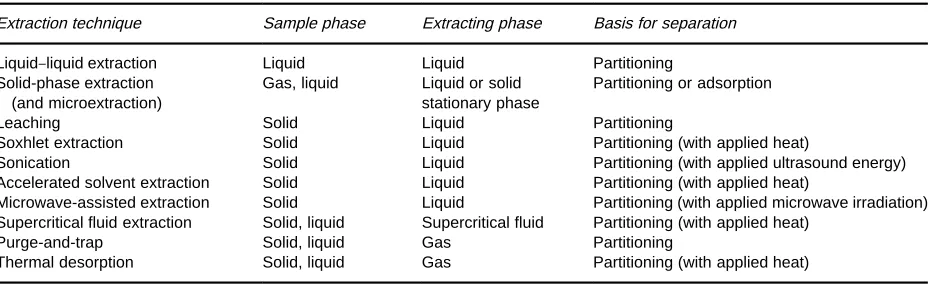
Table 1 Summary of selected extraction techniques by phases involved and the basis for separation
Extraction technique Sample phase Extracting phase Basis for separation
Liquid}liquid extraction Liquid Liquid Partitioning Solid-phase extraction
(and microextraction)
Gas, liquid Liquid or solid stationary phase
Partitioning or adsorption
Leaching Solid Liquid Partitioning
Soxhlet extraction Solid Liquid Partitioning (with applied heat)
Sonication Solid Liquid Partitioning (with applied ultrasound energy) Accelerated solvent extraction Solid Liquid Partitioning (with applied heat)
Microwave-assisted extraction Solid Liquid Partitioning (with applied microwave irradiation) Supercritical fluid extraction Solid, liquid Supercritical fluid Partitioning (with applied heat)
Purge-and-trap Solid, liquid Gas Partitioning
Thermal desorption Solid, liquid Gas Partitioning (with applied heat)
Figure 1 Plot of the relative amount (mass) extracted as a func-tion of extracfunc-tion progress (e.g. solvent volume, time, etc.). Three regions are defined: an equilibrium region dominated by solute partitioning, a diffusion region controlled by solute diffusion, and a transitional region.
for the sample. Finally the extracting phase (contain-ing the compound of interest) must diffuse back through the sample, separate into a distinct phase, and be removed for subsequent processing. With proper selection of the extracting solvent this Rnal step is generally not difRcult, though the forma-tion of emulsions must be avoided with liquid samples.
As previously mentioned, extractions (and other separation processes) are contrary to the principles of thermodynamics and work must be applied to over-come these thermodynamic constraints. Perhaps this has been expressed most eloquently by Giddings:
It seems enigmatic that we often struggle so hard to achieve desired separations when the basic concept of moving one component away from another is inherently so simple. Much of the difRculty arises because separation Sies in the face of the second law of thermodynamics. Entropy is gained in mixing, not in separation. Therefore it is the process of mixing that occurs spontaneously. To combat this and achieve separation, one must apply and manipulate external work and allow diffusion in a thermodynamically consistent way.
This external work is often applied as heat (temper-ature), which results in faster kinetics, decreased sol-vent viscosity and surface tension, increased solute solubility and diffusivity, and aids in overcoming interactions between the solute and the sample. A general analytical chemistry textbook (Peters, Hayes, and Hieftje (1974)Chemical Separations and
Measurements: Theory and Practice of Analytical
Chemisty. Philadelphia: Saunders) further describes
the extraction process and areas for improvement:
If two compounds are to be separated, we must, somewhere along the line, get them into two
dif-ferent and separable phases2At the heart of any chemical separation are the processes of (1) phase contact and equilibrium and (2) phase separation. These steps occur in all separation techniques, and a key in understanding a given method is the identi-Rcation and classiRcation of the steps according to the nature of the phases involved and the mech-anism of phase contact and separation. Similarly, if a particular method of separation is to be improved, these are the only processes worth adjusting.
Using this discussion as a framework we can class-ify various extraction techniques according to the phases and applied work (or the basis of separation), as shown in Table 1 for several selected extraction techniques.
[image:2.568.291.518.558.657.2]As the extraction progresses it transitions into a re-gion predominated by solute diffusion as well as the necessity for the solute to overcome effects such as solute}sample matrix interactions.
Preliminary Requirements
Chemical samples requiring extraction are composed of the compound of interest and the sample matrix, which may contain interfering species. Prior to choos-ing an extraction method, knowledge must be gained about the structure (including functional group ar-rangement), molecular mass, polarity, solubility, pKa, and other physical properties of both the species of interest and potential interfering compounds. Constraints speciRc to the sample and the solvent must be considered, and the resulting concentration and desired degree of puriRcation must be taken into account. This section discusses these preliminary considerations. Solvent-speciRc considerations and the roles of solute solubility, partitioning, and diffusion will subsequently be addressed.
Terminology
In discussing the fundamental processes in extraction, it is important to keep the appropriate terminology in mind. Extractions occur by the distribution of a com-pound between two immiscible phases. The mixture containing the component(s) to be separated is called
the feed or sample. The extracted compounds of
interest are described by several terms, including
soluteor analyte, while the phase left from the feed
after being contacted by the extracting phase is the
rafTnate (generally used for liquids) or residue
(solids). Thesolventis the immiscible extractingSuid added to the process for the purpose of extracting solutes from the feed. One key feature is the lack of mutual solubility between the feed and the extracting solvent. Usually less than 10% solubility of the sol-vent in the feed is desired. Because phase separation is a deRning parameter in chemical extractions, Suid Sow is important for transporting the solute both through the sample (facilitating diffusional mass transfer by maintaining a concentration gradient at the interface between the phases) and through the system. Thus the solvent must be a gas, liquid, or supercritical Suid. (Solid extracting phases do not serve to move the extracted material through the system. In extraction techniques such as solid-phase extraction or matrix}solid-phase dispersion the solid phase assists in removing the solute from the feed, but Suid solvents are required to remove the solute from the solid phase.) During an extraction process, each equilibrium event is termed astage; hence a
theoret-ical (or equilibrium) stage is a mechanism, or extrac-tion region, where the immiscible phases are brought under equilibrium conditions then physically separ-ated. The placement of the extraction stage can help deRne the extraction process. For example, a
cross-currentextraction is composed of a cascading series
of states where the rafRnate is brought into a sub-sequent stage and contacted with fresh solvent. In
acountercurrentextraction, the solvent and feed
en-ter from opposite ends of the system, and these two immiscible phases pass each other in opposing streams.
Batch and Continuous Extraction Modes
One means of classifying extractions is based on the mode of operation, batch or continuous and static or dynamic. The terms batch and continuous refer to how the sample (feed) is placed into the system. In batch extraction processes the entire material to be extracted is loaded into the extraction device. In the case of continuous extractions the feed is continuo-usly introduced into the extraction device. Static and dynamic describe the exposure of the two phases. In the static mode the extracting solvent and the feed are brought into contact and allowed to commingle for a prescribed period before the phases are separated, while dynamic extractions occur by continuously passing clean (whether fresh or recycled) extracting solvent through the sample.
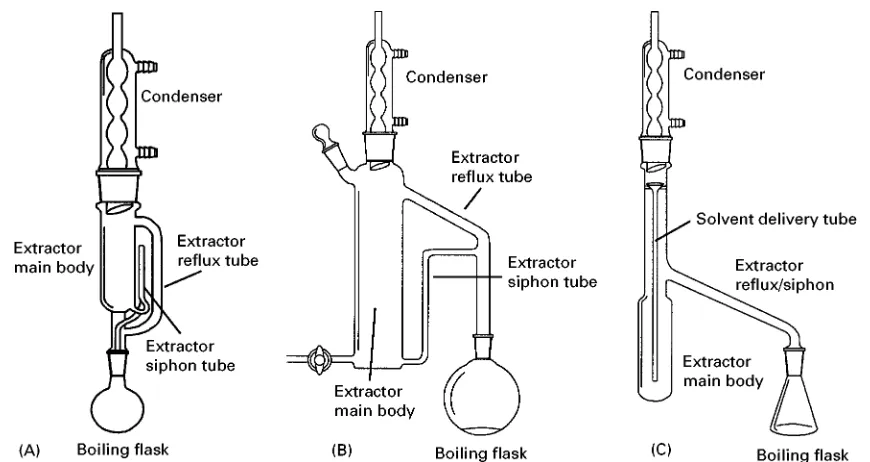
Most analytical extractions are performed using a batch-wise process. This mode is used when the distribution ratio (i.e., the ratio of the solute between the two phases) is high, favouring the extraction solvent. With batch extractions few stages are needed to achieve quantitative results, though phase separ-ation has to occur before the extraction is complete. Batch extractions can occur in static or dynamic modes, or in some combination. For example, the familiar Soxhlet technique for extracting solid sam-ples, depicted in Figure 2A, is considered a batch process with discontinuous solvent infusion, that is involving both static and dynamic modes.
Figure 2 Laboratory glassware for performing (A) Soxhlet extraction, (B) liquid}liquid extraction with extracting solvents more dense than the liquid solvent, and (C) liquid}liquid extraction with extracting solvents less dense than the liquid sample.
When batch-wise extraction procedures are used for studying physical chemical properties, such as solubility or distribution ratios, special care must be taken, especially when aqueous phases are involved. Volume changes due to mutual solubility of the phases should be noted for precise measurements. Both the extraction and sampling must take place at the same temperature, since the values of many prop-erties change as a function of temperature.
When distribution ratios are small, and also in many production-scale systems, continuous extrac-tion processes are used. Continuous extracextrac-tions are by deRnition also dynamic, since the two phases are continuously passed through each other. High efRciency continuous extractions depend on the viscosity of the two phases, the equilibrium rates, distribution ratios, solvent volumes, and the sur-face/contact area between the phases.
Countercurrent Extraction
A continuous extraction approach (though some-times performed in a batch-wise manner) is counter-current extraction. In countercounter-current extraction both phases are continuously added (or changed) andSow in opposite directions as the extraction progresses. (When only one phase is continuously added, the procedure becomes a crosscurrent extraction.) In the case of both countercurrent and crosscurrent extrac-tions, the feed is repeatedly (continuously) contacted or washed with extracting solvent. The number of theoretical stages is maximized by using solvents with favourable distribution coefRcients (see
sub-sequent discussion) or by increasing the solvent-to-feed ratio. Commonly, these processes employ up to eight theoretical stages. Although they have been re-placed by chromatographic methods in many cases, countercurrent extractions are useful in that they use solvent only, without sorbents, and relatively mild conditions. They are favoured when the distribution coefRcient is small. However, countercurrent ex-tractions use large volumes of solvent and are not advantageous when large amounts of solute are to be isolated. The Craig countercurrent device, popularly used to study partition chromatography, is a discon-tinuous, differential migration process, since the extraction stages are performed step-wise rather than as continuous extractions.
Solvent Considerations
The requisite immiscibility and viscosity of the ex-tractingSuid have been discussed.
Several other solvent properties that are important to the extraction process are listed here.
E Selectivity, i.e. the ability to extract the material of interest in preference to other, interfering material. Solvent selectivity can be supplemented through the use of adsorbents and secondary solvents, and by other means.
E High distribution coefRcient to minimize the solvent-to-feed ratio.
E Ability to recover the extracted material. Thus the formation of emulsions and other deleterious events must be minimized.
E Capacity, the ability to load a high amount of solute per unit of solvent.
E Density, as density differentials are needed for countercurrentSow. The solvent density is related to solubility in supercritical Suid extracting solvents.
E Low interfacial tension to facilitate mass transfer across the phase boundary. Interfacial tension tends to decrease with increasing solute solubility and as solute concentration increases. In liquid} liquid extraction low interfacial tension allows the disruption of solvent droplets (entrained in the feed solution) with low agitation.
E Low relative toxicity.
E Nonreactive. In some instances, such as ion-exchange extractions, known reactivity in the extracting Suid is used. In addition to being nonreactive with the feed, the solvent should be nonreactive with the extraction system (e.g., non-corrosive) and should be stable.
E Inexpensive. Cost considerations should emphasize the energy costs of an extraction procedure, since, for a given extraction method, capital costs are relatively constant.
Solubility
Of the solvent properties necessary for extraction, solubility of the solute into the solvent is of funda-mental importance. The general understanding of ‘like dissolves like’ is handy in the preliminary choice of extraction solvents. Solvent classiRcation schemes are often helpful, especially if the selectivity of sol-vents is of interest. The Snyder selectivity triangle results in eight classiRcations of solvents according to proton donor, proton acceptor, and dipole interac-tion properties. Another solvent classiRcation scheme is as follows.
E Class 1 solvents: capable of forming three-dimen-sional networks of strong hydrogen bonds. E Class 2 solvents: have active hydrogen atoms and
donor atoms, but do not form three-dimensional networks.
E Class 3 solvents: contain donor atoms, but not active hydrogen atoms.
E Class 4 solvents: contain active hydrogen atoms, but not donor atoms.
E Class 5 solvents: do not have hydrogen-bonding capability or donor atoms.
Comparisons of solubility values can give approxima-tions for the partitioning of a solute between two
solvents. Although experimentally generated solubil-ity data is preferred, relative solubilsolubil-ity scales can be used for estimation purposes. However, it is impor-tant to remember that no scale has been developed that completely accounts for all of the intermolecular interactions inSuencing solubility.
The most common relative solubility scale is the Hildebrand solubility parameter scale. The Hilde-brand solubility parameter, , is a measure of the cohesion (interaction) energy of the solvent}solute mixture and is deRned by"(Ev/V)1/2, whereEvis the heat (energy) of vaporization necessary for vol-umeV. Thus, the ratioEv/Vis the cohesive energy density. The ‘total’ Hildebrand solubility parameter (t) is related to the hydrogen-bonding ability (h), the dispersion coefRcient (d), and the polarity (p) by
2
t"2h#2d#2p. Consequently, there is a strong cor-relation between the Hildebrand solubility parameter value and the polarity. For extraction purposes, it is preferable to use solvents that havevalues similar to those of the solutes of interest. Several references provide detailed development of the Hildebrand solu-bility parameter, and similar scales, and these values are tabulated for several solvents.
When supercritical Suids are used in place of liquids, modiRed versions of the Hildebrand solubil-ity parameter are used in which "1.25P1/2
c (/liq) or"liq(/liq), wherePcis the critical pressure,is the density, andliqandliqare the Hildebrand value and density at liquid conditions. This modiRcation for supercriticalSuids, while only approximate, pro-vides for reference to liquid values of polarity and other ‘chemical’ properties, and for the relationship between supercritical density and solubility.
Solvent Removal Methods
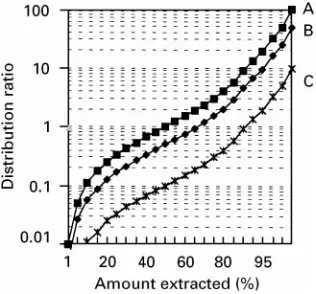
Figure 3 Relationship between distribution ratio and amount (percent) of solute extracted for (A) phase ratio of one, (B) phase ratio of two, and (C) phase ratio of ten.
compounds and an aqueous phase the fraction ionized into the aqueous phase is approximated by the Henderson}Hasselbach equation (i.e., log ionized ()/log nonionized (1!)"pH!pK). So in this example, the ionic form of 99% of the solute can be changed by adjusting the pH by two units from the pK.
Extraction of Ions
The extraction of ionic species, especially from aque-ous phases into organic phases, often requires some-what specialized treatment, generally ion-exchange or ion-pairing extraction. In ion-exchange extraction the ionic compound is covalently bonded to a com-pound of opposite charge, resulting in a neutral species. The more common ion-pairing extraction is based on formation of a neutral ion pair through the interaction of the ionic species of interest with a counterion. The resulting neutral ion pair is soluble in organic solvents. Usually solubility is greater in polar solvents. The solubility in the organic solvent is usually increased by selecting an ion-pair reagent containing a nonpolar portion in addition to the charged moiety. Counterions used are generally soft acids or bases possessing large ionic radii. In addition to selection of the counterion, experimental para-meters that can inSuence ion-pair extractions include pH, ionic strength (i.e., the total concentration of all ionic species in the sample), organic solvent, andSow rate.
Solute Distribution
Chemical extractions proceed by a drive towards equilibrium. Consequently, knowledge of the equilib-rium distribution of the solute between the phases is useful. Berthelot and JungSeisch studied phase distri-bution in 1871 and twenty years later, in 1891, Nernst developed his distribution law in whichKD"
(concentration of solute in phase1)/(concentration of solute in phase 2), whereKDis thedistribution coef-Tcient. However, the simple ratio of solute concentra-tions is not thermodynamically rigorous, since it does not account for association or dissociation in either phase. The IUPAC (International Union of Pure and Applied Chemistry) deRnition of the distribution
ratio,K, includes all species of the same component
and is used when the solute does not chemically react in either phase. This deRnition discusses the ratio, in organic}aqueous systems, as ‘the total analytical concentration of the substance in the organic phase to its total analytical concentration in the aqueous phase, usually measured at equilibrium’. This rela-tionship follows from Gibbs’ phase rule in which:
P#V"C#2, wherePis the number of phases,Vis
the number of degrees of freedom (independent sys-tem variables), andCis the number of components. So for the example of a simple extraction with two immiscible phases and a single solute of interest,
P"2 andC"3. At constant temperature and pres-sure, the number of degrees of freedom is one, mean-ing the solute concentration in each phase is Rxed. (Note that while activities and concentrations are not strictly equivalent, they can generally be treated equally over practical concentration ranges.)
Distribution ratios cannot be determined from the relative solubility data for several reasons: (1) the extraction may not be at equilibrium, (2) mutual solubility of the phases, and (3) solubility differ-ences, for example between hydrated and anhydrous forms of the solute. Therefore the ratio of solubilities is not the same as the distribution ratio for these same reasons. However, if solvation is properly considered, the relationship between solubility and extractability can be determined, especially for liquid}liquid sys-tems. Assuming equilibrium and phase immiscibility, the fraction of solute extracted,E, can be determined for a given phase ratio, V or V1/V2, by the expres-sions:
E"C1V1/(C1V1#C2V2)"KDV/(1#KDV)
E"1![1/(1#KDV)]n
%E"100KD/(KD#V2/V1)
Table 2 Solute distribution between phases in multistage extraction
Stage Distribution of solute
0 1 2 3
Initial equilibrated sample a b First transfer 0 a
b 0 Amount of solute
in each stage
a b a#b
Second transfer 0 ab a2 b2 ba 0 Amount of solute
in each stage
b2 2ab a2 (a#b)2
Third transfer 0 ab2 2ba2 a3 b3 2b2a ba2 0 Amount of solute
in each stage
b3 3b2a 3a2b a3 (a#b)3
Amount of solute in each stage upon subsequent transfers
(a#b)n
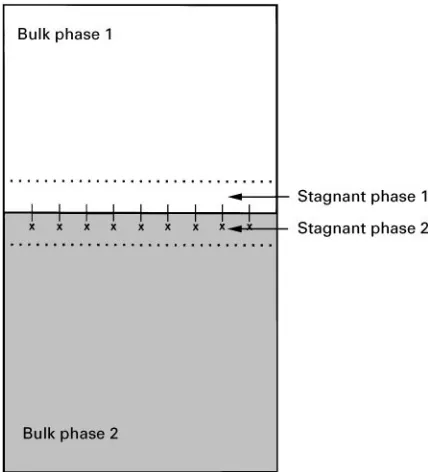
Figure 4 Schematic diagram of the role of interfacial diffusion in liquid}liquid extraction. Each stagnant layer is about 10\2}10\4cm. In this depiction, the molecules diffusing through the liquid}liquid interface contain a moiety (;) with an affinity toward phase 2 and a moiety (*) with an affinity toward phase 1. solvent. In this example, assuming a constant
[image:7.568.297.511.419.655.2]distri-bution ratio of 1, a doubling of the extraction volume (from phase ratio"1 to phase ratio"2, where the phase ratio is the simple ratio of the extraction sol-vent volume to the sample volume) only increases the amount extracted in a single stage from about 50% to about 66%. A ten-fold increase in solvent volume only increases the amount extracted from about 50% to about 90%. As additional stages are added, the solute distributes itself in each phase. This is similar to the distribution studied by Craig and shown in
Table 2. In this case, a solute distributes itself between the two phases in the ratio of a/b and the amount of solute in each stage can be determined. In practice, however, the stages are combined to maxi-mize solute yield and recovery.
Diffusion
In addition to the roles of solubility and distribution ratios during the equilibrium portion of an extrac-tion, diffusion is the largest factor inSuencing the extraction of solutes. Diffusion is that spontan-eous, irreversible process by which a compound moves from an area of high concentration to an area of lower concentration, resulting in a concentration equilibrium within a single phase. More rigorously, the diffusional Sow, J, of a compound is deRned as the mass of the material of interest passing through a reference surface during a speciRed time, and laws of diffusion can correlate this diffusional Sow with the concentration gradient responsible for the Sow. If the rate of mass Sow per unit area, or the
diffusion Sow, J, is in g cm\2s\1 and concentra-tion is in mol cm\3, Fick’s Rrst law of diffusion provides a correlation with the concentration gradi-ent such that J"!D(c/x), where D is the dif-fusion coefRcient (given in cm2s\1) and c/x is the concentration gradient (in g cm4, concentration
cis in g cm\3and areaxis in cm2). Thus, Fick’sRrst law deRnes a diffusion coefRcient that is in-dependent of solute concentration and is unique to every solute}solvent pair at constant temperature. Generally, this diffusion coefRcient, D, is in the range 10\5}10\6cm2s\1 in liquid solutions, whether aqueous or organic. When a steady state cannot be assumed, the concentration change with time must be considered, leading to Fick’s second law of diffusion, c/t"D(2c/x2)"DV2
molc, wheretis time (s) andVmolis molar volume. Thus in non-steady-state conditions the temporal rate of con-centration change is proportional to the spatial rate of concentration change in the direction of the con-centration gradient.
Diffusion in Liquids
In liquid systems, with small or medium-sized mol-ecules in dilute solution, diffusion is highly de-pendent on viscosity, , and consequently on temperature, T. Assuming a spherical particle, dif-fusion in liquids can be expressed by the Stokes} Einstein equation,D"(10\7T/V1/3
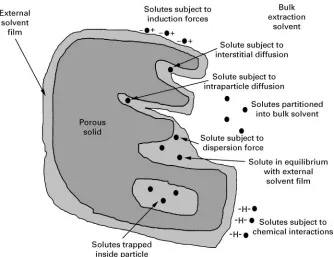
Figure 5 Schematic diagram of major physical/chemical processes that may occur during the extraction of solutes from a solid sample particle.
For the purposes of extraction, the rate of dif-fusion across the liquid}liquid boundary layer is of primary importance. This diffusion rate is depen-dent on solute shape and size and on solvent viscosity. Agitation or turbulence at the liquid}liquid interface can enhance the rate of diffusion across the phase boundary, but there is a practical limit to the degree of agitation in an extraction mixture.Figure 4depicts the liquid}liquid system, including the stagnantRlms on either side of the phase boundary. In practical extraction examples the bulk phases are adequately stirred so that diffusion in the bulk phases can be neglected. However, the interfacial stagnant layers are about 10\2}10\4cm (compared with diffu-sion coefRcients in the range 10\5}10\6cm2s\1) and must be considered as controlling the overall extraction kinetics. Moderate shaking or agitation can reduce the thickness of the stagnant, or station-ary,Rlms. If agitation is too vigorous, solutes in the mixture are given a high translational motion without an increase in the rate of solute movement to the phase interface. As phase dispersion increases, the relative velocity of the two phases decreases, until the limiting case of an emulsion (in which relative velocity becomes zero) is reached.
Diffusion in Solids
When extracting solutes from solid samples, one must not only overcome the solute}sample attraction, but
the solute must diffuse with the solvent back out of the porous solid sample. This diffusion through the pores of a solid sample is inSuenced by the geometry or tortuosity of the pore structure (e.g. the diffusion path length). Diffusion in solids, assum-ing weak solute}sample sorption (i.e., a linear iso-therm), is expressed byDeff"(D)/(KD#1), where
Deff is the effective (or apparent) diffusivity),
is the fraction of space available to the extracting solvent, KD is the distribution coefRcient (ex-pressed as the ratio of solute concentration in the solid volume to solute concentration in the solvent volume), D is the (true) diffusivity in the bulk solvent, and is a tortuosity factor. With ionic sol-utes, if the pore wall carries an electric charge, dif-fusion is also affected by the electrical potential gradient.
extractable material remaining after time t to the initial mass of extractable material, m0, where
m/m0"(6/2)(1/n2)exp(!n22Dt/r2), wherenis an integer, D is the diffusion coefRcient of the material in the sample matrix, andris the radius of the spherical sample. This equation reduces to a sum of exponential decays, and a plot of ln (m/m0) versus time eventually becomes linear. The physical ex-planation for the model is that, during the initial phases of an extraction, there is a concentration gradient at the surface of the sphere and diffu-sion from the sphere is rapid. This corresponds to the ‘equilibrium’ region (see Figure 1). When the concen-tration across the entire sphere becomes even and the rate of diffusion (and, hence, extraction) is a simple exponential decay, the ‘diffusion’ region of the extraction process (shown in Figure 1) is reach-ed. Extrapolation of this linear portion of the plot of ln (m/m0) versus time can be used to determine the time (or amount of solvent) necessary to achieve quantitative extraction recoveries.
Extraction Techniques
The previous sections described, in a practical way, the theory and the physical chemical basis for extrac-tion. The importance of the phase interface was noted, and it was emphasized that mass transfer is a function of several properties, such as diffu-sion, viscosity, density, interfacial tendiffu-sion, turbu-lence, etc. Extractions are more practically a function of those experimental parameters that affect dif-fusion, viscosity, etc. For example, temperature plays one of the largest roles in improving extraction yields (though selectivity may suffer), as does the par-ticle size of solid samples. The geometry of the extrac-tion system must also be considered.
Chemical extractions can take on a number of embodiments. This section will provide a brief over-view of these (mostly analytical) extraction tech-niques. The most important, and/or newly developed, are discussed in detail in other articles. While the methods discussed here are categorized as ‘liquid’ or ‘solid’ methods, there is some degree of exchange and methods used predominantly for solids can also be adopted for liquids in many cases, for example.
Extraction from Liquids
Liquid}liquid extraction (LLE) During LLE the sol-ute partitions between two immiscible liquid phases. The devices shown in Figure 2, as well as the com-mon separatory funnel, are simple laboratory methods for performing LLEs. The extraction sol-vents are chosen based on solubility differences
with the sample solvent. For example, with neutral, acidic, or basic aqueous samples, organic solvents such as hydrocarbons, ethers, halocarbons, and aliphatic alcohols or ketones are commonly used. LLE can be performed in batch or continuous mode, can accommodate unattended operation, is suitable for systems with low distribution ratios, and uses relatively low solvent volumes. If solvent reSux is used care must be taken to avoid loss of volatile solutes and thermal degradation of the sample or the solute. In all LLEs the formation of emulsions should be avoided.
Solid}phase extraction (SPE) In SPE, a solid, or a liquid phase adhered onto a solid support, is used to selectively (and reversibly) retain sample components as the sample solution passes through the extraction device, usually conRgured as a packed bed or disk. The solute is then removed from (‘washed off’) the sorbent phase with the extracting solvent. In essence, this extraction procedure can be thought of as a crude chromatographic method and many of the same principles, and stationary phases, apply. SPE is especially useful for improving the selectivity of an extraction for instance to ‘clean up’ dirty samples for analysis. The selective stationary phases can retain solutes based on ionic or hydrogen bonding, or dipole}dipole, dipole}induced dipole, or dispersion forces. The primary advantages of the technique, in addition to selectivity, include speed, efRciency, reproducibility, economics, and safety.
Another, specialized, version of SPE is solid-phase microextraction (SPME). With SPME, the sorbent phase is coated on a smallRbre which then comes in contact with the sample. The extracted solutes are eluted from the Rbre, in most cases directly by the chromatographic inlet system. The advantage of this technique is that the extraction is coupled directly with the analytical chromatography (so that all of the solute is introduced into the chromatographic system) so that the system can be ‘solvent-free’.
Extraction from Solids
It is estimated that 40% of all analytical samples are solids. This signiRcant portion of the analytical sample load represents the most difRcult extrac-tion challenge, since solute interacextrac-tions with the sample matrix must be overcome and the solute must then diffuse through the solid sample. As a result, the development of extraction methods for solids has focused on improving the diffusion issues.
adsorp-tive properties of the sample and the slow diffu-sion through a solid, leaching is not a very efRcient extraction method. Improvements to simple leaching can be made by placing the extraction vessel on a heat source (such as a heating plate or steam bath). Agita-tion, as in shake}Rlter methods, and a decrease in the sample particle size can also improve recoveries. An adaptation of leaching is forced-Sow leaching. In this case the sample is placed in a tube and solventSow is forced (under pressure) through the tube. In many instances the solvent is heated to near its boiling point and forced-Sow leaching can be a continuous process.
Soxhlet extraction This common procedure, which uses the device shown in Figure 2A, was developed nearly 100 years ago and is still in routine use. The sample is placed into a porous container (called a thimble) and the volatile extraction solvent is con-tinuously reSuxed and condensed through the sample. Although the method can be slow (12}24 h Soxhlet methods are not uncommon), the apparatus can be left unattended with multiple extractions being performed by a bank of Soxhlet extractors. As with any technique using applied heat, loss of volatile compounds and thermal degradation are concerns. Because of its routine use in established analytical procedures, Soxhlet extraction is undoubtedly the extraction method to which other methods for ex-tracting solids are compared.
New developments in Soxhlet extraction include a high pressure system, developed by J& W ScientiRc, which allows liquid carbon dioxide to be used as the extraction solvent, and an automated version. The automated Soxhlet extractor allows the thimble to be immersed in the boiling extraction solvent for a pre-scribed period, before the extraction is completed in the more traditional Soxhlet approach. This two-step pro-cess can be 4}10 times faster than conventional Soxhlet extractions and use about half of the solvent volume.
Sonication Sonication or ultrasound extractions can be considered a development of leaching, in which ultrasonic energy is applied to disrupt solute}sample interactions and facilitate solute diffusion. The use of ultrasonic probes can be quite efRcient.
Accelerated solvent extraction (ASE) (also called pressurized Wuid extraction) This technique, de-veloped by the Dionex Corporation, is commonly discussed using the trademarked name, accelerated solvent extraction. However, the more generic term pressurizedSuid extraction is becoming more widely used. In this technique the sample is placed into a sealed container and solvent is pumped through this extraction vessel. Because a modest pressure is
applied, temperatures much greater than the atmos-pheric boiling point can be used with liquid extrac-tion solvents. The technique is automated. This application of temperature greatly enhances solute solubility, diffusion, and viscosity, resulting in extractions that are qualitatively and quantitatively equivalent to Soxhlet in minutes instead of hours, and with signiRcantly less solvent.
Microwave-assisted extractions In some respects microwave extractions can be thought of as a form of leaching with the addition of microwave irradiation. The microwave irradiation, when absorbed by mater-ials with a permanent dipole, leads to heating. In a closed system, the approach is like ASE in the respect that temperatures greater than the atmos-pheric boiling point of the solvent can be achieved. This form of the technique is generally used with polar solvents (which absorb microwave energy). Open-cell approaches are generally used with non-absorbing solvents and samples with a high water content (or that otherwise possess a high dielectric constant). In this case localized heating in the sample allows extraction efRciencies to be improved.
Supercritical Wuid extraction (SFE) SFE employs solvents, generally carbon dioxide (neat or with ad-ded co-solvents), at temperatures and pressures near or above the critical point. These high-temperature, high-pressure solvents have gas-like diffusion, liquid-like solvation properties, and do not possess surface tension. Hence, SFE can be quite rapid. With the use of carbon dioxide, the deleterious effects (e.g. cost, health and environment concerns, etc.) of organic solvents can be minimized. Another advant-age of SFE is that solvating properties can be modiRed as a function of temperature and pressure, adding a selectivity advantage to the technique. In SFE the sample is placed in an extraction vessel and the super-critical Suid passes through the vessel in a series of static and dynamic steps. Upon depressurization of the extracting Suid the extracted solute remains in a solute collection region.
higher, controlled temperatures to force the solutes into the gas phase. Each of these gas-phase methods have been modiRed for use with the SPME approach to solute trapping.
Future Directions
Chemical extractions are thought to be a mature science. However, progress is still being made. The key inSuences driving these advances include the need for faster and more selective extractions and extrac-tions that use smaller (if any) amounts of organic solvents. Better predictive models to aid the design and scale-up of extraction processes will also continue to be of great interest.
Further Reading
Barton AFM (ed.) (1990) Handbook of Polymer}Liquid Interaction Parameters and Solubility Parameters. Boca Raton: CRC Press.
Dean JR (1990) Extraction Methods for Environmental Analysis. New York: John Wiley&Sons.
Giddings JC (1991)UniTed Separation Science. New York: John Wiley&Sons.
Handley AJ (ed.) (1999) Extraction Methods in Organic Analysis. ShefReld: ShefReld Academic Press.
Karger BL, Snyder LR and Horvath C (1973)An Introduc-tion to SeparaIntroduc-tion Science. New York: John Wiley &Sons.
Lide DR (ed.) (1994)Handbook of Organic Solvents. Boca Raton: CRC Press.
Morrison GH and Freiser H (1957) Solvent Extraction in Analytical Chemistry. New York: John Wiley&Sons. Perry RH and Green DW (eds) (1997)Perry’s Chemical Engineer’s Handbook, 7th edn. New York: McGraw-Hill.
Rydberg J, Musikas C and Choppin GR (eds) (1992) Principles and Practice of Solvent Extraction. New York: Marcel-Dekker.
Wolf FJ (1969)Separation Methods in Organic Chemistry and Biochemistry. New York: Academic Press.
FLOTATION
E. Woodburn, UMIST, Manchester, UK Copyright^ 2000 Academic Press
Introduction
Overview of the Essential Elements of Separations Based on Froth Flotation
The objective of aSotation separation operation is to remove small hydrophobic particles from an aqueous suspension (pulp) by causing them to collide with, and to attach to, air bubbles. The bubble}particle aggregates rise through the suspension forming a froth at the upper surface of the pulp. The froth, which consists of the bubble}particle aggregates with inter-bubble water containing both hydrophobic and hydrophilic particles, forms a second phase where further enhancement of the hydrophobic/hydrophilic particle separation occurs, by water draining back to the pulp. TheRnal product in which the hydrophobic particles are concentrated is removed as a froth over-Sow.
The science of the separation is primarily con-cerned with improving the selectivity of the hydro-phobic particle attachment in the pulp through the addition of surface active chemicals. In addition, the hydrodynamics of the bubble}particle collision in the aerated suspension is important, as is the regulation
of the drainage of water-containing hydrophilic par-ticles from the froth by controlling its structure, also with surfactants.
It is probably fair to say that the industrial practice ofSotation is effective even in the absence of a com-plete understanding of its scientiRc basis. The success-ful application of flotation separations in industry can be classiRed into three areas.
Mineral Processing
Froth Sotation is a widely used technique in the mineral processing industry as an early step in the process of concentrating a valuable material from an ore. It is preceded by crushing and grinding and may be followed by leaching/(ion exchange) electrowinning or smelting. In data cited by Merrill and Pennington from a US Bureau of Mines survey for 1960 nearly 200 million tons of raw material were processed annually by Sotation in the USA from which 20 million tons of concentrates were recovered. These consisted of 34 different commodities which, al-though principally metallic and non-metallic ores and coal, also currently reSects an increasing interest in recycling waste material.