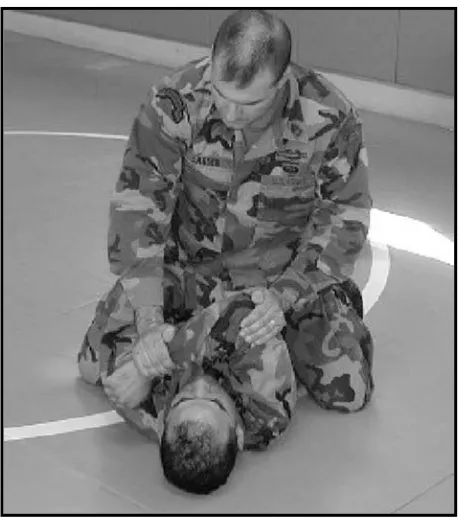
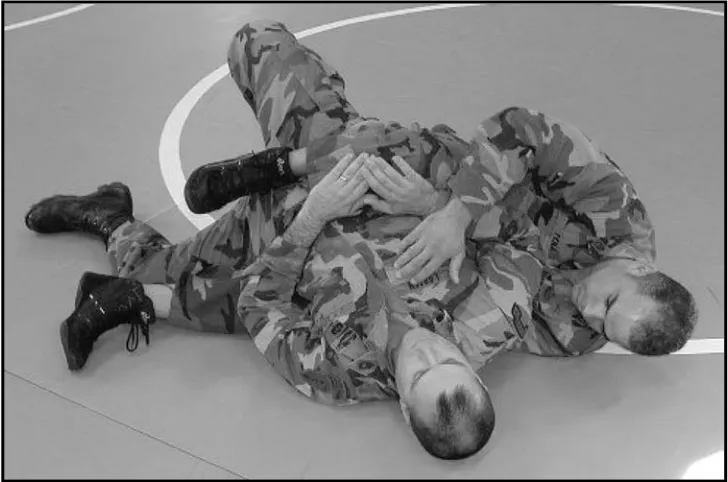
COMBATIVES
HEADQUARTERS
PREFACE
This field manual contains information and guidance pertaining to rifle-bayonet fighting and hand-to-hand combat. The hand-to-hand combat portion of this manual is divided into basic and advanced training. This manual serves as a guide for instructors, trainers, and soldiers in the art of instinctive rifle-bayonet fighting.
The proponent for this publication is the United States Army Infantry School. Send comments and recommendations on DA Form 2028 (Recommended Changes to Publications and Blank Forms) directly to Commandant, United States Army Infantry School, ATTN: ATSH-RB, Fort Benning, GA, 31905-5430.
FIELD MANUAL HEADQUARTERS
No. 3-25.150 DEPARTMENT OF THE ARMY
WASHINGTON, DC, 18 January 2002
COMBATIVES
TABLE OF CONTENTS
Page
PREFACE... iv
CHAPTER 1. INTRODUCTION
1-1. Definition of Combatives...1-1 1-2. Purposes of Combative Training...1-1
1-3. Basic Principles...1-1 1-4. Safety...1-2
CHAPTER 2. TRAINING
Section I. Train-the-Trainer...2-1 2-1. Responsibilities of Trainers ...2-1
2-2. Safety Precautions...2-1 Section II. Unit Training...2-2
2-3. Basic or One-Station Unit Training ...2-3 2-4. Unit Sustainment Training Program ...2-4 Section III. Training Areas...2-4
2-5. Training Formations...2-4 2-6. Matted Room...2-5 2-7. Pit Construction...2-5
2-8. Bayonet Assault Course ...2-6 Section IV. Teaching Techniques ...2-12
2-9. Warm-Ups and Stretches...2-12 2-10. Crawl, Walk, and Run...2-18
2-11. Demonstrations ...2-18 2-12. Execution by the Numbers ...2-19
2-13. Execution at Combat Speed ...2-19
2-14. Drills...2-19 2-15. Training Pads and Other Protective Equipment...2-19
Page
CHAPTER 3. BASIC GROUND-FIGHTING TECHNIQUES
Section I. Dominant Body Position ...3-1
3-1. Back Mount...3-1 3-2. Front Mount ...3-2 3-3. Guard...3-3 3-4. Side Control ...3-4 Section II. Basic Techniques ...3-4
3-5. Body Positioning Moves ...3-4
3-6. Finishing Moves...3-24 3-7. Drills...3-40
3-8. Defense Against Headlocks ...3-41
CHAPTER 4. ADVANCED GROUND-FIGHTING TECHNIQUES
Section I. Advanced Attacks ...4-1 4-1. Advanced Body Positions ...4-1 4-2. Pass the Guard...4-2 4-3. Attacks from the Mount ...4-14 4-4. Attacks from the Back Mount ...4-25 4-5. Attacks from the Guard...4-30
4-6. Knee Mount...4-41 4-7. Leg Attacks ...4-52 Section II. Strikes...4-57
4-8. Pass the Guard...4-57 4-9. Striking from Side Control...4-63 4-10. Defending Against Strikes in the Guard ...4-65
CHAPTER 5. TAKEDOWNS AND THROWS
5-1. Breakfalls ...5-1 5-2. Closing the Distance and Achieving the Clinch ...5-4
5-3. Throw and Takedown Techniques ...5-6 5-4. Defending Against Headlocks...5-13 5-5. Takedowns from Against a Wall...5-21 5-6. Double Leg Attack ...5-24 5-7. Single Leg Attacks ...5-28 5-8. Attacks from the Rear ...5-31
CHAPTER 6. STRIKES
6-1. Arm Strikes ...6-1 6-2. Punching Combinations ...6-6 6-3. Kicks...6-6
Page
CHAPTER 7. HANDHELD WEAPONS
Section I. Offensive Techniques...7-1 7-1. Angles of Attack...7-1 7-2. Rifle with Fixed Bayonet ...7-2
7-3. Bayonet/Knife ...7-23 7-4. Knife-Against-Rifle Sequence ...7-24
7-5. Advanced Weapons Techniques and Training...7-28 Section II. Field-Expedient Weapons ...7-29
7-6. Entrenching Tool...7-29 7-7. Three-Foot Stick...7-33 7-8. Six-Foot Pole...7-36
CHAPTER 8. STANDING DEFENSE
Section I. Unarmed Opponent ...8-1 8-1. Defense Against Chokes ...8-1 8-2. Defense Against Bear Hugs ...8-7 Section II. Armed Opponent ...8-13
8-3. Defense Against Armed Opponent ...8-13 8-4. Defense Against a Knife ...8-14 8-5. Unarmed Defense Against a Rifle with Fixed Bayonet ...8-22
CHAPTER 9. GROUP TACTICS
Section I. Lethal Force Scenarios...9-1
9-1. Range...9-1 9-2. Control...9-1 9-3. Finishing...9-1 Section II. Restrictive Force Scenarios...9-2
9-4. Two Against One ...9-2 9-5. Three Against Two...9-2
9-6. Parity ...9-2 9-7. One Against Two ...9-2
9-8. Two Against Three...9-3
CHAPTER 1
INTRODUCTION
Very few people have ever been killed with the bayonet or saber, but the fear of having their guts explored with cold steel in the hands of battle-maddened men has won many a fight.
-PATTON
1-1. DEFINITION OF COMBATIVES
Hand-to-hand combat is an engagement between two or more persons in an empty-handed struggle or with hand-held weapons such as knives, sticks, or projectile weapons that cannot be fired. Proficiency in hand-to-hand combat is one of the fundamental building blocks for training the modern soldier.
1-2. PURPOSES OF COMBATIVES TRAINING
Soldiers must be prepared to use different levels of force in an environment where conflict may change from low intensity to high intensity over a matter of hours. Many military operations, such as peacekeeping missions or noncombatant evacuation, may restrict the use of deadly weapons. Hand-to-hand combatives training will save lives when an unexpected confrontation occurs.
More importantly, combatives training helps to instill courage and self-confidence. With competence comes the understanding of controlled aggression and the ability to remain focused while under duress. Training in combatives includes hard and arduous physical training that is, at the same time, mentally demanding and carries over to other military pursuits. The overall effect of combatives training is—
• The culmination of a successful physical fitness program, enhancing individual and unit strength, flexibility, balance, and cardiorespiratory fitness.
• Building personal courage, self confidence, self-discipline, and esprit de corps.
1-3. BASIC PRINCIPLES
Underlying all combatives techniques are principles the hand-to-hand fighter must apply to successfully defeat an opponent. The natural progression of techniques, as presented in this manual, will instill these principles into the soldier.
a. Mental Calm. During a fight a soldier must keep his ability to think. He must not allow fear or anger to control his actions.
b. Situational Awareness. Things are often going on around the fighters that could have a direct impact on the outcome of the fight such as opportunity weapons or other personnel joining the fight.
c. Suppleness. A soldier cannot always count on being bigger and stronger than the enemy. He should, therefore, never try to oppose the enemy in a direct test of strength. Supple misdirection of the enemy’s strength allows superior technique and fight strategy to overcome superior strength.
e. Dominant Body Position. Position refers to the location of the fighter’s body in relation to his opponent’s. A vital principle when fighting is to gain control of the enemy by controlling this relationship. Before any killing or disabling technique can be applied, the soldier must first gain and maintain one of the dominant body positions (Chapter 3, Section I).
f. Distance. Each technique has a window of effectiveness based upon the amount of space between the two combatants. The fighter must control the distance between himself and the enemy in order to control the fight.
g. Physical Balance. Balance refers to the ability to maintain equilibrium and to remain in a stable upright position.
h. Leverage. A fighter uses the parts of his body to create a natural mechanical advantage over the parts of the enemy’s body. By using leverage, a fighter can have a greater effect on a much larger enemy.
1-4. SAFETY
The Army’s combatives program has been specifically designed to train the most competent fighters in the shortest possible time in the safest possible manner.
a. General Safety Precautions. The techniques of Army combatives should be taught in the order presented in this manual. They are arranged to not only give the natural progression of techniques, but to present the more dangerous techniques after the soldiers have established a familiarity with the dynamics of combative techniques in general. This will result in fewer serious injuries from the more dynamic moves.
b. Supervision. The most important safety consideration is proper supervision. Because of the potentially dangerous nature of the techniques involved, combatives training must always be conducted under the supervision of qualified leaders.
c. Training Areas. Most training should be conducted in an area with soft footing such as a grassy or sandy area. If training mats are available, they should be used. A hard surface area is not appropriate for combatives training.
d. Chokes. Chokes are the best way to end a fight. They are the most effective way to incapacitate an enemy and, with supervision, are also safe enough to apply in training exactly as on the battlefield.
e. Joint Locks. In order to incapacitate an enemy, attacks should be directed against large joints such as the elbow, shoulder, or knee. Attacks on most of these joints are very painful long before causing any injury, which allows full-force training to be conducted without significant risk of injury. The exceptions are wrist attacks and twisting knee attacks. The wrist is very easily damaged, and twisting the knee does not become painful until it is too late. Therefore, these attacks should be taught with great care and should not be allowed in sparring or competitions.
CHAPTER 2
TRAINING
This chapter discusses the trainer’s role in teaching and sustaining effective hand-to-hand combat. It also discusses unit training, training areas, teaching techniques, and safety precautions that must be considered before conducting combatives training.
Section I. TRAIN-THE-TRAINER
Professional instruction is the key to success in combatives training. Instructors must be physically fit and highly proficient in the demonstration and practical application of the skills. They must review and be familiar with this manual. Confidence, enthusiasm, and technical expertise are essential for success in teaching hand-to-hand combat. Assistant instructors must also be properly trained to help supervise and demonstrate maneuvers. Selecting the trainers is the first step in establishing an effective program.
2-1. RESPONSIBILITIES OF TRAINERS
Diligent effort is needed to perfect the various hand-to-hand combat techniques, to apply them instinctively, and to teach others to safely master them. The following instructor responsibilities are the core of planning and executing combatives training.
a. Seek maximum efficiency with minimum effort. Continually strive to reduce all unnecessary explanations, movement, and activity. Streamline the training without compromising content, efficiency, or safety.
b. Stress cooperation and technical mastery. Promote suppleness and controlling aggression.
c. Reinforce the details of each technique and provide positive feedback when warranted. Use occasional humor to motivate soldiers, but avoid degrading or insulting them.
d. Ensure serviceable training aids are present in sufficient quantities for all soldiers being trained. Ensure training areas are well maintained and free of dangerous obstructions.
e. Ensure instructors and assistant instructors are well-rehearsed and prepared before all training sessions. Conduct instructor training at least five hours weekly to maintain a high skill level.
f. Develop as many skilled combatives instructors for each unit as possible. Instructor-to-soldier ratios should not exceed 1 instructor for 20 soldiers. Encourage after-duty training and education for instructors.
g. Require strict discipline of all soldiers.
2-2. SAFETY PRECAUTIONS
To prevent injuries, the instructor must consider the following safety precautions before conducting combatives training.
b. Familiarize the soldiers with each maneuver by a complete explanation and demonstration before they attempt the moves.
c. Do not allow the soldiers to get ahead of the instruction.
d. Ensure the training partner offers no resistance, but allows the maneuver to be freely executed during the learning stages and while perfecting the techniques.
e. Ensure there is adequate space between soldiers during all practical work−for example, allow at least an 8-foot square for each pair of soldiers.
f. Ensure that soldiers empty their pockets, and remove their jewelry, and identification tags before training.
g. Stress that only simulated strikes to vital points, such as the head, neck, and groin area are to be executed. Soldiers may use light blows to other vulnerable areas; however, they must exercise caution at all times.
h. Ensure that soldiers understand the use of both physical tapping and verbal signals to indicate to the partner when to stop the pressure in grappling and choking techniques.
i. Make sure soldiers warm up and stretch properly before practical work. j. Teach and practice falls before conducting throws.
k. Ensure that the soldier to be disarmed does not place his finger in the trigger guard during rifle and bayonet disarming.
l. Make sure soldiers keep scabbards on knives and bayonets firmly attached to rifles while learning bayonet disarming methods.
m. Use bayonet scabbards or rubber knives during knife disarming training.
n. If utilizing a sawdust pit, inspect all sandbags on retaining wall before conduct of training to ensure that all bags are serviceable, at least 75 percent full, and that the entire retaining wall is covered with sandbags. Any bag placed where personnel are likely to fall will be filled with the same consistency filler as the sawdust in the pit and will also provide a minimum of 6 inches of sawdust.
o. Maintain a buffer zone of 6 feet from retainer wall and demonstration area during all training, especially training requiring throws and takedowns by students.
p. Rake the training pit to loosen sawdust and remove all sharp objects. Properly inspect the pit so that all safety hazards are removed before instruction or demonstrations are executed.
q. Perform inspections of the depth of sawdust with enough time before training to resurface the pit. Remember that new sawdust will need to be raked and inspected for foreign objects that may cause injuries.
Section II. UNIT TRAINING
2-3. BASIC OR ONE-STATION UNIT TRAINING
This is a suggested training program for basic training or OSUT. It is based on ten hours of available training time, divided into five periods of two hours each. Training should start with ground grappling, which is not only easier both to teach and to learn, but also provides a sound base for the more difficult standing techniques. A program should not begin with techniques that will take a long time to master. The result would be almost uniform disillusionment with combatives in general.
a. Period 1 (2 hours).
• Introduction to combatives safety.
• Combat demonstration performed by instructors or trainers to gain attention and to motivate soldiers.
• Warm-ups and stretches.
• Stand up in base.
• Escape the mount by trap and roll.
• Pass the guard.
• Achieve the mount.
• Drill No. 1, 10 to 15 repetitions; escape the mount, pass the guard, achieve the mount, in sequence.
• Escape the mount by shrimp to the guard.
• Escape the mount drill. b. Period 2 (2 hours).
• Warm-ups and stretches.
• Drill No. 1, ten repetitions.
• Arm push and roll to the rear mount.
• Escape the rear mount.
• Drill No. 2: Arm push and roll to the back mount, escape the back mount.
• Grappling for position, five minutes and then change partners. Repeat for duration of class.
c. Period 3 (2 hours).
• Warm-ups and stretches.
• Drill No. 1, ten repetitions.
• Drill No. 2, ten repetitions.
• Introduction to choking.
• Rear naked choke.
• Cross collar choke from the mount and guard.
• Front guillotine choke. d. Period 4 (2 hours).
• Warm-ups and stretches.
• Drill No. 1, ten repetitions.
• Drill No. 2, ten repetitions.
• Bent arm bar from the mount and cross mount.
• Straight arm bar from the mount.
e. Period 5 (2 hours).
• Warm-ups and stretches.
• Drill No. 1, ten repetitions.
• Drill No. 2, ten repetitions.
• Review.
• Rules introduction.
• Competition.
2-4. UNIT SUSTAINMENT TRAINING PROGRAM
Command emphasis is the key to a successful combatives program. Combatives training sessions should be regular, and should be included on unit training schedules at company and platoon level.
a. Successful unit combatives programs continue to focus on the core techniques taught in the basic training or OSUT program. Mastery of these moves will result in more proficient fighters than exposure to a large number of techniques will.
b. As the level of proficiency rises the natural progression of moves is as follows:
• Advanced ground grappling.
• Takedowns.
• Strikes and kicks.
• Fight strategy.
• Situational training.
c. Primary trainers should be designated at all levels. Regular training sessions with these trainers will ensure the quality of training at the small unit level.
d. Primary trainers should be of the appropriate rank; for instance, a platoon primary trainer should be a squad leader or the platoon sergeant to ensure that the training actually occurs.
e. Modern combatives allow soldiers to compete safely. To inspire the pursuit of excellence, individual soldiers may compete during organizational day. Leaders may also call squads, sections, or individuals to compete randomly as a method of inspecting training levels. All combatives competitions should be conducted IAW rules established in Appendix B of this manual. However, competition should not become the focus of combatives training, but remain a tool to inspire further training.
Section III. TRAINING AREAS
An advantage of combatives training is that it can be conducted almost anywhere with little preparation of the training area.
2-5. TRAINING FORMATIONS
2-6. MATTED ROOM
Because inclement weather can be a training distracter, the best training area is an indoor, climate-controlled facility with both padded floor and walls. Mats should be sufficiently firm to allow free movement, but provide enough impact absorption to allow safe throws and takedowns.
2-7. PIT CONSTRUCTION
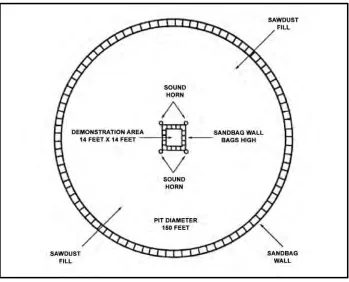
A common area for teaching hand-to-hand combat is a sawdust pit. Sawdust pits are designed to teach throws and falls safely, but are not very suitable for ground fighting. Figure 2-1 shows a training area for 200 soldiers with a sawdust pit surrounding an instructor and a demonstrator platform.
a. To construct the pit, dig out and level an area 50 meters wide, and build a retaining wall at least 24 inches high. The wall can be cinderblocks, sandbags, or dirt if other materials are not available. (To prevent injuries when using a cinderblock retaining wall, cover the wall and the top of the wall with sandbags.) Place a layer of plastic sheeting on the ground to prevent the growth of grass and weeds, and place a sand base up to 12 inches deep on top of the plastic. Then, place a layer of sawdust about 6 inches deep on top of the sand.
[image:12.612.149.498.390.672.2]b. Build a 14-foot square demonstration area (Figure 2-1) in the center of the pit with the same type of retaining wall described in paragraph a. This area should be large enough for two demonstrators and the primary instructor.
2-8. BAYONET ASSAULT COURSE
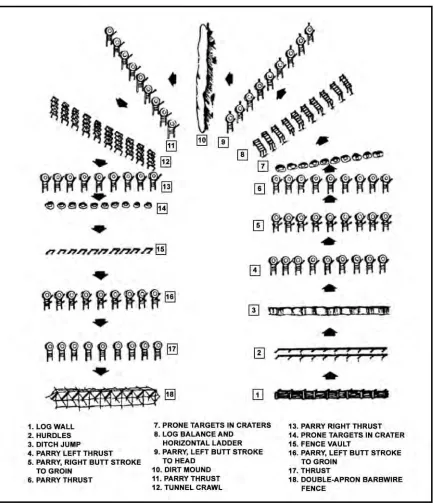
The bayonet assault course provides the commander a unique training opportunity by allowing soldiers to employ rifle-bayonet fighting skills under simulated combat conditions. The course can be built and negotiated so that demands placed on the soldiers’ abilities and on their endurance approach those experienced under combat conditions. Realistic sights and sounds of battle—fire, smoke, confusion, and pyrotechnics—can also be created to enhance realism. The training objectives of the bayonet assault course include:
• Improving rifle-bayonet fighting skills.
• Improving physical fitness and aggressiveness.
• Improving speed, strength, coordination, and accuracy.
• Providing realistic rifle-bayonet fighting under near combat conditions.
• Challenging the soldiers’ determination and stamina, which are needed in combat.
• Providing an opportunity for team and squad leaders to develop their leadership and control measures.
a. Safety. The safety of the soldiers should be the primary concern of the instructor and his assistants. The best safety aids are constant control and supervision. In addition, instructors should brief soldiers at the beginning of each class on the requirements for safety during rifle-bayonet training. Instructors use the following safety measures:
(1) Bayonets must be fixed and unfixed only on command.
(2) Rifles should be grounded near the targets when the soldiers are ordered to move to the instructor’s platform for explanations or demonstrations.
(3) A level surface that does not become slippery when wet should be provided for the training area.
(4) Left-handed soldiers should be positioned so they are opposite another left-handed soldier when working against the targets. This type of arrangement prevents possible injury when executing a series of movements.
(5) When using the M16 rifle against a target, the force of contact during the thrust movement may drive the hand gripping the small of the stock into the forward assist assembly (on the right-hand side of the weapon near the stock). To prevent injury to the hand, the soldier must maintain a firm grip on the small of the stock. Gloves should be worn as part of the training uniform when weather dictates.
Targets should be durable but should not damage weapons. Place a sign near each target to indicate the type of attack to be used.
d. Usage. An example of how to conduct the bayonet assault course is as follows: (1) Task. Negotiate the bayonet assault course.
Figure 2-4. Log wall.
Figure 2-8. Tunnel crawl.
Figure 2-10. Double-apron barbwire fence.
(3) Standards. The course must be successfully negotiated by all soldiers in the class with each soldier obtaining kills on 75 percent of the total targets in his lane. The course must be negotiated in 5 minutes or less (about 30 seconds for each 50 meters and time to attack and negotiate obstacles).
WARNING
To avoid injury, instructors ensure that the proper interval is constantly maintained.
Section IV. TEACHING TECHNIQUES
This section discusses a variety of effective teaching techniques to use while conducting combatives training.
2-9. WARM-UPS AND STRETCHES
further warm up. This allows for the maximum use of training time combining a portion of the warm up with building muscle memory, and refining the basic techniques.
a. Warm-up Exercises. To begin warm-up exercises, rotate the major jointsneck, shoulders, hips, and knees. The warm-up should include at least 7 to 10 minutes of stretching, running in place or jogging around the training area, and calisthenics. Grass drills and guerrilla exercises are good to use as a warm-up for combatives training. They condition the body through motion in all ranges, accustom the soldiers to contact with the ground, and promote aggressiveness.
b. Stretching Exercises. Any of the stretching exercises in FM 21-20 are recommended for hand-to-hand combat training. Five other exercises that increase flexibility in areas of the body that benefit hand-to-hand combat movements are as follows:
(1) Backroll Stretch.
(a) Position. Lay on ground on back with legs extended and arms by sides, palms down.
(b) Action. Raise legs over head and roll back as far as possible, trying to place toes on the ground behind head. Keep knees locked and feet and knees together; hold for 20 seconds (Figure 2-11). Gradually return to starting position. Repeat two or three times.
(2) Buddy-Assisted Splits (Leg Spreader).
(a) Position. Sit on ground facing buddy with legs extended and spread as far as possible. Position feet inside ankles of buddy.
(b) Action. Interlock hands with buddy and alternate pulling one toward the other, causing the buddy to bend forward over the hips until a stretch is felt (Figure 2-12). Hold this position for 20 seconds, then alternate and have him pull you into a stretch. Do sequence two or three times.
(3) Buddy-Assisted Hamstring Stretch.
(a) Position. Sit on ground with right leg extended to front and foot pointing up. Bend left leg with sole touching to inside of the right thigh. Have buddy kneel behind you with his hands on your shoulders (Figure 2-13).
(b) Action. Slowly bend forward from hips over the right leg and reach your hands toward ankles until stretch is felt (Figure 2-13). Hold this for 10 to 15 seconds. The buddy then applies downward pressure and allows you to adjust your stretch. Hold for 10 to 15 seconds and repeat. Alternate legs and positions after two or three sequences.
(4) Buddy-Assisted Groin (Butterfly) Stretch.
(a) Position. Sit on ground with the soles of your feet together, close to the torso. Hold ankles with hands. Have buddy kneel behind you with his hands on your knees. (b) Action. The buddy places his hands on top of your thighs at the knees. The buddy’s weight is supported by your shoulders while little weight is placed on the thighs. Then, the buddy increases downward pressure on your thighs until stretch is felt (Figure 2-14). Hold for 20 seconds, then alternate positions.
(5) Buddy-Assisted Back Stretch.
(a) Position. Stand back-to-back with buddy and interlock arms at your sides.
(b) Action. Bend forward at the waist and pull buddy up on your back over your hips. The buddy allows his back to arch and tells you when an adequate stretch is felt (Figure 2-15). Hold this position for 20 seconds, then, change places.
2-10. CRAWL, WALK, AND RUN
Training can be conducted using the crawl, walk, and run techniques, which may be applied on two levels.
a. First Level. The instructors use these techniques during each initial training session.
(1) Crawl Phase. New techniques are introduced, taught, demonstrated, and executed by the numbers.
(2) Walk Phase. During this phase, soldiers practice the new techniques by the numbers, but with more fluid movement and less instructor guidance.
(3) Run Phase. Soldiers execute the techniques at combat speed with supervision. b. Second Level. The instructors use these techniques when developing unit combatives programs. Before conducting combatives training, the instructor considers the abilities and experience level of the soldiers to be trained. During training, those soldiers with prior martial arts experience can be a great asset; they may be used as demonstrators or as assistant instructors. The crawl, walk, run approach to unit training ensures a high skill level throughout the unit and minimizes the risk of training injuries.
(1) Crawl Phase. During the crawl phase, the instructor introduces combatives to the unit. Here, the basic skills that set the standards for advancement to other levels are mastered. Emphasis is placed on the basic ground fighting techniques, gradually introducing standup fighting and fight strategy. Studying the new techniques in this method ensures that the movements are correctly programmed into the soldiers’ subconscious after a few repetitions.
(2) Walk Phase. Once a unit has developed a sufficient proficiency level in basic skills, begin the walk phase. Instructors introduce soldiers to more advanced ground fighting techniques and begin serious training on closing with the enemy and takedowns. Soldiers engage in full sparring and competitive matches.
(3) Run Phase. In the run phase, soldiers spar using slaps to represent striking during ground fighting, takedowns are practiced against an opponent with boxing gloves, and scenario driven training such as multiple opponent or restrictive equipment is used.
2-11. DEMONSTRATIONS
A well-coordinated demonstration and professional demonstrators are crucial for successful learning by soldiers. Unrehearsed presentations or inadequately trained demonstrators can immediately destroy the credibility of the training. Two methods are appropriate for demonstrating combative techniques based on the size of the group to be taught.
assistant instructor. The primary instructor talks himself through the demonstration. He stresses correct body movement and key teaching points as he does them.
2-12. EXECUTION BY THE NUMBERS
Instructors use execution by the numbers to break techniques down into step-by-step phases so soldiers can clearly see how the movements are developed from start to finish. Execution by the numbers also provides soldiers a way to see the mechanics of each technique. This teaching method allows the instructor to explain in detail the sequence of each movement. For example, on the command PHASE ONE, MOVE, the attacker throws a right-hand punch to the defender’s face. At the same time, the defender steps to the inside of the attacker off the line of attack and moves into position for the right-hip throw. Assistant instructors are able to move freely throughout the training formation and make on-the-spot corrections.
2-13. EXECUTION AT COMBAT SPEED
When the instructor is confident that the soldiers being trained are skilled at executing a technique by the numbers, he has them execute it at combat speed. Executing movements at combat speed enables soldiers to see how effective a technique is. This builds the soldier’s confidence in the technique, allows him to develop a clear mental picture of the principles behind the technique, and gives him confidence in his ability to perform the technique during an actual attack. For example, the command is, PASS THE GUARD AT COMBAT SPEED, MOVE. The soldiers then execute this technique from start to finish. It is important to remember that combat speed does not always mean very quickly. Speed requires space and space often favors the defender.
2-14. DRILLS
Drills are used to warm up, to reinforce the importance of dominant body position, and to perfect soldiers’ basic skills through repetition. During these drills, basic positional techniques are repeated at the beginning of each training session with a different detail emphasized each session. In this way the emphasis is kept on perfecting the basic techniques, while at the same time making the best use of limited training time.
2-15. TRAINING PADSANDOTHER PROTECTIVE EQUIPMENT
Training pads are highly recommended to enhance training (Figure 2-16, page 2-20). They allow full-forced strikes by soldiers and protect their training partners. Although striking is a inefficient way to end a fight, it is a very important part of a fight. Pads enable soldiers to feel the effectiveness of striking techniques and to develop power in their striking. Instructors should encourage spirited aggressiveness. Pads can be tackle dummy pads or martial arts striking pads. Training pads can be requisitioned through supply channels or purchased locally.
CHAPTER 3
BASIC GROUND-FIGHTING TECHNIQUES
Basic ground-fighting techniques build a fundamental understanding of dominant body position, which should be the focus of most combatives training before moving on to the more difficult standing techniques. Ground fighting is also where technique can most easily be used to overcome size and strength.
Section I. DOMINANT BODY POSITION
Before any killing or disabling technique can be applied, the soldier must first gain and maintain dominant body position. The leverage gained from dominant body position allows the fighter to defeat a stronger opponent. An appreciation for dominant position is fundamental to becoming a proficient fighter because it ties together what would otherwise be a long confusing list of unrelated techniques. If a finishing technique is attempted from dominant position and fails, the fighter can simply try again. If, on the other hand, a finishing technique is attempted from other than dominant position and fails, it will usually mean defeat. The dominant body positions will be introduced in order of precedence.
3-1. BACK MOUNT
The back mount gives the fighter the best control of the fight (Figure 3-1, page 3-2). From this position it is very difficult for the enemy to either defend himself or counterattack. Both legs should be wrapped around the enemy with the heels “hooked” inside his legs. One arm is under an armpit and the other is around the neck and the hands are clasped. Even though a fighter may find himself with his own back on the ground this is still the back mount.
CAUTION
Figure 3-1. Back mount.
3-2. FRONT MOUNT
Figure 3-2. Front mount. 3-3. GUARD
3-4. SIDE CONTROL
Although side control (Figure 3-4) is not a dominant position, many times a fighter will find himself in this position, and he must be able to counter the enemy’s defensive techniques. The fighter should place his elbow on the ground in the notch created by the enemy’s head and shoulder. His other hand should be palm down on the ground on the near side of the enemy. The leg closest to the enemy’s head should be straight and the other one bent so that the knee is near the enemy’s hip. He should keep his head down to avoid knee strikes.
Figure 3-4. Side control.
Section II. BASIC TECHNIQUES
These basic techniques not only teach a fighter to understand dominant body position, but also provide an introduction to a systematic way of fighting on the ground. Almost all types of finishing moves are represented by the simplest and, at the same time, most effective example of the type. Before any time is spent on the more complex and harder to learn techniques presented later in this manual, the fighter must master these basics.
3-5. BODY POSITIONING MOVES
The key to developing good ground fighters is ingraining a feel for the dominant body positions and how they relate to each other.
a. Stand up in Base. This is the most basic technique. It allows the fighter to stand up in the presence of an enemy or potential enemy without compromising his base and thus making himself vulnerable to attack. The principles of body movement inherent in this technique make it so important that leaders should reinforce it every time a fighter stands up
Figure 3-5 Stand up in base, step 1.
(3) Step 3 (Figure 3-7). After placing his weight on both feet, the fighter lifts his hand from the ground and assumes a fighter’s stance. He holds his hands high to protect his head and face. His fists are clenched, but relaxed. His elbows are close to his body, and his weight is evenly distributed on both feet, creating a stable base. He is light on his feet with his knees slightly flexed to allow quick movement in any direction.
Figure 3-7. The fighter’s stance.
b. Escape the Mount, Trap, and Roll. This move starts with the fighter on his back and the enemy mounted on his chest.
Figure 3-8. Escape the mount, trap, and roll, step 1.
(2) Step 2 (Figure 3-9). The fighter now lifts the enemy straight up with his hips and, because the enemy has neither a hand nor a foot to stop him, he will topple over.
(3) Step 3 (Figure 3-10). As the enemy begins to fall, the fighter turns over, ending within the enemy’s guard.
Figure 3-10. Escape the mount, trap, and roll, step 3.
c. Escape the Mount, Shrimp to the Guard. This move also starts with the fighter on his back and the enemy mounted on his chest. While the fighter is attempting to escape the mount, trap, and roll, he may be unable to capture the enemy’s leg. This occurs when the enemy moves his leg away. This movement, however, creates an opening under the same leg. The term shrimp refers to the action of moving the hips away, which is crucial to the success of this technique.
Figure 3-11. Escape the mount, shrimp to the guard, step 1.
(2) Step 2 (Figure 3-12). The fighter now uses either his elbow or hand to hold the enemy’s leg in place and brings his knee through the opening.
(3) Step 3 (Figure 3-13). When his knee gets past the enemy’s leg, the fighter places his weight on the same leg and turn towards the other side. This action will bring his knee up and create enough space to pull the leg out and place it over the enemy’s leg.
Figure 3-13. Escape the mount, shrimp to the guard, step 3.
(5) Step 5 (Figure 3-15). It is important that the fighter lock his feet together around the enemy, placing him in the open guard.
Figure 3-15. Escape the mount, shrimp to the guard, step 5.
d. Pass the Guard and Achieve the Mount. The fighter is in base within the enemy’s guard. From this position, the fighter must escape from within the enemy’s legs. This action is called passing the guard.
(2) Step 2 (Figure 3-17). The fighter then raises his opposite side foot and places it on the ground just out of reach of the enemy’s hand. He turns his hips, creating an opening, and pushes his hand through, fingertips first.
Figure 3-17. Pass the guard and achieve the mount, step 2.
(4) Step 4 (Figure 3-19). With the same hand, the fighter grasps the enemy’s collar with his thumb on the inside and drives the enemy’s knee straight past his head. Pressure on the enemy’s spine forces him to release his legs.
Figure 3-19. Pass the guard and achieve the mount, step 4.
(5) Step 5 (Figure 3-20). The fighter rides the enemy down into side control.
Figure 3-20. Pass the guard and achieve the mount, step 5.
(6) Step 6 (Figure 3-21). The fighter faces toward the enemy’s legs and changes his hips, ensuring that his knee is controlling the enemy’s hip, and that his legs are spread out to avoid a reversal.
Figure 3-21. Pass the guard and achieve the mount, step 6.
(7) Step 7 (Figure 3-22). The fighter uses his free hand to control the enemy’s legs, and swings his leg over into the mount.
e. Escape the Half Guard. Frequently the enemy will wrap his legs around one of fighter’s from the bottom. This is called the half guard.
(1) Step 1 (Figure 3-23). The fighter must prevent the enemy from either regaining the guard, or rolling him over. To do this, the fighter must assume a strong position. He should ensure that his elbow is against the side of the enemy’s neck, and he is blocking the enemy from placing his leg under him with his bottom knee.
Figure 3-23. Escape the half guard, step 1.
[image:43.612.107.470.455.670.2](3) Step 3 (Figure 3-25). The fighter uses his free hand to push the enemy’s knee until the fighter’s knee is exposed, and then drives it over the enemy until it is on the ground.
Figure 3-25. Escape the half guard, step 3.
[image:44.612.142.507.116.334.2](4) Step 4 (Figure 3-26). If the enemy attempts to push against the fighter’s knee with his hand, the fighter places his hand under the enemy’s arm at the bend in his elbow and pushes it upward towards his head.
f. Arm Push and Roll to the Rear Mount. The fighter starts this technique in the front mount.
[image:45.612.184.390.144.398.2] [image:45.612.173.403.430.689.2](1) Step 1 (Figure 3-27). When the enemy attempts to protect his face from punches by crossing his arms over it, the fighter uses both hands to push one arm farther across and captures it in place by using his body weight.
(3) Step 3 (Figure 3-29). The fighter now places the first hand on the enemy’s elbow and, by pushing with his chest, turns the enemy onto his stomach. The hand on the elbow is used to hold the enemy in place while the fighter repositions his chest for further pushing.
Figure 3-29. Arm push and roll to the rear mount, step 3.
[image:47.612.107.470.460.663.2](5) Step 5 (Figure 3-31). From this position the enemy normally tries to rise up and get his knees under him. When he attempts this, the fighter sits up and brings both legs around, “hooking” them inside of the enemy’s legs, and grasps his hands together around the enemy’s chest. One arm should be over the enemy’s shoulder and the other should be under his arm.
Figure 3-31. Arm push and roll to the rear mount, step 5.
g. Escape the Rear Mount. This technique begins with the fighter face down and the enemy on the fighter’s back in the rear mount.
[image:48.612.211.437.439.678.2](2) Step 2 (Figure 3-33). He now places one arm beside his own ear as shown and the other across his body in his armpit. This will prevent the enemy from securing a choke.
Figure 3-33. Escape the rear mount. step 2.
[image:49.612.105.469.447.688.2](4) Step 4 (Figure 3-35). Once his back is on the ground, the fighter uses his arms and legs to step over and gain the mount.
Figure 3-35. Escape the rear mount, step 4.
3-6. FINISHING MOVES
When dominant body position has been achieved the fighter can attempt to finish the fight secure in the knowledge that if an attempt fails, as long as he maintains dominant position, he may simply try again.
a. Rear Naked Choke. Chokes are the most effective method of disabling an enemy. This technique should only be executed from the back mount after both leg hooks are in place.
[image:51.612.142.435.211.622.2](1) Step 1 (Figure 3-36). Leaving the weak hand in place, the fighter reaches around the enemy’s neck and under his chin with the strong hand.
(2) Step 2 (Figure 3-37). The fighter now places the biceps of the weak hand under the strong hand, moves the weak hand to the back of the enemy’s head, and completes the choke by expanding his chest.
b. Cross Collar Choke from the Mount and Guard. This technique can only be executed from the guard or the mount.
[image:53.612.141.433.143.554.2](1) Step 1 (Figure 3-38). With the weak hand, the fighter grasps the enemy’s collar and pulls it open.
(2) Step 2 (Figure 3-39). While keeping a hold with the weak hand, the fighter now inserts his strong hand, fingers first, onto the collar. The hand should be relaxed and reach around to the back of the neck grasping the collar.
(3) Step 3 (Figure 3-40). After grasping the back of the enemy’s collar, the fighter inserts the weak hand under the strong hand and into the collar, fingers first, touching or very close to the first hand.
Figure 3-40. Cross collar choke from the mount, step 3.
Note: If the fighter is applying this choke from the mount, he should put his head on the ground on the side of the top hand and relax into the choke.
c. Front Guillotine Choke. Many times this technique may be used as a counter to the double leg takedown.
(1) Step 1 (Figure 3-42). As the enemy shoots in toward the fighter’s legs, the fighter should ensure that the enemy’s head goes underneath one of his arms. The fighter wraps his arm around the enemy’s head and under his neck. The fighter’s palm should be facing his own chest.
(2) Step 2 (Figure 3-43). With the other hand, the fighter grasps the first hand, ensuring that he has not reached around the enemy’s arm, and pulls upward with both hands.
(3) Step 3 (Figure 3-44). He now sits down and places the enemy within his guard, and finishes the choke by pulling with his arms and pushing with his legs.
Figure 3-44. Front guillotine choke, step 3. d. Bent Arm Bar from the Mount and Cross Mount.
(1) Step 1 (Figure 3-45). When the fighter has mounted the enemy, the enemy may
[image:58.612.237.410.419.684.2]Figure 3-45. Bent arm bar from the mount and cross mount, step 1 (continued).
[image:59.612.142.434.421.681.2](3) Step 3 (Figure 3-47). The fighter raises the enemy’s elbow and at the same time drags the back of his hand along the ground like a paint brush, breaking the enemy’s arm at the shoulder.
Figure 3-47. Bent arm bar from the mount and cross mount, step 3. e. Straight Arm Bar from the Mount.
(2) Step 2 (Figure 3-49). Placing all of his weight on the enemy’s chest, the fighter pops up and places his feet under him, ensuring that he keeps his butt low.
Figure 3-49. Straight arm bar from the mount, step 2.
[image:61.612.148.426.473.684.2](4) Step 4 (Figure 3-51). The fighter now pinches the enemy’s arm between his legs, grasps the arm at the wrist, and falls back extending the arm. The breaking action is hip pressure against the elbow joint.
Figure 3-51. Straight arm bar from the mount, step 4. f. Straight Arm Bar from the Guard.
(2) Step 2 (Figure 3-53). The fighter inserts his other hand under the enemy’s leg on the side opposite the targeted arm. The hand should be palm up.
Figure 3-53. Straight arm bar from the guard, step 2.
[image:63.612.163.413.434.669.2](4) Step 4 (Figure 3-55). He now curls his back to give himself a point on which to spin, and by pulling with the arm on the side opposite the targeted arm, he spins around and places his leg over the enemy’s head, capturing the target arm between his legs.
(5) Step 5 (Figure 3-56). The fighter now brings his hand from under the enemy’s leg and secures the wrist of the targeted arm, completing the move by breaking the targeted arm with pressure from his hips.
g. Sweep from the Attempted Straight Arm Bar.
(1) Step 1 (Figure 3-57). If the enemy tucks his head in to avoid the arm bar, The fighter maintains his grip on the enemy’s leg and swings his own leg down to gain momentum. The fighter ensures that he curls his leg under after swinging it down.
Figure 3-57. Sweep from the attempted straight arm bar, step 1.
(2) Step 2 (Figure 3-58, continued on page 3-40). The fighter pushes the enemy
Figure 3-58. Sweep from the attempted straight arm bar, step 2 (continued). 3-7. DRILLS
Drills are used as a portion of the warm-up, which allows the maximum use of training time, stresses the importance of position, and also keeps training focused on perfecting the basic moves. Different details can be taught or emphasized during each training session. This will result in a deeper understanding of the techniques, as well as building muscle memory, teaching the soldiers to move in the most efficient ways naturally. More advanced techniques can be substituted within the framework of the drill after sufficient skill level is shown in the basics.
a. Drill 1 (Basic Drill). This drill begins with one soldier mounted.
(1) Step 1. The soldier on the bottom escapes the mount using the trap and roll
technique.
(2) Step 2. The same soldier passes the guard and achieves the mount.
(3) Step 3. The roles now reverse and the second soldier goes through steps one and two.
b. Drill 2. This drill also begins with one soldier mounted.
(3) Step 3. When the second soldier is mounted, the roles will reverse, and they will go back through steps one and two.
3-8. DEFENSE AGAINST HEADLOCKS
The headlock is a very poor technique for anything more than immobilizing an enemy. It is, however, a very common technique in actual fighting; therefore, knowing how to escape is very important for a soldier. The techniques are progressive, and should be attempted in the order taught.
a. Form the Frame.
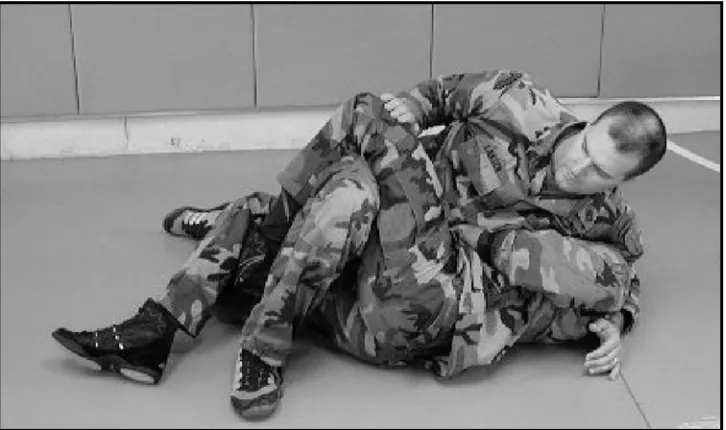
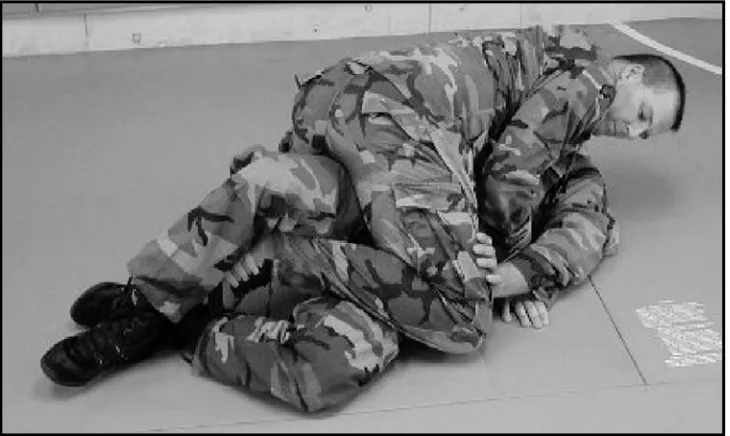
(1) Step 1 (Figure 3-59). The fighter’s first step in escaping from a headlock is to ensure that his arm is not captured. With a short jerky motion, the fighter pulls his elbow in and turns on his side.
(2) Step 2 (Figure 3-60). If able, the fighter forms a frame under the enemy’s chin. The fighter’s top arm should be under the enemy’s jawbone, and his top hand should rest comfortably in the grasp of the other hand. At this point, the fighter’s bone structure should be supporting the enemy’s weight.
Figure 3-60. Form the frame, step 2.
(4) Step 4 (Figure 3-62). The fighter reaches with both legs to grasp the enemy’s head. If the enemy lets go of his headlock, the fighter squeezes the enemy’s neck with his legs.
Figure 3-62. Form the frame, step 4.
(5) Step 5 (Figure 3-63). If the enemy does not release the headlock, the fighter rotates around until he is on both of his knees behind the enemy’s back.
(6) Step 6 (Figure 3-64). The fighter uses his top hand to clear the enemy’s legs out of the way and steps over, bringing his foot in tight against the enemy’s hip. The fighter establishes his base by putting both hands on the ground.
Figure 3-64. Form the frame, step 6.
(7) Step 7 (Figure 3-65). The fighter forces the enemy to release his grip on the fighter’s neck by forming the frame and leaning toward the enemy’s head, driving the bone of his upper arm under the enemy’s jawbone.
Figure 3-65. Form the frame, step 7.
b. Follow the Leg. Although the fighter should always try to form the frame, sometimes the enemy will tuck his head in making it impossible.
(1) Step 1 (Figure 3-66). After ensuring that his arm is not captured as in the first technique, the fighter moves as close to the enemy as possible and places his leg over him. The fighter’s heel should find the crease at the enemy’s hip formed by his leg.
(2) Step 2 (Figure 3-67). The fighter pulls his bottom arm free and places his weight on it. Holding the enemy tightly at the other shoulder, the fighter crawls over him using his own leg as a guide.
Figure 3-67. Follow the leg, step 2.
c. Roll Toward the Head (Figure 3-69). If the enemy should succeed in capturing the fighter’s arm, the fighter can use the enemy’s reaction to his attempts to free it to his advantage. With short jerky motions, the fighter attempts to pull his arm free. The enemy will have to adjust his position by leaning toward the fighter. Immediately after the fighter attempts to pull his arm free and feels the enemy pushing, the fighter arches toward his head and then over his opposite shoulder, taking the enemy over.
Figure 3-69. Roll toward the head.
CHAPTER 4
ADVANCED GROUND-FIGHTING TECHNIQUES
After achieving an understanding of the basics of ground fighting, other elements of fighting on the ground are added. These techniques, however, are dependent on a thorough grasp of the basics. Being systematic is important in building competent fighters. Staying with the program will not only produce competent fighters quickly, but will produce the most competent fighters over time as well.
Section I. ADVANCED ATTACKS
Concentrating on offensive techniques is preferable when developing a training plan. The best defense is simply knowing that the technique exists. If defenses are to be taught, there should be ample time between teaching the offense and teaching the defense to allow time for the students to master the offensive skills first. Training the defense prematurely will hinder development.
4-1. ADVANCED BODY POSITIONS
a. North-South Position (Figure 4-1). This position allows many possible attacks and is very difficult for the enemy to escape from. You should attempt to control the enemy’s arms by placing your elbows on the ground in his arm pits. You will also need to shift your weight in order to prevent him from rolling you over.
b. Knee in the Stomach (Figure 4-2). Another very important dominant body position is the knee mount. When in the knee mount, the knee should be in the middle of the enemy’s chest. The foot should be hooked around his hip. The opposite knee should be off of the ground and back away from the enemy’s head, and the hips should be set forward to maintain balance.
Figure 4-2. Knee in the stomach.
4-2. PASS THE GUARD
When you are inside of the enemy’s guard, he has many options to attack you or reverse the positions. Therefore, you will need several possible techniques to pass.
(1) Knee in the Tailbone.
(a) Step 1 (Figure 4-3). Moving one hand at a time, grasp the enemy at the belt with both hands. Keep pressure on him to prevent him from sitting up.
Figure 4-3. Knee in the tailbone, step 1.
will also create more distance between the knee in the tailbone and your hip, forcing him to loosen the grip with his legs.
Figure 4-5. Knee in the tailbone, step 3.
Figure 4-6. Knee in the tailbone, step 4 (continued).
(2) Stand Up With One Sleeve.
(a) Step 1 (Figure 4-8). Gain control of one of the enemy’s sleeves near the wrist, and with the other hand grasp his jacket in the center to keep him from sitting up.
Figure 4-8. Stand up with one sleeve, step 1.
Figure 4-9. Stand up with one sleeve, step 2 (continued).
(d) Step 4 (Figure 4-11). When his grip breaks, reach under the leg and pull it to you, tightening up to gain control and pass like before. It is important to control the leg below his knee so that he cannot bend it to escape and regain the guard.
Figure 4-11. Stand up with one sleeve, step 3. (3) Hands in the Arm Pits.
Figure 4-12. Hands in the arm pits, step 1 (continued).
(c) Step 3 (Figure 4-14). Sit down so that your knee is driven upward between the enemy’s legs. This will break the grip of his legs behind your back.
Figure 4-14. Hands in the arm pits, step 3.
Figure 4-15. Hands in the arm pits, step 4 (continued).
b. Open Guard. Once you have opened the enemy’s guard, he may block your passing by controlling you with his legs. You must gain control of his legs before you can pass.
(1) Throw the Legs.
(b) Step 2 (Figure 4-17). Swing both legs from side to side and then throw them forcefully to one side.
Figure 4-17. Throw the legs, step 2.
(2) Push the Knees.
(a) Step 1 (Figure 4-19). Gain control of the enemy’s pant legs on top of each knee.
(c) Step 3 (Figure 4-21). While still holding the enemy’s knees down, jump forward with both legs into the mounted position.
Figure 4-21. Push the knees, step 3.
4-3. ATTACKS FROM THE MOUNT
After the mount has been achieved, there are many options on how to attack. The first is to throw punches into the enemy’s face and force him to turn over, giving up his back. If he does not turn over he will most likely give an opening, making the following attacks easier.
(1) Paper Cutter Choke.
(a) Step 1 (Figure 4-22). Start by opening the collar with the weak hand, as in the cross collar choke. With the strong hand grasp deep into the collar, inserting the thumb on the inside.
Figure 4-22. Paper cutter choke, step 1.
(c) Step 3 (Figure 4-24). Drive the elbow of the other hand across the enemy’s neck to complete the choke.
Figure 4-24. Paper cutter choke, step 3.
(2) Leaning Choke.
(b) Step 2 (Figure 4-26). Pull one side of the collar across the enemy’s neck so the pinky knuckle is just past the Adam’s apple where the blood vessels are located. Pull the other hand tight as you drive this hand into the enemy’s neck.
Figure 4-26. Leaning choke, step 2.
(3) Nutcracker Choke.
(b) Step 2 (Figure 4-28). Pull the collar tight against the back of the enemy’s neck with both hands and, with the pinkies acting as the base, drive the pointer finger knuckles of both hands into the enemy’s neck on either side of the Adam’s apple.
Figure 4-28. Nutcracker choke, step 2. (4) Sleeve Choke.
(b) Step 2 (Figure 4-30). Drive the other hand behind the enemy’s head so the forearm of the first hand goes across the neck.
Figure 4-30. Sleeve choke, step 2.
b. Triple Attack. When the enemy tries to escape the mount using the trap and roll technique, he can be moved into the position shown by sliding the trapped foot forward and lifting on the enemy’s opposite shoulder. This position presents several attack opportunities.
(1) Lapel Choke.
(a) Step 1 (Figure 4-32). With the hand that corresponds to the side the enemy is facing, place the fingers inside of the enemy’s collar and pull it open.
Figure 4-32. Lapel choke, step 1.
(c) Step 3 (Figure 4-34). Change the grip of the first hand to the opposite side of his lapel to tighten the collar against the back of his neck.
(2) Straight Arm Bar. The enemy may attempt to block the choke with his hands. (a) Step 1 (Figure 4-36). Ensuring that your arm is under the enemy’s arm, push his elbow forward and hold it in place by grasping your own collar.
Figure 4-36. Straight arm bar, step 1. (b) Step 2 (Figure 4-37). Place your other hand on the enemy’s head.
(c) Step 3 (Figure 4-38). Rest all of your weight on the enemy’s head, and point your toe straight back.
Figure 4-38. Straight arm bar, step 3.
(3) Gain the Back Mount. If the enemy defends both the choke and the arm bar, you still have another option.
(a) Step 1 (Figure 4-40). Push the enemy toward his stomach with chest pressure, and at the same time bring your foot close to the enemy’s back.
Figure 4-40. Gain the back mount, step 1.
(b) Step 2 (Figure 4-41). Sit back, pulling the enemy on top of you, ensuring you give yourself room to swing your foot around to sink in your hook. You will finish in the back mount.
4-4. ATTACKS FROM THE BACK MOUNT
Once the back mount has been achieved, keeping it is the most important goal. The position learned earlier of one hand in the armpit and the other over the opposite shoulder allows the most possible attacks.
a. Collar Choke.
(1) Step 1 (Figure 4-42). Grasp the collar with the hand in the armpit, pulling it open to insert the thumb of the other hand deep into the collar. Secure a firm grip.
(2) Step 2 (Figure 4-43). Change the grip of the hand under the armpit to grasp the opposite lapel, pulling down to tighten the collar against the back of the enemy’s neck.
Figure 4-43. Collar choke, step 2.
b. Single Wing Choke.
(1) Step 1 (Figure 4-45). Open the collar and secure a grip the same as in the collar choke.
Figure 4-45. Single wing choke, step 1.
(3) Step 3 (Figure 4-47). Bring your hand around behind his head and finish the choke by pushing out with both hands.
Figure 4-47. Single wing choke, step 3. c. Straight Arm Bar.
(2) Step 2 (Figure 4-49). With the palm of your other hand, push his head away and step your leg over it. Break his grip by pushing with your legs and extending your body.
Figure 4-49. Straight arm bar, step 2.
4-5. ATTACKS FROM THE GUARD a. Arm Lock.
(1) Step 1 (Figure 4-51). If the enemy places his hand on the ground, grasp it around the wrist.
Figure 4-51. Arm lock, step 1.
(3) Step 3 (Figure 4-53). Keep your legs tight against his sides to prevent him stepping over them, and sit back.
Figure 4-53. Arm lock, step 3.
b. Guillotine Choke. When you are attempting the arm bar, the enemy may try to counter by grasping you around the waist.
(1) Step 1 (Figure 4-55). Release your grasp of his wrist and place your hand on the ground behind you. This allows you to move your hips back until you are sitting straight up.
Figure 4-55. Guillotine choke, step 1.
Figure 4-56. Guillotine choke, step 2 (continued).
c. Sweeps. When you have the enemy within your guard, he may provide the chance to reverse the positions.
(1) Scissors Sweep.
(a) Step 1 (Figure 4-58). When the enemy raises one leg while attempting to pass the guard, you should place your weight on the calf on that side and swing your hips out from underneath him. Your leg should go along his belt line with your foot hooked around his waist.
(b) Step 2 (Figure 4-59). Move your chest away and kick him over with a scissors action from your legs, ending up mounted.
(2) Captain Kirk. The enemy may attempt to pass by standing up. When he does he is very susceptible to being swept.
(a) Step 1 (Figure 4-60). When the enemy stands up, maintain control with your arms and let your feet slide naturally down until they are on his hips.
Figure 4-60. Captain Kirk, step 1.
(3) Ankle Grab/Knee Push.
(a) Step 1 (Figure 4-62). When the enemy stands up, maintain control with your arms and let your feet slide to his hips as in the previous move.
(b) Step 2 (Figure 4-63). If his weight gets too far back, let go with your arms and grasp both of his ankles. Push your knees upward causing him to fall backwards.
(c) Step 3 (Figure 4-64). Drive one of your knees to the ground and grasp the back of his neck with the other hand to pull yourself to the mount.
Figure 4-64. Ankle grab/knee push, step 3.
d. Triangle Choke. If the enemy gets his hand through and begins to pass your guard, you still have a chance to apply a choke.
(1) Step 1 (Figure 4-65). Post your leg on the ground and turn your body
(2) Step 2 (Figure 4-66). Place the inside of your knee over your own foot. You may assist yourself by grasping your foot with your hand.
Figure 4-66. Triangle choke, step 2.
4-6. KNEE MOUNT
When the enemy is defending well from side control, a good option is to go to the knee mount.
a. Achieve the knee mount from standard side control.
(1) Step 1 (Figure 4-68). With the hand closest to the enemy’s head, grasp the collar on either side of his head.
Figure 4-68. Knee mount from standard side control, step 1.
(3) Step 3 (Figure 4-70). Pushing up with both hands, pop up into the knee mount with one swift movement.
Figure 4-70. Knee mount from standard side control, step 3. b. Achieve the knee mount with control of the far side arm.
(1) Step 1 (Figure 4-71). From side control, move your arm through the enemy’s
(2) Step 2 (Figure 4-72). With the other arm, reach back and gain control of his elbow. Pulling the arm upwards as you change your hips, sit through to the position shown.