No. 46
March-April 1989
THE
MICRO
Software Tools
OK, you asked for it, an issue dedicated(mostly) to software.
The
Art
of Disassembly
page 8Using Sourcer to create commented, assembly source from object files.
Handling Interrupts
WithAnyC
page 16
Hacking Sprint:
page 36Creating Display Drivers
Annual C Reviews
Comparing the latest,
greatest C compilers.
And More ...
page 40
Turning A PC Into An
page 24Embedded Control System
Bringing Up A Surplus
page 2868000 Board
Part 2 of Karl Lunt's cheap 68000 project.
Plus:
Practical Fractals
32Shareware you
must register
62And Much, Much, More
04
o
74470 19388 3'.Aztec
C
ROM Cross Deve)opmel1tSyslems
Produce
Fast, TightC
Code
with
LessrEtTort
i
Aztec CROM Cross Development
Systems give you the best results
-clean, tight and fast running code.
Aztec C systems are available for a variety
of targets and for both MS-DOS or Apple
Macintosh hosts! And, Aztec C systems
come complete with all the tools to edit,
compile, assemble, optimize.and, now,
source debug
your C code in less time and
with less effort.
Quality, tight code that's. fast and efficient.
An
abundance of tools to produce better
results in less time. That's why Aztec C
1-800-221-0440(O~;de
(NJand·
1 201 5422121
Telex:4995812MANX Outside U.S.) - - - . Fax: 201/542-8386systems
areth~
choice of more .
professional ROM
developers.
.
So when you're 100kingJor
the best results, insist ()n
Aztec C ROM Cross Devel()pment
Systems. Call today and find out·mote
about our complete line of Cross··
Development Systems.
Supported targets include: the 68xxx family, the full 8086 family, the
80801280 family and the 6502 family of microprocessors.
ebyMJ\NX
SOFTWARE SYSTEMS
Quality
&
Price
You
Can't
Pass Up!
2 MB EMS
MEMORY BOARDS
~
XT SYSTEM ..
$49
AT SYSTEM ...
$99
XT SYSTEMS
Include: 640K RAM, serial/parallel/ game ports, clock/calendar, 101 key keyboard, turbo switch able, slide cabi-net, power supply, mono graphics with amber/green monitor. 1 yearwarranty. FREE assembly and testing. 4.77/10 with 2 Floppy ••••••••• 790 IFD and 1 Miniscribe HD:
4.77/10 with 20 MB HD •••••••• 995 4.77/10 with 30 MB HD ••••••• 1010
AT
SYSTEMS
Includes: 640K RAM, 1.2 MBFD, 1 360K FD, 40 MB Miniscribe 3650HD serial/parallel/game ports, clock/cal-endar, 101 key turbo switchable key-board, slide cabinet, power supply, monographics with amber or green monitor. Full one year warranty. FREE assembly and testing.
6/10 mhz ... 1450 12 mhz •••••••••• , ••••••••• 1495 Color options for any kit (includes video card and monitor)
CGA Color •••••••.••••••••• 175 CGA/EGA Color •••.••••••••• 380 VGA (analog) ••••••••••••••• 650 CGA/EGAlVGA Multisync ••••• 450
PCXT&AT
Clock .•••••••••••••••••••••• 19 Game .•••••••••••••••••••••• 14 Parallel (LPT 1, 2 or 3) ••••••••• 18 Serial Port Card - 1 installed
Switchable Com 1, 2, 3 or 4 •••• 18 Kit for 2nd SerialPort •••••••••• 18 Multi I/O
Serial/Par/Game •••••••••••• 32 2nd Serial Kit ••••••••••••••• 30 Multi Drive Controller •••••••••• 39 Supports 1.44, 720K, 1.2, 360K drives
SUPER 80386 SYSTEM
8/20 mhz features an 80386· 20 CPU on a full size DTK motherboard with 28MB 32 bit
memory slots. Accepts 80387·20. This machine runs an incredible Norton SI test of 24! For quality and reliability we've included a 40 MB Miniscribe hard drive, 1. 2MB & 360K Toshiba or Teac floppy drives, monographics with green or
PC/XT
Floppy Controller ••••••••••••• 19 Multi-f\..inction-1 ser/par/
clk/game/2 floppy ••••••••••• 47 640K RAM (0K) ••••••••••••••• 25 150 Watt Power Supply ••••••••• 50 Slide case lock, LED ••••••••••• 38
AT
200 Watt Power Supply ••••••••• 75 AT/386, Lock, LED •••••.•••••• 65 Tower AT/386, Lock,
LED & 200 Watt ps •••••••••• 239
MOTIlERBOARDS
XT/Turbo 4.77/10 ... 79 AT 6/10 Award/Phoenix!
DTK Bios •••••..••••• 0 •••• 249 AT 6/12 Award/Phoenix!
DTK Bios •••••••• 0 •••• 0 ••• 299 Baby AT 6/12 AMI/DTK ••••••• 279 803868/20 DTK Bios. o ' • • • 0 ••• 937
XT/AT Memory 0 ... $CALL
SOFfWARE
MS DOS 3.21 w/GW Basic 0 ••••• 49 DR DOS 3.3 w/GEM 0 0 •• 0 •••••• 49
DISKDRlVES
Teac/Toshiba 360K •• 0 ••••••••• 80 Teac/Toshiba 1.2 MB •••••••••• 105 Teac/Toshiba 3112" 720K •••••••• 99 Teac/Toshiba 3112" 1.44 MB kit. •• 139 XT 20 MB Miniscribe
8425 (65ms) 0 ... 279 8425 w/controller ••••••••••• 319 XT 30 MB Miniscribe
8438 (65ms) ... 0 0 0 0 0 0 .. 0299 8438 w/controller 0 0 0 0 0 0 0 0 0 0 0349
amber monitor, 101 keyboard, 1 MB of 80 ns DRAM, DTK Bios, slide case, 2 serial ports, 1 parallel port, po~r supply, clock, calendar. FREE assembly and test· ing. One year warranty.
configurations:
towenase, color, etc. 0 0 0 0 0 0 • SCan
DTK 8 MB RAM card 0 0 0 0 • 0 • 0 •• 99
(32 BIT, fK)
DISK DRIVES (Continued)
AT 40 MB MiniScribe
3650 (61 ms) 0 0 • 0 0 0 • 0 0 0 0 0 • 0 0339 AT 40 MB MiniScribe
3053 (25ms) • 0 0 • 0 0 0 0 0 •• 0 0 0 0489 AT 71MB MiniScribe
6085 (28ms) 0 0 0 • 0 0 • 0 • 0 0 0 0 • 0 649 AT (MFM) HD & FD
Controller card DTK 000.000.110 WD ... 0 0 0 .127 AT RLL HD & FD
Controller. 0 0 0 0 0 0 0 0 0 0 0 0 0 • 0 0 189
MONITORS
EGA/CGA
(Autoswitch .31 dot) 0 0 • 0 • 0 •• 385 CGA/EGA/VGA
MultiSync (.31 dot) 0 0 0 0 0 0 0 0 0495 CGA Color • 0 0 0 0 0 0 0 0 0 0 • 0 0 0 0 0249 Amber 12" TTL 00000000000000089 Green 12" TTL 0000.0000.0.0 •• 89 VGAAnalog
(Mitsubishi .28 dot) • 0 • 0 0 0 0 • 0 549 Color/Graphics/Par. 0 •• 0 0 0 0 0 0 0 049 Mono/Graphics/Par 0 0 • 0 0 0 0 0 0 • 049 CGA/EGA/VGA (640x480) 0 0 0 • 0 169 VGA Analog, STB Extra 0 0 •• 0 0 0 235
KEYBOARDS
Chicony Click 101 ••• 0 •• 0 • 0 0 0 • 049 Keytronic KB101 00 •••••• 0 0 0 0 • 067 Focus 101 Tactile,
Switch able, Control Caps Lock, Dust Cover 00' •• 0 0 0 0 00000.0089 (#1 find by MicroC Staff)
*
All keyboards, XT/ AT switchable)*
~Micro5~hEreNC
~COMrDUTCRIC' "HARDWARE MANUFACTURER-
,I
I CJ VI SINCE 1983"Prices are subject to change without notice. Shipping CHARGES will be added.
BUILDING YOUR OWN CWNE V2.1 .... FREE BOOKLET"·"
*90-day warranty /W-day money back (subject to restrictions)
Orders Only:
:[-800-234-8086
855 NoW. WALL • BEND, OREGON 97701
Reader Service Number 2
Tech cans: (503) 388-1194 Hours: Monday-Friday 9:00-5:30
SERIOUS DEBUGGJING
at a
REASONAB1LE lPRJIClE
All the speed and power of a
hardware-assisted debugger
at a software price
Soft-ll
L-".~_Hardware-level break points
REAL-TIME break points on memory locations, memory ranges, execution, I/O ports, hardware and software interrupts. More powerful break points than ANY software-only debugger on the market. Soft-ICE gives you the power of an in-circuit emulator on your desk.
Break out of hung programs
With a keystroke - no external switch necessary. Even with interrupts disabled.
Breaks the 640K barrier
Soft-ICE uses ZERO bytes of memory in the first 1MB of address space. This is especially useful for those subtle bugs that change when the starting address of your code changes. With Soft-ICE your code executes at the same address whether the debugger is loaded or not.
Works with your favorite debugger
Soft-ICE can be used as a stand-alone debugger or it can add its powerful break points to the software debugger you already use. You can continue to use your favorite debugger until you require
Soft-~CE. Simply pop up the Soft-ICE window to set powerful real-tIme break points. When a break point is reached, your debugger will be activated.
Solve tough systems problems too
Soft~ICE is ideal for debugging TSRs, interrupt handlers, self bootmg programs, DOS loadable device drivers, non-DOS operating systems, and debugging within DOS & BIOS. Soft-ICE is also great for firmware development because Soft-ICE's break points work in ROM.
How Soft-ICE Works
RUN CODEVIEW
IN~~LY8K!
?/~.A!!!II~"""
CodeView is a great integrated debugger, but it uses over 200K of conventional memory. MagicCV uses advanced features of the 80386 microprocessor to load Code View and symbols in extended memory. This allows MagicCV to run Code View using less than 8K of conventional memory on your 80386 PC.
Don't let 640K be your limit!
If you are closing in on the 640K limit and would like the power of Code View, MagicCV is for you.
Don't let the debugger hide the bug!
Even if you're not closing in on the 640K limit, running Code View with MagicCV makes your debugging environment much closer to the end user's program environment. You can use Code View to locate subtle bugs that only occur when there is plenty of free memory, or those difficult bugs that only occur when your program is running with a couple of TSRs loaded.
How MagicCV works
MagicCV uses the 80386 to create a separate virtual machine for Code View. MagicCV uses between 4K & 8K of conventional memory as a bridge between the DOS environment and CodeView.
MagicCV is easy to use
If you are a Code View user, you already know how to use MagicCV too. Just type MCV instead of CV; everything else is automatic.
Save $86
Soft-ICE uses the power of the 80386 tosurround your program in a virtual machine. This gives you complete control of the DOS environment, while Soft-ICE runs safely in protected mode. Soft-ICE uses 80386 protected mode features, such as paging, I/O privilege level, and break point registers, to provide real-time hardware-level break points.
MagicCV
$199
MagicCV
with Soft-ICE
"Soft-ICE is a product any MS-DOS developer serious enough to own a 386 machine should have."
Dr. Dobb's Journal -May 1988
Soft-ICE
$386
Buy Both
and Save
$861
CALL TODAY
(603) 888 - 2386
or
FAX (603) 888 - 246530 day money-back guarantee Visa, Master Card and AmEx accepted
l\U - r,lEG1\ TECHl\OLOGIES
P.O. BOX 7607· NASHUA, NH 03060-7607
Both require 80386 AT compatible or IBM PS/2 Model 80. MagicCV requires at ~ • • • Riiieiiiadiie~r s~er.ViiiceiiNiiuimiibeiir.l1iio •.. . . . least 384K of extended memory. CodeView is a trademark of Microsoft Corporation.
8
16
24
28
32
36
THE
MICRO
TECHNICAL
J
0 URN A L
MICRO CORNUCOPIA
B. H. Flusche,
Jr.
The Art of Disassembly
Disassembly has long remained one of the black arts: black because few do it well, black because of its hacker
reputation. However, it's a skill that will serve you well. Very, very well.
Sam Azer
Handling Interrupts With Any C
Some Cs support interrupts elegantly, some support them barely. Here's how to interrupt with any C in style.
Bruce Eckel
Turning A PC Into An Embedded Control
System
Bruce goes back to hardware and produces an EEPROM board. This is the first of a series on embedded controllers.
AS Data 0 2
AI Bl 18 OATAO /V OATA2
AS Data 1 3
A2 B2 17 DATAl -/V OATA3
A7 4 18 nATAl' DATM
M Data 3 5 A3 B3 15 OATA3 -/V OATA5 AS Oa184 8 M B4 14 OATM /V OATA8 M n ••• ~ 7 AS B5 13 ·DATAS /V OATA7 A3 08186 8 M A7 B6 B7 . 12 OATM /V
Karl Lunt
Bringing Up A Surplus 68000 Board
What would you do with a fancy, but undocumented, 68000-based processor board? Figure out how to make it run, of course.
I
Larry Foggi
Practical' Fractals
What does a,fractal have that'~ practical? What does a fractal have in common with the Deschutes River? Larry brings us the answers to these burning questions.
Brett Glass
Hacking Sprint: Creating Display Drivers
Now that you've hacked everything else you might as well write a display driver for a text editor. (You'll, of course, use the editor's interface language. Right? You knew about that, I know you did.)
MARCH/APRIL 1989 - ISSUE NO. 46
40
C'ing ClearlyThe great C comparison for 1989.
52
86 WorldLaine creates packed and unpacked screen fonts.
60
ShareWareTony reviews PC-File:dB and PC- Write 3.0.
62
The Culture ComerThis column is for adults only.
64
On Your OwnKent Peterson starts a computer newsletter.
68
Units And ModulesAbsolute precision using rational numbers (via irrational means).
82
CP/M NotesSources of CP/M products.
90
Tech Tips86
TidbitsGraphing your data with Slide Write.
96
LastPageGo.
THE MICRO TECHNICAL JOURNAL
MICRO CORNUCOPIA
Editor and Publisher David J. Thompson
Associate Editors Gary Entsminger
Cary Gatton
Technical Department Larry Fogg
Director of Advertising
& Distribution Jackie Ringsage
Accounting Sandy Thompson
Order Department Tammy Westfall
Graphic Design Carol Steffy
MICRO CORNUCOPIA (lSSN 0747-587X) is
published bi-monthly for $18 per year by Micro Cornucopia, Inc. 155 NW Hawthorne, Bend, OR 97701. Second-class postage paid at Bend, OR and additional mailing offices. POSfMASTER: Send address changes to MICRO CORNUCOPIA, PO Box 223, Bend, OR 97709.
SUBSCRIPTION RATES:
1 yr. (6 issues) $18.00
2 yr. (12 issues) $34.00
3 yr. (18 issues) $48.00
1 yr. Canada & Mexico $26.00
1 yr. Other foreign (surfaca) $36.00
1 yr. Foreign (airmail) $50.00
Make all orders payable in U.S. funds on a U.S. bank, please.
CHANGE OF ADDRESS: Please send your old label and new address.
MICRO CORNUCOPIA
P.O. Box 223 Bend, Oregon 97709
CUSTOMER SERVICE: For orders and
subscription problems call 503-382-8048, 9 am to 5 pm, Pacific time, M-F.
For technical help call 503-382-8048, 9 am to noon Pacific time, M-F.
BBS - 24 hrs. 300-1200-2400 baud 8Bits, No Parity, 1 Stop Bit
503-382-7643
Copyright 1989 by Micro Cornucopia, Inc. All rights reserved
ISSN 0747-587X
e
AROUND
THE BEND
By
David
J.
Thompson
Returning SOG To
Its Roots
This has probably been the most difficult editorial I've had to write. It's been difficult because I've had to make some hard choices, and it's been difficult because I can't explain everything that went into those choices.
Over the past couple of SaGs (Semi-Official Get-to-gethers), a number of you have approached me about future SaGs. Would there be future SaGs? Was I as ex-hausted as I appeared?
"Of course," I said, "there will be another SOG." "Yes, I'm exhausted," I added, ''but this is a wonder-ful time, the highlight of my year. Sure it's fun to write for 30,000, but it's ten times more exciting to speak with 400."
However, I'm not sure I'd survive another SaG. The Monday after SaG VII, Laura Logan left Micro C. It
wasn't a bad leaving, she'd always wanted to live on the Oregon Coast. However, when she left, we lost our SaG organizer. She planned to continue the project, re-motely, so we announced SaG VIII. But finally, as things became busy for her there (making waves, I pre-sume), she bowed out.
For SaGs I and II, loss of a key person wouldn't have been a problem. One hundred people showed up at our house for a day of potluck food and potluck dis-cussions. Sure, it was a long day - two days, really, but it was wonderful.
However, SaG has grown to 400 people, too many for any facility short of the local college. Laura made sure there were rest rooms, dorm rooms, motel rooms, and classrooms. She also set up rafting, volleyball nets, food services, apple barrels, and that myriad of wonder-ful, soggy things that had to be done.
We no longer have someone who has either the time or the experience to effectively handle another SaG, so I've been mulling over some options.
Charge for SOG. That way we could afford to hire a convention manager or service. But who pays? It's a family event with activities for spouses and kids and babysitting and all that. So far we've not charged for admission. (If we did charge, who'd patrol the corridors to make sure everyone had paid?) Plus, everyone from staff to speakers donated their time. That really made SaG unique.
End SOG. That's it. Kaput. No more. When I men-tion this opmen-tion to folks who call in, I always get a stunned silence. (Thanks.) But some have offered to
YOU'LL LOVE
/f
~il~ s~=~??T~;~~.ES.
The breakthrough
' 0 \ )
fast screen toolkit for
Q\t
b
generator Turbo Pascal
5.0
It doesn't matter which language you pro-
Wi
If you'd like to combine the raw power andgram in. With Saywhat, you can build beautiful,
E
speed of Turbo Pascal with the simplicity andelaborate, colorful screens in elegance of dBASE, Topaz
minut~s!
That's right. TrulyGU
r
ARANTEE IT'
is just what you're lookingfantastzc
screens for menus, ~ for. You see, Topaz (ourdata entry, data display, and • brand new collection of
help-panels that can all be displayed r\.
n
units for Turbo Pascal 5.0) was speciallywith as little as one line of code in
any
V IRON CLAD"d
created to let you enjoy the best ofboUt
language. Batch files, too. MONEY-BACK worlds. The result? You create truly
daz-With Saywhat, what you see is GUARANTEE. zling applications fast. And no wonder.
I h If you aren't completely h I
exact
y w at you get. And response time delighted with Saywhat or, Topaz is a compre ensive too kit ofis snappy and crisp, the way you like it. Topaz, return them within dBASE-like commands and functions,
That means screens pop up instantly, 30 days for a prompt, designed to help you easily write
out-whenever and wherever you want them. ~friendlY refund. standing, polished programs. Now you
Whether you're a novice program-
~
Q
can write in Pascal using SAYs andmerlongingforsimplicity,oraseasoned -~ GETs, PICTURE and RANGE clauses,
professional searching for higher produc- ,../ I ) " then SELECT and USE databases and SKIP through
tivity, you owe it to yourself to check out
U2/.
~1 records, plus BROWSE, INDEX ON, FIND, PACK,Saywhat. For starters, it will let you build
0~
APPEND, a complete set of time and date handlingyour own elegant, moving-bar menus into \ \ .... routines and lots more.
any screen. (They work like magic in any / )) ) In fact, we've emulated nearly one hundred
actual
application, with just one line of code!) I..:::::
U
dBASEcommands and functions,
and even addednew
You can also combine your screens into extremely commands and functions! All
you
do is declare Topaz'spowerful screen libraries. And Saywhafs remarkable units in your source code and you're up and running!
VIDPOP utility gives all languages running under PC/ The bottom line? Topaz makes writing
sophisti-MS-DOS, a whole new set of flexible screen handl ing cated Pascal appl ications a snap. Data entry and data
commands. Languages like dBASE, Pascal, BASIC, C, base applications come together with a minimum of
Modula-2, FORTRAN, and COBOL. Saywhat works with code and they'll always be easy to read and maintain.
all the dBASE compilers, too! Topaz comes with a free code generator that
auto-With Saywhat we also include a bunch of terrific matically writes all the Pascal code you need to
main-utilities, sample screens, sample programs, and out- tain a dBASE file with full-screen editing. Plus truly
standing technical support, all at no extra cost. (Com- outstanding technical support, at no extra cost.
(Com-prehensive manual included. Not copy protected. No prehensive manual included. Not copy protected. No
licenSing fee, fully guaranteed).
$49.95
licensing fee, fully guaranteed!.$49.95
ORDER NOW. YOU RISK NOTHING. Thousands of satisfied users have already ordered from us. Why not call toll-free, right now and put Saywhat and Topaz to the test yourself? They're fully guaranteed. You don't risk a penny.
---SPECIAL LIMITED-TIME OFFER! Buy Q"""YES. I want to try:Saywhat?! and Topaz together for just $85 (plus $5 shipping & handling). That's a savings of almost $15.
To order: Call toll-free
800 .. 468 .. 9273
In California: 800-231-7849International: 415-467-6840 The Research Group
100 Valley Drive Brisbane. CA 94005
Saywhat71 your lightning-fast screen gener- Topaz, your programmer's toolkit for Turbo ator. so send _ _ copies ($49.95 each. plus $5 Pascal 5.0. so send _ _ copies ($49.95 each. shipping & handling) subject to your clad plus $5 shipping & handling) subjecttoyour iron-money-back guarantee. clad money-back guarantee.
D YES. I want to take advantage of your special offer! Send me _ _ copies of both Saywhat?! and Topaz at $85 per pair (plus $5 shipping & handling). That's a savings of almost $15. NAME ______________________________________________ _ ADDRESS __________________________________________ _ C1lY ____________________ STATE _ _ _ _ _ ZIP __________ _
D Check enclosed D Ship C.O.D. D Credit card
# _ _ _ _ _ _ _ _ _ _ _ _ _ _ _ _ _ Exp. date _ _ Signature _____________ __
T H E
R E S EAR C H
G R 0
U P
Reader Service Number 129
"Pop-Up" DBASE Reference System
Powered by
The Norton Guides™
Only $99
(iliY~9E @iillilH~m~I!r'!I~i iijil€il~mill!ril~~!1l!l.~j i;l9f3l~i'(!f:J
@ti~Jlit~ (furiil~lLfI; t'Jmll4m!{~n
f~!IJ;"';Mt:J(:TiT!lYI!1:nmi::t=:ti m.; o ®tr:Ht~ti) @!It!J:f:'lIl!lH.
() (!@':..~~ fIIH:lI!~'1 '.1 (~r;}:(~
.., ('ill.)'~;I~'J t:. 1;r~~€Y.:.~1?;:
Instant "pop-up" Reference DBASE!l!LLi.M. is a "pop-up" quick reference system that provides you with instant access to all aspects of the DBASE language and programming environment.
No More SearchlngThrough
Books
Each DBASE Q.n...L.inL reference database is a complete and thorough reference library eliminating the need for tedious time-consuming searches through books and manuals. All reference databases are organized so you can find relevant information/ast.
Comprehensive DBASE Reference
DBASE Q.n..Lin.e.. gives you quick reference to important information such as; syntax, description, options, notes, library, example of use and complete cross reference to all related keywords.
Replaces Books & Manuals Reference topics include; Commands, Functions, Operators, Cursor Navigation Keys, Error codes and messages, Config settings, Technical specifications, dbf file structure, descriptions for all utility programs along with tables for reserved words, InkeyO, ReadkeyO, ASCII codes and line drawing characters. The Clipper and Quicksilver databases also provide complete reference on such topics as; Compiling, Linking, Debugging and full reference to the Clipper Extend System including C interface functions, Assembler macros and much much more.
Powered by The Norton Guides reference engine To power DBASE!l.a..Li.a&.. We have included the Norton Guides "reference engine". It features ease of use, small size and fast automatic lookup capability. It instantly "pops-up" information on your screen, right next to your work, right where you need it. In either full screen or movable half screen.
1!'li1.:.'\-:r: @.#!lJ1il~ 1f..;J i:l!WJ~('l!II~l~
Ilil<1 j~C!l~!:!lil (!t!Jf!~~:'; 1':1t;H::tH!J~
('1i~Jm~
l; l~jt~iilO]"'/INmJll~iit'Jil~::' ik.~!H)
u (lliml.i.!lill('IIJ~il!,millf!lfl~1,j
i I ill!l!!!'l iI I lima;,
'(!f:l')I.ri~ m~::r:I~H!!l:) tHj\~IIii'@
flit:-:H!.lllriliW 1~(ilil~lm
'I 1,:,\!'.!)iii~~-W:~',i~I-"~ I~):!l:'q, 1m I !i~'.''I'l~J(U:'J I iiliI!" t f!tii'llit:l
~'t.·ml'1il
:1 I~WI.!li lihllf "i!r(:t'1i1r!.If::l~h\'J
L' ~'II r:\lJul ~l!J t?J1 N!Ji [~)~II hI i l.!l!f:.c!l~
l!~It!t£§I!i'IW li~JiIVlHli,(lili
-l~t!Jil!Ji)<-fuIlH® li,~~I,~il!l.il
\~i~Iit~
" I£HH!)~(iLollH!.L~11Iil~i~l!1~t~1i1
(fultiIY;ilr.:tl§ltil"i&~\!h1!ililibi;CI
13iIiiHl/r'Ji -i1il!Jllril!<..:r, .~IIt!lwtil!) \'J!l!IIt!)(!I'iliH~ III!l!" !!lWil f(=t~i~ilW~,l!.I(!.l4-)
DBASE On Line ... Is Easy To Use
You will be using DBASE f2.n....LiM.
productively in less than 5 minutes. Guaranteed!
Create Your Own Reference Databases I
In addition to our databases, you can also create your own reference databases with The Norton Guides reference database Compiler and Linker which is included in every
DBASE ~ package. Our well
written manual will take you through each step of the creation process.
60 Day Guarantee
DBASED. "
-Free Upgrades
The Reference System of Choice for DBASE Users.
To Order, Call Toll Free: 1-800-622-6435
SofSolutions ~O Quentin Drive San Antonio, TX 78201
Trademarlls: Norton GuldeslPeter Norton Computing. dBASE III Plus IV/Ashton-Tate. CllpperlNantuckel, dBXL OulcksllverlWordtech Systems. FoxBASE+/Fox Software. On Une/SofSolutions
Reader Service Number 108
Letters
Oops Indeed
I thoroughly enjoyed Micro C's Object Oriented Program-ming issue (#44). Indeed, I am one of the religious fanatics of the WWLFSOG (We Who Live For SOG) sect that Micro C caters to so well. But I seem to be suffering from an acute case of Groping for Acronyms Syndrome (GAS).
In issue #44's articles and advertisements, the letters 00, OOP, or OOPS are used for the same phrase - Object Oriented Programming. Zak Urlocker calls it OOP on page 18, Bruce Eckel calls it 00 on page 32, the Digitalk ad on page 12 uses OOPS (the picture on page 13 does include the word "system"), and the Zortech ad on the inside back cover uses both OOP and oops (oops?).
First, I think 00 is incomplete (maybe Bruce saw fireworks as he bathed in the Pleasure of Object Oriented Programming (POOP». Then there's OOPS. What's the "S" for? Software? System? Or is it just Silent? I suspect some advertisers think it's cute or has a nice ring. But, frankly, oops is something I say when I've made a misteak.
. I can only hope these Fanatical Object Oriented Language Sellers (FOOLS) drop the "S" before we all Generate Adverse Gossip (GAG).
Larry Hollibaugh
2714 SE 19th Ave. Portland, OR 97202
A Dose Of Reality
With all the Object hype being published, there is one article which I fear will not get the attention it deserves. In the May '88 issue of IEEE Software, the creator of c++ published an article titled, ''What is Object Oriented Programming?"
Before some readers groan, "Oh God, not another one," I must say this article is different. I may do it injustice, but to bru-tally sum up the article:
In the beginning there was flat programming a hi BASIC, but it had a,b,c wrong with it. Trying to fix a,b,c gave us Pascal and procedures. But now we had d,e,f problems. Trying to fix d,e,f yielded modular programming, but with problems g,h,i. Fixing g,h,i yielded abstract data type programming, but with prob-lems j,k,l. We fixed j,k,l with object oriented programming, but now we have problems m,n,o, and we have no idea how to fix these!
The article goes on to say much more, but the fact that it
showed objects as part of a progression rather than being brought down off the mountain carved on stone tablets just
From
C
To
Shining
C
Greenleaf Has
Tile Best l?eplltcltioll
Over the last five years the name Greenleaf has become synonymous with quality software.
As a leader in the professional C programming library market, we are recognized by the industry in general, and our customers in particular, as the premier supplier of quality products that consistantly lead the industry in performance.
Our customers rate our products, support and documentation EXCELLENT. It's a fact that almost 50% of our clients bought one or more of their Greenleaf products without ever considering the competition.
Greenleaf's dedication to the attainment of excellence is driven by our customers. They tell us what they need and want in order to perform their jobs as professionally as possible. It is this partnership in excellence that has made Greenleaf the most respected provider of C language libraries in the world.
I
f you don't own a Greenleaf product, talk to one of our users. We suspect that you will be a Greenleaf owner soon. If you already own Greenleaf products we thank you for your trust and support and we look forward to our continued partnership.GREEI\JLEAF
G
Greenleaf Software Inc.
Bent Tree Tower Two - Suite 57016479 Dallas Parkway Dallas, TX 75248
1 -800-523-9830
Texas and Alaska: (214)248-2561 Telex: 559-068
Reader Service Number 146
711e Best fJroc/llcls
Greenleaf SuperFunctions
An advanced collection of functions for the experienced C programmer. Functions include expanded memory support,
_ _ _ _ _ . . extended mouse functions,
r
-,w--; advanced time
• manipulations,
~~~ unique date
b,,,w __ functions, DOS
.. ~ critical error
'~"1 handler along with , windows, menus , and keyboard " functions.
Greenleaf Business MathLib
The only product available that gives the programmer a complete set of math functions while providing the accuracy of BCD math to the C language. Business functions such as compound interest, internal rate of return, cash flow analysis, bond calculations, amortization, array processing, statistics, trigonometry and print flexibilty make financial output a breeze.
Greenleaf Data Windows
This easy to use and powerful windowing C library features overlaid logical windows, transaction data entry and three styles of menus. Functionality such as context sensitive help, menus within data entry, keyboard idle, list boxes and ROM BIOS redirection. Pop-up, pull-down and Lotus style menus are also included.
Greenleaf MakeForm
Working in conjunction with DataWindows, MakeForm will reduce the time it takes to design and build a human interface. Forms stored in special files enable you to change them without recompiling your application. Cut and paste between multiple forms while using the fully supported editing features.
Greenleaf Comm Library
XMODEM, XMODEM CRC, RTS/CTS, and XON/XOFF protocols are all available on up to 17 ports with this interrupt driven, asynchronous communications library. Your
programs can fly at up to 19,200 buad.
Greenleaf Functions
The Art of Disassembly;
Getting To The Source Of The Problem V\'hen The Object's The Data
,
~ -"~8"
it"'-;,
..
,
\*,
~.
'\
\"
,
"-'\:.
"
~\;
"
,
" ~
Disassembly is largely misunderstood. Many folks think it's some kind of reverse voodoo. Others think it's a nefarious sport better left to hackers. But the reasons to dis-assemble are many: including silencing an irritating bell, or recreating source after a hard disk crash.
I
've divided this article into two parts. In the first I do a general disassembly of disassembly; in the second I use a disassembler called Sourcer.What Is Disassembly?
Disassembly is the process of taking machine code and translating it back into assembly language. The program that does this is called a disassembler. There
is no requirement that the original code be written in assembly, but no matter what language was originally used, dis-assembly will only produce the dis-assembly translation of the machine code. An ex-ample of a disassembler is DEBUG's un-assemble command.
The disassembler can translate numeric instructions into assembly mne-monics, but not every byte or word in an .EXE or .COM file is an instruction. There are tables for data, embedded messages, and so on, so it's often up to a human to make the disassembler's output useful.
A knowledgeable operator can greatly improve the quality of the final disas-sembled code by making multiple passes, each time gleaning new information. This new information can be fed back to the disassembler to improve the quality of the next run.
Why Disassemble?
Now the question, why on earth would anyone but a hacker want to dis-assemble code? There are many reasons.
pro-grams to be sure they do not contain a virus.
Once you know how the program works, you can modify the program. I have a utility program called "browse" which allows me to view an ASCII file. It
can move though the file one line at a time, or one page at a time.
However, to search for something, I must page a screen at a time until I find it. Tedious. So I disassembled the pro-gram and added a string search feature.
A third reason is to document a pro-gram. Sometimes programmers produce only object code as their finished pro-duct. With a disassembler, the company can at least regain the assembly code.
You can also reverse engineer a pro-gram. However, be very careful since distributing the results would probably be illegal.
How A Disassembler Works
There are two types of disassembler programs. The first assumes that every byte or word it reads is an instruction. This works until the disassembler reaches the first data area. The "unassemble" command in DEBUG is a good example of this kind of disassembler.
Figure 1 is a printout from DEBUG. Is this data, instructions, or both?
The main disadvantage to this method is that it requires a great deal of highly skilled operator intervention.
More sophisticated disassemblers also assume the binary code is all instructions, but they can later correct themselves and determine which addresses are data and which are instructions. But even these disassemblers will sometimes need help. Sourcer falls into this category and the intervention it requires is discussed in detail later.
A Different Type Of Disassembler The second type of disassembler makes no initial assumptions about data or instructions. In this case the operator
A
knowledgeable
operator
can
greatly improve the
quality of the final
disassembled
code
by making multiple
passes,
each
time
gleaning new
in·formation.
Figure 1 - DEBUG Unassembly of Simple.com
118B:0100 EB61 JMP 0163
118B:0102 90 NOP
118B:0103 OAOO OR CL, [OIl
118B:0105 48 DEC AX
118B:0106 65 DB 65
118B:0107 6C DB 6C
118B:0108 6C DB 6C
118B:0109 6F DB 6F
118B:010A 2C20 SUB AL,20
118B:010C 706C JO 017A
118B:0101: 65 DB 65
118B:010F 61 DB 61
118B:0110 7365 JNB 0177
118B:0112 206561: AND [OI+61:] ,AB
118B:0115 7465 JZ 017C
118B:0117 7220 JB 0139
118B:0119 796F JNS 018A
118B:011B 7572 JNZ 018F
118B:0110 206E61 AND [BP+61] ,CH
/***/
By B. H.
Flusche, Jr.
3892 E. Geddes Ave. Littleton, CO 80122
must tell the disassembler the entry point into the target program. The disassem-bler then starts translating instructions from that point until it encounters an un-conditional jump or a subroutine return.
It then stops translating and stores the beginning and ending addresses that de-fine this portion of the program as in-structions.
As the disassembler translates, it notes the destination addresses of all condi-tional jumps and subroutine calls that it
encounters. It stores these addresses in a table and uses them as new entry points into the program since it can be sure that these addresses are for instructions.
The disassembler goes back and forth through the code until it has used up all the destination addresses. Thus, it gener-ates a map of the instructions. It assumes everything else is data.
What this disassembler calls instruc-tions, are usually instructions. However, the rest isn't always data. Instructions will be missed if they aren't called by the rest of the program.
There are two primary causes for un-called code:
1. Multiple external entry points to the program.
2. Non-accessible code produced by compilers.
The non-accessible code is not impor-tant since it is never executed. However, multiple entry points should be caught by the operator.
The listing produced by the diSassem-bler should be in a standard assemdiSassem-bler format. If not, you will have more diffi-culty reassembling the program after modifications. A good disassembler will even add the assembler directives.
I
• SEE HOW PROGRAMS WORK • EASILY MODIFY PROGRAMS
SOURCER'M creates detailed commented source code and listings from memory and executable files, Built in data analyzer and simulator resolves data across multiple segments and provides detailed comments on interrupts and subfunctions,
110 ports and much more, Determines necessary assembler directives for reassem-bly, Complete supportfor8088 through 80286, V20IV30, 8087, and 80287 instruction sets, We welcome comparisons with any other product, because no product comes close to the ease of use and output clarity of SOURCER.
SAMPLE
OUTPUT
Fully automatic Program
header
Assembler directives
Determines data areas and type
Detailed comments
Simulator follows segment changes
Easy to read format
On my list of programs that I simply won't do without!
-Robert Hummel, Senior Technical Editor, PC Magazine
resetprn,lst ResetPRN vl.OI Sourcer Listing 19-Apr-88 4:05 pm Page I
- OOOS
558E:0000 658E:0000 EB 23 658E:0002 52 55 73 65 74 50 658E:000S 52 4E 20 76 31 2E 658E :OOOE 30 31 00 658E:001l 0040 658E:0013 00 OA 52 65 73 65 658E:0019 74 20 50 72 59 6E 658E:00IF 74 65 72 3F 20 24 658E:0025
658E:0025 OE 658E:0026 IF 65SE:0027 ,BA 0013 658E: 002A .B4 09 658E:002C CO 21 658E:002E B4 01 658E:0030 CO 21 658E:0032 3C 79 658E:0034 75 16 658E:0036 BE IE 0011 658E:00lA 88 16 OOOS 658E:003E S3 C2 02 658E:0041 BO 08 658E: 0043 EE 658E:0044 B9 BOOO 658E:0047 658E:0047 E2 FE 658E:0049 BO OC 658E: 004B EE 65SE:004C 658E :004C 84 4C 658E:004E CO 21
6593:0000 OOCO[FFJ
PAGE 50,132
il
RESETPRNI
Created: 15-Apr-88 Version: 1.01
data.le equ : (0040:000S-37Sh) : seg.a ---seg.a selllllOnt para publiC
assume cs:seg.a, ds:seg.a, ss:stack.seg.b resetprn proc far
start:
J"I' short loci db 'ResetPRN·vl.OI', ooh
data 2 dw 40h
data) db ooh, OM, 'Reset Printer? S'
push cs pop ds
dX,offset data 3 : (658E:0013-ooh)
IIIlV ah,9 •
Int 21h : 005 Services ah-functlon 09h : display char string at ds:dx
IIIlV
Int c"l' Jne
IIIlV
add
IIIlV
out ah,l 21h al,79h loc 3 dS,aata 2 dx,ds:data Ie dX,2 • ai,S dX,al cX,BOOOh loop locloop 2
IIIlV al,OCh· out dX,al
IIIlV ah,4Ch Int 21h resetprn endp seg.a ends
: 005 Services ah-Iunctlon Olh , get keybd char ai, with echo : 'y'
: Ju"l' If not equal : (558E:001l-40h) : (0040:000S-378h)
: port 37M, pr I nter-2 contro I : al - 8, Inlttallze printer
: Loop If cx • 0 : port 37M, prlnter-2 control : al - OCh, Inlt I strobe off
: 'L'
; 005 Services ah-functlon 4Ch ; terminate with ai-return code
:--- stack seg b ----stack.seg.b segment para stack • •
db 192 dup (OFFh) stack.seg.b ends
end start
(Source code output and inline cross reference can also be selected)
BIOS SOURCE
• CHANGE AND ADD FEATURES • CLARIFY INTERFACESfor PS/2, AT, XT, PC, and Clones
The BIOS Pre-Processor'M with SOURCER provides the first means to obtain accurate legal source listings for any BIOS! Identifies entry points with full expla· nations, Resolves PS/2's multiple jumps for improved clarity, Provides highly descriptive labels such as "video_mode" and much more, Fully automatic, SOURCER $99,95 BIOS Pre· Processor· $49,95 SOURCER w/BIOS Pre-Processor $139 ,95
USA Shipping & Handling $3; Outside USA $15; CA Residents add local sales tax 6, 6.5 or 7%; -requires SOURCER
All our products come with a 30 day money back satisfaction guarantee, Not copy protected, To order or receive additional information just call!
1-800-662-VCOM
(1-800-662-8266)
V COMMUNICATIONS
3031 Tisch Way, Suite 905, Dept. M3, San Jose, CA 95128 (408) 296·4224
PS/2, AT, XT, and PC are Irademarks ollBM Corp.
Reader Service Number 62
"geCrs232_inpuf' or "screen_offset." One of your major tasks is to work through the code, figure out what's hap-pening, and change the sequential labels to meaningful ones, This process is com-plicated if the disassembler mistakes data for instructions or vice versa.
Most of the commercial disassemblers ad vertise a feature called. commented. code where the disassembler automati-cally puts comments in the listing. This is not really as useful as it seems. Remem-ber the disassembler does not understand the target program. So its comments can only tell you a bit about what is happen-ing, not why.
These three
goals, deciphering
program logic,
adding comments
and labels, and
.
ensunng accuracy
are synergistic. As
you improve one,
it's easier to
improve the others.
For example, Sourcer will comment a LODSB instruction with ";string [si] to
aI." This helps if you're an inexperienced. 8086 programmer who would otherwise have to look it up, but what you really want to know is the purpose of the in-struction. In this case, it might be "; get byte from filename for parsing."
How The Disassembly Process Works Now that we have seen what a disas-sembler does, and doesn't do, lefs look at the overall disassembly process, The basic steps are:
(1) Examine the machine code using DEBUG.
(2) Feed the machine code to the dis-assembler.
(3) Examine the disassembler's output. (4) Determine new settings for the dis-assembler.
Steps (2) and (5) are self-explanatory and step (4) is disassembler specific, so we will concentrate on steps (1) and (3).
In step (1) you use DEBUG to dump the target code. This is to give you a general idea which addresses contain data. Look for ASCll strings and initial-ized data areas.
ASCll strings are readily recognizable from the dump listing. Record their beginning and ending addresses so that you can tell the disassembler that this is a data area. (It will appreciate all the help you can give it.) By looking closely at the strings, you will be able to glean addi-tional information.
If the strings end with a zero, they are in the ASCIIZ form. This means the pro-gram was probably compiled with a high level language (for instance, C uses ASCIIZ strings): If the strings end with a $, then the source was probably an as-sembly program.
You will be able to recognize the ini-tialized areas if you get large areas of the same byte. In particular an area initial-ized to zero is easy to notice.
If you are not sure, use DEBUG to un-assemble the code. If you get the same instruction 100 times, then it's probably data. Two in a row, well, they could be data or instructions. When in doubt, as-sume instructions.
Step (3), examining the disassembler's output, is the hardest part of disas-sembly. This is a job for an experienced assembly programmer. The key to successfully disassembling the target pro-gram is to examine the listing, instruction by instruction, to decipher the original program logic.
Deciphering The Listing
You must understand the target pro-gram so that you can add labels and comments, and ensure the disassembled version is an accurate recreation of the original. The mechanics of deciphering the listing vary, but I have found the fol-lowing effective:
1. Start at the beginning and follow the program flow. When you come to a conditional jump, try to figure out why the jump exists. Record the conditions and take both branches. You may not ini-tially know why the jump is there, but by
comparing the instructions following both branches you can figure it out.
2. When you get to a subroutine call, note the contents of the registers, then go to the subroutine code. Try to determine the purpose of the subroutine. Record which registers it uses for input and which it uses to return values.
3. Don't try to get everything straight
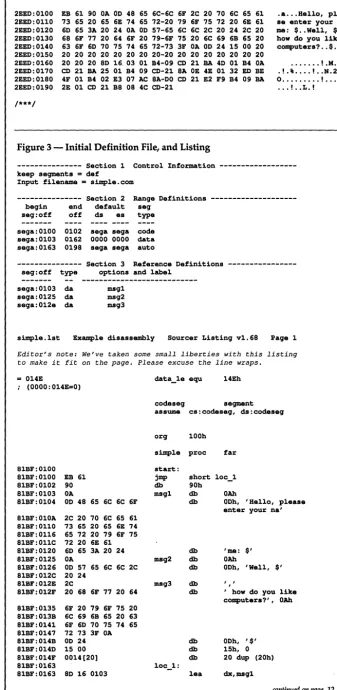
Figure 2 - Simple.com Object Code
2EEO:Ol00 EB 61 90 OA 00 48 65 6C-6C 6F 2C 20 70 6C 65 61 2EED:Oll0 73 65 20 65 6E 74 65 72-20 79 6F 75 72 20 6E 61 2EED:0120 60 65 3A 20 24 OA 00 57-65 6C 6C 2C 20 24 2C 20 2EEO:0130 68 6F 77 20 64 6F 20 79-6F 75 20 6C 69 6B 65 20 2EEO:0140 63 6F 60 70 75 74 65 72-73 3F OA 00 24 15 00 20 2EEO:0150 20 20 20 20 20 20 20 20-20 20 20 20 20 20 20 20 2EEO:0160 20 20 20 80 16. 03 01 B4-09 CD 21 BA 40 01 B4 OA 2EEO:0170 CD 21 BA 25 01 B4 09 CD-21 8A OE 4E 01 32 ED BE 2EED:0180 4F 01 B4 02 E3 07 AC 8A-00 CD 21 E2 F9 B4 09 BA 2EEO:0190 2E 01 CD 21 B8 08 4C CD-21
1***1
Figure 3 - Initial Definition File, and Listing
. a ... Hello, plea se enter your na me: $ .. Well, $,
how do you like computers? . $ ••
..••••. !.M .•. .! .!is •••• ! .. N.2 ••
O ••••••••• 1 •••••
... ! .. L.!
--- Section 1 Control Information ---keep segments = def
Input filename = simple.com
--- Section 2 Range Definitions
---begin end default seg
seg:off off ds es type
sega:Ol00 0102 sega sega code
sega:Ol03 0162 0000 0000 data
sega:0163 0198 sega sega auto
--- Section 3 Reference Definitions
---seg:off type options and label
sega:0103 da msg1
sega:0125 da msg2
sega:012e da msg3
simple. 1st Example disassembly Sourcer Listing vl.68 Page 1
Editor's note: We've taken some small liberties with this listing
to make it fit on the page. Please excuse the line wraps.
= 014E
; (OOOO:014E=O)
81BF 0100 81BF 0100 EB 61 81BF 0102 90 81BF 0103 OA
81BF 0104 00 48 65 6C 6C 6F
81BF 010A 2C 20 70 6C 65 61 81BF 0110 73 65 20 65 6E 74 81BF 0116 65 72 20 79 6F 75 81BF 011C 72 20 6E 61 81BF 0120 60 65 3A 20 24 81BF 0125 OA
81BF 0126 00 57 65 6C 6C 2C 81BF 012C 20 24
81BF 012E 2C
81BF 012F 20 68 6F 77 20 64
81BF 0135 6F 20 79 6F 75 20 81BF 013B 6C 69 6B 65 20 63 81BF 0141 6F 60 70 75 74 65 81BF 0147 72 73 3F OA 81BF 014B 00 24 81BF 0140 15 00 81BF 014F 0014[20) 81BF 0163
81BF 0163 80 16 0103
14Eh
codeseg segment
assume cs:codaseg, ds:codeseg
org 100h
simple
start: jmp
db
msgl
msg2
mag3
loc_l:
proc far
short loc 1
90h
-db OAb
db OOh, 'Hello, please
enter your na'
db
db db db db
db db db
lea
'me: $' OAb
OOh, 'Well, $'
, , ,
' how do you like computers?', OAb
OOh, '$'
15h, 0 20 dup (20h)
dx,msgl
[image:13.611.218.555.43.733.2]the first time. Get as much as you feel you can, then rerun the disassembler with the new information. You will be surprised at how much easier the second examination will be since the new listing will have some descriptive labels.
Instead of trying to remember that "sub_23" reads a sector and "sub_1S" writes a sector, you will have changed the labels to "read_sector" and "write_sector." If you can make the dis-assembler put comments in its listing, do so. You want as much information as possible on the listing.
4. As you examine the listing, be sure that the data is really data, and that the instructions are really instructions. Ideally you could check this before the detail exam, but unfortunately the exam
is the only real way to know.
These three goals, deciphering pro-gram logic, adding comments and mne-monic labels, and ensuring accurate translation have a synergistic effect. As you improve one, it's easier to improve the others. Conversely you cannot complete one until the others are nearly complete. Working on these three simul-taneously is the secret to disassembly.
Sourcer
Now that we have thoroughly ex-amined general disassembly, let's look at Sourcer. In the rest of this article, I'll ex-plain how Sourcer works, how to use it, and some things about it not mentioned in the operators manual. If you haven't read Sourcer's user manual, the last sec-tion may be hard to follow.
How Sourcer Works
Sourcer is a multipass disassembler where you set the number of passes from
2 to 5. On the first pass Sourcer assumes all the code in the target program is
made up of instructions. As it goes through the code, it stores the symbol addresses for use in the next pass. It
maintains three symbol tables; one each for data, locations, and subroutines. On the next pass it looks at the symbol tables and makes sure the item referenced is
valid.
With each additional pass, Sourcer re-fines the symbol tables and its ability to distinguish instructions from data. The number of entries in each table may decrease as invalid entries are recognized and removed. On the last pass it writes the listing to disk.
Sourcer works through the program sequentially. It does not take any jumps or subroutine calls, and as it works through the code it maintains a set of simulation registers which it tries to keep
Continued from page 11
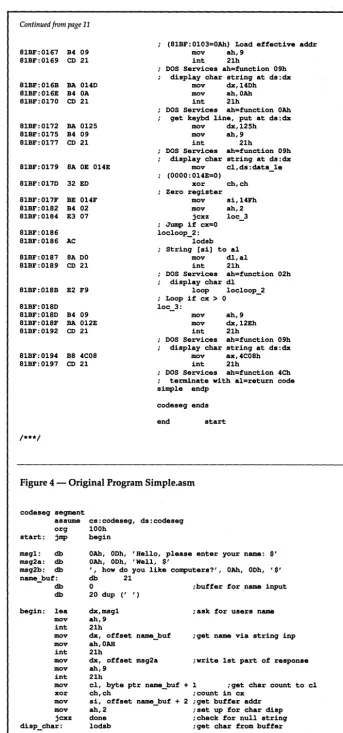
(SlBF:0103=OAb) Load effective addr
SlBF:0167 B4 09 mov ah,9
SlBF:0169 CD 21 int 21h
DOS Services ah=function 09h display char string at ds:dx
SlBF:016B BA 014D mov dx,14Dh
SlBF:016E B4 OA mov ah,OAb
SlBF:0170 CD 21 int 21h
DOS Services ah=function OAb get keybd line, put at ds:dx
SlBF:0172 BA 0125 mov dx,125h
SlBF:0175 B4 09 SlBF:Ol77 CD 21
mov ah,9
int 21h
DOS Services ah=function 09h display char string at ds:dx
SlBF:0179 SA OE Ol4E mov cl,ds:data_1e
(OOOO:Ol4E=O)
SlBF:017D 32 ED xor ch,ch
Zero register
SlBF:017F BE Ol4F mov si,l4Fh
SlBF:01S2 B4 02 SlBF:01S4 E3 07
SlBF:01S6 SlBF:01S6 AC
SlBF:01S7 SA DO
SlBF:01S9 CD 21
SlBF:01SB E2 F9
SlBF:01SD SlBF:01SD B4 09
mov jcxz
JUDq? if cx=O locloop 2:
-lodsb String (si] to al
mov dl,al
int 21h
DOS Services ah=function 02h display char dl
loop locloop 2
Loop if cx > 0
-10c_3:
mov ah,9
SlBF:01SF BA 012E mov dx,12Eh
81BF:0192 CD 21 int 21h
DOS Services ah=function 09h display char string at ds:dx
SlBF:0194 BS 4COS mov ax,4C08h
SlBF:0197 CD 21
/***/
int 21h
DOS Services ah=function 4Ch terminate with al=return code simple endp
codeseg ends
[image:14.612.215.558.12.745.2]end start
Figure 4 - Original Program Simple.asm
codeseg segment
assume cs:codeseg, ds:codeseg
org 100h
start: jmp begin
msg1: db
msg2a: db
msg2b: db
name buf:
- db
begin:
db
lea mov int mov mov int mov mov int mov xor mov mov jcxz disp_char:
OAb, ODh, 'Hello, please enter your name: $' OAb, ODh, 'Well, $'
" how do you like computers?', OAb, ODh, '$'
db 21
o ibuffer for ,name input
20dup ( " )
dx,msg1 ah,9 21h
dx, offset name buf
ah,OAH
-21h
dx, offset msg2a ah,9
21h
iask for users name
iget name via string inp
iwrite 1st part of response
cl, byte ptr name buf + 1 iget char count to cl
ch,ch - ;count in cx
si, offset name buf + 2 iget buffer addr
ah,2 - iset up for char disp
done icheck for null string
mov int loop
done: mov
mov int mov int codeseg ends
end
/***/
dl,al 21h disp char
ah,9-dx, offset msg2b 21h
ax,4C08h 21h
start
Figure 5 - Example of Range Overlap
Range Section fragment
sega:0100 0102 sega sega code
;mov to dl for service 2
;loop til all char displayed ;write rest of msg
;terminate process
sega:0100 0100 0000 0000 data Note overlap
Listing fragment
81BF:0100 81BF:0100 EB 61
81BF:0102 90
81BF:0100 EB 61 90 81BF:0103 OA
/***/
start:
updated. These registers are used in pro-ducing comments or finding the address of jump tables.
Since Sourcer does not jump or loop, the simulation register will be incorrect if
the program changes a register and then jumps to a previous location.
You control Sourcer via a command menu or a definition file.
Definition File
The definition file has three sections. The first is for control information and duplicates all of the commands available from the menu.
Section two is for range definition and
it specifies how Sourcer processes a range of bytes.
The third section is for reference defi-nition. It specifies how a particular address is to be treated. Figure 3 has sample definition files.
The range definition tells Sourcer which portions of the target program are data, which are instructions, which are unknown, and which are ROM. Sourcer
will read these directions, and it will skip the data areas during the first pass. This prevents bogus labels from being entered into the symbol tables.
Reference definition allows finer con-trol. You specify individual addresses and direct how Sourcer is to treat those addresses. For data you can specify a
short loc 1
90h
-OEBh, 61h, 90h OAb
byte, word, dword, ASCII, or even a structure. If you tell Sourcer that the data item is an offset, it will add the offset directive and target label. '
Sometimes Sourcer will override your range definitions. This can happen if you miss a data area, and Sourcer er-roneously translates the data as a jump to the area you defined as data. Sourcer will then believe the bogus jump and label the area (you previously defined as data) as instructions.
Example Disassembly Using Sourcer Let's look at an example disassembly process using Sourcer. Figure 2 is a DEBUG dump of the program "simple. com." This is the same code as in Figure 1. Note the possible data areas. Figure 3 is the define file derived from looking at the DEBUG dump and Sourcer's output based on that definition file. Compare the disassembled listing to the original program in Figure 4.
Sourcer Secrets And Tips
(1) Some of the definition file control commands are sequence sensitive. For in-stance, the "Header" command must be after the "Input filename" command or you'll get the default header. The "keep segments" command must be before the ''Input filename" command.
(2) Sourcer will accept almost any
NEW
BLAISE
TOOLS
Thefastest
way
fJ)create
-.. ,." •. ':_---
poweiful, progmms
with 'IUrbo Pascal and'lUrbo C 2.0/
Blaise Computing, manufacturer of function libraries that offer easy-to-use solutions to your pro-gramming needs, introduces: POWER TOOLS PLUS/5.0-$149 -completely in1egrated arullightning!ast routines tohelpyau:
• Add moving bar pull-down menus and windows to your user interfaces;.iWW! • Generate context sensitive help screens;.iWW! • Add easy-to-use date and time conversion
routines; NEW! • Let users choose from window oriented pick lists; NEW! • Create and access "huge" data structures; NEW! • Use multiple-line edit fields with fully
configurable edit keys;.iWW! • Speed up your sorting with flexible in-memory sort routines;.iWW! • Add EMS support; NEW! • Write TSRs and ISRs easily;
• Control DOS memory allocation; • Create powerful programs in Thrbo Pascal 4.0 & 5.0!
Thrbo C TOOLS/2.o-$149 -tighJ,fas4 highqualityjuncf:ian.y to helpyau:
• Add easy-to-use mousesuppoliforwindows and menus;mf.7 • Quickly include virtual windows and menus; NEW!
• Integrate your windows and menus with Thrbo CS text windows.NEW! • Create context-sensitive help screens; NEW!
• Provide multiple-line edit fields with fully configurable ' edit keys; NEW! • Use keyboard and video services
(including enhallced keyboard and VGA);.iWW! .WriteTSRsand ISRs easily; • Create powerful programs
: in.Turbo C.l~ 1..5.and 2.o!
~lVith tl\~le Pl'(HiU"If$l
¢Ode; com~ samlpleprogr.mlS,~ W!mpn~,i·,·t
[image:15.604.387.559.19.735.2] [image:15.604.32.371.25.352.2]You Don't Have To Be
A Programmer To Be
An Expert
TINY EINSTEIN 2.0
The Expert System Shell
• Create expert systems and
dynamic databases in
minutes
• With pulldown menus and
windows
• Context-sensitive online
help
• Free example expert
systems
• Tutorial
• Interactive full-screen text
editor
• DOS access from shell
• Turbo Fast execution
• For Diagnosing ...
Simulating .. .
Predicting .. .
Classifying .. .
Training ...
Monitoring ...
and Organizing systems.
Only $99.95! (Plus $5 8tH)
Demo $10.00 • The AI Newsletter $1
ACQUIRED INTELLIGENCE
P.o. BOX 2091 • DAVIS, CA 95617 • (916) 753-4704
Reader Service Number·72
string as a label, but it's a good bet your
assembler won't. H you plan on
reassem-bling the code, save yourseH some pain later and use only labels acceptable to your assembler.
(3) H the target program contains an
!NT 20H, Sourcer does not recognize this
as the end of the procedure and does not put the required "endp" directive into the listing.
(4) Sourcer has a number of built-in labels which it uses when it feels the need. They include: "copywrt" for a copyright statement, "start" for the pro-gram's entry point, "int_XXh_ext" for ex-ternal interrupt entries, and "strategy" and "interrupt" for device drivers. You have no control over these labels.
(5) H you use the "repeat" option to define a data area and you miscount the
number to be repeated, Sourcer will add
bogus bytes as needed. This can rear its
ugly head if you have defined ASCII text
and it contains a copyright. The built-in copywrt label will be applied, and your repeat count will be wrong.
(6) When you define segments via the
range definition section, you must expli-citly specify the last byte's address. There is no end of code operator. The best way to find the address of the last byte is to load the program with Sourcer then note the last address as shown on the main menu. Since Sourcer will process all the addresses you specify, it will stop where you told it regardless of the length of the program.
(7) The addresses in the range defini- .
tion section should be contiguous. H
there is a gap, Sourcer will skip over the gapped code and generate an org state-ment. This ensures the subsequent addresses are in their proper place, but the gapped code is removed.
(8) H two range definitions overlap, Sourcer will process the overlapped code twice. H the first range is a data defini-tion, and the second is code definidefini-tion, Sourcer will output both the data and code. Figure 5 illustrates this.
(9) The "keep segments" command is not explained well. It tells Sourcer which of two sets of range definition to use. The first is internal to Sourcer and is created as Sourcer processes the binary code. The second is the one you write in the defini-tion file and is opdefini-tional. The ''keep seg-ments" command tells Sourcer to use either: its internal definition (FILE), the one from the definition file (DEF), or to use both (BOTH).
H you haven't written a range defini-tion, use the default FILE option. H you have written a range definition that in-cludes the target program's address, use
the DEF option. H your range definition contains only addresses outside the pro-gram's areas (such as the BIOS data area), use the BOTH option. Sourcer will process the code twice if your range defi-nition covers the program's address space and you specify BOfH.
(10) Labels can be added to the disas-sembly listing at will. However you should restrict their use so that they are present only when they are the target of an instruction. For instance, if you add extraneous labels to instructions, it will be unclear which labels are decorations and which are the destinations of jumps and calls. Unfortunately Sourcer requires you to specify a label in order to add a comment. I recommend you use a sequential label notation so that each label is unique and is distinguished from functional labels.
(11) H Sourcer's analyzer makes a mis-take and translates data as instructions, these bogus instructions can cause trouble farther down the line. Any addresses the bogus instructions refer-ence as data will be marked as data, even
if they are really instructions. Bogus jumps or calls will mark the destinations as instructions and these second genera-tion bogus instrucgenera-tions can cause addi-tional trouble. H you find that Sourcer made a mistake, don't just fix the part you found, backtrack until you find the root cause. The cause will always be bogus instructions.
(12) The more passes you specify, the better the analyzer can separate data from instructions. Five passes will pro-duce the best resolution, and you can use the cross reference option. By using cross references, you can backtrack to the source error.
Sometimes a label will not have a cross reference. This indicates the label was created by a bogus instruction that the analyzer has converted back to data. You can find the cause by reducing the number of passes and then using the range definition to fix the problem.
Sourcer
V Communications 3031 Tisch Way Suite 905 San Jose, CA 95128
(408) 296-4224
ERAC
co.
8280 Clairemont Mesa Blvd., Suite 117
San Diego, California 92111
. 619 569-1864
AT
Motherboard 6 & 10 MegZero Wait State 8 Expansion Slots 640K RAM On·Board Math Co·processor Option
Phoenix Bios 200 Watt Power Supply Hercules Compat. Video Bd.
Parallel Port 2 Serial Ports Active
Game Port ClOck/Calendar Hard Disk & Floppy Controller
20M Hard Drive 1.2M 5114" Floppy Drive 360K 5 %" Floppy Drive
5061 Keyboard Case with Turbo & Reset,
Hard Drive Light and Keyboard Disable Switch Amber Graphics Monitor
$1581
EGA ADD $449 40M HD ADD $150 6 & 12 MHz ADD $73BABY AT
Motherboard 6 & 10 MegZero Wait State 8 Expansion Slots
80286 Processor Math Co·Processor Option
640K RAM On·Board Phoenix Bios 200 Watt Power Supply Hercules Compat. Video Bd.
Parallel Port 2 Serial Ports Active
Game Port Clock/Calendar Hard Disk & Floppy Controller
20M Hard Drive 1.2M 5 %" Floppy Drive 360K 5 %" Floppy Drive
5061 Keyboard Mini AT Case with Turbo &
Reset, Hard Drive Light and Keyboard Disable Switch Amber Graphics Monitor
$1531
EGA ADD $449 40M HD ADD $150XT/TURBO
Motherboard 5 & 8 MHz Switchable8088 - V20 Optional Optional Co·processor
8 Expansion Slots ERSO or Bison Bios
640K RAM 150 Watt Power Supply Hercules Compat. Video Bd.
Parallel Port 2 Serial Ports Active
Game Port Clock/Calendar
Hard Disk and Floppy Controller 20M 51/4 "Hard Drive 2 ea. 360K 5 %" Floppy Drive
AT Style Keyboard Standard Slide Case Amber Graphics Monitor
* *
$999
EGA ADD $429 40M HD ADD $150 5 & 10 MHz ADD $21NiCds
AA Cells .6ah ... $1.00 12V Pack AA Cells .6ah ... 6.50 Sub·C Cells 1.5ah ... 1.50 12V Pack Sub·C ... 10.00 Double D Cell 2.5V 4ah unused ... 8.00 C Cells ... 1.75 F Cells ... 2.50
GEL CELLS
12V 20ah ... $25.00 12V 15ah ... 15.00 12V 2.5ah ... 8.50 D Cell 2.5ah ... 2.00
ROBOTICS
5V DC Gear Motorwith Tach 1"x2" . 7.50 Joystick, 4 switches, 1" knob ... 5.00 Z80 Controller with 8-Bit AID . .... 15.00 Brushless 12VDC 3" Fan ... 7.50 Capacitor, .47farad 10V 1"x13/.t" ... 4.00 Solar Cells .5V .5A, .8"x1.6" ... 2.50 High Voltage Power Supply
Input: 15-30V DC
Output: 100V 400V 16KV ... 6.50
KAYPRO EQUIPMENT BARGAINS
9" Green Monitor ... $50 IC'S
*
NEW*
9" Amber CRT .$45 Keyboard. 75 81-189 Video Pal ... $15.00 CPM COMPUTERS
PRO-8 Mod. to your board ... 149 81-194 RAM Pal ... 15.00 K4-83 ... $350
Host Interface Board ... 15 81-Series Char. Gen. ROMs .. 10.00 K2-84 ... 400
Replacement Power Supply .... 50 81-Series Monitor ROMs ... 10.00 K4-84 ... 425
ELGAR UNINTERRUPTIBLE POWER SUPPLIES 560 Watt MODEL IPS560 $650 Sinewave, 560W complete w/batteries. 400 Watt MODEL SPR401 $149 Supplies may have minor cosmetic damage, but are electrically sound. Squarewave output. Run on internal or external 24VDC battery when line goes down. Typical transfer time
=
12MS. Battery supplied, not guaranteed. NEW 24V INTERNAL BATTERY $75 POWER SUPPLIES 0-8VDC 100A Metered ... $249.00 Volt & Current Regulated 5V/1A. -5V/.2A, 12V/1A, -12V/.2A, -24V/.05A ... 9.90 HOURS: Mon.· Fri. 9·6 - Sat. 10·4 MINIMUM ORDER - $15.00 TERMS: VISA. MasterCard. Certified Checks. Money Order. NO COD. Visa and MasterCard add3%. Personal checks must clear BEFORE we ship. Include shipping charges. California residents add 61/2 % Sales Tax. For more information please call. CPU & SUPPORT CHIPS MC68000-8 CPU ... $8.00 Z80 CPU ... .75Z80A CPU ... 1.50 Z80 CTC ... 1.50 Z80A PIO ... 2.00 Z80A 510 ... 5.00 8088 ... 6.50 8089-3 ... 6.50 D8284A ... 2.50 SIP DRAM 256-12 ... 7.00 4164-10 .: ... 2.50 4164-12 ... 2.10 1793 ... 6.00 1797 ... 7.00 6845 ... 5.00 VC3524 SWitching Regulators ... 5.00 1458 Dual Op·AMP ... 70
LM2877P 4W Stereo Amp Dual ... 2.50 MB81464-15 ... 2.75 2716 ... 3.00 2732 ... 3.25 2764 ... 3.50 27C128-1 ... 9.00 74HCOO ... 38
74LS125 ... 30
74LS373 ... 50
74LS174 ... 30
Reader Service Number 93 SWITCHERS 5V/9.5A, 12V/3.8A,-12V/.8A ... $39.00 5V/3A, 12V/2A, -12V/.4A ... 19.50 5V/6A, 12V/2A,-12V/1A ... 29.00 5V/6A, 24V/1 %A, 12V/.6A, -12V/.6A ... 29.00 5V/10A ... ... 19.00 5V/20A . ... 24.00 5V/30A . ... 39.00 5V 100A ... 100.00 5V 120A ... 110.00 TEST E