31 http://aajhss.org/index.php/ijhss International Journal of Humanities and Social Sciences p-ISSN: 1694-2620 e-ISSN: 1694-2639 Vol. 8 No. 3, pp. 31-43, ©IJHSS
The influence of clothing in the negotiation of identities. A
study between students and lecturers.
Simon Ntumi
University of Cape Coast, Ghana
Department of Educational Foundations Email: [email protected]
Esther Quarcoo
University of Cape Coast, Ghana
Department of Vocational and Technical Education Email: [email protected]
Abstract
Identity negotiation is the process by which perceivers target comes to agreement regarding the identities that the targets are to assume in the interaction. In this contemporary era, the notion of uniqueness shows that humans differ from one another, whilst what we do in the same way as well as what we share and have in common with others is understood as the social aspects of ourselves. The objective of the study was to find out the influence of clothing in the negotiation of identities in terms of the relationship between students and lecturers from the students perspective. For the study to be materialized, the researchers employed descriptive survey as the design for the study. Questionnaire was the sole instrument used to elicit response from respondents. A reliability of 0.71 using the Cronbach’s Alpha was obtained. The sample size for the study was 248 respondents. The key findings of the study revealed that most people consider their values, attitudes, status and mood in choosing clothing and are also able to identify the moods and values of others through their clothing. The findings further gave evidence that clothing plays a major role in helping student’s identify their lectures. It was recommended that workshops and seminars about clothing should be organized for both lecturers and students. And also on how the impact of clothing influence negotiation of identity. Again, lecturers should be encouraged by the school authorities to put on clothes that will differentiate them from their students. This will help them gain the necessary recognition.
Key words: Identity, Negotiation, Lecturers, Students, Attitudes, Values, Status, Moods.
Introduction
32 http://aajhss.org/index.php/ijhss theory. Swann described self-verification model as the theory which is based on the influence individuals have over the manner in which they are perceived. This model is based on the notion that individuals want people to understand them just as they understand themselves and therefore, they deliberately act in a way such as to achieve this goal. On the other hand, the reverse process of self categorization focuses attention on how individuals identify themselves with existing groups in accordance with how their self-perception is influenced by others. Both models occur concurrently and are connected although researchers most often analyze them separately. Identity can be defined in this context as the outcome of a negotiation.
Based on this background, identity can be seen as the result of a negotiation process involving the culture of individuals, self-conception and interaction among the individuals. Further, identity also involves the processes by which individuals in a given society reach agreements regarding their personalities. The process of identity negotiation thus establishes what people can expect of one another. In the work of Turner- Bowker (2001), he views identity negotiation as a key concept which provides the interpersonal cohesion among individuals. The fundamental principle of Swann’s identity negotiation theory is based on conscious individual ambition to feel good in his society in regards to the individual’s aspiration of psychological and interactional rationality. This emerges from the assumption that individual’s desire is influenced by the world around them therefore, they engage in social interaction with the anticipation of approving the expectations they have in life.
It is worthwhile for one to note that people engaged in notation identities so as to establish their relationship with others in the society to foster coherence. Taking into consideration the fact that negotiating identities plays a key role in social interaction, it is indeed evident that human interpersonal relationships, emotions, values, attitudes and perceptions are influence by negotiation of identity. “Just as identities define people and make them viable as humans, identity negotiation processes also define relationships and make them viable as a foundation for organized social activity” (Swann & Bosson, 2009. pp 69-71). Swann and Bosson (2006) further maintain that the idea of identity negotiation is mostly applicable to a specific situation. To them, it is true that humans persistently adopt some aspects of identities, but identity negotiation is indeed a concept addressing an implicit, unconscious phenomenon, informal, automatic, open-ended issues.
Humans are social animals therefore human life is interwoven with one another. Their actions, behaviour, perception, values, and above all appearance, is greatly influenced by people around them. Individual’s styles of outfit and adornment are largely determined by the way in which people around view and treat them. In effect, individual’s self- concepts offer some guidelines for appropriate styles of dress. However, our perceived selves may not always coincide exactly with our idealized selves. Since we realize the impact of appearance on others in interaction, we try to improve the visible images that we present to them. We generally strive to present ourselves to others in a manner consistent with our most positive self-interpretations. Each time we interact with different individuals, we may modify our self-perceptions and re-evaluate our self-presentations. A study by Baigh and Williams (2006), tested the idea that well-dressed individuals would present themselves more positively than poorly dressed ones. The symbolic communication with others serves asessential processes of individuals’ reflexive self-conceptions (Baigh & Williams, 2006).
33 http://aajhss.org/index.php/ijhss usually includes khaki pants, blouses, polo shirts and comfortable skirts and dresses of a modest length. Teachers may work at schools that allow them to wear blue jeans in good condition. They might also wear t-shirts, tennis shoes, and sandals. Despite this informal dress style, teachers must exercise good judgment when choosing clothing for work. In rare cases, teachers may be required to wear professional clothing. This may include suits and ties for men and skirts, dresses and pant suits for women. Teachers who work in public or private schools may sometimes be asked to dress in this manner (Polzer & Caruso, 2007).
Problem statement
The problems of modern contemporary era flow from the attempt of the individual to maintain independence and individuality in his existence against the sovereign powers of society, and how to live to the expectation of the society demands (Howard, 2000). The quest by individuals to resist the forces and pressures levelled by culture and society, while still depending entirely on the society is the most interesting of issues that needs consideration. Largely, the most discussed issue in social life today is the duality of the individual in regards to his identity. It is imperative that today, the idea of identity negotiation demonstrates the autonomy we have as independent entities that help in expressing of our differences from others. Despite the impact and influential aspect of negotiating identities in many societies, the issue of identity negotiation appears to be a tendency and characteristic of only more developed societies than the less privileged societies. It is evident that a lot of studies have been conducted on the negotiation of identities including works by Touche- Spelcht (2004) but it appears that not much study have been done on the influence of clothing in the negotiation of identities in terms of the relationship between lecturers and students. The conflict resulting from this internal dialog within individuals, sometimes labelled as an identity crisis, is the motivational background for this work. This therefore gives the researchers the impetus to conduct an empirical study to investigate the influence of clothing in the negotiation of identities in relation to students and lecturers in University of Cape Coast Campus.
Rationale for the study
The general purpose of this study was to find out the influence of clothing in the negotiation of identities. However, specifically, the study aimed to come out with some factors that people consider in selection of clothing, the role clothing plays in the negotiation of identities and finally, the role clothing plays in the negotiation of identities between lecturers and students.
Research questions
The following research questions were formulated for the study;
1. What factors do people consider in clothing selection? 2. What role does clothing play in the negotiation of identities?
3. What role does clothing play in the negotiation of identities between lecturers and students?
Significance of the study
34 http://aajhss.org/index.php/ijhss REVIEW OF RELATED LITERATURE
Theoretical groundings
Negotiated identities are constructed so that individuals can mutually develop a form of interpersonal realities that will allow them to interact with one another. In order for symbolic interaction to occur, these individuals must be capable of interpreting one another’s interests to the extent that they can empathize with one another, or take the role of the other (Kaiser, 1985). Clothing and personal appearance cues are used by individuals in interpreting roles, intents, and personal attitudes and values. Stone (2007) has indicated that the meanings of appearance can be symbolic of identities, values, moods and attitudes.
Attitudes
The appearance of individuals are anticipated by the reviewers in relation to their attitudes. One’s present and past actions can be influence by appearance. There are a variety of stimuli toward which we can propose attitudes through clothing. These involves objects (including clothes themselves), social groups or institutions, people, places, events or situations, and issues. Attitudes toward specific clothing styles are, of course, reflected through the clothes that we wear, by wearing certain styles, we represent the groups to which we belong and express our degree of commitment to these groups. Using Stone’s interpretation of communicated attitudes, it may be asserted that behaviours are likely to be anticipated as a result of group memberships (Stone, 2007).
Moods
In the view of Stone (2007), mood may be compared to feelings of pride one has about his or her appearance, with regard to a set of values that serve as a reference for self-evaluations. Mood is largely related then to social feedback received from others. Others may use visible cues (for example, bright colours, grooming) in interpreting and defining mood in a given situation. Mood is a very intangible, transient quality that is difficult to study or measure. It may be susceptible to regular change and is not necessarily accurately reflected through an individual’s clothes at any given time. Our moods may change from the wary we feel when selecting what to wear in the morning. Thus, clothes are not a very reliable cue for assessing another’s mood
Values
35 http://aajhss.org/index.php/ijhss METHODOLOGY
Descriptive survey research design was used for the study. The descriptive research design was deemed appropriate for the study because as described by Creswell (2003) it offers the researcher the opportunity to get the opinion of the population concerning some issues of interest relevant to the study. It is suitable for selecting a sample and describing the real situation or phenomena as it exists and hence more likely to give accurate information. The study sought to find out and describe the behaviour of the respondents in respect of how clothing influences the negotiation of identities. From the Krejcie and Morgan (2007) table for determining sample size from a given population, a population of 700 has a corresponding sample size of 248 respondents. This was done through the use of simple random sampling.
The instrument for data collection was solely questionnaires. The questionnaires items were drawn in relation to the research questions set for the study. Questionnaires was considered most appropriate for the study because it provides anonymity of the respondent and also because respondents can read and write. Structured question items of closed ended nature were used in collecting data from respondents. The questionnaires were in four sections; each section gathering information on a specific variable. The first section elicited information on background of respondents with the other three sections eliciting information on factors considered in clothing selection, how clothing affects peoples’ identity and negotiation of identities respectively.
Reliability validity of the instruments
In order to enhance the validity of the study, the questionnaire was given to an expert for assessment. This ensured both face and content related evidence of the items and also examined whether the items relate to the research questions and also comprehensively cover the details of the study. For the reliability of the instrument, a pre-test results was be used to determine the reliability of the instruments which obtained Cronbach’s Alpha of 0.71 measure of internal consistency.
The data collected was edited, coded and analysed using the descriptive statistics of the Statistical Product and Service Solution (SPSS version. 22.0) and presented in tables showing frequency and percentage distribution, to help describe the status of the issue as it prevailed within the population used for the study.The results of the findings were interpreted.
DATA ANALYSIS
Table 1a
Ages of Respondents (N=248)
Age Frequency Percentage (%)
17-20 years 67 27.0
21-24 years 114 46.0
25-28 years 66 26.6
Total 248 100.0
Source, Field Data (2016).
36 http://aajhss.org/index.php/ijhss the ages of 25 to 28. This means that a large percentage of the respondents were within the ages of 21-24.
Graphical representation of age of respondents
Table 1b
Gender of respondent (N=248)
Gender Frequency Percentage (%)
Male 82 33.1
Female 166 66.9
Total 248 100.0
Source, Field Data (2016).
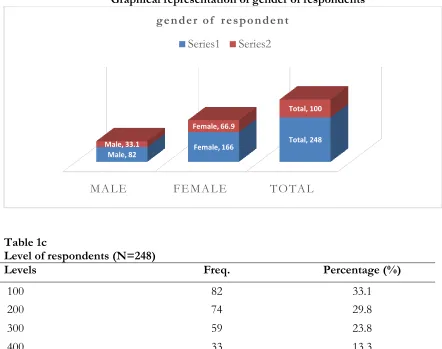
Gender is an important social, cultural and psychological construct, which describes the expected attitudes and behaviours a society associates with sex (Alami et al, 2013). This therefore suggests that sex of respondent’s forms an integral part in a study. It is evident from the table above that 82(33.1%) of the respondents were males whereas 166(66.9%) were females. This means that the number of females who took part in the study were more than the males.
0 100 200 300
17-20 years 21-24 years 25-28 years Total
Age of Respondentse
37 http://aajhss.org/index.php/ijhss Graphical representation of gender of respondents
Table 1c
Level of respondents (N=248)
Levels Freq. Percentage (%)
100 82 33.1
200 74 29.8
300 59 23.8
400 33 13.3
Total 248 100.0
Source, Field Data (2016).
It can be seen from the table above that 82 (33.1%) were level 100 students whilst 74(29.8%) were level 200 students. It was also confirmed that 59(23.8%) were level 300 students whereas 33(27.0) % were level 400 students. This means that there were more level 100 students in the study than all the other levels.
Graphical representation of levels of respondents
MALE FEMALE TOTAL
Male, 82 Female, 166
Total, 248 Male, 33.1
Female, 66.9
Total, 100
gender of respondent
Series1 Series2
100
200
300
400 Total
38 http://aajhss.org/index.php/ijhss Table 2
Research Question One
Factors people considered in clothing selection (N=248)
S / N
Statements SA (%) A (%) D (%) SD (%) Mean
(M) Std. Deviat ion 1 I wear clothes to improve
my social status 92(37.1) 97(39.1) 43(17.3) 16(6.5)
1.9 .894
2 I consider my values in choosing clothes
83(33.5) 124(50.0) 30(12.1) 11(4.4)
2.1 .998
3 I dress to impress others 52(21.0) 136(54.8) 51(20.6) 9(3.6)
2.0 .747 4 I dress to express my
mood
70(28.2) 155(62.5) 23(9.3) 0(0.0)
1.8 .583 5 I always want to look
good 83(33.5) 124(50.0) 30(12.1) 11(4.4) 1.8 .787
6 My attitudes determines
what I wear 93(37.5) 105(42.3) 38(15.3) 12(4.8) 1.8 .842 Total 248(100) 248(100) 248(100) 248(100) 11.4 4.811 Key: SA- Strongly agree, A- Agree, D- Disagree, SD- Strongly disagree, %- Percentage Source: Field data, 2016
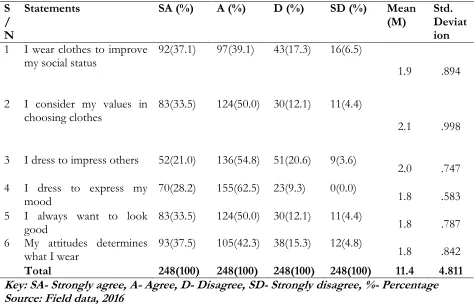
From the table, out of a total sample size of 248, it reveals that 189 (76.2%) agreed that they wear clothes to improve their social status whereas 59(23.8 %) disagreed that they wear clothes to improve their social status. Also, 207(83.5%) agreed that they consider their values in choosing clothes and 41(16.5%) disagreed to that fact. It is again evident from the table that 188(75.8%) agreed that they dress to impress others whereas 60(24.2%) disagreed that they dress to impress others. Again, 225(90.7%) agreed that they dress to express their mood whilst 23(9.3%) disagreed that they dress to express their mood. Two hundred and seven (83.5%) agreed that they dress to always look good whilst 41(16.5 %) disagreed to that fact. Lastly, the table indicates that 198(79.8%) agreed that their attitudes determined what they wear whilst 50(20.1%) disagreed that their attitudes determine what they wear.
39 http://aajhss.org/index.php/ijhss Table 3
Research Question Two
How clothing affects peoples’ identity (N=248)
S/
N Statements SA (%) A (%) D (%) SD (%) Mean (M) Std. Devi ation 1 My identity is sometimes
misinterpreted because of what I wear
40(16.1) 122(49.2) 50(20.2) 36(14.5)
2.33 .915
2 I focus on brands in
choosing my clothing 45(18.1) 162(65.3) 39(15.7) 2(8.00) 1.99 .610 3 Social expectations
influence the way I dress 19(7.7) 172(69.4) 46(18.6) 11(4.40) 1.99 .590 4 The style of clothing
affects my identity 40(16.1) 173(69.8) 35(14.1) 0(0.00) 2.19 .634 5 I identify people mood by
the way they dress
22(8.9) 181(73.0) 45(18.0) 0(0.00)
1.97 .550 6 I identify peoples values
by the way they dress 20(8.1) 178(71.8) 46(18.5) 4(1.60) 2.09 .512 Total 248(100) 248(100) 248(100) 248(100) 12.56 3.811
Key: SA- Strongly agree, A- Agree, D- Disagree, SD- Strongly disagree, %- Percentage Source: Field data, 2016
40 http://aajhss.org/index.php/ijhss Table 4
Research Question Three
Negotiation of identities between lecturers and students (N=248)
S / N
Statements SA (%) A (%) D (%) SD (%) Mean Std.
Deviat ion 1 Lecturers are easily
identified by their physique
0(0.0) 66(26.6) 158(63.7) 24(9.7)
2.13 .5595
2 Lecturers put on classy clothes
3(1.3) 41(16.5) 169(68.1) 35(14.1)
2.83 .5792 3 Lecturers are easily
identified by the way they dress.
2(8.8) 41(16.5) 157(63.3) 48(19.8)
2.95 .5949
4 Do you easily approach lecturers by the way they dress?
26(10.5) 166(66.9) 54(21.8) 2(8.80)
3.01 .6265
5 Are you able to identify the mood of lecturers by the way they dress?
43(17.3) 173(69.8) 30(21.1) 2(2.80)
2.12 .5827
6 Are you able to identify the attitudes of lecturers by the way they dress?
16(6.5) 170(68.5) 61(24.6) 1(0.40)
1.96 .5715
Total 248(100) 248(100) 248(100) 248(100) 15.99 3.5048
Key: SA- Strongly agree, A- Agree, D- Disagree, SD- Strongly disagree, %- Percentage Source: Field data, 2016.
41 http://aajhss.org/index.php/ijhss RESULTS AND DISCUSSIONS
Factors people considered in clothing selection
The rationale behind this research question was to explore the factors that influence the choice of peoples’ clothing. It was revealed from the study that, there are a number of factors that influence the choice of peoples’ clothing. Noticeable among them include; attitudes, moods, social status and values. A high percentage (90.7%) confirmed that their mood influences their choice of clothes. 83.5% of the respondents also indicated that their values determine what they wear. 79.8% believed that their attitudes influence their selection of clothes. A large number of respondents (76.2%) also indicated that their choice of clothing is based on their social status. It can therefore be concluded from the study that, factors such as attitudes, moods, social status and values play a major role in clothing selection. The results is in conformity with the work of Stone (2007) who indicated that peoples mood, values, identities and attitudes are some factors they consider in their clothes selection.
How clothing affects peoples’ identity
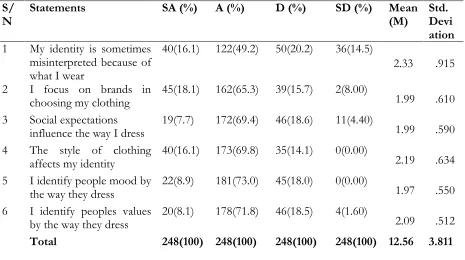
The research question two was also to investigate how clothing affects people’s identity. The results of the study gave ample evidence that people’s identity influence what they wear. A large number of the respondents affirmed that their choice of clothing is greatly influenced by their values, moods and attitudes. These results are parallel with the study of Beaudoin and Lachance (2006), who affirmed that, values guide our perception and purchase of clothes and styles and accessories as well as our planned selections of these items for our interactions. The findings of the study agrees with the idea of Kaiser, 1985 that the elements of attitudes influence clothing preferences and taste.
Negotiation of identities between lecturers and students
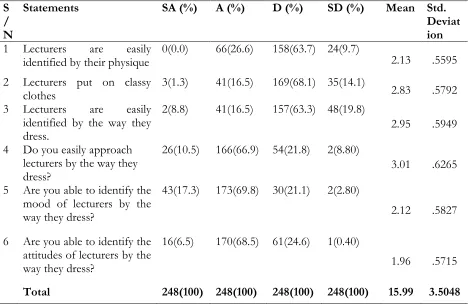
The last research question to the study was to investigate and come out with the negotiation of identities between lecturers and students. The results of the study confirmed that even though clothing plays a major role in negotiating identities, the respondents revealed that do not easily identify their lectures by their appearance. The results again revealed that students’ expectations, such as having a particular type of physique or appearing in classy clothes are not met.
CONCLUSION, RECOMMENDATION AND IMPLICATIONS FOR PRACTICE
Based on the findings of the study it can be concluded that some influential factors that peoples based in selection of clothes are attitudes, moods, values and status. The same factors influence the choice of peoples’ clothing. Finally, it can be drawn from the study that on the University of Cape Coast campus, lectures are not easily identified by their students by the way they dress.
Based on the findings, the researchers recommended the following;
Workshops and seminars on clothing should be organized for both lecturers and students on how the impact of clothing influences negotiation of identities. Lecturers should be encouraged by the school authorities to put on clothes that will differentiate them from their students. This will help them gain the necessary recognition and full expectation from their students.
Implications for practice
42 http://aajhss.org/index.php/ijhss clothing to meet peoples’ desires and expectations of individual societies. The study has also generated enough data that brings a call for further studies in improving issues in negotiation identities and also serve as a reference point for other researchers interested in researching into this similar issue.
REFERENCES
Alami, Athiqah Nur, et al. (2013). Strategi Pembangunan Wilayah Perbatasan melalui Pengelolaan Sumberdaya Alam Berbasis Gender. Jakarta: LIPI.
Baigh, J. A., & Williams, E. L. (2006). The atomicity of social life. Current Direction in Psychological Science,
15 (2), 1-4
Beaudoin, P., & Lachance, M. J. (2006). Determinants of adolescents’ brand sensitivity to clothing. Family and consumer sciences research journal, 34(4), 312-331.
Creswell, J. (2003). Research design: Qualitative, quantitative and mixed methods approaches (2nded.). Thousand
Oaks, CA: SAGE Publications.
Hoffman, B. J., & Woehr, D. J. (2006). A quantitative review of the relationship between person– organization fit and behavioral outcomes. Journal of 1161 Vocational Behavior, 68(4),389–399.
Howard, J. A. (2000). Social psychology of identities. Annual review of sociology. University of Columbia.
Retrieved on 22nd February, 2016 from arjournals.annualreviews.org.
Kaiser, S. B. (1985). The social psychology of clothing and personal adornment. MacmillanPublishing Company. New York.
Krejcie, R.V. & Morgan, D. W. (2007). Determining sample size for research activities. Educational
and Psychological Measurement. 30 (5), 607-610.
Marshalls, G., Jackson H. O., Stanley M. S. & Touche- Spelcht (2004). Individuality in clothing selection and personal appearance (6thed.) Pearson Prentice Hall.
Polzer, J. T., & Caruso, H. M. (2007). Identity negotiation amidst diversity: Understanding the influences of social identity and status. In A. Brief 1287 (Ed.), Diversity at work. Cambridge: Cambridge University Press.
Stone, G. P. (2007). Appearance and the self. In a Rose, ed. Human behaviour and social process, pp86-118. Bosten: Houghton-Mifflin Company.
Snyder, M., & Klein, O. (2005). Construing and constructing others: On the reality and the generality of the behavioral confirmation scenario. Journal of Interaction Studies, 6 (3) 53–67. Swann, W. B., Jr. (2007). Self- verification: Bringing social reality into harmony with the self. In J.
43 http://aajhss.org/index.php/ijhss & A. G. Greenwald (Eds.), Psychological perspectives on the self (Vol. II, pp. 33-66). Hillsdale, New Jersey: Erlbaum.
Swann, W. B., Jr. (2007). Identity negotiation: Where two roads meet. Journal of Personality and Social Psychology, 53,(4), 1038-1051.
Swann, W. & Bosson, J. (2006). Identity negotiation: A Theory of Self and Social Interaction. Chapter
prepared for O. John, R. Robins, & L. Pervin (Eds.) Handbook of Personality Psychology: Theory and Research. New York: Guilford.
Swann, W. & Bosson, J. (2009). Identity negotiation: A Theory of Self and Social Interaction. Chapter
prepared for O. John, R. Robins, & L. Pervin (Eds.) Handbook of Personality Psychology: Theory and Research. New York: Guilford.