Proceedings of the CIB W78 2010: 27th International Conference –Cairo, Egypt, 16-18 November
BUILDING SUPPORT FOR CLOUD COMPUTING IN THE IRISH
CONSTRUCTION INDUSTRY
Alan Redmond, Dublin Institute of Technology PhD Student
Alan Hore, Dublin Institute of Technology Lecturer and CEO, Construction IT Alliance Ltd,
School of Real Estate and Construction Economics, Dublin Institute of Technology, Bolton Street, Dublin 1, Ireland.
Roger West, Trinity College Dublin Senior Lecturer and Director of Construction IT Alliance Ltd,
Department of Civil, Structural and Environmental Engineering, Trinity College, Dublin 2, Ireland.
Mustafa Alshawi, University of Salford Professor of Management and IT in Construction,
Faculty of Business, Law and the Built Environment, Salford M5 4WT, UK.
[email protected]
ABSTRACT
The construction industry has been traditionally recognised as a fragmented sector associated with a poor level of implementation and penetration of Information Communication Technology (ICT) by Small to Medium Size Enterprises (SMEs). Cloud computing is a collective term that can facilitate the ability to collaborate within a central repository that can act as a base for interoperability between various construction disciplines and their software applications. Cloud computing is a new layer of internet architecture that creates an open opportunity to add better functionality to an increasingly global network. The characteristics of cloud computing, such as, shared infrastructure, on-demand applications, elasticity and consumption-based pricing, allows all disciplines in the sector to benefit. This paper will present the findings of a survey carried out by the Construction IT Alliance (CITA) in Ireland, as to the drivers, barriers and preferred procurement options for delivery of cloud computing services within the construction SME market in Ireland.
Keywords: Construction, Cloud Computing, Small to Medium sized Enterprises (SME)
1.
INTRODUCTION
Gallaher et al. (2004) identified that interoperability issues occur creating a fragmented business process and organisational structure. In recognising that ICT has the potential to revolutionize the construction industry and streamline historically fragmented operations, Gallaher et al. stated that tools, such as, computer-aided drafting technologies, 3-D modelling technologies and a host of Internet and standards-based design and project collaboration technologies can reduce the fragmented nature of the industry. However, the problems associated with not being able to manage and communicate electronic product and project data between collaborating firms and within individual companies are compounded by the fact that a large number of small companies have not adopted advanced ICT. According to Teicholz (2004) there has been a significant adoption of ICT by the construction industry over the past 35 years. However, Teicholz acknowledges that these applications are stand-alone and do not permit for significant, if any, collaboration.
respect to the business case for a new cloud computing product to be introduced into the Irish construction SME market by CITA.
2.
ESSENTIALS OF CLOUD COMPUTING
The development of the web has been seen as a wide range of legal, regulatory, political and cultural developments surrounding the control of, access to and rights of digital content. However, the web has also a strong tradition of working in an open fashion and this is also a powerful advantage (Anderson, 2007). Cloud computing technology, such as, Sun’s open-source and open storage provides interoperability for large-scale computing resources, where applications can be moved to and operate across multiple platforms, and hybrid data servers with unprecedented efficiency and performance for the emerging data-intensive computing applications (Sun Microsystems, 2009).
The benefits to SMEs include managed growth, regulatory compliance and competition, without having to deal with a variety of challenges relating to ICT. It is more easily affordable, immediate in its impact and provides modular functionality, in a way that is easy to extend and change, and easy to integrate with other systems. Ragsdale (2009) identified additional benefits of cloud computing to SME’s, such as, moving security concerns to the provider, eliminating scalability concerns, and allowing remote employees to easily access software from any internet-ready computer.
The use of ICT has proven instrumental in creating productivity gains within global markets, for example, through reduced transaction costs, scalability, and fast, reliable information flows, enhanced online collaboration tools and new ways to market goods and services (Pepper et al. 2009).
The National Institute of Standard Technology (NIST) definition V15 refers to cloud computing as a model for enabling convenient, on-demand network access to a shared pool of configurable resources (networks, servers, storage, applications, and services) that can be rapidly provisioned and released with minimal management effort or service provider interaction (Petri, 2010). Armburst et al. (2009) defined cloud computing, as both the applications delivered as a service over the internet and the hardware and systems software in datacenters that provide those services.
Reeves (2009) classified the service models in reference to a tier structure. The basic tier is Hardware Infrastructure as a Service (HIaaS): a virtual or physical hardware resource offered as a service, such as, an EC2 server. This is followed by Software Infrastructure as a Service (SIaaS), a stand-alone cloud service that provides a specific application support capability, but not the entire application software platform service, such as, Microsoft SQL data services. The next tier is Platform as a Service (PaaS) which is an externally managed application platform for building and operating applications and services, such as, Microsoft Azure and Force.com. The final tier is Software as a Service (SaaS): this is when a vendor designs the application and hosts it so that users can access the application through a web browser or a Rich Internet Application (RIA) mechanism such as Google Apps or Salesforce.com.
Armburst et al. refers to a public cloud when it is made available in a pay-as-you-go manner to the public, and a private cloud when the internal datacenters of a business are not made available to the public. The two remaining deployment models are community and hybrid, which refer to a cloud that is controlled and used by a group of organisations that have shared interests, and the latter is a combination of a public and private cloud that interoperates (Cloud Computing, 2010).
3.
CITA’S ENTERPRISES INNOVATION NETWORK PROGRAMME
allowed the identification of the support for a specific cloud computing solution for construction SME’s. It is envisioned that the results of this survey will shape the development of a CITA SME Construction Cloud-Based application, which will be developed for pilot testing in the next phase of the authors’ research.
4.
THE SURVEY
The survey primarily focused on establishing the drivers, barriers, benefits and procurement aspects of cloud computing. The driving forces identified the main attributes associated with attracting construction enterprises to the use of cloud computing. The barriers identified the industry’s most common perceived barriers for rejecting the adoption of a centralised heterogeneous network. The questions associated with the benefits of cloud computing acted as an investigative tool to analyse if a cloud-based model was suitable for the construction SME sector. The procurement questions related to the physical aspects of obtaining the services and identifying the most suitable licensing option from a construction perspective.
The survey attracted responses from a total of 90 customers and vendors. All respondents were associated with decision-making positions within their company. A total of 50 customers, represented the highest number of responses and their backgrounds varied from general contractors, to professional architects, quantity surveyors, engineers, and third level institutions. The majority of the respondents were general contractors representing 18%, quantity surveyors 16%, architects 12%, and engineers 10%. The remaining respondents were of a dispersed representation of health and safety analysts, software support, and building suppliers. The remaining 40 respondents represented vendors, ranged typically from construction related distributors of architect, engineering, or construction computing applications / services. There were however, 5 vendors that were affiliated to open source technology and cloud computing services.
4.1 Driving forces in favour of cloud computing
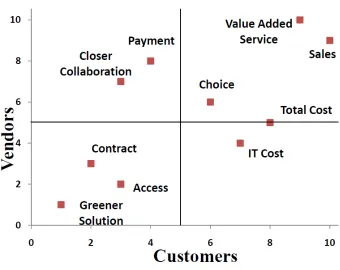
The driving forces question in the survey was presented in a ten point ranking scale format. The drivers used in the questionnaire were based on secondary data collected from Armburst et al. (2009). The respondents were requested to rank in order 1 – 10 (10 being the highest) the factors that will attract or are likely to attract their organisations to provide cloud services (for vendors) and use cloud services (for customers). The correlation diagram in Figure 1 illustrates the average results.
Figure 1 is separated into four quadrants representing; high vendor and low customer drivers (such as closer collaboration and payment), high customer and high vendor drivers (such as value added service, choice and sales), high customer drivers and low vendor drivers (such as total cost and ICT cost), and low vendor drivers and low customer drivers (such as contract, access, and providing a greener solution). For example, total cost is a higher driver for customers in comparision to the vendors.
Closer collaboration received a high ranking from the vendors, however, it was ranked third lowest by the customers. This indicates that either the customers have no experience of using collaboration tools or, having availed of them, found their use to be cumbersome. Payment flexibility was ranked highly by the vendors but unfortunately, probably due to its sensitivity, customers ranked payment as a below average driver. Value added service and sales were ranked as the highest drivers overall by both vendors and customers. In comparison, green solutions received the lowest ranking.
Figure 1: The correlation of cloud computing in response to the question:
Please rank in order 1 – 10 (10 being the highest) the following drivers that have attracted or are likely to attract your organization to provide (vendor) / use (customer) Software as a Service for Construction SMEs.
4.2 Barriers to cloud computing
The ten listed barriers used in the questionnaire were based on secondary data collected from various national and international publications on this topic and other survey’s, such as, by the Irish Internet Association (IIA, 2010) ‘Cloud Business’. Figure 2 illustrates the correlation between the two samples. The barriers to adoption question was formatted identically to the drivers question, with ranking 1-10 as in the previous case. The correlation line in Figure 2 represents equal priority between the vendors and the customers. The nearer proximity of the correlation to this line the greater the agreement between vendors and customers. Security received a ranking of 10 (the highest) by the customers and 8 by the vendors. Armburst et al. (2009) identified security in their top ten obstacles for cloud computing. The barriers of security, contract and pricing were identified from such literature as Software and Information Industry Association (SIIA, 2001).
Figure 2: Barriers for adoption of cloud computing adapted from Hore et al. (2010a) arising from the question:
Please rank in order 1 -10 (10 being the highest) the following barriers of providing (vendor) / using (customer) Software as a Service for construction SMEs.
4.3 Benefits of cloud computing
The eight perceived benefits of cloud computing cited in the survey were sourced from Ramanujam (2007). Table 1 demonstrates the opinions of both samples (customers and vendors) in relation to Ramanujam’s perceived benefits. The results in Table 1 indicate that the majority of the respondents in the construction industry are in agreement as to the cloud benefits. This highly positive response helps to support the case for the development of a cloud computing solutions for the construction SME market in Ireland.
Table 1: Perceived benefits of cloud computing in response to the question
Please indicate your opinion on the following received benefits of Software as a Service.
Perceived Benefits of Cloud
Strongly agree
Agree No
Opinion
Disagree Strongly disagree
Non-premise 30% 40% 25% 5% 0%
Pay as you go 45% 40% 8% 7% 0%
Easy role out 33% 43% 21% 3% 0%
Spread out cost 43% 32% 18% 7% 0%
Frequent updates 34% 48% 18% 0% 0%
Focus on growth 31% 41% 23% 5% 0%
[image:5.612.111.499.489.666.2]4.4 Procurement of cloud computing solutions
Hore et al. (2010b) analysed the CITA EIN programme respondents interest in delivering cloud based software to the marketplace. 27 respondents (15 customers and 12 vendors) were targeted initially to act as a pre-study for the main survey to identify errors and omissions and to contribute to forming a focus group. The same questions relating to receiving and renting cloud applications were used on both the pilot survey and the main survey. The following approaches to delivering cloud computing were offered in both vendors and customers questionnaires:
• Server-based Computing (thin-client): an application is run on a server.
• Hosted Client Computing (HCC): an application is run on the user’s desktop, but it is served, or “streamed,” from a server.
• Web based applications: web based application is developed to be maintained on a server and viewed through a browser.
• Rich Internet Application (RIA): Adobe (2009), describes this term as the new category of applications that bridge the client and the Internet cloud. It enables Internet applications to be both rich in functionality and engaging to use, but takes full advantage of the Internets connectivity, reach and deployment models.
Figure 3 illustrates the combined results of the main survey’s most favoured approach to delivering cloud based software. The majority of both vendors and customers identified a web based application maintained on a server and viewed through a browser, as the most preferred method for receiving a cloud based model. The next preferred option was the server based computing solution. Surprisingly less than 20% of the vendors and customers considered RIA as their preferred option. Unlike static web and desktop applications that are constrained by their domain; RIA can be used in either connected or disconnected mode. This would give the customer the benefit of having the richness associated with desktop applications applied to a lightweight applications.
[image:6.612.154.419.432.628.2]It is important however, to clarify that there is a degree of overlap between all four categories, as all of the four categories are hybrids of web-based applications.
Figure 3: The most favoured approach to delivering cloud based software in response to the question:
The following points are the choices presented to the respondents in relation to the question “if your firm was interested in cloud which of the following licensing options would it choose?”
• Subscription base model: monthly payment of the software actually used.
• Usage-based model: payment is determined by application usage (customers are charged for every computer that runs a hosted application).
• Transaction-based model: charge customers for each business transaction.
[image:7.612.149.479.226.412.2]• Value-based (share risk or revenue) model: whatever software is needed to achieve business goals payment is linked to the goals.
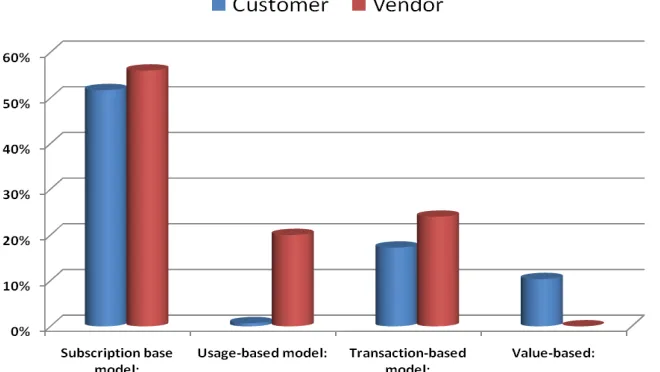
Figure 4 shows the results of the main surveysmost sought after licensing option for cloud computing.
Figure 4: The most favourable licensing option for cloud computing based on the question:
If your firm was interested in Software as a Service which of the following licensing (vendor) / renting (customer) options would it choose.
The subscription based model (monthly payment on software actually used) was the most favourable licensing option selected by both vendors and customers. The option of charging for each business transaction was also identified by both samples as the next preferred licensing option for cloud computing. The results of the licensing option are again a mirror representation of the EIN survey. The subscription base model allows one to control their cash flow more efficiently by being charged on a monthly basis for software that is actually used. The downward adjustment in the Irish construction industry may have contributed to the chosen option as it does not create an environment for long term commitment.
4. CONCLUSION
monthly basis. The survey results have identified the market for a cloud based model but further investigation is needed on the actual components that can create a typical supply chain of applications for an entire project for use by all parties involved. In today’s construction software environment the majority of SMEs cannot obtain the applications of larger enterprises and it is for this reason that the benefits of cloud computing received such a positive response from the respondents.
The next phase of research will involve carrying out a detailed business analysis of a potential cloud-based application for Irish construction SME’s. Issues, such as, product lifecycle, income generation, existing solutions, purchasing power of market and return on investment. However, the development plan has been designed to enable the industry to participate at every stage and this will assist CITA in identifying a solution that can create productivity gains for the industry though the use of ICT. If such a cloud model can be achieved, it will help to reduce the industry’s fragmented nature and enable SMEs to be more competitive not just domestically but also internationally.
REFERENCES
Adobe (2009), “The Business Benefits of Rich internet Applications for Enterprises”, Adobe Systems Incorporated, http://www.adobe.com/flashplatform/pdfs/95012113_enterpriseria_wp_ue.pdf.
Anderson, P. (2007), “What is Web 2.0?”, JISC: Technology & Standard Watch; Ideas, Technologies and Impli-cations for Education, available from
Armbrust, M. et.al. (2009), “Above the Clouds”, A Berkeley View of Cloud Computing, Electrical Engineering and Computer Sciences University of California at Berkeley, htt://www.eecs.berkeley.edu/Pubs/TechRpts /2009/EECS-200928.html.
Cloud Computing (2010), “Cloud Computing Use Cases”, A White Paper Produced by the Cloud Computing Use Case Discussion Group, Versio Computing_Use_Cases_Whitepaper-3_0.pdf.
Dibb, S. and Simkin, L. (2009) “Marketing Essentials”, Cengage Learning Inc, United States,
Gallaher, M.P, O’Connor, A.C, Dettbarn, J.L and Gilday, L.T, (2004), Cost Analysis of Inadequate Interoperabil-ity in the U.S. Capital Facilities Industry, U.S Department of Commerce Technology Administration, Na-tional Institute of Standards and Technology (NIST), American Government Publication, Maryland.
Hore, A.V. et.al. (2010a), “Development of a Cloud Web Collaborator for SMEs in the Irish Construction Industry”, 8th
Hore, A.V. et.al. (2010b), “Cloud Computing and its Application in the Irish Construction Industry, 6
European Conference on Product and Process Modelling, University of Cork, Ireland, 14-16
September, 2010.
th
Irish Internet Association. (2010), “Cloud Business
International Conference on Innovation in Architecture, Engineering and Construction, PennState University,
9-11 June, 2010.
Pepper, R. et.al. (2009),“Mobility in a Networked World”, World Economic Forum, The Global Information
Technology Report 2008-2009, printed and bound in Switzerland by SRO-Kundig, Geneva, 37-51.
Petri, G. (2010), “Shedding Light on Cloud Computing”, The Cloud Academy, http://www.ca.com/files/WhitePapers/mpe_cloud_primer_0110_226890.pdf.
Ragsdale, J. (2009), “Leveraging the Web Collaboration Capabilities within Remote Support Platforms”, Business Impact of Innovative Tools Available from Remote Support Specialist, Technology Services Industry Association (TSIA)
Reeves, D. (2009), “Cloud Computing Transforming IT”, Burton Group publication, Utah U.S.A 84047-4169, http://www.burtongroup.com.
Saugatuck Technology. (2008) “SaaS Realities: Business Benefits for Small and Midsized Business”, publication by Saugatuck Technology Inc, available
Software and Information Industry Association (SIIA). (2001) “Software as a Service: Strategic Backgrounder”, SIIA publication, Washington, DC, U.S.
Sun Microsystems (2009), “Take Your Business to a Higher Level” Sun Cloud-Computing Technology Scales Your Infrastructure to Take Advantage of New Business Opportunities, Sun Microsystems Inc.,